R E S E A R C H
Open Access
Strong convergence of a general iterative
algorithm for a finite family of accretive
operators in Banach spaces
Yanlai Song
1and Luchuan Ceng
2**Correspondence:
2Department of Mathematics,
Shanghai Normal University, Shanghai, 200234, China Full list of author information is available at the end of the article
Abstract
The purpose of this paper is to present a new iterative scheme for finding a common solution to a variational inclusion problem with a finite family of accretive operators and a modified system of variational inequalities in infinite-dimensional Banach spaces. Under mild conditions, a strong convergence theorem for approximating this common solution is proved. The methods in the paper are novel and different from those in the early and recent literature.
MSC: 47H09; 47H10; 47H17
Keywords: iterative algorithm; strong convergence; fixed point;q-uniformly smooth Banach space; inverse-strongly accretive operator
1 Introduction
Variational inequalities theory, which was introduced by Stampacchia [] in the early s, has emerged as an interesting and fascinating branch of applicable mathematics with a wide range of applications in industry, finance, economics, social, pure and applied sciences. It has been shown that this theory provides the most natural, direct, simple, uni-fied and efficient framework for a general treatment of a wide class of unrelated linear and nonlinear problems; see, for example, [–] and the references therein. Variational in-equalities have been extended and generalized in several directions using novel and new techniques.
In , Brézis [] initiated the study of the existence theory of a class of variational inequalities, later known as variational inclusions, using proximal-point mappings due to Moreau []. Variational inclusions include variational, quasi-variational, variational-like inequalities as special cases. Variational inclusions can be viewed as an innovative and novel extension of the variational principles and thus have wide applications in the fields of optimization, control, economics and engineering sciences.
In recent years, much attention has been given to study the system of variational inclu-sions/inequalities, which occupies a central and significant role in the interdisciplinary research among analysis, geometry, biology, elasticity, optimization, imaging process-ing, biomedical sciences and mathematical physics. One can see an immense breadth of mathematics and its simplicity in the works of this research. A number of problems
leading to the system of variational inclusions/inequalities arise in applications to vari-ational problems and engineering. It is well known that the system of varivari-ational inclu-sions/inequalities can provide new insight regarding problems being studied and can stim-ulate new and innovative ideas for problem solving.
In , Ansari and Yao [] introduced the system of generalized implicit variational inequalities and proved the existence of its solution. They derived the existence results for a solution of system of generalized variational inequalities, from which they established the existence of a solution of system of optimization problems.
Ansariet al.[] introduced the system of vector equilibrium problems and proved the existence of its solution. Moreover, they also applied their results to the system of vector variational inequalities. The results of [] and [] were used as tools to solve the Nash equilibrium problem for non-differentiable and (non)convex vector-valued functions.
LetA,B:C→Ebe two nonlinear mappings. In , Yaoet al.[] introduced a system of general variational inequalities problem of finding (x∗,y∗)∈C×Csuch that
Ay∗+x∗–y∗,j(x–x∗) ≥, ∀x∈C,
Bx∗+y∗–x∗,j(x–y∗) ≥, ∀x∈C. (.)
In -uniformly smooth Banach spaces, Kangtunyakarn [], recently, introduced a new system of variational inequalities problem of finding (x∗,y∗)∈C×Csuch that
x∗– (I–λA)(ax∗+ ( –a)y∗),j(x–x∗) ≥, ∀x∈C,
y∗– (I–μB)x∗,j(x–y∗) ≥, ∀x∈C. (.)
Ifa= , then problem (.) reduces to the problem of finding (x∗,y∗)∈C×Csuch that
λAy∗+x∗–y∗,j(x–x∗) ≥, ∀x∈C,
μBx∗+y∗–x∗,j(x–y∗) ≥, ∀x∈C, (.)
which is introduced by Cai and Bu []. In Hilbert spaces, problem (.) reduces to the problem of finding (x∗,y∗)∈C×Csuch that
λAy∗+x∗–y∗,x–x∗ ≥, ∀x∈C,
μBx∗+y∗–x∗,x–y∗ ≥, ∀x∈C, (.)
which is introduced by Cenget al.[]. IfA=B, then problem (.) collapses the problem of finding (x∗,y∗)∈C×Csuch that
λAy∗+x∗–y∗,x–x∗ ≥, ∀x∈C,
μAx∗+y∗–x∗,x–y∗ ≥, ∀x∈C, (.)
which is introduced by Verma []. In particular, if we letx∗=y∗ in (.), then problem (.) is nothing but the classical variational inequality problem: findx∗∈Csuch that
Ax∗,x–x∗≥, ∀x∈C. (.)
Motivated by the works mentioned above, we shall consider the following problem in q-uniformly smooth Banach spaces: find (x∗,y∗)∈C×Csuch that
x∗– (I–λA)(ax∗+ ( –a)y∗),jq(x–x∗) ≥, ∀x∈C, y∗– (I–μB)x∗,jq(x–y∗) ≥, ∀x∈C,
(.)
wherea∈[, ],λ> andμ> are three constants. This problem is called a modified system of variational inequalities, which clearly includes problems (.)-(.) as special cases.
In order to find a common element of the set of solutions of problem (.) and the set of fixed points of nonlinear operators, Kangtunyakarn [] also studied the following al-gorithm in a -uniformly smooth Banach space:
xn+=G
αnu+βnxn+γnSAxn
, ∀n≥, (.)
whereSAis theSA-mapping generated byS
,S, . . . ,SN,T,T, . . . ,TN,G:C→Cis the
mapping defined byGx=QC(I–λA)(aI+ ( –a)QC(I–μB))x, andQC is a sunny
non-expansive retraction ofEontoC. Then, under mild conditions, they established a strong convergence theorem.
On the other hand, we know that the quasi-variational inclusion problem in the setting of Hilbert spaces has been extensively studied in the literature; see, for instance, [–]. There is, however, little work in the existing literature on this problem in the setting of Banach spaces. The main difficulties are due to the fact that the inner product structure of Hilbert spaces fails to be true in Banach spaces. To overcome these difficulties, Lópezet al. [] used a new technique to carry out certain initiative investigations on splitting meth-ods for accretive operators in Banach spaces. They considered the following algorithms with errors in Banach spaces:
xn+= ( –αn)xn+αn
Jrn
xn–rn(Axn+an)
+bn
(.)
and
xn+=αnu+ ( –αn)
Jrn
xn–rn(Axn+an)
+bn
, (.)
whereu∈E,{an},{bn} ⊂EandJrn= (I+rnB)–is the resolvent ofB. Then they established the weak and strong convergence of algorithms (.) and (.), respectively.
Recently, Khuangsatung and Kangtunyakarn [] introduced the following algorithm in Hilbert spaces for finding a common element of the set of fixed points of ak-strictly pseudononspreading mapping, the set of solutions of a finite family of variational inclusion problems and the set of solutions of a finite family of equilibrium problems:
⎧ ⎪ ⎨ ⎪ ⎩
N
i=αii(zn,y) +rny–zn,zn–wn ≥, ∀y∈C,
wn+=αnμ+βnwn+γnJM,λ(I–λ
N
i=biAi)wn
+ηn(I–ρn(I–S))wn+δnzn, ∀n≥.
(.)
Motivated and inspired by Zhanget al.[], Qinet al. [], Lópezet al.[], Taka-hashiet al.[] and Khuangsatung and Kangtunyakarn [], we suggest and analyze a new iterative algorithm for finding a common solution to a variational inclusion problem with a finite family of accretive operators and a modified system of variational inequali-ties in infinite-dimensional Banach spaces. We also prove the convergence analysis of the proposed algorithm under some suitable conditions. The results obtained in this paper improve and extend the corresponding results announced by many others.
2 Preliminaries
Throughout this paper, we denote byEandE∗a real Banach space and the dual space of E, respectively. We useFix(T) to denote the set of fixed points ofTandBrto denote the
closed ball with center zero and radiusr. LetCbe a subset ofEandq> be a real number. The (generalized) duality mappingJq:E→E
∗
is defined by
Jq(x) =
x∗∈E∗:x,x∗=xq,x∗=xq–
for allx∈E, where·,·denotes the generalized duality pairing betweenEandE∗. It is well known that ifEis smooth, thenJqis single-valued, which is denoted byjq.
LetCbe a nonempty closed convex subset of a real Banach spaceE. LetA:E→Ebe a single-valued nonlinear mapping, and letM:E→E be a multivalued mapping. The
so-called quasi-variational inclusion problem is to find az∈Esuch that
∈(A+M)z. (.)
The set of solutions of (.) is denoted byVI(E,A,M).
Definition . LetEbe a Banach space. Then a functionδE: [, ]→[, ] is said to be
the modulus of convexity ofEif
δE() =inf
–x+y
:x ≤,y ≤,x–y ≥
.
IfδE() > for all∈(, ], thenEis uniformly convex.
Definition . The functionρE: [, )→[, ) is said to be the modulus of smoothness
ofEif
ρE(t) =sup
x+ty+x–ty– :x=y=
.
A Banach spaceEis said to be:
() uniformly smooth ifρE(t)
t →ast→;
() q-uniformly smooth if there exists a fixed constantc> such thatρE(t)≤ctq, where
q∈(, ].
It is known that a uniformly convex Banach space is reflexive and strictly convex.
() nonexpansive if
Tx–Ty ≤ x–y for allx,y∈C;
() r-contractive if there existsr∈[, )such that
Tx–Ty ≤rx–y for allx,y∈C;
() accretive if for allx,y∈C, there existsjq(x–y)∈Jq(x–y)such that
Tx–Ty,jq(x–y)
≥;
() η-strongly accretive if for allx,y∈C, there existη> andjq(x–y)∈Jq(x–y)such
that
Tx–Ty,jq(x–y)
≥ηx–yq;
() μ-inverse-strongly accretive if for allx,y∈C, there existμ> and
jq(x–y)∈Jq(x–y)such that
Tx–Ty,jq(x–y)
≥μTx–Tyq.
Definition . A set-valued mappingT:Dom(T)→Eis said to be:
() accretive if for anyx,y∈Dom(T), there existsjq(x–y)∈Jq(x–y)such that for all
u∈T(x)andv∈T(y),
u–v,jq(x–y)
≥;
() m-accretive ifTis accretive and(I+ρT)(Dom(T)) =Efor every (equivalently, for some)ρ> , whereIis the identity mapping.
LetM:Dom(M)→Ebem-accretive. The mappingJ
M,ρ:E→Dom(M) defined by
JM,ρ(u) = (I+ρM)–(u), ∀u∈E,
is called the resolvent operator associated withM, whereρis any positive number andI is the identity mapping. It is well known thatJM,ρis single-valued and nonexpansive.
We need some facts and tools which are listed as lemmas below.
Lemma .([]) Let E be a Banach space and Jqbe a generalized duality mapping.Then,
for any given x,y∈E,the following inequality holds:
x+yq≤ xq+qy,jq(x+y)
, jq(x+y)∈Jq(x+y).
Lemma .([]) Let{αn}be a sequence of nonnegative numbers satisfying the property
αn+≤( –γn)αn+bn+γncn, n∈N,
(i) ∞n=γn=∞,limn→∞γn= ;
(ii) bn≥,
∞
n=bn<∞;
(iii) lim supn→∞cn≤.
Thenlimn→∞αn= .
Lemma .([]) Let <p<∞,q∈(, ],r> be given.If E is a real q-uniformly smooth Banach space,then there exists a constant Cq> such that
x+yq≤ xq+qy,jq(x)
+Cqyq, ∀x,y∈E.
Lemma .([]) Let C be a nonempty closed convex subset of a real q-uniformly smooth Banach space E.Let the mapping A:C→E be anα-inverse-strongly accretive operator. Then the following inequality holds:
(I–λA)x– (I–λA)yq≤ x–yq–λqα–Cqλq–
Ax–Ayq.
In particular,if <λ≤(qαCq)q–,then I–λA is nonexpansive.
Recall that ifCandDare nonempty subsets of a Banach spaceEsuch thatCis closed convex andD⊂C, then a mappingQ:C→Dis sunny [] provided
Qx+tx–Q(x)=Q(x)
for allx∈Candt≥, wheneverQx+t(x–Q(x))∈C. A mappingQ:C→Dis called a retraction ifQx=xfor allx∈D. Furthermore,Qis a sunny nonexpansive retraction from ContoDifQis a retraction fromContoDwhich is also sunny and nonexpansive. A subset DofCis called a sunny nonexpansive retraction ofCif there exists a sunny nonexpansive retraction fromConto D. The following lemma collects some properties of the sunny nonexpansive retraction.
Lemma .([, ]) Let C be a closed convex subset of a smooth Banach space E.Let D be a nonempty subset of C.Let Q:C→D be a retraction and let j,jq be the normalized
duality mapping and generalized duality mapping on E,respectively.Then the following are equivalent:
(i) Qis sunny and nonexpansive;
(ii) Qx–Qy≤ x–y,j(Qx–Qy),∀x,y∈C; (iii) x–Qx,j(y–Qx) ≤,∀x∈C,y∈D; (iv) x–Qx,jq(y–Qx) ≤,∀x∈C,y∈D.
Lemma . Let A:C→E and M:C⊇Dom(M)→Ebe two nonlinear operators.
De-note Jrby
Jr:=JM,r= (I+rM)–
and Trby
Then it holds for all r> thatFix(Tr) =VI(E,A,M).
Proof From the definition ofTr, it follows that
x=Trx ⇐⇒ x= (I+rM)–(I–rA)x
⇐⇒ (I–rA)x∈(I+rM)x
⇐⇒ ∈(A+M)x
⇐⇒ x∈VI(E,A,M).
This completes the proof.
Lemma .([]) Assume that C is a nonempty closed subset of a real uniformly convex
and q-uniformly smooth Banach space E. Suppose that A:C→E isα-inverse-strongly accretive and M is an m-accretive operator in E,withDom(M)⊆C.Then it holds that:
(i) Given <s≤randx∈E,
Tsx–Trx ≤
–s
r
x–Trx and x–Tsx ≤x–Trx.
(ii) Givenk> ,there exists a continuous,strictly increasing and convex function φq: [,∞)→[,∞)withφq() = such that for allx,y∈Bk,
Trx–Tryq≤ x–yq–r
αq–rq–Cq
Ax–Ayq
–φq(I–Jr)(I–rA)x– (I–Jr)(I–rA)y.
3 Main results
For everyi= , , . . . ,N, letAi:C→EandM:C⊇Dom(M)→Ebe nonlinear mappings.
From (.), we introduce the combination of variational inclusion problems in Banach spaces as follows: find a pointx∗∈Csuch that
∈
N
i=
λiAi+M
x∗, (.)
whereλiis a real positive number for alli= , , . . . ,NwithNi=λi= . The set of solutions
of (.) in Banach spaces is denoted byVI(E,Ni=λiAi,M).
To prove the strong convergence results, we also need the following four lemmas.
Lemma . Let C be a nonempty closed convex subset of a real smooth Banach space E. Let N ≥be some positive integer,Ai:C→E beηi-inverse-strongly accretive withη=
min{η,η, . . . ,ηN},and M be m-accretive in E withDom(M)⊆C.Let{λi}be a real number
sequence in(, )withNi=λi= andVI(E,
N
i=λiAi,M)=∅.Then
VI
E,
N
i=
λiAi,M
=
N
i=
Proof It is obvious thatNi=VI(E,Ai,M)⊆VI(E,
N
i=λiAi,M). Next we prove that
VI E, N i=
λiAi,M
⊆ N
i=
VI(E,Ai,M).
Suppose that x ∈VI(E,
N
i=λiAi,M) and x ∈
N
i=VI(E,Ai,M). We have from
Lem-ma . that
x∈Fix
Jr
I–r
N
i=
λiAi
.
Since Ni=VI(E,Ai,M)⊆VI(E,
N
i=λiAi,M), we have x ∈VI(E,
N
i=λiAi,M). Again,
from Lemma ., we have
x∈Fix
Jr
I–r
N
i=
λiAi
.
In light of the nonexpansiveness ofJr, we deduce that
x–xq=
Jr
I–r
N
i=
λiAi
x–Jr
I–r
N
i=
λiAi
x q ≤
I–r
N
i=
λiAi
x–
I–r
N
i=
λiAi
x q =
(x–x) –r
N
i=
λiAix– N
i=
λiAix
q
≤ x–xq–qr N
i=
λi
Aix–Aix,jq(x–x)
+Cqrq N
i=
λiAix–Aixq
≤ x–xq–qr N
i=
λiηiAix–Aixq+Cqrq N
i=
λiAix–Aixq
≤ x–xq–qrη N
i=
λiAix–Aixq+Cqrq N
i=
λiAix–Aixq
≤ x–xq–r N
i=
λi
qη–Cqrq–
Aix–Aixq,
which means that
r N i= λi
qη–Cqrq–
By Lemma ., without loss of generality, we may assumer∈(, (Cqη q)
q–). We then deduce
that
Aix=Aix, ∀i= , , . . . ,N. (.)
Again sincex∈VI(E,
N
i=λiAi,M) andx∈
N
i=VI(E,Ai,M), we find that
∈
N
i=
λiAix+Mx (.)
and
∈
N
i=
λiAix+Mx. (.)
We derive from (.) and (.) that
∈
N
i=
λiAix+Mx– N
i=
λiAix–Mx. (.)
It then follows from (.) and (.) that
∈Mx–Mx.
By virtue ofx∈
N
i=VI(E,Ai,M) and (.), we see
∈Mx–Mx+Mx+Aix=Mx+Aix=Mx+Aix (.)
for alli= , , . . . ,N, which yields that
x∈ N
i=
VI(E,Ai,M).
Hence, we obtain the desired result.
Lemma . Let E,C,M,η,λiand Aibe the same as those in Lemma..Then the mapping
N
i=λiAiisη-inverse-strongly accretive.
Proof Letx,y∈C. It follows that
N
i=
λiAix– N
i=
λiAiy,jq(x–y)
=
N
i=
λi
Aix–Aiy,jq(x–y)
≥ N
i=
≥ N
i=
λiηAix–Aiyq
≥η
N
i=
λiAix– N
i=
λiAiy
q
.
Consequently, the mappingNi=λiAiisη-inverse-strongly accretive.
Lemma . Assume that C is a nonempty closed subset of a real uniformly convex and q-uniformly smooth Banach space E. Let S:C →C be nonexpansive, A:C →E be η-inverse-strongly accretive,and M:Dom(M)→Ebe m-accretive withDom(M)⊆C.
As-sume r∈(, (Cqη q)
q–)andFix(S)∩Fix(T
r)=∅.ThenFix(STr) =F(TrS) =Fix(S)∩Fix(Tr).
Proof It is easy to check thatFix(S)∩Fix(Tr)⊆Fix(STr) andFix(S)∩Fix(Tr)⊆Fix(TrS).
We are left to show thatFix(STr)⊆Fix(S)∩Fix(Tr) andFix(TrS)⊆Fix(S)∩Fix(Tr).
We first proveFix(STr)⊆Fix(S)∩Fix(Tr). Suppose thatxˆ∈Fix(STr) andx˜∈Fix(S)∩
Fix(Tr). We have by Lemma . that
ˆx–x˜q=STrxˆ–STrx˜q ≤ Trxˆ–Trx˜q
≤ ˆx–x˜q–rηq–rq–Cq
Axˆ–Ax˜q
–φq(I–Jr)(I–rA)xˆ– (I–Jr)(I–rA)x˜.
Hence, we have fromr∈(, (Cqη q)
q–) and the property ofφ
qthat
Axˆ–Ax˜=(I–Jr)(I–rA)xˆ– (I–Jr)(I–rA)x˜= .
It follows that
ˆx–Trxˆ–x˜+Trx˜= .
Hence, we have
Trxˆ=x.ˆ
By the assumption ofxˆ∈Fix(STr), we havexˆ=Sx. This means thatˆ xˆ∈Fix(S)∩Fix(Tr).
We now proveFix(TrS)⊆Fix(S)∩Fix(Tr). Suppose thatu˜∈Fix(TrS) anduˆ∈Fix(S)∩
Fix(Tr). Repeating the above proof again, we get that
ASu˜–ASuˆ=(I–Jr)(I–rA)Su˜– (I–Jr)(I–rA)Suˆ= .
It follows that
Su˜–TrSu˜–uˆ+TrSuˆ= .
Hence, we have
By the assumption of u˜ ∈Fix(TrS), we haveu˜ =Su˜ andu˜ =Tru. This means that˜ u˜ ∈
Fix(S)∩Fix(Tr), which impliesFix(TrS)⊆Fix(S)∩Fix(Tr).
Lemma . Let C be a nonempty closed convex subset of a q-uniformly smooth Banach space E,and let A,B:C→E be two nonlinear mappings.Let QCbe a sunny nonexpansive
retraction from E onto C.For∀λ,μ> and a∈[, ],define a mapping
Gx:=QC(I–λA)
aI+ ( –a)QC(I–μB)
x, ∀x∈C.
Then(x∗,y∗)is a solution of problem(.)if and only if x∗=Gx∗,where y∗=QC(I–μB)x∗.
Proof First, we prove ‘⇒’.
Let (x∗,y∗) be a solution of (.), and we have
x∗– (I–λA)(ax∗+ ( –a)y∗),jq(x–x∗) ≥, ∀x∈C, y∗– (I–μB)x∗,jq(x–y∗) ≥, ∀x∈C.
From Lemma ., we have
x∗=QC(I–λA)
ax∗+ ( –a)y∗
andy∗=QC(I–μB)x∗.
It follows that
x∗=QC(I–λA)
aI+ ( –a)QC(I–μB)
x∗=Gx∗,
which implies thatx∗∈Fix(G), wherey∗=QC(I–μB)x∗.
Next we prove ‘⇐’.
Letx∗∈Fix(G) andy∗=QC(I–μB)x∗. Then
x∗=Gx∗=QC(I–λA)
aI+ ( –a)QC(I–μB)
x∗=QC(I–λA)
ax∗+ ( –a)y∗.
It follows from Lemma . that
x∗– (I–λA)(ax∗+ ( –a)y∗),jq(x–x∗) ≥, ∀x∈C, y∗– (I–μB)x∗,jq(x–y∗) ≥, ∀x∈C.
Then we find that (x∗,y∗) is a solution of problem (.).
Example .([]) LetRbe a real line with the Euclidean norm and letA,B:R→Rbe defined byAx=x– andBx=x–for allx∈R. The mappingG:R→Ris defined by
Gx:= (I– A)
I+
(I– B)
x
Theorem . Let E be a uniformly convex and q-uniformly smooth Banach space. Let N ≥ be some positive integer and let Ai:C→E beηi-inverse-strongly accretive with
η=min{η,η, . . . ,ηN}. Let M be m-accretive on E with Dom(M)⊆C, f : C→C be
r-contractive.Let A,B:C→E beα- andβ-inverse-strongly accretive,respectively.Define a mapping Gx:=QC(I–λA)(aI+ ( –a)QC(I–μB))x for all x∈C and a∈[, ].Assume
λ∈(, (Cqα q)
q–),μ∈(, (qβ
Cq)
q–)andFix(G)∩N
i=VI(E,Ai,M).For arbitrarily given x∈C,
let{xn}be the sequence generated iteratively by
xn+=αnf(xn) + ( –αn)Jrn
I–rn N
i=
λiAi
Gxn+en
, (.)
where{en}∞ ⊂E,{αn}∞ ⊂[, ],{λn}N ⊂(, )and{rn}∞ ⊂(, +∞)satisfy the following
conditions:
(i) ∞n=en<∞;
(ii) ∞n=αn=∞,limn→∞αn= and
∞
n=|αn+–αn|<∞;
(iii) <lim infn→∞rn≤lim supn→∞rn< (Cqηq)
q– and∞
n=|rn+–rn|<∞;
(iv) Nn=λi= .
Then{xn}converges strongly to some point x∈Fix(G)∩
N
i=VI(E,Ai,M),which solves the
variational inequality
f(x) –x,jq(p–x)
≤, p∈Fix(G)∩
N
i=
VI(E,Ai,M).
And(x,y)solves problem(.),where y=QC(I–μB)x.
Proof Let{yn}be a sequence generated by
yn+=αnf(yn) + ( –αn)TnGyn, (.)
where Tn:=Jrn(I–rn
N
i=λiAi). Hence to show the desired result, it suffices to prove
thatyn→x. Indeed, by virtue of Lemma ., Lemma ., (iii),λ∈(, (qαCq)
q–) and μ∈
(, (qβC q)
q–), we find thatT
n:C→CandG:C→Care nonexpansive. And hence,
yn+–xn+
≤αnryn–xn+ ( –αn)
Jrn
I–rn N
i=
λiAi
Gyn
–Jrn
I–rn N
i=
λiAi
Gxn+en
≤αnryn–xn+ ( –αn)
I–rn N
i=
λiAi
Gyn–
I–rn N
i=
λiAi
Gxn
+en ≤ –αn( –r)
yn–xn+en. (.)
First, we prove that the sequence{yn}is bounded.
Takingx∈Fix(G)∩Ni=(Ai+M)–(), we findx∈Fix(G)∩Fix(Tn) by Lemma . and
Lemma .. It follows from (.) and Lemma . that
yn+–x=αnf(yn) + ( –αn)TnGyn–x ≤αnf(yn) –x+ ( –αn)TnGyn–x
≤αnf(yn) –f(x)+αnf(x) –x+ ( –αn)TnGyn–x ≤αnryn–x+αnf(x) –x+ ( –αn)yn–x
= –αn( –r)
yn–x+αnf(x) –x ≤max
f(x) –x
–r ,yn–x
.
By induction, we have
yn–x ≤max
f(x) –x
–r ,y–x
, ∀n≥.
Hence,{yn}is bounded, so are{f(yn)},{Tn(yn)}and{TnG(yn)}.
Next, we prove that
lim
n→∞yn+–yn →. (.)
Write V =Ni=λiAi. Noticing Lemma ., we get that the mappingV is η
-inverse-strongly accretive. Puttingzn=TnGyn, we derive from Lemma . that
zn+–zn
=Tn+Gyn+–TnGyn
≤ Tn+Gyn+–TnGyn++TnGyn+–TnGyn
≤ –rαn rβn
Gyn+–Jrβn( –rβnV)Gyn++Gyn+–Gyn
≤ |rβn–rαn|
Gyn+–Jrβn( –rβnV)Gyn+ rβn
+yn+–yn
≤ |rn+–rn|M+yn+–yn, (.)
whereM>supn≥{
Gyn+–Jrβn(–rβnV)Gyn+
rβn },rαn=min{rn+,rn}andrβn=max{rn+,rn}. Combining (.) and (.), we find that
yn+–yn
=αnf(yn) + ( –αn)zn–αn–f(yn–) – ( –αn–)zn–
=(αn–αn–)
f(yn–) –zn–
+ ( –αn)(zn–zn–)
≤ |αn–αn–|f(yn–) –zn–+ ( –αn)zn–zn–+αnryn–yn– ≤ |αn–αn–|M+ ( –αn)zn–zn–+αnryn–yn–
≤ |αn–αn–|M+|rn–rn–|M+
–αn( –r)
yn–yn–,
where M > supn≥{f(yn) – zn}. It follows from Lemma ., (ii) and (iii) that
limn→∞yn+–yn= .
Again, using Lemma ., Lemma . and Lemma ., we obtain
yn+–xq
=αn
f(yn) –x
+ ( –αn)(TnGyn–x)q ≤( –αn)TnGyn–xq+qαn
f(yn) –x,jq(yn+–x)
≤ TnGyn–xq+qαnM ≤ yn–xq–rn
αq–rqn–Cq
VGyn–VGxq
–φq
Gyn–rnVGyn–TnGyn+rnVGx
+qαnM,
whereM>supn≥{f(yn) –x,jq(yn+–x)}. Meanwhile, by the fact thatar–br≤rar–(a–b)
for allr≥, we find that
rn
αq–rqn–Cq
VGyn–VGxq
+φq
Gyn–rnVGyn–TnGyn+rnVGx
≤ yn–xq–yn+–xq+qαnM ≤qyn–xq–
yn–x–yn+–x
+qαnM. (.)
It follows immediately from (ii), (iii), (.) and the property ofφqthat
lim
n→∞VGyn–VGx=nlim→∞Gyn–rnVGyn–TnGyn+rnVGx= ,
which implies that
lim
n→∞TnGyn–Gyn= . (.)
In view of condition (iii), there existsε> such thatrn≥εfor alln≥. Then we get, by
Lemma ., that
lim
n→∞TεGyn–Gyn ≤nlim→∞TnGyn–Gyn= . (.)
We showlimn→∞TεGyn–yn= .
Thanks to (.), (.), (.) and (ii), we see
TεGyn–yn
≤ TεGyn–Gyn+Gyn–TnGyn+TnGyn–yn++yn+–yn ≤ TεGyn–Gyn+Gyn–TnGyn+αnf(yn) –TnGyn+yn+–yn
→. (.)
Next we prove that
lim sup
n→∞
f(x) –x,jq(yn–x)
≤.
Equivalently (shouldyn–x = ), we need to prove that
lim sup
n→∞
f(x) –x,j(yn–x)
≤.
To this end, letxt satisfy xt =tf(xt) + ( –t)TεGxt. By Xu’s Theorem . in [], we
get xt →x∈Fix(TεG) =Fix(G)∩
N
i=VI(E,Ai,M) (by Lemma ., Lemma . and
Lemma .) ast→, whichxsolves the variational inequality
f(x) –x,j(p–x)≤, ∀p∈Fix(TεG).
Using subdifferential inequality, we deduce that
xt–yn
=tf(xt) –yn,j(xt–yn)
+ ( –t)TεGxt–yn,j(xt–yn)
=tf(xt) –zt,j(xt–yn)
+txt–yn,j(xt–yn)
+ ( –t)TεGxt–TεGyn,j(xt–yn)
+ ( –t)TεGyn–yn,j(xt–yn)
≤tf(xt) –xt,j(xt–yn)
+txt–yn+ ( –t)xt–yn
+ ( –t)TεGyn–ynxt–yn
≤tf(xt) –xt,j(xt–yn)
+xt–yn+TεGyn–ynxt–yn,
which implies that
f(xt) –xt,j(yn–xt)
≤TεGyn–yn
t xt–yn. (.)
Using (.), taking the upper limit asn→ ∞firstly, and then ast→ in (.), we have
lim sup
t→
lim sup
n→∞
f(xt) –xt,j(yn–xt)
≤.
SinceEis a uniformly smooth Banach space, we have that the duality mappingjis norm-to-norm uniform on any bounded subset ofE, which ensures that the limitslim supt→and lim supn→∞are interchangeable. Then we have
lim sup
n→∞
f(x) –x,j(yn–x)
Finally, we showyn–x →.
By Lemma . and the fact thatab≤qaq+q– q b
q
q–, we get
yn+–xq
=αnf(yn) + ( –αn)TnGyn–x q
=αnf(yn) + ( –αn)TnGyn–x,jq(yn+–x)
=αn
f(yn) –f(x),jq(yn+–x)
+αn
f(x) –x,jq(yn+–x)
+ ( –αn)
TnGyn–x,jq(yn+–x)
≤αnf(yn) –f(x)yn+–xq–+αn
f(x) –x,jq(yn+–x)
+ ( –αn)yn–xyn+–xq–
≤αnryn–xyn+–xq–+αn
f(x) –x,jq(yn+–x)
+ ( –αn)yn–xyn+–xq–
≤ –αn( –r)
yn–xyn+–xq–+αn
f(x) –x,jq(yn+–x)
≤ –αn( –r)
qyn–x
q+q–
q yn+–x
q
+αn
f(x) –x,jq(yn+–x)
,
which implies that
yn+–xq≤
–αn( –r)
yn–xq+qαn
f(x) –x,jq(yn+–x)
. (.)
Apply Lemma . to (.) to concludeyn→x∈Fix(G)∩
N
i=VI(E,Ai,M) asn→ ∞,
which solves the variational inequality
f(x) –x,jq(p–x)
≤, p∈Fix(G)∩
N
i=
VI(E,Ai,M).
And (x,y) is a solution of the modified system of variational inequalities problem (.) due to Lemma ., wherey=QC(I–μB)x. This completes the proof.
Remark . Theorem . improves and extends Theorem . of Lópezet al.[] in the
sense:
• From the problem of finding a solution for a variational inclusion problem with two accretive operators to problem of finding a common solution for a variational inclusion problem with a finite family of accretive operators and a modified system of variational inequalities.
Remark . Theorem . improves and extends Theorem . of Zhanget al.[], The-orem . of Qin et al.[], Theorem . of Takahashi et al.[] and Theorem . of Khuangsatung and Kangtunyakarn [] in the following senses:
• From finding a common element of the set of solutions for the variational inclusion problem with two accretive operators and the set of fixed points of nonexpansive mappings to finding a common solution to a variational inclusion problem with a finite family of accretive operators and a modified system of variational inequalities.
As a direct consequence of Theorem ., we obtain the following corollary.
Corollary . Let C be a nonempty,closed and convex subset of a Hilbert space H.Let N≥be some positive integer and let Ai:C→H beηi-inverse-strongly monotone with
η=min{η,η, . . . ,ηN}.Let M be maximal monotone in H withDom(M)⊆C,f:C→C be
r-contractive.Let A,B:C→H beα- andβ-inverse-strongly monotone,respectively.Define a mapping Gx:=ProjC(I–λA)(aI+ ( –a)ProjC(I–μB))x for all x∈C and a∈[, ], whereProjCis the metric projection from H onto C.Assume thatλ∈(, α),μ∈(, β) andFix(G)∩Ni=VI(H,Ai,M)=∅.For arbitrarily given x∈C,let{xn}be the sequence
generated iteratively by
xn+=αnf(xn) + ( –αn)Jrn
I–rn N
i=
λiAi
Gxn+en
,
where{en}∞ ⊂E,{αn}∞ ⊂[, ],{λn}N ⊂[, ]and{rn}∞ ⊂(, +∞)satisfy the following
conditions:
(i) ∞n=en<∞;
(ii) ∞n=αn=∞,limn→∞αn= and
∞
n=|αn+–αn|<∞;
(iii) <lim infn→∞rn≤lim supn→∞rn< ηand
∞
n=|rn+–rn|<∞;
(iv) Nn=λi= .
Then{xn}converges strongly to some point x∈Fix(G)∩
N
i=VI(H,Ai,M),which solves the
variational inequality
f(x) –x,p–x≤, p∈Fix(G)∩
N
i=
VI(H,Ai,M).
4 Applications
In this section, we give some applications of our main results in the framework of Hilbert spaces. LetCbe a nonempty, closed and convex subset of a Hilbert space, and letf:C× C→Rbe a bifunction satisfying the following conditions:
(A) f(x,x) = for allx∈C;
(A) f is monotone,i.e.,f(x,y) +f(y,x)≤for allx,y∈C; (A) for allx,y,z∈C,
lim sup
t↓
ftz+ ( –t)x,y≤f(x,y);
(A) for allx∈C,f(x,·)is convex and lower semi-continuous.
Then the mathematical model related to equilibrium problems (with respect toC) is to findxˆ∈Csuch that
for ally∈C. The set of such solutionsxˆis denoted byEP(f). The following lemma appears implicitly in Blum and Oettli [].
Lemma . Let C be a nonempty,closed and convex subset of H and let f :C×C→Rbe a bifunction satisfying(A)-(A).Let r> and x∈H.Then there exists z∈C such that
f(z,y) +
ry–z,z–x ≥, ∀y∈C.
The following lemma is given in Combettes and Hirstoaga [].
Lemma . Assume that f :C×C→Rsatisfies(A)-(A).For r> and x∈H,define a mapping Sr:H→C as follows:
Srx=
z∈C:f(z,y) +
ry–z,z–x ≥,∀y∈C
for all x∈H.Then the following hold:
(i) Sris single-valued;
(ii) Sris a firmly nonexpansive mapping,i.e.,for allx,y∈H, Srx–Sry≤ Srx–Sry,x–y;
(iii) Fix(Sr) =EP(f);
(iv) EP(f)is closed and convex.
We call suchSrthe resolvent off forr> . Using Lemma . and Lemma ., Takahashi
et al.[] proved the following result.
Lemma . Let H be a Hilbert space and let C be a nonempty,closed and convex subset of H.Let f :C×C→Rsatisfy(A)-(A).Let Af be a multivalued mapping of H into itself
defined by
Afx=
{z∈H:f(x,y)≥ y–x,z,∀y∈C}, x∈C,
∅, x∈/C.
ThenEP(f) =A–
f and Af is a maximal monotone operator.Further,for any x∈H and
r> ,the resolvent Srof f coincides with the resolvent of Af;i.e.,Srx= (I+rAf)–x.
Theorem . Let C be a nonempty,closed and convex subset of a real Hilbert space H. Let f :C×C→Rbe a bifunction satisfying(A)-(A)and let Sδ be the resolvent of f for
δ> .Letψ:C→C be r-contractive,A,B:C→H beα- andβ-inverse-strongly monotone, respectively.Define a mapping Gx:=ProjC(I–λA)(aI+ ( –a)ProjC(I–μB))x for all x∈C and a∈[, ].Assume thatλ∈(, α),μ∈(, β)andFix(G)∩EP(f)=∅.For arbitrarily given x∈C,let{xn}be the sequence generated iteratively by
xn+=αnψ(xn) + ( –αn)Srn(Gxn+en),
where{en}∞ ⊂E,{αn}∞ ⊂[, ]and{rn}∞ ⊂(, +∞)for all n∈Nsatisfy the following
(i) ∞i=en<∞;
(ii) ∞n=αn=∞,limn→∞αn= and
∞
n=|αn+–αn|<∞;
(iii) ∞n=|rn+–rn|<∞.
Then{xn}converges strongly to some point x∈Fix(G)∩EP(f),which solves the variational
inequality
f(x) –x,p–x≤, p∈Fix(G)∩EP(f).
Proof PutAi= fori= , , . . . ,Nin Corollary .. From Lemma ., we know thatJrn=Srn for alln∈N. So, we obtain the desired result by Corollary ..
Letg:H→(–∞, +∞] be a proper convex lower semi-continuous function. Then, the subdifferential∂gofgis defined as follows:
∂g=y∈H:g(z)≥g(x) +z–x,y,z∈H, ∀x∈H.
From Rockafellar [], we know that∂g is maximal monotone. It is easy to verify that ∈∂g(x) if and only ifg(x) =miny∈Hg(y). LetICbe the indicator function ofC,i.e.,
IC(x) =
, x∈C, +∞, x∈/C.
ThenICis a proper lower semi-continuous convex function onH, and the subdifferential
∂IC ofIC is a maximal monotone operator. Furthermore, suppose thatCis a nonempty
closed convex subset. Then
(I+λ∂IC)–x=ProjCx, ∀x∈H,λ> .
For more details, one can refer to [].
Theorem . Let C be a nonempty,closed and convex subset of a Hilbert space H.Let N≥be some positive integer and let Ai:C→H beηi-inverse-strongly monotone withη=
min{η,η, . . . ,ηN}for each i∈ {, , . . . ,N}.Let f :C→C be r-contractive.Let A,B:C→
H beα- andβ-inverse-strongly monotone,respectively.Define a mapping Gx:=ProjC(I– λA)(aI+ ( –a)ProjC(I–μB))x for all x∈C and a∈[, ].Assume thatλ∈(, α),μ∈ (, β)andFix(G)∩Ni=VI(C,Ai)=∅.For arbitrarily given x∈C,let{xn}be the sequence
generated iteratively by
xn+=αnf(xn) + ( –αn)ProjC
I–rn N
i=
λiAi
Gxn+en
,
where{en}∞ ⊂E,{αn}∞ ⊂[, ],{λn}N ⊂[, ]and{rn}∞ ⊂(, +∞)satisfy the following
conditions:
(i) ∞n=en<∞;
(ii) ∞n=αn=∞,limn→∞αn= and
∞
n=|αn+–αn|<∞;
(iii) <lim infn→∞rn≤lim supn→∞rn< ηand
∞
n=|rn+–rn|<∞;
Then {xn} converges strongly to some point x∈Fix(G)∩
N
i=VI(C,Ai),which solves the
variational inequality
f(x) –x,p–x≤, p∈Fix(G)∩
N
i=
VI(C,Ai).
Proof PutB=∂IC. Next, we show thatVI(C,Ai) =VI(H,Ai,∂IC). Notice that
x∈VI(H,Ai,∂IC) ⇐⇒ ∈Aix+∂ICx
⇐⇒ –Aix∈∂ICx ⇐⇒ Aix,y–x ≥ ⇐⇒ x∈VI(C,Ai).
In view of Theorem ., we find the desired result immediately.
LetW :H→Rbe a convex and differentiable function andM:H→Rbe a convex function. Consider the convex minimization problemminx∈H(Wx+Mx). From [], we
know if∇W is L-Lipschitz continuous, then it isL-inverse-strongly monotone. Hence, we have the following theorem.
Theorem . Let C be a nonempty,closed and convex subset of a Hilbert space H.Let N≥be some positive integer.Let Wi:H→Rbe a convex and differentiable function
and∇Wibe Li-Lipschitz continuous with L=min{L,L, . . . ,LN}for each i∈ {, , . . . ,N}.
Let M be a convex and lower semi-continuous function,f :C→C be r-contractive.Let A,B:C→H be a convex and differentiable function and let∇A,∇B beα- andβ-Lipschitz continuous,respectively.Define a mapping
Gx:=ProjC(I–λ∇A)aI+ ( –a)ProjC(I–μ∇B)x, ∀x∈C,a∈[, ].
Assume thatλ∈(, α),μ∈(, β)andFix(G)∩Ni=VI(H,∇Wi,∂M)=∅.For
arbi-trarily given x∈C,let{xn}be the sequence generated iteratively by
xn+=αnf(xn) + ( –αn)(I+rn∂M)–
I–rn N
i=
λi∇Wi
Gxn+en
,
where{en}∞ ⊂E,{αn}∞ ⊂[, ],{λn}N ⊂[, ]and{rn}∞ ⊂(, +∞)satisfy the following
conditions:
(i) ∞n=en<∞;
(ii) ∞n=αn=∞,limn→∞αn= and
∞
n=|αn+–αn|<∞;
(iii) <lim infn→∞rn≤lim supn→∞rn< Land
∞
n=|rn+–rn|<∞;
(iv) Nn=λi= .
Then{xn}converges strongly to some point x∈Fix(G)∩
N
i=VI(H,∇Wi,∂M),which solves
the variational inequality
f(x) –x,p–x≤, p∈FixG∩
N
i=
Proof PutM=∂M,A=∇A,B=∇B,Ai=∇Wifor eachi∈ {, , . . . ,N}in Theorem ..
Then we get the desired conclusions immediately.
5 Numerical examples
The purpose of this section is to give two numerical examples supporting Theorem ..
Example . LetRbe a real line with the Euclidean norm. For allx∈R, letA,B,M,f :
R→Rbe defined byAx=x,Bx=x,Mx=xandf(x) = x, respectively. For eachi∈
{, , . . . ,N}, letAi:R→Rbe defined byAix=ixfor allx∈R. Leta=,λ= ,μ= ,
λi= i +
NN for each i∈ {, , . . . ,N}, anden= ne (i= , , . . .), where |e|<∞. Let the
sequence{xn}be generated iteratively by (.), whereαn=n andrn=n+ +N. Then the
sequence{xn}converges strongly to .
Solution: It can be observed that all the assumptions of Theorem . are satisfied. It is also easy to check that
Fix(G)∩
N
i=
VI(E,Ai,M) ={}.
We rewrite (.) as follows:
xn+=
nxn+
– n
(n+ )N n(N+ ) + N+
×
xn–
n+ +
N
N
i=
i+
NN
i xn+
e
n
. (.)
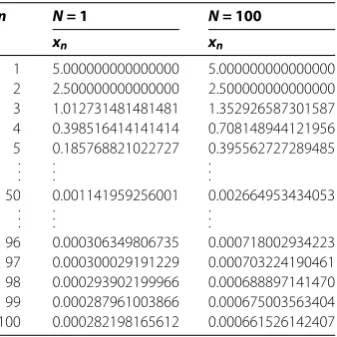
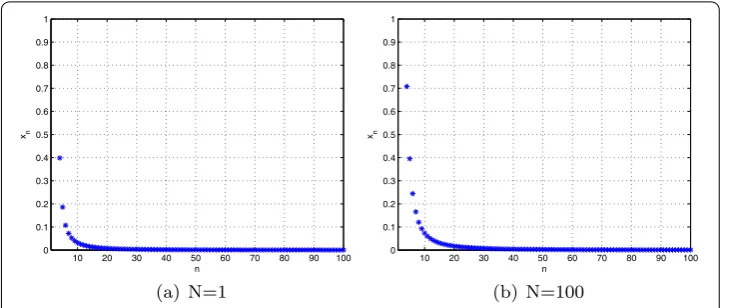
Using algorithm (.) and choosinge=x= withN= andN= (see Table ), we
see that Figure and numerical results demonstrate Theorem ..
Next, we present a numerical example inRthat also supports our result.
Example . Let the inner product·,·:R×R→Rbe defined byx, y= x·y=x ·
y+x·y+x·y and the usual norm · :R→Rbe defined byx=
x+x+x
Table 1 The values of the sequence{xn}
n N = 1 N = 100
xn xn
1 5.000000000000000 5.000000000000000 2 2.500000000000000 2.500000000000000 3 1.012731481481481 1.352926587301587 4 0.398516414141414 0.708148944121956 5 0.185768821022727 0.395562727289485
. . .
. . .
. . .
50 0.001141959256001 0.002664953434053 .
. .
. . .
. . .
Figure 1 The convergence of{xn}with initial valuese1=x1= 5.
Table 2 The values of the sequence{xn}
n x1
n xn2 x3n
1 1.000000000000000 6.000000000000000 12.000000000000000 2 0.166666666666667 1.000000000000000 2.000000000000000 3 0.123544973544974 0.741269841269841 1.482539682539682 4 0.078950180010786 0.473701080064716 0.947402160129433 5 0.051217417354718 0.307304504128309 0.614609008256618
. . .
. . .
. . .
. . .
50 0.000476097239794 0.002856583438761 0.005713166877522 .
. .
. . .
. . .
. . .
96 0.000128869584585 0.000773217507511 0.001546435015021 97 0.000126223335925 0.000757340015550 0.001514680031100 98 0.000123657771457 0.000741946628743 0.001483893257487 99 0.000121169643936 0.000727017863616 0.001454035727232 100 0.000118755867858 0.000712535207149 0.001425070414298
for all x = (x,x,x), y = (y,y,y)∈R. LetA,B,M,f :R→Rbe defined byAx=x,
Bx=fx=xandMx= x for all x∈R, respectively. For eachi∈ {, , . . . ,N}, letAi:R→ Rbe defined byA
ix=ixfor all x∈R. Leta=,λ= ,μ= ,λi=i +NN for each i∈ {, , . . . ,N}anden=ne (n= , , . . .), wheree∈R ande<∞. Let the sequence {xn}be generated iteratively by (.), whereαn=nandrn=n+ +N. Then the sequence {xn}converges strongly to .
Solution: It can be observed that all the assumptions of Theorem . are satisfied. It is also easy to checkFix(G)∩Ni=VI(E,Ai,M) ={}.
We rewrite (.) as follows:
xn+=
nxn+
– n
(n+ )N n(N+ ) + N+
×
xn–
n+ +
N
N
i=
i +
NN
i xn+
e
n
. (.)
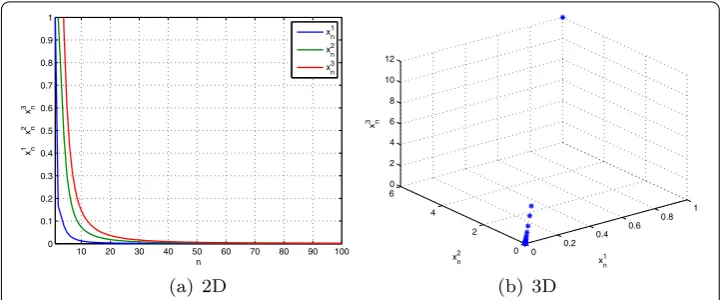
Utilizing algorithm (.) and choosing x=e= (, , ) withN= , we report the
Figure 2 The convergence of{xn}with initial valuesx1=e1= (1, 6, 12) andN= 100.
Competing interests
The authors declare that they have no competing interests.
Authors’ contributions
All authors contributed equally and significantly in writing this article. All authors read and approved the final manuscript.
Author details
1College of Science, Zhongyuan University of Technology, Zhengzhou, 450007, China.2Department of Mathematics,
Shanghai Normal University, Shanghai, 200234, China.
Acknowledgements
This research was partially supported by the Innovation Program of Shanghai Municipal Education Commission (15ZZ068), Ph.D. Program Foundation of Ministry of Education of China (20123127110002) and Program for Outstanding Academic Leaders in Shanghai City (15XD1503100).
Received: 10 September 2014 Accepted: 19 May 2015
References
1. Stampacchia, G: Formes bilineaires coercivities sur les ensembles convexes. C. R. Acad. Sci. Paris258, 4413-4416 (1964)
2. Peng, J, Wang, Y, Shyu, D, Yao, JC: Common solutions of an iterative scheme for variational inclusions, equilibrium problems, and fixed point problems. J. Inequal. Appl.2008, Article ID 720371 (2008)
3. Qin, X, Chang, SS, Cho, YJ, Kang, SM: Approximation of solutions to a system of variational inclusions in Banach spaces. J. Inequal. Appl.2010, Article ID 916806 (2010)
4. Hao, Y: On variational inclusion and common fixed point problems in Hilbert spaces with applications. Appl. Math. Comput.217, 3000-3010 (2010)
5. Yao, Y, Yao, J: On modified iterative method for nonexpansive mappings and monotone mappings. Appl. Math. Comput.186, 1551-1558 (2007)
6. Brézis, H: Équations et inéquations non linéaires dans les espaces vectoriels en dualité. Ann. Inst. Fourier (Grenoble)
18, 115-175 (1968)
7. Moreau, JJ: Proximité et dualité dans un espaces hilbertien. Bull. Soc. Math. Fr.93, 273-299 (1965)
8. Ansari, QH, Yao, JC: Systems of generalized variational inequalities and their applications. Appl. Anal.76, 203-217 (2000)
9. Ansari, QH, Schaible, S, Yao, JC: The system of generalized vector equilibrium problems with applications. J. Glob. Optim.22, 3-16 (2002)
10. Yao, Y, Noor, MA, Noor, K, Liou, YC, Yaqoob, H: Modified extragradient methods for a system of variational inequalities in Banach spaces. Acta Appl. Math.110, 1211-1224 (2010)
11. Kangtunyakarn, A: The modification of system of variational inequalities for fixed point theory in Banach spaces. Fixed Point Theory Appl.2014, Article ID 123 (2014)
12. Cai, G, Bu, S: Modified extragradient methods for variational inequality problems and fixed point problems for an infinite family of nonexpansive mappings in Banach spaces. J. Glob. Optim.55, 437-457 (2013)
13. Ceng, LC, Wang, C, Yao, YC: Strong convergence theorems by a relaxed extragradient method for a general system of variational inequalities. Math. Methods Oper. Res.67, 375-390 (2008)
14. Verma, RU: On a new system of nonlinear variational inequalities and associated iterative algorithms. Math. Sci. Res. Hot-Line3, 65-68 (1999)
15. Chang, SS: Existence and approximation of solutions for set-valued variational inclusions in Banach space. Nonlinear Anal.47(1), 583-594 (2001)
16. Chang, SS: Set-valued variational inclusions in Banach spaces. J. Math. Anal. Appl.248(2), 438-454 (2000)
18. Hartman, P, Stampacchia, G: On some non-linear elliptic differential-functional equations. Acta Math.115, 271-310 (1966)
19. Zhang, SS, Lee, J, Chan, CK: Algorithms of common solutions for quasi-variational inclusion and fixed point problems. Appl. Math. Mech.29, 571-581 (2008)
20. Manaka, H, Takahashi, W: Weak convergence theorems for maximal monotone operators with nonspreading mappings in a Hilbert space. CUBO13, 11-24 (2011)
21. Kamimura, S, Takahashi, W: Approximating solutions of maximal monotone operators in Hilbert spaces. J. Approx. Theory106, 226-240 (2000)
22. Aoyama, K, Iiduka, H, Takahashi, W: Weak convergence of an iterative sequence for accretive operators in Banach spaces. Fixed Point Theory Appl.2006, Article ID 35390 (2006)
23. Zegeye, H, Shahzad, N: Strong convergence theorems for a common zero of a finite family ofm-accretive mappings. Nonlinear Anal.66(5), 1161-1169 (2007)
24. López, G, Martín-Márquez, V, Wang, FH, Xu, HK: Forward-backward splitting methods for accretive operators in Banach spaces. Abstr. Appl. Anal.2012, Article ID 109236 (2012)
25. Khuangsatung, W, Kangtunyakarn, A: Algorithm of a new variational inclusion problem and strictly pseudononspreading mapping with application. Fixed Point Theory Appl.2014, Article ID 209 (2014)
26. Qin, XL, Cho, SY, Wang, L: A regularization method for treating zero points of the sum of two monotone operators. Fixed Point Theory Appl.2014, Article ID 75 (2014)
27. Takahashi, S, Takahashi, W, Toyoda, M: Strong convergence theorems for maximal monotone operators with nonlinear mappings in Hilbert spaces. J. Optim. Theory Appl.147, 27-41 (2010)
28. Xu, HK: Inequalities in Banach spaces with applications. Nonlinear Anal.16, 1127-1138 (1991) 29. Xu, HK: Iterative algorithm for nonlinear operators. J. Lond. Math. Soc.2, 1-17 (2002)
30. Song, YL, Ceng, LC: A general iteration scheme for variational inequality problem and common fixed point problems of nonexpansive mappings inq-uniformly smooth Banach spaces. J. Glob. Optim.57, 1327-1348 (2013)
31. Reich, S: Asymptotic behavior of contractions in Banach spaces. J. Math. Anal. Appl.44, 57-70 (1973) 32. Xu, HK: Viscosity approximation methods for nonexpansive mappings. J. Math. Anal. Appl.298, 279-291 (2004) 33. Blum, E, Oettli, W: From optimization and variational inequalities to equilibrium problems. Math. Stud.63, 123-145
(1994)
34. Combettes, PL, Hirstoaga, SA: Equilibrium programming in Hilbert spaces. J. Nonlinear Convex Anal.6, 117-136 (2005) 35. Rockafellar, R: Augmented Lagrangians and applications of the proximal point algorithm in convex programming.