Estimation of ionospheric reflection height using
long wave propagation
Dieter Keuer
Leibniz-Institute of Atmospheric Physics at the University of Rostock, Kühlungsborn, Germany Correspondence:Dieter Keuer ([email protected])
Received: 13 February 2019 – Revised: 21 May 2019 – Accepted: 15 July 2019 – Published: 19 September 2019
Abstract. Phase height measurements of low frequency ra-dio waves are used to study the long-term variability of the mesosphere over Europe. Phase height measurements use a characteristic pattern in field strength registration of radio waves interpreted as phase relations between sky wave and surface wave to obtain the apparent height of the reflection point, the Standard Phase Height (SPH). Based on this SPH-method a homogenized daily series was generated since 1959 at Kühlungsborn. Improvements of the measuring method show that the signal is significantly influenced by lower at-mospheric layers. Mesospheric reflection is not the exclusive source of the measured behavior. Tropospheric influence can not be neglected. Taking this into account one has to con-clude that the strong coherency of the SPH data to meso-spheric heights is not as significant as previously assumed.
1 Introduction
Indirect phase height measurements of long wave radio fre-quencies are a common method in order to study the long-term variability of the D region in the ionosphere. Field strength measurements have been maintained since Febru-ary 1959, after the International Geophysical Year 1957/58, in Kühlungsborn (e.g., Entzian, 1967; Bremer and Peters, 2008). The results can be used as an indicator for climate changes, which are nowadays important for the society (Pe-ters and Entzian, 2015). Pe(Pe-ters found a decrease of 114 m per decade in SPH. It is based onto the assumption that the field strength variations known as Hollingworth pattern (Holling-worth, 1926) is only caused by a change in mesospheric reflection height. Refinements and additional measurements suggest that the observed Hollingworth pattern are also in-fluenced by lower atmospheric layers. It is possible that the
influence of the lower layers is even much greater than previ-ously assumed (Bracewell et al., 1951; Entzian, 1967, 1972; Lauter et al., 1984; Taubenheim et al., 1997). The focus in this article is laid to clear some inconsistencies related to the measuring path from Allouis (47◦N, 2◦E, Central France) as broadcasting station to Kühlungsborn (54◦N, 12◦E, North-ern Germany), which is located about 1023 km away and serves as receiving location.
2 Model, analysis method
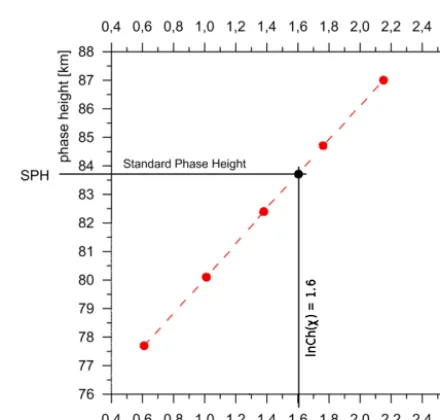
The diurnal amplitude pattern (upper panel a) in Fig. 2 of an VLF radio station is usually interpreted as a superposition of the ground wave following the Earth’s surface and the sky part reflected at ionospheric layers. Figure 1 shows the ge-ometry which is supposed in our case. For a phase difference between the waves ofn·λ(withλas wave length and n as an integer) a maximum is observed, and for a difference of 0.5+n·λa minimum. This approach allows to compute corre-sponding apparent heightsh(panel b) in Fig. 2, although the ambiguity has to be solved. Introducing the Chapman func-tion asx-axis one can find a linear relation betweenh and ln(Chap(χ )) (χ being solar zenith angle) on a daily basis (Lauter, 1984). The slopeHand a zero heighth0are obtained
by linear regression using the observed times of occurrence of the extremes and the corresponding heights. A zenith an-gle that appears during all seasons at the radio link path is χ=78.4◦(cos(χ )=0.2). This zenith angle is used to find a daily height value SPH viaH andh0 (Fig. 3). This way
one get a time series with one value daily, which is slightly removed from seasonal effects regarding the sun position.
mea-Figure 2. Hollingworth pattern(a), Relationship apparent height versus time(b)from Entzian (1967).
surements was slightly lowered by 1.22 %. This implicates also changes in the evaluation formulas regarding the height scale. Furthermore one have to debate whether or not physi-cal relationships changes due to the frequency shift. Through an estimation using electron density profiles the reflection height would decrease by less than 80 m, which can be ne-glected (Singer, 2013). This means the straight line in Fig. 3 should not change neither in the slope H nor inh0. Hence,
any jumps at the day of frequency change should not be vis-ible neither in SPH nor inH andh0after applying the new
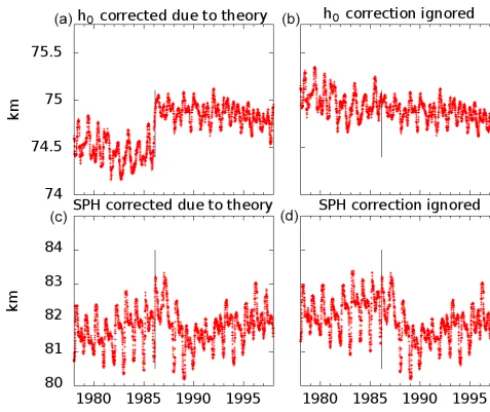
height scale reflecting the new frequency. Figure 4 shows a comparison of data following the suggested corrections in the formulas or not. The visible jumps in the data, after ap-plying the corrections, are shown in Fig. 4a, c. This indicates that the geophysical interpretation of the data has to be re-vised. It seems do be, that the underlying geometric model is wrong. This has a great influence on the interpretation of the SPH regarding long term issues. The decrease of 114 m per decade would be much greater because the data after 1986 are shifted upwards by 600 m due to the corrections.
Figure 3. Linear relationship between apparent height and ln(Chap(χ ))withχas solar zenith distance. Modified from Peters and Entzian (2015).
3 Improvements in receiver technique
Figure 4.Comparison of data reflecting the model change due to frequency shift(a, c) or not(b, d). Panels(a)and (b)show h0,
panels(c)and(d)show SPH. Although the jump in SPH data is(c)
not so easy to detect it is clearly visible inh0(a). The black lines
indicates the date of the frequency shift.
4 Results
4.1 Amplitude pattern
Subsequently are listed some effects that cannot easily be explained by the simple reflection model. Figure 5 shows the SPH for both measuring paths i.e. Allouis–Kühlungsborn and Allouis–Juliusruh for a few years. Noticeable are the dif-ferences in springtime which are roughly 400 m in height. Taking into account that the reflection point of both paths is only 50 km apart these differences seems to be much too large. One would expect a few 10th of meters. Since it is an apparent height and diffraction is neglected. The involved real reflection area is probably greater than 50 km in diam-eter. If this is not the case, a considerable inclination of re-flecting layer must be assumed, which could be also a source for changes in field strength recorded at the receiver place. In this case one would record a value representing a tilting factor and not an apparent height.
4.2 Antenna alignment
An other experiment was carried out using two antennas dis-torted by±45◦against the bearing to the transmitter. The am-plitude of both channels are decreasing by a factor of 0.707 due to cosine law, but they should be equal all the time. This is only the case a few hours around noon. But there are dif-ferences between both channels (Fig. 6). Just before sunset at 18:01 UTC one can find a minimum in one channel were in the other channel a maximum occurs. The reason for the differences could be for example a bending of the radio path
Figure 5. SPH data deduced from reception in Kühlungsborn (green) and Juliusruh (red).
Figure 6. Example (7 September 2018) of recepion amplitude recorded in Juliusruh using two antennas distorted by±45◦. A cal-culation of SPH of each channel separately would give a height dif-ference of about 2.5 km.
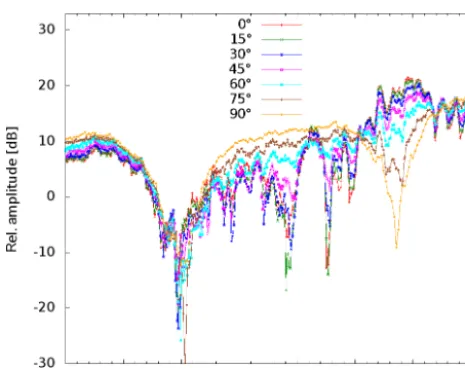
Figure 7.Reception amplitudes using a rotating ferrite rod. Indi-cated angles are taken against the upright position. The 90◦ record-ing shows a behavior quite similar like the usual Holrecord-ingworth pat-tern.
4.3 Direction finding
Following Fig. 1 and computing the elevation angleεof the sky wave one obtainsε=6.6◦. This low value makes it dif-ficult to design an antenna which is able to distinguish be-tween the incoming sky wave and the surface wave. A first approach to get elevation related values was to use a rotating ferrite rod in minimum bearing plane, which means that in the 90◦position the rod is horizontally aligned, while 0◦ rep-resents upright position. Figure 7 shows the result swinging the rod in 15◦steps. The 90◦sampling (light brown) shows the usual Hollingworth pattern known from the registration carried out since 1959 which has a loop antenna positioned in maximum bearing plane, but obviously with a much lower amplitude. Samples taken from an antenna orientation nearer to the upright position illustrate a completely different be-havior. There might be a connection with gravity waves. The normal Hollingworth amplitude pattern is fading away while the antenna is approaching to its upright position. One would actually expect the opposite behavior. Conjecturally the inci-dence angle of the radio wave is far away fromε=6.6◦. 4.4 Phase and Amplitude
As the receiver is equipped with its own stable reference os-cillator and furthermore the carrier of the used broadcast sta-tion at Allouis is seeded by a cesium fountain it is possible to record the absolute in-phase and quadrature component, known as complex amplitude or phasor. Figure 8a depicts a typical example of the amplitude recording over time, while the right part shows the coarse of the phasor. Each point in the plot is composed as addition of two vectors. A constant one which is representing the surface wave and a variable part depicting the sky wave. This is not so clear in the
il-Same data as the course of phasor with time as parameter, starting at sunrise, color change at local noon and ending at sunset(b).
lustration on the right, because the phase has bin lost there. With time as parameter in the panel (b) the phasor starts in this plot at sunrise, rotating anticlockwise (red crosses). Usu-ally two rounds can be observed each day under quiet sun conditions. From local noon on wards (green crosses) the ro-tating direction changes. Again after roughly two rounds the phasor ends here in the plot at sunset. The night time is not illustrated. Assuming a sky wave changing in amplitude and phase and a constant surface wave, then the addition of the two vectors should describe a spiral with a constant center. Obviously this is not the case in Fig. 8b. In order to explain the pattern one have to assume either that the surface wave is not constant or that there must be a third wave, unknown so far.
4.5 Tropospheric effects
Figure 9.Amplitude(a)and Phasor(b)during heavy tropospheric disturbances. Colors indicate time periods for better overview.
4.6 Run time experiments
Summarizing the above mentioned experiments it seems im-possible to gather separate information from the involved two wave components. Too many questions are still be open. Surely one would gain substantially more information with a pulsed system like a ionosonde. Oblique ionograms are avail-able from Juliusruh since 2015. Unfortunately, they are start-ing only from 1.5 MHz, which is too far away from 162 kHz, which are the subject here. As the new receiver is a capa-ble to receive the whole LF band the idea came up, to use the signals of the LORAN-C system. LORAN-C is a naval navigation system using LF pulses at 100 kHz. The technical parameters can be fond, for example, in Mills (1992), Pel-grum (2006) and U.S. Department of transportation (1994). The LORAN system was unfortunately decommissioned in December 2015, except for one transmission station at An-thorn (54◦N, 3◦W). The LORAN pulses are of a total length of about 200 µs and reach their maximum 65 µs after start (Fig. 10). For distances of up to 1000 km, for which the navigation system was designed, one expect for ionospheric echos a delay compared to the surface wave which is greater than 60 µs. But in the LORAN manuals it is recommended to use the third positive zero crossing, which is at 30 µs after of the start of the pulse at only halfway to maximum, for naviga-tion purposes because later readings could be contaminated by the ionosphere. To verify this, i.e. to show that there are really earlier echos from much lower layers than mesospheric ones at about 82 km, a campaign using LORAN transmitters was conducted in October/November 2014. The receiver site was located near the village Unbesandten (53◦N, 11◦E). The signal of the nearest three LORAN transmitters Sylt (55◦N, 8◦E, 274 km away), Lessay (49◦N, 1◦W, 993 km away) and Soustons (44◦N, 1◦W, 1395 km away) were evaluated. The stations mentioned all used 250 kW transmission power and the same antenna, so that their characteristics are well
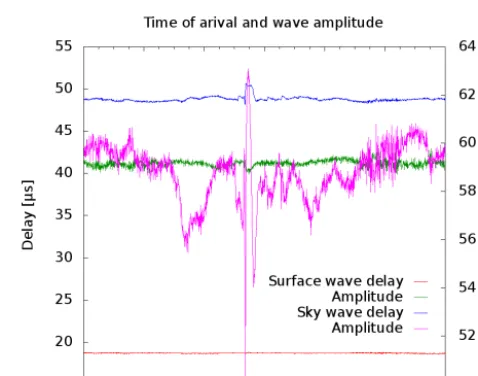
com-which is guaranteed by transmitter control. The tail is formed to minimize the frequency occupancy as much as possible. Figure 10 shows a real measured waveform 274 km away from the transmitter Sylt. The first 30 µs of the measured pulse were used to fit the signal against Eq. (1), withAand τ as free parameters. This should give an analytic presenta-tion of the surface wave which is then subtracted from the measured signal. As result a residual wave is visible roughly 40 µs delayed against the surface wave (Fig. 11). The rea-son could be a malformed transmitted pulse, but this would violate the LORAN specifications. Furthermore, a spectrum analysis shows that frequency occupancy is a little bit worse than one would expect. Therefore one can assume that the ex-istence of residual wave is not technically conditioned. The amplitude and the delay of this wave is calculated using the above mentioned fitting algorithm again. This procedure sep-arates waves arriving at a later time, i.e. mesospheric echoes. Figure 12 depicts the daily variations of amplitude and time of the surface wave and the sky wave which arrives before the mesospheric waves, counted as C layer echoes. The run time and the amplitude of the surface wave are obviously constant over daytime as expected, otherwise the LORAN navigation system would not work. The C layer echo has amplitude vari-ations that could be a hint of its ionospheric origin. The anal-ysis of the more distant stations can bee seen in Figs. 13 and 14. The amplitude of the C layer echo is in the same order of magnitude as the surface wave, in contrast to the short dis-tance to Sylt were it is 40 dB smaller as the surface wave, while the delay is 10 µs shorter. In summary, it can be said that earlier waves exist than previously expected. Remark-able are the variations in amplitude as well as in the run time of the C layer echoes starting at 10:42 UTC, which are corre-lated with an X-ray burst measured on the GOES-15 satellite while the surface wave is unaffected.
5 Conclusions
Figure 10.Pulse of the LORAN navigation system received 274 km away from transmitter. In panel(b)taken at 01:00 UTC the D-Layer reflection is clearly visible. It correspondents to a height of about 86 km.
Figure 11.LORAN signal with calculated surface envelope (blue), sky signal (green) and its envelope to estimate the delay against the surface wave, which is here 42 µs.
order of magnitude as the ground wave, when the 1000 km distance is considered, it makes a significant contribution to the reception field strength. The propagation model has to be questioned, as several effects cannot be explained with the used simple approach.
The findings based on SPH regarding trends are still valid. But the direct coupling to the mesosphere must be aban-doned. Even the troposphere can have an essential influence onto the observed long wave behavior. Therefore, the SPH series must be considered as one that only reflects integral
Figure 12. Daily variation of amplitude and signal delay of the emissions from Sylt, 274 km away. Recorded on 26 Novem-ber 2014. The nominal run time due to the speed of light for this distance is removed but the receiver delay is not removed.
Figure 13.Daily variation of amplitude and signal delay from of the emissions from Lessay, 993 km away. Recorded on 26 Novem-ber 2014. The nominal run time due to the speed of light for this distance is removed but the receiver delay is not removed.
properties of the hole region from the mesosphere over the stratosphere down to the troposphere.
However, a simple mathematical approach seems to make sense in order to obtain a statement on long-term behavior. Only the times of occurrence of the extreme values were used. To remove seasonal behavior the whole time series, more then 50 years, were fitted against Eq. (2). withx as running day of the series.
z (x)=Xn=5 n=1
h
ancos x
365.2422·2π n+cn
i
Figure 14. Daily variation of amplitude and signal delay of the emissions from Soustons, 1395 km away. Recorded on 26 Novem-ber 2014. The nominal run time due to the speed of light for this distance is removed but the receiver delay is not removed.
Figure 15.Deviation from the average of the occurrence of the sec-ond minimum in the daily Hollingwoth pattern in the morning after sunrise and the second minimum before sunset. The seasonal com-ponent is removed as described. The plots are smoothed by a 101 d running median.
This functionz(x)was then subtracted from the time series to remove seasonality. As an example, the times of the second minimum after sunrise and the second minimum before sun-set are plotted in Fig. 15. The linear fit shows an earlier oc-currence of the minimum of 27 min over a period of 60 years in the morning and 22 min in the afternoon. This can be in-terpreted as an extension of the ionospheric day by 49 min over this long period.
Data availability. Data are available at ftp://ftp.iap-kborn.de/ data-in-publications/KeuerARS2019 (last access: 7 August 2019).
“Kleinheubacher Berichte 2018”. It is a result of the Klein-heubacher Tagung 2018, Miltenberg, Germany, 24–26 September 2018.
Acknowledgements. The author is grateful to the Leibniz-Institute of Atmospheric Physics in Kühlungsborn and the precursor in-stitutions for running the phase height measurements over nearly 60 years. Thanks to Jörg Trautner who developed a reference re-ceiver and to Gérard Paviot who run it at the broadcast site near Allouis (France) from 2013 to 2017. I thank Dieter Peters and Günter Entzian for helpful discussions and the reviewers for their comments and suggestions that helped me a lot to improve the manuscript.
Financial support. The publication of this article was funded by the Open Access Fund of the Leibniz Association.
Review statement. This paper was edited by Ralph Latteck and re-viewed by Christoph Jacobi and Norbert Jakowski.
References
Bertoni, F. C. P., Raulin, J.-P., Gavilán, H. R., Kaufmann, P., Ro-driguez R., Clilverd, M., Cardenas, J. S., and Fernandez, G.: Lower ionosphere monitoring by the South America VLF Net-work (SAVNET): C region occurrence and atmospheric tem-perature variability, J. Geophys. Res.-Space, 118, 6686–6693, https://doi.org/10.1002/jgra.50559, 2013.
Bracewell, R. N., Budden, K. G., Ratcliffe, J. A., Straker, T. W., and Weekes, K.: The ionospheric propagation of and very low-frequency radio waves over distances less than 1000 km, Pro-ceedings of the IEE – Part III: Radio and Communication En-gineering, 98, 221–236, https://doi.org/10.1049/pi-3.1951.0043, 1951.
Bremer, J. and Peters, D. H. W.: Influence of stratospheric ozone changes on long-term trends in the meso- and lower thermosphere, J. Atmos. Sol.-Terr. Phy., 70, 1473–1481, https://doi.org/10.1016/j.jastp.2008.03.024, 2008.
Entzian, G.: Quasi-Phasenmessungen im Langwellenbereich (100– 200 kHz) zur indirekten Bestimmung von Plasmaparametern in der Hochatmosphäre (60–90 km), Diss. Univ. Rostock, 1967. Entzian, G.: Ableitung von Phaseninformationen aus
Feldstärke-beobachtungen im Langwellenbereich zur Überwachung der Hochatmosphäre, Experimentelle Technik der Physik, XX, Heft 6, 513–519, 1972.
Hollingworth, J.: The propagation of radio waves, J. IEE, 64, 579– 589, https://doi.org/10.1049/jiee-1.1926.0048, 1926.