https://doi.org/10.5194/ars-17-59-2019
© Author(s) 2019. This work is distributed under the Creative Commons Attribution 4.0 License.
Towards a Spectral Method of Moments using Computer
Aided Design
Stefan Kurz, Sebastian Schöps, and Felix Wolf
Technische Universität Darmstadt, Institute for Accelerator Science and Electromagnetic Fields and Centre for Computational Engineering, Darmstadt, Germany
Correspondence:Felix Wolf ([email protected])
Received: 13 February 2019 – Revised: 30 April 2019 – Accepted: 21 May 2019 – Published: 19 September 2019
Abstract. We present first numerical examples of how the framework of isogeometric boundary element methods, in the context of electromagnetism also known as method of moments, can be used to achieve higher accuracies by eleva-tion of the degree of basis funceleva-tions. Our numerical examples demonstrate the computation of the electric field in the exte-rior domain.
1 Introduction
Spectral methods, cf. Trefethen (2000), are classes of meth-ods for solving differential equations, closely related to clas-sical element based methods. They share the same idea: The approximation of the solution through a series of basis func-tions. While classical methods choose to refine a mesh, and with this to further localise the support of each individual basis function, spectral methods employ global basis func-tions to approximate the solution of the problem. Since such a global basis is not always readily available, quite often any finite and boundary element method which relies solely on p-refinement, i.e., the increase of the degree of the local with-out mesh (h-) refinement, is referred to as aspectral element method.
In engineering applications, spectral element methods are rarely considered; the reason simply being that to fully enjoy their convergence properties, meshes with curved elements of increasing orders must be generated. This poses chal-lenges to mesh generation and pre-processing. In contrast, classicalh-refinement based mesh generators are well under-stood. However, with the introduction ofisogeometric anal-ysis by Hughes et al. (2005) the problem of efficient mesh generation can be avoided by the use of exact geometry
map-pings, allowing computations directly on CAD-generated ob-jects.
In this document, we present numerical experiments which showcase how the isogeometric framework can be used to obtain an implementation of a spectral boundary element method. We demonstrate the implementation by the so-lution of electromagnetic scattering problems through p-refinement. For this, we employ a solution strategy via the electric field integral equation (Buffa and Hiptmair, 2003), which is also referred to asmethod of moments (MOM), and an isogeometric boundary element framework (Dölz et al., 2018b). We essentially employp-refinement to a patchwise polynomial basis, in our case based on Bernstein polynomi-als. Other variants of spectral MOM have already been stud-ied, eg. by Benoit et al. (1992) or Di Ruscio et al. (2014).
The organisation of the paper is straight forward. We first introduce basic notions of the electric field integral equation, and ourp-refinement based discretization scheme, built on top of the framework of isogeometric analysis. Afterwards, we comment on the matrix assembly, followed by a discus-sion of our numerical examples.
2 The Electric Field Integral Equation
We consider the scattering of an electromagnetic wave un-der the assumption of constant material coefficientsµand inc, i.e., the surroundings of a scatterer, PEC boundary condition on0:=∂and the Silver-Müller radiation condi-tion. Prescribing an incident wavegwe arrive at
Figure 1.Visualisations of the geometries. The maximum diameter of the boat is smaller than 4.5, the sphere is of radius 1.
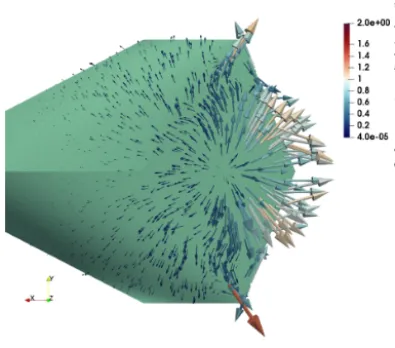
Figure 2.Visualisations of the real part of the unknown surface current.
with wave numberκ:=ω√µ.Herein, ndenotes the out-ward unit normal of0.Under these conditions, there exists a surface currentj such that the scattered field can be rep-resented by theelectric field integral equation (EFIE), given by
e(x)= − Vej
(x),for allx∈c, (2)
with
e
V (j)(x):=
Z
0
Gκ(x,y)j(y)d0y+ 1 κ2gradx
Z
0
Gκ(x,y)
·div0 j(y)
d0y, (3)
for all x6∈0. Herein,Gκ(·,·)denotes the Green’s function given byGκ(x,y):= e
iκ|x−y|
4π|x−y|,cf. Buffa and Hiptmair (2003)
for details.
In a continuous setting, this can be recast as the variational problem of finding an unknown surface currentj in the trace
of the spaceH (curl, ), such that
Z
0
Z
0
Gκ(x,y)j(x)·ξ(y)d0y+ 1 κ2
Z
0
Gκ(x,y)
(div0◦j)(x)(div0◦ξ)(y)d0yd0x= −
Z
0
(ei×n)·ξd0 (4)
holds for all test functionsξ in the same space. The corre-sponding trace space is often denoted byH×−1/2(div0, 0)and requires a divergence-conforming discretisation.
3 Discretisation
Figure 3.Numerical examples on the unit sphere. Wave numberκ=1. The error refers to the maximum error obtained by comparing the values of the analytical solution with the field values through evaluation of Eq. (2) on a selection of 10 000 points on a sphere of radius 2 around the origin. Computed on a desktop PC with 16 GB RAM and an Intel i7 8700k processor.
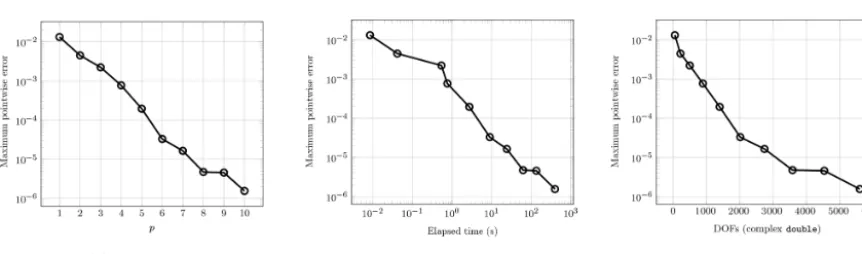
Figure 4.Numerical examples for the ship geometry as presented in Fig. 1a. Highestpgenerates a discretisation with 5600 complex-valued degrees of freedom. Wave numberκ=1. The error refers to the maximum error obtained by comparing the values of the analytical solution with the field values through evaluation of Eq. (2) on a selection of 10 000 points on a sphere of radius 6 around the origin. Computed on a desktop PC with 16 GB RAM and an Intel i7 8700k processor.
Implementations of such and related numerical schemes are, among others, given by Hiptmair and Kielhorn (2012), Tzoulis and Eibert (2005), or Weggler (2011). We utilise an approach based on the framework of isogeometric analysis, dealing with the special case where the B-spline basis re-duces to the set of Bernstein polynomials, for orderp≥0 given by
bα,p=
n α
xα(1−x)p−α, for 0≤α≤p.
To apply p-refinement, one needs sufficiently smooth (patchwise) geometry mappings, since otherwise they limit the order of ansatz functions which can be applied ef-fectively. Thus, we choose geometry mappings given by mappings from the unit square to parts of the geometry 0j parametrized as tensor product mappings of rational Bernstein polynomials. Such representations can be eas-ily extracted from NURBS (non uniform rational B-Spline) parametrisation through Bézier extraction (Borden et al., 2011).
Following Buffa et al. (2011), a suitable discretisation of the trace spaces on so-called multipatch domains 0=
S
0≤j <N0j, i.e., elements in the context of spectral element methods, is provided in Buffa et al. (2018). By tensor prod-uct constrprod-uction one constrprod-ucts discrete spaces that are con-forming w.r.t. the differential operators. As an example, ifSp denotes the Bernstein polynomials of orderp≥1 on(0,1), one finds that
Sp⊗Sp−→curl
Sp⊗Sp−1 Sp−1⊗Sp
div
−→Sp−1⊗Sp−1
holds. This way, using the NURBS geometry mappings in-duced by the CAD geometries to seamlessly map between (0,1)2and patches0j⊆0, one can define a conforming dis-cretisation of the entire de Rham complex
H1()−→gradH (curl, )−→curl H (div, )−→div L2(), (5) as well as its trace spaces
H1/2(0)curl−→0H×−1/2(div0, 0) div0
−→H−1/2(0), (6)
Z
0
Z
0
Gκ(x,y)jh(x)·ξh(y)d0y+
1 κ2
Z
0
Gκ(x,y)(div0◦jh)
(x)(div0◦ξh)(y)d0yd0x= −
Z
0
(ei×n)·ξhd0 (8)
holds for all test functions ξh∈Sp1(0). The coefficients to represent jh=P
cjξh,j, where the ξh,j denote the basis functions of Sp1(0), can be obtained in form of the vector cgiven by the solution to the linear systemAc=r, whereA andrcan be assembled in direct analogy to Eq. (8).
4 Matrix Assembly
We apply a modified version of the superspace approach as used by e.g. Dölz et al. (2018a) to construct the dense system matrixAresulting from Eq. (4) via the representation
A=P|A†P=P|
#elements
X
i,j=0 A†j,i
!
P,
where A† is the dense system matrix w.r.t an elementwise polynomial, globally discontinuous basis, and P is the su-perspace matrix assembling the divergence-conforming ba-sis. Herein, each matrixA†j,iis sparse, including only the in-teraction of the local basis on elementiwith that of element j. This way, the small dense systemAis assembled without the need to storeA†as a whole. In the special case of only p-refinement, the matrixP incorporates only linear combi-nations necessary to reduce the degree in one tensor product direction for the construction ofSp1(0), and to achieve nor-mal continuity across patch interfaces. For the solution of the arising linear system, we utilise a partially pivoted LU de-composition of the Eigen linear algebra library (Guennebaud et al., 2010).
5 Numerical Examples
To showcase the possibility of obtaining an increased accu-racy through (mainly)p-refinement, we present a simple nu-merical example in analogy to the ones forh-refinement pre-sented by Dölz et al. (2018a).
by existence and uniqueness of the solution of the exterior problem Eq. (4), cf. Buffa and Hiptmair (2003), we know that Eq. (8) will approximate the surface current required to represent the fieldEDP|c,cf. Dölz et al. (2018b). This
con-struction using a prescribed solution is known as amethod of manufactured solutions, cf. Oberkampf and Roy (2010, Chap. 6.3).
Summarised, we solve forj in Eq. (8) with an excitation given by Eq. (9). We then evaluate Eq. (2) numerically with the approximated surface currentjh whose induced eh(x) yields the numerical solution. By existence and uniqueness eh is an approximation toEDPin the exterior. We compute the error maxx∈V kEDP(x)−eh(x)kC3at pointsxin a setV
containing points placed on a sphere enclosing the geometry, see the captions of Figs. 3 or 4 for details.
As a first example, we choose the example of a unit sphere given by 6 patches and define a dipole with x0=p0= (0,0.1,0.1)as an excitation. Although a boundary element framework has been utilised to solve the problem, no com-pression was applied to the systems due to their small system size, cf. Fig. 3c.
Thus the condition of the system matters little compared to the case in which compression must be applied.
On the sphere, a stable exponential rate of convergence w.r.t.pis observed. The application ofp-refinement reduces the time required for matrix assembly as well as the overall system size, cf. Fig. 3, significantly.
We present another example. As geometry, we choose the boat depicted in Fig. 1 consisting of 28 Bézier patches. Plac-ing the dipole inside withx0=(1,0,0)andp0=(0,0,0.1), i.e., under the “bridge”, we evaluate the electric field around the geometry. For this non-smooth and non-convex geome-try, the rate of convergence, as seen in Fig. 4, is not as pro-nounced as before. Still, one can see an exponential conver-gence behaviour paired with excellent times to solution.
6 Conclusions
consisting of one patch each, or in the case of functions iden-tified to achieve normal continuity, multiple patches. Appli-cation ofp-refinement to this basis yields a spectral method of moments, which achieves high accuracies without the need for system compression.
These results are exceptionally promising since the re-duced system size makes the application of direct solvers possible, thus circumventing the need for preconditioners, which are still a challenging topic for boundary element methods for electromagnetic problems.
Code availability. The code basis, as well as the geometries for these computations are available at http://www.bembel.eu/ (last ac-cess: 21 May 2019). A fork of the repository ready to recreate the computations can be found at https://github.com/flx-wlf/bembel/ tree/ars2019aa/ (last access: 21 May 2019). See also Dölz et al. (2019) (https://doi.org/10.5281/zenodo.2671596).
Author contributions. All authors have jointly carried out research and worked together on the manuscript. The numerical tests have been conducted by the last author. All authors read and approved the final manuscript.
Competing interests. Stefan Kurz is also affiliated as Chief Expert with Robert Bosch GmbH.
Special issue statement. This article is part of the special issue “Kleinheubacher Berichte 2018”. It is a result of the Klein-heubacher Tagung 2018, Miltenberg, Germany, 24–26 September 2018.
Acknowledgements. The work of Felix Wolf is supported by the Excellence Initiative of the German Federal and State Govern-ments and the Graduate School of Computational Engineering at TU Darmstadt.
Financial support. This research has been supported by the DFG (grant no. SCHO1562/3-1) and the DFG (grant no. KU1553/4-1).
Review statement. This paper was edited by Thomas Eibert and re-viewed by three anonymous referees.
References
Benoit, C., Royer E., and Poussigue, G.: The spectral moments method, J. Phys. Condens. Matter., 4, 3125–3152, 1992. Borden, J., Scott, M. A., Evans, J. A., and Hughes T. J. R.:
Isoge-ometric finite element data structures based on Bézier extraction of NURBS, Int. J. Numer. Meth. Eng., 87, 15–47, 2011. Buffa, A. and Hiptmair, R.: Galerkin boundary element methods for
electromagnetic scattering, Lect. Notes Comp. Sci., 31, 83–124, 2003.
Buffa, A., Rivas, J., Sangalli, G., and Vázquez, R.: Isogeometric discrete differential forms in three dimensions, SIAM J. Numer. Anal., 49, 818–844, 2011.
Buffa, A., Dölz, J., Kurz, S., Schöps, S., Vázquez, R., and Wolf, F.: Multipatch approximation of the de Rham sequence and its traces in isogeometric analysis, submitted, preprint available: arXiv:1806.01062, 2018.
Di Ruscio, D., Burghignoli, P., Baccarelli, P., Comite, D., and Galli, A.: Spectral Method of Moments for Planar Structures With Az-imuthal Symmetry, IEEE T. Antenn. Propag., 62, 2317–2322, https://doi.org/10.1109/TAP.2014.2302831, 2014.
Dölz, J., Kurz, S., Schöps, S., and Wolf, F.: A Numerical Compar-ison of an Isogeometric and a Classical Higher-Order Approach to the Electric Field Integral Equation, submitted, preprint avail-able: arXiv:1807.03628, 2018a.
Dölz, J., Kurz, S., Schöps, S., and Wolf, F.: Isogeometric Boundary Elements in Electromagnetism: Rigorous Analysis, Fast Methods, and Examples, submitted, preprint available: arXiv:1807.03097, 2018b.
Dölz, J., Harbrecht, H., Kurz, S., Multerer, M., Schöps, S., and Wolf, F.: Bembel v0.9, https://doi.org/10.5281/zenodo.2671596, 2019.
Guennebaud, G. and Jacob, B.: Eigen v3, available at: http://eigen. tuxfamily.org (last access: 21 May 2019), 2010.
Hughes, T. J. R., Cottrell, J. A., and Bazilevs Y.: Isogeometric anal-ysis: CAD, finite elements, NURBS, exact geometry and mesh refinement, Comput. Meth. Appl. Mech. Eng., 194, 4135–4195, 2005.
Jackson, J. D.: Classical Electrodynamics, Wiley and Sons, New York, 3rd edition, 1998.
Oberkampf, W. L. and Roy, C. J.: Verification and Validation in Scientific Computing, Cambridge University Press, Caimbridge, 2010.
Trefethen, L. N.: Spectral Methods in MATLAB, SIAM, Philadel-phia, 2000.
Tzoulis, A. and Eibert, T. F.: A Hybrid FEBI-MLFMM-UTD Method for Numerical Solutions of Electromagnetic Problems Including Arbitrarily Shaped and Electrically Large Objects, IEEE T. Antenn. Propag., 53, 3358–3366, 2005.
Hiptmair, R. and Kielhorn, L.: BETL – A generic boundary element template library, Seminar for Applied Mathematics, ETH Zürich, Rep. no. 36, 2012.