P R O T O C O L
Open Access
Effects of testosterone therapy for women:
a systematic review and meta-analysis
protocol
Rakibul M. Islam
1*, Robin J. Bell
1, Sally Green
2and Susan R. Davis
1Abstract
Background:Testosterone therapy for women is in widespread use, primarily in the form of compounded preparations and off-label use of formulations for men. The benefits and risks of such therapy remain uncertain. This review will identify and evaluate studies that have examined the effects of testosterone therapy for women on a range of outcomes
including sexual function, cardiovascular events, metabolic parameters, musculoskeletal health, wellbeing, cancer events, androgenic effects and withdrawal rates.
Methods:Studies meeting our pre-determined inclusion criteria will be identified through searches in Ovid MEDLINE, EMBASE, the Cochrane Central Register of Controlled Trials (CENTRAL) and Web of Science. Assessing a range of outcomes, we will assess the risk-of-bias of relevant studies and draw conclusions about the strength of evidence for benefits and risks of testosterone therapy for each outcome.
Discussion:This comprehensive systematic review with meta-analysis will provide the foundation for the development of evidence-based clinical practice guidelines that will address benefits and risks of testosterone therapy, when treatment might be appropriate or inappropriate, areas of clinical uncertainty and the basis for assessment and monitoring of patients.
Systematic review registration: PROSPERO registration number: CRD42018104073
Keywords: Testosterone, Women, Premenopause, Perimenopause, Postmenopause, Sexual function
Background
Endogenous testosterone has a critical role in women’s health, either through direct androgenic action or as a con-sequence of conversion by the aromatase enzyme to estro-gens [1]. Testosterone has important physiological roles in female reproductive and non-reproductive health. There is a physiological decline in testosterone with age that com-mences prior to natural menopause [2–4]. The greatest de-cline in circulating testosterone occurs during the late reproductive years [2]. Testosterone is often prescribed to improve sexual function in postmenopausal women present-ing with low libido [5]. However, concern about the safety has been a major obstacle for the approval of testosterone
therapies for women. Consequently, in most countries, tes-tosterone therapy for women is off-label, such that the pre-scribed therapies are either formulations approved for men with dose modification or compounded therapy [6].
A systematic review of testosterone therapy for women in-dicated favourable effects on sexual function [5]. However, at the time this was published, limited safety data were avail-able. Subsequent studies have provided further efficacy and safety data. Testosterone is administered to postmenopausal women with concurrent estrogen [7, 8] or estrogen plus progestogen therapy [9, 10] or to premenopausal women [11, 12], and postmenopausal women not using other sex steroid therapy [13]. The Endocrine Society pub-lished recommendations for the use of androgens in post-menopausal women in 2014 that included recommendations for the use of testosterone [14].
With the increasing use of compounded therapies that in-clude testosterone, combined with the uncertainty of the * Correspondence:[email protected]
1Women’s Health Research Program, Monash University, Melbourne, Australia Full list of author information is available at the end of the article
role of testosterone therapy, there is a compelling need for a systematic review incorporating the more recently published clinical trials of testosterone for women that includes all modes of systemic administration studied and indications for use. This review will therefore assess the benefits and risks of using testosterone therapy for women, including ef-fects on measures of sexual function, cardiovascular events, metabolic parameters, musculoskeletal health and wellbeing.
Methods/design
This protocol states the conduct and reporting of a sys-tematic review and meta-analysis in compliance with the Preferred Reporting Items for Systematic Reviews and Meta-analyses protocols (PRISMA-P) [15]. This system-atic review is registered in the PROSPERO database with an identification number: CRD42018104073.
Electronic searches
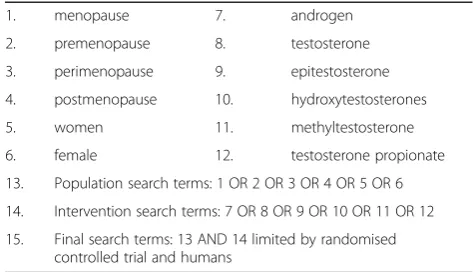
We will search the following electronic databases using Ovid software: MEDLINE, EMBASE, the Cochrane Cen-tral Register of Controlled Trials (CENTRAL) and Web of Science. These databases will be searched using the search terms shown in Table 1. The final search results will be limited to controlled clinical trials or randomised controlled trials and humans. The search strategy for Ovid MEDLINE is shown in theAppendix(Table 2).
Searching other resources
The reference lists of retrieved studies will be searched to identify other potentially eligible trials or ancillary publications.
Inclusion/exclusion of articles
We will include randomised placebo-controlled clinical trials (RCTs) published between January 1990 and July 2018. This includes crossover and parallel group designs. To be included in the review, studies will be required to (1) include women aged 18–75 years and (2) to have
directly compared systemic testosterone therapy with identical placebo or a blinded comparator therapy.
Studies with non-blinded intervention/s will be ex-cluded as the placebo for many of the outcomes of inter-est is high. Studies published prior to 1990 will be excluded as the effect of testosterone was not systemat-ically investigated prior to 1990.
Types of interventions
We will investigate the following comparisons of inter-vention versus control/comparator.
Intervention Systemic testosterone therapy administered
as a transdermal or oral preparation, intra-muscular injec-tion or subcutaneous implant.
Control/comparator Identical appearing placebo therapy.
Any concomitant therapies will be required to be the same in the intervention and comparator groups. Concomitant therapies will include estrogen alone or estrogen plus pro-gestogen therapy.
Types of outcome measures
Primary outcomes
The primary outcomes will be the effects of testosterone therapy on sexual function, cardiovascular events, metabolic parameters, cognitive function and musculoskeletal health. For example, the sexual function outcomes includes satisfy-ing sexual events, total sexual function scores, and scores for sexual desire, arousal, orgasm, pleasure, concerns, re-sponsiveness, sexual self-image and sexual distress.
Secondary outcomes
Secondary outcomes will include the effects of testosterone therapy on androgenic effects, cancer events, mood and wellbeing, and discontinuation rate. For example, the sec-ondary outcome of androgenic effects includes acne, alope-cia, clitoromegaly, increased hair growth and voice change.
Summary of findings’and adverse effects’table
A‘summary of findings table’reporting the following out-comes listed according to priority will be presented. A ‘summary of adverse events over a 12/26/52-Week Period’ reporting the following adverse events listed according to priority will be presented.
Data collection and analysis
Selection of studies
After elimination of duplicates, two review authors (RI, RB) will independently scan the abstract, title or both, of every record retrieved to determine which potential studies should be assessed further. All potentially relevant articles will be evaluated as a full text. Any discrepancy of a particu-lar study will be resolved through discussion by the review Table 1Search terms used to identify relevant studies in
electronic databases
1. menopause 7. androgen
2. premenopause 8. testosterone
3. perimenopause 9. epitestosterone
4. postmenopause 10. hydroxytestosterones
5. women 11. methyltestosterone
6. female 12. testosterone propionate
13. Population search terms: 1 OR 2 OR 3 OR 4 OR 5 OR 6
14. Intervention search terms: 7 OR 8 OR 9 OR 10 OR 11 OR 12
team members. If resolving disagreement is not possible, the article will be added to those‘awaiting assessment’and the study authors will be contacted for clarification. The PRISMA flowchart will be used in the final review [15].
Data extraction and management
For studies that fulfil inclusion criteria, two review authors (RI, RB) will independently abstract key participant and inter-vention characteristics and report data on efficacy outcomes and adverse events. A standardised form will be developed and piloted based on the template of the Cochrane data ab-straction form [16]. Any disagreements will be resolved by discussion, or if required by a third author (SD). Data will be extracted on the basic characteristics and outcomes of au-thor/year, country/setting, study population, age, number of women randomised, intervention (placebo/treatment), dur-ation and route of intervention, and different outcomes.
Dealing with duplicate publications
In case of duplicate publications or multiple reports of a pri-mary study, all available data will be collated and the most complete dataset aggregated across all known publications will be used. In case of uncertainty, the publication reporting the longest intervention/follow-up associated with our pri-mary or secondary outcomes will be given priority.
Assessment of risk of bias in included studies
Two review authors (RI, RB) will assess the risk of bias of each included study independently. We will resolve disagree-ments by consensus or by consultation with a third author (SD/SG).
We will assess risk of bias using the Cochrane risk of bias tool [16,17].
We will judge‘risk of bias criteria’as‘low risk’,‘high risk’ or ‘unclear risk’and evaluate individual bias items as de-scribed in theCochrane Handbook for Systematic Reviews of Interventions [16]. A‘risk of bias’graph and a‘risk of bias summary’figure will be generated. The impact of in-dividual bias domains on study results at the endpoint and study levels will be summarised. For blinding of partici-pants and personnel (performance bias), detection bias (blinding of outcome assessors) and attrition bias (incom-plete outcome data), the intention is to evaluate risk of bias separately for subjective (sexual function, wellbeing) and objective (lipid profiles, bone density) outcomes [18].
Measures of treatment effect
Continuous data will be expressed as standardised mean difference (CIs), while categorical data will be presented as risk ratio or absolute risk. All pooled analyses will be reported with the 95% prediction intervals accompany-ing the 95% confidence intervals (CIs).
Unit of analysis issues
We will take into account the level at which randomisa-tion occurred, such as crossover trials and multiple ob-servations for the same outcome.
Dealing with missing data
Authors will be contacted regarding missing data if feasible. Evaluation of the important numerical data such as screened, randomised participants as well as intention-to-treat and as-treated will be undertaken. We will investigate attrition rates, e.g. drop-outs, losses to follow-up and withdrawals, and critically appraise issues of missing data and imputation methods (e.g. last observation carried forward).
Where standard deviations for outcomes are not re-ported, we will impute these values by assuming the stand-ard deviation of the missing outcome to be the average of the standard deviations from those studies where this infor-mation was reported. We will investigate the impact of im-putation on meta-analyses by means of sensitivity analyses.
Assessment of heterogeneity
In the event of substantial clinical, methodological or stat-istical heterogeneity, we will not report study results as the pooled effect estimate in a meta-analysis. We will identify heterogeneity by visual inspection of the forest plots and by using a standard chi-square test with a significance level ofα= 0.1, in view of the low power of this test. Heterogen-eity using the I2 statistic, which quantifies inconsistency across studies, will be examined to assess the impact of heterogeneity on the meta-analysis [19]. AnI2statistic of 75% or more indicates a considerable level of inconsist-ency [16]. When heterogeneity is found, we will attempt to determine potential reasons for it by examining individual study and subgroup characteristics. Between-studies vari-ation will be quantified using the DerSimonian-Laird ran-dom effects models.
Assessment of reporting biases
Funnel plots will be generated to assess small study ef-fects if we include 10 studies or more that investigate a particular outcome. We will also employ Egger’s test to address the publication bias. Owing to several possible explanations for funnel plot asymmetry, we will interpret results carefully [20].
Data synthesis
events, the findings will be presented in narrative form where appropriate.
Subgroup analysis and investigation of heterogeneity
Sensitivity analysis We will carry out the following
sub-group analyses and plan to investigate interaction. Sensi-tivity analyses will be undertaken, when applicable, in order to explore the influence of the following factors on effect sizes:
◦Restricting the analysis by menopausal status
◦Restricting the analysis by taking into account risk of bias, as specified in the section assessment of risk of bias in included studies
◦Restricting the analysis by the questionnaire validation (validated versus non-validated)
◦Restricting the analysis by treatment duration (at least 12 weeks versus longer duration)
◦Restricting the analysis by mode of drug delivery
◦Restricting the analysis by dose of drug use
◦Restricting the analysis by methods of dealing with attrition bias
We will also test the robustness of the results by re-peating the analysis using different measures of effect size (such as mean difference, absolute risk, risk ratio), and our default model will be random-effects.
Discussion
Despite the prescribing of testosterone to women which is occurring globally [21], primarily for the treatment of low libido [22], internationally agreed guidelines for the use of testosterone in women are lacking. This systematic review, with meta-analysis, will provide a comprehensive systematic analysis of clinical studies that have examined the effects of systematic testosterone therapy in women on sexual func-tion, cardiovascular events, metabolic parameters, musculo-skeletal health and wellbeing. Strengths of this review include searching all the major clinical medicine data bases and the references of retrieved articles, not limiting our search to English publications, and recontacting authors for missing data. Although we cannot fully anticipate the limi-tations of our review, it is possible that we will not be able to get access to all studies published in languages other than English. This review will provide a critical basis for the development of evidence-based clinical practice guidelines for the indications and contra-indications to therapy, the benefits and risks of therapy, the areas of clinical uncer-tainty and the assessment and monitoring of patients. Thus, it is the first step towards filling this important gap in women’s health care. The findings of this review will be presented at international conferences and published in the relevant journal/s.
Abbreviations
CENTRAL:The Cochrane Central Register of Controlled Trials; EMBASE: International biomedical and pharmacological bibliographic database; MEDLINE: International biomedical bibliographic database; PRISMA-P: Preferred Reporting Items for Systematic Reviews and Meta-analyses Proto-cols; RCT: Randomised controlled trial
Acknowledgements
Not applicable.
Funding
This review is a part of the project entitled“Optimising the health of women at midlife to minimise immediate and long-term morbidity”funded by the National Health Medical Research Council, Australia.
Availability of data and materials
Not applicable since all data that are referred to in this article will have been obtained through reading original studies or contacting the authors of cited studies.
Authors’contributions
SRD developed the initial review concept. RMI, RJB, SG and SRD developed the review design further. RMI and SRD drafted the manuscript, and all authors read, contributed to, and approved the final draft.
Ethics approval and consent to participate
Not applicable.
Appendix
Table 2Search strategy used in Ovid MEDLINE database from 1990 to July 2018
Serial no. Search terms Results
1 menopause/ 26,370
2 premenopause/ 7244
3 perimenopause/ 1121
4 postmenopause/ 22,851
5 menopaus*.mp. 57,015
6 premenopaus*.mp. 19,983
7 perimenopaus*.mp. 4332
8 post?menopaus*.mp. 61,005
9 wom#n*.mp. 1,068,823
10 female.mp. 8,122,352
11 or/1–10 8,271,597
12 testosterone/ 66,324
13 epitestosterone/ 250
14 hydroxytestosterones/ 200
15 methyltestosterone/ 1409
16 testosterone propionate/ 732
17 androgen*.mp. 89,237
18 testosterone.mp. 95,520
19 or/12–18 154,811
20 11 and 19 63,288
21 limit 20 to (humans and yr =“1990 -Current” and (controlled clinical trial or randomised controlled trial))
Consent for publication
Not applicable.
Competing interests
SRD has received honoraria for presentations from Besins Healthcare, Pfizer Australia and Lawley Pharmaceuticals. The other authors declare that they have no competing interests.
Publisher’s Note
Springer Nature remains neutral with regard to jurisdictional claims in published maps and institutional affiliations.
Author details
1
Women’s Health Research Program, Monash University, Melbourne, Australia.2School of Public Health and Preventive Medicine, Monash University, Melbourne, Australia.
Received: 21 August 2018 Accepted: 3 January 2019
References
1. Simpson ER, Davis SR. Minireview: aromatase and the regulation of estrogen biosynthesis--some new perspectives. Endocrinology. 2001;142(11):4589–94. 2. Davison SL, Bell R, Donath S, Montalto JG, Davis SR. Androgen levels in
adult females: changes with age, menopause, and oophorectomy. J Clin Endocrinol Metab. 2005;90(7):3847–53.
3. Haring R, Hannemann A, John U, Radke D, Nauck M, Wallaschofski H, et al. Age-specific reference ranges for serum testosterone and androstenedione concentrations in women measured by liquid chromatography-tandem mass spectrometry. J Clin Endocrinol Metab. 2012;97(2):408–15. 4. Wahlin-Jacobsen S, Pedersen AT, Kristensen E, Laessoe NC, Lundqvist M,
Cohen AS, et al. Is there a correlation between androgens and sexual desire in women? J Sex Med. 2014;12(2):358-73.
5. Somboonporn W, Davis SR, Bell RJ. Testosterone for peri and postmenopausal women. Cochrane Libr. 2009;19;(4):CD004509.
6. Snabes MC, Simes SM. Approved hormonal treatments for HSDD: an unmet medical need. J Sex Med. 2009;6(7):1846–9.
7. Simon J, Braunstein G, Nachtigall L, Utian W, Katz M, Miller S, et al. Testosterone patch increases sexual activity and desire in surgically menopausal women with hypoactive sexual desire disorder. J Clin Endocrinol Metab. 2005;90(9):5226–33.
8. Braunstein GD, Sundwall DA, Katz M, Shifren JL, Buster JE, Simon JA, et al. Safety and efficacy of a testosterone patch for the treatment of hypoactive sexual desire disorder in surgically menopausal women: a randomized, placebo-controlled trial. Arch Intern Med. 2005;165(14):1582–9.
9. Shifren J, Davis SR, Moreau M, Waldbaum A, Bouchard C, DeRogatis L, et al. Testosterone patch for the treatment of hypoactive sexual desire disorder in naturally menopausal women: results from the INTIMATE NM1 study. Menopause. 2006;13(5):770–9.
10. Panay N, Al-Azzawi F, Bouchard C, Davis SR, Eden J, Lodhi I, et al. Testosterone treatment of HSDD in naturally menopausal women: the ADORE study. Climacteric. 2010;13(2):121–31.
11. Goldstat R, Briganti E, Tran J, Wolfe R, Davis S. Transdermal testosterone improves mood, well being and sexual function in premenopausal women. Menopause. 2003;10(5):390–8.
12. Davis SR, Papalia MA, Norman RJ, O’Neill S, Redelman M, Williamson M, et al. Safety and efficacy of a testosterone metered-dose transdermal spray for treatment of decreased sexual satisfaction in premenopausal women: a placebo-controlled randomized, dose-ranging study. Ann Intern Med. 2008; 148:569–77.
13. Davis SR, Moreau M, Kroll R, Bouchard C, Panay N, Gass M, et al. Testosterone for low libido in menopausal women not taking estrogen therapy. N Engl J Med. 2008;359:2005–17.
14. Wierman ME, Arlt W, Basson R, Davis SR, Miller KK, Murad MH, et al. Androgen therapy in women: a reappraisal: an endocrine society clinical practice guideline. J Clin Endocrinol Metab. 2014;99(10):3489–510. 15. Moher D, Shamseer L, Clarke M, Ghersi D, Liberati A, Petticrew M, et al.
Preferred reporting items for systematic review and meta-analysis protocols (PRISMA-P) 2015 statement. Syst Rev. 2015;4(1):1.
16. Higgins J. Cochrane handbook for systematic reviews of interventions. Version 5.1. 0 [updated March 2011]. The Cochrane Collaboration. www cochrane-handbook org. 2011.
17. Higgins JP, Altman DG, Gøtzsche PC, Jüni P, Moher D, Oxman AD, et al. The Cochrane Collaboration’s tool for assessing risk of bias in randomised trials. BMJ. 2011;343:d5928.
18. Hróbjartsson A, Thomsen ASS, Emanuelsson F, Tendal B, Hilden J, Boutron I, et al. Observer bias in randomized clinical trials with measurement scale outcomes: a systematic review of trials with both blinded and nonblinded assessors. Can Med Assoc J. 2013;185(4):E201-11.
19. Higgins JP, Thompson SG. Quantifying heterogeneity in a meta-analysis. Stat Med. 2002;21(11):1539–58.
20. Sterne JA, Sutton AJ, Ioannidis JP, Terrin N, Jones DR, Lau J, et al. Recommendations for examining and interpreting funnel plot asymmetry in meta-analyses of randomised controlled trials. BMJ. 2011;343:d4002. 21. Snabes MC, Simes SM. Commentary: approved hormonal treatments for
HSDD: an unmet medical need. J Sex Med. 2009;6(7):1846–9. 22. Clayton AH, Goldstein I, Kim NN, Althof SE, Faubion SS, Faught BM, et al.