Microgrid: Modelling and Control
A thesis report submitted in partial fulfillment of the requirements for the degree of Bachelor of Engineering to the School of Engineering and Energy
at
Murdoch University, Australia December, 2010
Mohammad Alotibe (30690406)
Acknowledgment
Firstly, I would like to express my sincere gratitude to my supervisor, Dr. Gregory Crebbin, for his valuable comments, guidance, and constant encouragement and for the confidence he continuously gave me throughout the course of this project. Gregory was always there to listen and to give advices with patience and smile on his face, despite his busy schedule.
ii
Abstract
This thesis presents a complete model of a typical microgrid, together with identification of the required control strategies in order to operate this new type of power system. More specifically, it involves the modelling of PV systems, inverters, Phase Locked Loops (PLLs), loads and utility distribution networks, which can be then combined together to form a microgrid. The proposed microgrid control strategies in this thesis consider different operation conditions of a microgrid. For islanded operation, control techniques similar to those in conventional power systems are adopted and modified to regulate the microgrid operation. For grid-connected operation, constant current control and P-Q control schemes are used to control output powers of the sources within a microgrid. After examining the simulation results, it has been concluded that the designed microgrid model is adequate in its representation and it behaved in a way similar to real integrated power systems. Furthermore, proposed control strategies have proven their robustness and effectiveness in controlling the operation of microgrid while maintaining system stability.
iii
Contents
Abstract ... ii
1.
Introduction
... 11.1 Definition of Microgrids ... 1
1.2 Literature Review ... 2
1.3 Thesis Objectives ... 4
1.4 Report Outline ... 5
2.
Background
... 62.1 Microgrid Concept ... 6
2.2 The Need for a Microgrid ... 6
2.3 Microgrid Structure and Components ... 7
2.3.1 Microsources ... 8
2.3.2 Microgrid Loads ... 9
2.3.3 Immediate Storage Devices ... 9
2.3.4 Control systems ... 10
2.3.5 Point of Common Coupling (PCC) ... 10
2.4 Microgrid Configuration ... 11
2.4.1 Unit Power Control Configuration ... 11
2.4.2 Feeder Flow Control Configuration ... 12
2.4.3 Mixed control Configuration ... 13
3.
System Modelling
... 143.1 Microsource ... 14
3.1.1 PV system ... 14
3.1.2 Three Phase Inverter ... 19
3.2 Microgrid Loads ... 25
3.3 Utility Grid ... 25
3.4 Point of Common Coupling (PPC) ... 26
3.5 Phase Locked Loop (PLL) ... 27
3.5.1 PLL Principles of Operation ... 27
4.
Proposed Control Strategies for Microgrid Operation
... 294.1 Microgrid Control during Grid-connected Mode ... 30
4.1.1 Constant Current Control ... 30
4.1.2 P-Q Control ... 32
iv
4.2.1 P and Q Calculations ... 39
4.2.2 Real Power versus Frequency Droop ... 40
4.2.3 Reactive Power versus Voltage Droop ... 43
5.
Simulation Platform
... 465.1 Matlab Simulink ... 46
5.2 Tested Microgrid Structure ... 46
5.3 Implementation in Simulink ... 49
6.
Simulation Results
... 53A. Microgrid Operates in Grid-Connected Mode with UPCC ... 53
B. Microgrid Operates in Grid-Connected Mode with a Mixed Configuration ... 57
C. Microgrid Switches from Grid-Connected Mode to Islanded Mode ... 60
D. Microgrid Operates in Islanded Mode ... 63
7.
Conclusion and Suggestions for Future Work
... 687.1 Thesis Conclusion ... 68
7.2 Suggestions for Future Work ... 69
8.
References
... 719.
Appendices
... 749.1 Appendix A ... 74
9.2 Appendix B ... 77
9.3 Appendix C ... 79
9.4 Appendix D ... 81
9.5 Appendix E ... 84
v
List of Figures
FIGURE 2.1:TYPICAL MICROGRID STRUCTURE ... 8
FIGURE 2.2:UNIT POWER CONTROL MODE ... 12
FIGURE 2.3:FEEDER FLOW CONTROL CONFIGURATION ... 13
FIGURE 3.1:EQUIVALENT CIRCUIT FOR A PV CELL ... 14
FIGURE 3.3: I-V CURVES AT CONSTANT G=1000𝑊/𝑚2 ... 17
FIGURE 3.4: P-V CURVES AT CONSTANT G=1000𝑊/𝑚2 ... 17
FIGURE 3.5:I-V CURVES FOR TWO DIFFERENT IRRADIANCE LEVELS AT A CONSTANT TEMPERATURE,T=25C ... 18
FIGURE 3.6:P-V CURVES FOR TWO DIFFERENT IRRADIANCE LEVESLS AT A CONSTANT TEMPERATURE,T=25C ... 18
FIGURE 3.7:THREE PHASE VOLTAGE SOURCE INVERTER ... 19
FIGURE 3.8:PULSE WIDTH MODULATION ... 22
FIGURE 3.10:LOAD MODEL ... 25
FIGURE 3.11:UTILITY GRID MODEL. ... 26
FIGURE 3.12:TIME- BASED CIRCUIT BREAKER. ... 26
FIGURE 3.13:3 PHASE PLL BLOCK DIAGRAM ... 27
FIGURE 4.1:CONSTANT CURRENT CONTROL BLOCK DIAGRAM ... 31
FIGURE 4.2:DETAILS OF THE CONTROLLER BLOCK ... 31
FIGURE4.3: BLOCK DIAGRAM FOR P-Q CONTROL ... 33
FIGURE 4.4:BLOCK DIAGRAM OF A MICROSOURCE CONTROLLER ... 36
FIGURE 4.5:INVERTER SUPPLYING A LOAD VIA A DISTRIBUTION CABLE ... 37
FIGURE 4.6:A MODIFIED VERSION OF THE CONTROL TECHNIQUE IN ... 38
FIGURE 4.7:P AND Q CALCULATION BLOCKS ... 39
FIGURE 4.8:PVS F CHARACTERISTICS FOR THREE UNITS ... 41
FIGURE 4.9: BLOCK DIAGRAM OF THE ACTIVE POWER DROOP ... 43
FIGURE 4.10:EXPANDED Q VERSUS V BLOCK ... 44
FIGURE 4.11:REACTIVE POWER VS VOLTAGE DROOP CHARACTERISTICS FOR 3 UNITS ... 45
FIGURE 5.1:TESTED MICROGRID STRUCTURE ... 47
FIGURE 5.2:DC-LINK CAPACITOR POWER BALANCE ... 49
FIGURE 5.3:DYNAMIC MODEL OF A DC-LINK ... 50
FIGURE 5.4:MICROSOURCE MODEL REPRESENTED BY ITS CONTROL FUNCTIONS ... 51
FIGURE 6.1:SIMULATION RESULTS FOR SCENARIO A ... 55
FIGURE 6.2:SIMULATION RESULTS FOR SCENARIO A ... 57
FIGURE 6.3:SIMULATION RESULTS FOR SCENARIO B ... 58
FIGURE 6.4:MS2 TERMINAL VOLTAGES ... 59
FIGURE 6.5: SIMULATION RESULTS FOR SCENARIO C ... 62
FIGURE 6.6:SIMULATION RESULTS FOR SCENARIO D. ... 66
FIGUREA.1:PV MODULE STRUCTURE IN SIMULINK. ... 76
FIGURE B.1:INVERTER SYSTEM STRUCTURE IN SIMULINK ... 77
FIGURE B.2:INVERTER SIMULATION RESULTS. ... 78
FIGURE B.3:INVERTER LINE CURRENT AND THD. ... 78
FIGURE E.1:TESTED MICROGRID STRUCTURE IN SIMULINK ... 84
FIGURE E.2: COMPLETE CONTROL SCHEME FOR EACH MICROSOURCE ... 85
List of Tables
TABLE 3.2: 80WPHOTOWATT PANEL PWZ750 PARAMETERS AT STC ... 16TABLE 3.9:INVERTER SYSTEM DETAILS ... 24
TABLE D.1:TRANSFORMER PARAMETERS ... 83
TABLE F.1:SIMULATION PARAMETERS DURING AUTONOMOUS MODE ... 86
1
Chapter 1
1.
Introduction
1.1
Definition of Microgrids
2
1.2
Literature Review
A lot of researches have been undertaken in the area of microgrid technology. In general, such researches can be classified into two categories- informative and technical. Researches in the first group mainly address the benefits of this technology on either the environment, power systems in general, or the economy. They might also address some technical details in the form of words only, without the support of equations or simulation results. These researches can be found in magazines that concern technology or in non-engineering books. On the other hand, technical researches always validate the provided assumptions and equations by either simulation results or experimental results. The key individual writer in this field is believed to be Robert H. Lasseter. Dr. Robert has written many technical documents addressing microgrid operation and control. Most of the contents in his documents have focused on autonomous control of microgrids. On group basis, it was found that The Consortium for Electric Reliability Technology Solutions (CERTS) group has the most interest in this field. Their model is based on two concepts- the peer to peer concept and the plug and play concept. The peer to peer concept insures that no component in the microgrid, such as a master controller, is critical for the operation of microgrid. This implies that the microgrid has to continuously operate even with the loss of any component or generation unit, and therefore, a control system has to be a part of each source in a microgrid. The plug and play concept, on the other hand, implies that a generation unit can be placed at any point within the microgrid without a need for engineering re-design. This model and its concepts are widely discussed and adopted in individual and group researches. It has also been adopted in this thesis studies.
3
rigid power system, and this at some points of operation may affect the microgrid stability. The response to that is, inverters are AC power supplies and therefore their responses to load demand and load variations would be similar to that of conventional generators if their prime movers (renewable energy systems) are independently controlled. Frequency and voltage at the inverter terminals can be also controlled by using a PWM technique that can be utilized in the control system to receive commands for voltage and frequency references and then operate accordingly. Nevertheless, the major difference between a microgrid system and a grid system is the means of power distribution. Due to the long distances that power travels from one location to another location in conventional power systems, resistance in distribution and transmission lines has a minor effect on the power flow regulation. Microgrid systems, on the other hand, are usually installed in narrow areas to serve nearby loads, and due to the short distances, cables used to transmit the power usually have from moderate to high resistance to reactance (R/X) ratios. The problem associated with this is the strong coupling between active and reactive power and this in turn can affect the stability of a microgrid since any change in the real power will trigger a change in reactive power, and vice versa. In order to solve this problem, some means of decoupling need to be included in the microgrid’s control system. See section 4.2 for more details.
4
1.3
Thesis Objectives
Existing studies on microgrids always deal with only one of many aspects in their simulation or experimental demonstrations. These aspects include power sharing methods between microsources, microgrid control during grid-connected mode, microgrid control during islanded mode, and microgrid stability enhancement. The work defined for this thesis aims to study all aspects in the microgrid operations area and combine them into one analytical framework in order to gain a full understanding of how microgrids behave under various loading and operational conditions. Overall, the objectives of this thesis can be summarized as follows:
To model the essential components in a three phase microgrid. This includes
renewable energy systems (specifically PV systems) , 3 phase inverters, 3 phase Phase Locked Loop (PLL), and balanced 3 phase loads.
To define, develop and demonstrate control strategies based on local measurements
that will ensure reliable and efficient operation of a balanced 3 phase low-voltage microgrid during both grid-connected and islanded modes.
To enhance load sharing techniques between microsources based on their rated
powers.
To simulate the complete model in Matlab/Simulink in order to verify the
5
1.4
Report Outline
Chapter 2 gives background information on microgrid concept and its needs. It also contains some descriptions on typical microgrid structures and components. Different microgrid configurations found in several researches are also discussed in this chapter.
Chapter 3 includes detailed descriptions of all dynamic models used in the simulation.
Chapter 4 focuses on control strategies needed for grid-connected and islanded operations of a microgrid. Various control techniques are explained in this chapter.
Chapter 5 shows tested microgrid structure and its implementation in Simulink.
Chapter 6 shows and discusses the simulation results of four typical operational scenarios.
Chapter 7 highlights and summarizes the main outcomes of the thesis project and gives some suggestions for future work.
6
Chapter 2
2.
Background
2.1
Microgrid Concept
Power systems around the world are experiencing a rapid growth in the connection of small and medium scale distributed generators (DGs). These DGs are usually powered by renewable/ non-conventional generators such as fuel cells, wind turbines, and photovoltaic systems [1, 2]. They are employed to share the peak generation with the utility grid during peak load hours when there is a shortfall in power supply and to provide standby generation during system outages if permitted. A more recent concept comes to exist which groups a cluster of loads and parallel DG systems in one certain area to form a microgrid. This system represents a new approach to integrating distribution generation units, particularly small generators, into power distribution systems. The traditional approach for a small power unit integration focuses on the impacts on grid performance of one, two, or a small number of individually interconnected microgenerators [2]. This approach ensures that interconnected generators will shut down automatically when power disappears in the grid network [2]. In contrast, a microgrid is designed to automatically disconnect itself and to independently serve its local load when a problem is detected in the utility grid, and then to reconnect with the grid once the problem is solved.
2.2
The Need for a Microgrid
7
1. Reduction in environment pollution: by using low or zero emission microsources
within the microgrid networks.
2. Utility grid support: Microgrids usually operate in parallel with the utility grid to feed a certain load. This prevents the grid being overloaded during peak load periods, which may consequently result in blackouts.
3. Reduction in the transmission losses (economic benefit)[2]: Power delivered to areas
where microgrids are installed are lower and losses on the lines are lower too. This decreases the consumption of fossil fuel by the conventional generators
4. System reliability: microgrids can operate in both grid-connected and autonomous mode. This ensures that the uninterruptable and high quality power is delivered to the loads, particularly critical loads.
5. Thermal energy savings when Combined Heat and Power (CHP) is employed [2]:
There are no technical difficulties associated with the location of a microsource in a microgrid. Thus, microsources can be placed near thermal and electrical loads to maximize energy efficiency and utilize the otherwise wasted heat.
2.3
Microgrid Structure and Components
8
Figure 2.1: Typical microgrid structure [3]
2.3.1
Microsources
Microsource units in a microgrid can be either conventional generators, such as synchronous and induction generators, or renewable energy units. They are usually small sources located near the point of use [4]. In addition to the electrical power provided, some types of microsources can also be used to provide thermal energy by recovering some of the waste generated during the operation. By doing so, the overall efficiency of the microsource unit will significantly increase and will benefit both the end-user and the power utility.
9
[4]. The output frequency and voltage of the electronics interfaces must be similar to those of the grid, and therefore in all cases output power filters are needed.
In terms of power flow control, microsources can be classified as dispatchable or nondispatchable units [3]. The output power of dispatchable units can be regulated and controlled externally by the supervisory control system, which defines the set points of the unit operation. Such control can be found in synchronous generators and other conventional units. In contrast, the output power of the nondispatchable units is only regulated based on the optimal output power of the primary energy source, such as the maximum power point tracker in photovoltaic systems. In general, DG units that use renewable energy sources are often nondispatchable.[3]
2.3.2
Microgrid Loads
Microgrid loads can be classified into sensitive loads and non-sensitive loads. Each class can also contain either electrical loads, thermal loads or both. When the microgrid is in grid-connected mode, the loads are serviced from both the utility and the microgrids at the same time. At the time when the microgrid operates autonomously, load shedding is often required to maintain the power balance and to make sure that voltage and frequency are under control within the microgrid.[3]. In this case, the operation strategies always suggest that the sensitive loads receive the priority in the microsources available power.
2.3.3
Immediate Storage Devices
10
that allow energy to be either stored or removed from these devices. Some of the backup energy storage devices that may be equipped in typical microgrids are [4]
1- Storage batteries 2- Flywheels. 3- Ultra capacitors.
2.3.4
Control systems
The control systems in microgrids are designed to securely regulate the operation of the system in grid-connected and autonomous modes. If there are physical communications between microsources, then the control system is based on one central controller for all microsources, otherwise the control system is a part of each microsource. In either case, the objective of the control system is to control the local voltage and frequency in the microgrid whenever the microgrid is disconnected from the utility, and ensure that these parameters remain within the acceptable limits. It also resynchronizes the microsource voltages with the grid voltage at the times of reconnection and regulates the output power from these sources based on defined set points for active and reactive power injecting/absorbing.
2.3.5
Point of Common Coupling (PCC)
11
1- Voltage sags in the utility grid that lasts for a period more than the sensitive load can tolerate
2- Frequency in the grid lines is not within the acceptable limits
3- High current in the system resulted from a fault
4- Poor voltage quality from the grid.
2.4
Microgrid Configuration
The microsources in a microgrid can be set up with various control configurations by which the microsources control their output powers based on input signals. Detailed descriptions on these configurations can be found in [5, 6, and 7].
2.4.1
Unit Power Control Configuration
12
When the microgrid turns to islanded mode, the droop control method takes over to assure that the voltages and frequencies of all microsources are the same in order maintain system stability. This is because any difference in voltage magnitudes will result in high reactive current circulation between the units and any deviation in frequency may also lead to active power being absorbed by some units. (See section 4.2 for more details.)
Figure 2.2: Unit power control mode [7]
2.4.2
Feeder Flow Control Configuration
13
Figure 2.3: Feeder flow control configuration [7]
2.4.3
Mixed control Configuration
14
Chapter 3
3.
System Modelling
In this chapter details on the modelling of the typical microgrid components is described.
3.1
Microsource
As stated in the objectives section, the modelling of a microsource will only cover PV systems and 3 phase inverters.
3.1.1
PV system
PV system models given in the literature vary in complexity from highly advanced to basic models. The aim of the modeling in this project is to gain insight into the performance of the PV system in response only to two parameters: ambient temperature and irradiance. Therefore, models with moderate complexity have been reviewed and adopted in the project. Such models can be found in [8- 10].
A basic solar cell can be symbolized by an electrical equivalent circuit with one diode model [8]. The cell circuit is shown in Figure 3.1 [8,9].
15
The PV cell can be modeled as a diode in parallel with a current constant source, 𝐼𝑝ℎ. Rs in the circuit represents the resistance in each solar cell and the connection between them. Therefore, the net current generated by this cell can be calculated as [8]:
𝐼 = 𝐼𝑝ℎ − 𝐼𝐷
= 𝐼𝑝ℎ − 𝐼𝑜 exp𝑒 𝑉 + 𝐼𝑅𝑠
𝑚𝐾𝑇𝐶 − 1 (3.1)
where
𝑚 Idealizing factor
𝐾 Boltzmann’s constant (1.38 ∗ 10−23𝐽/𝐾)
𝑇𝐶 Absolute temperature of the cell in Kelvin
e Electronic charge (1.602 ∗ 10−19𝐶)
V The imposed voltage across the cell
𝐼𝑜 The Dark saturation current
PV cells are grouped together to form modules. The open circuit voltage value and short circuit current value of a module proportionally depend on the number of cells in series and number of cells in parallel respectively. Environmental conditions, such as irradiance and ambient temperature, also have a great impact on the voltage and current values. In summary, a PV module current can be found using the following equation [8] :
𝐼𝑚 = 𝑁
𝑃𝐼𝑆𝐶𝑐 [1 − exp( 𝑉𝑚−𝑁
𝑆 𝑉𝑂𝐶𝑐 +𝐼𝑚 𝑅𝑆 𝑐
𝑁𝑃
𝑁𝑆𝑉𝑡𝑐 ) ]
(3.2)
where
𝐼𝑚 Module current
𝑉𝑚 Module voltage
16
𝑁𝑆 Number of cells in Series
𝐼𝑆𝐶𝑐 Cell short circuit current
𝑉𝑂𝐶𝑐 Cell open circuit voltage
𝑉𝑡𝑐 Cell thermal voltage, 𝑉𝑡𝑐 = 𝑚𝐾 𝑇𝑐
𝑒
The induced voltage across the module can be also calculated as:
𝑉𝑚 = ln((1 −𝐼𝑚
𝑁𝑃 )𝑁𝑠𝑉𝑡𝑐) + 𝑁𝑠𝑉𝑂𝐶𝐶 − 𝐼𝑚𝑅𝑠𝑐 𝑁𝑠
𝑁𝑃 (3.3)
The correlations between the short circuit current and the solar radiation and voltage Vs temperature are listed in Appendix A.
The parameters of a simulated PV panel are taken from [10] and listed in Table 3.2 below.
Parameter Value
Maximum Power Point, (Pmpp) 80W
Minimum Power Point, (Pminpp) 75.1W
Current at maximum power point,(Impp) 4.6A
Voltage at maximum power point ,(Vmpp) 17.3V
Short Circuit Current,(ISCR) 5A
Open Circuit Voltage,(Voc) 21.9V
Short circuit current temperature coefficient -1.57mA/C
Open circuit voltage temperature coefficient -78.2mV/C
NOCT (Normal Operating Cell Temperature) 45C
Ga=0.8KW/m2, Ta=20C, wind speed=1m/s
Table 3.2: 80W PHOTOWATT panel PWZ750 parameters at STC[10]
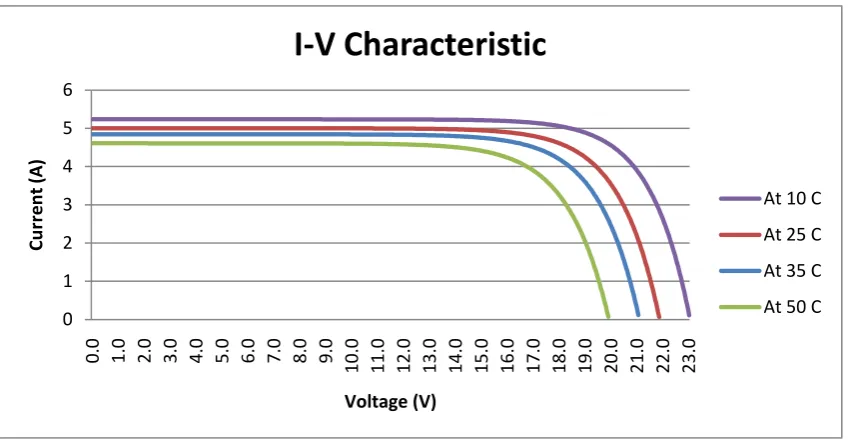
This PV panel has been implemented in Matlab/Simulink in order to obtain the I-V curves for various environmental conditions. Figures 3.3 and 3.4 show the characteristics of this PV
17
Figure 3.3: I-V curves at constant G=1000 𝑊/𝑚2
Figure 3.4: P-V curves at constant G=1000 𝑊/𝑚2
As can be seen from the Figures, the ambient temperature of the PV panel has a great effect on the open circuit voltage, which consequently leads to a significant variation in the maximum power point of the PV panel. The value of short circuit is slightly affected since it insignificantly depends on the thermal voltage, which in turn has a linear relationship with the operation temperature as given in equation (3.1).
0 1 2 3 4 5 6
0.0 1.0 2.0 3.0 4.0 5.0 6.0 7.0 8.0 9.0 10.0 11.0 12.0 13.0 14.0 15.0 16.0 17.0 18.0 19.0 20.0 21.0 22.0 23.0
Cu rr e n t (A) Voltage (V)
I-V Characteristic
At 10 C At 25 C At 35 C At 50 C
0 10 20 30 40 50 60 70 80 90 100
0.0 1.0 2.0 3.0 4.0 5.0 6.0 7.0 8.0 9.0 10.0 11.0 12.0 13.0 14.0 15.0 16.0 17.0 18.0 19.0 20.0 21.0 22.0 23.0
18
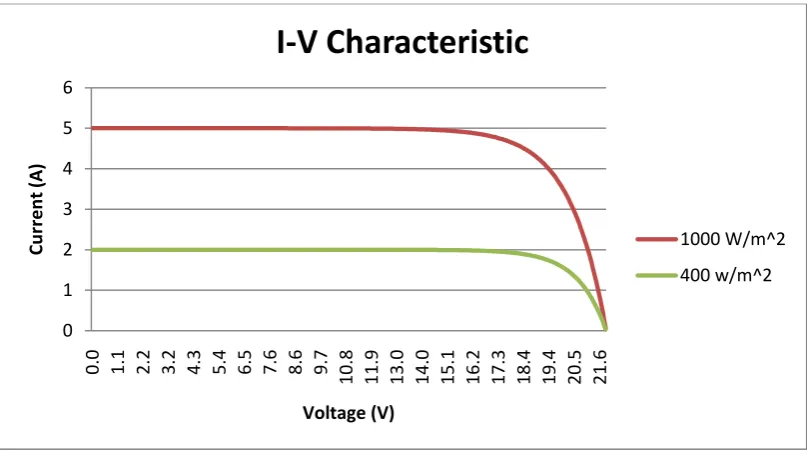
Short circuit current is the only parameter that has a linear dependency with the solar radiation. Any increase or decrease in the irradiance level will proportionally change the value of the short circuit current, and as a result the output power will respond almost in the same manner, except for the fact that the open circuit voltage will be slightly different at different irradiance levels, if the temperature is kept constant. This is illustrated in Figures 3.5 and 3.6 below.
Figure 3.5: I-V curves for two different irradiance levels at a constant temperature, T=25 C
Figure 3.6: P-V curves for two different irradiance levesls at a constant temperature, T=25 C
0 1 2 3 4 5 6
0.0 1.1 2.2 3.2 4.3 5.4 6.5 7.6 8.6 9.7 10.8 11.9 13.0 14.0 15.1 16.2 17.3 18.4 19.4 20.5 21.6
Cu rr e n t (A) Voltage (V)
I-V Characteristic
1000 W/m^2 400 w/m^2 0 20 40 60 80 1000.0 1.1 2.2 3.4 4.5 5.6 6.7 7.8 9.0 .110 11.2 12.3 13.4 14.6 15.7 16.8 17.9 19.0 20.2 21.3
19
3.1.2 Three Phase Inverter
The inverter is an electrical device used to converter DC power into AC power with required frequency and voltage magnitude. In microgrids, an inverter interfaces the DC source of a renewable energy system to AC systems where the loads and utility grid are coupled. Technically, the inverter is the key component in the microgrid by which the voltage, frequency, active and reactive power can be controlled and stabilized. Therefore, a proper understanding of inverter control ensures stable micro-generator operation and consequently microgrid operation.
The circuit model of a typical three-phase voltage source inverter is shown in Figure 3.7[11].
Figure 3.7: Three phase voltage source inverter [11]
20
are not switched ON or OFF simultaneously. The space vector for this type of inverter can be defined as [13]:
𝑉 = 2
3 𝑉𝑎 + 𝑎𝑉𝑏+ 𝑎2 𝑉𝑐 (3.4)
where 𝑎 = exp(𝑗23 )
This space vector representation can be applied to both Delta and Star connected loads. Assuming a star load, the sum of the phase voltages at the star load for both balanced and unbalanced conditions is zero:
𝑉𝑎 + 𝑉𝑏+ 𝑉𝑐 = 0 (3.5)
The phase voltage at the load can be defined as [14]:
𝑉𝑖 = 𝑉𝑗 − 𝑉𝑛𝑁 (3.6)
where 𝑖 = 𝑎, 𝑏, 𝑐 , 𝑗 = 𝐴, 𝐵, 𝐶
n is the neutral point at the load
N is the negative rail of the dc bus in the inverter
Now, from equations 3.5 and 3.6, 𝑉𝑛𝑁 can be expressed in terms of voltages at A, B and C
as:
𝑉𝑎 + 𝑉𝑏+ 𝑉𝑐 = 0 = 𝑉𝐴 − 𝑉𝑛𝑁 + 𝑉𝐵 − 𝑉𝑛𝑁 + 𝑉𝐶− 𝑉𝑛𝑁
21
From equation 3.6 and 3.7 phase to neutral voltage at the load can be represented in the
form:
𝑉𝑎 = 2
3𝑉𝐴+ (− 1 3𝑉𝐵 −
1 3𝑉𝐶)
𝑉𝑏 = 23𝑉𝐵 + (−3𝑉1
𝐶−
1
3𝑉𝐴)
𝑉𝑐 =
2
3𝑉𝐶+ (− 1 3𝑉𝐵 −
1 3𝑉𝐴)
(3.8)
From [ 7], 𝑉𝑛𝑁 can be expressed in terms of the switch states as :
𝑉𝑛𝑁 = 𝑉𝑑𝑐3 𝑎∗+ 𝑏∗+ 𝑐∗ (3.9)
Therefore, the relationship between the switching variable vectors 𝑎∗, 𝑏∗, 𝑐∗ and phase to neutral output voltage vector will be in the following form:
𝑉𝑎
𝑉𝑏 𝑉𝑐
=𝑉𝑑𝑐
3
2 −1 −1 −1 2 −1 −1 −1 2
𝑎 𝑏
𝑐 (3.10)
The phase to phase voltage is approximately equal to 3 𝑉𝑝ℎ in magnitude and 30 out of phase. Thus, the relationship between the switching variable vectors and the phase to phase voltage are :
𝑉𝑎𝑏
𝑉𝑏𝑐 𝑉𝑐𝑎
= 𝑉𝑑𝑐 10 −11 −10 −1 0 0
𝑎 𝑏
𝑐 (3.11)
3.1.2.1 Voltage and frequency control of three phase inverter
There are several techniques that can be used to control the voltage of a three-phase inverter. The most common techniques currently in use are sinusoidal PWM,
Third-harmonic PWM, 60 PWM and space vector modulation [12]. In this section, only sinusoidal
PWM is described.
22
voltage vd” [14]. PWM controlled inverters produce a pulse pattern for the switching signals by comparing a triangular waveform with three control signals of a desired
frequency. Each control signal is sinusoidal in shape and 120 out of phase from each other.
Compared waveforms and switching pattern are illustrated in Figure 3.8[14].
Figure 3.8: Pulse width modulation [14]
23
𝑚𝑓 = 𝑓𝑓𝑠
1 (3.12)
The output voltage of the inverter has the shape of pulses and will be rich in multiple harmonics of the fundamental frequency. The ratio of the control signal amplitude to the carrier signal amplitude, called the amplitude modulation ratio, can be used to predict the RMS value of the output line to line voltage of the inverter. The amplitude modulation ratio is defined as [12,14]
𝑚𝑎 = 𝑉𝑝 ,𝑐𝑜𝑛𝑡𝑟𝑜𝑙
𝑉𝑝 ,𝑡𝑟𝑖 (3.13)
This ratio is usually set equal to or less than 1. With this range, the line-to-line RMS voltage across the load at the fundamental frequency can be obtained as [14]:
𝑉𝐿𝐿1 =2 2 3 𝑚𝑎𝑉𝑑𝑐 (3.14)
3.1.2.2 PWM inverter Simulation
The purpose of PWM simulation is to verify the equations listed in section 3.1.2.1. The complete model of the inverter system has been developed using some of the existing power electronics blocks available in the Power Library in Simulink. This includes a 3-phase PWM IGBT inverter and a Discrete PWM Pulse Generator.
24
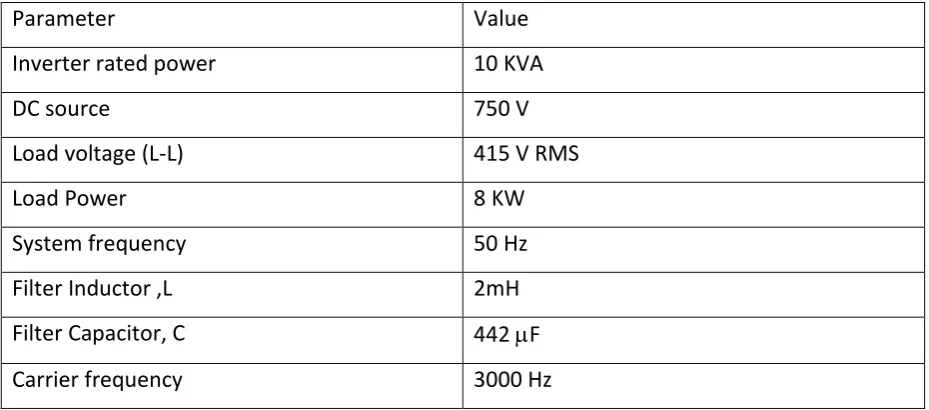
Parameter Value
Inverter rated power 10 KVA
DC source 750 V
Load voltage (L-L) 415 V RMS
Load Power 8 KW
System frequency 50 Hz
Filter Inductor ,L 2mH
Filter Capacitor, C 442 F
Carrier frequency 3000 Hz
Table 3.9: Inverter system details
In order to test the effectiveness of the designed filter system, a Total Harmonic Distortion (THD) measurement block, which is available in Simulink, was employed to measure THD in the inverter current. This is to ensure that the inverter complies with the requirement of THD in Section 4.5 of Australian Standard, AS4777.2 (2005), which states that the THD of the current shall be less than 5%. The measurement was not individually performed for single harmonics as in Table 1 and 2 in the Standard but rather for the total harmonic [15]. The equation used to calculate the Total Harmonic Distortion of the current is given by [16]
(THD) = IH/IF (3.15)
The numerator in equation (3.15) computes the root mean square (RMS) of the total harmonics in the current signal as:
𝐼𝐻 = 𝐼22+ 𝐼
32+ 𝐼42+ ⋯ + 𝐼𝑛2
Then, the obtained number is divided by the RMS value of the fundamental harmonic, 𝐼𝐹,
which in this case is 50 Hz. (see Appendix B for the simulation results)
25
the filter components with respect to the specified switching frequency were within the optimal range.
3.2
Microgrid Loads
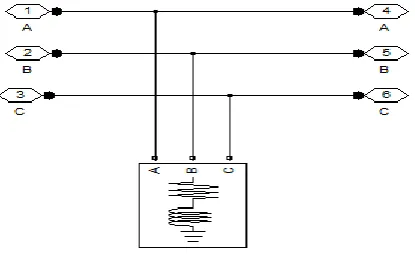
Load models consist of simple 3 phase series RL branches with constant impedances as shown in Figure 3.10. Throughout this report it will be assumed that all loads are balanced and in Star-grounded configuration. Loads in grid side will be disconnected by a controllable switch when the microgrid is islanded.
Figure 3.10: Load model
3.3
Utility Grid
26
Figure 3.11: Utility grid Model.
3.4
Point of Common Coupling (PPC)
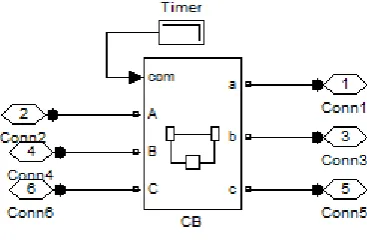
The point of common coupling can be modelled as a controllable 3 phase circuit breaker as shown in Figure 3.12. This breaker is a time-based controllable switch that opens and closes its contacts according to defined operation times. The reason for choosing a time-based breaker rather than a controllable static switch, is because Simulink does not have the tools needed to simulate the conditions described in section 2.3.5. However, the main purpose of the switch is to simulate a transition event, and this can be achieved in either case.
27
3.5
Phase Locked Loop (PLL)
A phase locked loop is a device that generates an output signal whose phase is matched with the phase of the input signal [5]. It is an important device used to synchronize the microsource voltages with the grid voltage during grid-connected mode in order to prevent the system from becoming unstable due to phase differences. During the simulation, each microsource is equipped with a 3 phase PPL. The model of this device is available in the power library in Simulink and it will be used frequently during the system studies. A similar structure of this device was also found in [18]. The main components of the 3 phase PLL are a Loop Filter (LF) and a Voltage Controlled Oscillator (VCO) as shown in Figure 3.13 [18].
Figure 3.13: 3 phase PLL block diagram [18]
3.5.1
PLL Principles of Operation
When a PLL receives the three phases voltages a, b, and c, it transforms them to the Clarke model (see Appendix C) and then to a quadrature signal by multiplying them with internal signals as in [18]:
28
Inside the PLL a reference signal, 𝐸𝑑∗, is kept at zero and compared with the synchronous voltage component obtained in equation (3.16). The error signal is then fed to the loop filter, which is a PI controller whose transfer function is given by:
𝐻 𝑠 = 𝐾𝑃+ 𝐾𝑖
𝑡𝑖𝑠 (3.17)
where
𝐾𝑃 proportional gain of the PI controller
𝐾𝑖 Integral gain of the PI controller
After a few loops the synchronous voltage Ed is minimized and thereby the PLL will remain
locked to the input voltages E and E and will generate a rotating reference angle, , synchronized with the input voltages. The Voltage Controlled Oscillator in this loop is simply an integrator, which can be described by [18]:
29
Chapter 4
4.
Proposed Control Strategies for Microgrid
Operation
There are several items research carried out in the area of microgrid operation control [1, 3,7,20-25]. The control strategies for power sources within a microgrid are usually proposed based on the required functions and the operational scenarios and they are distinguished in their implementations between renewable energy units (non-dispatchable) units and conventional units (dispatchable units)[3]. The focus in this chapter is only on renewable energy sources that use power inverters to interface with AC systems. In this case, inverters are the key components that need to be controlled in order to ensure a stable operation of a microgrid. This can be achieved by designing a proper control scheme that is capable of controlling the voltage, frequency and active and reactive power supplied by the inverters. It has been also assumed that the control scheme does not rely on physical communications between the power units. Therefore, control systems have to be designed as a part of each microsource and independent from the other units. In general, the appropriate control for such interfaces can be divided into two types:
- PQ inverter control
- Voltage source inverter control
30
the voltage and the frequency of the system within the acceptable limits. It also uses the Voltage-Reactive Power droop and Frequency-Active Power droop, that is defined in each microsource control unit, to adjust the power sharing amongst the microsources, based on their rated power.
4.1
Microgrid Control during Grid-connected Mode
When the microgrid is operating in parallel with the utility grid, three quantities need to be properly controlled and maintained. They are the frequency within the microgrid, the voltage amplitude at the connection points of the inverters to the feeder, and the power supplied by microsources. The voltage amplitude can be simply adjusted internally by using the PWM technique as described in section 3.1.2.1. The control system in this case uses the amplitude of the grid voltage as a reference and generates instantaneous voltages accordingly. The frequency of the microgrid, on the other hand, can be maintained by using a phase looked loop (PLL) technique that synchronizes the microgrid with the utility grid. This is done by adjusting the voltage phase angle of each inverter phase to the corresponding phase in the grid. Therefore, the voltage and the frequency of the inverter are indirectly controlled by the grid.
Microsources in this mode are controlled to provide specified amounts of real and reactive power depending on the rating of the units and the energy management. Their control schemes are designed such that units in power control configuration are operated by a constant current controller, and units in feeder flow configuration are operated by a P-Q controller.
4.1.1
Constant Current Control
31
Figure 4.1: Constant current control block diagram [17]
Figure 4.2: Details of the controller block [17]
32
(reactive power set point) to obtain error signals. The error signals are then applied to proportional-integral controllers to correct the errors and define the reference voltage signals Vd,ref and Vq,ref.. Overall, this process forces the inverter to inject the defined currents and at the same time it regulates the voltage at the connection point as measured from the grid side. It also compensates for the voltage drops in the cable by adding their value into the amplitude of the inverter output voltages, so that the voltage at the load is held to its specified value.
4.1.2 P-Q Control
The block diagram of P-Q control is shown in Figure 4.3 [25]. The control structure of this type is quite similar to the constant current control. The only difference between the two controls is the regulated parameters, though they reach to the same conclusion, which is output power control. In this control type, the regulated parameters are the active and reactive powers instead of the current. Active and reactive powers are measured at the output terminal of the inverter and then compared with the reference values to obtain the errors. These error signals are then applied to two PI controllers in order to obtain Id, ref and Iq,ref [25].The rest of the process is similar to the constant power technique shown earlier in Figure 4.2.
The authors in [25] propose this control scheme to be only used for constant active and reactive power supply. However, its implementation can be altered and it can be used for power flow regulation in the feeder. In other words, the reference power can be defined as the set point plus the deviation in the load demand. This is applicable for both active and reactive power. The equations that describe the reference active and reactive power can be written as:
𝑃𝑟𝑒𝑓 = 𝑃0+𝑝,𝑙𝑜𝑎𝑑 (4.1)
33 where
𝑃0 Active power set point in the microsource control
𝑄0 Reactive power set point in the microsource control
𝑝,𝑙𝑜𝑎𝑑 Variation in the load active power
𝑄,𝑙𝑜𝑎𝑑 Variation in the load reactive power
Figure4.3: block diagram for P-Q control [25]
34
demand increases or decreases, these units will proportionally respond by either increasing or decreasing their supply. For instance, if a 100 KVA microsource in a typical microgrid is controlled to inject 50% of its rated power as active power (50 KW) and 20% as reactive power (20KVAr) and the feeder monitor detects that the active power flow is being reduced say from 60KW to 40 KW and reactive power increased from 40 KVAr to 50 KVar, then the regulator unit will change the output powers as follow:
𝑃𝑛𝑒𝑤 = 50𝐾𝑊 + (40𝐾𝑊 − 60𝐾𝑊)
𝑃 = 30 𝐾𝑊
𝑄𝑛𝑒𝑤 = 20 𝐾𝑉𝐴𝑟 + (50𝐾𝑉𝐴𝑟 − 40𝐾𝑉𝐴𝑟)
𝑄 = 30𝐾𝑉𝐴𝑟
By doing this, the microgrid that incorporates some microsources with similar control configuration will be seen as fully dispatchable network since it can internally handle the load variation without external support from the main grid.
4.2
Microgrid Control during Islanded Operation
35
greatly endangers the system security since a failure in the master controller will result in a complete shutdown or an unstable operation of a microgrid. These factors, in addition to the expensive hardware and software setup, combined to make this type of control unattractive and imperfect to securely and reliably operate a microgrid.
The other technique is to install a control system in each microsource. The job of the microsource controller now is to respond autonomously to system changes without requiring any data from local loads, static switches or the other microsources. This technique enhances the security of the system by providing back-up energy to the loads from various microsources in case of one or more sources in the microgrid fail down. More details on advanced developed techniques for islanded operation can be found in [1, 5, 21-24]. Overall, the principles of the control techniques in these papers are based on the power generators control in conventional power systems with some minor modifications. The original design is basically a control scheme in which the value of the frequency and the voltage are determined from what is known “voltage and frequency droop methods”. Since the inverters are the power sources in most of the renewable energy units, their responses to the power regulations are quite similar to conventional generators, and therefore the conventional methods can still be used in islanded operations.
36
Figure 4.4: Block diagram of a microsource controller [5]
This controller can function perfectly in a microgrid system where the distribution cables are mainly inductive. In reality, such cables comprise a resistive part as well as an inductive part. The ratio of the resistance to the inductance varies from cable to cable and it mainly depends on the length and cross sectional area. Now consider the circuit diagram in Figure 4.5, where an inverter is supplying a load through a distribution cable. The resistance and inductance in the cable are denoted R and L respectively. In the arrangement the active power delivered to the load can be calculated as[22]:
𝑃 = 2𝜔𝐿 12+𝑅2 𝑅𝐸2− 𝑅𝐸𝑉 cos 𝛿 + 2𝜔𝐿 𝐸𝑉 sin 𝛿
(4.3)
The supplied reactive power can also be calculated as[22]:
𝑄 = 1
2𝜔𝐿 2+𝑅2((2𝜔𝐿)𝐸2− (2𝜔𝐿)𝐸𝑉 cos 𝛿 + 𝑅𝐸𝑉 sin 𝛿) (4.4)
where
37
𝛿 The angle power ( the angle difference between E and V)
It is clear from the previous equations that the coupling in the power flow between the active and reactive power actually exists since the resistance and inductance values appear in both approximations. The level of coupling can be considered as low, moderate or strong and it is primarily determined by the R/X ratio. This makes the independent regulation of the either active or reactive power impracticable without using decoupling techniques. One way to avoid this is to add a virtual inductor at the interfacing inverter output as proposed in [22]. This virtual inductance can effectively prevent the coupling between the active and reactive power by introducing a mainly inductive impedance. The control system will then estimate the impedance voltage drops and improve the reactive power control and sharing accuracy without affecting the similar process for real power flow. This method can precisely solve the power decoupling problem but at the same time it creates another problem. In distribution cables where the ratio R/X is high, the value of the virtual impedance has to be high as well in order to maximize the dependency of the reactive power control on the voltage difference. By doing this, higher voltage drops will occur in the cables and this will increase the losses in the cables, and thereby lower the performance of the system.
E
R
Load
L
Inverter
Cable1
V
38
Now the remaining straightforward and less complicated method is to add delay devices whose function is to delay the instantaneous measurement of the powers. These devices can be installed after the measurement centres of both reactive and active power and operate by holding-up the received signals for a defined constant time. This delay can decouple the time dependency of these parameters on each other and enhance independent and proper control algorithms.
A modified version of the control technique in Figure 4.4 is shown in Figure 4.6. Notice that the low pass-filters and the voltage control blocks are abandoned in the new control version. This is to simplify the control structure and reduce the complexity of the implementations. It is assumed that each inverter is equipped with a well designed filter that is able to filter out all unwanted harmonics and produce pure sinusoidal waves at specified frequency. Measurement devices were also assumed to be perfect in their measurements and have no noise effects. The voltage control block in the original design has an extra advantage of forcing the inverter to operate with a voltage value specified by the P-I controller. This desired value can be actually taken directly from the reactive power-voltage block since the inverter has to adjust its output power-voltage based on this frame in all cases. Therefore, voltage control can be also neglected. Extra details for this technique can be found in section 4.2.3.
39
Now with the new control scheme, the electrical parameters are measured and regulated in their instantaneous forms and do not require the extra step of being converted to the stationary frame components. This simplifies the equations and the overall process of the control system.
4.2.1
P and Q Calculations
The blocks that calculate the real and reactive power use the knowledge of the instantaneous values for the line current of the inverter and line-to-line voltage or phase voltage at the load [5]. Under balanced and unbalanced conditions, the voltages at two phases can be measured and the third phase will be predicated, since the sum of the three phases is zero in all cases. This principle can also be applied to the line currents, but only under balanced conditions.
Figure 4.7: P and Q calculation blocks
If the sensing equipments are to be kept at a minimum, so that only two phases are to be measured, then the following equations can be used to calculate the instantaneous three
40
𝑃3𝑝ℎ = 𝑉𝑏𝑐𝐼𝑐 − 𝑉𝑎𝑏𝐼𝑎 (4.5)
𝑄3𝑝ℎ = −𝑉𝑏𝑐 2𝐼𝑎+𝐼𝑏 +𝑉𝑐𝑎(2𝐼𝑏+𝐼𝑎)
3 (4.6)
If each phase is measured separately, then the following equations can be used:
𝑃3𝑝ℎ = 𝑉𝑎𝐼𝑎 + 𝑉𝑏𝐼𝑏 + 𝑉𝑐𝐼𝐶 (4.7)
𝑄3𝑝ℎ =𝑉𝑏𝑐 𝐼𝑎 + 𝑉𝑐𝑎𝐼𝑏+𝑉𝑎𝑏𝐼𝑐
3 (4.8)
4.2.2
Real Power versus Frequency Droop
41
Figure 4.8: P Vs F characteristics for three units
From Figure 4.8, it can be noticed that each microsource has a constant negative slope droop on the P−𝜔 plane. The coefficient of the slope is chosen to allow the frequency to
drop by a given amount as the power extends from one point to another point. When the
42
𝑛𝑒𝑤 ,𝑖=
0− 𝑚
𝑝,𝑖(𝑃
𝑛𝑒𝑤 ,𝑖− 𝑃
0,𝑖)
𝑚
𝑝=
𝑃
𝑚𝑎𝑥 ,𝑖.
(4.9)
where
𝑖 Microsource unit 1,2 or 3.
0 The angular frequency of the unit when the system is connected to the grid.
𝑛𝑒𝑤The angular frequency of the unit when the system is in islanded mode.
𝑃0 The real power supplied by the unit when the system is in grid-connected mode.
𝑃𝑛𝑒𝑤The real power supplied by the unit when the system is in islanded mode.
𝑚𝑝 The slope of the droop characteristics.
The difference in the frequency between grid connected operation and the minimum
allowable frequency.
𝑃𝑚𝑎𝑥 Maximum power available from the unit.
Now, since the three units have the same slope constant, this method ensures that the three units share the total real power load proportionally according to their power ratings, while maintaining the frequency at one level.
The control block that represents the droop is shown in Figure 4.9. The block receives three inputs: instantaneous measured power, desired power in grid-connected mode, and the nominal frequency and it then produces the desired angle of the voltage, 𝛿𝑣, at the inverter bus, that is needed by the pulse generator to process the gate pulses. This angle can be
obtained by integrating the instantaneous variable 𝜔 between the limits π and –π, which in
43
Figure 4.9: block diagram of the active power droop
4.2.3
Reactive Power versus Voltage Droop
Similar to the Active Power Vs. Frequency method, the Reactive Power Vs. Voltage method is used in conventional power systems to set a certain voltage level at the output terminals of the power sources based on the amount of the reactive power being injected or absorbed. In a microgrid, where parallel inverters are employed, this technique becomes an essential part in the microsource’s control system. Without this method, the voltage magnitudes at the inverter terminals may, for various technical reasons, have different values. This situation causes high current to move towards the lower voltage points, and as a result, this will more likely lead to an unstable operation. Therefore, the Reactive Power Vs Voltage technique is used to regulate the inverters’ voltages and to guarantee stability in the system during islanded operation.
The Q versus E block in Figure 4.6 is expanded in Figure 4.10. The inputs of this block are the
measured reactive power, Q, and the desired voltage value, Vo. The output is the modified
value of the desired voltage which is exclusively determined byMQ in Figure 4.10. Thus, the
main action of this block is to adjust the voltage, based on the amount of reactive power either delivered or absorbed by the source unit.
Mp
+
-π
-ω
∆ω 1
𝑆
-π
𝑖𝑛𝑣
+ P0
P
44
Figure 4.10: Expanded Q versus V block
Now consider a microgrid that has multiple inverters operating in parallel. The Reactive Power Vs Voltage droop characteristic of each unit must be designed in a way that creates a modified voltage whose set point is equal to the set points of other units in the system. Again, this is to avoid differences in voltage magnitudes with its associated problems. Now, since it is assumed that there is no communications between inverters, the only way to achieve this is to place all the droop characteristics on one plane whose y-axis is represented by the voltage and x-axis by the reactive power. This is illustrated in Figure 4.11 for three power units. On this plane maximum and minimum operating voltages are defined based on the linear relationship between the voltage and reactive power. Each unit droop is scaled such that the maximum reactive power injected from the unit correspond to the minimum allowable operating voltage and the maximum reactive power absorbed by the unit correspond to the maximum allowable operating voltage. In order to match the voltages of different rated power units, rated power values have to be included in their coefficients, MQ. From the plane in Figure 4.11, the operating voltage can be expressed as:
𝑉
𝑖= 𝑉
0,𝑖− 𝑚
𝑄,𝑖𝑄
𝑖𝑚
𝑝=
𝑃
𝑚𝑎𝑥 ,𝑖.
𝑚
𝑄=
∆V𝑄
𝑚𝑎𝑥 ,𝑖.
(4.10)
where
𝑖 Microsource unit 1,2 or 3.
𝑉 Operating voltage .
MQ
Q E
-+
∆V
45
𝑉𝑜 Nominal voltage value.
𝑄 The reactive power injected or absorbed by the microsource (negative value if the unit is
absorbing reactive power).
𝑚𝑄 The slope of the droop characteristics.
∆𝑉 The difference in the voltage between the nominal value and the maximum/minimum
value.
𝑄𝑚𝑎𝑥 Maximum reactive power from the microsource.
Notice that in equation 4.10 the operating voltage will be equal to the requested nominal voltage if the unit is neither injecting nor absorbing reactive power. However, in a situation where the unit is injecting reactive power, the operating voltage will be less than the nominal voltage and it will be higher if the reactive power is being absorbed. It can also be observed that the regulation of the voltage requires variation in the reactive power supply, since the voltage and the reactive power have a linear relationship. For multi sized power units, this variation is proportional to the size of the unit, and consequently the reactive power of the load will be shared evenly between the power units according to their sizes.
46
Chapter 5
5.
Simulation Platform
5.1
Matlab Simulink
Matlab Simulink is a powerful package for modelling, simulating and analysing an extraordinarily wide range of physical and mathematical systems. These systems include linear and non-linear systems, and in the Simulink environment they can be modelled in continuous or discrete times. What makes Simulink an attractive and relatively easy software tool is that it provides the users with a series of graphical block diagramming tools and a set of block libraries that help in completely designing and testing a wide range of time-varying systems. It also allows the integration of dynamic blocks, which require a set of defined transfer functions and differential equations, alongside with the electrical component blocks within the same frame.
5.2
Tested Microgrid Structure
47
Figure 5.1: Tested microgrid structure
48
frequency will be restricted within the defined ranges as stated in [15] for the inverter requirements.
The circuit breaker (CB) in the system will operate to isolate or reconnect the microgrid when it is required. The conditions that trigger isolation can be defined as any situation in which voltage, frequency or current in the main grid goes beyond the acceptable limits. However, due to the difficulties in simulating such situations in Simulink, the circuit breaker is modelled as a time-based isolator which gives the user the full control to isolate or reconnect the microgrid from the main grid at any specified times.
The proposed microgrid system incorporates three microsources with different rated powers. The reason for including three microsources in the structure is to study the load sharing principles, since the control techniques in the previous chapter were described for a variable number of microsources and loads. The biggest microsource is a PV unit that interfaces with the system through an inverter whose rated power is 50 KVA. The second and third units are also PV systems and their inverters are sized 25 KVA and 10 KVA respectively. Each microsource is connected to the common bus through a cable with a unity X/R ratio, since it is assumed that the cable length is a few hundred meters. The actual size of the inductance and resistance in the cables is derived from the size of the inverter to which the cable is connected. This is suggested in [5] for better operation performance. P and Q plane capability with constant voltage and impedance analysis had been performed in that report, and it was found that each value of cable inductance defines a certain region that limits the delivery of active and reactive power. Cable impedance with 0.2 pu was realized to be the best region over which the supplied powers can reach P=1 p.u and Q=0.75 p.u with an inverter voltage of 1.12 p.u and a power angle of 10 degrees.
49
5.3
Implementation in Simulink
The implementation of the microgrid structure in Simulink is shown in Figure E.1 in Appendix E. All the elements of the single line diagram in Figure 5.1 were replaced by their corresponding dynamic models. The models for all standard electrical components like transformers, voltage sources, and loads were adopted from the Powerlib toolbox in Simulink. The other blocks, which include transfer functions and integrators, were obtained from the main library.
The PV system and the inverter, that were modelled in chapter 3, can be combined with the control system to form a complete model for a microsource. However, when simulating a PV system with an inverter, the DC-link voltage of the prime mover needs to be considered [26]. This voltage has to be maintained at specified value in order to obtain a reference power delivered to the inverter from the PV system side. The configuration is illustrated in Figure 5.2.
Figure 5.2: DC-link capacitor power balance
Assuming that the capacitor is ideal, the power balance in the capacitor of the DC-link can
be instantaneously calculated by subtracting the power delivered by the PV system, PPV, and
the power received from the inverter, Pinv. The relationship can be mathematically expressed
as:
𝑃𝐶 = 𝑃𝑃𝑉 − 𝑃𝑖𝑛𝑣 (5.1)
50
𝑃𝐶 = 𝑉𝐷𝐶∗ 𝐼𝐷𝐶∗ (5.2)
where𝑉𝐷𝐶is the capacitor voltage and 𝐼𝐷𝐶∗ is the capacitor current. Now, from equation (5.2) it is clear that the DC-link can be maintained at a specified reference by regulating the power balance in the DC-link. Combining equation (5.1) and (5.2), to give:
𝑉𝐷𝐶 ∗ 𝐼𝐷𝐶∗ = 𝑃𝑃𝑉 − 𝑃𝑖𝑛𝑣 (5.3)
The relationship between the capacitor voltage and the capacitor current is given by
𝑉𝐷𝐶 = 1
𝐶 𝐼𝐷𝐶∗ 𝑑𝑡 (5.4)
where C is the capacitance value in the DC-link. Again, combining equation (5.2) and (5.4) and taking the Laplace transform of both sides, the DC -link can be modelled as shown in Figure 5.3 [26].
Figure 5.3: Dynamic model of a DC-link [26]
51
span does not exceed one minute per run, but with the detailed microsource in Simulink this will take several minutes. It is also suggested in [27] that the detailed inverter modelling should be avoided when analysing the dynamic behaviour of a microgrid and it is better to represent the inverters’ long term dynamic models by their control functions. This means that the transients related to the communication of solid-state switches in the inverters are not considered. Additionally, this technique assumes that the AC power injected from the inverters is without harmonics, distortions or losses. If the inverter transient is to be studied, then full modelling is required.
Since the study objectives in this thesis ask only for analysis of the overall microgrid dynamic behaviour and not for the microsource in particular, the microsource can be simplified to a model that responds to the commands from the controllers based on their control functions as suggested in [27]. The variables in these functions are only power, voltage, and frequency. The new model for the microsource is shown in Figure 5.4.
Figure 5.4: Microsource model represented by its control functions
𝑆𝑖𝑛 𝑢
𝑆𝑖𝑛 𝑢 −
2𝜋
3
𝑆𝑖𝑛 𝑢 +
2𝜋
3
×
×
×
From Q Vs V droop From P Vs ω droop
Ua
V,max
Ub
Uc
52
53
Chapter 6
6.
Simulation Results
In order to evaluate the performance of the proposed power control strategies, a significant number of simulated experiments have been carried out in Matlab/Simulink. The simulation was performed on the 3 phase low-voltage microgrid given in Figure 5.1. The simulation parameters for this system can be found in Tables F.1 and F.2 in Appendix F. In this chapter, four typical operational scenarios are considered. These are as follows:
Scenario A): the microgrid operates in parallel with the main grid and the three microsources are in unit power control configuration (UPC configuration).
Scenario B): the microgrid operates in parallel with the main grid and the microsources are in a mixed configuration.
Scenario C): the microgrid switches from grid-connected mode to islanded mode . Scenario D): the microgrid operates in islanded mode.
A.
Microgrid Operates in Grid-Connected Mode with UPCC
54
While the microsources inject 80% of their available power as real power, the total load, including the non-sensitive load, was initially set at 40KW and 15 KVAr. At time 0.1s the load variation is applied and the load increased by 60KW and 20 KVAr. Figure 6.1 shows the microsource power outputs, load demands, feeder flows in the grid side, and system frequency over a period of 0.3 s.
(a)
(b)
(c)
0 0.05 0.1 0.15 0.2 0.25 0.3
0 0.5 1 1.5 2 2.5 3 3.5 4 4.5 x 10 4
0 0.05 0.1 0.15 0.2 0.25 0.3
-1 -0.5 0 0.5 1 1.5x 10
4
0 0.05 0.1 0.15 0.2 0.25 0.3
55 (d)
(e)
Figure 6.1: Simulation results for scenario A – all microsources operate in UPC mode. (a) Real power output of
each microsource. (b) Reactive power output of each microsource. (c) Load active and reactive power demands.
(d)Total power flow in the grid feeder. (e) System frequency
As can be seen in Figure 6.1(a) and 6.1(b), the microsources output powers tracked the reference values very well. They injected the desired real power and left the reactive power of the load supplied by the grid. It can also be noticed that the microsource powers remained constant throughout the simulation, despite the variation of the load. The variations of the load in both active and reactive powers were totally compensated by the grid. This proves that the designed control system for the grid-connected mode is capable of totally dispatching the inverter currents independently from the load demand.
0 0.05 0.1 0.15 0.2 0.25 0.3
-5 -4 -3 -2 -1 0 1 2 3 4 x 10 4
0 0.05 0.1 0.15 0.2 0.25 0.3
49.975 49.98 49.985 49.99 49.995 50 50.005 50.01 50.015 FL(P,Q
) Q flow
P flow
F (H
![Figure 2.1: Typical microgrid structure [3]](https://thumb-us.123doks.com/thumbv2/123dok_us/9660052.1948639/14.595.72.526.71.398/figure-typical-microgrid-structure.webp)
![Figure 2.3: Feeder flow control configuration [7]](https://thumb-us.123doks.com/thumbv2/123dok_us/9660052.1948639/19.595.87.484.100.317/figure-feeder-flow-control-configuration.webp)
![Figure 3.1: Equivalent circuit for a PV cell [8-9]](https://thumb-us.123doks.com/thumbv2/123dok_us/9660052.1948639/20.595.148.467.546.698/figure-equivalent-circuit-a-pv-cell.webp)
![Table 3.2: 80W PHOTOWATT panel PWZ750 parameters at STC[10]](https://thumb-us.123doks.com/thumbv2/123dok_us/9660052.1948639/22.595.100.529.392.642/table-w-photowatt-panel-pwz-parameters-stc.webp)
![Figure 3.8: Pulse width modulation [14]](https://thumb-us.123doks.com/thumbv2/123dok_us/9660052.1948639/28.595.167.466.197.566/figure-pulse-width-modulation.webp)