R E S E A R C H
Open Access
Fixed points of multivalued mappings in
modular function spaces with a graph
Monther Rashed Alfuraidan
**Correspondence: [email protected] Department of Mathematics and Statistics, King Fahd University of Petroleum and Minerals, Dhahran, 31261, Saudi Arabia
Abstract
Let
ρ
∈ (the class of all nonzero regular function modulars defined on a nonempty set) and
Gbe a directed graph defined on a subsetCofLρ. In this paper, we discuss the existence of fixed points of monotoneG-contraction andG-nonexpansive mappings in modular function spaces. These results are the modular version of Jachymski fixed point results for mappings defined in a metric space endowed with a graph.MSC: Primary 47H09; secondary 46B20; 47H10; 47E10
Keywords: directed graph; fixed point; function modular space; multivalued contraction/nonexpansive mapping
1 Introduction
Fixed point theorems for monotone single-valued mappings in a metric space endowed with a partial ordering have been widely investigated. These theorems are hybrids of the two most fundamental and useful theorems in fixed point theory: Banach’s contrac-tion principle ([], Theorem .) and Tarski’s fixed point theorem [, ]. Generalizing the Banach contraction principle for multivalued mappings to metric spaces, Nadler [] ob-tained the following result.
Theorem .[] Let(X,d)be a complete metric space. Denote byCB(X)the set of all nonempty closed bounded subsets of X.Let F:X→CB(X)be a multivalued mapping.If there exists k∈[, )such that
HF(x),F(y)≤kd(x,y)
for all x,y∈X,where H is the Hausdorff metric onCB(X),then F has a fixed point in X. A number of extensions and generalizations of Nadler’s theorem were obtained by dif-ferent authors; see, for instance, [, ] and the references cited therein. Tarski’s theorem was extended to multivalued mappings by different authors; see [–]. Investigation of the existence of fixed points for single-valued mappings in partially ordered metric spaces was initially considered by Ran and Reurings in [] who proved the following result.
Theorem .[] Let(X,)be a partially ordered set such that every pair x,y∈X has an upper and lower bound.Let d be a metric on X such that(X,d)is a complete metric
space.Let f :X→X be a continuous monotone(either order preserving or order reversing)
mapping.Suppose that the following conditions hold:
() There existsk∈(, )with
df(x),f(y)≤kd(x,y) for allxy.
() There existsx∈Xwithxf(x)orxf(x).
Then f is a Picard operator(PO),that is,f has a unique fixed point x∗∈X and for each x∈X,limn→∞fn(x) =x∗.
After this, different authors considered the problem of existence of a fixed point for con-traction mappings in partially ordered sets; see [–] and the references cited therein. Nietoet al.in [] proved the following theorem.
Theorem .[] Let(X,d)be a complete metric space endowed with a partial ordering.
Let f :X→X be an order preserving mapping such that there exists k∈[, )with df(x),f(y)≤kd(x,y) for all xy.
Assume that one of the following conditions holds:
() f is continuous and there existsx∈Xwithxf(x)orxf(x);
() (X,d,)is such that for any nondecreasing(xn)n∈N,ifxn→x,thenxnxforn∈N,
and there existsx∈Xwithxf(x);
() (X,d,)is such that for any nonincreasing(xn)n∈N,ifxn→x,thenxnxforn∈N,
and there existsx∈Xwithxf(x).
Then f has a fixed point.Moreover,if(X,)is such that every pair of elements of X has an upper or a lower bound,then f is a PO.
Recently, two results have appeared, giving sufficient conditions forf to be a PO, if (X,d) is endowed with a graph. The first result in this direction was given by Jachymski and Lukawska [, ], which generalized the results of [, , , ] to a single-valued map-ping in metric spaces with a graph instead of partial ordering. Subsequently, Beget al.[] tried to extend the results of [] to multivalued mappings, but their extension was not carried correctly (see []). The aim of this paper is to give the correct extension by study-ing the existence of fixed points for multivalued mappstudy-ings in modular function spaces endowed with a graphG. Recall that the fixed point theory in modular function spaces was initiated by Khamsiet al.[]. The reader interested in fixed point theory in modular function spaces is referred to [–].
2 Preliminaries
Let be a nonempty set and be a nontrivialσ-algebra of subsets of. Let P be a
δ-ring of subsets ofsuch thatE∩A∈P for anyE∈P andA∈. Let us assume that there exists an increasing sequence of setsKn∈Psuch that=
Kn. ByEwe denote the
linear space of all simple functions with supports fromP. ByM∞we denote the space of all extended measurable functions,i.e., all functionsf :→[–∞,∞] such that there exists a sequence{gn} ⊂E,|gn| ≤ |f|andgn(ω)→f(ω) for allω∈. By Awe denote the
Definition . Letρ:M∞→[,∞] be a nontrivial even function. We say thatρ is a regular function pseudomodular if:
(i) ρ() = ;
(ii) ρis monotone,i.e.,|f(ω)| ≤ |g(ω)|for allω∈impliesρ(f)≤ρ(g), where
f,g∈M∞;
(iii) ρis orthogonally subadditive,i.e.,ρ(fA∪B)≤ρ(fA) +ρ(fB)for anyA,B∈such
thatA∩B=∅,f ∈M;
(iv) ρhas the Fatou property,i.e.,|fn(ω)| ↑ |f(ω)|for allω∈impliesρ(fn)↑ρ(f),
wheref ∈M∞;
(v) ρis order continuous inE,i.e.,gn∈Eand|gn(ω)| ↓impliesρ(gn)↓.
Similarly as in the case of measure spaces, we say that a setA∈isρ-null ifρ(gA) =
for everyg∈E. We say that a property holdsρ-almost everywhere if the exceptional set isρ-null. As usual we identify any pair of measurable sets whose symmetric difference is
ρ-null as well as any pair of measurable functions differing only on aρ-null set. With this in mind, we define
M(,,P,ρ) =f ∈M∞:f(ω)<∞ρ-a.e. for everyω∈, ()
where eachf ∈M(,,P,ρ) is actually an equivalence class of functions equalρ-a.e. rather than an individual function. Where no confusion exists, we will writeMinstead of
M(,,P,ρ).
Definition . Letρbe a regular function pseudomodular.
() We say thatρis a regular function semimodular ifρ(αf) = for everyα> implies
f= ρ-a.e.;
() We say thatρis a regular function modular ifρ(f) = impliesf = ρ-a.e.
The class of all nonzero regular function modulars defined onwill be denoted by. Let us denoteρ(f,E) =ρ(fE) forf ∈M,E∈. It is easy to prove thatρ(f,E) is a
func-tion pseudomodular in the sense of Definifunc-tion .. in [] (more precisely, it is a funcfunc-tion pseudomodular with the Fatou property). Therefore, we can use all results of the standard theory of modular function spaces as per the framework defined by Kozlowski in [, , ].
Definition .[, , ] Letρbe a function modular.
(a) A modular function space is the vector spaceLρ(,), or brieflyLρ, defined by
Lρ=f∈M;ρ(λf)→asλ→.
(b) The following formula defines a norm inLρ(frequently called Luxemburg norm):
fρ=inf
α> ;ρ(f/α)≤.
In the following theorem we recall some of the properties of modular spaces.
Theorem .[, , ] Letρ∈ .
() fnρ→if and only ifρ(αfn)→for everyα> .
() Ifρ(αfn)→forα> ,then there exists a subsequence{gn}of{fn}such thatgn→ ρ-a.e.
() ρ(f)≤lim infn→∞ρ(fn),wheneverfn→f ρ-a.e.Note this property will be referred to
as the Fatou property.
The following definition plays an important role in the theory of modular function spaces.
Definition . Letρ∈ . We say thatρ has the-property ifsupnρ(fn,Dk)→ as
k→ ∞wheneverDk↓ ∅andsupnρ(fn,Dk)→, where{fn}n≥⊂MandDk∈.
We have the following interesting result.
Theorem .[] Letρ∈ .The following conditions are equivalent:
(a) ρhas the-property,
(b) ifρ(fn)→,thenρ(fn)→,
(c) ifρ(αfn)→forα> ,thenfnρ→,i.e.,the modular convergence is equivalent to
the norm convergence.
Moreover,ifρhas the-type condition,i.e.,there exists k∈[, +∞)such that
ρ(f)≤kρ(f) for any f ∈Lρ,
thenρhas the-property.In general,the converse is not true(see Example..of[]).
Remark . It is easy to check thatρhas the-type condition if and only if for anyλ> ,
there existsk∈[, +∞) such that
ρ(λf)≤kρ(f) for anyf ∈Lρ.
We will also use another type of convergence which is situated between norm and mod-ular convergence. It is defined, among other important terms, in the following definition.
Definition . Letρ∈ .
(a) We say that{fn}isρ-convergent tof and writefn→f(ρ)if and only ifρ(fn–f)→.
(b) A sequence{fn}, wherefn∈Lρ, is calledρ-Cauchy ifρ(fn–fm)→asn,m→ ∞.
(c) A setB⊂Lρis calledρ-closed if for any sequence offn∈B, the convergence
fn→f(ρ)implies thatf belongs toB.
(d) A setB⊂Lρis calledρ-bounded ifsup{ρ(f –g);f,g∈B}<∞.
(e) A setC⊂Lρis calledρ-a.e. closed if for any{fn}inCwhichρ-a.e. converges to
somef, then we must havef∈C.
(f ) A setC⊂Lρis calledρ-a.e. compact if for any{fn}inC, there exists a subsequence {fnk}whichρ-a.e. converges to somef∈C.
Let us note thatρ-convergence does not necessarily implyρ-Cauchy condition. Also,
fn→f does not imply in generalλfn→λf,λ> . Using Theorem . it is not difficult to
Proposition . Letρ∈ .
(i) Lρisρ-complete.
(ii) Lρis a lattice,i.e.,for anyf,g∈Lρ,we havemax{f,g} ∈Lρandmin{f,g} ∈Lρ. (iii) ρ-ballsBρ(x,r) ={y∈Lρ;ρ(x–y)≤r}areρ-closed andρ-a.e.closed.
Using the property () of Theorem ., we get the following result.
Theorem . Letρ∈ and{fn}be aρ-Cauchy sequence in Lρ.Assume that{fn}is
mono-tone increasing,i.e.,fn≤fn+ ρ-a.e. (resp.decreasing,i.e.,fn+≤fnρ-a.e.)for any n≥.
Then there exists f ∈Lρsuch thatρ(fn–f)→and fn≤f ρ-a.e. (resp.f ≤fnρ-a.e.)for
any n≥.
It seems that the terminology of graph theory instead of partial ordering sets can give clearer pictures and yield to generalize the contraction theorems. Let us finish this section with such terminology for the modular space mapping which will be studied throughout. LetC⊆Lρ withρ∈ . LetGbe a directed graph (digraph) with a set of vertices ofG
being the elements ofCand a set of edgesE(G) containing all the loops,i.e., (x,x)∈E(G) for anyx∈V(G). We also assume thatGhas no parallel edges (arcs) and so we can identify
Gwith the pair (V(G),E(G)). Our graph theory notations and terminology are standard and can be found in all graph theory books, like [] and []. Moreover, we may treatG
as a weighted graph (see [], p.]) by assigning to each edge the distance between its vertices. ByG–we denote the conversion of a graphG,i.e., the graph obtained fromGby reversing the direction of edges. Thus we have
EG–=(y,x)|(x,y)∈E(G).
A digraphGis called an oriented graph if whenever (u,v)∈E(G), then (v,u) /∈E(G). The letterGdenotes the undirected graph obtained fromGby ignoring the direction of edges. Actually, it will be more convenient for us to treatGas a directed graph for which the set of its edges is symmetric. Under this convention,
E(G) =E(G)∪EG–.
We call (V,E) a subgraph of G ifV⊆V(G), E⊆E(G) and for any edge (x,y)∈E,
x,y∈V.
Ifxandyare vertices in a graphG, then a (directed) path inGfromxtoyof length
Nis a sequence{xi}ii==N ofN+ vertices such thatx=x,xN=y, and (xn–,xn)∈E(G) for
i= , . . . ,N. A graphGis connected if there is a directed path between any two vertices.Gis weakly connected ifGis connected. IfGis such thatE(G) is symmetric andxis a vertex in
G, then the subgraphGxconsisting of all edges and vertices which are contained in some
path beginning atxis called the component ofGcontainingx. In this caseV(Gx) = [x]G,
where [x]Gis the equivalence class of the following relationRdefined onV(G) by the rule:
yRzif there is a (directed) path inGfromytoz.
In the sequel we assume thatρ∈ is a convex,σ-finite modular function, andCis a nonempty subset of the modular function spaceLρ. We denote byC(C) the collection of all nonemptyρ-closed subsets ofC, and byK(C) the collection of all nonemptyρ-compact subsets ofC.
Definition . We say that a mappingT:C→CisG-edge preserving if
∀f,g∈C, (f,g)∈E(G) ⇒ T(f),T(g)∈E(G).
Definition . Letρ∈ andC⊂Lρ be nonemptyρ-closed andρ-bounded. A multi-valued mappingT :C→C is said to be a monotone increasingG-contraction if there
existsα∈[, ) such that for anyf,h∈Cwith (f,h)∈E(G) and anyF∈T(f) there exists
H∈T(h) such that
(F,H)∈E(G) and ρ(F–H)≤αρ(f–h).
Similarly we will say that the multivalued mappingT :C→Cis monotone increasing
G-nonexpansive if for anyf,h∈Cwith (f,h)∈E(G) and anyF∈T(f) there existsH∈T(h) such that
(F,H)∈E(G) and ρ(F–H)≤ρ(f–h).
f ∈Cis called a fixed point ofT if and only iff ∈T(f). The set of all fixed points of a mappingTis denoted byFixT.
Our definition of monotone multivalued mappings is slightly different from the one used in []. Indeed in Definition . in [], one may letα go to , which is very restrictive. Because of this, the proof of the main result is incorrect. In this work, we will show how our definition will give the correct proof.
Definition .[] Letρ∈ be convex and satisfy the-type condition. Define the
growth functionωby
ω(α) =sup ρ(αf)
ρ(f) ;f∈Lρ,f =
for anyα≥.
The following properties were proved in [].
Lemma .[] Letρ∈ be convex and satisfy the-type condition.Then the growth
functionωsatisfies the following properties:
() ω(α) <∞for anyα> ,
() ωis a strictly increasing function,andω() = , () ω(αβ)≤ω(α)ω(β)for anyα,β∈(,∞),
() for anyf ∈Lρ,f = ,we have
fρ≤
ω–(/ρ(f)).
The following technical lemma will be useful later on in this work.
Lemma .[] Letρ∈ be convex and satisfy the-type condition.Let{fn}be a
se-quence in Lρsuch that
ρ(fn+–fn)≤Kαn, n= , . . . ,
where K is an arbitrary nonzero constant andα∈(, ).Then{fn}is Cauchy for · ρand
ρ-Cauchy.
Note that this lemma is crucial since the main assumption on{fn}will not be enough to
imply that{fn}isρ-Cauchy sinceρfails the triangle inequality.
Property . For any sequence{fn}n∈NinC, iffnρ-converges tof and (fn,fn+)∈E(G) for
n∈N, then (fn,f)∈E(G).
3 Main results
We begin with the following theorem that gives the existence of a fixed point for monotone multivalued mappings in modular spaces endowed with a graph. The key feature in this theorem is that the Lipschitzian condition on the nonlinear map is only assumed to hold on elements that are comparable in the natural partial order ofLρ.
Theorem . Letρ∈ be convex.Let C⊂Lρbe a nonempty andρ-closed subset. As-sume thatρsatisfies the-type condition.Let T:C→C(C)be a monotone increasing
ρ-contraction mapping and CT:={f∈C;f ≤gρ-a.e. for some g∈T(f)}.If CT=∅,then T
has a fixed point in C.
Proof Recall thatTis a monotone increasingρ-contraction mapping if and only if there existsα∈[, ) such that for allf,g∈Cwithf ≤g ρ-a.e., then for anyF∈T(f), there existsG∈T(g) such thatF≤Gρ-a.e. and
ρ(F–G)≤αρ(f –g).
Fixf∈CT. Then there existsf∈T(f) such thatf≤f ρ-a.e. SinceT is a monotone
increasingρ-contraction, there existsf∈T(f),f≤fρ-a.e., such that
ρ(f–f)≤αρ(f–f),
whereα< is associated to the definition ofTbeing a monotone increasingρ-contraction. Without loss of generality, we may assumeα> . By induction, we construct a sequence
{fn}such thatfn+∈T(fn),fn≤fn+ρ-a.e. and
for anyn≥. The technical Lemma . implies that{fn}isρ-Cauchy and converges to
somef ∈CsinceLρ isρ-complete. We claim thatf ∈T(f),i.e.,f is a fixed point ofT. Indeed Theorem . implies thatfn≤f ρ-a.e. for anyn≥. SinceT is a monotone
in-creasingρ-contraction, there existsgn∈T(f) such thatfn+≤gnand
ρ(fn+–gn)≤αρ(fn–f).
Hence{fn+–gn}ρ-converges to . Sinceρsatisfies the-type condition, we conclude
that{fn+–gnρ}converges to . Hence{gn}alsoρ-converges tof. SinceT(f) isρ-closed,
we conclude thatf ∈T(f). Note that the fixed point may not be unique. Indeed if we takeA, any nonemptyρ-closed subset ofC, then the multivalued mapT:C→C(C) defined byT(f) =A, for anyf ∈C, is a monotone increasingρ-contraction mapping. The set of fixed points ofTis exactly the setA.
An easy consequence of Theorem . is the following result.
Proposition . Let ρ ∈ be convex. Let C⊂Lρ be a nonempty and ρ-closed con-vex subset. Assume thatρ satisfies the -type condition and C isρ-bounded. Let T :
C →C(C) be a monotone increasing ρ-nonexpansive mapping and CT :={f ∈C;f ≤
g ρ-a.e. for some g∈T(f)}. If CT=∅, then T has an approximate fixed point sequence {fn} ∈C,that is,for any n≥,there exists gn∈T(fn)such that
lim
n→∞ρ(fn–gn) = .
In particular,we havelimn→∞distρ(fn,T(fn)) = ,where
distρ
fn,T(fn)
=infρ(fn–g);g∈T(fn)
.
Proof Recall thatT is a monotone increasingρ-nonexpansive mapping if and only if for allf,g∈Cwithf ≤gρ-a.e. and for anyF∈T(f), there existsG∈T(g) such thatF≤G
ρ-a.e. and
ρ(F–G)≤ρ(f–g).
Fixλ∈(, ) andh∈C. Define the multivalued mapTλonCby
Tλ(f) =λh+ ( –λ)T(f) =
λh+ ( –λ)g;g∈T(f)
.
Note thatTλ(f) is nonempty andρ-closed subset ofC. Let us show thatTλis a mono-tone increasingρ-contraction. Letf,g∈Csuch thatf ≤g ρ-a.e. SinceT is a monotone increasingρ-nonexpansive mapping, for anyF∈T(f), there existsG∈T(g) such that
F≤Gρ-a.e. andρ(F–G)≤ρ(f–g). Since
ρλh+ ( –λ)F
–λh+ ( –λ)G
andρis convex, we get
ρλh+ ( –λ)F
–λh+ ( –λ)G
≤( –λ)ρ(F–G).
Using the basic properties of the partial order ofLρ, we getλh+ ( –λ)F≤λh+ ( –λ)G
ρ-a.e. This clearly shows thatTλis a monotone increasingρ-contraction as claimed. Note that ifCTis not empty, thenCTλis also nonempty. Using Theorem . we conclude that
Tλhas a fixed pointfλ∈C. Thus there existsFλ∈T(fλ) such that
fλ=λh+ ( –λ)Fλ.
In particular we have
ρ(fλ–Fλ) =ρλ(h–Fλ)
≤λδρ(C),
which impliesdistρ(fλ,T(fλ))≤λδρ(C). If we chooseλ=n forn≥, there existfn∈Cand
Fn∈T(fn) such thatρ(fn–Fn)≤nδρ(C), which implies
distρ
fn,T(fn)
≤
nδρ(C).
The proof of Proposition . is therefore complete.
Remark . We can modify slightly the above proof to show that the approximate fixed point sequence{fn}and its associated sequence{Fn}satisfyfn≤fn+≤Fn+ρ-a.e. Indeed,
set{λn}={/(n+ )}n≥. Letf∈CT. Then from the above proof, there exists a fixed point
f=λf+ ( –λ)F withf≤f ρ-a.e. It is easy to check thatf≤f≤Fρ-a.e. Clearly
f∈CT. By induction we build the sequences{fn}and{Fn}withFn∈T(fn),fn+=λn+fn+
( –λn+)Fn+, andfn≤fn+≤Fn+for everyn≥. Sinceλn→ asngo to∞, we conclude
that{fn}is an approximate fixed point sequence ofT.
Using the above results, we are now ready to prove the main fixed point theorem forρ-nonexpansive monotone multivalued mappings. This theorem may be seen as the monotone version of Theorem . of []. Note that the authors of [] must assume that
ρis additive to be able to have their conclusion. To avoid the additivity ofρ, we need the following property.
Definition . Letρ∈ . We will say thatLρsatisfies theρ-a.e.-Opial property if for every (fn) inLρρ-a.e. convergent to , such that there existsβ> for whichsupnρ(βfn) < +∞,
then we have
lim inf
n→+∞ρ(fn) <lim infn→+∞ρ(fn+f)
for everyf ∈Lρnot equal to .
Theorem . Letρ∈ be convex.Let C⊂Lρbe a nonempty,ρ-closed,andρ-bounded convex subset.Assume thatρsatisfies the-type condition,Lρsatisfies theρ-a.e.-Opial
Proof Proposition . and Remark . ensure us with the existence of a sequence{fn}in
C and a sequence{Fn} such thatFn∈T(fn),fn≤fn+≤Fn+ ρ-a.e., for everyn≥, and
limn→∞ρ(fn–Fn) = . Without loss of generality, we may assume thatfnρ-a.e. converges
tof ∈C, andFnρ-a.e. converges toF∈C. The Fatou property implies
ρ(f–F)≤ lim
n→∞infρ(fn–Fn) = .
Hencef =F. Clearly we havefn≤f ρ-a.e. for anyn≥. SinceTis a monotone increasing ρ-nonexpansive map, then there exists a sequence{Hn}inT(f) such thatFn≤Hnρ-a.e.
and
ρ(Fn–Hn)≤ρ(fn–f)
for alln≥. SinceT(f) isρ-compact, we may assume that{Hn}isρ-convergent to some
h∈T(f). Sinceρsatisfies the-condition, Lemma . in [] implies
lim inf
n→∞ ρ(fn–h) =lim infn→∞ ρ(fn–Fn+Fn–Hn+Hn–h) =lim infn→∞ ρ(Fn–Hn).
Sinceρ(Fn–Hn)≤ρ(fn–f), we get
lim inf
n→∞ ρ(fn–h)≤lim infn→∞ ρ(fn–f).
SinceCisρ-bounded andρsatisfies the-condition, theρ-a.e.-Opial property implies
thatf =h,i.e.,f∈T(f). Hencef is a fixed point ofT. Next we give the graph versions of our results found above.
Theorem . Letρ∈ be convex.Let C⊂Lρbe a nonempty,ρ-closed subset that has Property..Assume thatρsatisfies the-type condition and C isρ-bounded.Let T :
C=V(G)→C(C)be a monotone increasing G-contraction mapping and CT:={f ∈C:
(f,g)∈E(G)for some g∈T(f)}.If CT=∅,then the following statements hold:
() For anyf∈CT,T|[f]Ghas a fixed point.
() Iff ∈Cwith(f¯,f)∈E(G),wheref¯is a fixed point ofT,then there exists a sequence
{fn}such thatfn+∈T(fn)for everyn≥,and{fn}ρ-converges tof¯.
() IfGis weakly connected,thenT has a fixed point inG. () IfC:={[f]Gρ:f ∈CT},thenT|Chas a fixed point inC.
Proof . Letf∈CT, then there existsf∈T(f) with (f,f)∈E(G). SinceTis a monotone
increasingG-contraction, there existsf∈T(f) such that (f,f)∈E(G) and
ρ(f,f)≤αρ(f,f),
whereα< is the constant associated to the contraction definition ofT. Similarly, there existsf∈T(f) such that (f,f)∈E(G) and
By induction we build{fn}inCwithfn+∈T(fn) and (fn,fn+)∈E(G) such that
ρ(fn+,fn)≤αρ(fn,fn–)
for everyn≥. Hence
ρ(fn+,fn)≤αnρ(f,f)
for every n≥. The technical Lemma . implies that {fn} isρ-Cauchy. Since Lρ is ρ-complete and C is ρ-closed, therefore{fn} ρ-converges to some point g ∈C. Since
(fn,fn+)∈E(G), for everyn≥, then (fn,g)∈E(G) by Property .. SinceT is a
mono-tone increasingG-contraction, there existsgn∈T(g) such that
ρ(fn+,gn)≤αρ(fn,g)
for everyn≥. Hence
ρ
gn–g
≤ρ(gn–fn+) +ρ(fn+–g)
≤αρ(fn–g) +ρ(fn+–g)
for everyn≥. Since{fn}ρ-converges tog, we conclude thatlimn→∞ρ((gn–g)/) = . The -type condition satisfied byρimplies thatlimn→∞ρ(gn–g) = ,i.e.,{gn}ρ-converges
tog. SinceT(g) isρ-closed, we conclude thatg∈T(g),i.e.,gis a fixed point ofT. . Letf ∈Csuch that (f¯,f)∈E(G). SinceT is a monotone increasingG-contraction, then there existsf∈T(f) such that (f¯,f)∈E(G) and
ρ(f¯–f)≤αρ(f¯–f).
By induction, we construct a sequence{fn}such thatfn+∈T(fn), (f¯,fn)∈E(G), and
ρ(f¯–fn+)≤αρ(f¯–fn)
for everyn≥. Hence we have
ρ(f¯–fn)≤αnρ(f¯–f)
for everyn≥. Sinceα< , we conclude that{fn}ρ-converges tof¯.
. SinceCT=∅, there existsf∈CT, and sinceGis weakly connected, then [f]Gρ=C,
and by the mappingT has a fixed point.
. It follows easily from and .
The following is a direct consequence of Theorem ..
Corollary . Letρ∈ be convex.Let C⊂Lρ be a nonempty andρ-closed subset that has Property..Assume thatρsatisfies the-type condition and C isρ-bounded.
As-sume that G is weakly connected. Let T:C=V(G)→C(C)be a monotone increasing G-contraction multivalued mapping such that there exist fand f∈T(f)with(f,f)∈
E(G).Then T has a fixed point.
Let us give an example which will illustrate the role of the above defined notions.
Example . ConsiderL∞[, ] (the space of all bounded measurable functions on [, ] or rather all measurable functions which are bounded except possibly on a subset of measure zero). Notice that we identify functions which are equivalent,i.e., we should say that the elements ofL∞[, ] are not functions both, rather equivalent classes of functions. Then
L∞[, ] is a normed linear space with
f=f∞=infM:f(t)≤Ma.e.=infM:mt:f(t) >M= .
LetC={f,f,f}, where:
() fis the step function on[, ]with partition =x<x<x<· · ·<xn= such that
f=ci=i+ on(xi–,xi)andf(xi) =diarbitrary real number. Note that f∞=max|ci|=.
() f=exon[, ]. Sof∞=e.
() f=Xon[, ]. Sof∞= .
Letρ:= · ∞andT:C→C(C) be defined as follows:
T(f) =
f iff=f,
f iff=f,f.
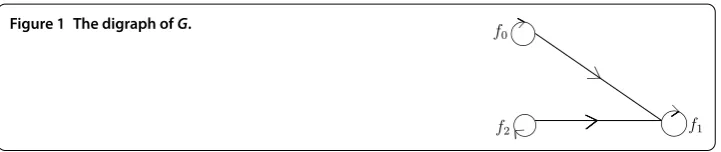
Therefore,E(G) ={(f,f), (f,f), (f,f), (f,f), (f,f)}. The digraph ofGis shown in
Fig-ure .
Now, for all (f,g)∈E(G),T is a G-contraction. Also all other assumptions of Theo-rem . are satisfied andThas a fixed point.
As an application of Theorem ., we have the following result whose proof is similar to Proposition ..
Proposition . Letρ∈ be convex.Let C⊂Lρbe a nonempty andρ-closed convex sub-set.Assume thatρsatisfies the-type condition and C isρ-bounded that has Property..
Let T:C→C(C)be a monotone increasing G-nonexpansive map.Then there exists an ap-proximate fixed points sequence{fn}in C,i.e.,for any n≥,there exists Fn∈T(fn)such
that
lim
n→∞ρ(fn–Fn) = .
Note that a similar conclusion to Theorem . in terms of graph may be found under strong properties satisfied by the graphG.
Competing interests
The author declares that they have no competing interests.
Acknowledgements
The author acknowledges King Fahd University of Petroleum and Minerals for supporting this research.
Received: 26 October 2014 Accepted: 15 January 2015
References
1. Kirk, WA, Goebel, K: Topics in Metric Fixed Point Theory. Cambridge University Press, Cambridge (1990) 2. Granas, A, Dugundji, J: Fixed Point Theory. Springer, New York (2003)
3. Tarski, A: A lattice theoretical fixed point and its application. Pac. J. Math.5, 285-309 (1955) 4. Nadler, SB: Multi-valued contraction mappings. Pac. J. Math.30(2), 475-488 (1969)
5. Feng, Y, Liu, S: Fixed point theorems for multivalued contractive mappings and multivalued Caristi type mappings. J. Math. Anal. Appl.317, 103-112 (2006)
6. Klim, D, Wardowski, D: Fixed point theorems for set-valued contractions in complete metric spaces. J. Math. Anal. Appl.334, 132-139 (2007)
7. Beg, I: Fixed points of fuzzy multivalued mappings with values in fuzzy ordered sets. J. Fuzzy Math.6(1), 127-131 (1998)
8. Echenique, F: A short and constructive proof of Tarski’s fixed point theorem. Int. J. Game Theory33(2), 215-218 (2005) 9. Fujimoto, T: An extension of Tarski’s fixed point theorem and its application to isotone complementarity problems.
Math. Program.28, 116-118 (1984)
10. Ran, ACM, Reurings, MCB: A fixed point theorem in partially ordered sets and some applications to matrix equations. Proc. Am. Math. Soc.132, 1435-1443 (2003)
11. Beg, I, Butt, AR: Fixed point for set valued mappings satisfying an implicit relation in partially ordered metric spaces. Nonlinear Anal.71, 3699-3704 (2009)
12. Drici, Z, McRae, FA, Devi, JV: Fixed point theorems in partially ordered metric space for operators with PPF dependence. Nonlinear Anal.67, 641-647 (2007)
13. Harjani, J, Sadarangani, K: Generalized contractions in partially ordered metric spaces and applications to ordinary differential equations. Nonlinear Anal.72, 1188-1197 (2010). doi:10.1016/j.na.2009.08.003
14. Nieto, JJ, Pouso, RL, Rodriguez-Lopez, R: Fixed point theorems in ordered abstract spaces. Proc. Am. Math. Soc.135, 2505-2517 (2007)
15. Jachymski, J: The contraction principle for mappings on a metric space with a graph. Proc. Am. Math. Soc.136(4), 1359-1373 (2008)
16. Lukawska, GG, Jachymski, J: IFS on a metric space with a graph structure and extension of the Kelisky-Rivlin theorem. J. Math. Anal. Appl.356, 453-463 (2009)
17. O’Regan, D, Petrusel, A: Fixed point theorems for generalized contraction in ordered metric spaces. J. Math. Anal. Appl.341, 1241-1252 (2008)
18. Petrusel, A, Rus, IA: Fixed point theorems in orderedL-spaces. Proc. Am. Math. Soc.134, 411-418 (2005) 19. Beg, I, Butt, AR, Radojevi´c, S: The contraction principle for set valued mappings on a metric space with a graph.
Comput. Math. Appl.60, 1214-1219 (2010)
20. Alfuraidan, MR: Remarks on monotone multivalued mappings on a metric space with a graph. J. Inequal. Appl. (submitted)
21. Khamsi, MA, Kozlowski, WM, Reich, S: Fixed point theory in modular function spaces. Nonlinear Anal., Theory Methods Appl.14, 935-953 (1990)
22. Kozlowski, WM: Modular Function Spaces. Series of Monographs and Textbooks in Pure and Applied Mathematics, vol. 122. Dekker, New York (1988)
23. Kozlowski, WM: An introduction to fixed point theory in modular function spaces. In: Almezel, S, Ansari, QH, Khamsi, MA (eds.) Topics in Fixed Point Theory. Springer, New York (2014)
24. Khamsi, MA, Kozlowski, WM: On asymptotic pointwise contractions in modular function spaces. Nonlinear Anal.73, 2957-2967 (2010)
25. Khamsi, MA, Kozlowski, WM: On asymptotic pointwise nonexpansive mappings in modular function spaces. J. Math. Anal. Appl.380(2), 697-708 (2011)
26. Kozlowski, WM: Notes on modular function spaces I. Comment. Math.28, 91-104 (1988) 27. Kozlowski, WM: Notes on modular function spaces II. Comment. Math.28, 105-120 (1988) 28. Diestel, R: Graph Theory. Springer, New York (2000)
30. Dominguez-Benavides, T, Khamsi, MA, Samadi, S: Uniformly Lipschitzian mappings in modular function spaces. Nonlinear Anal., Theory Methods Appl.46(2), 267-278 (2001)
31. Kutbi, MA, Latif, A: Fixed points of multivalued maps in modular function spaces. Fixed Point Theory Appl.2009, Article ID 786357 (2009). doi:10.1155/2009/786357