REVIEW
A trio-interaction theory for Madden–
Julian oscillation
Bin Wang
1,2*, Fei Liu
1and Guosen Chen
1,2Abstract
The Madden–Julian oscillation (MJO) is the dominant mode of tropical atmospheric intraseasonal variability and a primary source of predictability for global sub-seasonal prediction. Understanding the origin and perpetuation of the MJO has eluded scientists for decades. The present paper starts with a brief review of progresses in theoretical studies of the MJO and a discussion of the essential MJO characteristics that a theory should explain. A general theoretical model framework is then described in an attempt to integrate the major existing theoretical models: the frictionally coupled Kelvin–Rossby wave, the moisture mode, the frictionally coupled dynamic moisture mode, the MJO skeleton, and the gravity wave interference, which are shown to be special cases of the general MJO model. The last part of the present paper focuses on a special form of trio-interaction theory in terms of the general model with a simplified Betts–Miller (B-M) cumulus parameterization scheme. This trio-interaction theory extends the Matsuno–Gill theory by incorporating a trio-interaction among convection, moisture, and wave-boundary layer (BL) dynamics. The model is shown to produce robust large-scale characteristics of the observed MJO, including the coupled Kelvin–Rossby wave structure, slow eastward propagation (~5 m/s) over warm pool, the planetary (zonal) scale circulation, the BL low-pressure and moisture convergence preceding major convection, and amplification/decay over warm/cold sea surface temperature (SST) regions. The BL moisture convergence feedback plays a central role in coupling equatorial Kelvin and Rossby waves with convective heating, selecting a preferred eastward propagation, and generating insta-bility. The moisture feedback can enhance Rossby wave component, thereby substantially slowing down eastward propagation. With the trio-interaction theory, a number of fundamental issues of MJO dynamics are addressed: why the MJO possesses a mixed Kelvin–Rossby wave structure and how the Kelvin and Rossby waves, which propagate in opposite directions, could couple together with convection and select eastward propagation; what makes the MJO move eastward slowly in the eastern hemisphere, resulting in the 30–60-day periodicity; why MJO amplifies over the warm pool ocean and decays rapidly across the dateline. Limitation and ramifications of the model results to general circulation modeling of MJO are discussed.
Keywords: Madden–Julian oscillation, MJO theory, Tropical wave dynamics, Convectively coupled equatorial waves, Trio-interaction theory for MJO, Moisture mode, Dynamic moisture mode
© The Author(s) 2016. This article is distributed under the terms of the Creative Commons Attribution 4.0 International License (http://creativecommons.org/licenses/by/4.0/), which permits unrestricted use, distribution, and reproduction in any medium, provided you give appropriate credit to the original author(s) and the source, provide a link to the Creative Commons license, and indicate if changes were made.
Background
Madden and Julian (1971) discovered a 40–50-day oscillation in tropospheric zonal winds at the equato-rial central Pacific. This local 40–50-day oscillation is later understood as associated with an equatorial plan-etary-scale circulation system coupled with large-scale
convection that moves eastward slowly with a speed of about 5 m/s in the eastern hemisphere (Madden and Julian 1971; Nakazawa 1988). This phenomenon is named as Madden–Julian oscillation (MJO). In general, tropical atmospheric motion exhibits a significant energy peak on a broad range of 2–8 weeks, which is often referred to as tropical intraseasonal variability. The MJO is the dominant mode of tropical intraseasonal variability that bridges weather and climate variation.
Prediction of extreme weather events two-to-six weeks ahead (also called sub-seasonal prediction) has immense
Open Access
*Correspondence: [email protected]
1 Earth System Modeling Center, Nanjing University of Information Science and Technology, Nanjing, China
social–economic benefits for hazard prevention and risk management as well as economic planning. The physical basis for such sub-seasonal prediction is primarily rooted in the predictability of large-scale circulation associated with the MJO and the regulation of the MJO on extreme and high-impact weather events such as tropical storms, flooding, droughts, heavy snow storms, heat waves, cold surges, wild fires, hazes, tornado and hail days (Zhang 2013; Wang and Moon 2016). The MJO is considered as a major source of global predictability on the sub-seasonal timescale (Waliser 2012).
Dynamical MJO prediction has significantly advanced. The prediction skills for the first two leading modes have increased from 7 days during 1990s to about 25–30 days (ECMWF and GFDL models) during 2010s (Vitart 2014; Xiang et al. 2015). However, the models still have large room to reach potential predictability limit (Neena et al. 2014; Lee et al. 2015). Realistic simulation of MJO in many current general circulation models (GCMs) remains a great challenge (Jiang et al. 2015). Understand-ing the origin and perpetuation of the MJO has eluded scientists for decades. Further improvement of our understanding of the fundamental physics of the MJO is urgent and imperative. The present paper aims to pro-mote theoretical understanding of the essential physics of MJO.
Review of progresses in theoretical understanding A variety of theories and mechanisms have been pro-posed to explain various aspects of MJO over the past three decades. These theories are subjectively categorized as four groups of basic theories plus two groups of spe-cific theories.
1. Convectively coupled Kelvin–Rossby wave theory. This theory is centered on interaction between convec-tive heating, the low-frequency equatorial waves, and the boundary layer (BL) frictional moisture convergence, which integrated the mechanisms of the BL frictional moisture feedback (Wang 1988b; Wang and Chen 1989), non-linear wave-Conditional Instability of the Second Kind (CISK) (Lau and Peng 1987), and the evaporation-wind feedback (Emanuel 1987; Neelin et al. 1987; Wang 1988a). These mechanisms were later combined into a frictionally coupled moist Kelvin–Rossby wave theory (Wang and Rui 1990a; Wang and Li 1994; Kang et al. 2013). This theory explained why the observed MJO features a coupled Kelvin–Rossby wave structure (Rui and Wang 1990; Adames and Wallace 2014), why the low sea-level pressure and the BL moisture convergence lead the major convection in observations (Madden and Julian 1972; Hendon and Salby 1994; Jiang and al 2015), and why MJO moves eastward and can be unstable on planetary scales (Wang 1988b; Wang and Rui 1990a; Li
and Zhou 2009). The role of frictional moisture feedback also implies potentially important roles of the shallow-congestus convection–BL circulation interaction in MJO dynamics as proposed by Johnson et al. (1999), Lin et al. (2004), and Kikuchi and Takayabu (2004). The weakness of the theory is the use of a diagnostic moisture equation and moisture feedback process is neglected. The resulting eastward propagation speed is 10–15 m/s, which is too fast for a warm sea surface temperature (SST) of 29 °C. As suggested by Moskowitz and Bretherton (2000), the damping magnitude of the BL friction may be too large in Wang and Rui (1990a).
2. The moisture mode theory. This theory regards the moisture (or moist static energy) as the first order important. It emphasizes moisture–convection feedback (Woolnough et al. 2001; Grabowski and Moncrieff 2004) and moisture transport (Maloney 2009; Maloney et al. 2010; Andersen and Kuang 2012; Hsu and Li 2012; Kim et al. 2014; Pritchard and Bretherton 2014; Liu and Wang 2016a, b). A simple empirical model was proposed (Sobel and Maloney 2012, 2013), which is further implemented by Adames and Kim (2016). The MJO instability mainly comes from the parameterized cloud-radiative feedback by choice of negative “effective gross moist stability”. The eastward propagation is mainly driven by meridional advection of mean moisture by MJO winds, and the para-metrized BL convergence effect. This theory produces an MJO mode that is dispersive with a westward group velocity. In this model, the only prognostic variable is moisture anomaly; the circulation is a passive Gill-like (Gill 1980) response. The generation of MJO available potential energy is neglected due to the diagnostic ther-modynamic equation used. The numerical experiments of Pritchard and Yang (2016) showed that the horizontal advection of moist static energy is not significant to the eastward propagation of MJO-like mode, so the model may underestimate the feedbacks of wave dynamics on the MJO’s propagation.
packet that resembles observed MJO closely. This theory will be further discussed in “The MJO simulated in the MJO trio-interaction model” section.
4. The multiscale interaction theory. The MJO convec-tive complex consists of multiscale convecconvec-tive activity and motions (Nakazawa 1988). How these mesoscale and synoptic-scale motions interact and contribute to MJO dynamics has been a controversial issue. Many different schools of thinking have been proposed in this regard. Here, we introduce four types of models belonging to this category.
a. The MJO skeleton model. The effects of synoptic waves on MJO through upscale momentum, heat, and moisture transports are considered as a potential driver for MJO (Majda and Biello 2004; Biello and Majda 2005; Wang and Liu 2011; Liu et al. 2012; Liu and Wang 2012c, 2013b). The MJO skeleton model driven by synoptic wave activity ensemble (Majda and Biello 2004; Majda and Stechmann 2009) is a simplest model generalizing this idea. In the skeleton model, the tendency of planetary-scale wave envelope is linked to the low-level moisture anomaly, which is essentially a kind of convective heat-ing parameterization. This parameterization and resulted quadrupole structure remain to be validated against observations (Chen and Wang 2016). The skeleton model can produce a slow eastward-propagating mode with a dispersion feature in which frequency is nearly independ-ent of wavenumber. The model, however, yields neutral modes which can propagate either eastward or westward (Majda and Stechmann 2009). Liu and Wang (2012a) extended the original skeleton model by including BL frictional feedback. The resulting frictional skeleton mode becomes an unstable, planetary-scale, eastward-propagating mode, while the original westward-prop-agating mode is damped. The skeleton model is also extended to include stochasticity in synoptic and con-vective activities, reproducing the intermittency, growth and decay, seasonal variation, and vertical tilt of the MJO (Thual et al. 2014).
b. The MJO–synoptic wave interaction model. In this model, the effects of momentum, heat and moisture transports by synoptic-scale motions are parametrized in the governing equations for the MJO motion (Wang and Liu 2011; Liu et al. 2012; Liu and Wang 2012c, 2013b). This type of models allows for a two-way inter-action between high-frequency waves (inertial-grav-ity waves, Kelvin waves) and MJO. The impacts of the upscale momentum, heat and moisture transports to MJO were found to depend on the relative locations of the synoptic disturbance with respect to the MJO con-vective center. The MJO is found to amplify when the moist Kelvin waves are located to the west of the MJO convective center, meanwhile the westward-propagating
inertia–gravity waves could have a positive feedback on the MJO when they are located to the east of the MJO convective center (Wang and Liu 2011).
c. The multi-cloud model. The MJO has the so-called “self-similarity” cloud structure (Mapes et al. 2006; Kiladis et al. 2009). To understand the multi-cloud struc-ture of the MJO, a multi-cloud model has been built by Khouider and Majda (2006, 2007). The key features are (a) systematic low-level moisture convergence with retained conservation of vertically integrated moist static energy, and (b) the use of three cumulus cloud types (congestus, stratiform, and deep convective) together with their dif-fering vertical heating structures. This multi-cloud model successfully simulates the MJO analog of slow eastward propagation, “self-similarity” vertical structure and multiscale horizontal structure (Majda et al. 2007). The wavenumber 3 is most unstable and the instability comes from the second vertical baroclinic mode. This stratiform cloud–wave interaction or moisture stratiform–wave interaction mechanisms have also been found to support MJO growth in other works (Mapes 2000; Kuang 2008; Fu and Wang 2009; Seo and Wang 2010).
d. The gravity wave interference model. Motivated by the existence of relatively short-lived, eastward- and westward-moving disturbances within the MJO com-plex, the MJO has been thought as a wave packet—the interference pattern produced by a narrow frequency band of mixed Rossby-gravity (Yang and Ingersoll 2011) or inertia–gravity waves (Yang and Ingersoll 2013, 2014). In this model, the MJO is treated as a large-scale enve-lope of small-scale gravity waves triggered by individual convective cells. The eastward propagation arises from a zonal asymmetry in inertial-gravity waves, and the MJO planetary scale depends on a scaling factor of convective strength vs. gravity wave speed. This wave packet theory explains only a small fraction of the variance of the MJO in the outgoing longwave radiation (OLR) data.
In addition to the aforementioned basic MJO theo-ries, there are other specific theories focusing on “higher order” characteristics, including the boreal summer intraseasonal oscillation (ISO) theory and atmosphere– ocean interaction theory.
of the easterly vertical wind shears (easterly increase with height) in the monsoon regions. They showed that the basic state-specific humidity distribution and monsoon easterly vertical shear together shifts the centers of ISO variance to Northern Hemisphere summer monsoon regions. To explain northward propagation of the BSISO, several other mechanisms were also proposed, including the land sur-face heat fluxes (Webster and Holton 1982), the interaction between convection and moist stability (Gyoswami and Shukla 1984), the interaction between baroclinic and baro-tropic vorticity forced by vertical wind shear (Wang and Xie 1997; Jiang et al. 2004; Drbohlav and Wang 2005), the air–sea interaction (Kemball-Cook and Wang 2001; Fu and Wang 2004), the convective momentum transport-induced barotropic vorticity (Kang et al. 2010; Liu et al. 2015), the beta drift (Boos and Kuang 2010), and the BL moisture advection and the vertical wind shear-induced barotropic vorticity effect (DeMott et al. 2013).
6. The atmosphere–ocean interaction theory. The atmos-phere–ocean interaction has been shown to play a role in sustaining the MJO (Flatau et al. 1997; Wang and Xie 1998; Wang and Zhang 2002; Fu and Wang 2004). The linear atmosphere–ocean interaction theory proposed by Wang and Xie (1998) and Liu and Wang (2013a) has demon-strated that the air–sea interaction under mean westerly winds is conducive to unstable, eastward-propagating plan-etary-scale waves on intraseasonal timescale. Although the cloud–shortwave radiation–SST feedback can destabilize both eastward and westward modes, the air–sea feedback associated with the evaporation and oceanic entrainment favors planetary-scale eastward-propagating modes. Over the western hemisphere where easterly background winds prevail, the evaporation and entrainment feedbacks yield damped modes, indicating that longitudinal variation of the mean surface winds plays an important role in regula-tion of the MJO intensity in addiregula-tion to the longitudinal variation of the mean SST. The air–sea interaction over the Indian monsoon region and equatorial Indian Ocean, in cooperation with the instability caused by the local meridi-onal circulation and BL moisture convergence, can support a self-sustained Indian summer monsoon ISO (Liu and Wang 2012b). The monsoon trough over the western North Pacific during late boreal summer favors for a negative air–sea feedback to amplify the local ISO over the western North Pacific (Wang and Zhang 2002; Liu and Wang 2014), which explains why the strongest ISO occurs over the west-ern North Pacific during late boreal summer.
Observed MJO characteristics: setting up theoretical targets
What are the essential phenomenological features of the MJO that theories must explain? This is an indispensable question for establishing and validating MJO theories.
Unfortunately, this remains a controversial issue because of the complex nature of the tropical convection associ-ated with MJO. This section is devoted to discuss this issue.
Statistical features of MJO have been well documented, including seasonal variations of intraseasonal variances (Kemball-Cook and Wang 2001), the wavenumber–fre-quency spectrum and leading Empirical Orthogonal Function modes (Wheeler and Kiladis 1999; Wheeler and Hendon 2004). Statistically, MJO is defined as the spectral components within zonal wavenumbers 1–3 and having periods of 30–80 days in the wavenumber–fre-quency spectrum of OLR and 850 hPa zonal wind (Wal-iser 2012). However, to better understand the dynamics of the MJO, it is advantageous to define MJO properties from a dynamic system perspective. In this regard, the essential characteristics of MJO system may embrace the following aspects.
1. MJO is a planetary-scale (dominant zonal wavenum-ber 1 and 2) circulation system coupled with a large-scale (zonal wavenumber 3–5) convective complex, implying a preferred scale selection exists.
2. MJO moves eastward slowly with a speed of about 5 m/s over the Indo-Pacific warm pool and about 15 m/s over the western hemisphere (Madden and Julian 1972; Knutson and Weickmann 1987), leading to 30–60-day oscillation.
3. The MJO circulation exhibits a coupled Kelvin and Rossby wave structure (Rui and Wang 1990; Hendon and Salby 1994; Adames and Wallace 2014).
4. MJO exhibits a gravest baroclinic circulation struc-ture with a backward-tilted vertical motion and moisture. The BL low-pressure and convergence lead the major convective center (Madden and Julian 1972; Wang 1988b; Hendon and Salby 1994).
5. The MJO system amplifies over the Indo-Pacific warm pool and decays over the cold tongue in the central Pacific and eastern Pacific (Wang and Rui 1990b), implying an instability mechanism exists.
The three-dimensional structure of the MJO was sum-marized by the schematic diagram shown in Fig. 1, which can be viewed as an extension of the two-dimensional structure along the equator made by Madden and Julian (Madden and Julian 1972). From a dynamical standpoint, we may define MJO as a tropical, planetary-scale, unsta-ble circulation system (coupled with a multiscale con-vective complex) that moves eastward slowly (~5 m/s over the war pool ocean) with a rearward-tilted vertical motion and a coupled Kelvin–Rossby wave structure. The rudimentary features of the MJO that requests theoreti-cal explanation include (1) the planetary circulation stheoreti-cale, (2) slow eastward propagation over the warm Indian and western Pacific oceans (about 5 m/s) while fast propaga-tion over the cold eastern Pacific (about 15 m/s), (3) the coupled Kelvin–Rossby wave (horizontal) structure, (4) the backward-tilted baroclinic vertical structure, and (5) the growth (decay) in the warm (cold) oceans. These essential features should be viewed as major targets for theoretical interpretation and validation metrics of any basic MJO theory. The features (6)–(10) are also impor-tant but request more complicated or specific models to explain. We consider them as higher order theoretical targets. In this study, we will focus on understanding of the first five basic features of MJO.
A general theoretical model framework for essential dynamics of MJO
The principles for establishment of a theoretical model framework are as follows. (1) The model must be derived from the first principles with reasonable/justifiable assumptions. (2) The model is designed to include only the essential processes to MJO dynamics. (3) The model results are verifiable against observations. (4) The model can elucidate fundamental mechanisms at work. Based
on these principles, Wang and Chen (2016) proposed a general model framework for understanding MJO essen-tial dynamics.
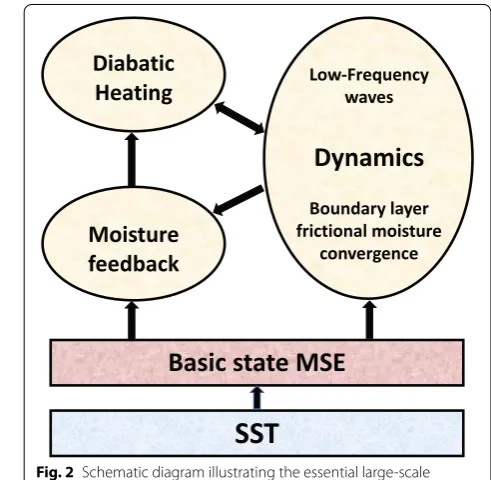
Figure 2 illustrates the key elements of large-scale MJO dynamics. The coupled Convection-Kelvin–Rossby wave structure and the phase lead of the BL convergence to convective heating imply that the low-frequency wave and BL dynamics, precipitation heating and their interactions must be the key elements, which also necessarily involve moisture feedback to convective precipitation. The mois-ture feedback is determined by surface entropy fluxes and the moisture convergence induced by the wave and BL dynamics. The precipitation heat energy comes from the basic state moist static energy that is largely controlled by basic state SST (Wang 1988b; Wang and Li 1994). The model framework shown in Fig. 2 includes all rudimen-tal elements that are considered in the five major exist-ing MJO theories mentioned in “Review of progresses in theoretical understanding” section, thus representing a general model framework for essential dynamics of MJO.
The simplest vertical structure of the model is a 1 and 1/2 layer equatorial beta-plane model, which consists of the first baroclinic mode in the free troposphere and barotropic BL dynamics (Wang 1988b). Detailed deri-vation of the model equations is given in Hoskins and Wang (2006) and Wang (2012). Briefly, using horizon-tal velocity scale C0, length scale (C0/β)1/2, timescale
(βC0)−1/2, geopotential scale C02, moisture scale d0Δp/g, where d0 = 2p2CpC02/ΔpRLc, the non-dimensional gov-erning equations are:
Fig. 1 Schematic diagram illustrating three-dimensional structure of the MJO mode. BLMC represents boundary layer moisture
Equation (3) is the combined hydrostatic, continuity and thermodynamic equation. Equation (4) is the verti-cally integrated moisture equation. Equations (5) and (6) are momentum equations for the barotropic BL. u v and
Φ represent the free tropospheric low-level zonal wind, meridional wind and geopotential, respectively. −→V and −
→
Vb denote, respectively, the wind vectors at the low-level
free atmosphere and the BL. μ and ǫ are the longwave
Newtonian cooling and Rayleigh friction coefficients. q
is the column-integrated perturbation moisture from the surface to the tropopause. Pr, R and Ev are precipitation
rate, longwave radiation and evaporation, respectively. Q
and Qb are, respectively, normalized basic state-specific
humidity at the lower tropospheric layer and the BL, both are controlled by the underlying SST. For a homogene-ous SST, the zonal and meridional moisture advection in Eq. (4) will vanish. D and Db are the lower tropospheric
and BL divergence, respectively. ub and vb are BL
baro-tropic winds, and Ek is the friction coefficient in the BL.
d is the non-dimensional BL depth. For more details, the reader is referred to Wang and Chen (2016).
The general model framework here can accommodate different convective heating parameterization schemes. Here are examples.
1. Simplified Kuo scheme (Wang and Rui 1990a), in which the moisture tendency is neglected, thus precipita-tion is balanced by the moisture convergence and surface evaporation:
(1) ∂u
∂t −yv= − ∂Φ
∂x −ǫu
(2) ∂v
∂t +yu= − ∂Φ
∂y −ǫv
(3) ∂Φ
∂t +D+dDb= −(Pr−R)−µΦ
(4) ∂q
∂t +QD+
�
V· ∇Q+d(QbDb+V�b· ∇Qb)=Ev−Pr
(5)
∂ub
∂t −yvb= − ∂Φ
∂x −Ekub
(6) ∂vb
∂t +yub= − ∂Φ
∂y −Ekvb
where b is a precipitation efficiency coefficient. H(x) is a Heaviside function, which represents the positive-only (non-linear) precipitation heating.
2. Simplified convection–moisture feedback sensitivity Bretherton et al. 2004 scheme (Sobel and Maloney 2012; Adames and Kim 2016) in which precipitation heating is proportional to the column-integrated moisture:
where τ is the convective timescale.
3. Cloud-radiation feedback scheme (Fuchs and Ray-mond 2002; Peters and Bretherton 2005) in which the reduction of radiative cooling is proportional to convec-tive heating associated with the precipitation
where r is a coefficient.
4. Simplified B-M scheme (Wang and Chen 2016, Liu and Wang 2016b), in which the moisture is relaxed back to a significant fraction of the saturation value when there is enough moisture for convection: Pr= 1τH(q−q(T))
(Frierson et al. 2004), and in the 1 and ½ layer model:
where τ is a convective adjustment time.
5. The wave activity ensemble (WAE) scheme (Majda and Stechmann 2009), in which the precipitation ten-dency is assumed to be proportional to low-level pertur-bation moisture:
where C is a constant that is determined by radiative– convective equilibrium state. qlow is the low-level
mois-ture (Majda and Stechmann 2009; Stechmann and Majda 2015), which can be approximated to q, since q is mainly contributed by the moisture from the surface to 500-hPa.
6. The triggered convective heating (Yang and Ingersoll 2013) in which convection is assumed to occur in a small area, and is triggered when the pressure anomaly is lower than a threshold:
(7)
Pr=H
b(Ev−QD−dQbDb)
(8) Pr= q
τ
(9) R= −rPr
(10)
Pr= 1
τH[(q+αΦ)]
(11)
∂Pr
∂t =Cqlow
(12) Pr=
Pr0
τA0
�
1−��tτ/−τ/22�2��1− L2 R2
�
;whenφ < φc, 0< �t< τ, andL2≤R2
where L=(�x2+�y2)1/2 measures the disturbance
from the convective center, Δx and Δy are measured rela-tive to the location where the convection is triggered.
These simplified parameterization schemes shown above all attempt to relate the large-scale convective heating to the large-scale atmospheric variables. The proper representation of convection in terms of the large-scale atmospheric variables affects the ability of a theo-retical model to simulate the trio-interaction between convection, moisture, and large-scale circulation, which determines how well a theoretical model can capture the essential features of MJO. Therefore, the validity and limitations of these schemes should be checked against observations.
Relationships between the general MJO model and the existing theoretical models
The governing Eqs. (1–6) for MJO dynamics and the sim-plified convective parameterization (7–12) have extended the Matsuno (1966)–Gill (1980) model massively by including (a) BL dynamics, (b) moisture conservation, and (c) parameterized interactive convective heating. The major existing theoretical models of MJO can be obtained from this general MJO model by introducing simplified assumptions as discussed below.
1. The frictionally coupled Kelvin–Rossby wave model can be obtained using a diagnostic moisture equation and choosing the simplified Kuo scheme, Eq. (7). 2. The moisture mode theory model (Sobel and Maloney
2013; Adames and Kim 2016) can be obtained by neglecting the BL dynamics and the tendency terms in the momentum and thermodynamic equations and choosing the simplified convection–moisture sensitivity scheme [Eq. (8)] and cloud-radiation feedback scheme, Eq. (9). It also implemented the effects of the BL frictional convergence and the high-frequency eddy-induced moistening in the moisture Eq. (4), which are both parameterized by the low-level zonal wind anomalies.
3. The frictionally coupled dynamic moisture mode model (Wang and Chen 2016, Liu and Wang 2016b) can be obtained by choosing the simplified B-M scheme, Eq. (10), without other simplification.
4. The MJO skeleton model (Majda and Stechmann 2009) can be obtained by neglecting the BL dynam-ics, Rayleigh friction, Newtonian cooling, and spatial variation of Q, and choosing the WAE precipitation
scheme, Eq. (11). The frictional skeleton model (Liu and Wang 2012a) can also be obtained by choosing the WAE precipitation scheme.
5. The gravity wave interference model (Yang and Inger-soll 2013) can be obtained by neglecting moisture
equation and BL dynamics and choosing the trig-gered convection scheme, Eq. (12).
Therefore, the major existing theoretical models of MJO are all specific cases of the general MJO model.
The MJO simulated in the MJO trio‑interaction model
Hereafter, we focus on the general model with the sim-plified B-M scheme. The essence of this model lies in a trio-interaction among convective heating, moisture, and equatorial wave-BL dynamics. For this reason, this theory is named as a trio-interaction theory. The trio-interaction mode obtained from this model is essentially a friction-ally coupled dynamic moisture mode. There are two fun-damental processes that interact with convective heating and support the trio-interaction mode, one is the BL fric-tional convergence feedback and the other is moisture feedback. Adding additional parametrized terms such as cloud-radiation feedback is trivial.
Figure 3 presents the propagation, horizontal struc-ture, and BL convergence of the simulated MJO-like, trio-interaction mode on an idealized “warm pool” SST configuration (Fig. 3a). The governing equations are solved in an aqua-planet channel between 40°S and 40°N on a spherical coordinate by rewriting Eqs. (1)–(6) to the spherical coordinate. The zonal boundary condition is periodic and the fluxes of mass, momentum, and heat normal to the meridional boundaries vanish. An initial pure Kelvin wave disturbance was placed on the equator and 60°E. The solution is not sensitive to the specified ini-tial disturbance.
With the specified warm pool SST (and basic state moisture distribution), the simulated MJO precipita-tion anomaly moves eastward from 60°E to 170°E with a speed about 5 m/s comparable to observations (Fig. 3b). Interestingly, the simulated precipitation anomaly ampli-fies over the warm ocean with the strongest precipitation nearly coinciding with the highest SSTs. The precipita-tion anomaly decays quickly near the dateline because the westward background SST gradients produce nega-tive moisture advection by MJO easterly and the low SST over cold tongue kills the convection.
The simulated low-level geopotential and wind fields display a coupled convection-Kelvin–Rossby wave pat-tern (Fig. 3c), the nearly symmetric double cyclone to the west of the precipitation and the low-pressure/east-erly anomaly to the east of the precipitation represent the Rossby wave and Kelvin wave components, respectively. This structure resembles closely to the observed struc-ture (Fig. 3d).
(a) (b)
(c) (d)
(e) (f)
they are not the same. The shape parameter defined by the zonal extent ratio of Kelvin easterly vs. Rossby west-erly is 3.0 in Gill pattern but only 2.0 in observed and simulated MJO. The Rossby–Kelvin (R–K) intensity parameter defined by the ratio of the maximum low-level westerly speed Umax vs. the maximum easterly speed
abs(Umin) averaged over 5°S and 5°N is 2.2 in Gill pattern
but only 0.6 and 1.3 in the observed and simulated MJO. The structural differences between the Gill pattern and MJO arise from the nature of the precipitation heating. In the Gill model the heating is specified and the waves are passive responses, while in the MJO structure the heating is interactive with the waves and the waves can feed back to the heating. For this reason, we will describe MJO structure as a coupled Kelvin–Rossby wave packet, avoiding using “Gill pattern”.
Figure 3e shows that the simulated BL frictional conver-gence is located under and to the east of the major convec-tion center, a feature which closely resembles observaconvec-tions (Fig. 3f). The phase shift between the BL convergence and free troposphere upward motion is the 1½ layer model’s counterpart of the observed backward-tilted vertical structure in a vertically continuous model. The vertical tilt of moisture field is mainly contributed by the BL frictional convergence to the east of the convective heating.
The planetary (zonal) scale of the simulated MJO low-level zonal winds is further analyzed in Fig. 3g in com-parison with observation (Fig. 3h). The zonal circulation is a single wave packet that is primarily made of zonal wavenumber 1–4 with wavenumber 1 having the larg-est contribution (Wang and Chen 2016). The result here may provide an explanation of the statistical definition of MJO which manifests itself as concentration of energy on wavenumber 1–3 and period of 30–80 days in the fre-quency–wavenumber spectrum diagram (Wheeler and Hendon 2004; Jiang et al. 2015).
In sum, the trio-interaction model yields an MJO-like mode that captures the five basic characteristics of the observed MJO realistically, producing an equatorial planetary-scale, unstable system moving eastward slowly (~5 m/s) over warm pool with a rearward-tilted, coupled Kelvin–Rossby wave structure.
Mechanisms of MJO offered by the trio‑interaction theory
There are a number of fundamental questions regard-ing the basic mechanisms of the MJO which will be addressed in this section in terms of the trio-interaction theory.
a. Mechanisms for the convective coupling of Kelvin and Rossby waves
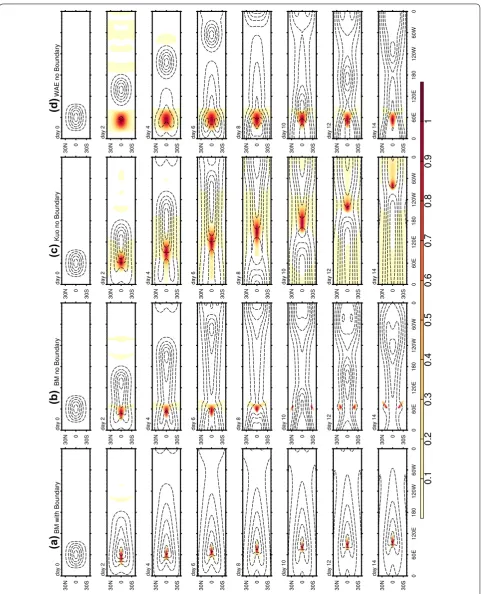
Why does MJO exhibit a coupled Kelvin–Rossby wave structure with BL convergence leading convection? To address this question, we use the trio-interaction model with uniform SST of 29.0 °C and compare the results from the models with and without BL dynamics (by set-ting the BL depth d to zero), respectively.
Figure 4 shows that the same initial dry Kelvin wave low-pressure induces precipitation, which further excites a coupled Kelvin–Rossby system at day 2. With BL dynamics, the trio-interaction mode exhibits a coupled K–R structure (Fig. 4a); however, without the BL dynam-ics, the Kelvin and Rossby waves are decoupled: the Rossby wave moves westward and the Kelvin wave moves eastward (Fig. 4b). Their propagation speeds are the same as predicted by the equatorial wave theory (Mat-suno 1966). Therefore, the moisture feedback in the B-M parameterization could not generate the MJO-like mode. Similarly, without BL dynamics the Kuo scheme and the moisture feedback in the WAE (skeleton model) scheme also cannot hold the Kelvin and Rossby wave together (Fig. 4c, d). It is the BL frictional moisture convergence that is responsible for the coupling among convection, Kelvin and Rossby waves.
How could the BL frictional convergence couple the eastward-propagating Kelvin wave and westward-propa-gating Rossby waves together with convection and select eastward propagation? Wang and Rui (1990a) showed that the Rossby wave-induced BL convergence exhibits not only off-equatorial maximum coinciding with Rossby wave lows but also an equatorial maximum convergence to the east of the Rossby wave lows; on the other hand, the Kelvin wave-induced BL convergence displays an equatorial maximum that coincides with Kelvin wave low pressure and easterly phase. Therefore, when convective
(See figure on previous page.)
Fig. 3 MJO propagation in a varying background SST (°C) simulated in the trio-interaction model with B-M scheme. a Idealized Indo-Pacific warm pool SST configuration. b Time-longitude diagram of simulated precipitation rate (mm/day) along the equator; c simulated normalized low-level (700-hPa) wind (vectors), geopotential height (contour) and the precipitation (shading) at day 7; d observed horizontal structures of MJO during winter (NDJFM), namely regressions of 700-hPa wind (m/s, vector), geopotential height (m, contour), as well as precipitation (mm/day, shading) with respect to the precipitation index over the eastern Indian Ocean (averaged over 5°S–5°N; and 70°E–90°E); e the simulated equatorial (averaged between 5°S and 5°N) precipitation (red), column-integrated moisture (green) and BL convergence (blue); f the same as e except for observation;
(a
)
(b
)
(c
)(
d)
heating excites Rossby wave lows to its west and Kelvin wave low to its east, the Kelvin and Rossby waves would produce a unified BL moisture convergence field that leads (to the east of) the major convective heating (see Fig. 3e). As a result, the frictional organization of convective heat-ing can couple the Kelvin and Rossby waves together with convective heating. The BL moisture convergence can also accumulate moist static energy and increase convective instability to the east of the major convection (Hsu and Li 2012), leading to eastward propagation of the MJO.
b. Mechanisms for slow eastward propagation of MJO Slow eastward propagation (about 5 m/s) in the warm pool is critical to explain the 30–60-day periodicity of MJO. What controls MJO propagation speed in gen-eral? In this subsection, we show that the slow eastward propagation is primarily attributed to (a) warm pool SST, which promotes convective heating that reduces effective static stability, thus reducing the moist equatorial wave speed, (b) the coupling of Kelvin and Rossby waves, and (c) the moisture feedback in the B-M parameterization. To understand the effects of factors (a) and (b), it is con-venient to examine the combined dimensional thermody-namic equation and moisture equation without BL and moisture tendency:
where C0 is the dry Kelvin wave or gravity wave speed,
which is determined by the dry static stability; b is the precipitation efficiency coefficient (b = 0.88 in this study); the quantity C02(1−bQ) represents the effective
static stability, which is the reduced static stability due to the precipitation heating. Thus, C=C0
(1−bQ) is the
phase speed of convectively coupled Kelvin wave. When SST increases, the (Q) increases accordingly, thus moist
Kelvin wave phase speed decreases.
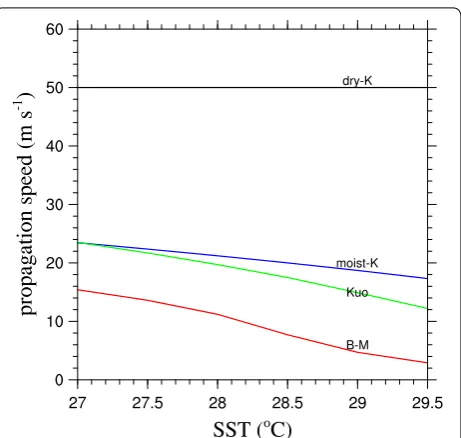
As shown in Fig. 5, given typical atmospheric static stability parameter, the dry baroclinic Kelvin (gravity) wave speed is 50 m/s. The convectively coupled Kelvin wave (moist-K) speed decreases with increasing SST with a value of 19 m/s for SST = 29 °C. The MJO eastward-propagating speed is further slowed down by the cou-pling of Kelvin and Rossby waves from 19 to 14.9 m/s when SST = 29 °C with the simplified Kuo scheme (with-out moisture feedback). This is because the Rossby wave component induced by β-effect tends to move westward. Finally, the moisture feedback in B-M scheme can fur-ther substantially slow down the eastward propagation speed to about 5 m/s. The SST dependence of tion speed is consistent with the observed slow propaga-tion over the warm pool and fast propagapropaga-tion in the cold ocean in the western hemisphere (Knutson et al. 1986).
(13)
∂Φ
∂t +C
2
0(1−bQ)∇ · �v=0
Why does the moisture feedback in the B-M simula-tion substantially slow down the eastward propagasimula-tion of the MJO mode? Wang and Chen (2016) has shown that the B-M scheme couples more tightly the convection and Rossby waves, resulting in an enhanced Rossby wave component, which substantially slows down MJO east-ward propagation because the Rossby wave component induced by β-effect tends to move westward. The theo-retical result here finds support from a previous aqua-planet numerical study, which shows that when Rossby wave component becomes weak, the eastward propaga-tion becomes faster (Kang et al. 2013).
c. Mechanism of amplification and decay of MJO The MJO instability in the trio-interaction model depends on the basic state SST or basic state moist static energy, which is the ultimate heating energy source for the MJO instability. The non-linear evolution of the simulated MJO mode in Fig. 3b has elucidated why MJO intensifies over the warm pool oceans while decays over the cold ocean. The linear instability analysis of Liu and Wang (2016b) shows that the growth rate of the MJO mode increases as SST increases. Note that the growth rate in the Kuo simulation without moisture feedback is significantly higher than that in the B-M simulation, sug-gesting the moisture feedback reduces the growth rate.
Why does the moisture feedback in B-M simulation reduce the instability? Energetic analysis provides an answer. The energetic analysis also reveals how MJO
perturbation energy is generated and what characteristic structure a growing MJO mode has. Following Wang and Li (1994), the non-dimensional total energy equation for the free atmosphere could be expressed as:
where the angle bracket denotes spatial average over the entire domain. The first term on the right-hand side of Eq. (14) represents the generation of eddy available potential energy (EAPE), which is determined by the negative covariance between precipitation and low-level geopotential height perturbation, and occurs only in the precipitation region; the second to fourth terms repre-sent the energy losses due to BL friction, Rayleigh friction and Newtonian cooling.
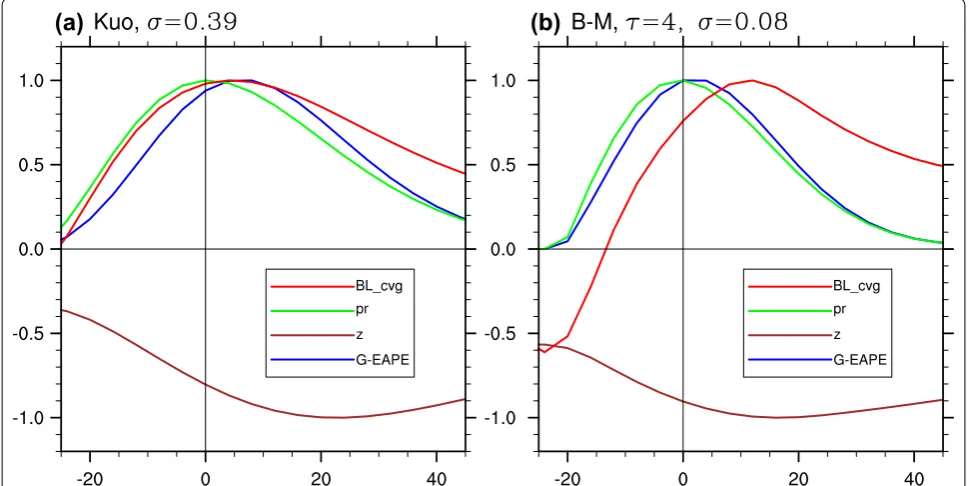
Figure 6 shows zonal distribution of EAPE generation along the equator where the EAPE reaches a maximum. In both parameterization schemes, precipitation occurs in the low-level low-pressure regions, so that the covari-ance between the low-pressure and precipitation heat-ing generates EAPE. The maximum eddy generation rate nearly coincides with precipitation. However, the region of EAPE generation slightly leads the precipitation in
(14)
∂ ∂t
(u2+v2+Φ2)/2
= −�ΦH(Pr)� −d�Φ∇ ·Vb�
−ǫ <u2+v2>−µΦ2
both simulations, which is consistent with observations (Johnson et al. 1999). This phase difference also implies that the EAPE generation may contribute to eastward propagation. The model reproduces an important feature that agrees very well with observation, that is, the low sea-level pressure and associated BL convergence leads precipitation region. This can be seen from (a) the low-pressure center and the maximum BL convergence center being located to the east of the precipitation center, and (b) the “integrated” low-pressure and BL convergence to the east of the precipitation center being much stronger than those to the west of the precipitation center.
In addition to the common features in the EAPE gen-eration, there is a difference between the two simula-tions. As shown in Fig. 6a, the maximum precipitation in Kuo simulation almost coincides with the maximum BL convergence, which means that the frictional moisture convergence can interact directly with precipitation and effectively generate the EAPE. In the B-M simulation, on the other hand, the maximum BL convergence is ahead of the precipitation maxima (Fig. 6b), and the maximum precipitation nearly coincides with the maximum mois-ture perturbation (not shown here), because the precipi-tation in the B-M simulation is determined by moisture anomaly, which is a delayed response to frictional mois-ture convergence, and the release of precipitation heat-ing takes a finite time (the convective adjustment time τ).
(a)
(b)
Thus, the energy generation rate or the growth rate in the B-M simulation is generally smaller than that in the Kuo simulation. The frictional convergence feedback gener-ates convective available potential energy (CAPE) for the instability; the moisture feedback can reduce the instabil-ity by reducing the efficiency of CAPE releasing rate.
Conclusion and discussion
Although notable progress has been made in developing the general circulation models, by far the MJO stays poorly simulated in many models and our prediction skill for MJO remains limited. Lack of adequate understanding of the essential MJO dynamics has resulted in divergent theories.
A general theoretical model for understanding essential dynamics of the MJO is proposed to extend the Matsuno and Gill models by including the trio-interaction among parameterized convective heating, moisture, and the free tropospheric low-frequency equatorial wave dynamics and BL dynamics (Fig. 2). The model accommodates different cumulus parameterization schemes. It is demonstrated that the five types of existing theoretical models are spe-cial cases of the general model, including the frictionally coupled Kelvin–Rossby wave model, the moisture mode model, the frictionally coupled dynamic moisture model, the MJO skeleton model, and the gravity wave interference model. The general model allows for considering realistic basic state SST, transient BL, non-linear heating, etc. The general model can also further extend to include other processes that are deemed to have important impacts on MJO’s evolution, such as upscale eddy momentum, mois-ture and heat transfer. The present model can also be extended to a multi-layer model to incorporate multi-layer cloud precipitation effects and explore stratiform cloud– wave interaction and radiation–cloud interaction. These are the future works and are currently underway.
The trio-interaction model with B-M scheme yields a frictionally coupled dynamic moisture mode, which repro-duces the following essential characteristics of the observed MJO (Fig. 3): (a) a coupled Kelvin–Rossby wave structure, (b) slow eastward propagation (~5 m/s) over warm pool, (c) planetary (zonal) scale circulation, (d) a vertical structure in which BL moisture convergence leads major convection, and (e) amplification/decay over warm/cold SST regions.
Using trio-interaction model, we demonstrate the fric-tional convergence feedback provides a mechanism that couples the Kelvin wave and Rossby wave together along with convective heating, and selects eastward propaga-tion. Without frictional convergence feedback, the Kelvin and Rossby waves are decoupled, and there is no grow-ing mode (Fig. 4). Therefore, the frictional convergence feedback acts like an engine that drives the wave dynamic feedback and moisture feedback to generate the unstable dynamic moisture mode.
Interestingly, the model suggests that eastward propa-gation speed decreases with increasing relative intensity of the Rossby wave component. The moisture feedback in the simplified B-M scheme can enhance the relative intensity of Rossby wave response in the MJO structure, thereby substantially reduce the eastward propagation speed (Fig. 5). The inverse relationship between eastward propagation speed and the relative intensity of the Rossby wave component seems to be consistent with the differ-ence between the models’ simulated non-propagating and propagating MJOs (Wang and Chen 2016), but needs to be further verified by observations and model results.
The trio-interaction theory offers answers to three key questions concerning essential dynamics of the MJO: why the MJO possesses a mixed Kelvin–Rossby wave structure; what makes the MJO move eastward slowly (about 5 m/s) in the eastern Hemisphere, resulting in the 30–60-day rhythm, and why MJO amplifies over the warm pool ocean.
The model solutions vary with the model parameters. The most sensitive parameters are the BL Ekman num-ber Ek and the convective adjustment time τ in the B-M
scheme. An enhanced BL convergence would enhance frictional moisture feedback, resulting in stronger insta-bility and enhanced Rossby wave component that slows down eastward propagation. A longer adjustment time τ
means slower atmospheric adjustment toward the quasi-equilibrium reference state, thus the precipitation inten-sity weakens, leading to weaker instability.
The results of this study suggest that MJO propagation and instability are sensitive to cumulus parameterization schemes because different schemes may produce differ-ent structures of the MJO and propagation speeds, and the EAPE generation is related to the horizontal struc-tures. The observed MJO structure consists of Kelvin wave and Rossby wave components but it is not the same as Gill pattern because the heating in Gill model is speci-fied whereas the heating in MJO interacts with dynam-ics and moisture. Even within the chosen B-M scheme, the instability and propagation speed depend on sensi-tive parameters such as the convecsensi-tive adjustment time
τ. This may explain why a variety of MJO behaviors have been produced in GCMs and why tuning parameters or change of cumulus parameterization can effectively improve the MJO simulation.
numerical models’ problems, we suggest focusing on the zonal structural asymmetry in the lower troposphere generated by the BL moisture feedback, including the phase leading of the BL moisture convergence to major convection (by about 4–5 days) and the associated lower troposphere moistening (increase in equivalent potential temperature), destabilization (increase of the convective instability), the 700 hPa diabatic heating and the gen-eration of MJO available potential energy. In the mod-els with good MJO simulation, the BL convergence can enhance congestus cloud heating and upward transport of moisture that further feeds back to BL moisture con-vergence. This positive feedback could amplify the effects of frictional convergence feedback. In the models with poor MJO simulation, the BL convergence is very weak to the east of MJO convective center, while the associated shallow convective heating as well as the vertically tilted structure disappears (Jiang and al 2015). This implies that MJO simulation may be sensitive to shallow and conges-tus cumulus parameterization schemes and the BL turbu-lence parameterization in GCMs. While the BL frictional convergence always exists in GCMs to various degrees, the ways by which BL convergence interacts with shallow and congestus clouds in different GCMs may differ and this interaction could significantly affect the frictional convergence feedback and thus the MJO behavior. This interactive process should be represented correctly in the numerical modeling of MJO with GCMs, including the lower tropospheric convective mixing and low cloud feedback.
Authors’ contributions
BW wrote the major parts of the manuscript. FL supplemented some parts of the manuscript and commented on the manuscript. GC supplemented some parts of the manuscript and provided all drawings as well as commented on the manuscript. All authors read and approved the final manuscript.
Author details
1 Earth System Modeling Center, Nanjing University of Information Science and Technology, Nanjing, China. 2 Department of Atmospheric Sciences and Atmosphere-Ocean Research Center, University of Hawaii at Manoa, Honolulu, HI 96822, USA.
Acknowledgements
This work is supported by the NSF award #AGS-1540783 and the Atmos-phere–Ocean Research Center sponsored by the Nanjing University of Infor-mation Science and Technology and University of Hawaii. This is the SEOST publication 9875, IPRC publication 1229 and ESMC publication 132.
Competing interests
The authors declare that they have no competing interests.
Received: 15 September 2016 Accepted: 29 November 2016
References
Adames ÁF, Kim D (2016) The MJO as a dispersive, convectively coupled mois-ture wave: theory and observations. J Atmos Sci 73:913–941
Adames ÁF, Wallace JM (2014) Three-dimensional structure and evolution of the vertical velocity and divergence fields in the MJO. J Atmos Sci 71:4661–4681
Andersen JA, Kuang Z (2012) Moist static energy budget of MJO-like distur-bances in the atmosphere of a zonally symmetric aquaplanet. J Clim 25:2782–2804
Benedict JJ, Randall DA (2007) Observed characteristics of the MJO relative to maximum rainfall. J Atmos Sci 64:2332–2354
Biello JA, Majda AJ (2005) A new multiscale model for the Madden–Julian oscillation. J Atmos Sci 62:1694–1721
Boos WR, Kuang Z (2010) Mechanisms of poleward propagating, intraseasonal convective anomalies in cloud system-resolving models. J Atmos Sci 67:3673–3691
Bretherton CS, Peters ME, Back LE (2004) Relationships between water vapor path and precipitation over the tropical oceans. J Clim 17:1517–1528 Chen G, Wang B (2016) Reexamination of the wave activity envelope con-vective scheme in theoretical modeling of MJO. J Clim. doi:10.1175/ JCLI-D-16-0325.1
DeMott CA, Stan C, Randall DA (2013) Northward propagation mechanisms of the boreal summer intraseasonal oscillation in the ERA-Interim and SP-CCSM. J Clim 26:1973–1992
Drbohlav HKL, Wang B (2005) Mechanism of the northward-propagating intraseasonal oscillation: insights from a zonally symmetric model*. J Clim 18:952–972
Emanuel KA (1987) An air-sea interaction model of intraseasonal oscillations in the tropics. J Atmos Sci 44:2324–2340
Flatau M, Flatau PJ, Phoebus P, Niiler PP (1997) The feedback between equato-rial convection and local radiative and evaporative processes: the impli-cations for intraseasonal oscillations. J Atmos Sci 54:2373–2386 Frierson DM, Majda AJ, Pauluis OM (2004) Large scale dynamics of
precipita-tion fronts in the tropical atmosphere: a novel relaxaprecipita-tion limit. Commun Math Sci 2:591–626
Fu X, Wang B (2004) The Boreal-Summer intraseasonal oscillations simulated in a hybrid coupled atmosphere–ocean model*. Mon Weather Rev. 132:2628–2649
Fu X, Wang B (2009) Critical roles of the stratiform rainfall in sustaining the Madden–Julian oscillation: GCM experiments. J Clim 22:3939–3959 Fuchs Ž, Raymond DJ (2002) Large-scale modes of a nonrotating atmos-phere with water vapor and cloud-radiation feedbacks. J Atmos Sci 59:1669–1679
Gill AE (1980) Some simple solutions for heat-induced tropical circulation. Q J R Meteorol Soc. 106:447–462
Grabowski WW, Moncrieff M (2004) Moisture–convection feedback in the tropics. Q J R Meteorol Soc. 130:3081–3104
Gyoswami B, Shukla J (1984) Quasi-periodic oscillations in a symmetric general circulation model. J Atmos Sci 41:20–37
Hendon HH, Salby ML (1994) The life cycle of the Madden–Julian oscillation. J Atmos Sci 51:2225–2237
Hoskins B, Wang B (2006) Large-scale atmospheric dynamics. The Asian Mon-soon. Springer, Berlin, pp 357–415
Hsu P-C, Li T (2012) Role of the boundary layer moisture asymmetry in causing the eastward propagation of the Madden–Julian oscillation*. J Clim 25:4914–4931
Jiang X et al (2015) Vertical structure and physical processes of the Madden– Julian oscillation: exploring key model physics in climate simulations. J Geophys Res Atmos 120:4718–4748
Jiang X, Li T, Wang B (2004) Structures and Mechanisms of the northward prop-agating boreal summer intraseasonal oscillation*. J Clim 17:1022–1039 Johnson RH, Rickenbach TM, Rutledge SA, Ciesielski PE, Schubert WH (1999)
Trimodal characteristics of tropical convection. J Clim 12:2397–2418 Kang IS, Kim D, Kug JS (2010) Mechanism for northward propagation of boreal
summer intraseasonal oscillation: convective momentum transport. Geophys Res Lett 37:24804
Kang IS, Liu F, Ahn MS, Yang YM, Wang B (2013) The role of SST structure in convectively coupled Kelvin–Rossby waves and its implications for MJO formation. J Clim 26:5915–5930
Kemball-Cook S, Wang B (2001) Equatorial waves and air-sea interaction in the boreal summer intraseasonal oscillation. J Clim 14:2923–2942
Khouider B, Majda AJ (2007) A simple multicloud parameterization for convec-tively coupled tropical waves. Part II: nonlinear simulations. J Atmos Sci 64:381–400
Kikuchi K, Takayabu YN (2004) The development of organized convection asso-ciated with the MJO during TOGA COARE IOP: trimodal characteristics. Geophys Res Lett 31:L10101. doi:10.1029/2004GL019601
Kiladis GN, Wheeler MC, Haertel PT, Straub KH, Roundy PE (2009) Convectively coupled equatorial waves. Rev Geophys 47:2003
Kim D, Kug J-S, Sobel AH (2014) Propagating versus nonpropagating Madden– Julian oscillation events. J Clim 27:111–125
Knutson TR, Weickmann KM (1987) 30–60 day atmospheric oscillations: com-posite life cycles of convection and circulation anomalies. Mon Weather Rev 115:1407–1436
Knutson TR, Weickmann KM, Kutzbach JE (1986) Global-scale intrasea-sonal oscillations of outgoing longwave radiation and 250 mb zonal wind during northern hemisphere summer. Mon Weather Rev. 114:605–623
Krishnamurti TN, Oosterhof DK, Mehta AV (1988) Air–sea interaction on the time scale of 30 to 50 days. J Atmos Sci 45:1304–1322
Kuang Z (2008) A moisture-stratiform instability for convectively coupled waves. J Atmos Sci 65:834–854
Lau K, Peng L (1987) Origin of low-frequency (intraseasonal) oscillations in the tropical atmosphere. Part I: basic theory. J Atmos Sci 44:950–972 Lee SS, Wang B, Waliser DE, Neena JM, Lee JY (2015) Predictability and
predic-tion skill of the boreal summer intraseasonal oscillapredic-tion in the intrasea-sonal variability hindcast experiment. Clim Dyn 45:2123–2135
Li T, Zhou C (2009) Planetary scale selection of the Madden–Julian oscillation*. J Atmos Sci 66:2429–2443
Lin J, Mapes B, Zhang M, Newman M (2004) Stratiform precipitation, verti-cal heating profiles, and the Madden–Julian oscillation. J Atmos Sci 61:296–309
Liu F, Wang B (2012a) A frictional skeleton model for the Madden–Julian oscil-lation. J Atmos Sci 69:2749–2758
Liu F, Wang B (2012b) A conceptual model for self-sustained active-break Indian summer monsoon. Geophys Res Lett 39:L20814
Liu F, Wang B (2012c) A model for the interaction between 2-day waves and moist kelvin waves. J Atmos Sci 69:611–625
Liu F, Wang B (2013a) An air–sea coupled skeleton model for the Madden– Julian oscillation. J Atmos Sci 70:3147–3156
Liu F, Wang B (2013b) Impacts of upscale heat and momentum transfer by moist Kelvin waves on the Madden–Julian oscillation: a theoretical model study. Clim Dynam 40:213–224
Liu F, Wang B (2014) A mechanism for explaining the maximum intraseasonal oscillation center over the western north pacific*. J Clim 27:958–968 Liu F, Wang B (2016a) Role of horizontal advection of seasonal-mean moisture
in the Madden–Julian oscillation: a theoretical model analysis. J Clim. doi:10.1175/JCLI-D-1116-0078.1171
Liu F, Wang B (2016b) Effects of moisture feedback in a frictional coupled Kel-vin–Rossby wave model and implication in the Madden–Julian oscillation dynamics. Clim Dynam. doi:10.1007/s00382-00016-03090-y
Liu F, Huang G, Feng L (2012) Critical roles of convective momentum transfer in sustaining the multi-scale Madden–Julian oscillation. Theor Appl Climatol 108:471–477
Liu F, Wang B, Kang I-S (2015) Roles of barotropic convective momentum transport in the intraseasonal oscillation. J Clim 28:4908–4920 Madden RA, Julian PR (1971) Detection of a 40–50 day oscillation in the zonal
wind in the tropical pacific. J Atmos Sci 28:702–708
Madden RA, Julian PR (1972) Description of global-scale circulation cells in the tropics with a 40–50 day period. J Atmos Sci 29:1109–1123
Majda AJ, Biello JA (2004) A multiscale model for tropical intraseasonal oscilla-tions. Proc Natl Acad Sci USA 101:4736–4741
Majda AJ, Stechmann SN (2009) The skeleton of tropical intraseasonal oscilla-tions. Proc Natl Acad Sci 106:8417–8422
Majda AJ, Stechmann SN, Khouider B (2007) Madden–Julian Oscillation analog and intraseasonal variability in a multicloud model above the equator. Proc Natl Acad Sci USA 104:9919–9924
Maloney ED (2009) The moist static energy budget of a composite tropical intraseasonal oscillation in a climate model. J Clim 22:711–729 Maloney ED, Sobel AH, Hannah WM (2010) Intraseasonal variability in an
aqua-planet general circulation model. J Adv Model Earth Syst 2:1–14
Mapes BE (2000) Convective inhibition, subgrid-scale triggering energy, and stratiform instability in a toy tropical wave model. J Atmos Sci 57:1515–1535
Mapes B, Tulich S, Lin J, Zuidema P (2006) The mesoscale convection life cycle: building block or prototype for large-scale tropical waves? Dynam Atmos Oceans 42:3–29
Matsuno T (1966) Quasi-geostrophic motions in the equatorial area. J Meteor Soc Jpn 44:25–43
Moskowitz BM, Bretherton CS (2000) An analysis of frictional feedback on a moist Equatorial Kelvin mode. J Atmos Sci 57:2188–2206
Nakazawa T (1988) Tropical super clusters within intraseasonal variations over the western Pacific. J Meteor Soc Jpn 66:823–839
Neelin JD, Held IM, Cook KH (1987) Evaporation-wind feedback and low-fre-quency variability in the tropical atmosphere. J Atmos Sci 44:2341–2348 Neena JM, Lee JY, Waliser D, Wang B, Jiang X (2014) Predictability of the Mad-den–Julian oscillation in the Intraseasonal variability hindcast experiment (ISVHE). J Clim 27:4531–4543
Peters ME, Bretherton CS (2005) A simplified model of the walker circulation with an interactive ocean mixed layer and cloud-radiative feedbacks. J Clim 18:4216–4234
Pritchard MS, Bretherton CS (2014) Causal evidence that rotational moisture advection is critical to the superparameterized Madden–Julian oscillation. J Atmos Sci 71:800–815
Pritchard MS, Yang D (2016) Response of the superparameterized Madden– Julian oscillation to extreme climate and basic-state variation challenges a moisture mode view. J Clim 29:4995–5008
Rui H, Wang B (1990) Development characteristics and dynamic structure of tropical intraseasonal convection anomalies. J Atmos Sci 47:357–379 Seo K-H, Wang W (2010) The Madden–Julian oscillation simulated in the NCEP
climate forecast system model: the importance of stratiform heating. J Clim 23:4770–4793
Sobel A, Maloney E (2012) An idealized semi-empirical framework for mod-eling the Madden–Julian oscillation. J Atmos Sci 69:1691–1705 Sobel A, Maloney E (2013) Moisture modes and the eastward propagation of
the MJO. J Atmos Sci 70:187–192
Stechmann SN, Majda AJ (2015) Identifying the skeleton of the Madden–Julian oscillation in observational data. Mon Weather Rev 143:395–416 Thual S, Majda AJ, Stechmann SN (2014) A Stochastic skeleton model for the
MJO. J Atmos Sci 71:697–715
Vitart F (2014) Evolution of ECMWF sub-seasonal forecast skill scores. Q J R Meteorol Soc 140:1889–1899
Waliser DE (2012) The “year” of tropical convection (May 2008–April 2010): climate variability and weather highlights. Bull Am Meteorol Soc 93:1189–1218
Wang B (1988a) Comments on “An air-sea interaction model of intraseasonal oscillation in the tropics”. J Atmos Sci 45:3521–3525
Wang B (1988b) Dynamics of tropical low-frequency waves: an analysis of the moist Kelvin wave. J Atmos Sci 45:2051–2065
Wang B (2012) Theory. In: Lau WKM, Waliser DE (eds) Intraseasonal variability in the atmosphere–ocean climate system, 2nd edn. Springer, Berlin, pp 335–398 Wang B, Chen J (1989) On the zonal-scale selection and vertical structure of equatorial intraseasonal waves †. Q J R Meteorol Soc 115:1301–1323 Wang B, Chen G (2016) A general theoretical framework for understanding
essential dynamics of Madden–Julian oscillation. Clim Dyn, accepted Wang B, Li T (1994) Convective interaction with boundary-layer
dynam-ics in the development of a tropical intraseasonal system. J Atmos Sci 51:1386–1400
Wang B, Liu F (2011) A model for scale interaction in the Madden–Julian oscil-lation. J Atmos Sci 68:2524–2536
Wang B, Moon JY (2016) Sub-seasonal prediction of extreme weather events, in “bridging science and policy implication for managing climate extremes: linking science and policy implication”. In: Chung CS, Wang B (eds). World Scientific Series of Asia-Pacific Weather and Climate Press. Revised
Wang B, Rui H (1990a) Dynamics of the coupled moist Kelvin–Rossby wave on an equatorial β-plane. J Atmos Sci 47:397–413
Wang B, Rui H (1990b) Synoptic climatology of transient tropical intraseasonal convection anomalies: 1975–1985. Meteorol Atmos Phys 44:43–61 Wang B, Xie X (1997) A Model for the boreal summer intraseasonal oscillation.
Wang B, Xie X (1998) Coupled modes of the warm pool climate system. Part I: the role of air–sea interaction in maintaining Madden–Julian oscillation. J Clim 11:2116–2135
Wang B, Zhang Q (2002) Pacific-East Asian teleconnection. Part II: how the Philippine Sea anomalous anticyclone is established during El Niño development*. J Clim 15:3252–3265
Webster PJ, Holton JR (1982) Cross-equatorial response to middle-latitude forc-ing in a zonally varyforc-ing basic state. J Atmos Sci 39:722–733
Wheeler MC, Hendon HH (2004) An all-season real-time multivariate MJO index: development of an Index for monitoring and prediction. Mon Weather Rev 132:1917–1932
Wheeler M, Kiladis GN (1999) Convectively coupled equatorial waves: analysis of clouds and temperature in the wavenumber-frequency domain. J Atmos Sci 56:374–399
Woolnough S, Slingo J, Hoskins B (2001) The organization of tropical convec-tion by intraseasonal sea surface temperature anomalies. Q J R Meteorol Soc 127:887–907
Xiang B, Zhao M, Jiang X, Lin S-J, Li T, Fu X, Vecchi G (2015) The 3–4-week MJO prediction skill in a GFDL coupled model. J Clim 28:5351–5364 Yang D, Ingersoll AP (2011) Testing the hypothesis that the MJO is a mixed
Rossby-Gravity wave packet. J Atmos Sci 68:226–239
Yang D, Ingersoll AP (2013) Triggered convection, gravity waves, and the MJO: a shallow-water model. J Atmos Sci 70:2476–2486
Yang D, Ingersoll AP (2014) A theory of the MJO horizontal scale. Geophys Res Lett 41:1059–1064