The Thirty-Third AAAI Conference on Artificial Intelligence (AAAI-19)
On Structured Argumentation with Conditional Preferences
Phan Minh Dung
∗ Department of Computer ScienceAsian Institute of Technology Thailand
Phan Minh Thang
BUUIC College of Burapha UniversityThailand
Tran Cao Son
Department of Computer ScienceNew Mexico State University Las Cruces, NM, USA
Abstract
We study defeasible knowledge bases with conditional pref-erences (DKB). A DKB consists of a set of undisputed facts and a rule-based system that contains different types of rules: strict, defeasible, and preference. A major challenge in defin-ing the semantics of DKB lies in determindefin-ing how conditional preferences interact with the attack relations represented by rebuts and undercuts, between arguments.
We introduce the notions of preference attack relations as sets of attacks between preference arguments and the rebuts or undercuts among arguments as well as of preference attack relation assignments which map knowledge bases to prefer-ence attack relations. We present five rational properties (re-ferred to as regular properties), the inconsistency-resolving, effective rebuts, context-independence, attack monotonicity and link-orientation properties generalizing the properties of the same names for the case of unconditional preferences. Preference attack relation assignment are defined asregular
if they satisfy all regular properties. We show that the set of regular assignments forms a complete lower semilattice whose least element is referred to as the canonical preference attack relation assignment. Canonical attack relation assign-ment represents the semantics of preferences in defeasible knowledge bases as intuitively, it could be viewed as being uniquely identified by the regular properties together with the principle of minimal removal of undesired attacks. We also present thenormalpreference attack relation assignment as an approximation of the canonical attack relation assignment.
Keywords: Conditional preferences, regular properties, minimal removal principle, preference attack relation as-signments, canonical and normal preference attack relation assignments.
Introduction
There are extensive research on rule-based systems with prioritized rules (see, e.g., Modgil and Prakken (2014); Amgoud and Cayrol (2002); Brewka (1989); Delgrande, Schaub, and Tompits (2003); Schaub and Wang (2001); Brewka and Eiter (1999)). Prakken and Sartor (1997) is ar-guably the first attempt to study the application of priorities of defeasible rules to define a preference order between
ar-∗
The lead and corresponding author
Copyright c2019, Association for the Advancement of Artificial Intelligence (www.aaai.org). All rights reserved.
guments and then using this preference order to remove un-desired attacks. Amgoud and Cayrol (2002) has studied dif-ferent ways to define preference order between arguments. Prakken (2010) and Modgil and Prakken (2013; 2014) have proposed ASPIC+, a rich framework for structured argu-mentation with prioritized rules with several distinct systems of preference orders between arguments.
The rich diversity of proposed attack relations poses a se-rious challenge for any potential user of structured argumen-tation as such a user would have to decide which attack rela-tion should be selected and implemented for her/his domain. To address this problem, general principles for the character-ization and evaluation of alternative attack relations for rule-based systems are needed. Caminada and Amgoud (2007) have introduced the postulates of consistency and closure for argument-based systems. A subargument closure postulate stating that any extension should contain all subarguments of its arguments has been studied by Martinez, Garcia, and Simari (2006), Amgoud (2014), Modgil and Prakken (2013). The three proposed postulates give important insights into the characteristics of attack relations in structured argumen-tation. But they are not sufficient to guarantee intuitive se-mantics, as they do not take into account the preferences among defeasible rules. Dung (2016) has proposed a set of simple and intuitive properties, referred to as regular prop-erties, to study the attack relations. Dung and Thang (2018) have showed that these properties coupled with the minimal removal principle stating that the removal of attacks should be kept to a minimum, uniquely identify the canonical attack relations that could be viewed as representing the intended attack relations for structured argumentation with prioritized rules.
Until now, axiomatic analysis of attack relations has been carried out mostly for systems with unconditional prefer-ences. In the next example, an extended version of the Sher-lock Holmes example from Dung (2016); Dung and Thang (2018), we can see that conditional preferences could be a natural part of many defeasible knowledge bases.
Example 1(Adapted from Dung (2016)). Sherlock Holmes is investigating a case involving three personsP1, P2andS
together with the dead body of a big man. Furthermore S is a small child who cannot kill a big man andP1is a beneficiary
from the dead of the big man.
base.
1. The knowledge that one of the persons is the murderer is represented by three strict rules:
r1: Inno(P1), Inno(S)→ ¬Inno(P2)1 r2: Inno(P2), Inno(S)→ ¬Inno(P1) r3: Inno(P1), Inno(P2)→ ¬Inno(S)
2. The legal principle that people are considered innocent until proven otherwise could be represented by three de-feasible rules di : ⇒Inno(Pi)fori = 1,2together
withd: ⇒Inno(S)
3. A “rule-of-thumb” for the investigation is to find out whether the possible suspects have any motives and to fo-cus the investigation on the one with strong motive to com-mit the crime. Such “rule-of-thumb” can be represented by two conditional preferences:
• π1:Have M otive(P1),¬Have M otive(P2)→d1≺d2.
• π2:¬Have M otive(P1), Have M otive(P2)→d2≺d1.
The rules state that ifPihas a motive andPj(i6=j) does
not have a motive then the defaultdj is more preferred
thandi.
4. A good reason for having a motive to kill is to be a bene-ficiary from the dead of the deceased.
• r4: Benef iciary(P1)→Have M otive(P1)
• r5: Benef iciary(P2)→Have M otive(P2)
5. Peoples are normally assumed not to have motives to kill. d3:⇒¬Have M otive(P1) d4:⇒¬Have M otive(P2).
6. The facts that S is a small child andP1 is a beneficiary
from the dead of the big man are represented by atoms Inno(S), Benef iciary(P1).
The considered knowledge base is represented by Ksh=(RSsh, RDsh, RPsh, BEsh)withRSsh={r1, r2, r3, r4, r5}containing of the strict rules,RDsh={d1, d2, d, d3, d4} consisting of the defeasible rules and RPsh =
{π1, π2}consisting of the preference rules whileBEsh =
{Inno(S), Benef iciary(P1)}represents the set of facts.
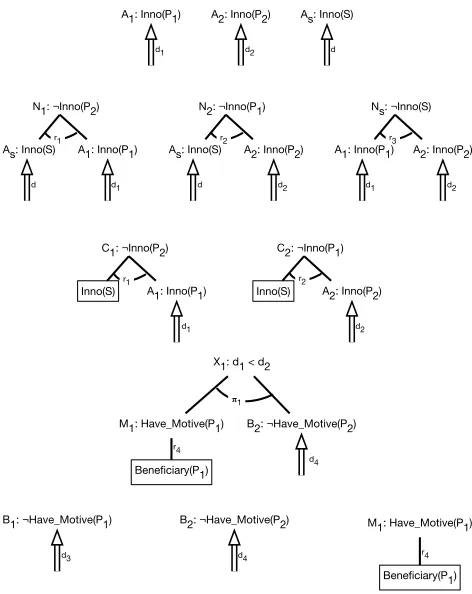
Relevant arguments are given in figures 1. Among these, X1 is a preference argument (formal definition a bit later)
whose conclusion isd1 ≺ d2. It is easy to see thatX1 is
defeasible sinced4is defeasible.
In this paper, we develop a framework for dealing with conditional preferences in structured argumentation. We de-fine defeasible knowledge bases with conditional prefer-ences (DKB) over a rule-based system. The semantics of a DKB is defined by a preference-based argumentation frame-work whose set of arguments consists of the arguments of the DKB and its direct undercuts and rebuts and whose set of attacks consists of the set of attacks created from the rebuts and undercuts of the DKB and a preference attack relation— a set of attacks between preference arguments and the rebuts or undercuts among arguments. We prove that this seman-tics is a conservative generalization of the semanseman-tics of basic knowledge bases when restricted to knowledge bases with-out preferences.
1
‘Inno’ stands for ‘Innocent’.
A1: Inno(P1)
d1
C1: ¬Inno(P2)
Inno(S)r1 A2: Inno(P2)
d2
C2: ¬Inno(P1)
Inno(S) r2 A1: Inno(P1)
d1
As: Inno(S)
d
A2: Inno(P2)
d2
A1: Inno(P1)
d1
N1: ¬Inno(P2)
d r1
As: Inno(S) A2: Inno(P2)
d2
N2: ¬Inno(P1)
d r2
As: Inno(S) A2: Inno(P2)
d2
Ns: ¬Inno(S)
d1 r3
A1: Inno(P1)
r4
B2: ¬Have_Motive(P2)
d4 X1: d1 < d2
M1: Have_Motive(P1)
Beneficiary(P1)
𝛑1
B1: ¬Have_Motive(P1)
d3
B2: ¬Have_Motive(P2)
d4
M1: Have_Motive(P1)
r4 Beneficiary(P1)
Figure 1: Sherlock Holmes Arguments
To analyze attack relations, we present the notion of a preference attack relation assignment which maps knowl-edge bases to preference attack relations and discuss five regular properties, the context-independence, effective re-buts, inconsistency-resolving, attack monotonicity, and link-orientation properties of preference attack relations gener-alizing properties of the same names in the unconditional cases in Dung (2016) and Dung and Thang (2018). We say an assignment is regular if it satisfies all regular properties and show that the set of regular assignments forms a com-plete lower semilattice whose least element is referred to as the canonical preference attack relation assignment. Canon-ical attack relation assignment could be viewed as represent-ing the semantics of preferences in defeasible knowledge bases as intuitively, it is uniquely identified by the regular properties together with the principle of minimal removal of undesired attacks.
We also define a notion of a normal preference attack re-lation assignment that satisfies all regular properties and dis-cuss sufficient conditions under which canonical and normal preference attack relation assignments coincide.
Preliminary: Abstract Argumentation
An abstract argumentation framework Dung (1995) is apair AF=(AR, At) whereAR is a set of arguments and
att ⊆ AR×AR.(A, B) ∈ Atmeans thatA attacksB. A set of argumentsSattacks (or is attacked by) an argument
conflict-freeif it does not attack itself. A set of argumentsSdefends
an argumentAifS attacks every argument that attacksA.
S isadmissibleifS is conflict-free and defends each argu-ment in it. Apreferred extensionis a maximal admissible set of arguments. Acomplete extensionis an admissible set of arguments containing each argument it defends. Astable ex-tensionis a conflict-free set of arguments that attacks every argument not belonging to it.
We introduce the concept of semilattice. A partial order2
≤ on a setS is a complete lower-semilattice (Davey and Priestley (2002)) iff each non-empty subset ofS has a infi-mum w.r.t.≤. It follows immediately that each non-empty complete lower semilatticeShas an unique least element.
Defeasible KBs with Conditional Preferences
We assume a non-empty setLof ground atoms. We distin-guish between• domain atoms representing propositions about the con-cerned domains;
• non-applicability atoms(orundercut atoms) of the form
abdrepresenting the non-applicability of a defeasible rule
deven if its premises hold; and
• preference atoms (or p-atom for short)of the formd ≺
d0(alsod0 d) whered, d0 are distinct defeasible rules, representing the preference ofd0overd.
A domain atoma(resp. its negation¬a) is called a positive (resp. negative)domain literal.aand¬aare said to be the complementary of each other. ≺ is a strict partial order. We write¬(d≺d0)ford0 ≺dand say thatd≺d0 andd0 ≺d
are complementary of each other. A set of literals is said to becontradictoryiff it contains an atom and its complement. We distinguish between strict and defeasible rules as of-ten done in the literature (e.g., Modgil and Prakken (2013, 2014); Garcia and Simari (2004)).
Definition 1. • Adefeasible(resp.strict)domain ruleris of the form b1, . . . , bn⇒h (resp.b1, . . . , bn→h)
whereb1, . . . , bnare domain literals, andhis
◦ a domain literal, or
◦ a non-applicability atomabd(andris also often called
anundercut rule).
• A preference rule (or p-rule for short)ris a strict rule of the formb1, . . . , bn → d0 ≺d1whereb1, . . . , bnare
domain literals andd0, d1are distinct defeasible domain
rules.
• The set{b1, . . . , bn}(resp. the literalhor the preference
atomd0≺d1) is referred to as thebody(resp.head) ofr
and denoted bybd(r)(resp.hd(r)).
When the body of a preference rule ris empty, we say thatrrepresents an unconditional preference.
Definition 2. • A rule-based system with conditional preferences(or simply arule-based system) is a
quadru-pleR= (RS, RD, RP, RT)where
◦ RSis a set of strict domain rules, and
◦ RDis a set of defeasible domain rules, and
◦ RP is a set of p-rules, and
2
A reflexive, transitive and antisymmetric relation
◦ RT is the set of alltransitive preference rulesthat are ground instances of the transitive rule
x≺y, y≺z → x≺z
wherex, y, zrange overRDandx, y, zare pairwise distinct.
• A defeasible knowledge base with conditional prefer-ences (DKB) (or a knowledge base) over R is a pair K = (R, BE)consisting of a rule-based systemR, and a set of ground domain literalsBE, thebase of evidence
ofK, representing unchallenged facts, observations.
• A DKBKisbasicif it contains no precedence rules.
A DKB K is often written directly as a tuple
(RS, RD, RP, RT, BE). For simplicity,we sometimes omit
the setRT in the description of a rule-based system. Arguments of a knowledge base are defined as follows.
Definition 3. LetK = (RS, RD, RP, RT, BE)be a KB. Anargumentw.r.t.Kis a proof tree defined as follows:
1. For eachα∈BE,[α]is an argument with conclusionα. 2. Let r be a rule of the formsα1, . . . , αn⇒(→)α, n≥0
fromRS∪RD∪RP∪RTand A1, . . . , An be arguments
with conclusionsαi,1 ≤i≤n, respectively. ThenA=
[A1, . . . , An, r]is an argument.
αandrare called theconclusionand thelast ruleofA and are denoted bycnl(A)andlast(A), respectively. Ifα is a domain (undercut) atom thenAis called a domain (undercut) argument.
3. Let A1, . . . , An be arguments with p-atoms αi as
conclusions, 1 ≤ i ≤ n, respectively. Then A = [A1, . . . , An]is apreference argument with the
conclu-sioncnl(A) ={α1, . . . , αn}.
4. Each argument w.r.t.Kis obtained by applying the above steps finitely many times.
In the following, a preference argument[A1, . . . , An]is
identified with any argument obtained from reordering of its components or removal of duplicates among its argu-ments. The set of all arguments (resp. preference arguments) w.r.t.K is denoted byARK (resp.ARp,K). ForS⊆ARK,
cnl(S)={l|A∈S, lappears incnl(A)}.
An argumentBis asubargumentof an argumentAiff (i)
B = A; or (ii)A = [A1, . . . , An, r]orA = [A1, . . . , An]
andBis a subargument of someAi.Bis aproper
subargu-mentofAifBis a subargument ofAandB 6=A.
A rule r is said to appear in an argument A if A = [A1, . . . , An, r]or r appears in some proper subargument A.
The set of defeasible rules appearing in an argumentA is denoted bydr(A).A isstrictif no defeasible rule appears in it. It isdefeasibleotherwise.Ais called basic defeasible
ifflast(A)is defeasible. The set of last defeasible rules in
A, denoted byldr(A), is{last(A)}if Ais basic defeasi-ble, otherwise it is equal ldr(A1)∪. . .∪ldr(An)where
A= [A1, . . . , An, r]orA= [A1, . . . , An].
re-buts or undercutsB if it is not relevant to specify the exact place at whichArebuts or undercutsB.
For a knowledge base K, let rbutK = {(A, B) |
ArebutsB}anducutK ={(A, B)| AundercutsB}.
Fur-thermore, dbutK = {(A, B)|A directly rebutsB} and
dcutK ={(A, B)|A directly undercutsB}.
Example 2. Let us revisit Ex. 1.3Most relevant arguments w.r.t. Ksh are given in Figure 1: (i) all arguments except
M1 are defeasible; (ii)A1,A2,As,B1, and B2 are basic
defeasible; and (iii)X1is a preference argument.
As we interpret the strict rules and the facts in the base of evidences of a knowledge base as representing the un-challenged knowledge and observation of the concerned do-main, it is therefore natural to expect that they are consistent as defined in the following definition.4
Definition 4. LetRbe a rule-based system.
1. The closure of a set of literals X over L w.r.t. a rule-based systemR, denoted by CNR(X), is the union of X and the set of conclusions of all strict arguments w.r.t. the knowledge base(R, Xdom)whereXdomis the set of
domain literals inX.X is said to beclosedw.r.t. Riff X=CNR(X). We writeX `Rl iff l∈CNR(X). X is said to be inconsistent w.r.t. R iff its closure CNR(X)is contradictory.X isconsistentw.r.t.Riff it is not inconsistent.
2. A knowledge baseKis said to beconsistentiff its base of evidenceBEis consistent w.r.t.R.
3. Ris said to be consistent iff the knowledge base(R,∅)is consistent.
4. CRdenotes the set of all consistent KBs overR.
Assumption:From now on, whenever we refer to rule-based systems, we always mean consistent ones.
Preference-based Argumentation Framework
of Defeasible KB with Conditional Preferences
The previous section defines different types of arguments and different types of attacks (like rebuts or undercuts) among them. However, the discussion thus far does not yet specify the semantics of a knowledge base. This is because it does not yet take into consideration preference arguments. In this section, we will address this problem.Example 3. ConsiderKshfrom Ex. 2. Let us consider the
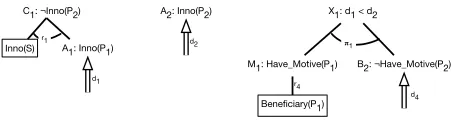
argumentsC1,A2, andX1(Fig. 2).
By definition, C1 directly rebuts A2 (i.e. (C1, A2) ∈ dbutKsh). The presence ofX1indicates thatd2is preferred
tod1. This means that the direct rebut (C1, A2) could be
removed from consideration wheneverX1is acceptable. In
other words, we can say thatX1attacks the rebuttal ofA2
byC1and represent thisattackin the form(X1,(C1, A2)).
3
Note that transitive rules are not mentioned explicitly in the representation of the knowledge base.
4
Note that if the evidences together with the strict rules are not consistent then they in fact represent defeasible knowledge. As such they should be represented by the defeasible rules, not by strict rules and facts.
r4
B2: ¬Have_Motive(P2)
d4 X1: d1 < d2
M1: Have_Motive(P1)
Beneficiary(P1) 𝛑1 A1: Inno(P1)
d1 C1: ¬Inno(P2)
Inno(S) r1
A2: Inno(P2)
d2
Figure 2:C1andA2and the preference argumentX1
The above example shows that preference arguments in-troduce a new type of attacks, i.e., attacks against direct re-buttals among arguments. We will refer to an attack of this new type as anattack by preference arguments. Formally, a set of attacks by preference arguments could be represented by a binary relation inARp,K×dbutK. Clearly, the choice
of the set defining the attacks by preference arguments will determine which arguments will be accepted. The next ex-ample illustrates this problem.
Example 4. Consider again Ksh from
Ex. 1. It is not difficult to see: dbutKsh =
{(N1, A2),(N2, A1),(C1, A2),(C2, A1),(M1, B1)}.
Furthermore, dcutKsh = ∅ and the only preference
argument w.r.t.KshisX1, i.e.,ARp,Ksh ={X1}.
We consider two situations with respect to the choice of the set of attacks by preference arguments:
• Assume that we select{(X1,(N1, A2)),(X1,(C1, A2))}
as the set of attacks by preference arguments. Then, be-causeX1 is not attacked by any argument w.r.t.Ksh, we
can conclude thatX1is always acceptable, and hence, we
should remove the attacks(N1, A2)and(C1, A2)from
con-sideration when determining the acceptability of arguments w.r.t.Ksh. Hence there is no attack againstA2which shows
thatP2is innocent andP1is not.
• Assume that we select the empty set as the set of attacks by preference arguments. Then argumentX1plays no role in
the attack relations betweenA1, A2, N1, N2, C1, C2. There
are then two acceptable scenarios: One in whichP1is
in-nocent and the other in whichP2is innocent.
Ex. 4 shows that the key question in dealing with pref-erence arguments is “what is the intuitively expected set of attacks by preference arguments?” More formally, given a knowledge baseK, which subset ofARp,K×dbutKshould
be selected as the set of attacks by preference arguments. In the rest of this paper, we will propose a solution for this question. Observe that we only consider attacks by prefer-ence arguments against rebuttals but not against undercuts. This is because, in our view, undercuts are preference inde-pendent, which is also in agreement with the view expressed by many others (e.g., by Modgil and Prakken (2013)).
At this point, it is instructive to recall that we are deal-ing with conditional preferences. Consequently, an attack against a rebuttal by a preference argument does not yet mean that the rebuttal should be eliminated from consid-eration. Let us consider again the argument X1 in Ex. 4.
As we have argued,X1 attacks the rebuttal of A2 by C1.
But this attack is effective only ifX1 itself is accepted. In
other words, whether the rebut(C1, A2)is accepted or not
depends on the acceptance ofX1. This insight suggests that
formal-ize this insight by viewing direct rebuts like(C1, A2)as
ar-guments. A question, that arises immediately, is thathow are the “rebut-arguments” attacked?Clearly, a rebut argument like(C1, A2)could be attacked in two ways: Attacking the
“rebutting connection” like the wayX1attacks(C1, A2)or
attacking the sourceC1.
As direct rebuttals are considered as arguments, it is con-venient to also consider direct undercuts as arguments. But in contrast to “rebut arguments,” there is only one way to attack “undercut arguments,” namely attacking their source. We can now introduce a novel notion of preference ar-gumentation framework capturing the key conceptual ideas discussed above.
Definition 5. (Preference-Based AF) Given a knowl-edge baseK, apreference-based argumentation framework (PAF)ofKis an abstract argumentation frameworkFK =
(ARPK, attF)where
• ARPK=ARK∪dbutK∪dcutK, and
• attF =dattK∪patt where
(a) dattK ⊆ (dbutK ∪ dcutK) × ARPK such that
((A, B), X)∈dattKiff
• X ∈ARKandBis a subargument ofX, or
• X=(C, D)∈(dbutK∪dcutK)andBis a subargument
ofC.
(b) patt ⊆ ARp,K ×dbutK where patt is often referred
to as thepreference attack relation(or justp-attack rela-tion) ofF.
For ease of reference, we often refer to a PAF ofKby the triple(ARPK, dattK, patt).
AsFK is an abstract argumentation framework, its
se-mantics is fully defined. As such, we can define the seman-tics of K by its PAFs. Intuitively,FK contains arguments
w.r.t. K together with the direct attacks and direct rebuts w.r.tKand the attacks inFKare of two types: attacks agains
arguments (type (a)) and attacks against attacks (type (b)). In this sense, PAF is similar to extended argumentation frame-works (see, e.g., Gabbay (2009); Baroni et al. (2011); Mod-gil (2009); Hanh et al. (2011); Young et al. (2018)) in which attacks against attacks are allowed or metalevel arguments are considered. The key difference between PAFs and ex-tended argumentation frameworks is that since PAF are ab-stract argumentation frameworks, we do not need to define new semantics for PAFs.
The next theorem shows that the concept of PAF is a con-servative generalization of the semantics of basic knowledge bases, i.e., when restricted to basic knowledge bases, our new concept of PAF delivers the same semantics captured in the traditional view of undercuts and rebuts as attacks.
Theorem 1. Let R be a basic rule-based system and K ∈ CR. Let F0 be the argumentation framework
(ARK, rbutK ∪ucutK)andF = (ARPK, dattK)be an
PAF of K.5 Then, (i) if E is a complete extension of F thenE ∩ARK is a complete extension of F0; and (ii) if Gis a complete extension ofF0 thenG∪ {(X, Y)|X ∈
5
Since there is no preference argument, the preference attack relation component is empty.
Gand(X, Y)∈dbutK∪dcutK}is a complete extension
ofF.
Definition 5 precisely defines dattK but leaves the set
patt unspecified. As we have alluded to above, the choice of pattwill affect the semantics ofK as it is specified by FK = (ARPK, dattK, patt). The next example discusses
this issue in more detail.
Example 5. Reconsider Ex. 4, we can easily check: (i)
F1=(ARPKsh, dattKsh, patt1), where patt1={(X1,(N1,
A2)),(X1,(C1, A2))}, has a unique stable (complete,
pre-ferred) extension that delivers the conclusion that P2 is
innocent in accordance with the 1st choice in Ex. 4; (ii)
F2 = (ARPKsh, dattKsh, patt2)wherepatt2 =∅.F2has
two stable extensions that deliver the two scenarios in the 2nd choice in Ex. 4.
F2 in Example 5 shows that not every p-attack relation
yields the expected and intuitive semantics for a DKB. The extreme case ofpatt2 =∅is equivalent to not considering
any preference in the DKB at all. Nevertheless, all PAFs—as defined in Definition 5- satisfies both the closure and subar-gument closure postulates introduced in Caminada and Am-goud (2007); Modgil and Prakken (2013); Martinez, Garcia, and Simari (2006); Amgoud (2014). We adapt these postu-lates to our notation below.
Note that for any setS ⊆ ARPK, we definecnl(S) =
cnl(S∩ARK).
• pattsatisfies theconsistency postulate(resp.closure pos-tulate) iff for each complete extensionEofFK,cnl(E)
is consistent (resp. closed);
• patt satisfies the subargument closure postulate iff for each complete extensionE of FK, E contains all
sub-arguments of its sub-arguments.
Before continuing, we introduce some additional notions. An argumentAis said to begenerated bya set of argu-mentsS⊆ARKif and only if all basic defeasible
subargu-ments ofAare subarguments of arguments inS.Ais said to begenerated bya set of arguments fromARPK if it is
generated by the arguments fromARKin this set. The next
theorem shows the closure and subargument closure postu-lates are satisfied with anypatt.
Theorem 2. LetRbe a rule based-system,K∈CR, andF= (ARPK, dattK, patt)a PAF ofK. IfEis a complete
exten-sion ofFthenEcontains all arguments generated byE.
Theorems 1-2 show that PAFs present a reasonable gen-eralization of the semantics of basic DKBs and can satisfy two of the basic postulates proposed for characterizing at-tack relations in structured argumentation. Definition 5 indi-cates that there are distinct preference attack relations for the same knowledge base. Example 5 shows that it is important to correctly identify this relation. The key question is then
given K, what should be selected as the intuitive p-attack relation?We next addresses this question.
Regular Properties
KBs, these properties guarantee the intuitively expected be-havior of the atack relations including the satisfaction of the basic postulates introduced in Caminada and Amgoud (2007); Amgoud (2014); Modgil and Prakken (2013); Mar-tinez, Garcia, and Simari (2006).
To save space, from now until the end of this section, we assume an arbitrary but fixed consistent rule-based
sys-tem R = (RS, RD, RP, RT), K ∈ CR, and F =
(ARPK, dattK, patt)a PAF ofK.
Even though the consistency postulate is very intuitive, it does not give any insight into the structure of the attack relations. We next adapt the inconsistency-resolving prop-erty from Dung (2016) and Dung and Thang (2018) to con-ditional preferences to shed light on the structure of attack relations underlining the consistency postulate.
Definition 6. patt satisfies the inconsistency-resolving property (IR) for K iff for each finite set of arguments S ⊆ ARK, if cnl(S) is inconsistent then there is some
(A, B) ∈ dbutK ∪dcutK s.t. bothA, B are generated by
Sand there is noP ∈ARp,Ks.t.(P,(A, B))∈patt.
Intuitively, the IR property states that the inconsistency between arguments is rooted in the conflict between them w.r.t. rebutting or undercutting relations.
Theorem 3. Ifpattsatisfies (IR) andE is a complete ex-tension ofFthencnl(E)is consistent.6
The next property focuses on a minimal interpretation of preferences. Specifically, in situations whend0 ≺d1holds
and bothd0andd1are applicable but accepting bothd0, d1
is not possible, thend1should be preferred.
Definition 7. pattsatisfies theeffective rebut property(ER) iff for eachP∈ARp,Kand(A0, A1)∈dbutKsuch that each
Ai,i= 0,1contains exactly one defeasible ruledi, it holds
that(P,(A0, A1))∈pattiff(d0≺d1)∈cnl(P).
Preference attacks propagate from stronger to weaker re-buts. For illustration, let consider the rebuts (N1, A2)and
(C1, A2)in Ex. 1. AsC1is based on a factInno(S)while N1 is based on a defeasible conclusion about Inno(S), it
is clear thatC1is stronger an argument thenN1. Hence the
rebuttal ofA2 byC1is stronger than the rebuttal ofA2 by N1. We say thatN1is a weakening ofC1.
LetA, B ∈ARKandASbe a set of domain arguments.
Bis said to bea weakening ofAbyASiff
• A = [α]forα ∈ BE, and (B = [α]or B ∈ AS with
cnl(B) =α), or
• A = [A1, . . . , An, r] andB = [B1, . . . , Bn, r],n ≥ 0
where eachBiis a weakening ofAibyAS, or
• A= [A1, . . . , An]andB = [B1, . . . , Bn],n ≥1where
eachBiis a weakening ofAibyAS.
ByA↓ASwe denote the set of all weakenings ofAbyAS. For simplicity, we often say thatAis astrengtheningofB
(byAS) ifBis a weakening ofA(byAS).
For illustration, consider the arguments in Example 1. For
AS={As}, we haveC1↓AS={C1, N1}.
SupposeA0is a weakening ofAandA0directly rebutsB. HenceAalso directly rebutsB. SinceAis a strengthening of
6
Note thatcnl(E) =cnl(E∩ARK).
A0, a rebut fromAagainstBshould be stronger than a rebut fromA0 againstB. Therefore, if a preference-argumentP
attacks(A, B), it should also attack(A0, B). Similarly if A
directly rebuts B thenAalso represents a stronger rebuttal against any weakeningB0 ofBthan againstB. Therefore, if a preference argument P attacks(A, B0), it should also attack(A, B).
Definition 8. patt satisfies the property of attack mono-tonicity (AM) iff for all A, B, P ∈ ARK, and for each
weakeningA0 ofA, for each weakeningB0 ofB, the fol-lowing assertions hold:
• If(P,(A, B))∈pattthen(P,(A0, B))∈patt.
• If(P,(A, B0))∈pattthen(P,(A, B))∈patt.
Let us look at Example 1 again for illustration. Suppose
pattsatisfies both (ER) and (AM) properties. (ER) implies thatX1attacks(C1, A2), i.e.,(X1,(C1, A2))∈patt. Since N1is a weakening ofC1, (AM) dictates thatX1also attacks
(N1, A2)(i.e.(X1,(N1, A2))∈patt).
The next property extends the link-oriented property, which focuses on identifying the culprit links within argu-ments and directs the attacks against these culprits.
Definition 9. pattsatisfies thelink-oriented property(LO) iff for all argumentsA, B, B0, P ∈ARKsuch that (i)B0 ∈
B ↓ BS for some BS ⊆ ARK, (ii)(P,(A, B)) ∈ patt,
and (iii)Adoes not rebut any argument inBS, it holds that (P,(A, B0) )∈patt.
A key property for attack relations is that the attacks de-pend only on the structure of the arguments involved. This property holds obviously for attack relationsdattKthat are
based on the rebut and undercut relations. We will introduce shortly the context-independence(CI) property that relates the p-attack relations among different DKBs of a rule-based system and states that the attacks depend only on the struc-ture of the arguments involved. But we first need to define the notion of attack relation assignments.
Definition 10. Apreference-attack relation assignment w.r.t. a rule-based system Ris a mapping Π assigning to each knowledge baseK ∈ CR a preference-attack relation Π(K)⊆ARp,K×dbutK.
Definition 11. (Context-Independence (CI)) A preference-attack relation assignmentΠ for a rule-based systemRis said to satisfy the property of context-independence (CI)
iff for any two knowledge basesK, K0 ∈ C
R and for any three arguments A, B, P from ARK ∩ARK0, it holds that
(P,(A, B) )∈Π(K) iff (P,(A, B) )∈Π(K0).
We can now present the concept of the regular preference-attack relation assignments.
For simplicity, we refer to the properties of context-independence, effective rebuts, inconsistency-resolving, at-tack monotonicity and link-orientation asregular properties. Letπbe one of the regular properties except the context-independent one. For ease of reference, we say that a pref-erence attack relation assignmentΠ satisfies πif for each knowledge baseK∈ CR,Π(K)satisfiesπ.
B: b d1 a
d0
A: ¬b r
Figure 3: patt and consistency postulate
rule-based systemRis said to beregulariff it satisfies all regular properties.
The set of all regular preference-attack relation assign-ments forRis denoted byRP AAR.
Semilattice Structure of Regular Assignments of
Preference-Attack Relations
LetR = (RS, RD, RP, RT)be a rule-based system. For
Π,Π0 ∈RP AA
R, defineΠ⊆Π0iff∀K∈ CR: Π(K)⊆ Π0(K). It is obvious that(RP AAR,⊆)is a partial order.
Definition 13. LetAbe a non-empty set of assignments of preference-attack relations. DefineuAby:
∀K∈ CR: (uA)(K) =
\
{Π(K)|Π∈ A }
The following simple lemma and theorem present a deep insight into the structure of regular attack assignments. Lemma 1. Let A be a non-empty set of assignments of preference-attack relations.
1. Suppose P is a regular property and every preference-attack relation assignmentΠ ∈ Asatisfies P. Then uA
also satisfies P.
2. If the preference-attack relations assignments in A are regular then uA is also regular.
Because of the second item in Lemma 1, we have that uA is the infimum ofAw.r.t.(RP AAR,⊆). It follows
im-mediately
Theorem 4. (RP AAR,⊆)is a complete lower semilattice.
The following example adapted from example 8 in Dung and Thang (2018) illustrates that the setRP AARof regular
assignments of preference attack relations could be empty. Example 6. Consider the DKBKwith empty base of evi-dence where all strict and defeasible rules of K appearing in Fig. 3 and K contains an unique unconditional prefer-ence rule π :→ d0 ≺ d1. We can check that ARK
con-sists of A and B (Fig. 3), C = [d0], and a preference
argument X = [π]. dbutK = {(A, B)}. By definition,
dattK ={((A, B), B)}. It is not difficult to see thatpatt=
{(X,(A, B))}is the unique preference attack relation satis-fying the effective rebut property. Therefore the correspond-ing PAF has an unique stable extensionE={A, B, C, X}. However,cnl(E)is inconsistent.
Canonical preference-attack relation assignment is de-fined next.
Definition 14. Suppose the setRP AARof all regular at-tack relation assignments forRis not empty. Thecanonical assignment of preference-attack relationsofRdenoted by CPRis defined by:CPR = uRP AAR.
In other words, we could say that the canonical attack re-lation assignment is uniquely characterized by the regular properties coupled with the minimal removal principle.
It turns out that even though in general regular attack re-lation assignments do not exist, their existence is guaranteed under fairly general and sensible conditions. We will discuss these conditions in the next section.
Normal Preference Attack Relation Assignment
Definition 15. A preference attack relation patt w.r.t. K is said to benormaliff for any argumentsA, B, X ∈ ARK,
(X,(A, B)) ∈ pattif and only if there existsd ∈ ldr(A) such that(d≺last(B)) ∈ cnl(X).
A preference-attack relation assignment Π w.r.t. a rule-based systemRisnormaliff for any knowledge baseK ∈ CR,Π(K)is normal.
We denote the normal assignment of preference attack re-lations byΠnr.
It is easy to check thatpatt1in Ex. 5 is indeed normal.
Lemma 2. The normal preference-attack relation assign-mentΠnr satisfies in general all regular properties except
the inconsistency-resolving one.
Furthermore, the following holds.
Lemma 3. If the canonical preference attack relation as-signmentCPRexists thenCPR ⊆ Πnr.
In general, the canonical and normal assignments of pref-erence attack relations are distinct (see Ex. 7 below adapted from Dung and Thang (2018)).
Example 7. LetR= (RS, RD, RP, RT)such thatRS∪
RP consists of the strict and defeasible rules appearing in Fig. 4 (where a bar on an arrow indicates that the conclu-sion of the rule is negated) andRPcontains an unique pref-erence ruleπ:→d2≺d3.
Let∅be an assignment of preference attack relations as-signing to eachK ∈ CR, the empty preference attack rela-tion.
We show that∅is also the canonical as-signment of preference attack relations ofR.
It is easy to check that ∅ satisfies the properties of attack monotonicity, link orientation, and context independence. Since the set{a, b}is inconsistent, there is no knowledge baseK∈ CRsuch that
{a, b} ⊆ BEK. Therefore arguments
[[a], d2]and [[b], d3]never coexist w.r.t.
b
d1 d0
r0 a
c
r1
d2 d3
Figure 4:
Rebut-Redundance
the same knowledge base. Hence the effective rebut property is always satisfied.
We show that∅satisfies the inconsistency-resolving prop-erty. LetS ⊆ ARK,K ∈ CR, be finite such thatcnl(S)
is inconsistent. Therefore there are two contradictory argu-ments X, Y generated by S. SinceBEKis consistent, at least
one of them (say X) is defeasible. We show that at least one of X, Y is basic defeasible. Suppose none of X, Y are basic defeasible. Therefore X is defeasible but not basic defeasi-ble. Sincer0, r1 are the only strict rules inR, X must be
of one of the following two forms: X = B0 = [[d0], r0]
¬a d’ b
d<d’ 𝛑 a d b
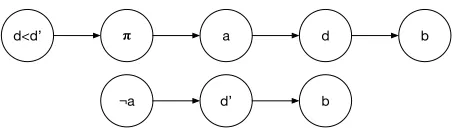
Figure 5: Preference Incoherence
both arguments[b, r1]and[d0]are generated w.r.t. S.
Simi-larly, we can prove that ifX =B1 = [[d1], r1]then
argu-ments[a, r0]and[d1]are generated w.r.t. S. Obviously[b, r1]
rebuts[d0](at[d0]) and [a, r0] rebsut[d1](at[d1]). Since
there is no preference attack, the inconsistency-resolving property holds obviously. Thus∅ is regular and hence the canonical assignment of preference attack relations.
Let K0 = (R,∅) and A0 = [d0],A1 = [d1], A2 =
[[d0], d2],A3= [[d1], d3].
It is obvious thatΠnr(K0) ={P,(A2, A3))}whereP =
[π]. Thus it is obvious thatΠnr6=∅.
We next discuss two rather intuitive properties of a DKB
K, which guarantee thatΠnr(K)satisfies (IR).
The first property addresses the sensibility of preference rules in a rule-based system.
Example 8. Consider a rule-based system consisting of only two defeasible rulesd:b⇒a d0:b⇒ ¬atogether with a preference ruleπ: a→d≺d0
The preference ruleπ intuitively states that “ifaholds and both rulesd, d0 are applicable then pickd0.” But fora to hold,dshould already be applied and so d0 can not be applied. The preference rule is obviously counter-intuitive.
To rule out counter-intuitive rule-based systems like the one above, we introduce below a new notion of general de-pendency graph between literals and rules.
Definition 16. Thegeneral dependency graphofR, denoted byDG(R) = (VR, ER), is defined as follows:
• Each vertice inVRis either (i) a rule fromRS∪RD∪ RP; or (ii) a preference atom or (iii) a domain literal appearing in some rule inRS∪RD∪RP.
• (x, y)∈ERiff (i) y is a rule d and x = hd(d); or (ii) x is a rule d andyis an element ofbd(d).
The general dependency graph of the rule-based system in Ex.8 is given in Fig. 5.
The next definition provides a characterization of rule-based system which does not admit the type of counter-intuitive dependence as shown in Ex. 8.
Definition 17. Ris said to bepreference-stratified(or just
p-stratifiedfor short) if there is a ranking functionrankfrom the set of defeasible rules into the set of natural numbers such that the following conditions holds:
1. Defeasible rules occurring in the head of the same pref-erence rule have the same rank.
2. If there is a path from a verticeνto a verticeµinDG(R), whereνis a preference atom containing a defeasible rule dandµis a defeasible ruled0, thenrank(d)> rank(d0).
The rule-based system in Ex. 8 is obviously not preference-stratified. The rule based system in Ex. 1 is
p-stratified where defeasible rulesd1, d2are given rank 1 and
the rest is given rank 0. Furthermore, rule-based systems with unconditional preferences are p-stratified.
The second property on R is on the strict rules of R adapted from Dung (2016) and Dung and Thang (2018). Definition 18. R is said to satisfy the self-contradiction propertyiff for each minimal inconsistent set of domain lit-eralsS⊆L, for eachl∈S, it holds:S `RS ¬l.
The next theorem relates (IR) and the self-contradiction property.
Theorem 5. If R is p-stratified and satisfies the self-contradictory property then Πnr also satisfies (IR) and
hence is regular.
An interesting question arisen immediately is under which conditions the canonical and normal preference attack rela-tion assignments coincide. Such a result has been given for the case of unconditional preferences in Dung and Thang (2018).
As the regular properties for preference attack relation as-signments generalize the properties with the same names for unconditional preferences, it is expected that similar result also holds w.r.t. the framework of preference attack relation assignments. We show below that it is indeed the case.
Let R = (RS, RD, RP) be a consistent unconditional
rule-based system. SinceRis consistent, it is obvious that the transitive closure ofRPis a strict partial order. For sim-plicity, we assume thatRP coincides with its transitive clo-sure and hence is a strict partial order.
We say a domain literalλdirectly dependson a domain literalβiff there is a ruler∈RS∪RDsuch thatλ=hd(r)
andβ∈bd(r).
λdependsonβiffλ=βorλdepends onαthat directly depends onβ.
The set of all sentences inL on whichλdepends is de-noted by∆(λ). For a setS⊆ L,∆(S)is the union of∆(λ)
forλ∈S.
Theorem 6. LetRbe an unconditional rule-based system satisfying the self-contradiction property. Furthermore for each defeasible ruled∈ RD, if there existsd0 ≺ dinRP then the set∆(bd(d))∪∆(¬hd(d))is consistent. Then the canonical attack relation assignmentCPR and the normal attack relation assignmentΠnrcoincide.
Discussion and Conclusion
We study defeasible knowledge bases with conditional pref-erences between defaults (DKB). We introduce the notion of a preference-based argumentation frameworks (PAF), which views direct rebut and undercut attacks among arguments as arguments and contains a preference-attack relation between preference arguments and direct rebuts and undercuts.
We show that PAF generalizes the semantics of basic knowledge bases to DKBs.
We prove that the set of all regular preference attack rela-tion assignments forms a complete lower-semilattice under the⊆relation.
We also define the notion of a normal preference at-tack relation assignment that in general satisfies all but the inconsistency-resolving property and specify conditions un-der which normal preference attack relation assignments co-incide with regular assignments.
Prakken and Sartor (1997) has studied conditional prefer-ences of defeasible rules. As pointed out in Caminada and Amgoud (2007), the proposed system does not satisfy the consistency postulate. Further, conditional preferences are not used to define attacks against attacks. Antoniou (2004) has studied the use of conditional preferences in the context of defeasible logics.
Delgrande, Schaub, and Tompits (2003) viewed prefer-ences as specifying application orders of rules. In Dung (2016), we show for unconditional preferences that this view is more conservative than our approach in the sense that ex-tensions following DST concept are also exex-tensions in our approach but not vice versa. It turns out that this result also holds for the general case of conditional preferences.
Our approach to dealing with conditional preferences gen-eralizes the approach in Dung and Thang (2018) where the regular properties of preference attack relation assignments generalize the properties with the same names for attack re-lation assignments for unconditional preferences.
References
Amgoud, L., and Cayrol, C. 2002. Infering from inconsis-tency in preference-based argumentation framework. Int J. Automated Reasoning29(2):197–215.
Amgoud, L. 2014. Postulates for logic-based argumentation systems.Int J. Approximate Reasoning55(9):2028–2048.
Antoniou, G. 2004. Defeasible logic with dynamic priori-ties. International Journal of Intelligent Systems19. Baroni, P.; Cerutti, F.; Giacomin, M.; and Guida, G. 2011. AFRA: argumentation framework with recursive attacks.
Int. J. Approx. Reasoning52(1):19–37.
Brewka, G., and Eiter, T. 1999. Preferred answer sets for extended logic programs. Artificial Intelligence 109:297– 356.
Brewka, G. 1989. Preferred subtheories: An extended log-ical framework for default reasoning. InProc of IJCAI’89, 1043–1048. Morgan Kaufmann.
Caminada, M., and Amgoud, L. 2007. On the evaluation of argumentation formalisms. Artificial Intelligence171:286– 310.
Davey, B. A., and Priestley, H. A. 2002. Introduction to Lattices and Order. Cambridge University Press.
Delgrande, J.; Schaub, T.; and Tompits, H. 2003. A frame-work for compiling preferences in logic programs. Theory and Practice of Logic Programming129–187.
Dung, P. M., and Thang, P. M. 2018. Fundamental prop-erties of attack relations in structured argumentation with priorities.Artificial Intelligence255:1–42.
Dung, P. 1995. On the acceptability of arguments and its fundamental role in nonmonotonic reasoning, logic pro-gramming and n-person games.Artif. Intell.77(2):321–358.
Dung, P. M. 2016. An axiomatic analysis of structured ar-gumentation with priorities.Artificial Intelligence231:107– 150.
Gabbay, D. M. 2009. Semantics for higher level attacks in extended argumentation frames part 1: Overview. Studia Logica93(2-3):357–381.
Garcia, A., and Simari, G. 2004. Defeasible logic program-ming: An argumentative approach. TPLP4(1-2):95–138.
Hanh, D.; Dung, P.; Hung, N.; and Thang, P. M. 2011. In-ductive defence for skeptixcal semantics of extended argu-mentation.J of Logic and Computation21(2):307–349.
Martinez, D. C.; Garcia, A. J.; and Simari, G. R. 2006. On acceptability in abstract argumentation frameworks with an extended defeat relation. In P.E. Dunne, T. J. M. B.-C., ed.,
Proc. of Int. Conf. on Computational models of arguments. IOS Press.
Modgil, S., and Prakken, H. 2013. A general account of argumentation with preferences. Artificial Intelligence
197:361–397.
Modgil, S., and Prakken, H. 2014. The aspic+ framework for structured argumenttion: a tutorial. J. Arguments and Computation5:31–62.
Modgil, S. 2009. Reasoning about preferences in argumen-tation frameworks. Artif. Intell.173(9-10):901–934.
Prakken, H., and Sartor, G. 1997. Argument-based extended logic programming with defeasible priorities.Journal of Ap-plied Non-Classical Logics (1997)7(1):25–75.
Prakken, H. 2010. An abstract framework for argumentation with structured arguments. J. Arguments and Computation
1.
Schaub, T., and Wang, K. 2001. A comparative study of logic programs with preferences. InProc of IJCAI, 2001. Morgan kaufmann.