DEMOGRAPHIC RESEARCH
VOLUME 35, ARTICLE 39, PAGES 1149
−
1168
PUBLISHED 20 OCTOBER 2016
http://www.demographic-research.org/Volumes/Vol35/39/ DOI: 10.4054/DemRes.2016.35.39
Research Article
Infertility and fertility intentions, desires, and
outcomes among US women
Karina M. Shreffler
Stacy Tiemeyer
Cassandra Dorius
Tiffany Spierling
Arthur L. Greil
Julia McQuillan
©2016 Karina M. Shreffler et al.
This open-access work is published under the terms of the Creative Commons Attribution NonCommercial License 2.0 Germany, which permits use, reproduction & distribution in any medium for non-commercial purposes, provided the original author(s) and source are given credit.
1 Introduction 1150 1.1 Connecting the infertility experience and identity with demographic
research on fertility 1151
1.2 What does it mean to “intend to give birth” in the context of
infertility? 1152
2 Data and methods 1153
2.1 Sample 1153
2.2 Measures 1154
2.3 Analytic strategy 1155
3 Results 1156
4 Conclusions 1161
Infertility and fertility intentions, desires,
and outcomes among US women
Karina M. Shreffler1
Stacy Tiemeyer2
Cassandra Dorius3
Tiffany Spierling4
Arthur L. Greil5
Julia McQuillan6
Abstract
BACKGROUND AND OBJECTIVE
Little is known about how the experience of infertility or identification as someone with infertility shapes women’s fertility intentions, desires, or birth outcomes. The purpose of this paper is to help fill this gap in knowledge for fertility-intentions research.
METHODS
Using data from the National Survey of Fertility Barriers (NSFB), we use linear and logistic regression methods to assess how infertility and parity statuses are associated with fertility intentions and desires, as well as how statuses at one point in time predict birth three years later.
RESULTS
We find that infertility is associated with lower fertility intentions. Women who have experienced infertility and/or identify as a person with infertility, however, express greater desires to have a baby and a higher ideal number of children. Women who meet the medical criteria for infertility are less likely than fecund women to give birth, despite greater desires.
1 Oklahoma State University, USA. E-Mail: [email protected]. 2 Oklahoma State University, USA.
3 Iowa State University, USA. 4 Oklahoma State University, USA. 5 Alfred University, USA.
CONCLUSION
These findings have important theoretical implications for our understanding of the meaning of fertility intentions for those who think their ability to achieve their intentions is uncertain, as well as for empirical research on fertility.
1. Introduction
Demographers interested in fertility trends and projections have long considered the role of infertility, particularly in analyses of developing countries (see Rutstein and Shah 2004). When surveyed about infertility, the lay public also understands the term ‘infertility’ to mean a permanent inability to give birth (Maill 1994). Yet the medical definition of infertility ‒ 12 months or more of unprotected, heterosexual intercourse without conception (American Society for Reproductive Medicine [ASRM] 2008), sometimes referred to as subfecundity ‒ does not indicate permanent involuntary childlessness. The proportion of women in the US who experience infertility using the ASRM definition is 7% to 15.5% in a given year depending upon specific measurement procedures (Thoma et al. 2013). The percentage is substantially higher (51.8%) for women who have met the ASRM criteria at some point throughout their reproductive lifespan (Greil et al. 2011a). Little is known about how women who experience infertility (e.g., meet the medical criteria) or identify as having a fertility problem (i.e., with or without meeting the medical criteria) think about their fertility intentions and desires compared to women without infertility experiences. Further, it is not known how infertility affects birth outcomes in countries such as the United States, where over 10% of all women trying to become pregnant seek medical treatment for infertility (Simonsen, Baksh, and Stanford 2012). Fears of infertility and decisions about how to respond to failures to conceive may influence fertility intentions, desires, and outcomes. Yet scant research has examined these relationships. We therefore use the National Survey of Fertility Barriers (NSFB) to explore the associations between infertility and fertility intentions, fertility desires, and the ideal number of children among US women
1.1 Connecting the infertility experience and identity with demographic research on fertility
Infertility is an interesting phenomenon for fertility researchers and theorists who study fertility intentions. Though seemingly straightforward, infertility does not necessarily have clear implications for fertility considerations. Demographers have long realized the importance of infertility at the societal level for measures of fertility trends. For example, Davis and Blake (1956) identified intermediate fertility variables including sterility, which included noncontraceptive sterility, or what we think of today as infertility or subfecundity. Calculations predicting fertility trends measure infertility in different ways: Stover (1998) suggested including a measure of sterility in fertility calculations that includes women in a union who are not menopausal, postpartum amenorrheic, or pregnant but have not given birth within the past five years despite not using contraception, as well as women who declare themselves to be infertile. Mascarenhas and colleagues (2012) have applied this approach to Demographic Health Survey data from 53 countries, for example, in an effort to determine the global prevalence of infertility.
conceive. A study of unmarried adults aged 18‒29, for example, found that 19% of women believed that they were “very likely” to be infertile, and having this belief was associated with contraceptive behaviors (Polis and Zabin 2012). Infertility, therefore, could affect fertility in two directions. Women who meet the medical criteria for infertility are not getting pregnant, at least temporarily. Women who identify as infertile but do not meet the medical criteria may actually be more likely to give birth due to their beliefs that contraception to prevent birth is unnecessary. Moreover, if women who are infertile do not think that they will become pregnant, these births could be classified as ‘unintended’ due to the current measurement of fertility intentions..
1.2 What does it mean to “intend to give birth” in the context of infertility?
Theoretical conceptualizations of fertility intentions suggest that they are shaped by the desire for a particular outcome, a belief that taking an action will result in that desired outcome, and a commitment to perform the action (Malle, Moses, and Baldwin 2003). Ajzen and Klobas (2013) suggest that one factor affecting fertility intentions is the degree of perceived control that individuals have over their fertility. Women who are infertile may not believe that taking an action (e.g., stopping contraception, predicting ovulation) will result in pregnancy. Yet the experience of infertility alone may not be enough to influence fertility intentions and behaviors. It may require conscious processing of this experience, resulting in identification of a fertility problem. Thus, there needs to be a consideration of both the experience of infertility and the perception of infertility. Not all women who meet the medical criteria for infertility are aware that they have a problem (Greil and McQuillan 2010). Indeed, it is the perception of infertility that matters more for psychological outcomes than merely meeting the medical criteria for infertility (Greil et al. 2011b).
Therefore, women who have given thought to their fertility experiences and have come to realize that they have trouble becoming pregnant may be particularly susceptible to influences of infertility on their fertility intentions. Fertility-intentions questions seemingly assume the ability to carry out intentions; for example, the 2006‒
2010 National Survey of Family Growth (NSFG) asked respondents, “Looking to the future, do you intend to have (a/another) child at some time?” followed by, “How sure are you that you (will/will not) have a baby?” Often, these questions are coded into one measure ranging from ‘very sure, do not intend’ to ‘very sure, intend’ (e.g., Thomson 1997), which is then used to predict future fertility (e.g., Schoen et al. 1999) or intendedness of a birth (e.g., Maximova and Quesnel-Vallée 2009).
particular time frame. McQuillan et al. (2015) suggest a stronger emphasis on identity is needed in studies of fertility intentions in addition to the more structural (i.e., life course) and cultural (i.e., values) approaches often used. Though they focused on motherhood identity, we suggest that identifying as infertile may be another salient identity in the study of fertility intentions. Because perception of infertility and meeting the medical criteria of infertility are often not synonymous constructs, measuring them separately allows for more-refined investigation of associations between infertility and fertility intentions, desires, ideals, and outcomes. For example, the uncertainty of the outcome following perceived infertility raises interesting questions about fertility intentions. What do intentions mean for women who may strongly want to give birth or avoid giving birth but are uncertain about their ability to be able to conceive? Do they report strong intentions (e.g., very sure that they intend or do not intend to give birth), or do they downgrade or downplay their intentions even if they might want to have a baby, or alternatively, do they downplay intentions if they plan to avoid pregnancy because it seems unnecessary to have strong intentions not to have a baby while infertile? Do infertile women reduce their intentions, and possibly their preferred number of children, to meet their expectations of lowered fertility, perhaps because they are trying to be realistic about what they believe is possible? On the other hand, does concern over infertility increase their desire to have a baby and/or preferred family size, resulting in inflated preferences? And finally, are infertile women able to have the number of children that they want to have, or does meeting the medical criteria for infertility predict a lower likelihood of a birth?
2. Data and methods
2.1 Sample
birth odds by infertility and parity status includes 1,547 women from the first sample who participated in the wave-two interview.
2.2 Measures
Dependent variables. In our first set of multivariate analyses utilizing wave-one data
only, we examine three dependent variables targeting fertility intentions, wants, and ideals. In a subsequent analysis, we utilize these variables as predictor variables of whether or not a birth occurred between survey waves. The first dependent variable,
fertility intentions, is based on two questions that are combined to create an ordinal measure of fertility intentions. Respondents were asked, “Do you intend to have a baby?” and “Of course, sometimes things do not work out exactly as we intend them to, or something makes us change our minds. In your case, how sure are you that you will/will not have a child?” Responses were coded so that low scores indicate, “Very sure, do not intend,” (‒2) and high scores indicate, “Very sure, do intend” (+2). Women who said they “don’t know” their intentions, who said they cannot have children, or who said they would let God or nature decide are coded 0 (the center of the scale). These questions are similar to those used in the National Survey of Families and Households; we recoded the response categories so that a positive score indicates intending and a negative score indicates not intending to have a baby. Our second dependent variable, want a baby, is measured by a question asking, “In the future, would you like to have a(nother) baby?” Responses are coded from 1 (definitely no) to 4 (definitely yes). Ideal number of children was measured by asking, “How many children would you consider to be ideal for you?” and coded from 0 to 5, with 5 including preferences of five or more children. Birth between waves is an indicator variable where 1 means that the respondent gave birth between waves.
Infertility and parity groups. We categorized women as medically infertile if
further split by parity, comparing women who were childless to women who had at least one biological child.
Sociodemographic control variables. Age is a continuous variable and ranges
from 25 to 45 in our sample. Married was measured by a question about marital status, with 1 indicating that the respondent was married at the time of the interview.
Cohabiting was coded by either a voluntary response to the marital status question or a yes to a follow-up question, “Are you currently living with a romantic partner?” Single women who are neither married nor in a cohabiting relationship are the reference category. Education (in years) is a continuous variable, ranging from 2 to 22 in our sample. Race/ethnicity is included as a dummy variable for Black, Hispanic, and “Other race,” with White respondents as the reference category.
2.3 Analytic strategy
We first provide an overview of the sample, comparing descriptive statistics (means/percentages) of all study variables by infertility and parity status. To examine differences within infertility and parity groups, we employed Bonferroni post-hoc tests. The differences in distributions of our variables by parity motivated our decision to run separate multivariate analyses for women with young children and women with 1 or more children.
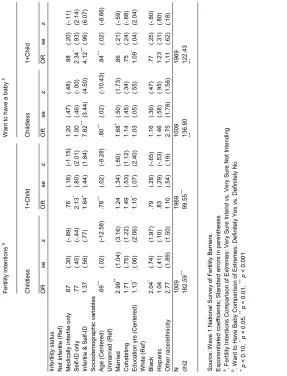
Our first multivariate analysis uses stereotype logistic regression (SLM) to predict fertility intentions and desires. Both fertility intentions and fertility desires are measured on an ordinal scale, but ordinal logistic regression assumes that the distance between each category is the same (proportional odds) (Long and Freese 2006). We tested the proportional-odds assumption using a likelihood-ratio test and a Brant test. Our sensitivity analyses suggested that coefficients for both fertility intentions and fertility desires were significantly different, which violates the proportional-odds assumption. SLM does not require proportional odds and is therefore a more appropriate method for variables that have unequal distances between response options.
3. Results
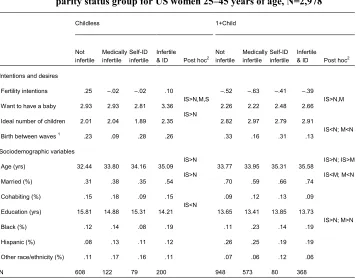
Results indicate that infertility experience and identity shape fertility intentions and desires in interesting ways. The means and percentages of fertility intentions, desires for a baby, and ideal number of children are provided in Table 1 by infertility- and parity-group statuses. Findings reveal that childless women at the extremes of the infertility continuum have the highest overall fertility intentions, including women who are not infertile and those who are both medically infertile and self-identifying as infertile; all other groups had negative scores on the intentions variable, indicating that the average response was a no to the question on intentions to have a child. The ‘desire to have a baby’ and ‘ideal number of children’ variables reveal a different pattern, however. Childless women in every group had higher scores for wanting to have a baby than women with children. Women without children who both identify as infertile and meet medical criteria for infertility, however, had the highest mean score (M=3.36), indicating their responses to wanting a baby were between “definitely yes” and “probably yes.” Further, when asked how many children would be ideal for them, women who already had at least one child reported more children as ideal across every category of infertility. Among childless women, however, those who experienced infertility and identified as infertile reported the highest ideal number of children (M=2.35). At the bivariate level, therefore, it appears that women at the extreme end of infertility ‒ those who are both medically infertile and identifying as infertile ‒ have higher fertility intentions, are more likely to report wanting to have a baby, and report a higher ideal number of children than women in other groups. Women who already had at least one child at the first wave and were not infertile were significantly more likely to have given birth by wave two compared to women who only met the medical criteria and women with children who met the medical criteria and identified as infertile.
Table 1: Means of dependent and sociodemographic variables by fertility and
parity status group for US women 25‒45 years of age, N=2,978
Childless 1+Child
Not infertile
Medically infertile
Self-ID infertile
Infertile
& ID Post hoc2 Not infertile Medically infertile Self-ID infertile Infertile & ID Post hoc2
Intentions and desires
Fertility intentions .25 ‒.02 ‒.02 .10 ‒.52 ‒.63 ‒.41 ‒.39 Want to have a baby 2.93 2.93 2.81 3.36 IS>N,M,S 2.26 2.22 2.48 2.66 IS>N,M
Ideal number of children 2.01 2.04 1.89 2.35 IS>N 2.82 2.97 2.79 2.91
Birth between waves 1 .23 .09 .28 .26 .33 .16 .31 .13 IS<N; M<N
Sociodemographic variables
Age (yrs) 32.44 33.80 34.16 35.09 IS>N 33.77 33.95 35.31 35.58 IS>N; IS>M
Married (%) .31 .38 .35 .54 IS>N .70 .59 .66 .74 IS<M; M<N Cohabiting (%) .15 .18 .09 .15 .09 .12 .13 .09
Education (yrs) 15.81 14.88 15.31 14.21 IS<N 13.65 13.41 13.85 13.73
Black (%) .12 .14 .08 .19 .11 .23 .14 .19 IS>N; M>N Hispanic (%) .08 .13 .11 .12 .26 .25 .19 .19
Other race/ethnicity (%) .11 .17 .16 .11 .07 .06 .12 .06
N 608 122 79 200 948 573 80 368
Source: Wave 1 & Wave 2 National Survey of Fertility Barriers, N=2,978.
1. Birth between waves reflect a smaller subset of respondents re-interviewed at Wave 2, N=1,547. 2. N= Not infertile, M= Medically infertile only, S= Self-ID infertile only, IS= Medically infertile & Self-ID
Table 2: Stereotype logistic regression analyses of the association among fertility-status indicators, sociodemographic characteristics, with fertility intentions and wants by parity status, N=2,978
Fe rtili ty int ent ions a W an t to h av e a baby b Ch ild le ss 1+ Ch ild Ch ild le ss 1+ Ch ild OR se z OR se z OR se z OR se z In fe rti lity s tat us N ot Inf er til e ( R ef ) M ed ica lly in fe rti le o nl y .6 7 (.30) (-.8 9) .7 6 (.18) (-1. 15 ) 1. 20 (.47) (.48) .9 8 (.20) (-.1 1) Se lf-ID o nl y .7 7 (.45) (-.4 4) 2. 13 * (.80) (2. 01) 1. 00 (.46) (-.0 0) 2. 34 * (.93) (2. 14) Inf er til e & S el f-ID 1. 37 (.56) (.77) 1. 64 + (.44) (1. 84) 7. 62 *** ( 3. 44) (4. 50) 4. 12 *** ( .96) (6. 07) Soc iodem ogr aph ic v ar iab les Age ( C ent er ed) .6 9 *** (.02) (-12. 58) .7 8 *** (.02) (-8. 28 ) .8 0 *** (.02) (-10. 43) .8 4 *** (.02) (-8. 66 ) U nm ar rie d ( R ef ) M arri ed 2. 99 ** (1. 04) (3. 16) 1. 24 (.34) (.80) 1. 68 + (.50) (1. 73) .8 6 (.21) (-.5 9) C ohab iti ng 1. 71 (.75) (1. 22) 1. 49 (.53) (1. 12) 1. 14 (.45) (.34) .7 5 (.24) (-.8 8) Educ at io n yr s ( C ent er ed) 1. 13 * (.06) (2. 06) 1. 15 * (.07) (2. 40) 1. 03 (.05) (.55) 1. 09 * (.04) (2. 04) W hit e ( Re f) Bl ac k 2. 04 * (.74) (1. 97) .7 9 (.28) (-.6 5) 1. 16 (.36) (.47) .7 7 (.25) (-.8 0) H is pan ic 1. 04 (.41) (.10) .8 3 (.29) (-.5 3) 1. 46 (.58) (.95) 1. 23 (.31) (.80) Oth er rac e/ eth ni ci ty 2. 77 (1. 89) (1. 50) 1. 10 (.54) (.19) 2. 75 (1. 78) (1. 56) 1. 11 (.62) (.18) N 1009 1969 1009 1969 ch i2 182. 59 *** 99. 55 *** 136. 80 *** 122. 43 *** Sour ce : W av
e 1 N
at iona l S ur vey of F er til ity B ar rier s. Ex ponent iat ed c oef fic ient s; S ta ndar d er ror s in par ent hes es
a. F
er til ity Int en tions C om par is on of E xt rem es : V er y S ur e In te nd vs. V er y S ur e N ot Int end ing
b. W
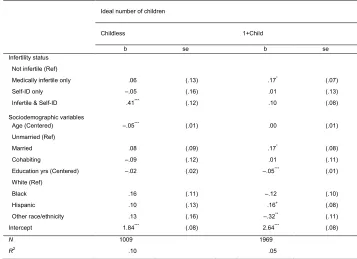
In Table 3 we present the linear regression analyses of the association between fertility status, sociodemographic variables, and the ideal number of children by parity status. Among childless women, those who were both medically infertile and self-identified as infertile reported wanting more children than their fertile counterparts, supporting the notion that infertility may be driving the higher preferences for childbearing among infertile women. The pattern is not the same among women who already had children (parity of one or more). Among mothers, those who were medically infertile wanted significantly more children than fertile women, net of other factors.
Table 3: OLS regression analyses of the association between fertility,
sociodemographic variables, and ideal number of children by parity status, N=2,978
Ideal number of children
Childless 1+Child
b se b se
Infertility status Not infertile (Ref)
Medically infertile only .06 (.13) .17* (.07)
Self-ID only ‒.05 (.16) .01 (.13)
Infertile & Self-ID .41*** (.12) .10 (.08)
Sociodemographic variables
Age (Centered) ‒.05*** (.01) .00 (.01)
Unmarried (Ref)
Married .08 (.09) .17* (.08)
Cohabiting ‒.09 (.12) .01 (.11)
Education yrs (Centered) ‒.02 (.02) ‒.05*** (.01)
White (Ref)
Black .16 (.11) ‒.12 (.10)
Hispanic .10 (.13) .16+ (.08)
Other race/ethnicity .13 (.16) ‒.32** (.11)
Intercept 1.84*** (.08) 2.64*** (.08)
N 1009 1969
R2 .10 .05
Source: Wave 1 National Survey of Fertility Barriers.
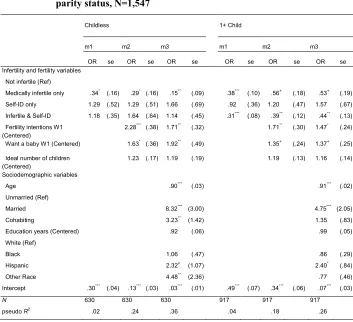
Table 4: Logistic regression analyses of the association between infertility, fertility, sociodemographic variables, and birth between waves by parity status, N=1,547
Childless 1+ Child
m1 m2 m3 m1 m2 m3
OR se OR se OR se OR se OR se OR se Infertility and fertility variables
Not infertile (Ref)
Medically infertile only .34* (.16) .29* (.16) .15** (.09) .38*** (.10) .56+ (.18) .53+ (.19)
Self-ID only 1.29 (.52) 1.29 (.51) 1.66 (.69) .92 (.36) 1.20 (.47) 1.57 (.67) Infertile & Self-ID 1.18 (.35) 1.64 (.64) 1.14 (.45) .31*** (.08) .39** (.12) .44** (.13)
Fertility intentions W1
(Centered) 2.28
*** (.38) 1.71** (.32) 1.71** (.30) 1.47* (.24)
Want a baby W1 (Centered) 1.63* (.36) 1.92** (.49) 1.35+ (.24) 1.37+ (.25)
Ideal number of children (Centered)
1.23 (.17) 1.19 (.19) 1.19 (.13) 1.16 (.14)
Sociodemographic variables
Age .90*** (.03) .91*** (.02)
Unmarried (Ref)
Married 8.32*** (3.00) 4.75*** (2.05)
Cohabiting 3.23** (1.42) 1.35 (.83)
Education years (Centered) .92 (.06) .99 (.05) White (Ref)
Black 1.06 (.47) .86 (.29)
Hispanic 2.32+ (1.07) 2.40* (.84)
Other Race 4.48** (2.36) .77 (.46)
Intercept .30*** (.04) .13*** (.03) .03*** (.01) .49*** (.07) .34*** (.06) .07*** (.03)
N 630 630 630 917 917 917
pseudo R2 .02 .24 .36 .04 .18 .26
Source: Wave 1 and Wave 2 National Survey of Fertility Barriers.
Exponentiated coefficients; Standard errors in parentheses.
Birth between waves reflect a smaller subset of respondents re-interviewed at Wave 2, N=1,547.
+p < 0.10, *p < 0.05, **p < 0.01, ***p < 0.001
4. Conclusions
to differentiate between those who meet the medical criteria but do not realize they are infertile, those who perceive themselves to have a fertility problem although they do not meet the medical criteria for infertility, and those who both meet the medical criteria and identify as infertile. A few exceptions are Greil and colleagues’ work on the “hidden infertile” (Greil et al. 2009) and the link between perceiving a fertility problem and distress about infertility (Greil et al. 2011b).
The findings presented here highlight the importance of both the experience of infertility and identification as a person with fertility problems for fertility intentions, desires, and birth outcomes. Supporting theories of intentions that suggest that an outcome needs to be certain to formulate an intention (Ajzen and Klobas 2013; Malle, Moses, and Baldwin 2003), we found that fertility intentions were highest for women who had never experienced infertility and were childless at the time of the first interview. Taken at face value, this might suggest that women who meet the medical criteria or perceive that they are infertile are not trying to get pregnant. Yet when we explored fertility desires further, we found that women who both meet the medical criteria and identify as infertile report significantly greater desires to have a baby. Among childless women, they also have a much higher ideal number of children than other women in the sample. Of course, simply wanting a birth may not predict one, especially for women who have met the medical criteria for infertility in the past. Indeed, our findings indicate that, regardless of parity, women who met the medical criteria for infertility but did not identify as having a fertility problem at the first survey wave were less likely to give birth by the second wave. Women who identified as infertile but did not meet the medical criteria at the first wave were actually more likely to give births between waves than women who were not infertile, though the difference was not significant.
These findings suggest that fertility intentions may not be the best predictors of births for women who have experienced infertility and/or identify as someone with fertility problems. The uncertainty of whether or not they will be able to give birth may prevent them from reporting a strong intention to have a baby. Bachrach and Morgan (2013) have called for greater theory development “at the intersection of cognitive science, social science, and social demography” (page 480) to better understand fertility intentions and their realization. In particular, they argue that fertility researchers need improved understanding of how mental and social phenomena are related to intentions (Bachrach and Morgan 2013). This study provides an example of when intentions may not be as meaningful or predictive for fertility outcomes. Because of the substantial minority of women who experience infertility each year, our findings have important implications for theory and research regarding fertility intentions.
matter in different ways for fertility intentions vs. outcomes. Not surprisingly, identity matters for fertility intentions; women who view themselves as having a fertility problem, especially when they also have met the medical criteria for infertility, are reporting lower fertility intentions but greater desires to have a baby and higher family size preferences. This is problematic because women who believe that they have fertility problems may be assigned lower values on fertility intentions measures despite wanting (and perhaps trying) to have a baby, and any births may be misidentified as unplanned or unwanted when they do give birth. Interestingly, it appears that women who fail to realize a fertility problem when, in fact, they meet the criteria for infertility, are least likely to give birth. This finding has important implications as well; this may be one reason why fertility outcomes do not always match intentions. There are also important medical implications, as women who do not identify as having fertility problems may be less likely to seek treatment that could help them achieve a desired birth (White et al. 2006).
Of course, the results of this study should be interpreted with caution in light of its limitations. First, respondents’ infertility statuses relied on retrospective reports of periods of 12 months or more during which respondents had regular, unprotected heterosexual intercourse with no pregnancy. To our knowledge, there have been no studies examining the validity of retrospective reports of infertility episodes. Integrating medical records with survey data would provide a more accurate classification of infertility episodes. Given our significant findings for infertility experience, however, we are confident that, if anything, our findings provide conservative estimates. Second, although the study participants were of reproductive age and not surgically sterilized, the timing of the infertility episode(s) varied; in some cases, the infertility episodes occurred more than 10 years before the survey interview. Again, we suspect that, if anything, this might make our findings more conservative than a study that includes only women currently experiencing infertility. Due to the much smaller percentage of women who experience infertility in a given year as compared to women who ever experience infertility, it is difficult to assess these relationships with such small samples. Another limitation related to this issue of small cell counts when creating four groups of infertility statuses is that we were only able to utilize two groups of parity statuses (women with and without children).
illustrate the ways in which infertility affects fertility. Future research is also encouraged to investigate the reverse relationship between fertility intentions, wants, and ideals and perception of a fertility problem. The meaning of the period of infertility may matter for outcomes; not all women who are not contracepting are actively “trying” to get pregnant (Johnson et al. 2014). Whereas some women may experience a relatively long period of unprotected sex without conception and not consider it a problem, those who are hoping or trying for a pregnancy may self-identify a problem before they meet the medical criteria for infertility
References
Ajzen, I. and Klobas, J. (2013). Fertility intentions: An approach based on the theory of planned behavior. Demographic Research 29(8): 203‒232. doi:10.4054/Dem Res.2013.29.8.
American Society for Reproductive Medicine (ASRM). (2008). Definitions of infertility and recurrent pregnancy loss. Fertility and Sterility 90(5) supplement: S60.
doi:10.1016/j.fertnstert.2008.08.065.
Bachrach, C.A. and Morgan, S.P. (2014). A cognitive‒social model of fertility intentions. Population and Development Review 39(3): 459‒485. doi:10.1111/ j.1728-4457.2013.00612.x.
Bongaarts, J. and Potter, R.E. (2013). Fertility, biology, and behavior: An analysis of the proximate determinants. New York: Academic Press.
Davis, K. and Blake, J. (1956). Social structure and fertility: An analytic framework.
Economic development and cultural change 4(2): 211‒235.
Greil, A.L. and McQuillan, J. (2010). ‘Trying times’: Medicalization, intent, and ambiguity in the definition of infertility. Medical Anthropology Quarterly 24(2): 137–156. doi:10.1111/j.1548-1387.2010.01094.x.
Greil, A.L., McQuillan, J., Johnson, K., Blevins-Slauson, K., and Shreffler, K.M. (2009). The hidden infertile: Infertile women without pregnancy intent in the United States. Fertility and Sterility 93(6): 2080‒2083. doi:10.1016/j.fert nstert.2009.08.024.
Greil, A.L., McQuillan, J., Lowry, M., and Shreffler, K.M. (2011a). Infertility treatment and fertility specific distress: A longitudinal analysis of a population-based sample of U.S. women. Social Science and Medicine 73(1): 87‒94. doi:10.1016/ j.socscimed.2011.04.023.
Greil, A.L., Shreffler, K.M., Schmidt, L., and McQuillan, J. (2011b). Variation in distress among women with infertility: Evidence from a population-based sample. Human Reproduction 26(8): 2101‒2112. doi:10.1093/humrep/der148. Johnson, K.M., McQuillan, J., Greil, A.L., and Shreffler, K.M. (2014). Towards a more
inclusive framework for understanding fertility barriers. In: Nash, M. (ed.).
Reframing reproduction: Sociological perspectives on gender, sexuality, and reproduction in late modernity. New York: Palgrave Macmillan: 23‒38.
Long, S.J. and Freese, J. (2006). Regression models for categorical dependent variables using Stata. 2nd ed. College Station: Stata Press.
Maill, C.E. (1994). Community constructs on involuntary childlessness: Sympathy, stigma, and social support. Canadian Review of Sociology and Anthropology
31(4): 392‒421. doi:10.1111/j.1755-618X.1994.tb00828.x.
Malle, B.F., Moses, L.J., and Baldwin, D.A. (2003). Intentions and intentionality: Foundations of social cognition. Cambridge: MIT Press.
Mascarenhas, M.N., Cheung, H., Mathers, C.D., and Stevens, G.A. (2012). Measuring infertility in populations: Constructing a standard definition for use with demographic and reproductive health surveys. Population Health Metrics
10(17): 1‒11. doi:10.1186/1478-7954-10-17.
Maximova, K. and Quesnel-Vallée, A. (2009). Mental health consequences of unintended childlessness and unplanned births: Gender differences and life course dynamics. Social Science & Medicine 68(5): 850‒857. doi:10.1016/ j.socscimed.2008.11.012.
McQuillan, J., Greil, A.L., Shreffler, K.M., and Bedrous, A.V. (2015). The importance of motherhood and fertility intentions among women in the United States.
Sociological Perspectives 58(1): 20‒35. doi:10.1177/0731121414534393. Polis, C.B. and Zabin, L.S. (2012). Missed conceptions or misconceptions? Perceived
infertility among unmarried young adults in the United States. Perspectives on Sexual and Reproductive Health 44(1): 30‒38. doi:10.1363/4403012.
Rutstein, S.O. and Shah, I.H. (2004). Infecundity, infertility, and childlessness in developing countries. DHS Comparative Reports No. 9. Calverton: ORC Macro and the World Health Organization.
Schoen, R., Astone, N.M., Kim, Y.T., Nathanson, C.A., and Fields, J.M. (1999). Do fertility intentions affect fertility behavior? Journal of Marriage and Family
61(3): 790‒799. doi:10.2307/353578.
Schwerdtfeger, K.L. and Shreffler, K.M. (2009). Trauma of pregnancy loss and infertility among mothers and involuntarily childless women in the United States. Journal of Loss and Trauma 14(3): 211‒227. doi:10.1080/153250208 02537468.
Simonsen, S.E., Baksh, L., and Stanford, J.B. (2012). Infertility treatment in a population-based sample: 2004‒2005. Maternal and Child Health Journal 16(4):
Stover, J. (1998). Revising the proximate determinants of fertility framework: What have we learned in the past 20 years? Studies in Family Planning 29(3): 255‒
267. doi:10.2307/172272.
Thoma, M.E., McLain, A.C., Louis, J.F., King, R.B., Trumble, A.C., Sundaram, R., and Buck Louis, G.M. (2013). The prevalence of infertility in the United States as estimated by the current duration approach and a traditional constructed approach. Fertility and Sterility 99(5): 1324‒1331.doi:10.1016/j.fertnstert.2012. 11.037.
Thomson, E. (1997). Couple childbearing desires, intentions, and births. Demography
34(3): 343‒354. doi:10.2307/3038288.