www.ijper.org DOI: 10.5530/ijper.53.2s.61 Correspondence: Mr. Vasudev Pai, Department of Pharmacog-nosy, Manipal College of Pharmaceutical Sciences, Manipal Academy of Higher Education, Manipal, Karna-taka- 576104, INDIA. Phone: +91-0820-2922482 E-mail: pai.vasudev@ manipal.edu
Submission Date: 29-11-2018;
Revision Date: 12-12-2018;
Accepted Date: 20-03-2019.
Development and Evaluation of Polyherbal Lozenges
for Cold and Flu
Anshul Kumar1, Manish Kumar Mishra1, Afeefa1, Chandrashekar K.S1, Girish Pai2, Vasudev Pai1,*
1Department of Pharmacognosy, Manipal College of Pharmaceutical Sciences, Manipal Academy of Higher Education, Manipal, Karnataka, INDIA.
2Department of Pharmaceutics, Manipal College of Pharmaceutical Sciences, Manipal Academy of Higher Education, Manipal, Karnataka, INDIA.
ABSTRACT
Background: Lozenges are solid dosage form which are intended to slowly dissolve in
the mouth for therapeutic effect. Common cold and flu are common diseases which
usually infects the respiratory tract including symptoms like head and body ache, fever, drowsiness, runny nose, congestion and cough. Aim: The present polyherbal lozenge
formulations developed to eliminate all symptoms of cold and flu. Although many herbal and allopathic drugs are available, but they are not sufficient to treat all the
symptoms through one formulation. Materials and Methods: Jaggery and sugar were dissolved in water and all the juices of drugs mixed and heated till suitable consistency
and finally poured in lozenges mold and cooled to form lozenges. Results: The lozenges are evaluated for various quality parameters like hardness, friability, thickness, weight uniformity and disintegration time which comply with the standard mentioned in GMP guidelines. Conclusion: Lozenge is completely herbal containing no synthetic ingredient
and is economical to treat all the symptoms of cold and flu.
Key words: Polyherbal lozenges, Common col, Flu Polyherbal, Lozenges, Formulations, Cold, Flu, Standardization.
INTRODUCTION
The lozenges are the medicated tablet kept in the mouth until it gets dissolved and releases the medicament and produces the soothing effect on throat. Varieties of loz-enges are usually used to treat cough and sore throat. Lozenges are dissolved slowly in the mouth to stop the cough and soothe irritation of the tissues in the throat.1,2
History of Lozenges
Candies were used to soothe the throat since date back to 1000 BC in Egypt’s Twentieth Dynasty, when the candies were made from pure honey and flavored with juices of citrus fruits, various herbs and some valu-able spices. In the 19th century, some of the physicians used morphine and heroin from opium, which has antitussive property. Most popular formulations at that era were by Smith Brothers Cough Drops and was first
advertised in the year 1850 and Luden’s, cre-ated in 1880. Later the concern over the risk of opioid dependence and addition which led to the development of alternative medi-cations.3-5
About the Disease
Influenza is popularly known as “the flu”, which is a infectious disease caused by an influenza virus. Symptoms are be mild to severe. The common symptoms are: a high fever, loose runny nose, sore throat, pain in the muscle, irritating headache, frequent coughing and tiredness.
About Herbal Drugs
differ-ent dosage forms like tablets, capsules, powders, in the form of tea bags, solid extracts and sometimes as fresh or dried plants. People use herbal drugs to maintain or improve their general health.
About the Ingredients Liquorice
It is the root of Glycyrrhiza glabra (Family: Legumino-sae) from which a sweet flavour can be extracted. The liquorice plant is a herbaceous perennial legume native to southern Europe and parts of Asia, such as India. It is also known as mulethi and Jestamadhu in India and is widely used in Ayurvedic system of medicine for various ailment related to respiratory system. Used as Expectorant and Demulcent. These properties are due to the presence of Glycyrrhenic acid.
Clove
Cloves are the aromatic flower buds of a tree (Myrta -ceae) Syzygium aromaticum (Eugenia caryophyllus). They are native to the Maluku Islands (or Moluccas) in Indonesia. Used as an analgesic and antiviral. These effects are because of the presence of Eugenol and other constituents in the flower bud.
Ginger
It consists of rhizomes of Zinziber officinale (Fam.: Zinzi-beraceae), scrapped to remove the dark outer skin and dried in the sun. Ginger mainly contain oleo-resin which has aromatic, carminative and expectorant property. Gingerol is the active principle of fresh ginger, it is nor-mally found as a yellow pungent oil and has spicy-sweet aroma.
Long Pepper
It consists of the dried unripe or nearly ripe fruits of perennial climbing vine s (Family: Piperaceae). It is also called as long native pepper and pipli in Hindi. In Ayurveda long pepper is widely used for various formu-lations because of its wide range of therapeutic applica-tions. It has a taste same to, but hotter than other closely related species of pepper. Pepper in mainly indicated in respiratory disorders in cold, as decongestant, helps in expelling out mucus accumulated in the respiratory tract, bronchodilator in asthma patients, also in fever. Honey
It is a saccharine fluid (From the nectar of flower) deposited in the honey comb by the hive bee, Apismal-lifera, Apisdorsata and other species of Apis (Fam: Api-dae). Honey is well known home remedy for dry cough as well as wet cough because of its consistence. It is
having soothing effect helps in relieving irritation in the throat.
Guduchi
Guduchi consists of dried, matured pieces of stem of Tinospora cordifolia (Family- Menispermaceae). It is also known as Giloy which very popular herb in Ayurveda is extensively used in fever and respiratory problems, diabetes, anemia, cardiac disorders etc.
Vasaka
It consists of the fresh and dried leaves of Adhatoda vasica (Family: Acanthaceae). Vasaka is an important Ayurvedic medicinal herb. The entire parts of the plant from roots to leaves are used to treat many diseases. Leaves of the plant have great importance in the treat-ment of asthama, bronchitis, tuberculosis and other it is very good mucolytic. Vasaka contains vasicine which has mucolytic property used in various herbal expecto-rant formulations.
Turmeric
They are dried rhizomes of Curcuma longa ( Zingibera-ceae). Turmeric is one of the spice widely used in Indian dishes because of its yellow colour. It possesses anti-septic property hence used for respiratory conditions like common cold, bronchitis, cough and other upper respiratory problems. It is also protective to skin and hence used in cosmetic products. It contains curcumi-noids and curcumin is chief constituents which has many therapeutic applications.
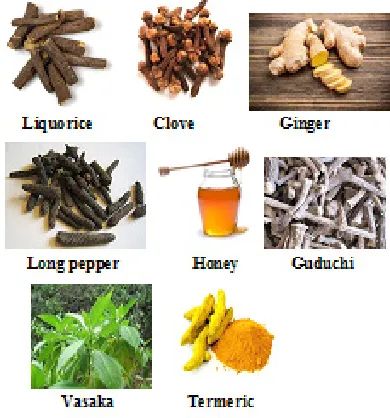
The various ingredients used for formulation is given in Figure 1.
MATERIALS AND METHODS
Method of Preparation of Lozenges
formula-tion-2 includes Liquorice, Clove, Ginger, Long pepper, Guduchi and Vasaka. Honey was used for both the for-mulation to produce soothing effect on throat.
Survey
A survey was done on 100 volunteers through a ques-tionnaire to check acceptability of different parameters and quality of the lozenge. A scoring was done where 1 was the highest and 5 was the least. The pattern of questionnaire is given in Figure 2.
Physico-Chemical Parameters
The prepared lozenges were evaluated for its organolep-tic parameters like colour, odour, taste and touch, hard-ness, weight uniformity etc.
The Hardness testing was done by using PFIZER hard-ness tester of (n=5) and the average was taken. Thick-ness (n=5) of lozenges were calculated using thickness apparatus, friability test is done by friability test appa-ratus (n=5). Weigh uniformity was determined by weighing 5 lozenges individually, the average weigh was calculated and the percent variation of each tablet was determined.6,7
Disintegration Time Studies
Disintegration time is the interval required for complete disappearance of a lozenges or its particles from the tes-ter net. Disintegration test of the prepared lozenges was performed according to USP30, using a disintegration tester through the disintegration medium of phosphate buffer with pH 6.2 maintained at 37 ± 0.5°C.
Economic Survey: Average cost for the lozenge was asked from the volunteers they would pay through ques-tionnaire.8-10
Organoleptic characters
A survey was done on 100 volunteers to know the organoleptic acceptability through a questionnaire.
Measurement of pH
The acidity or alkalinity of a lozenges was indicated by using lab pH meter, a scale from 1.0 to 14.0. 1% W/V solution of candy was prepared by dissolving 1 g candy in 100 ml distilled water and its pH was recorded.
RESULTS AND DISCUSSION
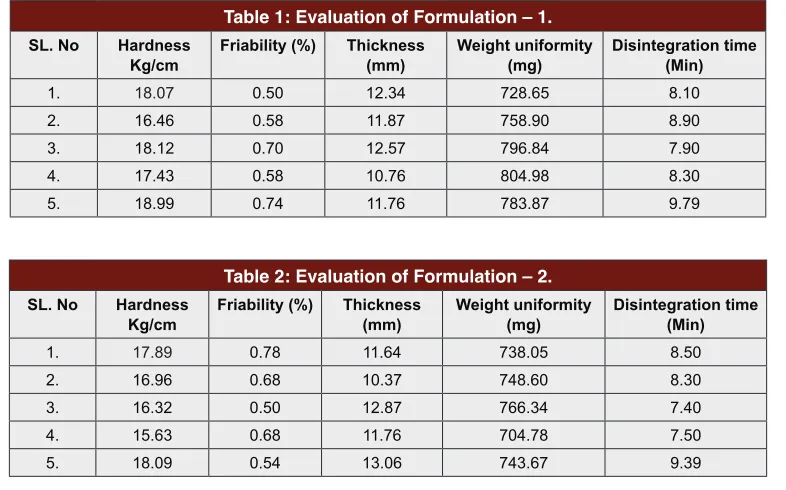
The hardness (n=5), friability (n=5), thickness (n=5), weight uniformity (n=5) and disintegration time (n=5) of prepared lozenges were evaluated and results are given in Table 1 and Table 2.
pH of candy
The pH of 1% w/v solution of herbal lozenges in dis-tilled water was found to be 4.5 for formulation 1 and 4.7 for formulation 2.
The lozenge were administered to 100 patients with cold and flu and the feedback was taken with the help of a questionnaire. The results are shown in the Table 3 below with average scores.
Scoring Key: 5 is the highest and 1 is the least.
The acceptance criteria of any lozenges from market was analyzed in the form of questionnaire feedback
Table 1: Evaluation of Formulation – 1.
SL. No Hardness
Kg/cm Friability (%) Thickness(mm) Weight uniformity (mg) Disintegration time (Min)
1. 18.07 0.50 12.34 728.65 8.10
2. 16.46 0.58 11.87 758.90 8.90
3. 18.12 0.70 12.57 796.84 7.90
4. 17.43 0.58 10.76 804.98 8.30
5. 18.99 0.74 11.76 783.87 9.79
Table 2: Evaluation of Formulation – 2.
SL. No Hardness
Kg/cm Friability (%) Thickness(mm) Weight uniformity (mg) Disintegration time (Min)
1. 17.89 0.78 11.64 738.05 8.50
2. 16.96 0.68 10.37 748.60 8.30
3. 16.32 0.50 12.87 766.34 7.40
4. 15.63 0.68 11.76 704.78 7.50
of 100 volunteers. The results are given in Figure 3 as acceptance parameter scoring
Factors affecting the choice of selection of any loz-enges from market.
Economic Survey
Average price for one Lozenge, volunteers (100) willing to pay: Rs 3.
CONCLUSION
Polyherbal lozenges have been developed with 6 differ-ent herbs. The various measures taken for the qualita-tive, quantitative analysis and physical parameters of finished product are in compliance with the standard mentioned in GMP guidelines and requirements simul-taneously supporting the impression of the polyherbal lozenges which can compete with the standard lozenges available in market.
The polyherbal lozenges were developed by thorough study of herbs, followed by optimization of formulation dosage and evaluation of qualitative and quantitative analysis by precised advanced analytical instrumental methods for assessment. The effectiveness has been analyzed by a survey through questionnaire. The study carried out has endorsed the quality and effectiveness of the polyherbal lozenges. This study reveals that the lozenges are suitable dosage form for the symptom-atic relief of cold and flu. The standardization which provides a specific and rapid tool for setting the qual -ity standard, ident-ity and reproducibil-ity in herbal loz-enges for cold and flu. Hence the lozloz-enges pass all the parameters and was found to be more effective in the treatment of cold and flu (As per the survey on 100 patients). Hence this formulation can be recommended for patients having cold and flu symptoms.
Table 3: Feedback Questionnaire Average Score.
PARAMETERS AVERAGE
SCORE
Colour Acceptability 3
Taste and Palatability 4
Ease of Dissolution 5
Safety and Sterility 4
Duration of action and Satisfaction 4 Recommendation to other flu patients 4
Comparison with other marketed
lozenges 3
Figure 1: Harbal Ingredients used for Lazenges.
Figure 2: Questionnaire Pattern for Polyherbal Lozenges.
Figure 3: Acceptance Parameter Scoring.
ACKNOWLEDGEMENT
CONFLICT OF INTEREST
The authors declare no conflict of interest.
ABBREVIATIONS
GMP: Good manufacturing practice.
REFERENCES
1. Panati C. Panati’s extraordinary origins of everyday things. New York: Harper and Row. ISBN 0060964197. 1989;258 and 8211;260.
2. Aulton ME. Pharmaceutics: the science of dosage form design. Churchill Livingstone. 2000.
3. Prashar D, Saklani S. Formulation and evaluation of anthelmintic chewable tablets. IPS. 2012;2(1):13-6.
4. Birader. Formulation and evaluation of chewable tablets. Int J Pharmacy and Pharm Sci. 2006;2(6):461-4.
5. Bhowmik D, Pankaj C, Tripathi KK, Chandira MR, Kumar KPS. Zingiber
officinale the herbal and traditional medicine and its therapeutically
importance. Res J Pharmacognos Phytochem. 2010;2(2):102-10. 6. 6. Esimone CO, Onuh PU, Egege MK, Ugoeze KC, Obitte NC. In vitro
evaluation of lozenges containing extracts of roots of Zapoteca portoricensis
(FAM: Fabaceae). J Pharmacol Toxicol. 2009;4(3):132-7.
7. 7. Reading SJ, Spring MS. The effects of binder film characteristics on
granule and tablet prop-erties. J Pharm Pharmacol. 1984;36(7):421-6. 8. 8. Kathiresan K, Vijin P, Moorthi C, Manavalan R. (2010) Formulation and
evaluation of loratadine chewable tablets. Res J Pharm Biological Chem Sci. 2010; 1(4): 763-774.
9. 9. Abdelbary G, Eouani C, Prinderre P, Joachim J, Reynier JP, et al. (2004) Determination of the in vitro disintegration profile of rapidly disintegrating
tablets and correlation with oral disinte-gration. Int J Pharm. 2004; 292(1-2): 29-41.
10. Bajelan E, Kamali-nejad M, Albasha H. Formulation and physicochemical evaluation of lozenge tablets containing Salvia officinalis. Journal of Young Pharmacists. 2014;6(1):34.
11. 10. Bajelan E, Kamali-nejad M, Albasha H. Formulation and physicochemical
evaluation of loz-enge tablets containing Salvia officinalis. Journal of Young
Pharmacists. 2014 Jan 1;6(1):34.
• Lozenges are used to treat the symptoms like sore throat and congestion of throat which are the common in cold and flu. The developed lozenges includes many herbs having effect on respiratory tract and completely natural. The lozenges are evaluated for its quality and therapeutic efficacy by various parameters and feed-back of people having symptoms of cold and flu. The developed formulations comply with all the standards men-tioned in GMP and can be used safely without any side effects.
SUMMARY PICTORIAL ABSTRACT
ABOUT AUTHORS
Mr. Vasudev Pai is an Assistant professor, Department of Phar-macognosy Manipal College of Pharmaceutical Sciences MAHE, Manipal.
Mr. Anshul Kumar is a Student, Department of Pharmacognosy Manipal College of Pharmaceutical Sciences MAHE, Manipal.
Mr. Manish Kumar Mishra: is
a Student, Department of Phar-macognosy Manipal College of Pharmaceutical Sciences MAHE, Manipal.
Ms. Afeefa is a Student, Department of Pharmacognosy, Manipal College of Pharmaceutical Sciences MAHE, Manipal.
Dr. Chandrashekar KS is an
Associate Professor, Department of Pharmacognosy Manipal College of Pharmaceutical Sciences MAHE, Manipal.
Dr. Girish Pai is an Associate Pro-fessor, Department of Pharmaceutics Manipal College of Pharmaceutical Sciences MAHE, Manipal.