Empirical Analysis of Depositor Funds Determinants in
BPRS in Indonesia
Evi Grediani, Nanik Niandari, Rahmawati Hanny Y Academy of Accounting YKPN
Abstract
This study aims to analyze empirically the determinants of deposit funds, which include various proxy of bank health level, including Capital Adequacy Ratio (CAR), Provision for Earning Assets Losses (PEAL), Return on Assets (ROA), Operational Efficiency Ratio (OER), Non-Performing Financing (NPF), Financing Deposit Ratio (FDR), and BI Rate. Depositor funds represent the amount of savings and deposits in the Bank Pembiayaan Rakyat Syariah (BPRS). The study uses a sample of BPRS registered in Bank Indonesia and the Financial Services Authority for the period of 2010 to 2015 by using a purposive sampling method. Data analysis technique used is a multiple regression analysis. The results show the various proxies of bank health level is the determinant of depositor funds simultaneously and that shows only CAR and NPF are not determinants of depositor funds.
Keywords: Depositor funds, CAR, PEAL, ROA, OER, NPF, FDR, BI Rate
INTRODUCTION
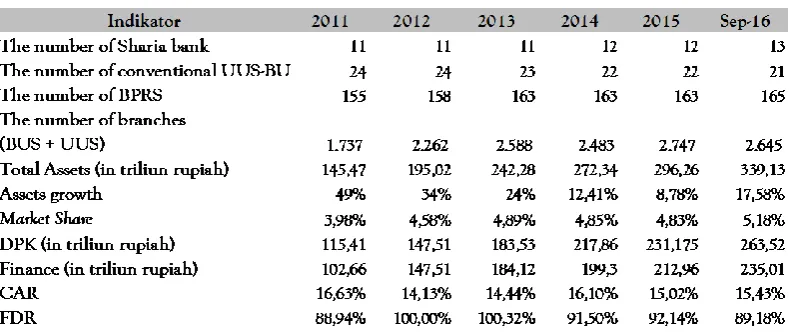
The vision and direction of the national sharia-banking development policy is to realize sharia banking that contributes significantly to sustainable economic growth, equitable development, financial system stability, and high competitiveness (OJK, 2017); this is one of the factors driving the development of sharia banking in Indonesia. The statistics by Bank Indonesia show that as of December 2016, Total Assets, Third Party Funds, and PYD of the sharia banking industry (BUS, UUS, and BPRS) was IDR 365 trillion, IDR 285.2 trillion, and IDR 254.7 trillion respectively or increased by 20.28%, 20.84%, and 16.41%. BPRS experienced growth of assets, deposits, and PYD at 18.16%, 21.24%, and 15.20%. The Third Party Funds of sharia banking also experienced an increase from year to year. Since 2011 until the 2016, it has grown by 27.81%, 24.41%, 18.70%, 6.11%, and 20.83%. The growth, however, decreased from 2011 to 2015 and increased from 2015 to 2016. Table 1 presents the growth of Indonesian sharia banking.
Table 1. The Growth of Sharia Banking in Indonesia1
The sharia banks shall comply with the regulations of Bank Indonesia and OJK2 in performing their operations. The basic principles of sharia banking operations as a financial intermediary are capital from bank owners and profit sharing and/or bonuses are channeled through debt financing, profit lost sharing, and fee-based financing or ujroh. (OJK, 2017). The collection of funds is very important as the capital of the sharia bank to fulfill its obligations to channel funds to the public. Statistics released by Bank
1Otoritas Jasa Keuangan (the Financial Services Authority), 2017
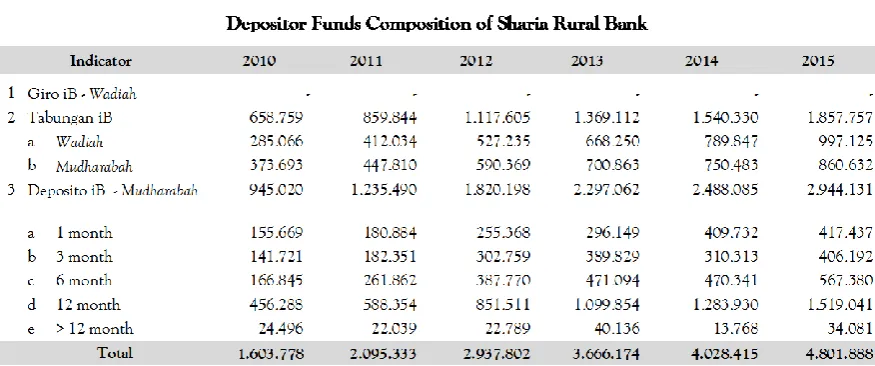
Indonesia for the period of December 2015 show that the Composition of Third Party Funds from 2010 to 2015 was 30.64%, 40.20%, 24.79%, 9.88%, and 19.20%, presented below:
Table 2. The Composition of BPRS Third Party Funds3
The number of depositor funds in sharia banks influences the distribution of funds to the community. If deposits decrease, it will indirectly reduce the performance of sharia banks because it decreases the amount of funding in the form of financing. Performance assessment resulting in a good category indicates that health level of the bank is good. Bank health level is the result of qualitative assessment on various aspects affecting the condition or performance of a bank or UUS. Thus, performance is one aspect of health level rating. Assessment of the health level of a sharia bank may be linked to depositor funds. This factor encourages researchers to examine the effect of bank health level on depositor funds. Several previous studies have been empirically tested the performance of sharia banks in Indonesia to influence deposit funds. A study of 31 sharia banks in Indonesia using financial ratios has found that good performance may affect deposit funds.4 Subsequent studies using variables to test with CAMEL, found that CAR, ROA, NPF, OER, and FDR influenced depositors funds. Tests have been conducted on 11 sharia commercial banks and 23 sharia business units in Indonesia; it found that NPF affect
mudharabah deposits, but FDR has no effect on mudharabah deposits.5 Other studies on sharia commercial banks and sharia business units in Indonesia during 2006-2015 have confirmed that profit sharing rates positively affect mudharabah deposits.6
This study is trying to develop the research by Hasbi & Haruman by adding some variables and proxies, one of which is BI rate. The underlying factor of adding BI rate is the possibility that people in general still see interests or profit sharing as a consideration to save their money in sharia banks. Based on the above description, the following research problems are formulated. (1) Does the health level of BPRS affect the deposit funds? (2) Does the BI rate affect the deposit funds? Referring to the formulation of the problem, this study is directed to know and analyze the influence of BPRS health level and BI rate to deposit fund.
LITERATURE REVIEW &HYPOTHESIS DEVELOPMENT Stakeholder Theory
The focus in this theory is how the company monitors and responds to the needs of its stakeholders.7 Stakeholders are parties that have a direct or indirect interest to the existence or activities of the company. Stakeholder theory says that a company is not an entity that operates only for its own sake, but it must provide benefits to its stakeholders. Stakeholders can control the use of economic resources used by companies. Therefore, the stakeholder power associated with it is determined by the small amount of
3 The Data by Central Bureau of Statistics Bank Indonesia 2015
4Hasbi & Haruman, 2011
5 Yulianto & Solikhah, 2016 6 Hilman, 2016
power in controlling the economic resources of the existing company. The same applies to the analysis of the effect of bank health level on depositor funds.8
Depositor Funds
According to Law Number 21 of 2008 concerning sharia banking, the business activities of BPRS among others are collecting funds from the public in the form of (a) savings or the equivalent according to other contracts which are not contrary to sharia principles and (b) investment in the form of deposits or savings or other similar forms based on a mudharabah or other akad or contracts, which are not contrary to sharia principles. Mudharabah is derived from the word adhdharbhy fil ardhi, which means traveling for business affairs; it is also called Qiradh, derived from the word alqardhu, which discount, because the owner take some of his or her property to trade and obtain some profit from the mudharabah contract.9 The mudharabah agreement is a business cooperation agreement between the owner of the fund and the fund manager acting as the manager; the business profit is shared among them as agreed, while the financial loss is borne by the fund owner. 10 Owners of funds deliberately provide funds or deposit funds to fund managers to be processed to get benefits. These funds are commonly referred to as Third Party Funds. These third party funds are very important because the basic principles of sharia bank operations are the collection of funds and the channeling of funds.11 The greater the funds that can be collected by the sharia bank, the greater the distribution of funds that it can do.
Bank Health Level
Bank health levels according to Bank Indonesia Regulation Number 9/17PBI/2007 is the result of qualitative assessment on various aspects affecting the condition or performance of banks or UUS through: (1) quantitative and qualitative assessment on capital factors, asset quality, liquidity, sensitivity to risk, and (2) qualitative assessment on management factors. Quantitative assessment is the assessment of position, development, and projection of financial ratios of banks or UUS. Qualitative assessment is an assessment on factors that support the results of quantitative assessment, implementation of risk management, and compliance of banks or UUS. Factors of the results of quantitative assessment take into account some relevant supporting and/or benchmark indicators. Factors that form the health level of a bank are capital, asset quality, profitability, liquidity, and market risk sensitivity. Sharia banks including BPRS shall conduct business activities based on prudential principles and sharia principles in order to maintain or improve the health level. Sharia banks must be able to raise funds, manage funds, channel funds to the community, fulfill obligations as shareholders, and meet the rules. Assessment of BPRS health level includes assessment on (1) capital, (2) asset quality, (3) earnings, (4) liquidity, and (5) management.12 This study will only examine capital, asset quality, earnings, and liquidity quantitatively.
Capital is based on the obligation of minimum capital provision of sharia banks. Capital Adequacy Ratio (CAR) is a ratio that shows the ability of a bank to maintain capital, which includes (a) adequacy, projection, and capital capability in anticipating risks and (b) the intermediation function of investment fund by profit sharing method (PBI No.9/17/pbi/2007).
The quality of assets is to assess the type of assets held by sharia banks. The assessment shall be in accordance with the regulations of Bank Indonesia and the Financial Services Authority. Asset quality assessment is based on allowance for uncollectible accounts (earning) assets. Productive assets in rupiah are owned by sharia banks to earn income in accordance with its functions, including: (1) credits granted and (2) placement of funds in other banks except in the form of demand deposits. Assets classified are productive assets, either existing or potential of providing income or causing losses to the bank. Thus, the greater the financing distributed, the greater the PEAL formed.13
Earnings describes the ability of the bank to generate profits through existing resources in order to determine the level of business efficiency and profitability achieved by the bank.14 Profitability is the ability or possibility to earn profits.15 To measure profitability, we use profitability ratio or Return on Asset (ROA), a ratio used to know the ability of banks in generating profits from the management of assets
8 Freeman, 1994
9 Nurhayati & Wasilah, 2011 10
PSAK Syariah, 2017
11Otoritas Jasa Keuangan (the Financial Services Authority), 2017
12Otoritas Jasa Keuangan (the Financial Services Authority), 2017
13Otoritas Jasa Keuangan (the Financial Services Authority), 2017
owned. The supporting ratio to assess the ability of banks in generating subsequent profits is Operational Efficiency Ratio (OER) or operational efficiency level. Operational efficiency can be measured by comparing operational costs with operating income.16
Liquidity is the ability to meet short-term obligations, potential maturity mismatch, and concentration of funding sources. The liquidity assessment is intended to assess the ability of sharia banks to maintain adequate levels of liquidity including anticipation of liquidity risks that will arise.17 To measure liquidity, we can use Financing to Deposit Ratio (FDR) and Non-Performing Financing (NPF). FDR is used to measure the amount of financing by the amount of funds received.18
NPF can be broadly defined as default or close to default financing or problems in financing payment and insufficient minimum liability, financing that is difficult to settle or even uncollectible.19 Indicators of financing quality are smooth financing, special-attention-needed financing, unsmooth financing, call-to-doubt financing, and bad financing. NPF is known by calculating problem financing to total financing. The bigger the NPF of the sharia bank, the lower the financing quality of the sharia bank will be.
Bank Indonesia Rate
BI-Rate is a policy interest rate that reflects the stance of monetary policy stipulated by Bank Indonesia and announced to the public. BI rate is a one-month tenor of rate announced by Bank Indonesia periodically that serves as a stance of the monetary policy. The bank rate is the amount given by the bank to the customer on the funds deposited in the bank calculated in percentage of the main deposits and term deposits or the interest rate charged on loans granted to the debtor (bank interest). Interest rates are considered an important factor that determines the behavior of people to save money.20
DEVELOPMENT OF HYPOTHESIS
Sharia banks perform their functions in collecting funds and channeling funds. Sharia banks must be able to carry out operational activities and fulfill responsibilities to stakeholders and shareholders. It shall also comply with regulations stipulated by Bank Indonesia, Regulation Number 9/17/PBI/2007, and the Financial Services Authority. As with the rating of BPRS, the assessment includes capital appraisal, asset quality, earnings, liquidity, and management. Capital can be assessed by CAR (Capital Adequacy Ratio) of capital compared to risk-weighted assets. CAR significantly affects depositor funds.21 Based on the description, the proposed hypothesis is
H1: CAR positively affects Depositor Funds
Asset quality can be assessed by PEAL (Provision for Uncollectible Assets). The greater the financing disbursed, the higher the PEAL, so the hypothesis proposed is:
H2: PEAL significantly affects Depositor Funds
ROA (Return on Asset) is a ratio used to determine the ability of banks in generating profits from the management of assets owned. ROA significantly affects deposit funds.22 The greater the ROA, the greater the level of profit achieved by the bank and the better the bank’s position.23
Based on the description, the proposed hypothesis is:
H3: ROA significantly affects Depositor Funds
Operational efficiency is the supporting ratio to assess earnings that is to reward the bank’s ability to generate profit. This efficiency is measured by comparing operational costs with operating income. The higher the operational cost to earn the income, the more inefficient the operation of sharia banks will be that leads to declining profit. OER significantly affects depositor funds.24 Based on this, the proposed hypothesis is:
H4: OER significantly affects Depositor Funds
16Rustam, 2013
17Rustam, 2013 18Hasbi & Haruman
, 2011
19Hasbi & Haruman, 2011 20Farizi & Riduwan, 2016
21Hasbi & Haruman, 2011 22Hasbi & Haruman, 2011
Based on Bank Indonesia Regulation Number 11/10/PBI/ 2009, the maximum limit of NPF for sharia commercial banks is 5%. It is the same for BPRS. NPF is an instrument of performance appraisal of sharia banks especially the assessment of problem financing. Default financing or NPF (non-performing financing) is associated with the risk of loss financing. This risk refers to the potential losses the bank has when the financing it provides losses.25 NPF does not significantly affect depositor funds.26 NPF has an effect on mudharabah deposits.27 Based on the description, the proposed hypothesis is:
H5: NPF negatively affects Depositor Funds
Financing Deposit Ratio is used to measure the amount of credit granted with the amount of funds received. FDR does not significantly affect depositor funds.28 Based on this, the proposed hypothesis is: H6: FDR positively affects Depositor Funds
The interest rate issued by Bank Indonesia becomes the reference of conventional banks to attract customers to deposit funds. In this case, the amount of deposit funds is negatively affected by the interest rate. If conventional bank interest rates increase, then the savings will decrease because the public tend to save funds in conventional banks.29 Based on this, the proposed hypothesis is:
H7: BI rate negatively affect depositor funds
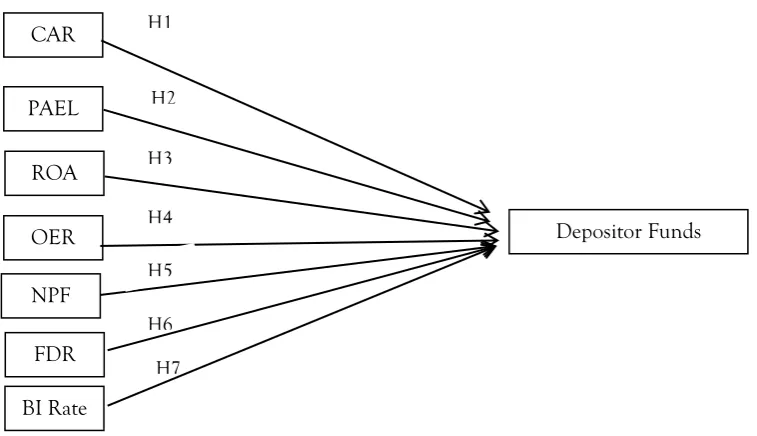
Based on the description, the conceptual framework in this study is as follows:
Figure 1. The Conceptual Framework
RESEARCH METHOD
The data used in this study is secondary data obtained from www.ojk.go.id. The type of data used is quantitative data. The population in this study is BPRS throughout Indonesia registered in OJK during 2011-2016. Sampling method used is the purposive sampling method.
Measurement of Variables
Deposit funds are used as the dependent variable to measure the level of public trust in the sharia banking system:30
Depositor funds = Savings + Deposit
25Wahyudi et al., 2013
26Hasbi dan Haruman, 2011
27Yulianto & Solikhah, 2016 28Hasbi & Haruman, 2011
29Pratasari, 2010 in Farizi & Riduwan, 2016 30Hasbi & Haruman, 2011
(1)
CARPAEL
ROA
OER
NPF
FDR
BI Rate
Depositor Funds
H7 H6 H5 H1
Measurement on the bank health level are done using the followings: a. CAR (Capital Adequacy Ratio)
CAR is defined as the situation where the adjusted capital is sufficient to absorb all losses and cover the bank’s fixed assets. This ratio is derived from capital compared to risk-weighted assets:31
b. Provision for Earning Assets Losses (PEAL)
PEAL is measured by comparing the allowance that should be established with productive assets. 32
c. ROA (Return on Assets)
ROA is an indicator of how profitable a company is relative to its total assets. 33
d. OER (Operational Efficiency Ratio)
Operational efficiency is obtained from the comparison of operational costs with income: 34
e. NPF (Non-Performing Financing)
A non-performing financing (NPF) is financing that is in default or close to being in default. The ratio is the comparison between default and total financing. 35
f. FDR (Financing to Deposit Ratio)
FDR in this study is obtained from the comparison of total financing with total third party funds. 36
g. BI-Rate
The interest rate used is the interest rate of Bank Indonesia (BI Rate) which becomes the reference bank in Indonesia in determining the interest rate.
Data Analysis Techniques
This study uses a quantitative descriptive model. Multiple linear regression analysis is used to test the influence of two or more explanatory variables on a dependent variable. The regression equation is expressed as follows.37
DFit=α +β1CARit-1+β2PPAPit-1+β3NPF it-1 +β4ROA it-1+β5OERit-1+β6FDR it-1+β7BI-Rateit-1+e
Note:
DF = Depositor funds
CAR = Capital Adequacy Ratio
PEAL = Provision for Earning Assets Losses NPF = Non Performing Financing
ROA = Return On Assets
OER = Operational Efficiency Ratio
31Sarker, 2006
32 PAPSI, 2003
33 Hasbi & Haruman, 2011 34 Hasbi & Haruman, 2011 35 Hasbi & Haruman, 2011 36 Hasbi & Haruman, 2011
FDR = Financing to Deposit Ratio BI-Rate = the rate by Bank Indonesia i t-I = company i, year t-1
e = error
HYPOTHESIS TESTING AND DISCUSSION The result of hypothesis testing is presented in Table 3.
Table 3. The Results of Regression Analysis
Variable Coefficient p-value
Constant 11.614 0.000***
CAR -1.407 0.160
PEAL 13.729 0.000***
NPF -1.715 0.087*
ROA 2.052 0.040**
OER 10.557 0.000***
FDR 2.251 0.025**
BI Rate -2.787 0.005***
Dependent variable: depositor funds Adj R2 0.298
F-Statistic 62.268
Probability (F-Statistic) 0.000a N 1009
***, **, * significant at 0.01, 0.05, 0.1
The equation model based on the regression analysis is as follows:
DF = 11.614 - 1.407CAR + 13.729PPAP - 1.715NPF +2.052ROA + 10.557OER + 2.251FDR - 2.787BI-Rate+e
Table 1 above shows that CAR has no significant effect on depositor funds (coefficient -1,407 with significance level 0.160 > 0.05), so H1 is rejected. The results are not in line with the study by Hasbi and Haruman (2011). This indicates that the people who keep the funds do not see capital as the main factor to save their funds in the bank. The community puts their trust in saving funds in sharia banks, especially BPRS.
The coefficient of PEAL is 13.729 with the significance level 0.000 < 0.05, which means that PEAL has positive and significant influence to depositor funds. It indicates the greater the depositor funds, the greater the bank can channel the financing, which means the greater the PEAL formed.
Table 1 also shows the NPF coefficient of -1.715 with a significance value of 0.087 > 0.05. This means that the NPF has no effect on deposit funds. The results are consistent with findings in the research by Hasbi and Haruman (2011), yet contrary to the study by of Yulianto and Solikhah (2016). In sharia banks, there is a principle of profit sharing, and through profit sharing, the risk of NPF is not too high when default financing shall happen. The possibility is that customers not to see it as a factor or indicator of the declining bank health level of the, so the customer still keeps the funds in sharia banks.
The ROA coefficient is 2.052 with a significance value of 0.040 < 0.05. This indicates that ROA has a positive and significant effect on depositor funds. The findings are in line with the results obtained by Hasbi and Haruman (2011). This illustrates that the good financial performance can increase third party funds.
The OER coefficient is 10.557 with a significance value of 0.000 < 0.05. It indicates that OER has a positive and significant effect on depositor funds. The findings are in line with the results obtained by Hasbi and Haruman (2011). This shows that performance appraisals by the public will increase when banks are more efficient. Therefore, the community put their trust to save their funds in BPRS.
Test FDR coefficient is 2.251 with a significance value of 0.025 < 0.05. This means that FDR has a positive and significant effect on depositor funds. The results are not in line with research findings of Hasbi and Haruman (2011) and yet inconsistent with the findings of Yulianto and Solikhah (2016).
CONCLUSIONS
Based on the results of data analysis and discussion, the conclusion of this research is as follows. First, the bank health level with PEAL proxy has positive and significant effect to depositor funds. Second, ROA have positive and significant effect to depositor funds. Third, OER has a positive and significant effect on depositor funds. Fourth, FDR has a positive and significant effect on depositor funds. Fifth, NPF has no effect on depositor funds. Sixth, CAR has no effect on depositor funds. Seventh, BI rate has a negative and significant effect on depositor funds. The implication of this study is that BPRS have to maintain and improve financial ratios that affect the health level, thereby increasing public trust to place its funds in the bank.
This study only examines the bank health level with quantitative assessment proxies. Further research is suggested to add the proxy and the qualitative research variables (such as management appraisal, good corporate governance, and market sensitivity risk) and the year range of research.
BIBLIOGRAPHY
Anisah, N. (2013). Faktor-Faktor yang Mempengaruhi Deposito Mudharabah Bank Syariah. Tesis. Sekolah Tinggi Ilmu Ekonomi Indonesia (STIESIA). Surabaya.
Antonio, Muhammad Syafi’i .(2001). Bank Syariah: Dari Teori Ke Praktek. Gema Insani Press, Jakarta. Chariri, A., dan I. Ghozali. (2008). Teori Akuntansi. Badan Penerbit Universitas Diponegoro. Semarang.
Ezike, John Emeka & Oke. MO. (2013) Capital Adequacy Standars, Basle accord and Bank Performance: The Nigerian Experience (A case study of selected banks in nigeria). Asian and Economic Financial Review 3 (2): 146-159.
Farizi, A.F & Riduwan, A. (2016). Pengaruh Inflasi, Suku Bunga, Likuiditas dan Bagi Hasil terhadap Deposito Mudharabah. Jurnal Ilmu dan Riset Akuntansi (5) 4.
Fitri, Maltuf. (2016). Peran Dana Pihak Ketiga Dalam Kinerja Lembaga Pembiayaan Syariah dan Faktor-Faktor yang Mempengaruhinya. Economika Vol. VII/Edisi 1/Mei: 73-95.
Freeman, R.E. (1994). Business Ethics Quarterly 4 (4): 409-421.
Hasbi, H., & Haruman, T. (2011). Banking: According to Islamic Sharia Concepts and Its Performance in Indonesia. International Review of Business Research Papers, 7 (1), 60-76.
Hilman, Iim, (2016). The Factors Affecting Mudharabah Deposits of Sharia Banking in Indonesia. International Journal of Business and Management Invention. Volume 5 Issue 8. pp: 56-66
Muhammad. (2001).Teknik Perhitungan Bagi Hasil di Bank Syariah. Yogyakarta: UII Press.
Nurhayati, S. dan Wasilah. (2011). Akuntansi Syariah di Indonesia. Edisi Kedua Revisi. Salemba Empat. Jakarta.
Oktavia, Ariska dan Mawardi, Imron. (2016). Kinerja Keuangan dan Kemaslahatan Stakeholder Bank Umum Syariah di Indonesia Periode 2010-2014. Jurnal Ekonomi Syariah Teori dan Terapan Vol.3 No.1 Januari 2016: 39-55.
Olimov, Sayakhmad, Hamid, Abdul & Mufraini, Arif. (2017). Performance of Depositor fund: A Lesson from Indonesian Islamic Banking Industry. Etikonomi Volume 16 (1) April: 53-70
Otoritas Jasa Keuangan. (2017). Modul Training of Trainers Keuangan Syariah. FEB UGM Yogyakarta Pedoman Akuntansi Perbankan Syariah Indonesia. (2003). PAPSI, Jakarta: Ikatan Akuntansi Indonesia.
Peraturan Bank Indonesia Nomor 9/17/PBI/2007 tentang Sistem Penilaian Tingkat Kesehatan Bank Perkreditan Rakyat Berdasarkan Prinsip Syariah
Peraturan Bank Indonesia Nomor 13/14/PBI/2011 tentang Penilaian Kualitas Aktiva Bagi Bank Pembiayaan Rakyat Syariah Rivai, V dan A. Arifin. (2010). Islamic Banking Sebuah Teori, Konsep dan Aplikasi. PT Bumi Aksara. Jakarta.
Sabir, M. M., M. Ali & A.H. Habbe. (2012). Pengaruh Rasio Kesehatan Bank Terhadap Kinerja Keuangan Bank Umum Syariah dan Bank Konvensional di Indonesia. Jurnal Analisis, Juni, Vol.1 No.1: 79-86.
Sarker, A. (2006). CAMELS Rating System in the Context of Islamic Banking: A Proposed ‘S’ for Shariah Framework. Journal of Islamic Economics, Banking and Finance, 2(2), July-December.