www.ijper.org
Evaluation on Teaching Mentoring Program Based on
Reflective Pedagogy Paradigm
Yosef Wijoyo1, Gandes Retno Rahayu2*, Iwan Dwiprahasto2
1Faculty of Pharmacy, Faculty of Pharmacy, Sanata Dharma University, Yogyakarta, INDONESIA. 2Faculty of Medicine, Universitas Gadjah Mada, Yogyakarta, INDONESIA.
ABSTRACT
Background:The aim of Jesuit education in brief is to produce graduates who have the intellectual and emotional capacity to be humanist, open to change, and full of love to serve others. To form graduates with such qualities, the Reflective Pedagogy Paradigm (RPP) is a critical part of the learning process. In order to teach using the RPP, an academic program was needed and developed in Jesuit institutions. For this reason, a study of an academic mentoring program was conducted in the Faculty of Pharmacy, Sanata Dharma University, Yogyakarta, Indonesia. This study is aimed to evaluate the mentoring process on RPP practice in the classroom. Method: One lecturer from the Community Pharmaceutical Service Course participated in the mentoring process. The mentoring activities were conducted in four separate meetings with different materials in each meeting. The evaluation was done by assessing: (1) recorded video from mentoring sessions based on an evaluation rubric; (2) personal reflection from the participating lecturer; and (3) the results of student’s reflections and action plans. Results: The result shows that: (1) the mentee teaching performance based on video assessed by two observers was 14.25 ± 3.4 (72% perform), (2) personal reflection from the lecturer indicated readiness to teach and make improvement, (3) overall student reflection journal based on rubric scoring by two observers were 13.62 ± 1.65 (68% achievement), and several students showed follow up activity in community service. Conclusion: After participating in mentoring activities, faculty is: (1) ready to perform RPP for large group student, (2) capable to make continuous improvement for teaching, and (3) capable to stimulate better achievement of students, as well as stimulate students to do follow-up in the community service.
Key words: Ignatian Spirituality, Reflective Pedagogy Paradigm, Academic mentoring program, Teaching preparation, Lecturer development.
DOI: 10.5530/ijper.50.2.34
Correspondence Address
Gandes Retno Rahayu, Faculty of Medicine, Universitas Gadjah Mada, Jl. Farmako, Sekip Utara, Yogyakarta 55281, INDONESIA.
E-mail: gandes_rr@ugm. ac.id
INTRODUCTION
The main aim of Jesuit education is to develop fully-human persons who will be
“men and women for and with others”,
in accordance with the spirit and example of Jesus Christ. Jesuit school graduates are expected to be socially-active persons who have the intellectual competence, the consci-entious willingness to develop their personal, moral and emotional dimensions, to be full of love, and concerned commitment to achieve justice in the service of the
people. Reflective Pedagogy is a mindset
(paradigm) and a way for lecturers to act in order to help students’ growth and develop-ment into a humanistic person. The three
main elements of the RPP are ‘experience,
Submission Date : 02-12-15 Revised Date : 08-01-16 Accepted Date : 21-06-16
reflection, and action’ which are
context-based and always get evaluated in a cycle of
pedagogical assessment and reflection. The
learning experience for both lecturers and students alike involves the deeper study, per-sonal understanding, and mentored training based on their own activities. The meaning
of reflection is to deepen the understanding
of learning activities, seek the meaning
of humanity, society, and find motivation, awareness, encouragement, and confidence
Ignatian Pedagogy Paradigm, or known in Indonesia as the Reflective Pedagogy Paradigm (RPP). Learning strategies that are made in reference to the RPP cycle
involve the following expanded version: context,
experi-ence, reflection, action and evaluation. This strategy is
made according to individual and environmental factors
to obtain optimal reflection skills for both students and also lecturers. Lecturers who will implement reflective learning strategy (like RPP) should get a mentored training to keep them engaged and able to reflect in order to
effectively implement the learning process.2,3
In order to apply the cycle learning of RPP, the men -toring program for lecturers is needed, for example by doing a video-recorded microteaching to provide feed-back for improvement of the learning process.4 This activity is known as an academic mentoring program.
For this research, mentoring is defined as the
one-to-one support of a novice or less experienced practitione-to-oner (mentee) by a more experienced practitioners (mentor),5 designed to assist the development of the mentee
expertise in teaching with RPP. We used “one to one
mentoring”, to adopt cura personalis, one of Jesuit educa-tion principle. Cura personalis means concern for the individual person.6 The benefit of using RPP-learning promises to help teachers be better teachers. It enables teachers to enrich the content and structure of what they are teaching and also helps teachers to motivate learners by providing the occasion and rationale for them to relate what is being studied to their own world experience.7-9 We believed that this model, will support the lecturer to internalize, improve and be ready to teach
using Reflective Pedagogical Paradigm.
During mentoring activities all activities should be docu mented, and the mentee should make self-reflection
on the learning process.10,11 This process named the
process as reflective experiencing, in which someone
commits time to reflect about the experience in the
context of improving the learning process outcomes.12 To enhance the performance of the mentee, a mentorship dialogue and an appreciation statement are required, so that the mentee could feel appreciated, being listened to and have the opportunity to respond criticisms and suggestions for improvements.5,13 In view of this, we con-ducted this study to assess the performance of lecturer to
teach based on RPP after academic mentoring program.
MATERIAL AND METHODS Research design
We conducted the research in the Faculty of Pharmacy,
Sanata Dharma University, Yogyakarta, Indonesia from
March until September 2014. This research received an ethics committee approval (Ref: KE/FK/233/EC) from Medical and Health Research Ethical Clearance (MHREC), Faculty of Medicine, Universitas Gadjah Mada, Yogyakarta, Indonesia.
Material development
Before conducting the research, we developed
pharma-cotherapy learning plan based on RPP, a student journal for reflection and diary. The designed pharmacotherapy learning plan and the student reflection journal were
validated by experts and being used in mentoring. The mentoring program was conducted in four meetings, with duration of 100 min in each meeting.
Subject
The lecturer who participated in the mentoring program
fulfilled the following criteria: (a) expert in pharmaco -therapy, (b) had not been awarded a lecturing grant from teaching and learning centre Sanata Dharma University or had gained the grant more than 3 years ago to avoid unnecessary similar training, and (c) joined the previous
RPP seminar conducted by researchers.
Students who participated in the mentoring process
were the students of Pharmacist Education Program (PEP) who were in the professional service learning or final year undergraduate students.
Analysis
All mentoring activities were video recorded and then
analyzed by two assessors (incl. YW). The lecturer also wrote personal reflection about her teaching. The student participants also wrote reflection about the
course and documented their activity in diary. The
assessment for student reflection was done by two assessors (incl. YW) and diary was analyzed by YW.
RESULTS
Mentee performance in teaching based on RPP
Under the mentoring process, the obtained data is as follows:
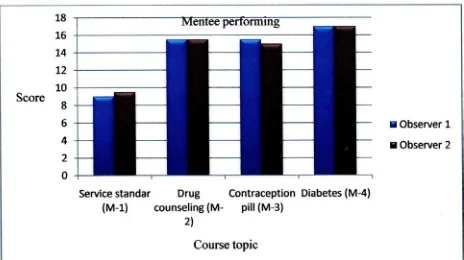
Based on Figure 1, the mean score was 14.25 (with maxi-mum score of 20). It shows that the performance of the mentee during the mentoring process has achieved 72%. As seen in Figure 1, the assessment score at the
first meeting was relatively low, because the mentee still struggled to understand and find the form of teaching and learning process based on RPP. Meanwhile, at the
good indicator that the mentee was able to implement
the teaching and learning process based on RPP for the
upcoming semester.
The detail on the mentee performance development
on all stages of the RPP is presented in Figure 2. This stages are context, experience, reflection, action and
evaluation. It is expected by the end of four meeting score of each stages is at least 3.
Context
In Figure 2, the mentee’s scores were fluctuating. The
average was 2.93, which means that the mentee had explored students’ prior knowledge, described the stages of the learning process and explained the
rele-vance of the course to the students’ working field after
graduation. For exploration of prior knowledge, the mentee gave tasks to the students a few days before the mentoring process to read literature or create a resume on course material or facilitate discussion at the begin-ning of class.
Experience
Based on Figure 2, there was also dynamic assessment at this stage. The relatively low score at about 2.5 was only found at the 1st meeting, while at the next three meetings the performance scores had reached 4 or the maximum score. Based on the results, the average was 3.65. The conducted activities were as follows: (1) teaching
using power point presentation and playback film or
animation; (2) facilitating student’s group discussion and role play simulation, followed by providing feedback on these activities and giving opportunity for students to give their argumentation; and (3) asking the students to make conclusions and suggestions for lessons if necessary. Reflection
Based on Figure 2, the mean score reflects stagnancy at the first three meetings with 1 point increase at the last
meeting. Based on the above scores result, the average
yield assessment was 2.25. Lecturer activities included distributing student journal reflections and describing how to write a reflection at the 1st until 3rd meeting, while at the 4th meeting the lecturer also shared student
reflections results from last week in addition to the fore -mentioned two activities. This change at the 4th meeting explains the increased score of the mentee.
Action
Based on Figure 2, there was also a dynamic assessment at this stage. Based on these results, the average score was 2.2. The management of this stage was quite
dif-ficult for the mentee. This stage was carried out in two
phases. The first stage was assigning homework for the
group of students and the mentee to present the results
of last week’s reflection and motivate students to apply
this knowledge in the community. The second stage was monitoring the student activities through the weekly diary. This use of diary served two functions: to document the activities they performed, and to remind students
Figure 3: Results of the assessment reflective journal for mentoring based on the rubric, which was carried out by independent evaluators and researchers. (M-2: second mentoring; M-3: third mentoring; M-4: fourth mentoring. There were 7 students who participated in the M-2, and there
were 6 students who participated in the M-3 and M-4, respectively)
Figure 1: Overall mentee performance in teaching based on RPP
Figure 2: Overall mentee performance in teaching at each stage of the RPP assessed in four meetings. (M-1: first meeting; M-2: second meeting; M-3: third meeting; M-4:
to conduct the action plan that they had written in the
reflection journals. Finally, at the 4th meeting, the mentee was able to motivate students by giving examples of possible activities and let them made consultation outside of class.
Evaluation
Evaluation was not only done on the academic aspect, but also on humanitarian aspects. Based on the results, the average was 3.18. At the 1st meeting, the mentee was
still having difficulties in managing this stage. After given
feedback by the two observers (as mentors), the mentee made improvements in the process. Evaluation of stud-ents was done through giving homework and feedback about the role-play process. By doing this step during the learning process, the mentee prepared students to be ready to apply their knowledge in the community. Student reflection and activities
Based on Figure 3, the assessment result for each type
of question in the students reflection journal showed
improvement. The presented results are data from the 2nd, 3rd and 4th meeting, because at the 1st meeting, the researcher found an imprecise question and needed to correct it and consulted with the experts.
The results of the total score of the journal reflections
on the 2nd, 3rd and 4th meeting amounted to 11.74, 14.31, and 14.83 out of the total maximum score of 20. The
inter rater reliability on student reflection journal by two
observers was 0.83. These results showed an
improve-ment in the students’ ability in writing a reflection on
the learning process.
One of the assignments in the student journal reflec -tions was: “Describe your action plan as a follow-up to the knowledge and life values that you have learned after studying this material”. This question aimed to know what the students had obtained during the learning process and the planned follow-up actions. As seen in Figure 3, the action plan writing scores increased from time to time
DISCUSSION
Mentee performance in teaching based on RPP Context
Activities that were done emphasized teachers to pro-vide a description of the learning objectives, stages of the learning process and explore the students’ prior knowledge.14 In the same way, an explanation from the mentee about the relationship between the course
mate-rial and work field is also very important to allow
stud-ents develop practical understanding of the importance
of this subject.15 The learning situation should be put in the context or the real situation, so the students really understand the goals and achievements of the learning process based on the course material. By understanding the context, students are expected to be motivated to apply their gained knowledge in the action stage.3,7 The lecturer who consistently performs this stage of context has successfully prepared the students to parti-cipate in the learning process and has provided clarity for students on the learning process that will be experienced, which is also known as prelection in Jesuit education. 7,15
The aforementioned description of prelection was in line
with the mentee reflection on this stage of context. For example, her reflection at the 3rd meeting is as follows:
I explained the significance of the use of oral contraceptives after giving the questions on what should be known about oral contraceptives, the importance of mentoring for the users about oral contraceptives because of the possible dangers that can arise, and guidance is certainly should only be given by pharmacists due to to their expertise in the field. According to initial assignment of students that I have read, it appears that the student has already had a good initial understanding of the pill, but they still do not understand the type, manner and means when patients forget to take the pill. This became my focus in teaching.
Experience
This learning process has helped the students to con-struct knowledge by doing a comparison, contrast, evaluation, analysis, and synthesis for all mental and psychomotor activities to better understand the real world applications. These activities are able to inte-grate cognitive and affective aspects directly and/or indirectly.17 The use of different variations of instruc-tional media to optimize the absorption of knowledge by students.18
Stage of experience for students could be understood as: (1) the action to feel something deeply; and (2) activities
that involve the brain, heart, senses and will. Without
the combination of the “brain” (intellectual under-standing) and “heart” (feelings), learning will not move the will to perform an action.7 The lecturer presentation
consisted of power point presentation and film/anima -tion with group discussion activities were a process to improve the deep understanding of the course material, while the role play simulation was a process to achieve integration of the brain, heart, senses and will.18 The innovation in teaching by engaging students to discuss and showing the performance of a simulated scenario
could contribute significantly in achieving learning
were a process to strengthen the integration process. During the group discussions, the lecturer accompanied the students from one group to another to assist the discussion, with the purpose to develop the potential of the students in the group to gain further understanding of the knowledge. This activity can also be called as cura personalis in Jesuit education.6,19 Encouragement through feedbacks on the performance of the role-play is consi-dered as reinforcement. This stage of experience is a process of active learning for students. Active learning process is ideally performed at this stage in the form of personal interaction of students with course materials, group discussions and sharing the results of these discussions. All the stages of active learning had been successfully done in this mentoring activity.16
Here is the result of the mentee personal reflection at
this stage, which was taken from the 2nd meeting:
I explained the counseling as a whole, which ranged from under-standing the structure, the factors that influence and support communication, different types of communication and principles of effective communication. I gave examples of bad communi-cation and how to fix it. I gave the students the opportunity to practice doing counseling and gave feedback on what has been done in the role play for improvements.
Reflection
Reflection is the heart of the RPP and is a bridge between
the effectiveness of the teaching and the learning by students.17 Reflection means conducting careful consi-deration to the use of memory, understanding, imagi-nation, and feelings about science, experience, ideas, desired purpose or spontaneous reaction to capture the meaning and the intrinsic value of what is learned.7 The
reflection results, which are shared with all students in
the next meeting, will make the students better able to learn from the entire community in the classroom. This
sharing is the ‘bridge’ between the topics in the lecture
and the learning experience in the actual classroom.20
As a means of reflection, we used mentee and student reflection journals. By writing journal reflection, it can
be a means to promote one’s inner dialogue, fostering inspiration and new ideas, sharpening awareness, and emotional processing, to become active learners, reach enlightenment, and cultivate honesty of expression as well as train the ability to write.21,22 In the reflection pro -cess, there are two main purposes: understanding and
judging. Understanding aims to find the meaning of an
experience by assessing the obtained data (information input) based on the sensory experience (seeing, hearing, touch, taste, and smell). Furthermore, it will trigger various concepts, formulation of hypotheses, elaboration of
theory and able to provide a definition of the gained
experience. Judging aims to detemine value, to verify the relationship between what is seen and experienced, or to
verify hypothesis made from data obtained from the five
senses.17 There is also decision-making that is reflected
from the writing of action plan at the end of the reflec -tion.23 Writing this weekly reflection will strengthen and challenge or trigger reconsideration, which will increase the action to be taken in the future.22
Underscoring its importance, the reflection of lecturer
at the 4th meeting was as follows:
I reminded the students again on the procedure to write reflections. To facilitate the students, I summarize the procedures in a power point presentation. I shared reflection resuls from students which were written with the mind and taste. These reflection examples were included in power point presentation as well. By doing this, I wish to facilitate students in writing reflections, as in the three previous meetings I always forget to share their results.
Action
Processing experiences through reflection will shape attitudes and values of the students. Reflections are not
a complete process if these do not guide a person in making decision, commitment and concrete action. In
the learning process, action is defined as: to interpret the results of learning with the mind and heart to realize the knowledge in real-life practice. Actions that can be applied in the RPP
include: project-based learning, service learning, essays, developing business plan, etc. By doing these activities, students are not only able in theoretical level, but also
able to apply their knowledge in the field.7
That homework is a process of repetition that strengthens students’ understanding of the course material.16 In making the homework, the students need to use higher-order thinking skills and the ability of imagina-tion as reinforced with video recording. This process
will provide support for their self-confidence and moti
-vation to apply their knowledge in society. Weekly diary entries become a means for students to become a reflec -tive practitioner and develop the ability to engage in knowledge internalization. The reason for this activity is that writing in their diary helps students able to be both
inward and outward looking.24
During the first three meetings, the mentee already
had motivated students, but she had not committed to accompany them through consultation before joining the service learning. Only at the 4th meeting, the mentee
was willing to assist students. One of the reflections on
4th meeting is as follows:
with them. I am willing to provide consultation outside lectures on diabetes education because this material is difficult.
The motivation of the students to be engaged in service learning is an attempt to realize the hallmark of Jesuit education, to be men and women for and with others. 6The application of knowledge in society will make students gain greater meaning and better understand their posi-tion in the world and also enable them to be agents of change in the future.25
Evaluation
Evaluation is conducted periodically to encourage the lecturer and students to observe the intellectual growth, attitudes, and actions that are aligned with the principles of men and women for and with others. Knowledge and skills are evaluated by exams, portfolios, projects, etc. Mean-while, the development of attitudes and personality are evaluated by personal interviews, review of the learner journal/diary, interpersonal relationships, and observ-ing the activity of learners in the classroom and other aspects. 7
In her reflection, the mentee writes as follows:
During performance of counseling role play by students in the class, other students were assigned to fill out an observation form. It is important for them to recognize aspects in the counseling process that were already good and aspects that still needs improve-ment. These forms are excellent to provide a personal feedback to each student group. I assessed the role play based on existing checklist. It is easier for me to do the feedback and it helps me to be more systematic, and it is easy to be followed by students.
Student reflection and activities
By writing journal reflections, students reach deep
understanding of all the process that has been experi-enced. This insight is shown by an increasing number in scores on the second and third question that were related to the knowledge and the values obtained (as seen at Figure 3). This increase indicates that students developed better understanding of the value of the knowledge acquired during the learning.26
Some of the results of the reflection paper are as
follows:
1. I participated in community health services, such as charity service and counseling (as told by student 1 at 2nd meeting);
2. The action I plan to do is providing correct information and education related to the use of birth-control pills to my house-mates, and preventing its abuse, as in treating acne (as told by student 3 at 3rd meeting);
3. In providing education to patients with diabetes, you should focus to what has been delivered. In addition, information
delivery should be in a joyful atmosphere and should use language that is easily understood by the patient, as well as willing to be a listener and a good communicator, so that the patients understand more about the treatment he received. This is expected to improve therapy compliance of patients with diabetes mellitus (as told by student 6 at 4th meeting).
Writing journal reflection is the main tool to strengthen
active learning. The ultimate goal of this reflection is to
enable students to apply their knowledge to the public, or at least show intention of it by having a plan of action.17 Meanwhile, the reflections help the students to
be able to find a linkage between knowledge and reality.
During this stage, it is important to make students have interaction with their social environment.7
Interestingly, after the 3rd and 4th meeting, there were some students who made the follow up by providing drug information to neighbours or family. One person provided information about birth control pills and three persons provided information about antidiabetic drugs. The following are some of their reasons for their activities:
1. I provide information about birth control pills medicine to my neighbor who happens to ask it to me last Monday. The benefits that I gained is that I came to realize that not all oral contraceptive users know about side effects or contraindi-cations that should be a concern. By providing this informa-tion, I became more confident because my acquired knowledge proved to be very useful in the community (as told by student 1 at 3rd meeting);
2. My landlord is suffering from diabetes and I ventured to ask about his diabetic condition. From my chat with him, he became demotivated to meet doctors because he felt there was no improvement from his disease, his blood sugar level was always above 200 and he actually did not take his medica-tions regularly. I adviced him to consult a doctor again and asked him to take medication on a regular basis. I also told him the possible harm if the medication is not taken regularly, that is the blood sugar will become uncontrolled and can lead to complications. I gained benefits from the experience, such as that I feel to be a responsible person, because as a future pharmacist I have shared my knowledge to people in need. My chat with my landlord was the beginning of my concern to give attention to my neighbors who may need my knowledge as a prospective pharmacist (as told by student 3 at 4th meeting).
Based on the follow-up by the students, it has been shown that the encouragement given by the mentee at the end of the course could lead students to actuate
the action plans they had written in the reflection journal.
the students will obtain an experience to support their preparedness after graduation, while also strengthening the understanding of the gained knowledge.27 Further-more, the implementation of the action is a shift from
reflection-on-action into knowledge-in-action. By applying real action, the students are no longer being a consumer of knowledge, but becoming the producer and applier of knowledge.28
The limitation of the study due to the only one lecturer that being trained in teaching preparation. So all the result can not be generalized, but can be as a model for
teaching preparation. We recommend to apply
one-to-one mentoring as a part of introducing and/or
strength-ening the application of RPP
CONCLUSION
After participating in mentoring activities, faculty is: (1)
ready to perform RPP for large group student, (2) capable
to make continuous improvement for teaching, and (3) capable to stimulate better achievement of students, as well as stimulate students to do follow-up in the com-munity service
ACKNOWLEDGEMENT
The research is done under funding from Sanata Dharma Foundation
CONFLICT OF INTEREST
The author declare that they have no competing interests.
REFERENCES
1. Metts RE. Ignatius Knew, 1st printing. (Washington DC: Jesuit Secondary Education Association, 1995;12-33.
2. Schaub-de JM, Schonrock-Adema J, Dekker H, Verkerk M, Cohen-Schotanus
J. Teacher competencies essential for facilitating reflective learning in small
groups: development of a student rating scale to evaluate teachers. Medical Education. 2011;45(2):155-65.
3. Mc Avoy M, Crowe T, Lotz R, Truka B. The influence of the Ignatian
Pedagogical Paradigm on instructors integrating it into undergraduate courses in the College of Professional Studies at Marquette University. Jesuit Higher Education 2012;1(2):82-105.
4. Duminuco VJ. A New Ratio for a New Millenium in Duminuco VJ. The Jesuit Ratio Studiorum 400th Anniversary Perspectives, Fordham University Press. 2000, 145-159.
5. Hobson AJ, Ashby P, Malderez A, Tomlinson PD. Mentoring beginning teachers: What we know and what we don’t. Teaching and Teacher Education. 2009;25:207-16.
6. International Commission on the Apostolate of Jesuit Education (ICAJE). Characteristics Typical Education at the Institute of Jesuit Education.Rome: International Center for Jesuit Education. 1987.
7. International Commission on the Apostolate of Jesuit Education (ICAJE). Ignatian Pedagogy A Practical Approach. Rome: International Center for Jesuit Education. 1993.
8. Kolvenbach. Jesuit Education and Ignatian Pedagogy. 2005. Available in
www.saintpeter.edu/file/2012/08. Accessed on March 2013.
9. Mc Avoy. Training Faculty to Adopt the Ignatian Pedagogical Paradigm: Process and Outcome. Jesuit Higher Education. 2013;2(2):62-109. 10. Brown BK, Hanson SH. Development of a student mentoring program.
American Journal of Pharmaceutical Education. 2003;67(4) article 121. 11. Kohn H. A Mentoring Program to Help Junior Faculty Member Achieve
Scholarship Success. American Journal of Pharmaceutical Education. 2014;78(2): article 29.
12. Larkin S. Reflective reading and experiencing: An Ignatian model for writing reflection journal, in Mooney D. Teaching to the Mission: A Compendium of
the Ignatian Mentoring Programme. Xavier University. 2010:219-22. 13. Thomas T. Rethinking Magis in Mooney D. 2010, Teaching to the Mission:
A Compendium of the Ignatian Mentoring Programme. Xavier University. 2010;228-34.
14. Pennington K, Crewel J, Snedden T, Mulhall M, Ellison N. Ignatian pedagogy: Transforming nursing education. Jesuit Higher Education. 2013;2(1):34-40.
15. Hattie J. Visible Learning: A Synthesis of Over 800 Meta-analysis Related to Achievement. Routledge, London. 2009.
16. Metts RE. 1995 Four hallmarks of Jesuit Pedagogy: Prelection. Reflection.
Active Learning. Repetition in Foundation, ed., O’Connel, JF. Jesuit Secondary Education Association. 2005.
17. Rincon JL. Ignatian pedagogy at the service of lay mission. Review of Ignatian Spirituality. 1/2007, 14, XXXVIII.
18. Newton RR. 1977. Reflections on the Educational Principles of the Spiritual Exercise in Foundation, ed. O’Connel, JF. Jesuit Secondary Education Association. 2005.
19. Geger BT. Cura Personalis: Some Ignatian Inspirations. Jesuit Higher Education. 2014;3(2):6-20.
20. van Hise J. Transformative Education-Using Ignatian Pedagogy To Teach
Business Ethics. Fairfield University.2012.
21. Moon. Learning Journals and Log, Reflective Diaries. Centre for Teaching
and Learning, UCD Dublin. 2003, 1-29.
22. Aronson L. Twelve tips for teaching reflection at all levels of medical
education. Medical Teacher. 2010,1-6.
23. Denk KM. Making Connections, Finding Meaning, Engaging the World:
Theory and Techniques for Ignatian Reflection on Service for and with
Others. Maryland Province Society of Jesus. 2006,6-7.
24. Coghlan D. Ignatian Spirituality as transformational social science. Action Research. 2005;3(1):89-107.
25. Reason. Integrating action and reflection through cooperation inquiry.
Management Learning Special Issue The Action Dimension in Management Diverse Approach to Research Teaching and Development. 1999;30(2): 207-27.
26. Peters TJ. Marquette University Global Brigades: Using the Spiritual
Exercises as an orientation for a short-term international engagement
project. Jesuit Higher Education. 2013;2(2):54-61.
27. Lo. Professorial reflection and practical pedagogical suggestions for increasing guided reflection for students in a service-learning class. Jesuit
Higher Education.2014;3(2):104-16.
28. Caruana V. Using the Ignatian Pedagogical Paradigm to frame the reflective
SUMMARY PICTORIAL ABSTRACT
• One lecturer from the Community Pharmaceutical Service Course participated in the mentoring pro-cess.
• After participating in mentoring activities, faculty is : (1) ready to perform RPP for large group student, (2) capable to make continuous improve-ment for teaching, and (3) capable to stimulate better achievement of students, as well as stimu-late students to do follow-up in the community service.
Yosef Wijoyo: Is a senior lecturer in Faculty of Pharmacy, Sanata Dharma University, Yogyakarta, Indonesia. Now being a doctoral student in Faculty of Medicine, Universitas Gadjah Mada, Yogyakarta, Indonesia. His doctoral research focused on the development of learning strategies based on reflective pedagogy paradigm.
Gandes Retno Rahayu: Is senior lecturer in Department of Medical Education, Faculty of Medicine, Universitas Gadjah Mada, Yogyakarta, Indonesia. Obtained her PhD degree in Medical Education in 2005 from University of Dundee, Scotland, United Kingdom.
Iwan Dwiprahasto: Is Professor of Clinical Pharmacology, Faculty of Medicine, Universitas Gadjah Mada, Yogyakarta, Indonesia. Obtained his PhD degree in 1996 from London School of Hygiene and Tropical Medicine, United Kingdom. Riset interest in pharmacotherapy.
RPP : Reflective Pedagogy Paradigm.
About Authors