R E V I E W
Open Access
Adaptive laboratory evolution
–
principles and
applications for biotechnology
Martin Dragosits
1*and Diethard Mattanovich
2Abstract:Adaptive laboratory evolution is a frequent method in biological studies to gain insights into the basic mechanisms of molecular evolution and adaptive changes that accumulate in microbial populations during long term selection under specified growth conditions. Although regularly performed for more than 25 years, the advent of transcript and cheap next-generation sequencing technologies has resulted in many recent studies, which successfully applied this technique in order to engineer microbial cells for biotechnological applications. Adaptive laboratory evolution has some major benefits as compared with classical genetic engineering but also some inherent limitations. However, recent studies show how some of the limitations may be overcome in order to successfully incorporate adaptive laboratory evolution in microbial cell factory design. Over the last two decades important insights into nutrient and stress metabolism of relevant model species were acquired, whereas some other aspects such as niche-specific differences of non-conventional cell factories are not completely understood. Altogether the current status and its future perspectives highlight the importance and potential of adaptive laboratory evolution as approach in biotechnological engineering.
Keywords:Laboratory evolution, Cell factory engineering, Microbial growth, Microbial stress, Biotechnology
Microbial cells are of special importance for biotechno-logical applications and bacteria and yeasts are used for many biotechnological tasks, ranging from biofuel pro-duction [1-3], commodity chemical synthesis [4,5], through to the production of industrial and biopharma-ceutical proteins [6-8]. Moreover, biological catalysis of-fers several advantages over chemical synthesis, such as stereo-selective production of chemical compounds [9]. Synthetic biology is a new emerging field [10,11] and systems metabolic engineering has proven very success-ful for the design and implementation of biotechno-logical production processes [12-14]. Recently, classical genetic engineering was successfully complemented with artificial laboratory selection of microbial cells in order to generate potentially robust and optimized microbial production systems [15,16].
Here we summarize the basics and implications of adaptive laboratory evolution for biological engineering. We present important studies on laboratory evolution and evolutionary engineering with the aim of improving microbial growth on relevant substrates and stress
resistance. Furthermore, we discuss the existence of cross-stress dependencies in bacteria and yeasts and the implications of evolutionary engineering for non-conventional host organisms. It is clear that the vast amount of available data on this topic exceeds the scope of this recapitulation. Towards this end we want to point out that some other recent reviews discussed the im-portance of adaptive laboratory evolution (ALE) in ap-plied microbiology and may cover other relevant topics [15-19]. Furthermore, additional reviews cover more general aspects of ALE [20-23].
Adaptive laboratory evolution
Adaptive laboratory evolution as a scientific approach is very important towards the analysis of evolutionary phe-nomena in a controlled laboratory setting. The principles on which laboratory evolution experiments are based, date back to scientists such as Antonie van Leeuwenhoek, Louis Pasteur, Robert Koch and most notably Charles Darwin, with their discoveries of microorganisms, the ge-neral acceptance of the germ theory and the importance of natural and artificial selection for biological evolution and breeding. Hence, adaptive laboratory evolution was already performed about a hundred years ago by William Dallinger [22] and during the middle of the last century
* Correspondence:[email protected] 1
Department of Chemistry, University of Natural Resources and Life Sciences, Muthgasse 11, A-1190 Vienna, Austria
Full list of author information is available at the end of the article
[24,25]; however, particularly in the last 25 years, there has been an ever increasing number of such experiments with Escherichia coli and Saccharomyces cerevisiae being the most prominent organisms under investigation [26-28].
During microbial ALE, a microorganism is cultivated under clearly defined conditions for prolonged periods of time, in the range of weeks to years, which allows the selection of improved phenotypes. Microbial cells offer important advantages for ALE studies: (a) most micro-bial cells have simple nutrient requirements, (b) they can be easily cultivated in the laboratory and (c) micro-bial cells generally grow very fast and can be cultivated for several hundred generations within several weeks or months (with typical specific growth rates of microbial cells in the range of μ= 0.05 to 1.0 h-1). In contrast to comparative genomics [29], ALE allows phenotypic changes to be clearly associated with a certain growth environment that leads to the selection of traits. More-over, due to rather new technologies, including tran-scriptional profiling [30] and massive next-generation DNA sequencing (NGS) [31,32], phenotype-genotype correlations can be easily obtained by whole genome re-sequencing (WGS). ALE led to important insights and experimental proof for evolutionary biology. On the forefront of laboratory evolution experiments, the long term study of Professor Lenski and his research group at
the Michigan State University has to be mentioned. This single parallel E. coli adaptation experiment is already exceeding 50000 generations [33-35]. Together with other similar experiments, the scientific community was provided with insights into the genetic basis of increased fitness [36], implications of historical contingency in laboratory evolution [37], second order effects during evolution [38], the interrelation of population size, ro-bustness and evolvability [39-41], clonal interference [42] and evolutionary bet hedging [43].
Laboratory selection methods
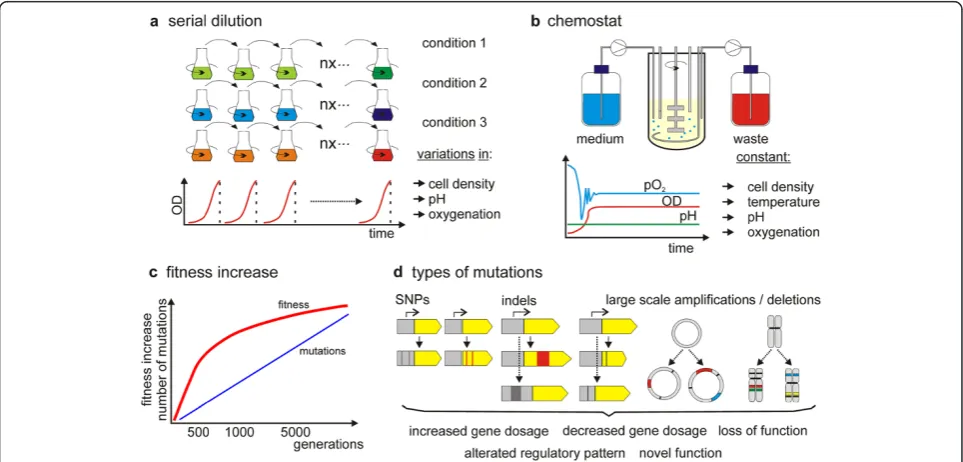
Generally, ALE experiments with microorganisms are easy to establish and the common methods, which are used, are shown in Figure 1a and Figure 1b. Batch culti-vation in shake flasks can be performed to propagate mi-crobial cells in parallel serial cultures. At regular intervals (usually on a daily basis), an aliquot of the cul-ture is transferred to a new flask with fresh medium for an additional round of growth. Clearly, this easy setup has the advantages of cheap equipment and the ease of massive parallel cultures. By replacing shake flasks with deep well plates with even smaller culture volumes, hun-dreds of microbial cultures can be grown in parallel [44]. Several environmental factors can be easily controlled, including temperature and spatial culture homogeneity
(by constant mixing of the culture). Nevertheless, batch cultivation has certain shortcomings, including varying population density, fluctuating growth rate, nutrient sup-ply and fluctuating environmental conditions such as environmental pH and dissolved oxygen (partial oxygen pressure, pO2). In many cases, these factors may not be of great importance for the experimental setup but the simplicity of the setup can prevent the implementation of complex environments for microbial selection experi-ments. As an alternative to serial batch growth, continu-ous (chemostat) cultures in bioreactor vessels (Figure 1b) are applied [45-50]. The advantages of chemostat cultiva-tion are constant growth rates and populacultiva-tion densities. Furthermore, it is possible to tightly control nutrient sup-ply and environmental conditions such as pH and oxygen-ation. A major drawback is the costs of operoxygen-ation. Even with small vessels and parallel operation, as they are avail-able from many manufacturers, the costs are by far exceeding the costs of shake flask cultivations. A major difference between prolonged selective growth in batch and chemostat cultures is, however, the growth in nutrient-sufficient versus potentially nutrient-limited con-ditions. Principally, feedback control mechanisms, such as in the case of a pH-auxostat [51] allow nutrient-sufficient growth in chemostat cultures at the maximum specific growth rate; however, nutrient-limited growth at a growth rate below the maximum is predominantly applied in con-tinuous cultures. As indicated in Figure 1a, in serial batch cultures for ALE, the transfer often occurs before the sta-tionary phase is reached. Clearly, this is a prerequisite to avoid stationary phase adaptation [52]. Thus, microbial cells are predominantly grown in exponential cultures. In contrast, in continuous cultures, the growth rate is kept constant (or in certain experimental setups stepwise / con-tinuously increasing) by the limitation of a major growth nutrient, such as glucose, nitrogen or phosphate. In this context, cells selected under growth limiting conditions can show growth trade-offs in non-limiting conditions and vice versa [53]. If the selection aims at phenotypes that do not rely on increased growth rates or biomass yield but other traits such as e.g. a yes / no survival pheno-type after gene knockout or antibiotic production, solid media or combinations of solid and liquid media can be applied in order to select for proper phenotypes [54,55].
There are several critical issues that may arise during the genetic engineering and artificial selection for micro-bial biotechnology [16]. As example, for certain processes selection for increased tolerance to an accumulating but toxic bio-product can be appropriate. Other biotechno-logical processes, such as recombinant protein production and metabolite co-production in microbial cells, are coupled to microbial growth [56]. Furthermore, scale-up of microbial processes often represents a major obstacle in process design. Whereas small-scale cultivations and
initial engineering steps are often performed in complex media in batch culture, during the scale-up of the process, cells are exposed to altered environmental conditions and environmental stress regimes [57,58].
Altogether, these factors should ideally also be well-considered in the case that ALE is implemented in microbial cell factory design. The initial choice of condi-tions, including media composition and limited versus non-limited growth rate, will greatly influence whether the artificially selected microbial host will be suitable for its dedicated application.
Increased growth and fitness as desirable criteria
During adaptive evolution, certain trait values change and are associated with increased (Darwinian) fitness [20]; as such, an improved phenotype or property is often equal to increased fitness. During direct competi-tion of an ancestral microbial strain and an adapted strain, the increased fitness of the adapted variant will be obvious by its increased frequency in the total popula-tion. With suitable neutral genetic markers, this fitness difference can be easily monitored during laboratory evolution of microbial cells [34,59]. Competitive fitness assays usually involve growth in batch cultures and are balanced for all growth phases (lag, exponential and sta-tionary phase). On the other hand, the maximum growth rate (μmax) of microbial cells is less commonly used in order to determine changes of the evolutionary fitness. Nevertheless, for biotechnology, parameters such as
μmax, survival rates in toxic concentrations of certain chemical compounds and absolute biomass yield are ap-propriate fitness criteria.
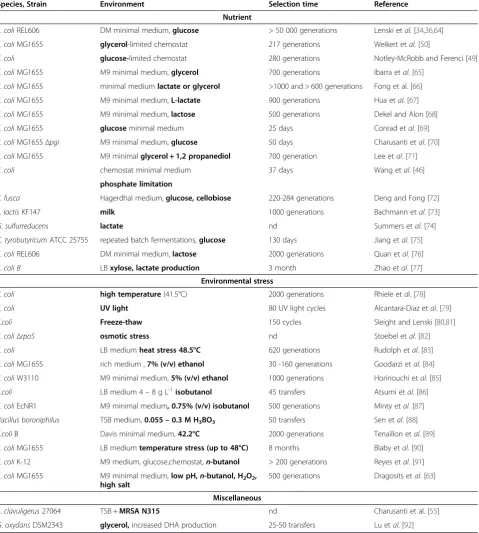
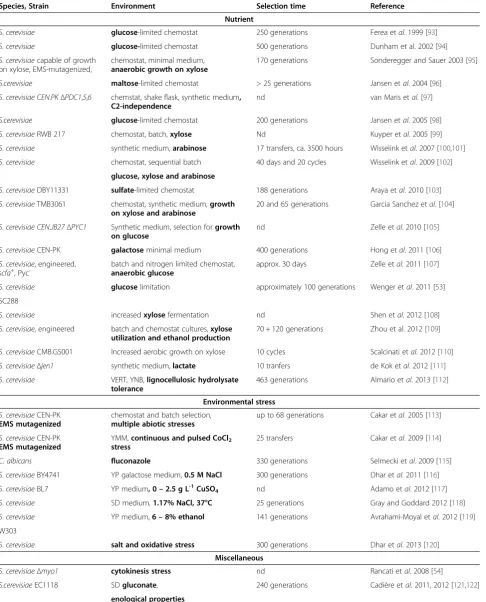
An important factor during the search for improved phenotypes by ALE is the time span for the selection ex-periment. In summary Tables 1 and Table 2, it can be seen that a typical ALE experiment is performed for somewhat between 100 and 2000 generations and usu-ally takes a few weeks up to a few months. During ALE, several phenotypes will occur at first and compete for
Besides the time needed to accumulate improved phe-notypes, the degree of increased fitness that can be achieved, is an important factor for efficient implemen-tation of ALE in microbial strain engineering. Based on previous studies, we can estimate that within 100 to 500
generations (corresponding to up to 2 months of selec-tion for a typicalE.coliorS.cerevisiaeculture), a fitness increase of up to 50–100% can be achieved. In certain cases ALE can lead to an even higher increase of up to 1000% as recently shown for the iron reduction rate of
Table 1 Adaptive laboratory evolution experiments with bacteria
Species, Strain Environment Selection time Reference
Nutrient
E.coliREL606 DM minimal medium,glucose > 50 000 generations Lenski etal. [34,36,64]
E.coliMG1655 glycerol-limited chemostat 217 generations Weikert etal. [50]
E.coli glucose-limited chemostat 280 generations Notley-McRobb and Ferenci [49]
E.coliMG1655 M9 minimal medium,glycerol 700 generations Ibarra etal. [65]
E.coliMG1655 minimal mediumlactate or glycerol >1000 and > 600 generations Fong et al. [66]
E.coliMG1655 M9 minimal medium,L-lactate 900 generations Hua etal. [67]
E.coliMG1655 M9 minimal medium,lactose 500 generations Dekel and Alon [68]
E.coliMG1655 glucoseminimal medium 25 days Conrad etal. [69]
E.coliMG1655Δpgi M9 minimal medium,glucose 50 days Charusanti etal. [70]
E.coliMG1655 M9 minimalglycerol + 1,2 propanediol 700 generation Lee etal. [71]
E.coli chemostat minimal medium 37 days Wang etal. [46]
phosphate limitation
T.fusca Hagerdhal medium,glucose, cellobiose 220-284 generations Deng and Fong [72]
L.lactisKF147 milk 1000 generations Bachmann etal. [73]
G.sulfurreducens lactate nd Summers etal. [74]
C.tyrobutyricumATCC 25755 repeated batch fermentations,glucose 130 days Jiang etal. [75]
E.coliREL606 DM minimal medium,lactose 2000 generations Quan etal. [76]
E.coli B LBxylose, lactate production 3 month Zhao etal. [77] Environmental stress
E.coli high temperature(41.5°C) 2000 generations Rhiele etal. [78]
E.coli UV light 80 UV light cycles Alcantara-Diaz etal. [79]
E.coli Freeze-thaw 150 cycles Sleight and Lenski [80,81]
E.coliΔrpoS osmotic stress nd Stoebel etal. [82]
E.coli LB mediumheat stress 48.5°C 620 generations Rudolph etal. [83]
E.coliMG1655 rich medium ,7% (v/v) ethanol 30 -160 generations Goodarzi etal. [84]
E.coliW3110 M9 minimal medium,5% (v/v) ethanol 1000 generations Horinouchi etal. [85]
E.coli LB medium 4–8 g L-1isobutanol 45 transfers Atsumi etal. [86]
E.coliEcNR1 M9 minimal medium, 0.75% (v/v) isobutanol 500 generations Minty etal. [87]
Bacillus boroniphilus TSB medium,0.055–0.3 M H3BO3 50 transfers Sen etal. [88]
E.coliB Davis minimal medium,42.2°C 2000 generations Tenaillon etal. [89]
E.coliMG1655 LB mediumtemperature stress (up to 48°C) 8 months Blaby etal. [90]
E.coliK-12 M9 medium, glucose,chemostat,n-butanol > 200 generations Reyes etal. [91]
E.coliMG1655 M9 minimal medium,low pH,n-butanol, H2O2, high salt
500 generations Dragosits etal. [63]
Miscellaneous
S.clavuligerus27064 TSB +MRSA N315 nd Charusanti et al. [55]
G.oxydansDSM2343 glycerol,increased DHA production 25-50 transfers Lu etal. [92]
Table 2 Adaptive laboratory evolution experiments with yeasts
Species, Strain Environment Selection time Reference
Nutrient
S.cerevisiae glucose-limited chemostat 250 generations Ferea etal. 1999 [93]
S.cerevisiae glucose-limited chemostat 500 generations Dunham et al. 2002 [94]
S.cerevisiaecapable of growth on xylose, EMS-mutagenized,
chemostat, minimal medium, anaerobic growth on xylose
170 generations Sonderegger and Sauer 2003 [95]
S.cerevisiae maltose-limited chemostat > 25 generations Jansen etal. 2004 [96]
S.cerevisiae CEN.PKΔPDC1,5,6 chemstat, shake flask, synthetic medium, C2-independence
nd van Maris etal. [97]
S.cerevisiae glucose-limited chemostat 200 generations Jansen etal. 2005 [98]
S.cerevisiaeRWB 217 chemostat, batch,xylose Nd Kuyper etal. 2005 [99]
S.cerevisiae synthetic medium,arabinose 17 transfers, ca. 3500 hours Wisselink etal. 2007 [100,101]
S.cerevisiae chemostat, sequential batch 40 days and 20 cycles Wisselink etal. 2009 [102]
glucose, xylose and arabinose
S.cerevisiaeDBY11331 sulfate-limited chemostat 188 generations Araya etal. 2010 [103]
S.cerevisiaeTMB3061 chemostat, synthetic medium,growth on xylose and arabinose
20 and 65 generations Garcia Sanchez etal. [104]
S.cerevisiae CEN.JB27ΔPYC1 Synthetic medium, selection forgrowth on glucose
nd Zelle etal. 2010 [105]
S.cerevisiaeCEN-PK galactoseminimal medium 400 generations Hong etal. 2011 [106]
S.cerevisiae, engineered,
scfa+, Pyc
-batch and nitrogen limited chemostat, anaerobic glucose
approx. 30 days Zelle etal. 2011 [107]
S.cerevisiae glucoselimitation approximately 100 generations Wenger etal. 2011 [53]
SC288
S.cerevisiae increasedxylosefermentation nd Shen etal. 2012 [108]
S.cerevisiae, engineered batch and chemostat cultures,xylose utilization and ethanol production
70 + 120 generations Zhou et al. 2012 [109]
S.cerevisiaeCMB.GS001 Increased aerobic growth on xylose 10 cycles Scalcinati etal. 2012 [110]
S.cerevisiaeΔjen1 synthetic medium,lactate 10 tranfers de Kok etal. 2012 [111]
S.cerevisiae VERT, YNB,lignocellulosic hydrolysate tolerance
463 generations Almario etal. 2013 [112]
Environmental stress
S.cerevisiaeCEN-PK EMS mutagenized
chemostat and batch selection, multiple abiotic stresses
up to 68 generations Cakar etal. 2005 [113]
S.cerevisiaeCEN-PK EMS mutagenized
YMM,continuous and pulsed CoCl2 stress
25 transfers Cakar etal. 2009 [114]
C.albicans fluconazole 330 generations Selmecki etal. 2009 [115]
S.cerevisiaeBY4741 YP galactose medium,0.5 M NaCl 300 generations Dhar etal. 2011 [116]
S.cerevisiaeBL7 YP medium, 0–2.5 g L-1CuSO4 nd Adamo etal. 2012 [117]
S.cerevisiae SD medium,1.17% NaCl, 37°C 25 generations Gray and Goddard 2012 [118]
S.cerevisiae YP medium,6–8% ethanol 141 generations Avrahami-Moyal etal. 2012 [119]
W303
S.cerevisiae salt and oxidative stress 300 generations Dhar etal. 2013 [120] Miscellaneous
S.cerevisiaeΔmyo1 cytokinesis stress nd Rancati etal. 2008 [54]
S.cerevisiaeEC1118 SDgluconate, 240 generations Cadière etal. 2011, 2012 [121,122]
enological properties
Geobacter sulfurreducens [123], although this increase was only achieved after 24 months of selection (a time scale that may not be feasible for many biotechnological purposes). The maximum achievable fitness increase within a certain time or generation span can vary signifi-cantly depending on the selection pressure. Whereas certain environments can lead to fast selection of im-proved phenotypes, others, including the long-term adaptation to environmental pH [59,63], represent com-plex environments where microbial cells show low adap-tive potential in terms of absolute fitness gain. In this context, we cannot clearly predict the scale at which im-proved phenotypes emerge during laboratory evolution, although recent literature indicates that such predictions are possible in certain growth contexts such as carbon source adaptation [65]. Moreover, it is important to note that the fitness increase as a function of the total num-ber of generations is not linear (Figure 1c). Whereas the fitness increase is usually fast within the first 100 to 500 generations, it slows considerably down during the course of ALE [36]. For standard ALE in biotechnology this is a critical factor, as prolonged selection that ex-ceeds the first rapid evolutionary adaptation phase will not necessarily lead to significantly improved phenotypes [67]; therefore, there is a clear cost benefit ratio of ex-perimental selection time and achievable fitness im-provements for most microbial engineering purposes. Thus, complex environments may depend on advanced selection strategies to compensate a low adaptive poten-tial and the ceasing fitness gain during ALE.
Many typical ALE experiments were performed in shake flasks and similar growth conditions with cell densities in the range of 107 to 109 cells per mL for typical microbial cultures [124,125] and as such, the total number of generations is commonly used to esti-mate the emergence of adaptive mutations. Nevertheless, this correlation does not take into account the total number of cells in a population. Only recently, the cu-mulative number of cell divisions (CCD) was proposed as a more appropriate denominator to evaluate microbial evolution [126].
Mutations and robustness
Mutations are the basis underlying genetic change and the selection of improved phenotypes in nature as well as in the laboratory. Although DNA replication itself is a process of high fidelity with a mutation rate of approxi-mately 10-10 per base pair per replication for microbial cells [127], the large population sizes in microbial cul-tures still allow the emergence of frequent mutations within a short time span.
In recent ALE experiments various types of mutations were detected: Single-nucleotide polymorphisms (SNPs), small scale insertions and deletions (indels), transposable
element (insertion sequence, IS) movements and ampli-fications as well as deletions of larger genomic regions (Figure 1d). Altogether, these genomic changes contrib-ute to the change of trait values during laboratory evolu-tion. As summarized in a recent review, SNPs (61%, with G:C to T:A mutations being disproportionally frequent) account for the majority of observed genetic changes [15]. Deletions accounted for approximately 29% of the observed genomic changes, followed by insertions (7%) and IS movements (3%) [15]. Similar to SNPs, these types of mutations also contribute to increased and decreased gene dosage, altered or diminished gene func-tion or altered gene regulatory patterns. In several recent studies, gene amplifications were identified to contribute to increased gene dosage [63,116,128] and subsequently increased fitness. In a purely evolutionary perspective, they are even more important. Whereas there is an on-going debate about the long-term fixation of gene dupli-cations, either by their selective advantage under selection pressure, or by selective neutrality and fixation by random drift, they are a prerequisite for the develop-ment of novel molecular functions [129-131].
For microbial, more specifically prokaryotic cells, a new model for the emergence of novel metabolic path-ways was introduced. This so-called toolbox model sug-gests that prokaryotic metabolic pathways emerge through horizontal gene transfer (HGT) and are rapidly acquired and lost based on nutrient availability [132]. Nevertheless, the role of HGT in natural evolution re-mains a controversial topic [133].
example, in a recent E. coli study, a mutator phenotype mutTwas invaded bymutYmutations. The authors esti-mated that themutTmutation leads to an approximately 150-fold increase of the mutation rate, whereas the mutYmutations decreased the mutation rate by 40–60% in order to decrease the genetic load [143]. Furthermore, it was shown that mutational robustness tends to in-crease with mutation rate and decline with population size [40].
Considering this general tension between mutational robustness of genes and networks and the potential to evolve, enzyme promiscuity is also important for the evolution of novel functions [144]. Moreover, there is evidence that the interplay of protein mutational robust-ness, protein folding and environmental stress is an add-itional key factor that determines the evolution of new traits [145,146]. The evolution of novel functions and pathways can be hardly observed in a laboratory evolu-tion experiment, even with microbial cells and their fast growth rates. Nevertheless, there are a few examples that highlight that a novel trait can emerge rapidly on a la-boratory time scale. For example, an experimentalE.coli culture could evolve the ability to aerobically utilize cit-rate [37], or the ability to use the non-natural carbon source 1,2-propanediol [71]; also, a strain deficient in glutathione biosynthesis was able to develop compensa-tory mutations to restore this function [147].
Microbial cells are generally grown at constant growth rate in chemostats or at constant μmaxduring the expo-nential phase of a batch culture. It should be noted that microbial batch cultures can show rapid evolutionary adaptation if they are exposed to prolonged stationary phase. In fact, this nutrient limited condition represents a very dynamic environment for microbial populations. So-called GASP (growth advantage in stationary phase) mutants are rapidly fixed in E. coli populations [52]. Mutations in amino acid catabolic processes and stress response sigma factor, rpoS, are of special importance for acquiring a selective advantage in such nutrient starved conditions [148,149]; however, such mutational adaptations might be counterproductive for some appli-cations of microbial cells in biotechnology.
Adaptation towards nutrient sources and environmental stresses
In nature as well as in biotechnological processes, mi-croorganisms are challenged with changing environmen-tal conditions, where they experience fluctuations in temperature, pH, oxygenation, atmospheric or hydro-static pressure but also water and nutrient availability; thus, the selective pressures can be divided in two main categories: nutrient availability and environmental stress [17]. Microbial cells evolved mechanisms to successfully cope with such stressful conditions in order to maintain
cellular homeostasis. In contrast to natural environ-ments, in industrial processes microbial cells may be challenged with non-natural stresses that may result in poor and non-competitive process performance. Many ALE studies analyzed the impact and molecular adapta-tion towards both stresses (Table 1 and Table 2), leading to major findings regarding the emergence of specialists, generalists, the underlying mutations and the applicabi-lity of evolved cells for industrial microbiology.
Nutrient stress
Efficiency of nutrient source utilization is an important aspect of microbial growth and for industrial purposes it may be governed by factors such as substrate cost or in-creased bioconversion rates. Multiple studies analyzed the adaptive changes in microbial populations upon nu-trient selection pressure.
In a 1997 study, E.coli was evolved in chemostat cul-tures in order to select for improved growth on glycerol. The authors reported phenotypic changes in terms of colony morphology accompanied with increased growth rate and biomass yield and decreased acetate formation [50]. Subsequently, it was shown that suboptimal growth on glycerol can approach its theoretical maximum du-ring laboratory evolution [65]. In a more recent study, rpoCRNA polymerase (RNAP) mutations were found to be a major source for improved growth on glycerol du-ring batch selection [69]. In this study, the biomass yield increased up to 40% and acetate overflow was reduced, whereas the metabolic rate increased and the evolved cells showed a lowered or total loss of motility. TherpoC mutations that were identified led to altered gene ex-pression patterns by a global redistribution of transcrip-tional units (TUs) from ribosomal RNAs to other units.
regulatormalTwere identified as the cause of long-term adaptation. Moreover, within a single chemostat culture, the authors observed multiple stably co-existing malT mutations [49]. Strikingly, the authors also noticed that malT regulatory mutations, although common in ae-robic conditions, were absent during oxygen-limited chemostat growth, where mutations in the glucose per-mease ptsG were common [48]. In another study, the adaptation of a phosphoglucose isomerase (pgi) deficient strain to glucose was analyzed [70]. Growth rates and glucose uptake rates increased up to 3.6 and up to 2.6 fold in evolvedΔpgistrains as compared with the ances-tor and were accompanied with different phenotypes regarding acetate and formate production. The authors found frequent point mutations in rpoS, udhA (soluble transhydrogenase),pntABand a prophage deletion. They did not observe these mutations in the glucose-adapted wildtype strain; other regulatory mutations (including rpoABC) occurred in both backgrounds and thereby show, how changes in the gene regulatory network lead to divergent evolutionary results. Frequent rpoB mutations were also found during batch evolution on glucose in a more recent study [63], but most import-antly the rpoS mutation alone did not positively influ-ence the growth rate in the ancestral Δpgi strain; rpoS mutations were epistatically linked to additional mutations.
For other, tightly regulated carbon sources such as lac-tose in E. coli, it was shown that lacZ expression levels were evolutionary fine-tuned depending on the lactose concentration in the environment, in order to balance the cost of lacZ expression and increased fitness [68]. Moreover, recent data showed thatE.colican evolve dif-ferent modes of lacZ expression, depending on the en-vironment that contained either lactose, glucose or both as carbon sources. Mutations that lead to altered expres-sion patterns accumulated predominantly in lacI and lacO1 regions of the lac operon [76]. Altogether, these mutations were responsible for a reduced (diauxic) lag phase and increased maximum growth rates in lactose growth medium.
Growth on other carbon sources such as lactate also leads to altered phenotypes, such as decreased acetate overflow in order to tune the cellular energy metabolism [67]. Phosphate limitation experiments resulted in geno-typic and phenogeno-typic divergence ofE.colithrough muta-tions inrpoS,spoTandhfq, which led to the de-regulation of pho genes and increased phosphate transport [46]. Finally, a recent study applied laboratory evolution in order to allow homofermentative L-lactic acid production from xylose in recombinant E. coli. By serial transfers the authors were able to improve anaerobic growth on xylose, although the genetic basis remains yet to be determined [77].
Similarly toE.coli, nutrient adaptation was also exten-sively studied in S. cerevisiae. Early studies in glucose-limited chemostats revealed that glucose-glucose-limited selection led to increased biomass yield and a decreased fer-mentative capacity [93,98]. Decreased activity levels of enzymes related to glycolysis but also correlating changes in the expression levels of genes such asENO1, ENO2, TDH1 and PYK1 and down-regulation of the stress response (MSN2/4) were observed. Altered cell morphology was also observed, as well as higher affinity towards glucose, although no expression change in the major HXT low-affinity glucose transporters was observed [98]; another study reported the emergence of aneuploidy during glucose-limited growth and amplifica-tion of the HXT6 gene with significant divergence be-tween co-evolved populations [94]. Glucose import, sensing and regulation represent major targets during glucose-limited chemostat growth, as a further study also identified frequent mutations inHXTgenes and glu-cose sensors and regulators such asRGT1andMIG2[53]. In another study, van Maris and co-workers evolved a S. cerevisiae strain with deficient pyruvate decarboxylase activity for high-glucose tolerance [97]. Subsequently, it was discovered that this glucose tolerant phenotype was due to an in-frame deletion in the glucose regulator MTH1, which led to altered stability of the MTH1 encoded protein [151]. Similarly, Zelle and co-workers established growth on glucose by genetic- and evolu-tionary engineering in a pyruvate carboxylase-negative S. cerevisiae strain. The authors identified a point mu-tation in the recombinantsfcAgene, which shifted the co-factor preference from NADH to NADPH [107].
For other carbon sources, it was shown that selection for improved galactose utilization could be achieved by serial transfer with a 24% increase ofμmaxwithin 62 days. Galactose uptake rates and ethanol production were in-creased. Transcript analysis showed up-regulation of tre-halose and glycogen metabolism, whereas no mutations were identified in galactose or storage carbohydrate related genes. Interestingly, the authors rather identified mutations in RAS/PKA signaling as a source for in-creased fitness on galactose medium [106].
increased gene copy numbers of the heterologous genes in recombinantS.cerevisiaecan emerge during evolutionary engineering and contribute to increased growth in anae-robic conditions [104,109]. Finally, another example of nu-trient stress selection inS. cerevisiae showed that sulfate limitation led to mutations affecting TOR signaling via an RRN3mutation and a genomic amplification of the high-affinity sulfate transporterSUL1[103].
Although rare at this point, at least one evolution ex-periment showed that the general principles that were observed forE.coli and S.cerevisiae, including the ten-dency towards optimized biomass yield and overflow metabolism, large-scale regulatory changes and mutator strains also emerge in other microbial hosts, such as Lactococcus lactis[73].
Environmental stress
Among environmental stresses, adaptation to temperature has been investigated in multiple E. coli studies. Riehle and co-workers reported that heat-inducible genes, including hslT, fkpA and gapA, showed adaptive expres-sion changes during prolonged exposure to increased temperature [78]. In another study it was found that the adaptation to extreme temperature relied on the constitu-tive expression ofGroEL/ESinE.coli[83], whereas a simi-lar study with a different selection procedure identified mutations inglpFand fabA, accompanied with increased membrane fatty acid saturation as critical factors towards increased thermo-tolerance [90].
Increased growth during osmotic stress was linked to mutations that led to increased expression of enterobactin biosynthesis genes (fepA and entD among others) [63]. Furthermore, it is known thatrpoSplays a crucial role to-wards survival in high osmotic conditions. It was shown that anE.colipopulation with arpoSdeletion can still de-velop increased salt tolerance during laboratory evolution by uncoupling ofrpoSdependent expression of theotsBA operon, which is important for trehalose synthesis [82].
Apart from temperature and salt stress adaptation, organic solvent tolerance has been a major research topic in recent years, due to its importance for next ge-neration biofuel production. Adaptive changes towards ethanol tolerance were linked to the up-regulation of oxyR and nrdR, indicating major changes in the cellular respiratory system but also changes in amino acid me-tabolism [85]. Furthermore, changes in enterobactin bio-synthetic processes (ent genes) were also observed in independent studies [84,85,91]. Increased ethanol tole-rance inE.colican also be mediated by increased catab-olism of ethanol through the TCA cycle [84]. Three other studies dealt with the adaptive evolution towards increased iso- andn-butanol stress [63,86,87]. Mutations in acrAB and marC were found independently in these studies; further changes were linked to carbon and
nitrogen metabolism viagatYandtnaA[86], enterobactin synthesis [63] or attenuatedrpoSactivity viahfqmutations [87]. Moreover, mutations identified in isobutanol-resistant strains showed a high degree of epistasis [87]. The occurrence of enterobactin related mutations in mul-tiple ALE studies highlight the importance of tuning the cellular redox machinery during environmental stress exposure ofE.coli. Furthermore, increased oxidative stress resistance inE.colimay be linked to mutations in thesoxR reducing system and increased levels of cellular catalase/ peroxidase (katG) [63].
In the model yeast S. cerevisiae, adaptation towards salt tolerance led to increased cell size and increased ploidy. Additionally, gene expression changes in CTT1 and MSN4 were observed, as well as a high-frequency SNP in the transcriptional regulatorMOT2[116]. In an-other study, increased ethanol tolerance was mediated by mutations in the translational regulator SSD1 and UTH1, a protein of unknown function, and indicated that cell wall stability is a major factor in ethanol tole-rance of S. cerevisiae [119]. Increased copper tolerance was reported to be mediated by a genomic amplification ofCUP1, decreased basal levels of the copper transporters CTR2andCCC2and decreased activity of antioxidant en-zymes [117,128]. Increased tolerance of S. cerevisiae to-wards lignocellulosic hydrolysates such as acetic acid and furfural was correlated with adaptive changes of the oxida-tive stress response [112].
Altogether, large scale transcriptional re-arrangements and gene amplifications are common during laboratory evolution. As such, ALE studies highlight that duplica-tions and large scale genomic variaduplica-tions, although they can lead to significant issues such as genomic instability [152], play a major role in e.g. yeast evolution; this is also indicated by data on wine yeasts, galactose utilization, comparative genomics and drug resistance [115,153-156]. From these data it can be concluded that: (a) long-term adaptation leads to both large-scale transcriptional de-regulation and optimization of terminal nodes (fine-tuning of the expression levels of individual genes), (b) although parallelism is often ob-served in replicate cultures or even among different laboratories, different evolutionary paths (divergence) can lead phenotypic convergence and (c) epistasis is a major factor for adaptive optimization of gene regula-tion [89,157]. Importantly, epistatic interacregula-tions can be hardly inferred from metabolic modeling studies although significant epistatic connections for strain engineering may be easily identified in ALE studies.
Evolutionary trade-offs and cross-protection
studied in E. coli and is governed by strict control of processes such as stress and stringent response [158,159]. Recently it was also shown that yeast has a similar intrinsic sensing mechanism to balance growth and stress resistance [160,161]. Evolutionary studies as described above highlight how transcriptional changes can shift the balance from one to the other in order to shut down costly but gratuitous processes. In this con-text, transcriptional changes during laboratory evolution and specialization can lead to trade-offs or cross-benefits in alternative environments.
Glycerol-limited growth led to stable mutants in a sin-gle E. coli population, where one mutant showed in-creased growth in glycerol-sufficient batch cultures and a second mutant did not. Furthermore, the mutant that showed increased growth in batch culture also showed increased fitness under general nutrient limitation, heat and osmotic stress [50]. On the other hand, long term batch cultivation on glucose led to a rapid decay of non-used metabolic functions, including growth on D-ribose and L-glutamine, in E. coli [35], whereas other studies reported improved growth on many non-evolutionary carbon sources after batch selection with gluconeogenic carbon sources [66,67].
Similarly, aerobic chemostat-selectedS.cerevisiaecells also showed increased fitness in anaerobic glucose-limited chemostats and in acetate-glucose-limited chemostats, but decreased fitness in nitrogen-limited batch cultiva-tions [53]. Yeast cells that were evolved for efficient ga-lactose utilization [106] subsequently showed trade-offs when grown on glucose as carbon source. This effect was due to antagonistic pleiotropy that was based on mutations of the regulatory proteinRAS2[162].
Regarding the adaptation towards environmental stresses, it was shown for E. coli that increased ethanol tolerance comes at the cost of decreased resistance to acidic conditions [84] and n-butanol tolerance is weakly compatible with oxidative stress [63] and leads to trade-offs in hexane and chloramphenicol resistance [86]. Fur-thermore, strains evolved under phosphate limitation showed trade-offs in sodium chloride and oxidative stress survival due to decreasedrpoSlevels [46].
In contrast, it was shown for low temperature evolved E. coli populations that trade-offs at non-evolutionary high temperatures are not universal as individual line-ages showed no trade-offs or even a fitness increase [163]. Similarly, n-butanol tolerance was reported to be highly compatible with osmotic stress [63].
Examples for adaptive cross-protection are also avail-able for S. cerevisiae where cobalt resistance also im-proved tolerance for other metal ions and pulsed cobalt stress exposure during laboratory evolution even resulted in evolutionary cross-protection to thermal and oxidative stress [114]. A recent study showed that
cross-protection towards lignocellulosic hydrolysates can be evolved in S. cerevisiae. Interestingly, several mutants showed increased fitness in the presence of inhibitor combinations but reduced fitness when exposed to indi-vidual hydrolysate components [112]. Another interest-ing study analyzed to which extent multi-stress resistant S. cerevisiae populations can be evolved. The authors tested various chemostat and batch stress regimes and found that batch selection for freeze-thaw tolerance also selected for increased thermal, oxidative and ethanol stress resistance [113].
Thus, evolutionary trade-offs and cross-protection against process-relevant parameters are ubiquitous, but the mode of cultivation and the specificities of the selec-tion pressure largely determine to which extent these phenomena arise.
Non-conventional hosts–implications of
ecological niches and genetic network architecture
Mesophilic organisms such as E. coli and S. cerevisiae have inherent properties that limit their use in certain applications, e.g. high temperature processes. Therefore, non-conventional microbial species play an important role in biotechnology [164-168].
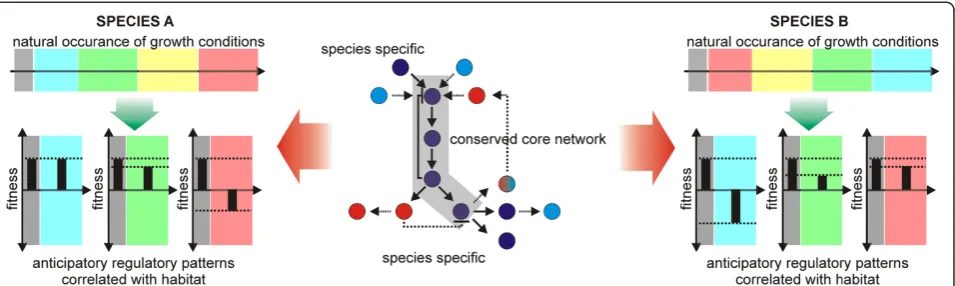
Currently, limited data on the physiology of such or-ganisms still represent a significant obstacle towards ra-tional host cell engineering. Although there are many similarities in the biochemical networks across most mi-crobial hosts, it is well documented that species and en-vironmental niche-specific differences evolved. Whereas core sub-networks and pathways tend to be well con-served, the up- and downstream connections to other cellular networks vary significantly among different spe-cies and lead to spespe-cies-specific differences of stress re-sistance in adverse environments [169,170] (Figure 2). The evolutionary mechanisms described in the preced-ing sections are crucial towards the development of such specializations [130,156,171]. They allow anticipatory and foraging behavior in pro- and eukaryotic microbial cells [172-174]. In fact, a recent study inS.cerevisiae in-dicated that anticipatory gene regulatory patterns can evolve under cycling salt and oxidative stress conditions on a laboratory time scale within 300 generations and that cross-stress protection against salt and oxidative stress is strikingly asymmetrical, with oxidative stress protecting against salt stress but not vice versa [120]. Another recent study inE.colishowed that, by using in-creased genotypic diversity leveraged by a transposon li-brary, evolutionarily ‘old’ anticipatory responses can be rapidly decoupled [172].
to protect carbon resources from other competing species [175]. Consequently, there are differences in the regula-tory blueprints of different species [169,176,177], which can ultimately lead to distinct evolutionary stress trade-offs during selection. Towards this end, a recent study with S. cerevisiae and Saccharomyces paradoxus showed that the evolutionary rescue (ER) frequency was positively correlated with stress concentration during 100 genera-tions of evolution inS.cerevisiaebut negatively correlated inS.paradoxus[44].
It can be concluded that insights into the adaptive cross-stress dependencies of one organism cannot infer the dependencies in a second organism with a distinct evolutionary background. As such, biotechnologists have to be aware that different (evolved) microbial hosts are likely to show distinct trade-offs during process-related stress exposure.
Future directions
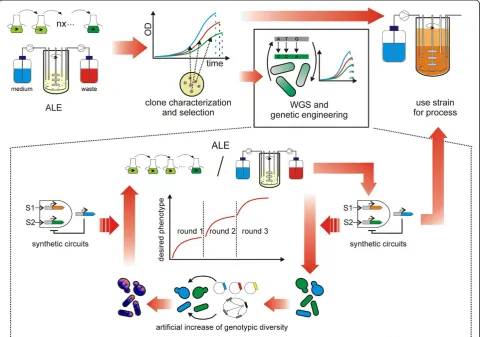
Artificially-evolved microbial cells can be directly used for biotechnological processes (Figure 3). However, based on the data that are available to date, the direct usage comes with certain drawbacks. Biological engi-neers aim at improving cellular phenotypes by targeted genetic engineering and an evolved microbial strain can impair such engineering approaches because of its un-known genotype, which bears the risk of e.g. hitchhiking of unfavorable mutations that can have adverse effects during environmental stress exposure. In many respects, the same aim can be achieved by ALE and classical ge-netic engineering. For example, laboratory selection can lead to large-scale rewiring of gene regulatory networks, but an approach, that the authors called gTME, global transcription machinery engineering, can also yield simi-lar results [2]. Nevertheless, with laboratory evolution balanced protein expression levels may be achieved more easily than with standard molecular biology tech-niques. Moreover, for eukaryotic host organisms such as
yeasts, alternating asexual and sexual propagation during selection can be applied in order to decouple beneficial and unsound mutations and thus reduce potential defi-cits of laboratory evolution experiments [118]. Never-theless, efficient evolutionary engineering of industrial S. cerevisiae strains has been suggested to be limited by polyploidy, due to increased genetic robustness as compared with haploid laboratory strains [104,178].
In this context, laboratory evolution can be combined with other methods in order to achieve effective biotech-nological engineering (Figure 3). Some recent studies highlight the suitability of a highly integrated approach. For example, several studies improved the carbon source utilization of S. cerevisiae strains by genetic engineering in combination with evolutionary adapta-tion [104,107-109]. Trait selecadapta-tion during laboratory evolution can be restricted by the limited number of beneficial mutations that occur on a reasonable time scale. In silico experiments indicate that stepwise evo-lution can increase microbial evolvability [179]; as such, sequential short rounds of evolution may be used to increase the efficiency of ALE. The genotypic diversity can also be increased to speed up evolution. In a recent study towards increased n-butanol tole-rance in E. coli, a drastic increase in solvent tolerance was rapidly achieved by combining laboratory evolu-tion and genome shuffling of the evolved clones [91]. Other studies used ethylmethanesulfonate (EMS) treatedBacillus boroniphilusto select for increased boron resistance [88] or EMS-treated S. cerevisiae in order to achieve increased nutrient utilization and stress resistance [95,113,114]. Similarly, MAGE (multiplexed automated genome engineering) technology makes use of massively increased genotypic diversity in order to generate im-proved phenotypes such as imim-proved lycopene production inE.coliand accelerate evolution [180].
results in a significant number of viable clones with in-creased evolvability as compared with the wildtype [181]. In this context, a heterologous transcriptional regulator from Deinococcus radiodurans was recently introduced into E. coli in order to select for improved phenotypes [182] and such extensive perturbations of regulatory networks may greatly expand our possibilities in rapid la-boratory evolution towards complex traits. Another pro-spective approach is the co-cultivation of multiple organisms. Besides insights into co-evolutionary behavior, this approach can be exploited in order to increase anti-biotic production such as in the case of co-cultivation of Streptomyces clavuligerusandStaphylococcus aureus[55]. Furthermore, in the last decade synthetic biology emerged as a very promising route in biological engineering. In contrast to classical approaches it is highly structured and biological networks are split into smaller functional mo-dules [11,183], leading to complex optimization needs.
Nevertheless, Darwinian selection and adaptive evolution has also been proposed as a potential optimization stra-tegy in this field [184].
S. cerevisiae, there is still a significant number (ap-proximately 30%) of genes with unknown function. Furthermore, the complex interactions of living or-ganisms with their environment are not well under-stood. Specifically, our understanding of the effect of many environmental stressors on cells, their precise action on certain cellular components, the mode of stress sensing, cellular signal transduction and cross-talk between signal transduction pathways is still limited. These deficits impede the correct implementation of such constraints into computational models. In this context, computational approaches provide important benefits to-wards rational engineering of microbial cell factories but as it can be foreseen right now, they cannot replace or prevent ‘trial and error’ laboratory experiments for the foreseeable future.
Conclusions
As François Jacob pointed out:“Evolution is a tinkerer”, and as such evolution is constrained to work on avail-able blueprints. However, genetic engineers have the possibility to rapidly construct novel circuits. The inte-gration of adaptive laboratory evolution into metabolic engineering of microbial cells offers tuning possibilities at multiple levels of the engineering process. Towards this end, future biological engineering studies will also greatly benefit from the insights into microbial physi-ology that were already acquired by adaptive evolution experiments. Nevertheless, it seems necessary to expand such studies to non-conventional organisms. By combi-ning two worlds, where we rely on the innovative power of the human mind and nature’s inherent ability to optimize existing building blocks in a non-directional manner under selective pressure, significant advances in microbial cell factory design can be expected.
Abbreviations
ALE:Adaptive laboratory evolution; CCD: Cumulative number of cell divisions; DHA: Dihydroxyacetone; EMS: Ethylmethanesulfonate; ER: Evolutionary rescue; GASP: Growth advantage in stationary phase; GSR: General stress response; gTME: Global transcription machinery engineering; HGT: Horizontal gene transfer; indel: Insertion / deletion; IS: Insertion sequence; MAGE: Multiplex automated genome engineering; NGS: Next generation sequencing; RNAP: RNA polymerase; rRNA: Ribosomal RNA; SNP: Single nucleotide polymorphism; SPANC: Self preservation and nutritional competence; TU: Transcriptional unit; VERT: Visualizing Evolution in real-time; WGS: Whole genome sequencing.
Competing interests
The authors declare that they have no competing interests.
Authors’contributions
MD and DM wrote the manuscript. Both authors read and approved the final manuscript.
Acknowledgements
We would like to thank Iain B. H. Wilson and Julia Krasensky for their useful comments on the manuscript. Furthermore, we appreciate the valuable input of the anonymous reviewers, which helped us to improve the quality
of the manuscript. Special thanks to the University of Natural Resources and Life Sciences Vienna for financially supporting the publication of this review.
Author details
1Department of Chemistry, University of Natural Resources and Life Sciences,
Muthgasse 11, A-1190 Vienna, Austria.2Department of Biotechnology, University of Natural Resources and Life Sciences, Vienna, Austria.
Received: 22 April 2013 Accepted: 24 June 2013 Published: 1 July 2013
References
1. Clomburg JM, Gonzalez R:Biofuel production in Escherichia coli: the role of metabolic engineering and synthetic biology.Appl Microbiol Biotechnol
2010,86:419–434.
2. Alper H, Moxley J, Nevoigt E, Fink G, Stephanopoulos G:Engineering yeast transcription machinery for improved ethanol tolerance and production.
Science2006,314:1565–1568.
3. Kalia VC, Purohit HJ:Microbial diversity and genomics in aid of bioenergy.
J Ind Microbiol Biotechnol2008,35:403–419.
4. Lee JW, Kim HU, Choi S, Yi J, Lee SY:Microbial production of building block chemicals and polymers.Curr Opin Biotechnol2011,22:758–767. 5. Sauer M, Porro D, Mattanovich D, Branduardi P:Microbial production of
organic acids: expanding the markets.Trends Biotechnol2008,26:100–108. 6. Falch EA:Industrial enzymes–developments in production and
application.Biotechnol Adv1991,9:643–658.
7. Bouws H, Wattenberg A, Zorn H:Fungal secretomes–nature's toolbox for white biotechnology.Appl Microbiol Biotechnol2008,80:381–388. 8. Ferrer-Miralles N, Domingo-Espín J, Corchero J, Vázquez E, Villaverde A:
Microbial factories for recombinant pharmaceuticals.Microb Cell Fact
2009,8:17.
9. Ren Q, Ruth K, Thöny-Meyer L, Zinn M:Enatiomerically pure hydroxycarboxylic acids: current approaches and future perspectives.
Appl Microbiol Biotechnol2010,87:41–52.
10. Lu T, Khalil A, Collins J:Next-generation synthetic gene networks.
Nat Biotechnol2009,27:1139–1150.
11. Purnick P, Weiss R:The second wave of synthetic biology: from modules to systems.Nat Rev Mol Cell Biol2009,10:410–422.
12. Kim T, Sohn S, Kim H, Lee S:Strategies for systems-level metabolic engineering.Biotechnol J2008,3:612–623.
13. Mukhopadhyay A, Redding A, Rutherford B, Keasling J:Importance of systems biology in engineering microbes for biofuel production.
Curr Opin Biotechnol2008,19:228–234.
14. Bro C, Nielsen J:Impact of 'ome' analyses on inverse metabolic engineering.Metab Eng2004,6:204–211.
15. Conrad TM, Lewis NE, Palsson B:Microbial laboratory evolution in the era of genome-scale science.Mol Syst Biol2011,7:509.
16. Portnoy VA, Bezdan D, Zengler K:Adaptive laboratory evolution– harnessing the power of biology for metabolic engineering.Curr Opin Biotechnol2011,22:590–594.
17. Nam H, Conrad TM, Lewis NE:The role of cellular objectives and selective pressures in metabolic pathway evolution.Curr Opin Biotechnol2011, 22:595–600.
18. Oud B, Van Maris AJ, Daran JM, Pronk JT:Genome-wide analytical approaches for reverse metabolic engineering of industrially relevant phenotypes in yeast.FEMS Yeast Res2012,12:183–196.
19. Cakar ZP, Turanli-Yildiz B, Alkim C, Yilmaz U:Evolutionary engineering of Saccharomyces cerevisiae for improved industrially important properties.
FEMS Yeast Res2012,12:171–182.
20. Dettman JR, Rodrigue N, Melnyk AH, Wong A, Bailey SF, Kassen R: Evolutionary insight from whole-genome sequencing of experimentally evolved microbes.Mol Ecol2012,21:2058–2077.
21. Mozhayskiy V, Tagkopoulos I:Microbial evolution in vivo and in silico: methods and applications.Integr Biol (Camb)2013,5:262–277. 22. Bennett AF, Hughes BS:Microbial experimental evolution.Am J Physiol
Regul Integr Comp Physiol2009,297:R17–25.
23. Ryall B, Eydallin G, Ferenci T:Culture history and population heterogeneity as determinants of bacterial adaptation: the adaptomics of a single environmental transition.Microbiol Mol Biol Rev2012,76:597–625. 24. Silver R, Mateles R:Control of mixed-substrate utilization in continuous
25. Lederberg J:Prevalence of Escherichia coli strains exhibiting genetic recombination.Science1951,114:68–69.
26. Bennett AF, Dao KM, Lenski RE:Rapid evolution in response to high-temperature selection.Nature1990,346:79–81.
27. Paquin C, Adams J:Frequency of fixation of adaptive mutations is higher in evolving diploid than haploid yeast populations.Nature1983,302:495–500. 28. Paquin CE, Adams J:Relative fitness can decrease in evolving asexual
populations of S. cerevisiae.Nature1983,306:368–370. 29. Hardison RC:Comparative genomics.PLoS Biol2003,1:E58.
30. Schena M, Shalon D, Davis R, Brown P:Quantitative monitoring of gene expression patterns with a complementary DNA microarray.Science1995, 270:467–470.
31. Liu L, Li Y, Li S, Hu N, He Y, Pong R, Lin D, Lu L, Law M:Comparison of next-generation sequencing systems.J Biomed Biotechnol2012, 2012:251364.
32. Ansorge W:Next-generation DNA sequencing techniques.N Biotechnol
2009,25:195–203.
33. Sniegowski P, Gerrish P, Lenski R:Evolution of high mutation rates in experimental populations of E. coli.Nature1997,387:703–705.
34. Lenski R, Mongold J, Sniegowski P, Travisano M, Vasi F, Gerrish P, Schmidt T: Evolution of competitive fitness in experimental populations of E. coli: what makes one genotype a better competitor than another?
Antonie Van Leeuwenhoek1998,73:35–47.
35. Cooper V, Lenski R:The population genetics of ecological specialization in evolving Escherichia coli populations.Nature2000,407:736–739. 36. Barrick J, Yu D, Yoon S, Jeong H, Oh T, Schneider D, Lenski R, Kim J:
Genome evolution and adaptation in a long-term experiment with Escherichia coli.Nature2009,461:1243–1247.
37. Blount Z, Borland C, Lenski R:Historical contingency and the evolution of a key innovation in an experimental population of Escherichia coli.
Proc Natl Acad Sci USA2008,105:7899–7906.
38. Woods RJ, Barrick JE, Cooper TF, Shrestha U, Kauth MR, Lenski RE: Second-order selection for evolvability in a large Escherichia coli population.
Science2011,331:1433–1436.
39. Bloom J, Lu Z, Chen D, Raval A, Venturelli O, Arnold F:Evolution favors protein mutational robustness in sufficiently large populations.BMC Biol
2007,5:29.
40. Elena SF, Wilke CO, Ofria C, Lenski RE:Effects of population size and mutation rate on the evolution of mutational robustness.Evolution2007, 61:666–674.
41. Draghi J, Parsons T, Wagner G, Plotkin J:Mutational robustness can facilitate adaptation.Nature2010,463:353–355.
42. Kao KC, Sherlock G:Molecular characterization of clonal interference during adaptive evolution in asexual populations of Saccharomyces cerevisiae.Nat Genet2008,40:1499–1504.
43. Beaumont H, Gallie J, Kost C, Ferguson G, Rainey P:Experimental evolution of bet hedging.Nature2009,462:90–93.
44. Gonzalez A, Bell G:Evolutionary rescue and adaptation to abrupt environmental change depends upon the history of stress.Philos Trans R Soc Lond B Biol Sci2013,368:20120079.
45. Wright J, Bellissimi E, De Hulster E, Wagner A, Pronk JT, Van Maris AJ:Batch and continuous culture-based selection strategies for acetic acid tolerance in xylose-fermenting Saccharomyces cerevisiae.FEMS Yeast Res
2011,11:299–306.
46. Wang L, Spira B, Zhou Z, Feng L, Maharjan RP, Li X, Li F, McKenzie C, Reeves PR, Ferenci T:Divergence involving global regulatory gene mutations in an Escherichia coli population evolving under phosphate limitation.
Genome Biol Evol2010,2:478–487.
47. Koppram R, Albers E, Olsson L:Evolutionary engineering strategies to enhance tolerance of xylose utilizing recombinant yeast to inhibitors derived from spruce biomass.Biotechnol Biofuels2012,5:32. 48. Manch K, Notley-McRobb L, Ferenci T:Mutational adaptation of
Escherichia coli to glucose limitation involves distinct evolutionary pathways in aerobic and oxygen-limited environments.Genetics1999, 153:5–12.
49. Notley-McRobb L, Ferenci T:The generation of multiple co-existing mal-regulatory mutations through polygenic evolution in glucose-limited populations of Escherichia coli.Environ Microbiol1999,1:45–52. 50. Weikert C, Sauer U, Bailey J:Use of a glycerol-limited, long-term
chemostat for isolation of Escherichia coli mutants with improved physiological properties.Microbiology1997,143(Pt 5):1567–1574.
51. Larsson G, Enfors SO, Pham H:The pH-auxostat as a tool for studying microbial dynamics in continuous fermentation.Biotechnol Bioeng1990, 36:224–232.
52. Zambrano MM, Siegele DA, Almirón M, Tormo A, Kolter R:Microbial competition: Escherichia coli mutants that take over stationary phase cultures.Science1993,259:1757–1760.
53. Wenger JW, Piotrowski J, Nagarajan S, Chiotti K, Sherlock G, Rosenzweig F: Hunger artists: yeast adapted to carbon limitation show trade-offs under carbon sufficiency.PLoS Genet2011,7:e1002202.
54. Rancati G, Pavelka N, Fleharty B, Noll A, Trimble R, Walton K, Perera A, Staehling-Hampton K, Seidel CW, Li R:Aneuploidy underlies rapid adaptive evolution of yeast cells deprived of a conserved cytokinesis motor.Cell2008,135:879–893.
55. Charusanti P, Fong NL, Nagarajan H, Pereira AR, Li HJ, Abate EA, Su Y, Gerwick WH, Palsson BO:Exploiting adaptive laboratory evolution of Streptomyces clavuligerus for antibiotic discovery and overproduction.
PLoS One2012,7:e33727.
56. Feist AM, Zielinski DC, Orth JD, Schellenberger J, Herrgard MJ, Palsson B: Model-driven evaluation of the production potential for growth-coupled products of Escherichia coli.Metab Eng2010,12:173–186.
57. Schmidt FR:Optimization and scale up of industrial fermentation processes.Appl Microbiol Biotechnol2005,68:425–435.
58. Hahn-Hägerdal B, Karhumaa K, Larsson CU, Gorwa-Grauslund M, Görgens J, Van Zyl WH:Role of cultivation media in the development of yeast strains for large scale industrial use.Microb Cell Fact2005,4:31. 59. Hughes B, Cullum A, Bennett A:Evolutionary adaptation to environmental
pH in experimental lineages of Escherichia coli.Evolution2007, 61:1725–1734.
60. Rainey PB, Beaumont HJ, Ferguson GC, Gallie J, Kost C, Libby E, Zhang XX: The evolutionary emergence of stochastic phenotype switching in bacteria.Microb Cell Fact2011,10:1–14.
61. Barton NH:Genetic hitchhiking.Philos Trans R Soc Lond B Biol Sci2000, 355:1553–1562.
62. Cooper T, Lenski R:Experimental evolution with E. coli in diverse resource environments. I. Fluctuating environments promote divergence of replicate populations.BMC Evol Biol2010,10:11.
63. Dragosits M, Mozhayskiy V, Quinones-Soto S, Park J, Tagkopoulos I: Evolutionary potential, cross-stress behavior and the genetic basis of acquired stress resistance in Escherichia coli.Mol Syst Biol2013,9:643. 64. Cooper T, Rozen D, Lenski R:Parallel changes in gene expression after
20,000 generations of evolution in Escherichiacoli.Proc Natl Acad Sci USA
2003,100:1072–1077.
65. Ibarra R, Edwards J, Palsson B:Escherichia coli K-12 undergoes adaptive evolution to achieve in silico predicted optimal growth.Nature2002, 420:186–189.
66. Fong S, Joyce A, Palsson B:Parallel adaptive evolution cultures of Escherichia coli lead to convergent growth phenotypes with different gene expression states.Genome Res2005,15:1365–1372.
67. Hua Q, Joyce AR, Palsson B, Fong SS:Metabolic characterization of Escherichia coli strains adapted to growth on lactate.Appl Environ Microbiol2007,73:4639–4647.
68. Dekel E, Alon U:Optimality and evolutionary tuning of the expression level of a protein.Nature2005,436:588–592.
69. Conrad TM, Frazier M, Joyce AR, Cho BK, Knight EM, Lewis NE, Landick R, Palsson B:RNA polymerase mutants found through adaptive evolution reprogram Escherichia coli for optimal growth in minimal media.Proc Natl Acad Sci USA2010,107:20500–20505.
70. Charusanti P, Conrad TM, Knight EM, Venkataraman K, Fong NL, Xie B, Gao Y, Palsson B:Genetic basis of growth adaptation of Escherichia coli after deletion of pgi, a major metabolic gene.PLoS Genet2010, 6:e1001186.
71. Lee DH, Palsson B:Adaptive evolution of Escherichia coli K-12 MG1655 during growth on a Nonnative carbon source, L-1,2-propanediol.
Appl Environ Microbiol2010,76:4158–4168.
72. Deng Y, Fong SS:Laboratory evolution and multi-platform genome re-sequencing of the cellulolytic actinobacterium Thermobifida fusca.J Biol Chem2011,286:39958–39966.
74. Summers ZM, Ueki T, Ismail W, Haveman SA, Lovley DR:Laboratory evolution of Geobacter sulfurreducens for enhanced growth on lactate via a single-base-pair substitution in a transcriptional regulator.ISME J
2012,6:975–983.
75. Jiang L, Li S, Hu Y, Xu Q, Huang H:Adaptive evolution for fast growth on glucose and the effects on the regulation of glucose transport system in Clostridium tyrobutyricum.Biotechnol Bioeng2012,109:708–718. 76. Quan S, Ray JC, Kwota Z, Duong T, Balázsi G, Cooper TF, Monds RD:
Adaptive evolution of the lactose utilization network in experimentally evolved populations of Escherichia coli.PLoS Genet2012,8:e1002444. 77. Zhao J, Xu L, Wang Y, Zhao X, Wang J, Garza E, Manow R, Zhou S:
Homofermentative production of optically pure L-lactic acid from xylose by genetically engineeredEscherichia coliB.Microb Cell Fact2013,12:57. 78. Riehle M, Bennett A, Lenski R, Long A:Evolutionary changes in
heat-inducible gene expression in lines of Escherichia coli adapted to high temperature.Physiol Genomics2003,14:47–58.
79. Alcántara-Díaz D, Breña-Valle M, Serment-Guerrero J:Divergent adaptation of Escherichia coli to cyclic ultraviolet light exposures.Mutagenesis2004, 19:349–354.
80. Sleight S, Lenski R:Evolutionary adaptation to freeze-thaw-growth cycles in Escherichia coli.Physiol Biochem Zool2007,80:370–385.
81. Sleight S, Orlic C, Schneider D, Lenski R:Genetic basis of evolutionary adaptation by Escherichia coli to stressful cycles of freezing, thawing and growth.Genetics2008,180:431–443.
82. Stoebel D, Hokamp K, Last M, Dorman C:Compensatory evolution of gene regulation in response to stress by Escherichia coli lacking RpoS.
PLoS Genet2009,5:e1000671.
83. Rudolph B, Gebendorfer KM, Buchner J, Winter J:Evolution of Escherichia coli for growth at high temperatures.J Biol Chem2010,285:19029–19034. 84. Goodarzi H, Bennett B, Amini S, Reaves M, Hottes A, Rabinowitz J:Tavazoie
S: Regulatory and metabolic rewiring during laboratory evolution of ethanol tolerance in E. coli.Mol Syst Biol2010,6:378.
85. Horinouchi T, Tamaoka K, Furusawa C, Ono N, Suzuki S, Hirasawa T, Yomo T, Shimizu H:Transcriptome analysis of parallel-evolved Escherichia coli strains under ethanol stress.BMC Genomics2010,11:579.
86. Atsumi S, Wu TY, Machado IM, Huang WC, Chen PY, Pellegrini M, Liao JC: Evolution, genomic analysis, and reconstruction of isobutanol tolerance in Escherichia coli.Mol Syst Biol2010,6:449.
87. Minty JJ, Lesnefsky AA, Lin F, Chen Y, Zaroff TA, Veloso AB, Xie B, McConnell CA, Ward RJ, Schwartz DR,et al:Evolution combined with genomic study elucidates genetic bases of isobutanol tolerance in Escherichia coli.
Microb Cell Fact2011,10:18.
88. Sen M, Yılmaz U, Baysal A, Akman S, Cakar ZP:In vivo evolutionary engineering of a boron-resistant bacterium: Bacillus boroniphilus.
Antonie Van Leeuwenhoek2011,99:825–835.
89. Tenaillon O, Rodríguez-Verdugo A, Gaut RL, McDonald P, Bennett AF, Long AD, Gaut BS:The molecular diversity of adaptive convergence.Science
2012,335:457–461.
90. Blaby IK, Lyons BJ, Wroclawska-Hughes E, Phillips GC, Pyle TP, Chamberlin SG, Benner SA, Lyons TJ, Crécy-Lagard V, Crécy E:Experimental evolution of a facultative thermophile from a mesophilic ancestor.Appl Environ Microbiol2012,78:144–155.
91. Reyes LH, Almario MP, Winkler J, Orozco MM, Kao KC:Visualizing evolution in real time to determine the molecular mechanisms of n-butanol tolerance in Escherichia coli.Metab Eng2012,14:579–590.
92. Lu L, Wei L, Zhu K, Wei D, Hua Q:Combining metabolic engineering and adaptive evolution to enhance the production of dihydroxyacetone from glycerol by Gluconobacter oxydans in a low-cost way.Bioresour Technol2012,117:317–324.
93. Ferea T, Botstein D, Brown P, Rosenzweig R:Systematic changes in gene expression patterns following adaptive evolution in yeast.Proc Natl Acad Sci USA1999,96:9721–9726.
94. Dunham MJ, Badrane H, Ferea T, Adams J, Brown PO, Rosenzweig F, Botstein D:Characteristic genome rearrangements in experimental evolution of Saccharomyces cerevisiae.Proc Natl Acad Sci USA2002, 99:16144–16149.
95. Sonderegger M, Sauer U:Evolutionary engineering of Saccharomyces cerevisiae for anaerobic growth on xylose.Appl Environ Microbiol2003, 69:1990–1998.
96. Jansen ML, Daran-Lapujade P, De Winde JH, Piper MD, Pronk JT:Prolonged maltose-limited cultivation of Saccharomyces cerevisiae selects for cells
with improved maltose affinity and hypersensitivity.Appl Environ Microbiol2004,70:1956–1963.
97. Van Maris AJ, Geertman JM, Vermeulen A, Groothuizen MK, Winkler AA, Piper MD, Van Dijken JP, Pronk JT:Directed evolution of pyruvate decarboxylase-negative Saccharomyces cerevisiae, yielding a C2-independent, glucose-tolerant, and pyruvate-hyperproducing yeast.
Appl Environ Microbiol2004,70:159–166.
98. Jansen ML, Diderich JA, Mashego M, Hassane A, De Winde JH, Daran-Lapujade P, Pronk JT:Prolonged selection in aerobic, glucose-limited chemostat cultures of Saccharomyces cerevisiae causes a partial loss of glycolytic capacity.Microbiology2005,151:1657–1669.
99. Kuyper M, Toirkens MJ, Diderich JA, Winkler AA, Van Dijken JP, Pronk JT: Evolutionary engineering of mixed-sugar utilization by a xylose-fermenting Saccharomyces cerevisiae strain.FEMS Yeast Res2005, 5:925–934.
100. Wisselink HW:Toirkens MJ, del Rosario Franco Berriel M, Winkler AA, van Dijken JP, Pronk JT, van Maris AJ: Engineering of Saccharomyces cerevisiae for efficient anaerobic alcoholic fermentation of L-arabinose.
Appl Environ Microbiol2007,73:4881–4891.
101. Wisselink HW, Cipollina C, Oud B, Crimi B, Heijnen JJ, Pronk JT, Van Maris AJ: Metabolome, transcriptome and metabolic flux analysis of arabinose fermentation by engineered Saccharomyces cerevisiae.Metab Eng2010, 12:537–551.
102. Wisselink HW, Toirkens MJ, Wu Q, Pronk JT, Van Maris AJ:Novel
evolutionary engineering approach for accelerated utilization of glucose, xylose, and arabinose mixtures by engineered Saccharomyces cerevisiae strains.Appl Environ Microbiol2009,75:907–914.
103. Araya CL, Payen C, Dunham MJ, Fields S:Whole-genome sequencing of a laboratory-evolved yeast strain.BMC Genomics2010,11:88.
104. Garcia Sanchez R, Karhumaa K, Fonseca C, Sànchez Nogué V, Almeida JR, Larsson CU, Bengtsson O, Bettiga M, Hahn-Hägerdal B, Gorwa-Grauslund MF:Improved xylose and arabinose utilization by an industrial recombinant Saccharomyces cerevisiae strain using evolutionary engineering.Biotechnol Biofuels2010,3:13.
105. Zelle RM, Trueheart J, Harrison JC, Pronk JT, Van Maris AJ:
Phosphoenolpyruvate carboxykinase as the sole anaplerotic enzyme in Saccharomyces cerevisiae.Appl Environ Microbiol2010,76:5383–5389. 106. Hong KK, Vongsangnak W, Vemuri GN, Nielsen J:Unravelling
evolutionary strategies of yeast for improving galactose utilization through integrated systems level analysis.Proc Natl Acad Sci USA
2011,108:12179–12184.
107. Zelle RM, Harrison JC, Pronk JT, Van Maris AJ:Anaplerotic role for cytosolic malic enzyme in engineered Saccharomyces cerevisiae strains.
Appl Environ Microbiol2011,77:732–738.
108. Shen Y, Chen X, Peng B, Chen L, Hou J, Bao X:An efficient xylose-fermenting recombinant Saccharomyces cerevisiae strain obtained through adaptive evolution and its global transcription profile.Appl Microbiol Biotechnol2012,96:1079–1091.
109. Zhou H, Cheng JS, Wang BL, Fink GR, Stephanopoulos G:Xylose isomerase overexpression along with engineering of the pentose phosphate pathway and evolutionary engineering enable rapid xylose utilization and ethanol production by Saccharomyces cerevisiae.Metab Eng2012, 14:611–622.
110. Scalcinati G, Otero JM, Van Vleet JR, Jeffries TW, Olsson L, Nielsen J: Evolutionary engineering of Saccharomyces cerevisiae for efficient aerobic xylose consumption.FEMS Yeast Res2012,12:582–597. 111. De Kok S, Nijkamp JF, Oud B, Roque FC, De Ridder D, Daran JM, Pronk JT,
Van Maris AJ:Laboratory evolution of new lactate transporter genes in a jen1Δmutant of Saccharomyces cerevisiae and their identification as ADY2 alleles by whole-genome resequencing and transcriptome analysis.FEMS Yeast Res2012,12:359–374.
112. Almario MP, Reyes LH, Kao KC:Evolutionary engineering of Saccharomyces cerevisiae for enhanced tolerance to hydrolysates of lignocellulosic biomass.Biotechnol Bioeng2013. epub April 2013. 113. Cakar ZP, Seker UO, Tamerler C, Sonderegger M, Sauer U:Evolutionary
engineering of multiple-stress resistant Saccharomyces cerevisiae.
FEMS Yeast Res2005,5:569–578.
114. Cakar ZP, Alkim C, Turanli B, Tokman N, Akman S, Sarikaya M, Tamerler C, Benbadis L, François JM:Isolation of cobalt hyper-resistant mutants of Saccharomyces cerevisiae by in vivo evolutionary engineering approach.