Togo National Herbarium database 1
Togo National Herbarium database
Raoufou Radji1, Kossi Adjonou1, Marie-Luce Akossiwoa Quashie1, Komlan Edjèdu Sodjinou1, Francisco Pando2, Kouami Kokou1
1 Laboratory of Forestry Research, Faculty of Science, University of Lomé, 01BP 1515 Lomé 1, Togo 2 Real Jardin Botanico, CSIC, Madrid, Spain
Corresponding author:Raoufou Radji ([email protected]; [email protected])
Academic editor:T. Couvreur | Received 31 March 2018 | Accepted 14 August 2018 | Published 13 September 2018
Citation: Radji R, Adjonou K, Quashie MLA, Sodjinou KE, Pando F, Kokou K (2018) Togo National Herbarium database. PhytoKeys 109: 1–16. https://doi.org/10.3897/phytokeys.109.25385
Abstract
This article describes the herbarium database of the University of Lomé. The database provides a good representation of the current knowledge of the flora of Togo. The herbarium of University of Lomé,
known also as Herbarium togoense is the national herbarium and is registered in Index Herbariorum with
the abbreviation TOGO. It contains 15,000 specimens of vascular plants coming mostly from all Togo's ecofloristic regions. Less than one percent of the specimens are from neighbouring countries such as Ghana, Benin and Burkina Faso. Collecting site details are specified in more that 97% of the sheet labels, but only about 50% contain geographic coordinates. Besides being a research resource, the herbarium constitutes an educational collection. The dataset described in this paper is registered with GBIF and accessible at https://www.gbif.org/dataset/b05dd467-aaf8-4c67-843c-27f049057b78. It was developed with the RIHA software (Réseau Informatique des Herbiers d'Afrique). The RIHA system (Chevillotte and Florence 2006, Radji et al. 2009) allows the capture of label data and associated information such as synonyms, vernacular names, taxonomic hierarchy and references.
Keywords
herbarium collection, herbarium sheets, Liliopsida, Magnoliopsida, Occurrence, Plants, RIHA, Togo, University of Lomé, West Africa
Context
Botanical collections are an indispensable tool in the field of biodiversity conservation. Indeed, they provide basic data for the evaluation of species conservation status, a task that presents a significant lack in Africa, especially in Togo (Radji et al. 2010; Billand 2010).
PhytoKeys 109: 1–16 (2018) doi: 10.3897/phytokeys.109.25385 http://phytokeys.pensoft.net
Copyright Raoufou Radji et al. This is an open access article distributed under the terms of the Creative Commons Attribution License (CC BY 4.0), which permits unrestricted use, distribution, and reproduction in any medium, provided the original author and source are credited.
DATA PAPER
Launched to accelerate biodiversity research
In West Africa as in Central Africa, the level of digital accessible information (DAK) on vascular plants – though far from satisfactory – has been raised by efforts in neighbouring countries (Dauby et al. 2016, Sosef et al. 2017). Remarkable in this regard is the onlined dataset published by Benin (e.g. The census of national forest of Benin (Gaston 2016) and the University of Ghana Herbarium database (Asase 2015). Those contributions spotlighted the lack of information available on plants from Togo, a fact that has been limiting the feasibility of sound floristic and ecological studies in the region until now.
The dataset, here described, narrows this knowledge gap and should be a key re-source in the making of a national plant checklist for Togo, monographs, floras and other research crucial to addressing challenges of knowledge, pedagogy, sustainable development and decision-making about natural resources and environments (Chap-man 2005; Sousa-Baena et al. 2013).
In a wider context, this dataset contributes to the correction of a global lack of tropical biodiversity data availability (Collen et al. 2008, Feeley and Silman 2011) and to the GBIF Content Mobilization Priorities set in 2017 (https://www.gbif.org/ mobilization-priorities-2017).
Data capture of the University of Lomé herbarium collections started in 2003 as part of the RIHA initiative led by the IRD (Institut de Recherche pour le Développe-ment) team at the MNHN Paris. In 2008, this work underwent considerable growth with the Sud Expert Plantes project (http://www.sud-expert-plantes.ird.fr/), which en-abled the capture of the "Letouzey" database (Radji et al. 2009) of more than 12,500 specimens. Also in 2008, as part of the "African Plants Initiative" (API) project, http:// apps.kew.org/herbcat/gotoApi.do, 8,000 images from TOGO Herbarium specimens where captured and published.
DAK on the plants of Togo is relatively large, based on nearly 85% of primary biodiversity data records derived from specimens in the National Herbarium, plus data from other institutions (Ministry of Environment and NGOs etc.) served through biodiversity informatics initiatives such as GBIF. Data on plants of Togo have not yet been integrated and assessed to establish how complete the site inventories are across the country, so that appropriate levels of confidence can be applied; these gaps in knowledge directly affect the fitness-for-use of the data (Otegui et al. 2013).
Project
The database of the National Herbarium of Togo is the result of several digitisation programmes:
Togo National Herbarium database 3
– 2008–2011 SEP (Sud Expert Plantes programme (http://www.sud-expert-plantes. ird.fr/ projets/Herbiers_et_J_Botaniques funded by MAEE France (SEP Pro-ject N°206) (http://www.sud-expert-plantes.ird.fr/ projets/dossier_206) makes it possible for the University of Lomé to start modernising its herbarium by assembling herbarium specimens to international standards and to capture la-bels’ data into the RIHA database.
– 2008–2010 API African Plants Initiative Projects, funded by Mellon Foundation through JsTor https://plants.jstor.org/, allows the publishing of the first 8,000 specimens digitalised (Figure 1).
– 2016–2018 BID Project (BID-AF2015-0004-NAC), led by GBIF secretariat and funded by the European Union https://www.gbif.org/project/82693/ strength-ening-the-biodiversity-stakeholders-network-in-togo)
Personnel
Sodjinou Komlan Edjèdu, Allassani Stephane, Tchani Watchiou, Abotsi Eli, Dogbé Yawa and Koda Donko.
Data published through
https://www.gbif.org/dataset/3294d36a-987c-4dcb-8ecf-bd2082796f08#
Taxonomic coverage
Most specimens in Togo Herbarium belong to class Magnoliopsida (2,101 specimens) and Liliopsida (8,508 specimens). These classes are followed by Filicopsida (505 speci-mens), Lycopsida (138 specispeci-mens), Coniferopsida (104 specispeci-mens), Equisetopsida (24 specimens), Ophioglossopsida (14 specimens), Gnetopsida (6 specimens), Taxopsida (4 specimens), Cycadopsida and Ginkgopsida (both with 2 specimens) and Psilotop-sida (1 specimen) (Figure 2).
Togo herbarium contains specimens belonging to 194 families, of which 13.25% of the specimens belong to Leguminosae-Papilionoideae, followed by Graminae (7.73%), Rubiaceae (7.37%), Euphorbiaceae (6.69%), Asteraceae (5%), Cyperaceae (4.50%), Gleicheniaceae (2.66%), Leguminosae-Caesalpinioideae (2.24%), Com-bretaceae (2.12%), Commelinaceae (1.90%), Moraceae (1.74%), Scrophulariaceae (1.72%), Ulmaceae (1.66%), Leguminosae-Mimosoideae (1.63%), Asclepiadaceae and Apocynaceae (1.57%).
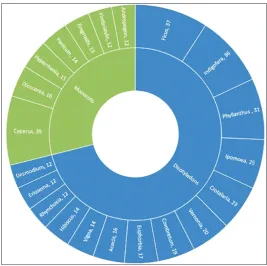
The herbarium includes 198 genera, significant ones amongst them being Phyllan-thus (344 specimens), Ficus (207 specimens), Indigofera (193 specimens), Combretum (165 specimens), Crotalaria (148 specimens), Vernonia (119 specimens), Euphorbia (92 specimens), Trema (92 specimens), Cyperus (168 specimens), Eriosema (82 speci-mens), Fimbristylis (82 specimens) and Uvaria (45 specimens). Although the herbari-um contains specimens from all major botanical groups, Phanerogams (angiosperms-gymnosperms), Pteridophyta (ferns), Bryophyta and Thallophyta (algae-lichens-fun-gi), the dataset used for this paper covers exclusively Angiosperms (Dicotyledonous and Monocotyledonous) (Figure 3).
The collection includes 508 singletons from 117 different families that represent 4% of the total record. Important families concerned are Graminae (43 specimens), Leguminosae-Papilionoideae 35, Orchidaceae 26, Rubiaceae 25, Euphorbiaceae 22 and Cyperaceae 21 species. Major genera are Ficus and Indigofera (9 specimens), Di-oscorea (8 specimens), Eulophia (7 specimens), Crotalaria and Phyllanthus (6 speci-mens) and Ceropegia (5 specimens).
Taxonomic ranks
Kingdom: Plantae
Division: Magnoliophyta (Cronquist, Takht. & W. Zimm., 1996) Phylum: Spermaphyta
Class: Magnoliopsida, Liliopsida
Togo National Herbarium database 5
Figure 2. Taxonomic coverage of TOGO dataset in term of specimens.
Orchidaceae, Palmae, Pandanaceae, Pontederiaceae, Smilacaceae, Taccaceae, Ty-phaceae, Xyridaceae, Zingiberaceae.
Acanthaceae, Aizoaceae, Amaranthaceae, Anacardiaceae, Annonaceae, Apocynaceae, Araliaceae, Aristolochiaceae, Asclepiadaceae, Avicenniaceae, Azollaceae, Balanita-ceae, BalanophoraBalanita-ceae, BalsaminaBalanita-ceae, BasellaBalanita-ceae, BegoniaBalanita-ceae, BignoniaBalanita-ceae, Bixaceae, Bombacaceae, Boraginaceae, Burseraceae, Cactaceae, Campanulaceae, Capparaceae, Caricaceae, Caryophyllaceae, Casuarinaceae, Cecropiaceae, Cel-astraceae, Ceratophyllaceae, Chenopodiaceae, Chrysobalanaceae, Cochlosper-maceae, Colchicaceae, Combretaceae, Compositae, Connaraceae, Convolvu-laceae, CrassuConvolvu-laceae, Cruciferae, Cucurbitaceae, DichapetaConvolvu-laceae, Dilleniaceae, Dipterocarpaceae, Ebenaceae, Euphorbiaceae, Flacourtiaceae, Flagellariaceae, Gentianaceae, Gesneriaceae, Goodeniaceae, Guttiferae, Haloragaceae, Her-nandiaceae, Hippocrateaceae, Icacinaceae, Irvingiaceae, Labiatae, Lauraceae, Lecythidaceae, Leeaceae, Leguminosae, Leguminosae-Caesalpinioideae, Legu-minosae-Mimosoideae, Leguminosae-Papilionoideae, Lentibulariaceae, Loga-niaceae, Loranthaceae, Lycopodiaceae, Lythraceae, Malpighiaceae, Malvaceae, Melastomataceae, Meliaceae, Menispermaceae, Molluginaceae, Moraceae, Mor-ingaceae, Myristicaceae, Myrsinaceae, Myrtaceae, Nyctaginaceae, Nymphaeaceae, Ochnaceae, Olacaceae, Oleaceae, Onagraceae, Opiliaceae, Oxalidaceae, Pandace-ae, PapaveracePandace-ae, PassifloracePandace-ae, PedaliacePandace-ae, PhytolaccacePandace-ae, PiperacePandace-ae, Pitto-sporaceae, Plumbaginaceae, Podostemaceae, Polygalaceae, Polygonaceae, Portu-lacaceae, Proteaceae, Punicaceae, Ranunculaceae, Rhamnaceae, Rhizophoraceae, Rosaceae, Rubiaceae, Rutaceae, Salicaceae, Santalaceae, Sapindaceae, Sapotaceae, Saxifragaceae, Scrophulariaceae, Simaroubaceae, Solanaceae, Sphenocleaceae, Sterculiaceae, Thymelaeaceae, Tiliaceae, Turneraceae, Ulmaceae, Umbelliferae, Urticaceae, Verbenaceae, Violaceae, Vitaceae, Zygophyllaceae.
Spatial coverage
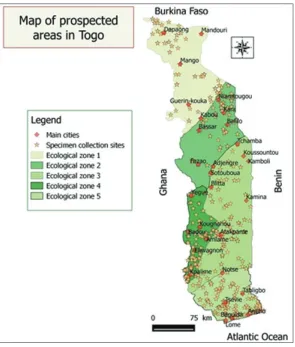
The described dataset collections come from all over Togo. Togo is located in West Africa which has an area of 56,600 km2. It stretches for 600 km from North to South
and East to West between 50 and 150 km wide (Figure 4).
Togo National Herbarium database 7
Figure 4. Map of prospected areas in the whole country.
deep red lateritic soils. This ZE is the domain of dense semi-deciduous forests. The last one, ZE.V is a coastal plain of southern Togo with a subequatorial climate marked by a deficit in rainfall. It is characterised by a climate with two rainy sea-sons and the vegetation is set up by a mosaic of savannah, farmland and dry forests (Kokou and Caballé 2000).
Coordinates
Temporal coverage
With respect to the temporal coverage of the specimens, 5,895 (47.16%) consist of specimens collected from 1970 to 1984, most of them used for the botanical species description and the drafting of the Togo's Flora (Brunel 1975, 1987; Brunel et al. 1984). Newer specimens came from the fieldwork of local researchers (Kokou and Ca-ballé 2000, Akpagana and Guelly 1994, Akpagana 1992b), teaching trips from teach-ers with students in Plant Biology and the Environment Department from the Uni-versity of Benin (UniUni-versity of Lomé from 2001 onwards). These collections represent 60% of the current holdings (Figures 5, 6).
Figure 5. Pattern of accumulation of records collected per year in Togo National Herbarium.
Togo National Herbarium database 9
Natural collections description
The herbarium specimens were mainly collected in Togo (99%). The remaining 1% come from neighbouring countries such as Ghana, Benin and Côte d'Ivoire collected by Togolese researchers on research trips. These specimens date from the second half of the 20th century. Today, the Herbarium occupies an area of approximately 100 m2 and
is located on the ground floor of the building that houses the Dean’s Office of the Fac-ulty of Sciences of the University of Lomé. Thanks to SEP Project N°206 --funded in 2008 by the French Ministry of Foreign Affairs, the storage for 12,572 specimens was upgraded to international standards by use of new closed door wooden cabinets. The collection is arranged in alphabetical order by Family, Genus and Species names. There are no type specimens kept in the Herbarium but the only recognised endemic species is well-represented by 16 specimens. The main collectors are: Brunel (6227 specimens, Figures 7 and 8), Akpagana (2023), Schäfer (911), Guelly (654), Kokou (508), Kou-mantega (276) and Ern (200) (Figure 8). While most of the samples have little useful information, those of Schäfer PA are well georeferenced and contain an unsuspected amount of information about traditional knowledge as well as the vernacular names of the samples in its collection (Figure 8).
Collection name
University of Lomé herbarium: Herbarium togoense; Index Herbariorum Acronym: TOGO.
Methods
Figure 8. Major collectors who collected around Togo’s ecological area from 1971 to 2017 and compari-son to the rest of the collection.
Togo National Herbarium database 11
Figure 9. Localities botanically prospected by ecological zone in Togo.
Botanist's Index (http://kiki.huh.harvard.edu/databases/botanist_index.html) have been used. The list of synonyms followed The Plant List www.theplantlist.org. For Lycophytes and Ferns, the classification followed that established by Christenhusz et al. (2011), while that of flowering plants followed Cronquist (1981).
Method step description
The fieldwork and herbarium specimens study followed traditional procedures (Mori et al. 2011).
Data processing. Details -measures, label facts, nomenclature etc. from all studied specimens were entered into a MS-Access database (RIHA database) designed and built for that purpose. Additional tables and queries were created to record specimen measures as well as bibliographic, taxonomic and nomenclatural information - these are not included in this dataset, but nomenclature information is available through 'The Plant List' (2013) and 'African Plant Database (2018). Specific guidelines regard-ing data entry and quality control procedures followed Pando et al. (1999). The dataset was published in a standardised format using the Integrated Publishing Toolkit (Rob-ertson et al. 2014) hosted by GBIF France. The standardised format is Darwin Core Archive (DwC-A, GBIF 2010), which is a biodiversity data standard that makes use of Darwin Core terms (Wieczorek et al. 2012). A Darwin Core Archive is a zip file con-taining a data file in tab delimited text (.txt) format, an xml file describing the data file, the relationships between the archive’s data files when there is more than one (meta. xml) and a machine readable dataset metadata in XML format (eml.xml), complying with GBIF Metadata Profile (GBIF 2011), based on EML.
Study extent description: The analysis of this dataset reveals that eco-floristic zone IV is the most significant and prospected with 31.63% of the herbarium specimens whereas ecological zone II remains the least prospected with 11.33% of the collected specimens.
Although quite rich, Togolese spontaneous flora remains incompletely known (Ak-pagana 1992b, Radji 1997, Kokou 1998).
Figure 9: Localities botanically prospected by ecological zone in Togo
Togo National Herbarium database 13
During the SEP project (2008–2012), 6 students studying for Master's degrees in Plant Biology were recruited to assemble herbarium specimens deposited by collectors in presses and sometimes in Canson papers. Most specimens have original collectors’ labels. Trained in the use of RIHA database (under Microsoft Access), the students digitised the data as and when the specimens were mounted. Data were exported to Excel for publication..
Quality control description: The present dataset was updated to match the Cron-quist classification for the orders and families of flowering plants and all species names were checked for validity (spelling, synomyms and authorship) against online databases: http://www.ipni.org/ipni/plantnamesearchpage.do; http://www.theplantlist.org/; http:// www.ville-ge.ch/musinfo/bd/cjb/africa/recherche.php.
Datasets
Dataset description
Object name: Togo National Herbarium database Character encoding: UTF-8
Format name: Darwin Core Archive format Format version: 1.0
Distribution: http://ipt-togo.gbif.fr/resource?r=herbarium_database&v=1.5 Publication date of data: 2018-01-05
Language: French
Licences of use: This database “Togo National Herbarium database” is made available under licence Creative Commons Attribution (CC-BY) 4.0 License
Metadata language: English
Date of metadata creation: 2018-01-05 Hierarchy level: Dataset
Acknowledgements
References
African Plant Database (2018) Conservatoire et Jardin botaniques de la Ville de Genève and South African National Biodiversity Institute, Pretoria. http://www.ville-ge.ch/musinfo/ bd/cjb/africa [version 3.4.0]
Ake Assi L (1984) Flore descriptive de Ia Côte-d’lvoire: Etude descriptive et biogeographique avec quelques notes ethnobotaniques. Vol. II: Liste alphabetique des especes. Thèse de Doctorat d’Etat, Université d’Abidjan, 895–1067.
Akpagana K, Guelly AK (1994) Nouvelles especes d’Angiospermes pour Ia flore du Togo. Acta Botanica Gallica 141(6/7): 781–787. https://doi.org/10.1080/12538078.1994.10515237 Akpagana K (1992b) Espèces nouvelles pour la flore du Togo. Annales de l’Université du Bénin
(Série sciences) 10: 25–32.
Asase A (2015) University of Ghana – Ghana Herbarium. Version 8.2. Ghana Biodiversity Information Facility (GhaBIF). Occurrence dataset. https://doi.org/10.15468/l7b2zt [ac-cessed via GBIF.org on 2018-06-27]
Aubreville A [Ed.] (1959) Flore forestière de Ia Côte-d’lvoire. Centre Technique Forestier Tropi-cal, 3 volumes.
Bebber DP, Carine MA, Wood JRI, Worrtley AH, Harris DJ, Prance GT, Davidse G, Paige J, Pennington TD, Robson NKB, Scotland RW (2010) Herbaria are a major frontier for spe-cies discovery. www.pnas.org/cgi/doi/10.1073/pnas.1011841108
Berhaut J [Ed.] (1967) Flore du Senegal. Clairafrique. Dakar, 483 pp.
Berhaut J (1971–1988) Flore Illustree du Senegal. Clairafrique et Maisonneuve, Dakar et Paris. Billand A (2010) Biodiversité dans les forêts d’Afrique centrale: panorama des connaissances,
principaux enjeux et mesures de conservation. CIRAD. Consulté en ligne le 18 janvier 2018 sur. https://www.observatoire-comifac.net/docs/edf2010/FR/EDF_2010_FR_03.pdf Brunel JF (1975) Contribution à l'étude de quelques Phyllanthoideae africains et à la
taxono-mie du genre Phyllanthus L. (Euphorbiaceae). Thèse 3e cycle, ULP, Strasbourg, 206. Brunel JF, Hiepko P, Scholz H (1984) Flore analytique du Togo. GTZ éd., Eschborn, 750 pp. Brunel JF (1987) Sur le genre Phyllanthus L. et quelques genres voisins de la Tribu des
Phyllan-thoidae Dumort. (Euphorbiaceae) en Afrique intertropicale et à Madagascar. Thèse ès-sci, Université de Strasbourg, 768 pp.
Chapman AD (2005) Uses of Primary Species Occurrence Data, version 1.0. Global Biodiver-sity Information Facility, Copenhagen.
Chevillotte H, Florence J (2006) RIHA a database on plant biodiversity in western and central Africa: first step for a networking of African herbaria. In: Ghazanfar SA, Beentje HJ (Eds) Taxonomy and ecology of African plants, their conservation and sustainable use. Proceed-ings of the 17th AETFAT Congress. Royal Botanic Gardens, London, 643–650.
Christenhusz MJM, Zhang X-C, Schneider H (2011) A linear sequence of extant families and genera of lycophytes and ferns. Phytotaxa 19(1): 7–54. https://doi.org/10.11646/phyto-taxa.19.1.2
Togo National Herbarium database 15
Cronquist A (1981) An Integrated System of Classification of Flowering Plants. Columbia University Press, New York, 1261 pp.
Dauby G, Zaiss R, Blach-Overgaard A, Catarino L, Damen T, Deblauwe V, Dessein S, Drans-field J, Droissart V, Duarte MC, Engledow H, Fadeur G, Figueira R, Gereau RE, Hardy OJ, Harris DJ, de Heij J, Janssens S, Klomberg Y, Ley AC, Mackinder BA, Meerts P, van de Poel JL, Sonké B, Sosef MSM, Stévart T, Stoffelen P, Svenning J-C, Sepulchre P, van der Burgt X, Wieringa JJ, Couvreur TLP (2016) RAINBIO: A mega-database of tropi-cal African vascular plants distributions. PhytoKeys 74: 1–18. https://doi.org/10.3897/ phytokeys.74.9723
Ern H (1979) Die Vegetation Togos. Gliederrung, Gefährdung, Erhaltung. Willdenowia 9: 295–312.
Feeley KJ, Silman MR (2011) The data void in modeling current and future distributions of tropical species. Global Change Biology 17(1): 626–630. https://doi.org/10.1111/j.1365-2486.2010.02239.x
Gaston KJ (2000) Global patterns in biodiversity. Nature 405(6783): 220–227. https://doi. org/10.1038/35012228
Gaston SA (2016) The census of national forest of Benin. Version 1.2. GBIF Benin. Occur-rence dataset https://doi.org/10.15468/5cdfgv [accessed via GBIF.org on 2018-06-27] GBIF (2010) Darwin Core Archives How-to Guide, version 1, released on 1 March 2011. 21
pp. http://links.gbif.org/gbif_dwca_how_to_guide_v1
GBIF (2011) GBIF Metadata Profile, Reference Guide 19. http://www.gbif.org/resource/80640 Hutchinson J, Dalziel JM (1954–1972) Flora of West Tropical Africa. Vol 3. Second Edition.
London.
Kokou K, Caballé G (2000) Les îlots forestiers de la plaine côtière togolaise. Bois et Forêts des Tropiques 263(1): 39–51.
Kokou K (1998) Les mosaïques forestières au sud du Togo: biodiversité, dynamique et activités humaines. Thèse de doctorat en Biologie des populations et écologie, Université de Mont-pellier II, 140 pp.
Kokou K, Caballé G, Akpagana K, Batawila K (1999) Les îlots forestiers au sud du Togo: Dy-namique et relations avec les végétations périphériques. Revue d’Écologie 54: 301–313. [Terre vie]
Lebrun JP, Stork A (1991–1992) Enumeration des plantes a fleurs d'Afrique tropicale. Con-servatoire et Jardin botaniques de la Ville de Genève, vol. 1 & 250 pp.; vol. 2, 258 pp. Lebrun JP, Stork A (2006) Tropical african Flowering plants. Ecology and distribution. Vol. 2
Euphorbiaceae-Dichapetalaceae. Conservatoire et Jardin botaniques de la Ville de Genève. Hors-série 9a, 306 pp.
Lebrun JP, Stork A (2008) Tropical african Flowering plants. Ecology and distribution. Vol.3 Mimosaceae-Fabaceae. Conservatoire et Jardin botaniques de la Ville de Genève. Hors-série, 325 pp.
Lebrun JP, Stork A (2008) Tropical african Flowering plants. Ecology and distribution. Vol.4 Fabaceae (Desmodium-Zornia). Conservatoire et Jardin botaniques de la Ville de Genève. Hors-série, 291 pp.
Mori SA, Berkov A, Gracie CA, Hecklau EF (2011) Tropical Plant Collecting. From the Field to the Internet. TECC Editora.
Otegui J, Ariño AH, Encinas MA, Pando F (2013) Assessing the Primary Data Hosted by the Spanish Node of the Global Biodiversity Information Facility (GBIF). PLoS One 8(1): e55144. https://doi.org/10.1371/journal.pone.0055144
Pando F, Muñoz Garmendia F, Aedo C (1999) Manual de las bases de datos nomenclaturales de Flora Mycologica Iberica y Flora iberica. Cuad. Trab. Flora Micol. Iber 1: 1–56.
Radji AR (1997) Contribution à l'étude de la diversité floristique du Togo: la flore horticole de la ville de Lomé et ses aspects économiques. Mémoire de DEA Biol. Vég. App., Univ. Bénin, Togo, 52 pp.
Radji R, Guelly K, Akpagana AK, Florence J, Chevillotte H, Kokou K, Gueye EM, Diop D, Diop S, Koma S, Cambier C, Saadou M, Mahamane A, Vall OMA, Diabate M, Guila-vogui K, BeaGuila-vogui P, Adou Yao CY, N’da DH, Ipou Ipou J, N’guessan KE, Bakayoko A, Kouamé NF, Koulibali A, Traoré D, Belem M, Ouedraogo RL, Koura P, Ouedraogo K, Compaore Yedomonhan HP, Akoegninou A, Adomou AC (2009) Etat des lieux sur la flore et les herbiers d’Afrique Occidentale Francophone. Annales de l’Université de Lomé (Togo). Service Science 17: 73–87.
Radji R, Kokou K, Akpagana K (2010) Etude diagnostique de la flore ornementale du Togo. International Journal of Biological and Chemical Sciences 4(2): 491–508. https://doi. org/10.4314/ijbcs.v4i2.58159
Robertson T, Döring M, Guralnick R, Bloom D, Wieczorek J, Braak K, Otegui J, Russell L, Desmet P (2014) The GBIF integrated publishing toolkit: Facilitating the efficient publishing of biodiversity data on the internet. PLoS One 9(8): e102623. https://doi. org/10.1371/journal.pone.0102623
Sosef MSM, Dauby G, Blach-Overgaard A, van der Burgt X, Catarino L, Damen T, Deblauwe V, Dessein S, Dransfield J, Droissart V, Duarte MC, Engledow H, Fadeur G, Figueira R, Gereau RE, Hardy OJ, Harris DJ, de Heij J, Janssens S, Klomberg Y, Ley AC, Mackinder BA, Meerts P, van de Poel JL, Sonké B, Stévart T, Stoffelen P, Svenning J-C, Sepulchre P, Zaiss R, Wieringa JJ, Couvreur TLP (2017) Exploring the floristic diversity of tropical Africa. BMC Biology 15(1): 15. https://doi.org/10.1186/s12915-017-0356-8
Sousa-Baena MS, Garcia LC, Peterson AT (2013) Completeness of digital accessible knowledge of the plants of Brazil and priorities for survey and inventory. Diversity & Distributions 20(4): 369–381. https://doi.org/10.1111/ddi.12136
The Plant List (2013) The Plant List, Version 1.1. http://www.theplantlist.org/