A key to the North American genera of Stipeae
(Poaceae, Pooideae) with descriptions and taxonomic
names for species of
Eriocoma
,
Neotrinia
,
Oloptum
,
and five new genera:
Barkworthia
,
×Eriosella
,
Pseudoeriocoma
,
Ptilagrostiella
, and
Thorneochloa
Paul M. Peterson1, Konstantin Romaschenko1,
Robert J. Soreng1, Jesus Valdés Reyna2
1 Department of Botany MRC-166, National Museum of Natural History, Smithsonian Institution, Washing-ton, DC 20013-7012, USA 2 Departamento de Botánica, Universidad Autónoma Agraria Antonio Narro, Saltillo, C.P. 25315, México
Corresponding author: Paul M. Peterson ([email protected])
Academic editor:Maria Vorontsova | Received 25 February 2019 | Accepted 24 May 2019 | Published 16 July 2019
Citation: Peterson PM, Romaschenko K, Soreng RJ, Reyna JV (2019) A key to the North American genera of Stipeae (Poaceae, Pooideae) with descriptions and taxonomic names for species of Eriocoma, Neotrinia, Oloptum, and five new genera: Barkworthia, ×Eriosella, Pseudoeriocoma, Ptilagrostiella, and Thorneochloa. PhytoKeys 126: 89–125. https://doi. org/10.3897/phytokeys.126.34096
Abstract
Based on earlier molecular DNA studies we recognize 14 native Stipeae genera and one intergeneric hybrid in North America. We provide descriptions, new combinations, and 10 illustrations for species of Barkworthiagen. nov., Eriocoma, Neotrinia, Oloptum, Pseudoeriocomagen. nov., Ptilagrostiellagen. nov., Thorneochloagen. nov., and ×Eriosella nothogen. nov. The following 40 new combinations are made: Barkworthia stillmanii, Eriocoma alta, E. arida, E. arnowiae, E. bloomeri, E. bracteata, E. contracta, E. coronata, E. curvifolia, E. hendersonii, E. latiglumis, E. lemmonii, E. lemmonii ssp. pubescens, E. lettermanii, E. lobata, E. nelsonii, E. nelsonii ssp. dorei, E. nevadensis, E. occidentalis, E. occidentalis ssp. californica, E. occidentalis ssp. pubescens, E. parishii, E. parishii ssp. depaupertata, E. perplexa, E. pinetorum, E. richardso-nii, E. robusta, E. scribneri, E. swallenii, E. thurberiana, E. wallowaensis, ×Eriosella caduca, Pseudoeriocoma acuta, P. constricta, P. editorum, P. eminens, P. hirticulmis, P. multinodis, Ptilagrostiella kingii, and Thorneo-chloa diegoensis. A key to the native and introduced genera of North American Stipeae, and an overview of the tribe in North America and worldwide are given. Lectotypes are designated for Eriocoma cuspidata Nutt., Fendleria rhynchelytroides Steud., Stipa bloomeri Bol., Stipa coronata Thurb., Stipa membranacea Pursh, Stipa mormonum Mez, Stipa richardsonii Link, and Stipa williamsii Scribn. Achnatherum s.s. and Piptatherum s.s. are now restricted to Eurasia and the Mediterranean/Asia, respectively.
http://phytokeys.pensoft.net
Copyright Paul M. Peterson et al. This is an open access article distributed under the terms of the Creative Commons Attribution License (CC BY 4.0), which permits unrestricted use, distribution, and reproduction in any medium, provided the original author and source are credited.
Resumen
Basados en estudios anteriores de ADN molecular, reconocemos 14 géneros nativos de Stipeae y un hí-brido intergenérico en América del Norte. Se presentan descripciones, nuevas combinaciones, y 10 il-ustraciones para las especies de Barkworthia gen. nov., Eriocoma, Neotrinia, Oloptum, Pseudoeriocoma
gen. nov., Ptilagrostiellagen. nov., Thorneochloagen. nov. y ×Eriosella nothogen. nov. Se realizan las siguientes 40 nuevas combinaciones: Barkworthia stillmanii, Eriocoma alta, E. arida, E. arnowiae, E. bloomeri, E. bracteata, E. contracta, E. coronata, E. curvifolia, E. hendersonii, E. latiglumis, E. lemmonii, E. lemmonii ssp. pubescens, E. lettermanii, E. lobata, E. nelsonii, E. nelsonii ssp. dorei, E. nevadensis, E. occiden-talis, E. occidentalis ssp. californica, E. occidentalis ssp. pubescens, E. parishii, E. parishii ssp. depaupertata, E. perplexa, E. pinetorum, E. richardsonii, E. robusta, E. scribneri, E. swallenii, E. thurberiana, E. wallowaensis, ×Eriosella caduca, Pseudoeriocoma acuta, P. constricta, P. editorum, P. eminens, P. hirticulmis, P. multinodis, Ptilagrostiella kingii y Thorneochloa diegoensis. Se presenta una clave para los géneros nativos e introducidos de las especies norteamericanas, y una visión general de la tribu en América del Norte y en todo el mundo. Se designan lectotipos para Eriocoma cuspidata Nutt., Fendleria rhynchelytroides Steud., Stipa bloomeri Bol., Stipa coronata Thurb., Stipa membranacea Pursh, Stipa mormonum Mez, Stipa richardsonii Link y Stipa williamsii Scribn. Achnatherum s.s. y Piptatherum s.s. ahora están con distribución restringida- a Eurasia y el Mediterráneo/Asia, respectivamente.
Keywords
Barkworthia, Eriocoma, ×Eriosella, Gramineae, Neotrinia, North America, Poaceae, Pseudoeriocoma, Ptila-grostiella, Stipeae, taxonomy, Thorneochloa
Introduction
The tribe Stipeae Dumort. comprises temperate, cool-season (C3) grasses that generally occupy somewhat moist to predominantly dry open grasslands and steppe communi-ties in all continents except Antarctica. They represent an ecologically and morpho-logically specialized lineage within the subfamily Pooideae including approximately 527 species in 28 genera (Tzvelev 1977; Watson and Dallwitz 1992, Barkworth 2007; Romaschenko et al. 2008, 2010, 2011, 2012, 2013; Soreng et al. 2015, 2017). Histori-cally, delimitation of taxa within the American Stipeae was based on broad concepts of the genera Stipa L. and Oryzopsis Michx. Hitchcock (1935, 1951) accepted three native genera in North America: Oryzopsis (12 spp.), Piptochaetium J. Presl (1 sp.), and Stipa
(34 spp. + 2 introduced), and Nassella (Trin.) E. Desv. (1 sp. as introduced). In the Flora of North America Barkworth (2007) recognized nine native Stipeae genera: Achnather-um P. Beauv., Amelichloa Arriaga & Barkworth, Hesperostipa (M.K. Elias) Barkworth,
Jarava Ruiz & Pav., Nassella, Oryzopsis, Piptatherum P. Beauv., Piptochaetium J. Presl,
Ptilagrostis Griseb., and a single hybrid genus ×Achnella Barkworth. Recent molecular
DNA studies have greatly increased our understanding of the evolutionary relation-ships among members of this tribe worldwide and in North America. In addition to the genera listed previously for North America, we now recognize species belonging to
Pappostipa (Speg.) Romasch., P.M. Peterson & Soreng, Patis Ohwi, and Piptatheropsis
identified well-supported clades for ‘Stillmania’ (= Barkworthia gen. nov.), Eriocoma
Nutt., ‘Miliacea’ (= Oloptum Röser & H.R. Hamasha), ‘Neotrinia’ [= Neotrinia (Tzvel-ev) M. Nobis, P. Gudkova & A. Nowak; Nobis et al. 2019], Pseudoeriocoma gen. nov.,
Ptilagrostis kingii (Bol.) Barkworth (= Ptilagrostiella gen. nov.) sister to the Piptatheropsis
clade, and Thorneochloa gen. nov. (Hamasha et al. 2012; Romaschenko et al. 2012, 2013, 2014; Valdés Reyna et al. 2013). Table 1 provides an overview of the numbers of species in each Stipeae genus as applied in North America by Hitchcock (1951), Barkworth (2007), here, and Worldwide (updating Soreng et al. 2017).
Thomasson (1978, 1980, 1981, 1982, 1985) was the first to document the phy-logenetic importance of the lemma epidermal pattern among the Stipeae genera, and Barkworth and Everett (1988) used this information to delineate relationships. Ro-maschenko et al. (2008, 2011, 2012, 2013) mapped lemma patterns onto DNA-de-rived phylogenetic trees and found two major types (first-named, described, typified, and tested): 1) the saw-like pattern common in Stipeae and widespread among grasses outside of this tribe, characterized by having long fundamental cells 2× longer than wide with sinuate to lobate sidewalls and cork cells usually paired with silica bodies; and 2) maize-like pattern confined only to achnatheroid grasses within Stipeae, charac-terized by having thin-walled fundamental cells that are approximately equal in length and width to shorter than wide with mostly straight sidewalls, and silica bodies that are similar in shape and alternate regularly with fundamental cells. The saw-like pattern is found in Aciachne Benth., Ampelodesmos, Anatherostipa (Hack. ex Kuntze) Peñail.,
Barkworthia, Hesperostipa, Lorenzochloa Reeder & C. Reeder, Macrochloa Kunth,
Ne-otrinia, Ortachne Nees, Orthoraphium Nees, Oryzopsis, Patis, Piptatheropsis,
Piptochae-tium, Ptilagrostiella, Ptilagrostis, Stipa, and Trikeraia Bor, while the maize-like pattern is
found in Achnatherum, Amelichloa, Anemanthele Veldkamp, Austrostipa S.W.L. Jacobs & J. Everett, Celtica F.M. Vázquez & Barkworth, Eriocoma, Jarava, Nassella, Oloptum,
Pappostipa, Pseudoeriocoma, Thorneochloa, and Timouria Roshev. (Romaschenko et al.
2012). The achnatheroid clade is a strongly-supported worldwide lineage (BS = 100, PP =1.00) defined by the maize-like lemma epidermal pattern (Romaschenko et al. 2012).
We follow the results previously presented in our molecular studies and provide overall morphological evidence for all genera recognized in this manuscript (Ro-maschenko et al. 2012, 2013, 2014; Valdés Reyna et al. 2013). We circumscribe genera based on shared morphological characteristics and apply the concept of monophyly as supported by recent molecular DNA-derived phylogenies. We think it is unwise to recognize paraphyletic genera portrayed as grades, e.g., Stipellula Röser & H.R. Hama-sha (HamaHama-sha et al. 2012). Therefore, we recognize Stipellula capensis (Thunb.) Röser & H.R. Hamasha as the only species in this genus as originally described by Tzvelev (1974, 2012). One alternative classification for the Stipeae might be the recognition of a single genus, Stipa. However, we feel this would be inappropriate and not informa-tive, as would the recognition of Triticum L. for all species within the Triticeae or Poa
Table 1. Overview of numbers of species in each genus of Stipeae in North America north of Mexico (FNA), endemic to Mexico, and Worldwide with distribution.
Genus Year
Publ. Hitchcock 1951 Barkworth 2007 Present in FNA Region
Mexico
Endemic World-wide Distribution (* = genus introduced in NA, c =
cultivated NA)
Achnatherum 1812 0 28 0 0 21 Mediterranean & Eurasia
Aciachne 1881 0 0 0 0 3 South America
Amelichloa 2006 ‒ 3 3 0 5 Americas
Anatherostipa 1996 ‒ 0 0 0 8 South America
Anemanthele 1985 ‒ 0 1 0 1 New Zealand*c
Austrostipa 1996 ‒ 2 2 0 64 Australia*c
Barkworthia here ‒ ‒ 1 0 1 United States
Celtica 2004 ‒ 1 1 0 1 Mediterranean*c
Eriocoma 1818 0 ‒ 25 2 27 North America
Hesperostipa 1993 ‒ 4 4 1 5 North America
Jarava 1794 0 3 1 1 33? Latin America*c
Lorenzochloa 1969 ‒ 0 0 0 1 South America
Macrochloa 1829 0 1 1 0 1 Mediterranean*c
Nassella 1854 1 10 10 3 117 Americas
Neotrinia 2019 ‒ ‒ 1 0 1 Asia *c
Oloptum 2012 ‒ ‒ 1 0 1 Mediterranean*c
Ortachne 1854 0 0 0 0 2 South America
Orthoraphium 1841 0 0 0 0 1 Southeast Asia
Oryzopsis 1803 12 1 1 0 1 North America
Pappostipa 2008 ‒ ‒ 2 0 31 South America*c
Patis 1942 0 0 1 0 3 East Asia & North America
Piptatheropsis 2011 ‒ ‒ 5 0 5 North America
Piptochaetium 1830 1 6 6 5 35? Americas
Piptatherum 1812 0 7 0 0 32 Mediterranean and Asia
Psammochloa 1927 0 0 0 0 1 East Asia
Pseudoeriocoma here ‒ ‒ 1 5 6 North America
Ptilagrostiella here ‒ ‒ 1 0 1 United States
Ptilagrostis 1852 0 2 1 0 15 East Asia & North America
Stipa 1753 34 + 2 2 1 0 150+ Mediterranean & Eurasia*c
Stipellula 2012 ‒ ‒ 1 0 1 Mediterranean & Eurasia*
Thorneochloa here ‒ ‒ 1 0 1 Western North America
Timouria 1916 0 0 0 0 1 East Asia
Trikeraia 1954 ‒ 0 0 0 3 East Asia
× Achnella 1993 ‒ 1 0 ‒ ‒ North America
× Eriosella here ‒ ‒ 1 0 1 North America
Taxonomy
Barkworthia Romasch., P.M.Peterson & Soreng, gen. nov. urn:lsid:ipni.org:names:77199063-1
Type.Barkworthia stillmanii (Bol.) Romasch., P.M. Peterson & Soreng (≡Stipa
still-manii Bol.).
Diagnosis. Barkworthia differs from Piptatherum P. Beauv. in having spikelets with a pilose callus, paleas with prolonged veins, and 2-lobed lemma apices with lobes 1–3 mm long; and differs from Achnatherum in having saw-like lemma epidermal pattern, not the maize-like pattern characteristic of all achnatheroid grasses.
Description. Plants short-rhizomatous perennials. Culms 60–150 cm tall with 2–5 puberulent nodes, 2–5 mm thick below, often geniculate. Leaf sheaths mostly glabrous or distally ciliate; collars glabrous or pubescent; ligules 0.2–0.5 mm long, membranous, apex truncate; blades 15–30 cm long; 3–7 mm wide, scabrous. Pan-icles 10–24 cm long, 1.5–3 cm wide, contracted; branches appressed, ascending, lower branches 2–3.5 cm long. Spikelets 14–18 mm long, lanceolate, subterete with one fertile floret without rachilla extension, disarticulation above the glumes; glumes 14–18 mm long, single-awned, the awns 2–3 mm long; lower glumes 1–3-veined, upper glumes 3–5-veined; florets 8–10 mm long, fusiform; calluses 0.5–1.2 mm long, rounded, pilose; lemmas 3-veined, evenly hairy, the hairs about 1.5 mm long, apex 2-lobed, the lobes 1–3 mm long with awnlike tips, narrow; lemma epidermal pattern saw-like; fundamental cells of variable length with sinuous sidewalls 2–7 times longer than silica cells irregularly alternating; silica bodies elongated-rectan-gular with straight or very shallow contracted sidewalls; cork cells not prominent; lemmatal awns 18–30 mm long, terminal, awned from the sinus, scabrous, 1 or 2-geniculate, persistent; paleas as long or longer than lemmas, 2-veined, hairy, the veins 1–3 mm prolonged reaching almost to the tip of the lemma lobes; anthers 4–6 mm long, penicillate, 3 in number; lodicules 3; stigmas 2. Caryopses fusiform, peri-carp adherent, hilum linear.
Etymology. The generic name honors Mary Elizabeth Barkworth, a well-known American agrostologist, who has contributed many papers investigating the taxonomy of the Stipeae.
Barkworthia stillmanii (Bol.) Romasch., P.M.Peterson & Soreng, comb. nov. urn:lsid:ipni.org:names:77199064-1
Stipa stillmanii Bol., Proc. Calif. Acad. Sci. 4: 169. 1872 [Basionym] ≡Achnatherum
stillmanii (Bol.) Barkworth, Phytologia 74(1): 14. 1993 – Type: USA, California,
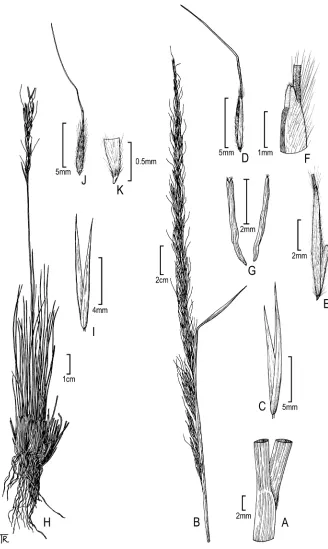
Figure 1. Barkworthia stillmanii: A habit B ligule C panicle D glumes E floret F floret (close up). Eriocoma hymenoides: G culm and panicle H panicle branch I glumes J floret K lemma awn L floret base (callus).
Comments. In a molecular-derived phylogeny of the Stipeae using 10 DNA markers Barkworthia stillmanii is sister to a well-supported Piptatherum clade, which is strictly Old World in distribution, and has cauducous awns, and dark glossy lemmas in fruit (Romaschenko et al. 2012).
Eriocoma Nutt., Gen. N. Amer. Pl. 1: 40. 1818
= Fendleria Steud., Syn. Pl. Glumac. 1: 419. 1854. Type: Fendleria rhynchelytroides
Steud. (= Eriocoma hymenoides).
Type.Eriocoma hymenoides (Roem. & Schult.) Rydb. (≡Stipa hymenoides Roem. & Schult.).
Description. Plants perennial, sometimes short rhizomatous, tightly to loosely cespitose. Culms 10–230 cm tall, erect, unbranched above, nodes glabrous or pubes-cent, nodes 2–4 (5). Leaf sheaths glabrous, pubescent or pilose, glabrous or distally ciliate; collars glabrous or with a tufts of hairs; ligules 0.1–10 mm long, hyaline to mem-branous, apex truncate, obtuse, acute or narrowly acute; blades 0.1–7 mm wide, flat, convolute or involute, smooth, scabrous, glabrous or hairy. Panicles 2.5–60 cm long, up to 15 cm wide, usually contracted, sometimes open with divergent branches; branches straight, sometimes flexuous. Spikelets 5–21 mm long, usually lanceolate, sometimes obovoid, subterete, rarely laterally compressed, with one fertile floret without rachilla extension, disarticulation above the glumes; glumes 5–21 mm long, longer than the florets, unawned, 1(3)-veined, apex usually acuminate, sometimes acute; florets 2.5–10 mm long, usually fusiform, sometimes obovoid; calluses 0.3–2 mm long, blunt, sharp, or acute, hairy; lemmas usually coriaceous, sometimes indurate, usually evenly hairy, sometimes glabrous, or distally or with longer or shorter hairs than the body, apex usu-ally entire or 2-lobed with lobes less than 2.1 mm long; lemma epidermal pattern maize-like; fundamental cells square with roundish corners and straight sidewalls subequal to silica cells or shorter, often regularly alternating; silica bodies square-cornered or some-times rounded without contractions; cork cells scarce to absent; lemmatal awns 3–80 mm long, 1 or 2-geniculate; paleas ¼ to as long or longer than the lemma, 2-veined, usually hairy, sometimes glabrous, veins usually not prolonged, but if prolonged then not more than 0.3 mm long; anthers 1–5 mm long, usually penicillate, 3 in number; lodicules 2 or 3; stigmas 2. Caryopses fusiform, pericarp adherent, hilum linear.
Distribution. There are 27 species of Eriocoma, all occurring in western North America (Canada, Mexico, and the USA) and only E. hymenoides extends its range into northeastern USA (Gleason and Cronquist 1991).
Comments. Within our earlier and unpublished molecular analyses of Eriocoma
there are three separate clades of E. lobata and one undescribed species (Romaschenko et al. 2012, 2014; Valdés Reyna et al. 2013; Romaschenko et al. in prep.). Species now included in Eriocoma were placed in Oryzopsis or Stipa (Hitchcock 1951), in Stipa
(Espejo Serna et al. 2000), in Achnatherum (Barkworth 2007; Dávila et al. 2018), or in
Eriocoma alta (Swallen) Romasch., comb. nov. urn:lsid:ipni.org:names:77199065-1
Stipa alta Swallen, Proc. Biol. Soc. Wash. 56: 79. 1943 [Basionym] ≡ Achnatherum
altum (Swallen) Hoge & Barkworth, Phytologia 74(1): 5. 1993. Type: Mexico,
Coahuila, mpio. Cuatro Cienegas, Sierra de la Madera, Canon del Agua, rare in dry shrub zones of lower canyon, 10 Sep 1939, C. H. Muller 3261 (holotype: US-2209361!; isotypes: GH-00024473 [image!], US-2871136!).
Eriocoma arida (M.E. Jones) Romasch., comb. nov. urn:lsid:ipni.org:names:77199066-1
Stipa arida M.E. Jones, Proc. Calif. Acad. Sci., ser. 2, 5: 725. 1895 [Basionym] ≡
Achnatherum aridum (M.E. Jones) Barkworth, Phytologia 74(1): 6. 1993. Type: USA,
Utah, Piute Co., Marysvale, 6000 ft, 4 Jun 1894, M.E. Jones 5377 (holotype: not located; isotypes: AHUC-13276 [image!], BM-001042155 [image!], G-00176508 [image!], MO-2151568 [image!], MSC-0092934 [image!], US-236787!).
= Stipa mormonum Mez, Repert. Spec. Nov. Regni Veg. 17: 209. 1921. Type: USA,
Utah, Milford, 21 Jun 1880, 5000 ft, M.E. Jones 2106 (lectotype: MO-2151566 [image!] designated here; isolectotypes: S-G-5821 [image!], US-866079 fragm. ex B! [image 00157472!]).
Eriocoma arnowiae (S.L. Welsh & N.D. Atwood) Romasch, comb. nov. urn:lsid:ipni.org:names:77199067-1
Stipa arnowiae S.L. Welsh & N.D. Atwood, Utah Fl. (ed. 3) 799. 2003 [Basionym] ≡
Achnatherum arnowiae (S.L. Welsh & N.D. Atwood) Barkworth, Sida 22(1): 496.
2006. Type: USA, Utah, Kane Co., T43S, R4W, S13, ca. 9 mi E of Johnson Can-yon Jct,, 1740 m, 30 May 2003, S. L. Welsh & T. O’Dell 28062 (holotype: BRY; isotypes: GH-00247115 [image!], NY-00887984 [image!], US-3498681!).
Eriocoma bloomeri (Bol.) Romasch. comb. nov. urn:lsid:ipni.org:names:77199068-1
Stipa bloomeri Bol., Proc. Calif. Acad. Sci. 4: 168. 1872 [Basionym] ≡ Oryzopsis
bloomeri (Bol.) Ricker, Contr. U.S. Natl. Herb. 11: 109. 1906 ≡ ×Stiporyzopsis
bloomeri (Bol.) B.L. Johnson, Amer. J. Bot. 32: 602, f. 14–18. 1945 ≡
Achnather-um ×bloomeri (Bol.) Barkworth, Phytologia 74(1): 14. 1993 Type: USA,
isolectotypes: CAS-0005671 [image!], K-000912826 [image!], K-000912827 [im-age!], MO-2151483 [im[im-age!], MO-2151484[im[im-age!], UC-38998 [image!].
Eriocoma bracteata (Swallen) Romasch., comb. nov. urn:lsid:ipni.org:names:77199069-1
Stipa bracteata Swallen, J. Wash. Acad. Sci. 30(5): 213. 1940[Basionym] ≡
Achnather-um bracteatAchnather-um (Swallen) Valdés-Reyna & Barkworth, Contr. U.S. Natl. Herb. 48:
15. 2003. Type: Mexico, Baja California, collected on grassy flats 25 mi N of Ensenada, 4 Apr 1931, I.L. Wiggins 5153 (holotype: US-1721797!; isotypes: CAS-0004680 [image!], CAS-0004681 [image!], GH-00024475 [image!].
Eriocoma contracta (B.L. Johnson) Romasch., comb. nov. urn:lsid:ipni.org:names:77199070-1
Oryzopsis hymenoides var. contracta B.L. Johnson, Bot. Gaz. 107: 24. 1945[Basionym]
≡ Oryzopsis contracta (B.L. Johnson) Y. Schechter, Brittonia 18: 342. 1967 ≡ Stipa
contracta (B.L. Johnson) W.A. Weber, Phytologia 67(6): 428. 1989, nom. illeg.
hom., non Stipa contracta Phil. ≡ Achnatherum contractum (B.L. Johnson) Bark-worth, Phytologia 74(1): 6. 1993. Type: USA, Wyoming, Carbon Co., Freezeout Hills, E. Nelson 4850 (holotype: RM-0000328 [image!].
Eriocoma coronata (Thurb.) Romasch., comb. nov. urn:lsid:ipni.org:names:77199071-1
Stipa coronata Thurb., Bot. California 2: 287–288. 1880[Basionym] ≡ Achnatherum
coronatum (Thurb.) Barkworth, Phytologia 74(1): 6. 1993. Type: USA, California,
San Diego Co., in a cañon around springs on hillside near Julian City, Apr 1872,
H.N. Bolander, A. Kellogg & co. s.n. (lectotype: US-745776 [accession no.!] &
US-00406146 [image!] designated here; isolectotypes: GH-00017898 [image!], MO-2151562 [image!], MO-2151563 [image!], MO-2151564 [image!]).
Eriocoma curvifolia (Swallen) Romasch., comb. nov. urn:lsid:ipni.org:names:77199072-1
Stipa curvifolia Swallen, J. Wash. Acad. Sci. 23(10): 456. 1933 [Basionym] ≡
Achnatherum curvifolium (Swallen) Barkworth, Phytologia 74(1): 7. 1993. Type:
USA, New Mexico, Eddy Co., Guadalupe Mountains, in crevices of limestone cliff near mouth of North Fork of Rocky Arroyo, 29 Apr 1932, H. Wilkens 1660
Eriocoma hendersonii (Vasey) Romasch., comb. nov. urn:lsid:ipni.org:names:77199073-1
Oryzopsis hendersonii Vasey, Contr. U.S. Natl. Herb. 1(8): 267[Basionym] ≡ Oryzopsis
exi-gua var. hendersonii (Vasey) M.E. Jones, Contr. W. Bot. 14: 11. 1912 ≡ Stipa
hender-sonii (Vasey) Mehlenb., Canad. J. Bot. 49(9): 1568. 1971 ≡ Achnatherum hendersonii
(Vasey) Barkworth, Phytologia 74(1): 7. 1993. 1893. Type: USA, Washington, North Yakima, Clements Mountain, 1892, L.F. Henderson 2249 (holotype: US-81978!).
Eriocoma hymenoides (Roem. & Schult.) Rydb., Bull. Torrey Bot. Club 39(3): 102. 1912.
Stipa hymenoides Roem. & Schult., Syst. Veg. 2: 339. 1817[Basionym] ≡ Stipa
mem-branacea Pursh, Fl. Amer. Sept. II: 728. 1814 nom. illeg., non Stipa membranacea
L. ≡ Oryzopsis membranacea Vasey, U.S.D.A. Div. Bot. Bull. 12(2): 10, t. 10. 1891,
nom. illeg. superfl. ≡ Eriocoma membranacea (Vasey) Beal, Grass. N. Amer. 2: 232. 1896, nom. illeg. superfl. ≡ Oryzopsis hymenoides (Roem. & Schult.) Ricker ex Piper, Contr. U.S. Natl. Herb. 11: 109. 1906 ≡ Achnatherum hymenoides (Roem. & Schult.) Barkworth, Phytologia 74(1): 7–8. 1993. Type: USA, on the banks of the Missouri River, J. Bradbury no. 12 (lectotype: K-000912825 [image!] desig-nated here; isolectotype: PH-00008181 [image!]). Fig. 1G–L.
= Eriocoma cuspidata Nutt., Gen. N. Amer. Pl. 1: 40. 1818 ≡ Milium cuspidatum
(Nutt.) Spreng., Syst. Veg. 1: 251. 1824 ≡ Urachne lanata Trin. & Rupr., Mem. Acad. Imp. Sci. Saint-Petersbourg, Ser. 6, Sci. Math., Seconde Pt. Sci. Nat. 3,1(2– 3): 126. 1834, nom. Illeg. superfl. ≡ Eriocoma membranacea Steud., Nomencl. Bot. (ed 2) 1: 586. 1840, nom. inval., as syn. of Urachne lanata Trin. ≡ Oryzopsis
cuspidata (Nutt.) Benth. ex Vasey, Grass. U.S. 23. 1883. Type: USA, Platte Plains,
T. Nuttall s.n. (lectotype: BM-001042144 [image!]) designated here; isolectotype:
LE-TRIN 1466.01 ex PH!).
= Fendleria rhynchelytroides Steud., Syn. Pl. Glumac. 1: 420. 1854. Type: USA, New
Mexico, near Santa Fe, 1847, A. Fendler 979 (lectotype: P-01941338 [image!]
designated here ; isolectotypes: GH-00023719 [image!], K-000912824 [image!], NY [image!], S14-1154 [image!], US-823154 [image!], W-0029207 [image!], W-0029208 [image!], W-18890236595 [image!].
Eriocoma latiglumis (Swallen) Romasch., comb. nov. urn:lsid:ipni.org:names:77199074-1
Stipa latiglumis Swallen, J. Wash. Acad. Sci. 23(4): 198, f. 1. 1933 [Basionym] ≡
Achnatherum latiglume (Swallen) Barkworth, Phytologia 74(1): 8. 1993. Type:
USA, California, Yosemite Valley, Camp Lost Arrow, 4000–4500 ft, 22 Jun 1911,
Eriocoma lemmonii (Vasey) Romasch., comb. nov. urn:lsid:ipni.org:names:77199075-1
Stipa pringlei var. lemmonii Vasey, Contr. U.S. Natl. Herb. 3(1): 55. 1892[Basionym]
≡ Stipa lemmonii (Vasey) Scribn., Circ. Div. Agrostol. U.S.D.A. 30: 3. 1901 ≡
Achnatherum lemmonii (Vasey) Barkworth, Phytologia 74(1): 8. 1993. Type: USA,
California, Plumas Co., Mohawk Valley, May 1889, J.G. Lemmon 5456 (holotype: US-556900!).
= Stipa columbiana Macoun, Cat. Canad. Pl. 2(4): 191. 1888, nom. utique rej. under
International Code of Botanical Nomenclature (ICBN 1988) Art. 56.1, (see IC-NAFP 2018 - Appendix V; also Barkworth and Maze 1979). Type: Canada, British Columbia, Yale, on rocks, 17 May 1875, J. Macoun 28940 (lectotype: CAN-9899 designated by Hitchcock, Contr. U.S. Natl. Herb. 24(7): 253. 1925; isolectotype: US-77975!).
Eriocoma lemmonii subsp. pubescens (Crampton) Romasch., comb. nov. urn:lsid:ipni.org:names:77199076-1
Stipa lemmonii var. pubescens Crampton, Leafl. W. Bot. 7(9): 220. 1955[Basionym] ≡
Achnatherum lemmonii subsp. pubescens (Crampton) Barkworth, Phytologia 74(1):
8. 1993. Type: USA, California, Tehama Co., Whitlock Camp, Round Mt. area west of Paskenta, 4000 ft, 16 Jul 1954, B. Crampton 2000 (holotype: AHUC-21077 [image!]; isotypes: AHUC-21078 [image!], CAS-0005669 [image!], US-2152024!).
= Stipa lemmonii var. jonesii Scribn., Bull. Div. Agrostol., U.S.D.A. 30: 4. 1901.
Type: USA, California:, Emigrant Gap, 28 Jun 1882, M.E. Jones 3298 (holotype: US-556899! [US-00141633 image!]; isotypes: BR-0000006884598 [image!], CAS-0005668 [image!], GH-00017900 [image!], MO-2151560 [image!], NY-00431560 [image!]), POM-116527).
Eriocoma lettermanii (Vasey) Romasch., comb. nov. urn:lsid:ipni.org:names:77199077-1
Stipa lettermanii Vasey, Bull. Torrey Bot. Club 13: 53. 1886[Basionym] ≡ Stipa viridula
var. lettermanii (Vasey) Vasey, Contr. U.S. Natl. Herb. 3(1): 50. 1892 ≡
Achnather-um lettermanii (Vasey) Barkworth, Phytologia 74(1): 9. 1993. Type: USA, Idaho,
Snake River, Aug 1885, G.W. Letterman 102 (lectotype: US-556904! designated by Hitchcock, Manual. Grass. US ed. 1, 964. 1935 as to the collection no. 102, Bark-worth & Maze identifed the US specimen number, Taxon 31(2): 294 f. 6. 1982).
= Stipa viridula var. minor Vasey, Contr. U.S. Natl. Herb. 3(1): 50. 1892 ≡ Stipa
oc-cidentalis var. minor (Vasey) C.L. Hitchc., Vasc. Pl. Pacific NW 1: 714. 1969 ≡
USA, Colorado, Kelso Mountain near Torrey’s Peak, 13000 ft, 13 Aug 1885, G.W.
Letterman 95 (lectotype: US-556903! designated by Hitchcock, Contr. U.S. Natl.
Herb. 24(7): 253. 1925).
Eriocoma lobata (Swallen) Romasch. comb. nov. urn:lsid:ipni.org:names:77199078-1
Stipa lobata Swallen, J. Wash. Acad. Sci. 23(10): 199, f. 2. 1933 [Basionym] ≡
Achnatherum lobatum (Swallen) Barkworth, Phytologia 74(1): 9. 1993. Type:
USA, New Mexico, Guadalupe Co., Queen, Guadalupe Mts., on a rocky hill, Ranger Station, 6000–7000 ft, 3–6 Sep 1915, A. S. Hitchcock 13502 (holotype: US-905722!). Fig. 2A–G.
Eriocoma nelsonii (Scribn.) Romasch., comb. nov. urn:lsid:ipni.org:names:77199079-1
Stipa nelsonii Scribn., Bull. Div. Agrostol., U.S.D.A. 11: 46. 1898[Basionym] ≡ Stipa
columbiana var. nelsonii (Scribn.) Hitchc., Contr. U.S. Natl. Herb. 24(7): 254.
1925 ≡ Stipa columbiana var. nelsonii (Scribn.) H. St. John, Fl. S.-E. Washington
61. 1937 ≡ Stipa occidentalis var. nelsonii (Scribn.) C.L. Hitchc., Vasc. Pl. Pacific NW 1: 715. 1969 ≡ Achnatherum nelsonii (Scribn.) Barkworth, Phytologia 74(1): 9. 1993. Type: USA, Wyoming, Albany Co., Woods Landing, 2600 m, 9 Aug 1898, A. Nelson 3963 (lectotype: US-556901! designated by Barkworth, Phytolo-gia 74(1): 9. 1993; isolectotype: MPU-026968 [image!]).
= Stipa williamsii Scribn., Bull. Div. Agrostol., U.S.D.A. 11: 45–46, t. 4. 1898. Type:
USA, Wyoming, dry soil on W side of Big Horn Mt., near Monument Spring, 2200–2400 m, 3 Aug 1897, T.A. Williams 2804 (lectotype: 556907! & US-00141714 [image!] designated here, partially lectotypified by Hitchcock, N. Amer. Fl., part 6. 422. 1935).
Eriocoma nelsonii subsp. dorei (Barkworth & J. Maze) Romasch., comb. nov. urn:lsid:ipni.org:names:77199080-1
Stipa nelsonii subsp. dorei Barkworth & J. Maze, Taxon 28(5/6): 623[Basionym] ≡
Stipa nelsonii var. dorei (Barkworth & J. Maze) Dorn, Vasc. Pl. Wyoming 298.
1988 ≡ Achnatherum nelsonii subsp. dorei (Barkworth & J. Maze) Barkworth,
Phy-tologia 74(1): 9. 1993. 1979. Type: Canada, Alberta, Dungarvan Creek, W.G.
Eriocoma nevadensis (B.L. Johnson) Romasch., comb. nov. urn:lsid:ipni.org:names:77199081-1
Stipa nevadensis B.L. Johnson, Amer. J. Bot. 49: 257. 1962[Basionym] ≡
Achnather-um nevadense (B.L. Johnson) Barkworth, Phytologia 74(1): 9. 1993. Type: USA,
California, Mono Co., Upper Twin Lake, near Bridgeport, 7096 ft, 29 Aug 1960, B.L. Johnson 211 (holotype: UC-1936202 [image!]; isotypes: ARIZ-BOT-0005299[image!], DAV-181068 [image!], SD-00000116 [image!]).
Eriocoma occidentalis (Thurb. ex S. Watson) Romasch., comb. nov. urn:lsid:ipni.org:names:77199082-1
Stipa occidentalis Thurb. ex S. Watson, Botany (Fortieth Parallel) 380. 1871
[Basio-nym] ≡ Stipa stricta var. sparsiflora Vasey, Contr. U.S. Natl. Herb. 3(1): 51. 1892
≡ Stipa occidentalis var. montana Merr. & Davy, Univ. Calif. Publ. Bot. 1: 62.
1902, nom. illeg. superfl. Achnatherum occidentale (Thurb. ex S. Watson) Bark-worth, Phytologia 74(1): 10. 1993 ≡ Type: USA, California, Yosemite Trail, 8000 ft, 20 Aug 1866, H.N. Bolander 5038 (lectotype: GH-22338! designated by Hitch-cock, Contr. U.S. Natl. Herb. 24(7): 242. 1925; isolectotypes: BM-000797606 [image], G-00176505 [image!], MO-2151636 [image!], NY-00431565 [im-age!], NY-00431567 [im[im-age!], US-3441781, US-992306 ex GH!, US-745821!, W-18890217496 [image!], YU-244757 [image!]).
= Stipa stricta Vasey, Bull. Torrey Bot. Club 10: 42. 1883, nom. illeg. hom. non S.
stricta Lam. ≡ Stipa oregonensis Scribn., Bull. Div. Agrostol., U.S.D.A. 17: 130, f.
426. 1899. Type: USA, “Oregon” [but from Washington, which became a state in 1889], 1882, W.N. Suksdorf s.n. (holotype: US-556921!).
Eriocoma occidentalis subsp. californica (Merr. & Burtt Davy) Romasch., comb. nov. urn:lsid:ipni.org:names:77199083-1
Stipa californica Merr. & Burtt Davy, Univ. Calif. Publ. Bot. 1: 61. 1902[Basionym]
≡ Stipa occidentalis var. californica (Merr. & Burtt Davy) C.L. Hitchc., Vasc. Pl.
Pacific NW 1: 715. 1969 ≡ Achnatherum occidentale subsp. californicum (Merr. & Burtt Davy) Barkworth, Phytologia 74(1): 10. 1993. Type: USA, California, San Jacinto Mts., north side of Fullers Ridge, 2100 m, Jul 1901, H.M. Hall 2556
(holotype: unknown; isotypes: CAS-0005660 [image!], US-556911!).
= Stipa nelsonii var. longiaristata Barkworth & J. Maze, Taxon 28(5/6): 623. 1979 ≡
Achnatherum nelsonii subsp. longiaristatum (Barkworth & J. Maze) Barkworth,
Phyt-ologia 74(1): 9. 1993. Type: USA, Washington, 8–9 mi W of Spokane, 19 Jun 1940,
Eriocoma occidentalis subsp. pubescens (Vasey) Romasch., comb. nov. urn:lsid:ipni.org:names:77199084-1
Stipa viridula var. pubescens Vasey, Contr. U.S. Natl. Herb. 3(1): 50. 1892
[Basio-nym] ≡ Stipa elmeri Piper & Brodie ex Scribn., Bull. Div. Agrostol., U.S.D.A. 11: 46. 1898 ≡ Stipa occidentalis var. pubescens (Vasey) J. Maze, Roy L. Taylor & MacBryde, Canad. J. Bot. 56(2): 193. 1978 ≡ Achnatherum occidentale subsp.
pu-bescens (Vasey) Barkworth, Phytologia 74(1): 10. 1993. Type: USA, Washington,
on dry ground along the Columbia River, 1883, W.N. Suksdorf s.n. (lectotype: US-79560! [US-00036944 image!], designated by Hitchcock, Contr. U.S. Natl. Herb. 24(7): 241. 1925; isolectotype: GH-00443467 [image!]).
Eriocoma parishii (Vasey) Romasch., comb. nov. urn:lsid:ipni.org:names:77199085-1
Stipa parishii Vasey, Bot. Gaz. 7(3): 33. 1882[Basionym] ≡ Stipa coronata var. parishii
(Vasey) Hitchc., Contr. U.S. Natl. Herb. 24: 227, t. 50, f. 13. 1925 ≡
Achnather-um parishii (Vasey) Barkworth, Phytologia 74(1): 11. 1993. Type: USA,
Califor-nia, San Berardino Mts., Aug 1881, S.B. Parish & W.F. Parish 1079 (lectotype: US-556918! & US-00406147 [image!] designated by Hitchcock, Contr. U.S. Natl. Herb. 24(7): 227. 1925).
Eriocoma parishii subsp. depauperata (M.E. Jones) Romasch., comb. nov. urn:lsid:ipni.org:names:77199086-1
Stipa parishii var. depauperata M.E. Jones, Contr. W. Bot. 14: 11. 1912[Basionym]
≡ Stipa coronata var. depauperata (M.E. Jones) Hitchc., J. Wash. Acad. Sci. 24(7):
292. 1934 ≡ Achnatherum parishii subsp. depauperatum (M.E. Jones) Barkworth, Phytologia 74(1): 11. 1993. Type: USA, Utah, Detroit, 25 May 1891, M.E. Jones s.n. (holotype: RSA-0000500 [image!]; isotype: US-83026!).
Eriocoma perplexa (Hoge & Barkworth) Romasch., comb. nov. urn:lsid:ipni.org:names:77199087-1
Achnatherum perplexum Hoge & Barkworth, Phytologia 74(1): 11. 1993 [Basionym]
≡ Stipa perplexa (Hoge & Barkworth) Wipff & S.D. Jones, Phytologia 77(6): 461.
1995. Type: USA, New Mexico, Bernalillo Co., Cibola National Forest, 1.5 mi E of USFS road 413, 9 mi S of Tijeres on NM 14, 8 Sep 1985, M.E. Barkworth 4764
Eriocoma pinetorum (M.E. Jones) Romasch., comb. nov. urn:lsid:ipni.org:names:77199088-1
Stipa pinetorum M.E. Jones, Proc. Calif. Acad. Sci., ser. 2, 5: 724. 1895 [Basionym]
≡ Achnatherum pinetorum (M.E. Jones) Barkworth, Phytologia 74(1): 12. 1993.
Type: USA, Utah, Panguitch Lake, 8400 ft, growing in open places among the pine forests, 8 Sep 1894, M.E. Jones 6023 (holotype: RSA-0000501 [image!]); isotype: US-236788!). Fig. 2H–K.
Eriocoma richardsonii (Link) Romasch., comb. nov. urn:lsid:ipni.org:names:77199089-1
Stipa richardsonii Link, Enum. Pl. 2: 245. 1833[Basionym] ≡ Oryzopsis richardsonii
(Link) Beal, Bot. Gaz. 15(5)12: 111. 1890 ≡ Achnatherum richardsonii (Link) Barkworth, Phytologia 74(1): 12. 1993. Type: Habitat in America boreali occi-dental, cultivated in Hortus Berolensis from seed sent by Richardson (lectotype: LE-TRIN-1436.01 fragm. ex B! designated here).
Eriocoma robusta (Vasey) Romasch., comb. nov. urn:lsid:ipni.org:names:77199090-1
Stipa viridula var. robusta Vasey, Contr. U.S. Natl. Herb. 1(2): 56. 1890[Basionym] ≡
Stipa robusta (Vasey) Scribn., Bull. Div. Agrostol., U.S.D.A. 5: 23. 1897 ≡ Stipa
vaseyi Scribn., Bull. Div. Agrostol., U.S.D.A. 11: 46. 1898, nom. illeg. superfl. ≡
Achnatherum robustum (Vasey) Barkworth, Phytologia 74(1): 12. 1993. Type: USA,
New Mexico, 1881, G.R. Vasey s.n. (conserved type: US-993051!). Fig. 3A–G.
Eriocoma scribneri (Vasey) Romasch., comb. nov. urn:lsid:ipni.org:names:77199091-1
Stipa scribneri Vasey, Bull. Torrey Bot. Club 11: 125. 1884[Basionym] ≡ Achnatherum
scribneri (Vasey) Barkworth, Phytologia 74(1): 13. 1993. Type: USA, New
Mex-ico, Santa Fe Co., Santa Fe, collected on dry hillsides, Aug 1884, G.R. Vasey s.n.
Eriocoma swallenii (C.L. Hitchc. & Spellenb.) Romasch., comb. nov. urn:lsid:ipni.org:names:77199092-1
Oryzopsis swallenii C.L. Hitchc. & Spellenb., Brittonia 20: 164. 1968[Basionym] ≡
Achnatherum swallenii (C.L. Hitchc. & Spellenb.) Barkworth, Phytologia 74(1):
14. 1993. Type: USA, Idaho, Clark Co., just N of Birch Creek, along Hwy. 28, near the Lemhi Co. line, 7 Jul 1965, C.L. Hitchcock 23868 (holotype: WTU-227273 & WTU-V-000041[image!]; isotypes: CAS-0006990 [image!], COLO-00391284 [image!], DAV-38298 [image!], DAO-000465414 [image!], F-0046857F [im-age!], G-00176562 [im[im-age!], GH-00024084 [im[im-age!], ID-00157718 [im[im-age!], NCU-00000362 [image!], NY-00381560 [image!], OSC-0001820 [image!], RM-0000329 [image!], RSA-0000458 [image!], TEX-00370123 [image!], UBC-V116845 [image!], US-3465271!, V-047552 [image!]).
Eriocoma thurberiana (Piper) Romasch., comb. nov. urn:lsid:ipni.org:names:77199093-1
Stipa thurberiana Piper, Circ. Div. Agrostol. U.S.D.A. 27: 10. 1900, nom. nov
[Basio-nym] ≡ Stipa occidentalis Thurb., U.S. Expl. Exped. 17: 483. 1874 non. Stipa
occi-dentalis Thurb. ex S. Watson ≡ Achnatherum thurberianum (Piper) Barkworth,
Phy-tologia 74(1): 14. 1993. Type: USA, Washington, North Branch of the Columbia River, C. Pickering & W. D. Brackenridge s.n. (holotype: GH-00017772 [image!]).
Eriocoma wallowaensis (J. Maze & K. Robson) Romasch., comb. nov. urn:lsid:ipni.org:names:77199094-1
Achnatherum wallowaense J. Maze & K. Robson, Madrono 43(3): 401, f. 1–2. 1996
[Basionym]. Type: USA, Oregon, Wallowa Co., Wallowa-Whitman National For-est, ca. 34 km N of Enterprise, near Boner Gulch along Forest Service road, 46, 45°43'41.16"N, 117°08'10.32"W (SW 1/4 of SE 1/4, sect 24, T3N, R45E), 1481 m, 26 Jun 1993, J. Maze, E. Maze, K.A. Robson & T. Henn 1007 (holotype: US-3323518!; isotypes: COLO-00339663 [image!], 126946 [image!], DAV-128405 [image!], ID-00157713 [image!], MO-128384 [image!], NCU-00012752 [image!], NY-00039022 [image!], UBC-V209875 [image!]).
Eriocoma webberi Thurb., Bot. California 2: 283–284. 1880
Eriocoma webberi Thurb., Bot. California 2: 283–284. 1880 [Basionym] ≡ Oryzopsis
B.L. Johnson, Bot. Gaz. 107: 25. 1945 ≡ Achnatherum webberi (Thurb.) Bark-worth, Phytologia 74(1): 14. 1993. Type: USA, California, Sierra Valley, 1 May 1871, H.N. Bolander, A. Kellogg & co. s.n. (holotype: GH-00024083 [image!]; isotypes: MO-2151485[image!], NY-00381032 [image!], US-81935!).
×Eriosella Romasch., nothogen. nov. urn:lsid:ipni.org:names:77199095-1
Eriocoma Nutt. × Nassella (Trin.) E. Desv. Type: ×Eriosella caduca (Beal) Romasch. (≡
Oryzopsis caduca Beal)
Description. Plants perennial, cespitose, not rhizomatous. Culms up to 90 cm tall, nodes glabrous. Leaf sheaths mostly glabrous, margins sparsely ciliate, hairs longer api-cally; collars glabrous or with tufts of hairs; ligules 0.5–1.7 mm long, scarious, gla-brous, apex truncate to obtuse; blades 1–3.5 mm wide, flat to convolute when dry, api-ces narrowly acute; basal blades to 40 cm long; flag blades longer than 10 cm. Panicles 15–18 cm long, narrow, branches ascending. Spikelets 6–8.5 mm long, fusiform, with one fertile floret without rachilla extension, disarticulation above the glumes; glumes 6–8.5 mm long, longer than the florets, saccate-lanceolate, 3–5-veined, apices atten-uate from about the middle; upper glumes slightly narrower than the lower; florets 4–5 mm long, fusiform; calluses about 0.7 mm long, blunt; lemmas 7-veined, coria-ceous, evenly hairy throughout, the hairs 1–2 mm long, apex minutely lobed; lem-matal awns 9–16 mm long, twisted, straight or 1-geniculate, readily deciduous, lower portion scabrous and without hairs; paleas 2.5–3.3 mm long, 2/3–3/4 as long as the lemma, hairy; stamens 2, anthers 1.2–2.3 mm long, variable in length within the floret, 2 in number indehiscent, penicillate, with only a few apical hairs. Caryopses not seen.
Etymology. The name, ×Eriosella, is a combination of the prefix ‘Erio’ from Erio-coma and the suffix ‘sella’ from Nassella.
Distribution. Known only from Montana, North Dakota, and western Wyoming (Johnson and Rogler 1943; Barkworth 2007).
×Eriosella caduca (Beal) Romasch., comb. nov. urn:lsid:ipni.org:names:77199096-1
Oryzopsis caduca Beal, Bot. Gaz. 15(5): 111. 1890 [Basionym] ≡ Eriocoma caduca
(Beal) Rydb., Mem. New York Bot. Gard. 1: 25. 1900 ≡ Stipa caduca (Beal) Scribn., Contr. U.S. Natl. Herb. 3(1): 54. 1892 ≡ ×Stiporyzopsis caduca (Beal) B.L. Johnson & Rogler, Amer. J. Bot. 30: 55, f. 10, 14, 28–33. 1943 ≡ ×Achnella
caduca (Beal) Barkworth, Phytologia 74(1): 15. 1993. Type: USA, Montana, Belt
Comments. ×Eriosella caduca is thought to be a hybrid between Eriocoma hymenoides
and Nassella viridula. It can be separated from E. hymenoides in having shorter hairs on
the lemma and panicles with ascending branches (not divergent), and from N. viridula
in having longer lemma hairs, paleas 2/3–3/4 as long as the lemma, and readily decidu-ous lemmatal awns (Barkworth 2007). Another species similar to ×Eriosella caduca is
Eriocoma bloomeri. However, the latter species has glabrous sheaths, shorter ligules,
5-veined lemmas, awns with a sub-plumose lower section below the bend, and anthers with more numerous apical hairs (Johnson and Rogler 1943).
Neotrinia (Tzvelev) M. Nobis, P. Gudkova & A. Nowak, Turczaninowia 22 (1): 40. 2019
Achnatherum sect. Neotrinia Tzvelev, Novosti Sist. Vyssh. Rast. 9: 55. 1972.
Type. Neotrinia splendens (Trin.) M. Nobis, P. Gudkova & A. Nowak (≡ Stipa
splendens Trin.).
Neotrinia splendens (Trin.) M. Nobis, P. Gudkova & A. Nowak, Turczaninowia 22 (1): 40. 2019
Stipa splendens Trin., Neue Entdeck. Pflanzenk. 2: 54. 1821 [Basionym] ≡ Agrostis
longiaristata Herb. in Ross. ex Kunth, Enum. Pl. 1: 178. 1833, nom. illeg. ≡
Lasia-grostis splendens (Trin.) Kunth, Révis. Gramin. 1: 58. 1829 ≡ Achnatherum
splen-dens (Trin.) Nevski, Trudy Bot. Inst. Akad. Nauk S.S.S.R., Ser. 1, Fl. Sist. Vyssh. Rast. 4: 224. 1937. Type: Russia, Transbaicalia, Siberia, Fischer et Steven s.n. (holo-type: LE-TRIN1444.1!). Fig. 3H–K.
Distribution and habitat. The single species, Neotrinia splendens, is native to Asia in Afghanistan, India, Kazakhstan, Kyrgyzstan, China, Mongolia, Pakistan, Russia, Ta-jikistan, Turkmenistan, and Uzbekistan (Wu and Phillips 2006). In North America N.
splendens has been introduced as an ornamental (Barkworth 2007). The species occurs
in cold, semi desert regions along drainages at 2100–3800 m (Freitag 1985).
Comments.Psammochloa villosa (Trin.) Bor is sister to Neotrinia splendens in our earlier molecular phylogeny (BS = 100, PP = 1.00) and both species share the following morphological features: basal fibrous sheaths, panicles with whorled primary branches arising from the rachis, (1–) 3–5-veined glumes with hyaline margins, short, obtuse to elliptic calluses, and evenly hairy lemmas with flexuous cauducous awns that arise between the apical teeth (Freitag 1985; Wu and Phillips 2006; Barkworth 2007; Ro-maschenko et al. 2012). Neotrinia splendens differs from Psammochloa villosa in having cespitose culms without rhizomes, 4–7 (–8.5) mm long spikelets, 2.5–6.5 mm long glumes, 4.2–7.2 mm long lemmas that are evenly hairy with hairs up to 1.5 mm long, linear-lanceolate lodicules (versus flabellate), and 3.5–4.5 mm long anthers. It also dif-fers from Achnatherum in having saw-like lemma epidermal pattern.
As noted by Barkworth (2007), the plants are rarely grazed upon, and some-times form dense tall stands in Asia (RJS pers. obs.; Tzvelev 1976, p. 564 comment).
Achnatherum caragana (Trin.) Nevski was treated as the only other A. sect. Neotrinia
species (Tzvelev 1976), and may belong to the genus.
Oloptum Röser & H.R. Hamasha, Pl. Syst. Evol. 298: 365. 2012
Type.Oloptum miliaceum (L.) Röser & H.R. Hamasha (≡Agrostis miliacea L.).
Figure 3. Eriocoma robusta: A habit B sheath and blade with a hairy collar C panicle D glumes E floret
node, these often with sterile spikelets. Spikelets 2.5‒3.5 mm long, elliptic, dorsally compressed with one fertile floret without rachilla extension; disarticulation above the glumes; glumes subequal, longer than the florets, 3-veined without transverse veinlets, membranous, apices acuminate; florets 2‒2.5 mm long, chartaceous; calluses about 0.3 mm long, with non-grooved circular disarticulation scar, glabrous; lemmas with narrow open borders, central vein not grooved, apex awned, the awns 3‒5 mm long, flexuous, cauducous; lemma epidermal pattern maize-like; fundamental cells elongated with straight thin sidewalls 3–7 times longer than silica cells, irregularly alternating; silica bodies round; cork cells crescent-shaped scarce to absent; paleas about as long as the lemma, coriaceous, 2-veined; stamens 3, anthers 2‒2.5 mm long, penicillate; lodicules 3; stigmas 2; ovary glabrous. Caryopses 1.5‒1.7 mm long, fusiform, pericarp adherent, hilum linear about ½ as long as the caryopsis. Chromosome number 2n = 24 (Faruqi et al. 1987; Devesa et al. 1991; Luque and Lifante 1991; Verlaque et al. 1997).
Oloptum miliaceum (L.) Röser & H.R. Hamasha, Pl. Syst. Evol. 298(365): 2012
Agrostis mileacea L., Sp. Pl. 1: 61. 1753[Basionym] ≡ Achnatherum miliaceum (L.) P.
Beauv., Ess. Agrostogr. 20, 146, 148. 1812 ≡ Urachne miliacea (L.) K. Koch, Lin-naea 21(4): 439. 1848 ≡ Piptatherum miliaceum (L.) Coss., Notes Pl. Crit. 129.
1851 ≡ Oryzopsis miliacea (L.) Benth. & Hook. ex Asch. & Schweinf., Mém. Inst.
Égypte 2: 169. 1887 ≡ Stipa miliacea (L.) Hoover, Leafl. W. Bot. 10(16): 340. 1966. Type: Sweden, Uppsala, Anon. s.n. (lectotype: LINN-HL84-2 [image!] des-ignated by R.D. Meikle, Fl. Cyprus 2: 1794. 1985). Fig. 4A–E.
Distribution and habitat. Oloptum miliaceum is native to Europe, particularly the whole Mediterranean region, from northern Africa, Sinai to Western Asia (Arabian Pen-insula, Cyprus, Egypt, Iraq, Iran, Israel, Jordan, Lebanon, Palestinian territories, Syria, and Turkey) [Freitag 1975; Soreng et al. 2003; Ibrahim et al. 2016]. It is naturalized in southern Africa, Australia, New Zealand, North America (Arizona, California, Mary-land) and South America (Barkworth 2007), and has been cultivated in Mississippi, North Carolina, Tennessee, and Utah (see SEINet http://swbiodiversity.org/seinet/col-lections/list.php?db=all&taxa=Achnatherum+miliaceum&usethes=1&taxontype=2&p age=1). The species occurs in various disturbed habitats along roadsides, ditches, borders of fields, dry river beds, and dumping grounds usually below 2000 m (Freitag 1975).
Comments. The unique morphological features of this taxon (glabrous lemma with a central vein not grooved, 3-veined glumes without transverse veinlets, and a callus with a circular disarticulation scar) were first recognized by Roshevitz (1951) and later officially named by Freitag (1975) as Piptatherum sect. Miliacea Roshev. ex Freitag. Lemma epidermal pattern of Oloptum is unusual among achnatheroid grasses resembling only that of Celtica. It is distinguished by having long fundamental cells ir-regularly alternating with silica bodies. In our earlier molecular analysis, O. miliaceum
includes Stipellula, Austrostipa S.W.L. Jacobs & J. Everett, Anemanthele Veldkamp and
Celtica F.M. Vázquez & Barkworth (Romaschenko et al. 2011, 2012).
Traditionally, two subspecies have been recognized. Oloptum miliaceum subsp.
thomasii (Duby) Boiss. differs from the typical form in having densely verticillate
pani-cles with 15‒30 or more often sterile branches on the lowest whorl (Freitag 1975). There is genetic variation between these two subspecies in our earlier analyses (Ro-maschenko et al. 2011, 2012). A molecular study with a larger sample of the subspecies is necessary to fully explore evolutionary relationships.
Pseudoeriocoma Romasch., P.M.Peterson & Soreng, gen. nov. urn:lsid:ipni.org:names:77199097-1
Type.Pseudoeriocoma eminens (Cav.) Romasch. (≡Stipa eminens Cav.)
Diagnosis. Pseudoeriocoma differs from Eriocoma Nutt. in having bamboo-like culms commonly with up to 13 nodes, 3–6 mm thick below, with ramified branching at the middle and upper nodes.
Description. Plants perennial, cespitose, usually short rhizomatous from a knotty base. Culms 30–230 (often over 100) cm tall, erect or ascending, often geniculate, 3–6 mm thick and often woody and bamboo-like below with ramified and branching at the middle and upper nodes, with (2) 3–13 nodes, internodes glabrous or hairy. Leaf sheaths shorter than the internodes above to shorter or longer below, glabrous, pubes-cent or hirsute, sometimes ciliate on the margins and summit; collars glabrous or with a tuft of hairs; ligules 0.5–8 mm long, hyaline to membranous, apex truncate to acute or obtuse, often lacerate; blades (1.5–) 5–40 cm long, 1–4 mm wide, flat to tightly involute or convolute, glabrous or pubescent, usually scabrous. Panicles 8–45 (–55) cm long, usually rather narrow and less than 8.5 cm wide, loosely or densely flowered, branches ascending to spreading and naked near base; pedicles longer than the spike-lets. Spikelets 8–15 mm long, lanceolate with one fertile floret without rachilla exten-sion; disarticulation above the glumes; glumes (4–) 6–15 mm long, longer than the florets, subequal or unequal, hyaline to membranous, 1–7-veined, glabrous, acumi-nate; florets 4–7 mm long, usually fusiform; calluses 0.2–2 long, sharp, hairy; lemmas 4–7 mm long, fusiform, coriaceous, evenly hairy, the hairs 0.4–2 mm long, margins enveloping most of the palea, apex entire and awned; lemma epidermal pattern maize-like; fundamental cells squared, longitudinally compressed with straight thin sidewalls subequal to silica cells (silica bodies) or shorter, regularly alternating; cork cells absent; lemmatal awns 20–80 mm long, 2-geniculate, flexuous, the segments scabrous or pu-bescent; paleas 1–4.6 mm long, 1/3 to ¾ as long as the lemmas, 2-veined, veins not prolonged, hairy; anthers 2.5–4 mm long, penicillate or not, 3 in number, lodicules 2 or 3; stigmas 2. Caryopses 3–4 mm long, fusiform, pericarp adherent, hilum linear.
Comments. Within our preliminary molecular analyses of Pseudoeriocoma there are two clades each of P. constricta, P. eminens, and P. multinodis that require further study, and at least three species currently placed in Jarava from South America that align within Pseudoeriocoma (Romaschenko et al. 2012, 2014; Valdés Reyna et al. 2013; Romaschenko et al. in prep.).
Pseudoeriocoma acuta (Swallen) Romasch., comb. nov. urn:lsid:ipni.org:names:77199098-1
Stipa acuta Swallen, J. Wash. Acad. Sci. 30(5): 212. 1940[Basionym] ≡ Achnatherum
acu-tum (Swallen) Valdés-Reyna & Barkworth, Contr. U.S. Natl. Herb. 48: 15. 2003. Type: Mexico, Coahuila, on rocky soil on Carneras Pass, 21 mi S of Saltillo, 1 Sep 1938, F.
Shreve 8545 (holotype: US-1760238!; isotype: ARIZ-BOT-0004856 [image!]).
Pseudoeriocoma constricta (Hitchc.) Romasch., comb. nov. urn:lsid:ipni.org:names:77199099-1
Stipa constricta Hitchc., Contr. U.S. Natl. Herb. 24(7): 244, t. 51, f. 28–29. 1925
[Ba-sionym] ≡ Achnatherum constrictum (Hitchc.) Valdés-Reyna & Barkworth, Contr. U.S. Natl. Herb. 48: 15. 2003. Type: Mexico, Hidalgo, Pachuca, collected on a rocky hill at 2400 m alt., 7 Sep 1910, A.S. Hitchcock 6742 (holotype: US-993345!; isotype: NY-00431580 [image!]).
Pseudoeriocoma editorum (E. Fourn.) Romasch., comb. nov. urn:lsid:ipni.org:names:77199100-1
Stipa editorum E. Fourn., Mexic. Pl. 2: 75. 1886[Basionym] ≡ Achnatherum editorum
(E. Fourn.) Valdés-Reyna & Barkworth, Contr. U.S. Natl. Herb. 48: 16. 2003. Type: Mexico, in valle edita inter La Noria del Viejo et La Miquiguana, W.F. von
Karwinski 1009c (holotype: P; isotypes: KFTA-0002846 [image!], US-866119A!
fragm. ex P).
Pseudoeriocoma eminens (Cav.) Romasch., comb. nov. urn:lsid:ipni.org:names:77199101-1
Stipa eminens Cav., Icon. 5: 42, t. 467, f. 1. 1799[Basionym] ≡ Achnatherum eminens
(Cav.) Barkworth, Phytologia 74(1): 7. 1993. Type: Mexico, Chalma, L. Née s.n.
(holotype: MA-656523: isotype: US-866118!).
= Stipa erecta E. Fourn., Mexic. Pl. 2: 75. 1886, nom. illeg. hom., non Stipa erecta
Type: Mexico, Tehuacán, Dec, F.M. Liebmann 654 (holotype: C-10017241 [im-age!]; isotype: US-866117! fragm. ex C).
= Stipa flexuosa Vasey, Bull. Torrey Bot. Club 15: 49. 1888. Type: USA, western Texas,
Chenate Mountains, 1887, G.C. Nealley s.n. (holotype: US-556913!; isotypes: NY-00431557 [image!], W-19160022725 [image!]). Fig. 5F–I.
Pseudoeriocoma hirticulmis (S.L. Hatch, Valdés-Reyna & Morden) Romasch., comb. nov.
urn:lsid:ipni.org:names:77199102-1
Stipa hirticulmis S.L. Hatch, Valdés-Reyna & Morden, Syst. Bot. 11(1): 186–188,
f. 1. 1986 [Basionym] ≡ Achnatherum hirticulme (S.L. Hatch, Valdés-Reyna & Morden) Valdés-Reyna & Barkworth, Contr. U.S. Natl. Herb. 48: 16. 2003. Type: Mexico, Nuevo León, 8 mi E of San Roberto Jct. along Hwy. 58 on the road to Galeana, 24°40'N, 100°14'W, 1890 m, 22 Aug 1983, S. Hatch & J. Valdés Reyna 5007 (holotype: TAES; isotypes: ANSM-028729 [image!], CHAPA-0000220 [image!], ENCB-003270 [image!], MEXU-00415572 [image!], MO-123113 [im-age!], NY-00431581 [im[im-age!], TEX-00370148 [im[im-age!], US-3037668!).
Pseudoeriocoma multinodis (Scribn. ex Beal) Romasch., comb. nov. urn:lsid:ipni.org:names:77199103-1
Stipa multinodis Scribn. ex Beal, Grass. N. Amer. 2: 222. 1896 [Basionym] ≡
Achnatherum multinode (Scribn. ex Beal) Valdés-Reyna & Barkworth, Contr. U.S.
Natl. Herb. 48: 17. 2003. Type: Mexico, Chihuahua, Santa Eulalia Mountains, 14 Aug 1885, C.G. Pringle 385 (holotype: MSC-0092939 [image!]; isotypes: AC-00320221 [image!], BM-000938477 [image!], BR-0000006884895 [image!], JE-00001162 [image!], G-00168339 [image!], G-00168541 [image!], G-00168542 [image!], G-00168543 [image!], GH-00024478 [image!], K-000433421 [image!], KFTA-0000585 [image!], 123114 [image!], 123115 [image!], MO-5114652, NY-00431585 [image!], NY-00431586 [image!], NY-00431587 [im-age!], US-90985!, US-155154!, US-825176!, W-19160026109 [image!]).
Ptilagrostiella Romasch., P.M.Peterson & Soreng, gen. nov. urn:lsid:ipni.org:names:77199104-1
Type.Ptilagrostiella kingii (Bol.) Romasch. (≡Stipa kingii Bol.).
differs from Ptilagrostis Griseb. in having a sharp-pointed callus and lemmatal awns with very short hairs.
Description. Plants perennial, cespitose, not rhizomatous with intravaginal branch-ing. Culms 15–40 cm tall, 0.4–0.8 mm in diameter, erect, glabrous, not branching above. Leaf sheaths open, glabrous to scaberulous; ligules 1–2.5 mm long, membranous, apex obtuse to acute; blades 3–15 cm long, 0.3–0.5 mm wide, convolute, filiform, flexuous. Panicles 4–10 cm long, loosely contracted; branches ascending and usually appressed. Spikelets 3–4.5 mm long, lanceolate with one fertile floret without rachilla extension; disarticulation above the glumes; glumes 3–4.5 mm long, usually longer than the florets, hyaline, without veins, apex obtuse; florets 2.8–4.2 mm long, laterally compressed; cal-luses 0.3–0.7 mm long, sharp, hairy; lemmas 2.8–4.2 mm long, membranous to charta-ceous, evenly pubescent throughout, the hairs 0.3–0.5 mm long, margins overlapping most of the palea at maturity, apex 2-lobed, the lobes 0.1–0.4 mm long, awned; lemma epidermal pattern saw-like; fundamental cells of variable length with sinuous sidewalls 2–8 times longer than silica cells irregularly alternating; silica bodies elongated-rectan-gular, sometimes paired with square-shaped cork cells; lemmatal awns 10–14 mm long, strigillose in lower part; 1- or 2-geniculate, persistent; paleas 2.6–3.2 mm long, shorter to about as long as the lemma, chartaceous, 2-veined; stamens 3, anthers 0.5–1.5 mm long, penicillate; lodicules 3, membranous; stigmas 2; ovary glabrous. Caryopses 1.5–2.3 mm long, fusiform, pericarp adherent. Chromosome number 2n = 22 (Johnson 1945).
Ptilagrostiella kingii (Bol.) Romasch., comb. nov. urn:lsid:ipni.org:names:77199105-1
Stipa kingii Bol., Proc. Calif. Acad. Sci. 4: 170. 1872[Basionym] ≡ Oryzopsis kingii
(Bol.) Beal, Grass. N. Amer. 2: 229. 1896 ≡ Ptilagrostis kingii (Bol.) Barkworth, Syst. Bot. 8(4): 417. 1983. Type: USA, California, Tuolumne Co., Mt. Dana and Toulumne Meadows, 7000–12000 ft, Sep 1866, H.N. Bolander 6097 (lectotype: CAS-0005666 [image!] designated by M.E. Barkworth, Syst. Bot. 8: 417. 1983; isolectotypes: BM-001042147 [image!], F-0047023F [image!], G-00176575 [image!], G-00176576 [image!], G-00176577 [image!], GH-00361770 [image!, NY-01785914 [image!], US-81910!, YU-000920 [image!], YU-244788 [image!], W-18890217500 [image!]). Fig. 4F–J.
Distribution and habitat.Ptilagrostiella kingii is endemic to California known only in the Sierra Nevada (Fresno, Inyo, Madera, Mariposa, Mono, Tulare, and Tuolomne counties) and is associated with lodgepole and subalpine forests (Calflora 2018). The species grows along moist streambanks and open, wet to dry meadows; 2000–3650 m (Barkworth 1983, 2007).
Barkworth (1983), the similarities between P. kingii and Ptilagrostis may have resulted from convergent evolution in distantly related taxa growing under similar environ-mental conditions since the former species shares an immediate common ancestor with
Piptatheropsis and does not align near the Ptilagrostis clade (Romaschenko et al. 2012).
Ptilagrostiella kingii also lacks a blunt callus and the plumose awns characteristic of
most Ptilagrostis species (Wu and Phillips 2006).
Thorneochloa Romasch., P.M.Peterson & Soreng, gen. nov. urn:lsid:ipni.org:names:77199107-1
Type.Thorneochloa diegoensis (Swallen) Romasch. ≡ (Stipa diegoensis Swallen).
Diagnosis. Thorneochloa differs from Pseudoeriocoma Romasch., P.M. Peterson & Soreng in having dense pubescence 3–9 mm below the lower nodes, the hairs retrorse, non ramified branching on the middle and upper culms, and pedicels usually shorter than the spikelets.
Description. Plants perennial, cespitose, not rhizomatous. Culms 70–140 cm tall, erect or ascending, often geniculate, 2–4 mm thick never bamboo-like or ramified above with (2) 3 nodes that are densely pubescent 3–9 mm below the lower nodes, the hairs retrorse, internodes usually pubescent. Leaf sheaths longer than the internodes below and shorter than the internodes above, glabrous or pubescent, ciliate on the margins and summit; collars with a tuft of hairs, the hairs 1.5–2 mm long; ligules 1–3 mm long, membranous and pubescent, apex truncate to obtuse; blades 15–40 cm long, 1–3.5 mm wide, flat to involute, scabrous below and pubescent above. Panicles 15–30 cm long, (2–) 4–8 cm wide, narrow, densely flowered, branches ascending ap-pressed; pedicles usually shorter than the spikelets. Spikelets 8–11.5 mm long, lanceo-late with one fertile floret without rachilla extension; disarticulation above the glumes; glumes 8–11.5 mm long, longer than the florets, subequal, hyaline, 3–5-veined, gla-brous, acuminate; florets 5.5–7.5 mm long, usually fusiform; calluses 0.25–1.2 mm long, sharp, hairy; lemmas 5.5–7.5 mm long, fusiform, coriaceous, evenly hairy, the hairs 0.5–2 mm long, margins enveloping most of the palea, apex awned with min-ute apical lobes 0.2–0.4 mm long; lemma epidermal pattern maize-like; fundamental cells squared, longitudinally compressed with straight thin sidewalls subequal to silica cells (silica bodies) or shorter, regularly alternating; cork cells absent; lemmatal awns 20–50 mm long, 2-geniculate, flexuous, the segments scabrous, terminal segment straight; paleas 2.6–4 mm long, 1/2 to ¾ as long as the lemmas, 2-veined, veins not prolonged, hairy; anthers 2.5–4 mm long, not penicillate, 3 in number; lodicules 2 or 3; stigmas 2. Caryopses 3.8–4 mm long, fusiform, pericarp adherent, hilum linear, embryo ¼ the length.
Thorneochloa diegoensis (Swallen) Romasch., comb. nov. urn:lsid:ipni.org:names:77199108-1 77199108-1
Stipa diegoensis Swallen, J. Wash. Acad. Sci. 30(5): 212, f. 2. 1940 [Basionym] ≡
Achnatherum diegoense (Swallen) Barkworth, Phytologia 74(1): 7. 1993. Type:
USA, California, San Diego Co., Proctor Valley near Jamul, along vernal stream in chaparral, 23 May 1938, F. F. Gander 5778 (holotype: US-1761177!; isotypes: AHUC-30095 [image!], CAS-0005662 [image!], DAO-000465418 [image!], F-0044439F [image!], SD-00000072 [image!]). Fig. 5A–E.
Distribution and habitat.Thorneochloa diegoensis is found in Channel Islands (Santa Barbara County), San Diego, and Ventura Counties and Baja California, Mexico in rocky soil along vernal streams and canyons in chaparral and coastal sage-scrub vegeta-tion; usually below 500 m (Barkworth 2007; Calflora 2018).
Comments. Molecular sequence analysis reveals multiple origins of this taxon. In our preliminary ITS-derived phylogenetic tree Thorneochloa diegoensis aligns within
Nas-sella whereas in the combined plastid-derived tree it aligns within Pseudoeriocoma (Valdés
Reyna et al. 2013). Geographically, the most likely parents, if of hybrid origin, would
be Nassella mucronata (Kunth) R.W. Pohl and Pseudoeriocoma eminens. A more detailed
genetic study using low-copy nuclear genes would perhaps resolve this hypothesis.
A key to the native and introduced(marked with an asterisk) genera of Stipeae
(and Ampelodesmeae) in North America (modified from Barkworth 2007)
1 Spikelets with 2–6 florets; cultivated as ornamental, a Mediterranean species es-caped in California ...AmpelodesmosLink* (tribe Ampelodesmeae)
– Spikelets with 1 floret (tribe Stipeae); plants native or not ...2
2 Paleas sulcate, longer than the lemmas; lemma margins involute, fitting into the paleal grove; lemma apices not lobed ...Piptochaetium – Paleas flat, from shorter than to longer than the lemmas; lemma margins convo-lute or not overlapping; lemma apices often lobed or bifid ...3
3 Prophylls exceeding the leaf sheaths; lemmas with 2 prominent lobes at apex (0.9–2 mm long); plants cultivated as ornamentals, not escaped ...4
– Prophylls concealed by the leaf sheaths; lemmas with mostly shorter lobed or unlobed apices; plants native, introduced from Mediterranean region, sometimes cultivated as ornamentals ...5
4 Panicles contracted; lemma awns once-geniculate, first segment plumose; style 1 ...Macrochloa*
– Panicles open; lemma awns twice-geniculate, segments glabrous; styles 2 ... ...Celtica*
– Plants not branching at the upper nodes, or with a few, flexible branches (
Pseu-doeriocoma); pedicels never plumose; species native, established introductions, or
cultivated as ornamentals ...6
6 Apices of the leaf blade sharp and stiff; caryopses obovoid, often with 3 smooth ribs at maturity; cleistogenes usually present in sheaths; plants adventive in Cali-fornia, native from Mexico southward ...Amelichloa – Apices of the leaf blades acute to acuminate, never both sharp and stiff; cary-opses fusiform, ovoid or obovoid, without ribs; cleistogenes sometimes present in sheaths ...7
7 Lemma margins strongly overlapping over their whole length at maturity, lemma bodies usually rough throughout, apices with a membranous or indurate crown and not lobed; paleas ¼–½ the length of the lemmas, without veins, glabrous; plants native to North America and southward, South American species some-times cultivated as ornamentals and escaped ...Nassella – Lemma margins usually not or only slightly overlapping for some or all of their
length at maturity, strongly overlapping in some species with smooth lemmas, lemma bodies usually smooth on the lower portion, apices often 1–2-lobed and never with a membranous or indurate crown; paleas from 1/3 as long as to equal-ing or slightly exceedequal-ing the lemmas, 2-veined at least on the lower portion, usu-ally with hairs or both lemmas and paleas glabrous ...8
8 Calluses 1.5–6 mm long, sharply pointed; plants perennial or annual, if peren-nial, awns 65–500 mm long, if annual, awns 50–100 mm long; panicle branches straight ...9
– Calluses 0.1–2 mm long, blunt to sharply pointed; plants perennial; awns 1–70 mm; panicle branches straight or flexuous ...12
9 Lower ligules densely hairy, upper ligules less densely hairy or glabrous; awns plumose in lower segment, glabrous above, unigeniculate; plants perennial ... ...Pappostipa – Ligules glabrous or inconspicuously pubescent, lower and upper ligules alike in
vestiture; awns glabrous or pilose throughout or in lower segment; plants peren-nial or annual ...10
10 Plants perennial; florets 7–25 mm long; awns scabrous or pilose on the first 2 seg-ments, the terminal segment scabrous, or if pilose, the hairs 1–3 mm long ... ...Hesperostipa – Plants annual or perennial, if perennial, the florets 18–27 mm long and the awns
plumose on the terminal segment, the hairs 5–6 mm long ...11
11 Plants annual; glumes 12–20 mm long; florets 4–7 mm long; awn sparsely short hairy in basal segment only; plants adventive from Mediterranean, noxious weeds in Southern California ...Stipelulla*
– Plants perennial (sometimes short-lived); glumes 60–90 cm long; florets 18–27 mm long; the awns plumose on the terminal segment, the hairs 5–6 mm long; plants cultivated ornamentals from Eurasia, not escaped ...Stipa*