17
PID Controller Design for Two Link Flexible Manipulator
Mahamood R. M.
1*, Aweda J.O
1, Ajao K.R.
1, Popoola O. T.
1and Odusote J.K
21
Department of Mechanical Engineering, University of Ilorin, Nigeria.
2
Department of Materials and Metallurgical Engineering, University of Ilorin, Nigeria.
*Corresponding Author-Email: [email protected] or [email protected]
ABSTRACT
Flexible Link Manipulator Systems (FLMs) is more favoured in the industries when compared to the rigid link manipulator, the reason for this include: their light weight, the ease with which they can be manipulated, they consume less energy because of their light weight, and they can be manipulated faster when compared to their rigid counterpart. Despite all these advantages, controlling flexible system can pose a lot of challenges because of the distributed nature of such flexible systems. In this research work, a traditional proportional, integral derivative (PID) control system was designed for two-link flexible manipulator. The two-link robot manipulator was modelled using Lagrange and assumed mode method. The control law was developed and tested in Matlab/Simulink environment. The performance of the designed controllers is evaluated in terms of input tracking capability, energy utilization, and deflection suppression and vibration control. This study shows that a simple traditional PD/PID controller can be effectively designed for two link flexible manipulators for point to point motion control and vibration suppression.
Keywords: Flexible link manipulator, Matlab/Simulink, PID control, Step input signal, Traditional control law.
1. INTRODUCTION
In space exploration for instance, robot is required to be light in weight due to the space and weight restriction issues. The advantages of using a lighter weight manipulator as against the rigid link manipulator include: higher manipulation speed, less power consumption, they require less material for their construction, they required smaller actuator, and they are easily maneuverable and can easily be transported anywhere [1]. By making the weight of the manipulator to be lighter has resulted in the flexibility of the manipulator that makes the modeling of such a system to become very cumbersome. The dynamic behaviour of such a system is usually described by partial differential
equation that is characterized by infinite
dimensional distributed parameters with non-minimum phase property [2]. This complex model that is generated by such a flexible system is often truncated to reduce the complexity that it will pose on the controller design. Truncating such model in order to simplify the controller design process will affect the performance of the model based controller in real time operation because; the unmodelled part of the system that creates a ripple effect on any small error in the control system which will result in the collapse of such a system.
Against this background, the controlling of any Flexible Link Manipulation System is very challenging as a result of the flexible modes. The control of single link flexible manipulator is less challenging when compared to their two-link flexible manipulator counterpart, this is because of its simpler structure. This is not true with two-link flexible manipulator because of the complexity of the system dynamics and the highly coupled nature of this dynamics that makes the control of such a system more challenging.
Different control techniques have been applied to the flexible link manipulator systems in the literature [1-10], they include: Proportional Integral Derivative (PID) control, robust control, adaptive control and intelligent control. Of all these control methods, PID control is the most widely used industrial control system [11] because of their
simple control structure, the ease of
steady state error can be greatly reduced. In order to maintain accurate input tracking, there is need to have a controller that is able to account for the rigid motion (tracking) and the flexible motion (vibration).
In this present work, a simple and effective PID control law was designed for two-link flexible manipulator. The control algorithm was designed to control the rigid motion as well as the flexible modes (deflections and vibrations). The control system was divided into two, namely: the Proportional Derivative (PD) controller and the PD-PID controller. The PD controller was used to regulate the rigid body motion, while the PID controller was used to regulate the fast motion dynamics (vibration). The proposed control law was used to track a reference trajectory (step input signal). An extensive study was performed on the proposed control law through simulation in
Matlab/Simulink environment. The dynamic model of the two-link flexible manipulator was developed by De Luca and Siciliano [13] using the Lagrange and the assumed mode method.
The rest of the paper is organized as follows: In Section 2 the mathematical model of the planar two-link flexible manipulator is presented. The designing of the control law is presented in Section 3. Section 4 provides a comprehensive simulation results and discussion of results. The concluding remarks are presented in section 5.
1. MATHEMATICAL MODELLING
The mathematical model used in this study was developed by De Luca and Siciliano [13]using Lagrange and Assumed mode method. The diagram of the planar two-link flexible manipulator used in this study is shown in Fig. 1.
Fig. 1. The Planar Two-Link Flexible Manipulator [14].
The two links were modelled as
Euler-Bernoulli beam with proper clamped-mass
boundary conditions. The small elastic deflection is assumed and the motion is assumed to be restricted to the plane of the rigid motion. The compact closed-form dynamic equation of the two arms as developed by De Luca and Siciliano [13] is given by:
B (q) q̈ +h (q, q̇) +K (q) = τ (1)
)
,
(
f
q
(2)Where θ is a n-vector of joint coordinates and the δ is a m-vector of the link deformation coordinates.
Let N= n+m
Then q (θ, δ) is the N-vector that characterizes the arms configuration.
B is a NxN positive definite symmetric inertial matrix.
h is a N-vector containing the Coriolis and the centrifugal forces.
Kis a diagonal stiffness matrix.
The detailed derivation of the mathematical model can be found in [13].
2. CONTROLLER DESIGN
design of PD controllers and the stage two is the PID controller. The hub of the second link is considered as the end effector of the first link and the vibration control of this hub is required to be
controlled properly because of the coupling effect. The architecture of the PD/PID controller is shown in Fig.2.
Fig. 2. The PD-PID controller structure for the manipulator [10].
The control input of the PD controller is given as:
( () ()) ()
)
(t A K t t K t
uPDi ci Pi id i vii
i=1, 2 (3)
Where UPDi is the PD control input of link i, the
θid, θi, Aci, KPi and Kvi are the desired hub angle, the
actual hub angle, the amplifier, the proportional and the derivative gains of link i respectively.
The control input of the PID controller is described in equations (4) and (5). The PID controller uses the end-point elastic acceleration in feedback loop to control the vibrations in each of the two links. This is because of the coupling effects of the two links, and they have to be controlled simultaneously.
k et k etdt k det dt
tuPIDj() pj () ij
() dj ()/j=1, 2 (4)
)
(
)
(
)
(
t
t
t
e
i
id
i (5)Where uPIDi is the PID control input, Kpj, Kij,
and kdj are the proportional, integral and the
derivative gains respectively. αid (t) and αi (t) are
the desired and the actual end-point accelerations of the links. αid (t) is set to zero because, the control objective is to have zero acceleration in the system. The total control input τi (t) is then given by:
)
(
)
(
)
(
t
u
t
u
t
ii PID
PD
i
i=1, 2 (6)To study the performance of the proposed
controllers, the performance index was investigated using the objective quadratic cost function shown in equation (7)
(7) Where: J is the performance index. tf, θimax, ˙θimax,
δimax, αimax,and τimaxare the final simulation time,
maximum hub angle, hub velocity, link deflection, tip acceleration and torque oflink i respectively. θi, ˙θ, δi, αi, and τi are the hub angle, hub velocity, link deflection, tip acceleration and torque of link I
respectively.
3. SIMULATION RESULTS.
To test the effectiveness and the performance of the proposed PD/PID control law, simulation was carried out on the two-link flexible manipulator in Matlab/Simulink simulation environment using the system parameters in Table 1. As was described by
De Luca and Sicilianio 1991 [13].
Table1. Two-link flexible manipulator parameters [13]
Symbol Parameter Value
ρ1= ρ2 Mass density 0.2 kgm-3
EI1 = EI2 Flexural rigidity 1.0 Nm2
l1 =l1 Length 0.51m
Jh1 =Jh2 Mass moment of inertia of the hub 0.1 kgm2
G Gear ratio 1
M1 =m1 Mass of the link 0.102kg
Mp Mass of pay load 0.102kg
Jo1 =Jo2 Mass moment of inertia of the link about its hub 0.0083 kgm2
The manipulator was to track a step input and at the same time to suppress the end-effector vibration. The gain parameters of the controller were first tuned using the Ziegler-Nichols procedure but the results achieved were poor because, two link flexible manipulator is a highly open loop unstable system. Thereafter the gains were tuned manually in two stages as described below:
3.1 Stage 1.
At the beginning of the tuning process, all the PID controllers were turned off; and the PD controller for the link 2 is also turned off. Then the proportional gain of the link 1 was tuned simultaneously with the derivative gain of the link 1. Unlike the Ziegler-Nichols procedure, where the proportional gain is tuned until there is overshoot in the system, two link flexible manipulator is a highly unstable system; this method does not work well for the gain tuning for such unstable system. According to Yun et al. [15] for optimum performance of the PID controllers, the gains: KP,
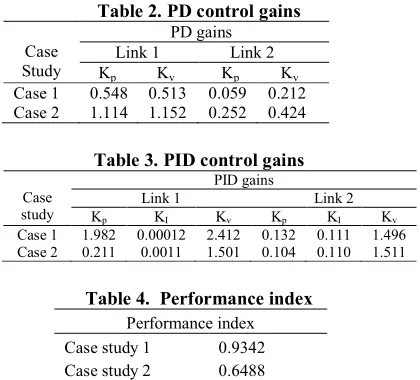
KI and KD must be tuned jointly. Also, Eriksson and Wikander [16] observed that manual tuning is still the most favoured method despite different types of tuning methods available. At certain point, the derivative of the link 2 PD controller has to be tuned to be able to further tune the link 1PD controller in order to obtain a satisfactory performance. This is because of the coupling effect in the system. The PD gains are shown in Table 2.
3.2 Stage 2.
After achieving a good motion tracking in stage one, then the PID controller the for link 1 is turned on and systematically tuned. Tuning the of the PID gains tend to degrade the perfect tracking initially obtained is stage 1. After some few trials the PID gains in table 3 are achieved.
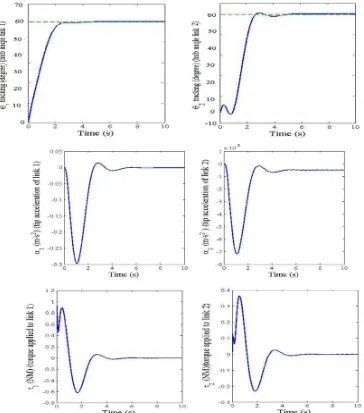
Results of the effect of these gains on link 1, link 2, and their performance indices are shown in fig. 3, 4 and 5 respectively. Two cases are presented from the tuning of the gains to investigate their effect on performance index. From the performance evaluation investigated and as shown in Table 4, it is observed that the proposed PD/PID control scheme is not different from other control strategies because there is always a trade off in the performance specification requirements. By comparing Fig. 3 and Fig.4, it was observed that if a smoother tracking is desired, the tradeoff will be in energy requirement by the actuators to achieve the task. It can be seen that the performance index in case study 1 is higher than that of case study 2 because of the extra energy required in obtaining the better tracking in case study 2. The overall performance of the proposed controllers is very good at different gain values as the performance indices in the two case studies are
Figure 3. Case study 1. The step Input response of the two-link flexible manipulator
Table 2. PD control gains
Case Study
PD gains
Link 1 Link 2
Kp Kv Kp Kv
Case 1 0.548 0.513 0.059 0.212
Case 2 1.114 1.152 0.252 0.424
Table 3. PID control gains
Case study
PID gains
Link 1 Link 2
Kp KI Kv Kp KI Kv
Case 1 1.982 0.00012 2.412 0.132 0.111 1.496 Case 2 0.211 0.0011 1.501 0.104 0.110 1.511
Table 4. Performance index
Performance index
Case study 1 0.9342
Case study 2 0.6488
CONCLUSSION
A PD/PID controller has been successfully designed for a two link flexible manipulator to track a step input trajectory and the links deflections and vibrations has been successfully controlled using a combination of PD and PID controllers. The designed controller was tested in Matlab/Simulink simulation environment. The Performance of the proposed controllers has also been investigated using a performance index. The results show that the proposed controllers are very efficient in the midst of the complexity imposed by the two link flexible manipulator.
REFERENCES
1. Dwivedy, S.K. and Eberhard, P. Dynamic
Analysis of Flexible Manipulators, A
Literature Review, Mechanism and Machine
Theory, vol. 41, no. 7, 2006, pp. 749-777.
2. Tokhi, M. O. and Azad, A. K. M. Flexible
Robot Manipulators -Modelling, Simulation and Control, Institution of Engineering and Technology, London, 2008.
3. Azad, A. K. M. Analysis and design of control
mechanisms for flexible manipulator systems, PhD thesis, Department of Automatic Control and Systems Engineering, The University of Sheffield, UK, 1994.
4. Poerwanto, H. Dynamic Simulation and
Control of flexible manipulator systems, PhD thesis, Department of Automatic Control and Systems Engineering, The University of Sheffield, UK, 1998.
5. Sutton, R. P., Halikias, G. D., Plummer A. R. and Wilson, D. A. Modelling and H ͚ control
of a single-link Flexible
Manipulator,Proceeding of the Instn Mech
Engrs, 1998, vol. 213 Part 1, pp. 85-104.
6. Mahamood M.R., Direct Adaptive Hybrid
PD-PID Controller for Two-Link Flexible Robotic Manipulator, Lecture Notes in Engineering and Computer Science: Proceedings of The
World Congress on Engineering and
Computer Science 2012, WCECS 2012, 24-26 October, 2012, San Francisco, USA, pp. 1127-1132
7. Ho, M. T. and Tu, Y. W. PID controller design
for a flexible link manipulator, Proceedings of
the 44th IEEE Conference on Decision and Control and European Control Conference,
2005, pp. 6841 – 6846.
8. Maouche, A.R. and Meddahi, H. Adaptive
Neural Control of a Two-Link Flexible Manipulator, Advances in Information Science and Computer Engineering, 2015, pp. 247-254.
9. Karagülle, H., Malgaca, L., Dirilmiş, M.,
Akdağ, M and Yavuz, Ş. Vibration control of
a two-link flexible manipulator, Journal of
Vibration and Control, 2015,
doi:10.1177/1077546315607694
10. Mahamood M.R. and Pedro J. O. Hybrid
PD/PID Controller Design for Two-Link Flexible Manipulators, Proceedings of the 8th
Asian Control Conference (ASCC),
Kaohsiung, Taiwan, 2011, pp. 1358-1363.
11. De Luca, A. and Panzieri, S. An iterative
scheme for learning gravity compensation in
flexible robot arms, Automatica, 1994, vol.
30(6), pp.993-1002.
12. Ang, K. H., Chong, G. and Li, Y. PID control
system analysis, design, and technology, IEEE
Transactions on Control Systems Technology,
Vol. 13, No. 4, 2005, pp. 559 – 576.
13. De Luca, A. and Siciliano, B. closed-form
dynamic model of planar multilink lightweight
robots, IEEE Transactions on Systems, Man
and Cybernetics, Vol. 21, No. 4, 1991, pp. 826 – 839.
14. R.M. Mahamood. (2014). Adaptive Controller
Design for Two-Link Flexible Manipulator. Transactions on Engineering Technologies. H.K.Kim (Haeng Kon Kim, Sio-Iong Ao, Mahyar A. Amouzegar, Burghard B. Rieger) et al.(eds) 115-128. Springer.
15. Yun L., Kiam, H.A. and Chong, G.C.Y.
(2006), "PID control system analysis and
design", Control Systems Magazine, IEEE,
vol. 26(1), pp. 32-41.
16. Eriksson, E. and Wikander, J. (2002), "Robust
PID design of flexible manipulators through
pole assignment", 2002.7th International
![Fig. 1. The Planar Two-Link Flexible Manipulator [14].](https://thumb-us.123doks.com/thumbv2/123dok_us/9958993.1984010/2.612.186.441.287.453/fig-the-planar-two-link-flexible-manipulator.webp)
![Fig. 2. The PD-PID controller structure for the manipulator [10].](https://thumb-us.123doks.com/thumbv2/123dok_us/9958993.1984010/3.612.141.473.601.711/fig-pd-pid-controller-structure-manipulator.webp)