Research Journal
Volume 8, No. 21, March 2014, pp. 13–17
DOI: 10.12913/22998624.1091872 Original Article
Received: 2013.11.22 Accepted: 2014.01.24 Published: 2014.03.05
DETECTION OF CHANGES OF THE SYSTEM TECHNICAL STATE USING
STOCHASTIC SUBSPACE OBSERVATION METHOD
Andrzej Puchalski1
1 University of Technology and Humanities in Radom, Malczewskiego 29, 26-600 Radom, Poland, e-mail:
ABSTRACT
System diagnostics based on vibroacoustics signals, carried out by means of stochas-tic subspace methods was undertaken in the hereby paper. Subspace methods are the ones based on numerical linear algebra tools. The considered solutions belong to diag-nostic methods according to data, leading to the generation of residuals allowing fail-ure recognition of elements and assemblies in machines and devices. The algorithm of diagnostics according to the subspace observation method was applied – in the paper – for the estimation of the valve system of the spark ignition engine.
Keyworda: system diagnostic, subspace method, vibroacoustic.
INTRODUCTION
The methods of identification of dynamic models by means of subspace, known from the control theory [1–4]: N4SID (Numerical Algo -rithms for Subspace State Space System IDen-tification), MOESP (Multivariable Output-Error State Space), CVA (Canonical Variate Analysis) or the method of principal components analysis (PCA) are also used for diagnostics of technical objects.
The idea of identification by subspace meth -ods is applied in structural health monitoring (SHM) [5]. The SHM range, aimed at improv-ing a broadly considered safety and at decreasimprov-ing maintenance costs, encompasses low-frequency methods originated from vibroacoustic diagnos-tics of machines, as well as high-frequency meth-ods (the so-called non-destructive inspections).
The condition monitoring is used in the au-tomotive and aircraft industry, power industry (mainly rotating machines) and in civil engineer -ing [6–10]. The result of the vibroacoustic analy-sis is often a modal model in a form of a natural frequencies set, damping ratios and mode shapes used in various detection procedures of structural defects based on these parameters.
Algorithms of vibroacoustic diagnostics of mechanical objects by subspace methods lead to the determination of the signature (pattern) of the system in a serviceable state [11–14]. This approach requires neither knowledge of modal parameters nor finite elements method (FEM) in relation to the identification of the system state.
Both direct measuring data and covariances of these data or impulse characteristics of inves-tigated systems can be used in constructing sub-space matrices. As the result of the decomposition of the subspace observation matrix the vectors of residuals – assessed as ‘null’ in a nominal (ser -viceable) state – are obtained.
BASIC PROBLEMS OF STOCHASTIC
FILTRATION OF EMPIRICAL DATA
The assessment method of vectors of residu-als, by means of the theory of local approach to the statistic identification of changes in dynamic systems, is used in the hereby paper [15–17].
and parameters space generating residual – is considered.
The subset of the parameters space in a nomi-nal state is marked as , while the subset of the parameters space in a damage state as . In
ad-dition: and .
It is assumed that the distance between the in-vestigated models or experiments, represented by the error vector:
(1)
is sufficiently small when the observation data re-cord N is large. The local approach to the identifi-cation of the nominal model means that the devia-tion of the error vector – determined by equadevia-tion (1) – is of the order of .
The statistics of diagnostics parameters con-structed on the basis of observation of the system in a serviceable state constitutes, in turn, grounds for formulating the zero hypothesis, which is test-ed against the alternative hypothesis, correspond-ing to small deviations of parameter values.
These assumptions allow to transfer the prob-lem of detection of changes in the system into the plane of investigating the expected value of the residual in a form of random vector of the nor-mal Gaussian distribution in a serviceable state as well as during further monitoring.
Applying generalized likelihood ratio (GLR) the rejection criterion of the verified hypothesis, in a form of the chi-square test with the assumed critical level for the given confidence interval, is obtained.
CONSTRUCTING THE SIGNATURE OF THE
VIBRATING STRUCTURES
The model of the linear mechanical system – given by equations [18] – is considered.
(2)
(3)
where: M, D, K, L are matrices of mass, damping, stiffness and monitored states filter – respectively,
q(t) is the displacement vector, f(t) is the external forces vector (modelled in a general case as the non-stationary Gaussian white noise) and y(t) is the vector of the monitored states.
Modes of the system (representing natural frequencies and damping ratios corresponding to them) are the solution of the equation:
(4) while mode shapes:
(5) satisfy the formula:
(6) Assuming forcing in a white noise form and discretising the above model with a sampling time T, the system description is obtained by means of differential equations of state and observations:
(7a) (7b) where:
, , (8)
,
– state vector, – response (ob-servation) vector in the k-ts sampling moment,
, , and represent white Gaussian noises of mean values being zero and covariance matrices and – respectively.
Discrete eigenvalues and eigenvectors ) of matrix A complying with the equations:
, (9)
represent the modal description for a continuous time, as follows:
, (10)
Equations (9) and (10) indicate that the matrix pair (A, C), and thus also the observability matrix of the system described by equations (7), allows to calculate modal parameters of the object.
The problem of detection of defects in a me-chanical system on the bases of vibration moni-toring is thus equivalent to the problem of analys-ing changes in the structure of its linear model of state variables with an unstable process noise.
Defining various ways of signature determi-nation and generation the investigated system residual will be the main subject of further con-siderations.
When the modal model is available, the signature of the nominal system
where .
In case of diagnostics of systems for which the modal model is not available, the observabil-ity matrix can be determined by means of singular value decomposition (SVD) of the Hankel matrix of covariances of experimental data ob-tained for the serviceable system.
In order to do this, the series of covariances of the output signals vector :
will be considered and the Hankel matrix of data covariances, for the selected constants p and q, will be defined as follows:
The empirical Hankel matrix is determined on the basis of the covariance estimator in a form:
Then the SVD of the Hankel matrix of data covariance is considered:
where and are
or-thogonal matrices, and is squared diagonal matrix of n – singular values of the Hankel matrix .
It is known, from the theory of realisation by subspace methods, that the observability matrix and the Hankel matrix are linked by the equation:
(15) where and is the matrix of a form resulting from the assumed identifica-tion algorithm. In addiidentifica-tion the observability ma-trix of the system is determined by:
(16)
Matrices and have the same left null space. The left null space determined for the observability matrix satisfies as-ymptotically – under serviceable conditions – the equation:
(17) for the empirical Hankel matrix .
DIAGNOSTICS PROCEDURE
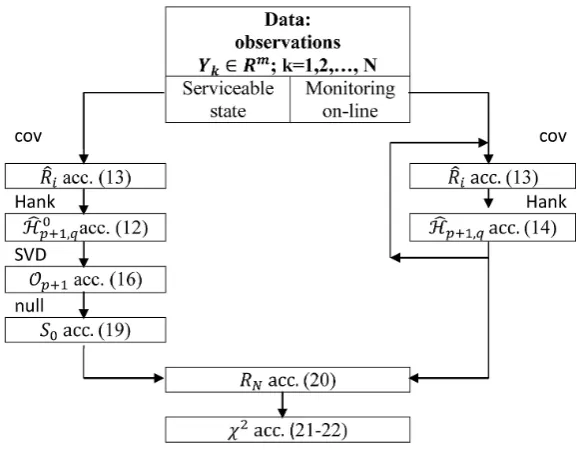
The described procedure can be presented in a form of the algorithm of the dynamic system diagnostics, based on the observed vibrations out-put signals:
• Step 1. To calculate of the averaged Hankel matrix of data covariance, on the basis of J data sets recorded under various working and environmental conditions of the serviceable system:
(18)
• Step 2. To perform SVD of the matrix according to equation (14).
• Step 3. To determine the observability matrix according to equation (16).
• Step 4. To determine the left null space of the observability matrix of the data ob-tained in the serviceable state:
(19)
• Step 5. To determine the residual vector in a form:
(20) for the empirical matrix obtained for
the current experimental data
• Step 6. To determine the estimator of the co-variance matrix of the residual vector , af-ter dividing data into K segments of the same dimension l acc. to:
(21)
• Step 7. To calculate the index of defects detec-tion in a form of the chi-square test:
(22)
The algorithm is illustrated in Figure 1 and verified on the example of data sets obtained in measurements of the acceleration of the IC en-gine head vibrations, at cylinder 1 in a horizontal direction.
The analysis was performed on the basis of the data originated from road tests of 4-cylinder IC engine of a cubic capacity 1.4 l and a mileage of 400 000 km described in details in [20, 21].
Data collections formed from the recorded and properly transformed vibration responses (11)
(12)
(13)
for closing the exhaust valve were utilised. Each observation contained 26 signal samples, record-ed at a constant rotational sperecord-ed of 3000 rpm, at states:
• Non-defective valve, a proper valve clearance (0.25 mm),
• Defective valve type I (valve head cut 3 mm), a proper valve clearance.
Values of detection indices in a form of
chi-square test of the discussed defects for the
successive observation collections of
non-de-fective and denon-de-fective systems are presented in
Figure 2.
CONCLUSIONS
The presented example of a non-parametric diagnostics method of the IC engine valve sys-tem, on the basis of data subspace, belongs to al-gorithms of filtration realised according to statis-tic properties. Original results of the acceleration vibrations signal, obtained in several road tests for various maintenance states of the valve sys-tem, proved the algorithm efficiency.
The analysis of results indicates the possibility of applying this method for fault detection and iso-lation. However, the method does not allow for de-fect identification, i.e. for the determination of its size and discriminating the reason of such a state. Fig. 1. Algorithm of the index determination for the monitored object
REFERENCES
1. Van Overshee P., De Moor B., Subspace Identifi -cation for Linear Systems. Theory – Implementa-tion – ApplicaImplementa-tions. Kluwer Academic Publishers,
Boston - London - Dordrecht 1996.
2. Katayama T., Subspace methods for system
identi-fication. Springer-Verlag, London 2005.
3. Huang B., Kadali R., Dynamic modeling, predictive control and performance monitoring. A data drive subspace approach. Springer-Verlag, London 2008. 4. Isermann R., Münchhof M., Identification of Dy
-namic Systems. Springer-Verlag, Berlin 2011.
5. Farrar Ch.R., Worden K., An introduction to struc-tural health monitoring. Phil. Trans. R. Soc. 365, 2006, 303-315.
6. Radkowski S., Wibroakustyczna diagnostyka
uszko-dzeń niskoenergetycznych. Wyd. ITE, Radom 2002.
7. Uhl T., The use and challenge of modal analysis in diagnostics. Diagnostyka, 30, 2004, 151-161, 8. Mendrok K., Uhl T., Maj W., Paćko P., SHM sys
-tem based on modal filtration. Key Engineering
Materials, 518, 2012, 289-297.
9. Dybała J., Vibrodiagnostics of gearboxes using
NBV-based classifiers: A pattern recognition ap -proach. Mechanical Systems and Signal Process-ing, 38, 2013, 5-22.
10. Zimroz R., Bartkowiak A., Two simple multivari -ate procedures for monitoring planetary gearboxes in non-stationary operating conditions. Mechanical Systems and Signal Processing, 38, 2013, 237-247. 11. Basseville M., Mevel M., Goursat M., Statistical model-based damage detection and localization: subspace-based residuals and damage-to-noise sensitivity ratios. Journal of Sound and Vibration, 275, 2004, 769-794.
12. Mevel L. at al., Input/output versus output-only
processing for structural identification-application to in-flight data analysis. Journal of Sound and Vi -bration, 295, 2006, 531-552.
13. Ding S.H. at al., Subspace method aided data-driv-en design of fault detection and isolation systems. Journal of Process Control, 19, 2009, 1496-1510. 14. Mevel L., Hermans L., Van Der Auweraer H.,
Ap-plication of a subspace-based fault detection meth-od to industrial structures. Mechanical Systems and Signal Processing, No.mssp.1999.1247, avail-able online at http://www.idealibrary.com
15. Pollard D., Some thoughts on LeCam’s statistical decision theory. Cornell University Library, 19 Jul 2011, arxiv.org/abs/1107.3811
16. Benveniste A., Basseville M., Moustakides G.V., The Asymptotic Local Approach to Change Detec-tion and Model ValidaDetec-tion, IEEE Trans. on
Auto-matic Control, 32(7), 1987, 583-592.
17. Benveniste A., Basseville M., Goursat M., Mevel L., The local approach to change detection, diag-nosis, and model validation: application to vibra-tion mechanics, 2006, www.irisa.fr/distribcom/ benveniste/pub/Ljung2006_birthday.html
18. Awrejcewicz J., Drgania deterministyczne układów dyskretnych. WNT, Warszawa 1996.
19. Basseville M., Abdelghani M., Benveniste A., Sub -space-based fault detection algorithms for vibra-tion monitoring. Automatica, 36, 2000, 101-109. 20. Komorska I. Vibroacoustic diagnostic model of
the vehicle driving system. Wydawnictwo
ITE-PIB, Radom 2011.
21. Puchalski A., Komorska I.: Application of
vibra-tion signal Kalman filtering to fault diagnostics of
engine exhaust valve. Journal of Vibroegineering,