Kinetics of Polymerization of Poly (Lactic Acid) under
Different Environments
Paramjit Kaur
Department of Chemistry,
Bebe Nanaki GNDU College, Mithra, Kapurthala, Punjab, INDIA. *Address correspondence to: email: [email protected]
(Received on: April 6, 2018)
ABSTRACT
The kinetics of ring opening polymerization of L- lactide to poly (lactic acid) using stannous octoate with and without triphenylphosphine has been investigated under nitrogen and vacuum. Modeling of polymerization process has also been carried out using a simple numerical technique to evaluate the rate constants. Comparison of the rate constants in presence and absence of triphenylphosphine under nitrogen and vacuum has revealed interesting results.
Keywords: Modeling and simulation, Polylactide, Kinetic rate constants. Stannous octoate, Triphenylphosphine.
INTRODUCTION
Poly (lactic acid), PLA is bio-degradable and thermoplastic polymer which can usually be made from renewable resources. Stannous octoate has been the most widely used initiator because of high reaction rates, the solubility in the monomer melt and the ability to produce high molecular weight polylactide (Swift 1993, Schwach etal., 1994, Cabaret etal., 2004). The addition of an equimolar amount of Lewis base, particularly triphenylphosphine into 2-ethylhexanoic acid, significantly enhances the lactide polymerization rate in bulk. Triphenylphosphine has two beneficial effects: it increases the polymerization rate and delays the occurrence of the undesirable back biting reactions at monomer/initiator ratios greater or equal to 5000 (Degee etal., 1999). So, we used triphenylphosphine as co-initiator to enhance the polymerization rate and molecular weight of polylactide. Molecular weight increased from thousands to several ten thousands.
the discrete variable of infinite range, the polymer chain length, by a continuous variable (Ray, 1972). The difference – differential equations become partial differential equations. (Bamford
etal., 1958, Bamford and Jenkins 1960, Bamford and Tompa, 1954) used this procedure in their analysis of vinyl (radical chain growth) polymerization. Analytical solutions were obtained by taking terms from the Taylor series expansion of the activated polymer concentration function. It has been found that the accuracy of approximation is very strongly dependent on the number of terms retained in the Taylor’s series expansion, as well as on the polymer chain length (Penczek et al., 1980). Falkovitz and Segal, (1982) concluded that at least a second- order approximation is required in these analyses.
For chain length independent rate constants, the kinetic equations for free radical polymerization have been exactly solved (Kumar and Gupta, 1998, Venkateshwaran and Kumar, 1992). For chain length dependent rate constants, a series solution has been developed (Sailaja and Kumar, 1995, 1997). It is shown that the various rate constants can be directly determined from the experimental data on molecular weight distribution. Also, if the monomer concentration as a function of reaction time is known, differential equations describing the generation of activated polymer specie become linear equations with time dependent coefficients and its series solution has been given in terms of monomer conversion (Sailaja and Kumar, 1995, 1997). The authors have used a technique similar to the finite element method for boundary problems to divide the conversion into sub domains. The size of these steps is decided by a convergence criterion and results were determined at the end of the conversion domain through sequential computation. Other numerical methods make the use of a steady-state assumption (or a stationary state assumption) (Bamford etal., 1958) that the concentration of ions increases initially, but almost instantaneously reaches a steady state value. This method also assumes that the rate of initiation is equal to the rate of termination. In slower polymerizations, as in the PLA synthesis, the validity of steady-state assumption is not justified. The ratios of various rate constants can be ascertained by careful experimentation. However, the determination of individual rate constants is a difficult task.
MATHEMATICAL MODELING OF THE PLA RING-OPENING POLYMERIZATION KINETICS
Modelled equations were solved on a PC using a simple numerical technique with a very small step size, has been reported by Mehta, (2006) and Mehta etal., (2005, 2007). It should be mentioned that steady state assumption has not been made in the present analysis. It was observed during the simulations that the molecular weight of polymer formed is more sensitive to kpthan kt for shorter reaction time whereas effect of kt is pronounced for prolonged
reaction time. The number average molecular weight, Mn, however, is not very sensitive to ko.
It is known that ratio of rate of initiation to sum of the rates of initiation, propagation and termination, affects the molecular weight distribution. Thus, kovalues were fine-tuned using
the dispersity (Mw/Mn) data, where Mw is the weight average molecular weight. The parameters
ko, kp and kt were selected from Mn and Mw vs polymerization time curves for different values
of rate constant parameters by comparing the simulated and experimental curves. The values giving a close fit were chosen. Thus the curve fitting was optimized by trial and error and model comparison was done by visual assessment. An average simulation took about 30 minutes for simulating polymerization on a 1.9 GHz Pentium 4 PC.
RESULT AND DISCUSSION
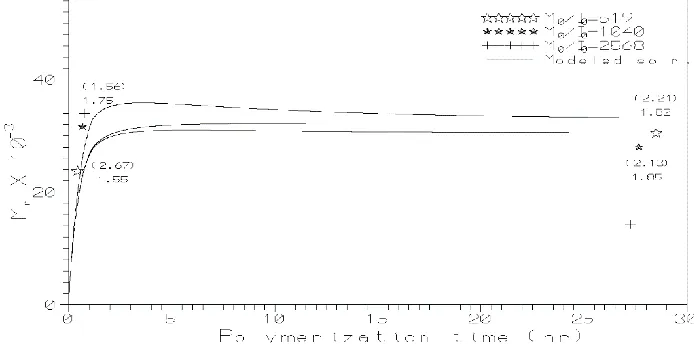
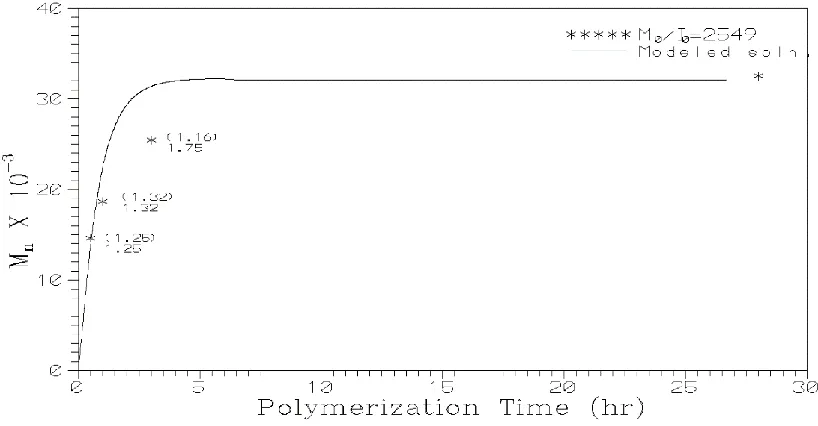
Figures 1 and 2 show the comparison of experimental and modeling results for stannous octoate and stannous octoate/ triphenylphosphine initiators under Nitrogen atmosphere, for different monomer to initiator ratio (M0/I0). Table 1 lists the summary of
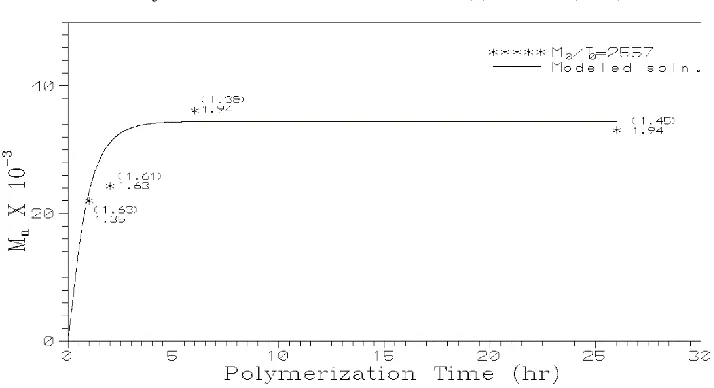
kinetic rate constants for various initiators. Figures 3 and 4 show the comparison of experimental and modeling results for stannous octoate and stannous octoate/ triphenylphosphine initiators under Vacuum, for single monomer to initiator ratio (M0/I0).
Figure 2 Comparison of experimental and modeling results (number average molecular weight) for the polymerization of l- lactide, using stannous octoate/triphenylphosphine initiator under Nitrogen atmosphere. The solid lines are the solutions obtained from the model and points are the experimental values.
Figure 4 Comparison of experimental and modeling results (number average molecular weight) for the polymerization of l - lactide, using stannous octoate/triphenylphosphine initiator under Vacuum. The solid lines are the solutions obtained from the model and points are the experimental values.
Table 1 Summary of rate constants (L/mol.min) for various initiators
S.No. Initiators ko
(l/mol.min)
kp
(l/mol.min)
kt (l/mol.min)
Atmosphere – Nitrogen, T = 130 (± 1) °C
1. Stannous Octoate 0.003 15 0.060
2. Stannous Octoate and Triphenylphosphine 0.200 15 0.023
Atmosphere – Vacuum, T = 130 (± 1) °C
3. Stannous Octoate 0.200 5 0.020
4. Stannous Octoate and Triphenylphosphine 0.200 5 0.020
On comparing the kinetic rate constants for the two initiators: stannous octoate and stannous octoate with triphenylphosphine (polymerization carried out under two different environments: nitrogen atmosphere and vacuum), few interesting observations are seen, The propagation rate constant, kp, is same for both the initiators. This means that the polymer chain
once initiated will grow at the same rate in both cases (also, there is an assumption in the analysis that the propagation rate constant is independent of the chain length).
The initiation rate constant, ko, is comparatively very less for pure stannous octoate
initiator (nitrogen atmosphere). This would also explain the high experimental values of Polydispersity Index (PD) (implying a very broad molecular weight distribution). The growing polymer chains will start and terminate at different time leading to a broad MWD. In contrast, for stannous octoate with triphenylphosphine initiator, the experimental PD is very less which would be a desirable attribute of this system.
For the vacuum atmosphere polymerizations, ko,is identical for both stannous octoate
provided in the reaction kettle somehow decreases the rate constant. The termination rate constant, kt, for pure stannous octoate initiator is about 2.6 time that for stannous octoate with
triphenylphosphine initiator. This could be the major reason for the difference in the average molecule weights achieved in PLA synthesis in the two cases. In case of vacuum, kt, is same
for both. In the case of stannous octoate with triphenylphosphine initiator there is an induction time up to about 2.5 hr. It is interesting to note that initially it was not possible to curve fit the data for any value of kp and kt. However, once the time axis was shifted by an amount up to
2.5 hr, an excellent fit was obtained for particular kp and kt. This induction time is possibly
due to the fact that the catalyst has to be thermally activated in the beginning of the polymerization in order to be effective.
For the vacuum atmosphere polymerizations, the induction time decreases. In both cases, the highest values of the average molecular weights are observed at initial monomer to initiator ratio of 2568. Thus, the polymerizations (vacuum atmosphere) were carried out only at this monomer to initiator ratio. The increase in molecular weights with increasing initial monomer to initiator ratio is because as this ratio increases, there will be fewer initiating sites for same number of monomer molecules and thus will lead to longer polymer chains. However, it is observed that at initial monomer to initiator ratio of 5068, the average molecular weights values fall dramatically. This could be because the numbers of initiating sites are reduced to such a level that chain termination by impurities or other molecules becomes significant and thus results in a lower chain length.
CONCLUSION
Comparison of polymerization kinetics has been done when the initiator used is stannous octoate with and without triphenylphosphine under two different environments: nitrogen atmosphere and vacuum at 130 (± 1) °C. It is interesting that even though higher molecular weight product is obtained in a shorter time period with the latter, the propagation rate constant is same for both cases.
In the case of stannous octoate with triphenylphosphine initiator there is an induction time up to about 2.5 h. It is interesting to note that initially it was not possible to curve fit the data for any value of kp and kt. However, once the time axis was shifted by an amount up to
2.5 h, an excellent fit was obtained for particular kp and kt. This induction time is possibly due
to the fact that the catalyst has to be thermally activated in the beginning of the polymerization in order to be effective.
For the vacuum atmosphere polymerizations, the induction time decreases. The termination rate constant is higher for stannous octoate as compared to the case when triphenylphosphine is also added to the polymerization kettle and this would lead to lower molecular weights under nitrogen atmosphere. In case of vacuum, kt, is same for both. Also,
stannous octoate and stannous octoate/triphenylphosphine. Thus, it is possible that the nitrogen atmosphere provided in the reaction kettle somehow decrease the rate constant.
There is always some water and other ionic impurities present on the monomer (lactide) which are detrimental to polymer chain growth. So, under vacuum or dry nitrogen atmosphere the experimental points are at low molecular weights because model assume zero or, no presence of water and other impurities because at high temperature in vacuum most of water and other impurities will be evaporated.
ACKNOWLEDGEMENT
The authors are grateful to the Naval Research Board for financial support of the research work.
REFERENCES
1. Bamford C. H., Tompa, H., The calculation of molecular weight distribution from kinetic schemes, Trans. Faraday Soc., 50: 1097-1115 (1954).
2. Bamford, C. H., Barb, W. G., Jenkins, A. D., Onyon, P. F., The Kinetics of Vinyl Polymerization by Radical Mechanisms, Academic Press, New York, (1958).
3. Bamford, C. H., Jenkins, A. D., The coupling of polymers. Part 1 - Size distributions and intrinsic viscosities, Trans. Faraday Soc., 56: 907-931 (1960).
4. Cabaret, O. D., Vaca, B. M., Bourissou, D., Controlled Ring-Opening Polymerization of Lactide and Glycolide,Chem. Rev., 104:6147-6176 (2004).
5. Degee, O., Dubois, P., Jacobsen, S., Fritz, S. G., Jerome, R., Beneficial effect of triphenylphosphine on the bulk polymerization of L, L- lactide promoted by 2-ethylhexanoic acid tin(II) salt, J. Polym. Sci. Part A: Polym. Chem., 37: 2413-2420 (1999). 6. Falkovitz, M. S., Segal, L. A., Some analytic results concerning the accuracy of the
continuous approximation in a polymerization problem, SIAMJ. Appl. Math., 42: 542-548 (1982).
7. Kumar, A., Gupta, R. K., Fundamentals of Polymers, McGraw-Hill International Edition, Singapore, (1998).
8. Mehta, R., PhD Thesis, Modeling and Simulation of Poly(lactic acid) polymerization, Thapar University, Patiala, (2006).
9. Mehta, R., Kumar, V., Upadhyay, S. N., Mathematical Modeling of the Poly(lactic acid) Ring–Opening Polymerization Kinetics, Polymer Plastic Technology and Engineering, 46: 257-264 (2007).
10. Mehta, R., Kumar, V., Upadhyay, S. N., Mathematical modeling of the poly (lactic acid) ring-opening polymerization using stannous octoate as a catalyst., Polymer Plastic Engineering and Technology, 46: 933-937 (2007).
11. Penczek, S., Kubisa, P., Matyjaszewski, K., Advances in Polymer Science 37 Springer-Verlag: New York, (1980).
13. Sailaja, R. R. N., Kumar, A., Semianalytical solution of irreversible anionic polymerization with unequal reactivity in batch reactors. Journal of Applied Polymer Science, 58: 1865-1876 (1995).
14. Sailaja, R. R. N., Kumar, A., Evaluation of rate constants from experimental batch reactor data for anionic polymerization of poly (methyl methacrylate) at high temperatures.
Journal of Applied Polymer Science, 65: 845-859 (1997).
15. Schwach, G., Coudane, J., Engel, R., Vert, M., Stannous-octoate versus zinc-initiated polymerization of racemic lactide-effect of configurational structure. Polymer Bulletin (Berlin), 32 (5-6), 617-623Swift, G., Acc. Chem. Res., 26: 105 (1994).