Research Journal
Volume 10, No. 30, June 2016, pages 164–175
DOI: 10.12913/22998624/62633 Research Article
SELECTION OF REFERENCE PLANE BY THE LEAST SQUARES FITTING
METHODS
Przemysław Podulka1
1 The Faculty of Mechanical Engineering and Aeronautics, Rzeszow University of Technology, Powstańców Warszawy 8, 35-959 Rzeszów, Poland, e-mail: [email protected]
ABSTRACT
There are many disadvantages affecting the accuracy of surface topography measure-ment and analysis. One of them are the errors obtained during data processing. Usu-ally surface topographies of car engine parts are studied after form removal. Many algorithms and procedures were developed and suggested. However, the selection of reference plane with accordance to surface topography measurements of cylindrical elements was not fully recognized. In this paper least square fitting methods (cylinder, polynomial) and commercial filters (Gaussian filter, Gaussian regression filter and ro-bust Gaussian regression filter) for areal form removal were compared and proposed. Three types of surfaces: cylinder liners after plateau-honing, plateau-honed cylinder liners with oil pockets created by burnishing techniques and turned piston skirts were analyzed. Distortion of surface topography parameters (from ISO 25178 standard) according to improper selection of reference plane was also taken into consideration. It was assumed that least squares fitted cylinder plane gave better results for both of type cylinder liners according to commonly used algorithm. However, for piston skirt surfaces the obtained results were very similar. For least squares polynomial fittings it was found that applied method for cylinder liners gave usually better robustness for scratches, valleys and dimples occurrence. For piston skirt surfaces better edge-filtering results were obtained. It was also recommended to analyse the Sk parameters for proper selection of reference plane in surface topography measurements.
Keywords: surface topography, reference plane, least squares fitting, cylinder fitting,
polynomial approximation, oil pockets, cylinder liners, piston skirts.
INTRODUCTION
There are the following kinds of measure
-ment uncertainty: errors typical for the measuring method [17, 21], errors caused by the digitisation process, errors obtained during data processing [9] and other errors [19]. Errors typical for sur
-face topography measurement using a stylus in
-strument were described in [16]. Surface topogra
-phy parameters are usually calculated afterwards form removal as a data evaluation process. There were many algorithms created and used for ex
-traction of surface texture properties. However, not many research concerns the influence of ref
-erence plane on the values of surface topography parameters [19].
Examples of filters encountered in surface topography measurement systems include me
-chanical, electrical and digital filtering [24]. For car engine cylinder liners and piston skirts, evalu
-ation of reference plane was often proposed by: cylinder fittings [8, 19], polynomial approxima
-tions [3, 9, 19, 24], plenty Gaussian filtering pro
-cedures (Gaussian filters [1, 4, 10, 13, 25, 27, 28], regression algorithms [1, 2, 4, 13], robust filter
-ing [1, 5, 6, 13, 18, 23]), spline filters [4, 13, 29], morphological methods [11, 13], wavelet decom
-positions [3, 13] and others [12, 13, 24].
One of the commonly used method is fitting a plane with geometrical shape. It was proposed to fit the cylinder plane by the least square methods [8, 13, 21]. It was found, that the application of
proposed for each type of surface [25]. The 2 and 3rd degree was selected for plateau-honed
cylinder liners with additionally burnished oil pockets, 3rd or 4th for cylinder liners after pla
-teau-honing and turned piston skirts. It was shown that higher (more than 4th) degree of the
polynomial caused a dissertation of surface to
-pography parameters. However, for piston skirt surfaces containing the curvatures, it was no
-ticed, that using the 4th degree of polynomial was
not a good solution. Therefore, the polynomials from 6th to 8th degree were recommended [19]. The change of the rough core Sk is interesting, especially for cylinder surfaces containing deep and wide valleys. Initially during an increase of the polynomial degree the Sk parameter de
-creased [19]. Improper estimation of Sk param
-eters is of great importance. It was found that oil emission by the engine was proportional to the core roughness Sk and cylinder wear under vari
-ous conditions was proportional to the emptiness coefficient Sp/Sz [14, 15]. Improper selection of reference planes can also cause wrong estima
-tion of dimple sizes [9].
and confirmed.
MATERIALS AND METHODS
In this paper three types of surfaces were analysed: cylinder liners after plateau-honing process (example in Figure 1a and 1d), plateau-honed cylinder liners with oil pockets created by burnishing techniques (Figure 1b and 1e) and turned piston skirts (see Figure 1c and 1f). More than 30 surfaces were analysed. They were mea
-sured by Talyscan 150 stylus equipment (nominal
tip radius about 2 μm, height resolution about 10 nm) and white light interferometer Talysurf CCI Lite with height resolution 0.01 nm.
Two types of the least square algorithms were proposed: cylinder and polynomial fittings. Algo
-rithms were created in Matlab environment (The MathWorks, Inc.).
The parameters from ISO 25178 standard were analysed (such as: root mean square height Sq, skewness Ssk, kurtosis Sku, maxi
-mum surface peak height Sp, maxi-mum valley
Fig. 1. Contour plots (a, b and c) and isometric views (d, e and f) of measured surface of: cylinder liner after
depth Sv, maximum height Sz, arithmetic mean height Sa, auto-correlation length Sal, texture-as
-pect ratio Str, texture direction Std, root mean square slope Sdq, interfacial area ratio Sdr, summit density Spd, arithmetic mean peak curvature Spc) with particular attention to Sk group parameters (reduced summit height Spk, reduced valley depth Svk, core roughness depth Sk, upper bearing area Sr1 and lower bearing area Sr2).
LEAST SQUARE FITTING ALGORITHMS FOR THE REFERENCE PLANE SELECTION
For selection of reference plane two least square fitting procedures were proposed. Firstly, the al
-gorithm of cylinder fitting was created and applied. Secondly, the polynomial least square fitted plane of n-th order was recommended. In this part the mathematical aspects of suggested procedures were presented.
Cylinder fitting by the least square method
For functional textures, form elimination seems to be a better alternative to digital filtration [19]. One of the form removal method is the least square fitting a cylinder plane [8, 21].
The cylinder plane is defined by [8, 13]:
• a points (xo, yo, zo) on the axis,
• a vector (a, b, c) pointing along the axis and its radius r.
For fitting process, the distance from a point (xi, yi, zi) to a cylinder need to be found. It is defined as [8]:
di = ri – r (1)
where:
(2)
with:
u(i) = c(y(i)–yc ) – b(z(i)–zc) (3) ν(i) = a(z(i)–zc ) – c(x(i)–xc) (4) w(i) = b(x(i)–xc ) – a(y(i)–yc) (5) The objective function is given by [13]:
(6)
Than the objective function is linearized to:
(7)
and solve the resulting system of n equations in seven variables expressed in the form JP = −D or (JTJ+λRTR)P = −JTD, as the case may be [13]. The matrices J, P, and D are given by:
(10)
The optimization process is usually given by Gauss-Newton algorithm [7, 8].
Least square fitted polynomial plane of n-th order
The least square n-th order polynomial surface is expressed as [24]:
(11)
For example a second order quadratic polynomial surface [23] would involve all the items of the first three columns of Table 1, that is:
f(x,y)=a00+a10x+a01y+a20x2+a
11xy+a02y
2 (12)
The sum of the surface asperity departures from this polynomial plane was given by [24]:
(13)
For simplicity of analysis, that was assumed:
qp = z(xk,yl), gp = f(xk,yl), up = x(p-[p/M]∙M) = xk, νp = y[p/M+1] = yl (14)
where: p = (l-1)M+k and [.] means that the integer part of the result was taken. Thus, the final result from equation (13) was rewritten as [24]:
(15)
and the normal equations of the least squares problem, was expressed in matrix form as:
[ν]
T[ν]{A} = [ν]
T{Q}
(16)where:
Table 1. Elements of polynomial surfaces
n
i=0 i=1 i=2 i=3 i=4
j=0 1 x x2 x3 x4
j=1 y xy x2y x3y
j=2 y2 xy2 x2y2
j=3 y3 xy3
j=4 y4
Then the Gauss-Jordan elimination can be easily employed [22] and equation (16) can be solved as the follows:
{A}= ([ν]
T[ν])[ν]
T{Q}
(18)These two least square procedures were elab
-orated in Matlab environment and applied for ar
-eal form removal in cylinder liner and piston skirt surface analysis.
RESULTS AND DISCUSSIONS
Cylinder liners after plateau-honing process
For cylinder liner surfaces after plateau-hon
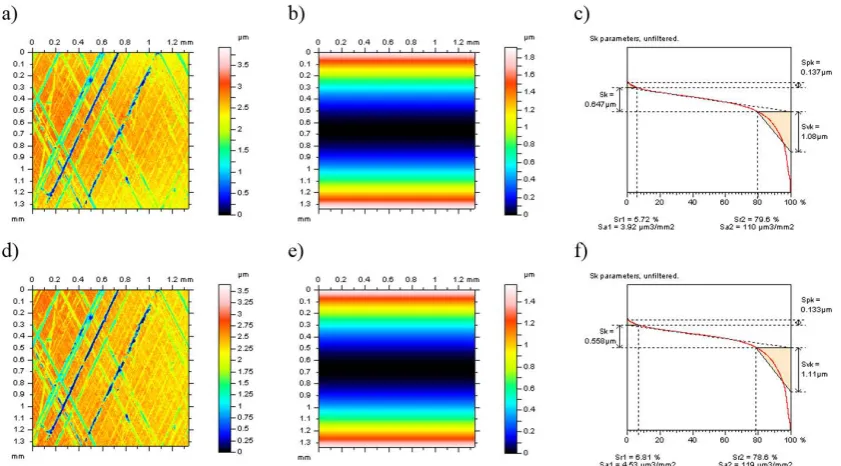
-ing treatment the commonly used algorithm for cylinder form removal did not allow to select the reference plane correctly. The surface curvature was not fully removed (see Figure 2a).
For least square fitted cylinder plane it was found that values of Sk and Spk parameters de
-creased while Svk parameter value in-creased according to generally used algorithm (Figure 2c and 2f). The Sz parameter values has also de
-creased (Table 2).
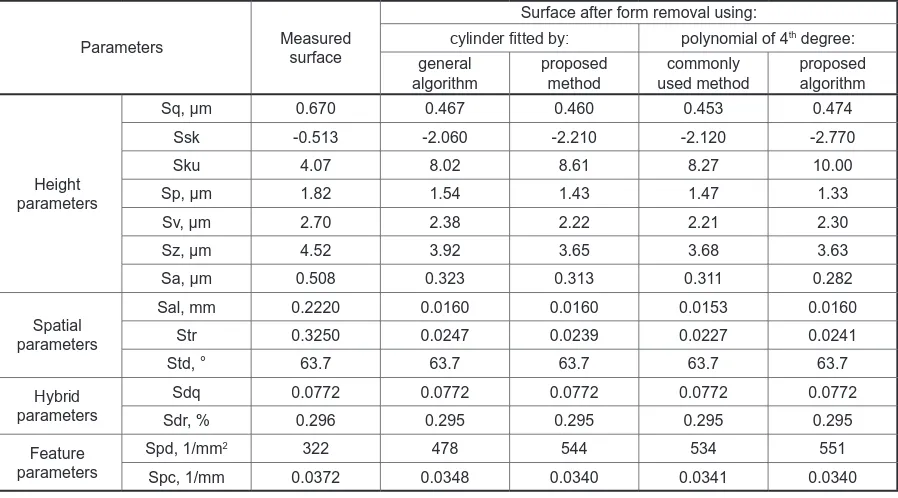
For cylinder fitted by proposed procedure, height parameters Sq, Sp, Sv, Sz as well as Sa decreased, but skewness Ssk and kurtosis Sku in
-creased according to generally used algorithm. Spatial parameter texture-aspect ratio Str de
-creased but auto-correlation length Sal and tex
-ture direction Std were not changed as well as hybrid parameters Sdq and Sdr.
For application of polynomial of 4th degree
form removal, the difference in Sz parameters value was not found so clearly. However, Sk pa
-rameter decrease by about 22%, Spk by about 16% while Svk parameter increased by around 7% (Figure 3c and 3f). Moreover, the least square fitting procedure was particularly more robust for valleys and scratches occurrence.
For the proposed procedure, due to gener
-ally used algorithm, application of 4th degree
of polynomial resulted in an increase of height parameters Sq, Ssk and Sku but decrease of Sp, Sv, Sz and Sa parameters. The values of spa
-tial parameter Std was equal but Sal and Str parameters increased. The differences of val
-ues of hybrid parameters Sdq and Sdr were not found (see Table 2).
For proposed algorithms (cylinder and poly
-nomial) peak density Spd increased but peak
Fig. 2. Contour plots of surface after form removal (a, d); removed form (b, e); material ratio curve (c, f) of
curvature Spc decreased and for polynomial ap
-proximation differences of Spc parameter were negligible.
Least square fitted cylinder and polyno
-mial planes seem to give more effective solu
-tions for areal form removal of plateau-honed cylinder liners according to generally used al
-gorithms.
Plateau-honed cylinder liners with additionally burnished oil pockets
Is was noticed that the application of com
-monly used algorithm for cylinder fitting did not allow to correctly eliminate the form from the results of surface topography measurements of plateau-honed cylinder liners with additionally added oil pockets (see Figure 4a).
Fig. 3. Contour plots of surface after form removal (a, d); removed form (b, e); material ratio curve (c, f) of
cyl-inder liner after plateau-honing process and after form removal by: generally used 4th degree of polynomial (a, b and c), proposed least squares polynomial fitting procedure (d, e and f)
Table 2. Surface topography parameters of cylinder liner after plateau-honing for cylinder and polynomial of 4th
degree form removal
Parameters Measured surface
Surface after form removal using:
cylinder fitted by: polynomial of 4th degree:
general algorithm
proposed method
commonly used method
proposed algorithm
Height parameters
Sq, µm 0.670 0.467 0.460 0.453 0.474
Ssk -0.513 -2.060 -2.210 -2.120 -2.770
Sku 4.07 8.02 8.61 8.27 10.00
Sp, µm 1.82 1.54 1.43 1.47 1.33
Sv, µm 2.70 2.38 2.22 2.21 2.30
Sz, µm 4.52 3.92 3.65 3.68 3.63
Sa, µm 0.508 0.323 0.313 0.311 0.282
Spatial parameters
Sal, mm 0.2220 0.0160 0.0160 0.0153 0.0160
Str 0.3250 0.0247 0.0239 0.0227 0.0241
Std, ° 63.7 63.7 63.7 63.7 63.7
Hybrid
parameters
Sdq 0.0772 0.0772 0.0772 0.0772 0.0772
Sdr, % 0.296 0.295 0.295 0.295 0.295
Feature parameters
Spd, 1/mm2 322 478 544 534 551
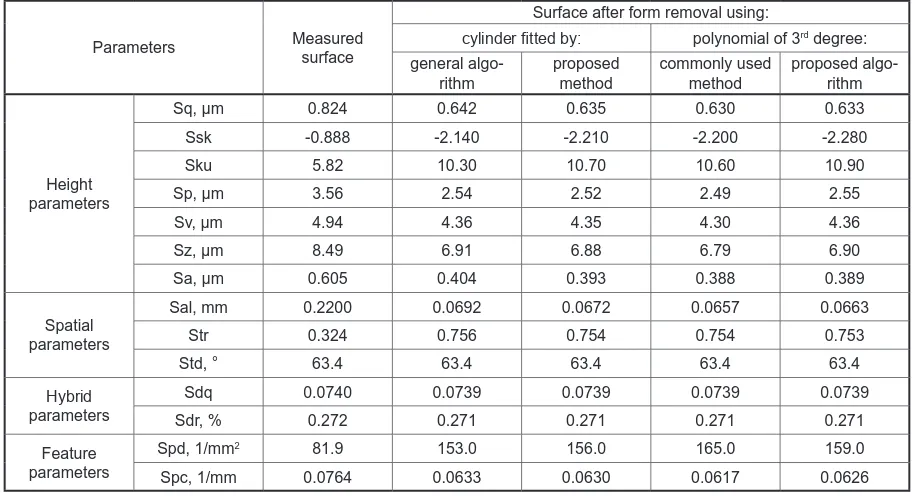
It was also found that proposed method of cylinder form removal resulted in a decrease of Sk and Spk parameter values by 16% and 3% re
-spectively.
The height parameters Sq, Sp, Sv, Sz and Sa decreased with the proposed procedure but kurtosis Sku and skewness Ssk (equally as for cylinder liners without oil pockets) increased 3% and 4% respectively. Spatial parameters
Str and Std did not change or the difference was slight but Sal parameter decreased 3% (see Table 3). Hybrid parameters (Sdq and Sdr) have not changed. Feature parameter Spd increased while peak curvature Spc decreased according to commonly used algorithm of cyl
-inder fitting.
Application of 3rd degree polynomial least
square fitted plane caused the following changes
Fig. 4. Surface contour plots (a, d), removed form (b, e) and material ratio curve (c, f) of plateau-honed
cylin-der liner surface with oil pockets created by burnishing techniques after form removal by: general algorithm of cylinder fitting (a, b and c) and cylinder fitted by proposed method (d, e and f)
Table 3. Surface topography parameters of plateau-honed cylinder liner with burnished oil pockets for cylinder
and polynomial of 3rd degree form removal
Parameters Measured surface
Surface after form removal using:
cylinder fitted by: polynomial of 3rd degree:
general algo-rithm
proposed method
commonly used method
proposed algo-rithm
Height parameters
Sq, µm 0.824 0.642 0.635 0.630 0.633
Ssk -0.888 -2.140 -2.210 -2.200 -2.280
Sku 5.82 10.30 10.70 10.60 10.90
Sp, µm 3.56 2.54 2.52 2.49 2.55
Sv, µm 4.94 4.36 4.35 4.30 4.36
Sz, µm 8.49 6.91 6.88 6.79 6.90
Sa, µm 0.605 0.404 0.393 0.388 0.389
Spatial parameters
Sal, mm 0.2200 0.0692 0.0672 0.0657 0.0663
Str 0.324 0.756 0.754 0.754 0.753
Std, ° 63.4 63.4 63.4 63.4 63.4
Hybrid
parameters
Sdq 0.0740 0.0739 0.0739 0.0739 0.0739
Sdr, % 0.272 0.271 0.271 0.271 0.271
Feature parameters
Spd, 1/mm2 81.9 153.0 156.0 165.0 159.0
(according to generally used procedure) of pa
-rameters values: decrease of Sk and Spk param
-eters when Svk parameter increased (see Figure 5c and 5f).
It was similar for plateau-honed cylinder lin
-ers that usage of the least square fitted polyno
-mial plane resulted in increasing Sq, Ssk, Sku and Sv parameters. For cylinder liners contain
-ing additionally burnished dimples Sp, Sz and Sa
parameters also increased (Table 3). The differ
-ence in values of spatial parameters Str and Std was negligible or equal to zero. Sal parameter increased in contrast to the plateau-honed cyl
-inder liners. Hybrid parameters (Sdq, Sdr) have not changed repeatedly (to compare see Table 2 and Table 3). For feature parameters peak den
-sity Spd decreased 4% and peak curvature Spc increased from 1 to 2%.
Fig. 5. Contour plots of surface after form removal (a, d); removed form (b, e); material ratio curve (c, f) of
cyl-inder liner after plateau-honing process with additionally added oil pockets and after form removal by 3rd degree of polynomial fitted by algorithm: generally used (a, b and c), proposed (d, e and f)
Table 4. Surface topography parameters of plateau-honed cylinder liner with additionally burnished oil pockets
for various form removal
Parameters Measured surface
Surface after form removal using:
proposed procedure of:
Gaussian filter gression filterGaussian re- robust Gaussian regression filter
cylinder
fitting polynomial of 3rd degree
Height parameters
Sq, µm 0.824 0.635 0.633 0.620 0.600 0.638
Ssk -0.888 -2.210 -2.280 -1.840 -2.140 -2.360
Sku 5.82 10.70 10.90 9.67 10.70 11.10
Sp, µm 3.56 2.52 2.55 2.79 2.46 2.60
Sv, µm 4.94 4.35 4.36 4.31 4.20 4.36
Sz, µm 8.49 6.88 6.90 7.10 6.67 6.97
Sa, µm 0.605 0.393 0.389 0.379 0.362 0.392
Spatial parameters
Sal, mm 0.2200 0.0672 0.0663 0.0662 0.0630 0.0680
Str 0.324 0.754 0.753 0.772 0.744 0.753
Std, ° 63.4 63.4 63.4 63.4 63.4 63.4
Hybrid
parameters
Sdq 0.0740 0.0739 0.0739 0.0583 0.0491 0.0739
Sdr, % 0.272 0.271 0.271 0.169 0.120 0.271
Feature parameters
Spd, 1/mm2 81.9 156.0 159.0 70.2 52.9 154.0
For plateau-honed cylinder liners with added oil pockets, robust filters are recommended. Pro
-posed least square procedures were compared with various Gaussian filtering (general Gaussian filter, Gaussian regression filter and robust Gauss
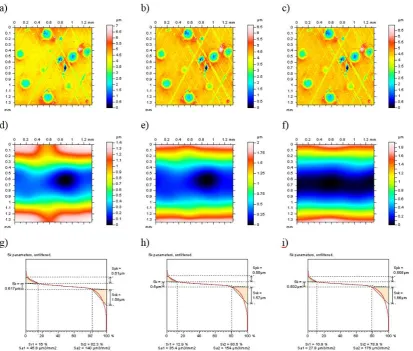
-ian filter) for fitting the best reference plane. The difference of various Gaussian filtering (with λc equal to 0.8 mm) was showed in Figure 6. It was obvious that regression filter gave better results in the edge-filtering than regular Gaussian filter. Moreover, application of robust filter caused a smaller distortion of surface topography param
-eters according to oil pockets occurrence.
Generally used Gaussian filter did not allow to remove form properly. The edge-filtering prob
-lems were not solved and the reference plane was falsely estimated. Better results were obtained when regression filter was applied. Core rough
-ness Sk parameter has reached the minimum val
-ue after regression filtering but difference accord
-ing to robust filter-ing was very small about 0.4% (see Figure 6h and 6i). However, the value of re
-duced summit height Spk parameter was higher for regression filter about 7.5% due to robust fil
-tering results.
It was found that reference planes obtained by regular Gaussian filter and regression filtering were wrong approximated when oil pockets and deep valleys were located close to each other (see Figure 6e). Moreover, the minor difference of Spk parameter values was received after robust filter
-ing and application of 2nd degree of polynomial
(to compare see Figure 5f and 6i). Slight varia
-tion was also found for feature parameters (Table 4) but for hybrid parameters difference was not noticed. The values of some spatial parameters (Str and Std) were similar after application of pro
-posed polynomial fitting procedure according to robust filtering, but the value of auto-correlation length parameter (Sal) was bigger.
It was found that selection of reference planes by Gaussian filter and regression filter
-ing can cause wrong estimation of dimple sizes. For height parameters, the differences of values
Fig. 6. Surface contour plots of plateau-honed cylinder liner with additionally added oil pockets after form removal
were larger for Gaussian filter and regression fil
-ter in accordance with proposed procedures and robust filter.
Turned piston skirts
Application of least square fitted cylinder plane in areal form removal gave similar results as commonly used cylinder algorithm. Usage the Gaussian filtering methods (regular Gaussian fil
-ter, regression filtering and robust filter) have not given desired results. It was suggested to compare the commonly used polynomial approximation method with proposed procedure of least square polynomial fittings.
It was noticed (Figure 7a and 7d) that pro
-posed procedure for 4th degree of polynomial
gave better results in the edges of analysed sur
-face (form was removed more effectively). The distortion of Sk parameter (expressed in percent
-age) was smaller than Spk and Svk parameters (see Figure 7c and 7f).
For 3rd degree of polynomial fitted by pro
-posed procedure, the height parameters skewness Ssk and maximum peak height Sp, were severely distorted in accordance with polynomial of 4th
de-gree (see Table 5). Higher dede-gree (4th) of polyno
-mial gave better results in Sk group parameters analysis (Figure 7c and 7f). For proposed proce
-dure Sk parameter decreased.
For each type of reference plane (3rd or 4th
degree of polynomial approximation) all height parameters decreased except the skewness pa
-rameter Ssk according to the measured surface. From spatial parameters Std was not changed but Sal and Str decreased. For both types of 3rd
de-gree polynomial approximation and for the 4th degree of least square fitted polynomial plane, the resulting values of auto-correlation length and texture-aspect ratio parameters were constant, but for generally used 4th degree of polynomial the
values were smaller by about 8%. Hybrid param
-eters Sdq and Sdr were constant for all the refer
-ence plane suggested.
Peak curvature Spc parameter increased when the degree of polynomial increased also. The value of peak density Spd parameter was invariable ex
-cept generally applied polynomial of 4th degree. For piston skirt surfaces it is recommended to select the reference plane by application of 4th degree of polynomial plane fitted by the proposed method. In some cases the surface topography fil
-tering of piston skirts is more edge-selected when the least square procedure is applied.
CONCLUSIONS
1. Selection of reference plane by application of the least square cylinder fitting procedure
Height
parameters Sp, µm 12.7 11.5 11.8 11.4 11.3
Sv, µm 18.1 12.1 11.9 12.8 12.1
Sz, µm 30.9 23.7 23.6 24.2 23.4
Sa, µm 4.28 3.69 3.73 3.64 3.72
Spatial parameters
Sal, mm 0.0705 0.0509 0.0509 0.0470 0.0509
Str 0.0922 0.0546 0.0546 0.0504 0.0546
Std, ° 90 90 90 90 90
Hybrid
parameters
Sdq 0.132 0.131 0.131 0.131 0.131
Sdr, % 0.859 0.848 0.848 0.849 0.848
Feature parameters
Spd, 1/mm2 4.00 9.00 9.00 8.75 9.00
gave better results for both types of cylinder liners (after plateau-honing and plateau-honed with additionally added oil pockets). For pis
-ton skirt surfaces obtained results were very similar for commonly used algorithm.
2. Applying of polynomial least square fitting method for all three types of surfaces provid
-ed a noticeable improvement. For piston skirt surfaces this method gave usually better edge-results in surface topography form removal. For cylinder liners, this technique provided higher robustness for valley occurrence. 3. According to Gaussian filter and Gaussian
regression filter, polynomial least square fit
-ting algorithm improved encouraging results. However, proposed procedure brought neg
-ligible effects for all three types of measured parts due to robust Gaussian regression filter. 4. It is suggested to select the reference plane
along with surface topography parameters analysis. Least square fitting methods not always gave better results due to minimiza
-tion of the distor-tion of parameter values. For proper selection of reference plane, the Sk pa
-rameters should be mandatory analyzed. 5. For further research robust Gaussian regres
-sion filter as well as polynomial least-square fitting method are recommended for areal form removal in surface topography measure
-ment. It is substantial to select the reference plane by these two methods instead of ordi
-nary Gaussian filtering.
Acknowledgements
This paper was prepared with financial sup
-port from the project no. 2013/09/N/ST8/04333 from National Science Center.
REFERENCES
1. Brinkman S., Bodschwinna H.: Advanced Gauss-ian Filters in Advanced Techniques for Assessment Surface Topography, Elsevier, 2000.
2. Brinkmann S., Bodschwinna H., Lemke H.-W.: Ac-cessing roughness in three-dimensions using Gauss-ian regression filtering, International Journal of Ma-chine Tools & Manufacture 41, 2001, 2153–2161. 3. De Chiffre L., Lonardo P., Trumpold H., Lucca
D.A., Goch G., Brown C.A., Raja J., Hansen H.N.: Quantitative Characterisation of Surface Texture, CIRP Annals - Manufacturing Technology, 2000 2, 635–642, 644–652.
4. Dobrzański P., Pawlus P.: Digital filtering of sur-face topography Part I. Separation of one-process surface roughness and waviness. Precision Engi-neering 34, 2010, 647–650.
5. Dobrzański P., Pawlus P.: Digital filtering of sur-face topography: Part II. Applications of robust and
Fig. 7. Contour plots of surface after form removal (a, d); removed form (b, e); material ratio curve (c, f) of
1989.
9. Grabon W., Pawlus P., Galda L., Dzierwa A., Pod-ulka P.: Problems of surface topography with oil pockets analysis, Journal of Physics: Conference Series, 2011, 311 012023.
10. Janecki D.: Gaussian filters with profile extrapola-tion, Precision Engineering 4, 2011, 602–606. 11. Lou S., Jiang X., Scott P.J.: Applications of
mor-phological operations in surface metrology and di-mensional metrology. Journal of Physics: Confer-ence Series, 2014, 483 012020.
12. Mainsah E., Greenwood J. A., Chetwynd D. G.: Metrology and Properties of Engineering Surfaces, Springer, 2001.
13. Muralikrishnan B., Raja J.: Computational surface and roundness metrology, Springer, 2009.
14. Pawlus, P.: A study on the functional properties of honed cylinder surface during running-in. Wear, 176, 1994, 247–254.
15. Pawlus, P.: Effects of honed cylinder surface topog-raphy on the wear of piston-piston ring-cylinder as-semblies under artificially increased dustiness con-ditions. Tribology International, 26, 1993, 49–56. 16. Pawlus, P.: The errors of surface topography
mea-surement using stylus instruments. Metrology and Measurement Systems, 3, 2002, 273–289.
17. Pawlus P., Reizer R., Podulka P., Dobrzanski P.: Comparison of surface topography measurements obtained with optical and stylus methods, Proc. of XIth Intern. Scientific Conference on Coordinate
Measuring Technique CMT 2014, Bielsko Biała, 124–130.
18. Podulka P., Dobrzański P., Pawlus P.: Selection of reference plane by application of robust Gaussian
of Physics: Conference Series, 2014, 483 012025. 21. Podulka P., Pawlus P., Dobrzański P., Reizer R.:
Areal form removal by cylinder fitting, Proceed-ings of XIth International Scientific Conference on Coordinate Measuring Technique CMT 2014, Biel-sko Biała, 145–149.
22. Press P.H., Teukolski S.A., Wetterling W.T., Flan-nery B.P.: Nemerical Recipes. Cambridge Univer-sity Press, Cambridge, 1992.
23. Rosen B-G., Anderberg C., Ohlsson R.: Parameter correlation study of cylinder liner roughness for pro-duction and quality control. Proceedings of the Insti-tution of Mechanical Engineers, Part B: Journal of Engineering Manufacture, 222, 2008, 1475– 1487. 24. Sullivan P.J.: Surface topography filtering in:
Me-trology and Properties of Engineering Surfaces, Springer, 2001.
25. Stout K.J., Sullivan P.J., Dong W.P., Mainsah E., Luo N., Mathia T., Zahouani H.: The development of methods for the characterisation of roughness in three dimensions. Publication EUR 15178 EN Commission of the European Communities, 1993. 26. Whitehouse D.J.: Handbook of Surface and
Nano-metrology, CRC Press, 2010.
27. Yuan Y.-B., Qiang X.-F., Song J.-F., Vorburger T.V.: A fast algorithm for determining the Gaussian filtered mean line in surface metrology, Precision Engineering, 1, 2000, 62–69.
28. Yuan Y.-B, Piao W.-Y., Xu J.-B.: A fast Gaussian filtering algorithm for three-dimensional surface roughness measurements, Journal of Physics: Con-ference Series, 2006, 48 1401–1406.