Pneumococcal Hemolysin*
CLARE N. SHUMWAY
Department of Pediatrics,
Medical College of Virginia,
Richmond, 23219
Diplococcus pneumoniae elaborates a heat labile substance capable of lysing rabbit erythrocytes in vitro and in vivo (Shumway and Pollock, 1965). It has been suggested (Shumway and Pollock, 1965) that this substance may be responsible for the hemolytic anemia which occurs in rabbits with pneumococcal septicemia (Shumway, 1958) but proof for this hypothesis is still lacking.
The purposes of this report are to describe a method of preparing a potent crude pneumococcal hemolysin, to define some of its characteristics, and to describe the effects of its administration to rabbits.
Methods
Preparation of Crude Hemolysin
The microorganism utilized in these studies was a strain of Diplococcus pneumoniae, type 1, kindly sup-plied by Herbert Morgan. As the microorganism grows in glucose-enriched brain-heart infusion broth, it elaborates a hemolysin which can be precipitated from the supernatant broth by ammonium sulfate. Because early investigations suggested that the hemoly-sin was an endotoxin (Cole, 1914), attempts were made to extract the hemolytic substance from bacterial cells rather than from the supernatant broth. Pre-liminary studies disclosed that hemolytically active extracts could be obtained when the bacteria were disrupted enzymatically with lysozyme, osmotically with distilled water, or mechanically with glass beads or high frequency sound. Sonic disintegration proved to be the simplest and most efficient method of cell disruption.
A potent crude hemolysin was prepared in the fol-lowing manner: Three liters of brain-heart infusion broth (Difeo) containing glucose in a final concentra-tion of 500 mg/100 ml was inoculated with 300 ml of
*
This study was supported by US Public Health Ser-vice Grant Al 03154-04 from the National Institute of Allergy and Infectious Disease and by Institutional Re-search Grant SO 1 FR05430. The author thanks D. Pol -lock for technical assistance.a 6 to 8 hr broth culture of Diplococcus pneu-moniae, type 1. The broth was maintained at 37 C in an atmosphere of nitrogen and was mixed con-tinuously with a magnetic stirrer. Aliquots were with-drawn at 30 to 60 min intervals to measure turbidity at 650 m,u., pH and glucose concentration. The pH, which decreased rapidly during the logarithmic phase of bacterial growth, was maintained between 7.0 and 7.5 by the gradual addition of sterile 5N sodium car-bonate. Glucose concentration was maintained be-tween 400 and 600 mg/100 ml by the addition of sterile 50% glucose solution. When the optical density of the culture reached its maximum ( 6-8 hr) the broth was placed at 4 C under nitrogen for 18 hr. It was then centrifuged at 18,000 G in a continuous flow system; this centrifugation and all subsequent manipulations were carried out at 5 C.
The sedimented bacteria were suspended in approx-imately two volumes of cold distilled water and sub-jected to high frequency sound (Branson Model S-75 Sonifier at full power) for a total of 10 min. The sonication was carried out at 1 min intervals so that the temperature of the bacterial suspension did not rise above 10 C. The material was then centrifuged at 18,000 G for 30 min, and the supernate, which con-tained the hemolysin, was removed and frozen at
its potency for at least 5 years. When it was stored in solution at room temperature for 8 days, there was a four-fold reduction in its hemolytic activity; when stored in solution at -20 C for 12 months, there was a 16-fold reduction in its activity. In the latter instance, part of its activity could be restored by the addition of 0.4 M cysteine.
Hemolysin Assay
Maximal lysis of either human or rabbit erythrocytes by the hemolysin occurred within 60 min at 37 C. Two methods of quantitation were used for the studies to be reported here. The first involved the addition of 0.5 ml of a known dilution of the hemolysin to 1 ml of a 50% suspension of thrice washed rabbit or human erythrocytes in isotonic sodium chloride solution; this mixture was incubated for 60 min at 37 C, centrifuged at 3000 G for 5· min, and the amount of hemoglobin released into the supernatant solution was measured spectrophotometrically. Results were expressed as per-centage of red cells lysed. This method was satis-factory for much of the early work where gross differences of hemolysis were evident, but when dif-ferences were more subtle, a more sensitive method of assay was needed.
For this latter purpose, serial dilutions of the hemolysin were made in 0.85% sodium chloride so-lution. One ml of a 3 % suspension of thrice washed human or rabbit erythrocytes in isotonic saline was added to an equal volume of each dilution of hemoly-sin. The tubes containing these mixtures were mixed thoroughly and incubated for 60 min at 37 C. After incubation, the contents of the tubes were mixed again, centrifuged at 2000 G for 2 min, and the degree of hemolysis graded on a scale of from 0 to
4+ (complete hemolysis). Results using this method were reproducible within one tube dilution.
Hemolysin Inhibition Titer
Two-fold serial dilutions of the serum under investi-gation were made using 0.85% sodium chloride as dilu-ent. Five-tenths milliliter of each serum dilution was mixed with 0.5 ml of diluted hemolysin; the concen-tration of hemolysin used was one tube dilution less than that dilution which produced complete lysis of the standard red cell suspension. After the mixtures of serum and hemolysin had been incubated at 37 C for 15 min, 1 ml of a 3% suspension of washed rabbit erythrocytes was added to each tube. The contents of the tubes were thoroughly mixed, incubated at 37 C for 60 min, centrifuged at 3000 G for 2 min, and examined for hemolysis. The highest dilution of serum which completely inhibited hemolysis under these conditions was termed the "hemolysin inhibition titer." Results were reproducible from day to day within two tube dilutions, but whenever two or more sera were compared they were analyzed simultaneously.
70
TABLE I
Effect of Trypsin on Pneumococcal Hemolysin
Hemolysin Dilution Trypsin-Percent Percent Hemolysis
1 : 200 1: 200 1: 200
0 0
0 .0009 .009 .0009 .009
94 85 2 1 1
Crystalline trypsin was dissolved in M/15 phosphate buffer pH 7.3 and mixed with the crude bacterial extract (hemolysin) so that final concentrations were as above. Control tubes contained isotonic saline solu-tion. After 30 min at 37 C, 0.5 ml of each mixture was added to 1 ml of 50% suspension of washed rabbit erythrocytes, tubes mixed arid incubated at 37 C for 60 min and centrifuged. Percentage of cells lysed was measured spectrophotometrically.
TABLE II
Effect of Cholesterol on Pneumococcal Hemolysin Cholesterol
Hemolysin Dilution mg/100 ml Percent hemolysis
1: 200 0 93
1: 200 90
<
1 : 200 9
<
0 90
<
0 9
<
Cholesterol suspended in isotonic sodium chloride solution was mixed with bacterial extract (hemolysin) to give final concentrations noted above. Control tubes contained isotonic saline solution. After 30 min at 37 C, 0.5 ml of each mixture was added to 1 ml of
CLARE N. SHUMWAY
As an additional control, at the time of each assay a "standard serum" of known inhibitory effect was also analyzed; these results were always within one tube dilution.
The animals used for in vivo studies were mature
male albino rabbits. Blood was obtained from mar-ginal ear veins and measurements of packed red cell volume and erythrocyte osmotic fragility were made by standard methods (Shumway and Pollock, 1965). The degree of hemoglobinemia was estimated qualita-tively by inspection of supernatant plasma.
Results
The hemolysin present in this bacterial extract ex-hibited characteristics similar to those described by others working with "pneumococcal hemolysin," "pneumotoxin," or "pneumococcus hemotoxin"
(Cohen, Halbert and Perkins, 1942; Cole, 1914;
Cowan, 1934; Fleming and Neill, 1927; Halbert, Cohen and Perkins, 1946; Neill, 1926; Weiss, 1918). Hemolytic activity was abolished by heating to 56 C for 10 min and by exposure of the hemolysin to trypsin (Table I) or cholesterol (Table II).
Sodium cyanide 0.02m and disodium-EDTA 0.003m exhibited no inhibitory effects. Normal human sera and normal rabbits' sera exhibited slight inhibitory effect, the former more than the latter.
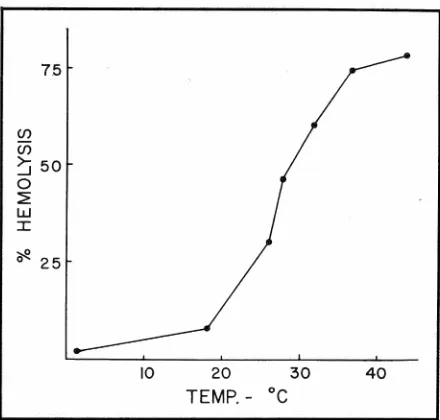
The effect of temperature upon the interaction of hemolysin and erythrocytes was noteworthy. When hemolysin and either human or rabbit red blood cells were incubated together for 60 min at temperatures between 4 C and 37 C, the 'degree of hemolysis was greater at the higher temperatures (Fig 1), At 4 C hemolysis was virtually absent. When erythrocytes which had been exposed to hemolysin for 60 min at 4 C were washed three times with 10 volumes of cold isotonic saline solution, resuspended to their original volume and incubated at 37 C for 60 min, lysis occurred. The supernatant material from the original mixture of hemolysin and erythrocytes failed to lyse fresh erythrocytes when exposed to them at 37 C for 60 min.
Earlier studies had shown that the intravenous ad-ministration of supernatant broth from a culture of Diplococcus pneumoniae to rabbits resulted in intra-vascular hemolysis (Shumway and Pollock, 1965). As will be demonstrated, this same phenomenon was observed after injection of crude bacterial extract. Be-cause the characteristics of the hemolysin suggested that it was a protein or contained protein as an integral part of its structure, it was likely to be antigenic. The results of the following experiments are compatible with this hypothesis.
Normal mature male albino rabbits were selected at random. Blood samples were obtained for baseline measurements of red blood cell morphology, packed
7.5
U)
en
~ 50 0 ~ w I~ 25
10 20 30 40
TEMP. - °C
aliquot of serum was frozen for subsequent determi-nation of the "hemolysin inhibition titer." A standard amount of the crude bacterial hemolysin (0.2 ml/kg) diluted in isotonic sodium chloride solution was given intravenously to each rabbit, and 2 hr later a sec-ond blood sample was obtained to reassess the above mentioned parameters.
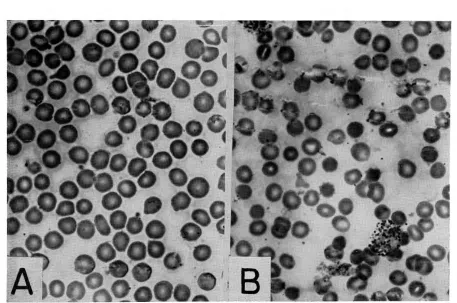
The results are summarized in Table III. Twelve of 22 rabbits exhibited unequivocal evidence of intra-vascular hemolysis as manifested by a 6% or greater decrease in packed red cell volume, an increase of erythrocyte osmotic fragility and hemoglobinemia. The animals' erythrocytes were found to be spherocytic or to have a crenated or spiculated appearance (Fig 2). Abnormalities of at least one or two of these param-eters were evident in nine other animals. The one rabbit which failed to exhibit any evidence of
hemoly-sis was subsequently found to have a high "hemolysin inhibition titer" (1/5120) without any known prior exposure to the hemolysin.
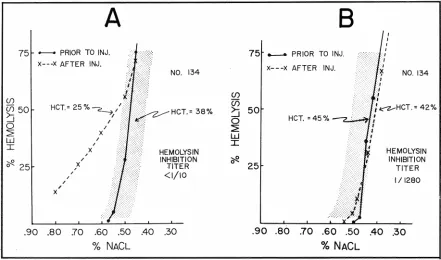
Nine of the rabbits which had been challenged by the intravenous injection of the hemolysin were given "booster doses" of the material (one-fourth original amount) intramuscularly, 9, 12, and 14 days after the original challenge. On the 21st day the sera of seven of the nine animals had an increased ability to inhibit the hemolysin in vitro; the "hemolysin in-hibition titers" rose from 1/80 or less to values from 1/640 to 1/5120. When these immunized rabbits were challenged a second time by the intravenous injection of the standard amount of hemolysin, none exhibited any evidence of intra vascular hemolysis (Fig 3;
Table III).
Fig 2-Photomicrographs of rabbit's blood smear (Wright Stain). (A) Normal rabbit. (B) Same animal 2 hr after
in-travenous administration of pneumococcal hemolysin. Note presence of spherocytes and "spiculated" erythrocytes.
CLARE N. SHUMWAY
TABLE III
Effects of Administration of Pneumococcal Hemolysin to Normal and Immunized Rabbits
SECOND INJECTION OF PNEUMOCOCCAL
FIRST INJECTION OF PNEUMOCOCCAL HEMOLYSIN HEMOLYSIN
Increase of** Increase of
Hemolysin Change in* Erythrocyte Hemolysin Change in Erythrocyte
Rabbit Inhibition PCV Osmotic Inhibition PCV Osmotic
No. Titer % Fragility Hemoglobinemia Titer % Fragility Hemoglobinemia
127 1/10 -13 + +
128 1/10 -17 + +
130 1/20 -5 0 +
133 <1/10 -1 0 +
141 1/80 -3 + +
142 1/160 -3 0 +
147 1/5120 -4 0 0
151 <1/10 -23 + +
152 <1/10 -25 + +
183 1/40 -2 0 +
184 <1/10 0 + +
185 1/10 - 11 + +
. 186 <1/10 - 14 + +
129 1/10 -4 + + 1/640 0 0 0
131 1/20 -10 + + 1 /1280 +2 0 0
132 <1/10 -18 + + 1/1280 -3 0 0
134 <1/10 -13 + + 1 /1280 - 3 0 0
144 1/80 - 11 + + 1/80 +6 0 0
145 <1/10 -5 0 + >1/5120 - 1 0 0
146 <l/10 - 3 0 + 1/2560 - 3 0 0
153 1/80 -7 + + 1/80 -5 0 0
157 1/40 -7 + + 1/640 +2 0 0
* Packed red cell volume (hematocrit)
*
+ Denotes an increase beyond two standard deviations of normal meanA surprising phenomenon was noted in five of six rabbits that were studied in more detail. On the first and second day after the first intravenous injection of the bacterial product, the animals' "hemolysin inhi-bition titer" rose transiently, but by the fifth day the results returned to the previous low values. Coincident with the transient rise 'in "inhibition titer" these sera appeared opalescent as if hyperlipemic.
Discussion
Libman ( 1905) is credited with first describing the lysis of erythrocytes by Diplococcus pneumoniae. Nine years later Cole ( 1914) prepared an extract of pneumococcal cell bodies which lysed human, rabbit, sheep, and guinae pig erythrocytes. He noted that the hemolysin was inactivated by trypsin, cholesterol, heat (55 C for 30 min), and by the sera of animals which had been immunized with the material.
From 1914 to 1946 many investigators (Cohen,
( 1934) demonstrated that the sera from animals :immunized with streptolysin 0 partially inhibited
'pneumococcal hemolysin. However, Tunevall (1953) noted that in human infections there was no significant
;neutralization of "pneumolysin" by antistreptolysin immune sera or of streptolysin 0 by "antipneumolysin" sera.
A great deal of effort was expended to determine the role, if any, which the hemolysin played in the pathogenesis of pneumococcal infections. All investi-gators who administered the material to experimental animals commented upon the absence of demonstrable hemolysis in vivo. Although it has not been shown that this substance plays a significant part in the disease process, this possibility has not been excluded.
With the advent of chemotherapeutic agents and antibiotics, interest in Diplococcus pneumoniae waned. In 1958 it was noted that pneumococcal septicemia in rabbits was associated with a spherocytic hemolytic anemia. (Shumway, 1958) Later it was found that
,the intravenous administration to rabbits of super-natant broth from cultures of Diplococcus pneumoniae, type l, resulted in spherocytosis, increased erythrocyte osmotic fragility and intravascular hemolysis (Shum
-way and Pollock, 1965). This observation suggested that pneumococcal septicemia of rabbits might offer a
model in which to test the hypothesis that this
bac-A
75 _______. PRIOR TO
x---X AFTER INJ.
NO. 134
(J)
en
50 HCT.= 25 %HGT.= 38%
~ 0
2
w
::r::
~ 0
x HEMOLYSIN
,
/ INHIBITION
25
,
, x TITER<1/ 10
/
/
/
x
.90 .80 .70 .60 .50 .40 .30
%
NA
CL
terial hemolysin plays a role in the . pathogenesis of pneumococcal infections. The studies reported here represent a step toward this goal.
The results of these studies demonstrate that a crude extract of Diplococcus pneumoniae, type 1 cells, damages and lyses human and rabbit erythrocytes in vitro and rabbit erythrocytes in vivo. The character-istics of our material suggest that it contains the same products which other workers have described as
"pneumolysin," "pneumococcal hemolysin," "pneumo-coccal hemotoxin" and "pneumotoxin." The observa-tion that the sera of rabbits which have received mul-tiple injections of the material are able to neutralize the hemolysin in vitro, suggests that the material is
antigenic. This suggestion is strengthened by the demonstration that an immunized rabbit does not experience hemolysis when challenged by an intrave-nous injection of the active hemolysin.
Although the term "hemolysin" has been used to describe this bacterial product, the term should not be taken literally. Halbert, Cohen and Perkins ( 1946) presented evidence which suggested that the material was lethal to mice and dermotoxic to guinea pigs. Robert Post working with our crude material has demonstrated that it damages and destroys human A V3 cells in tissue culture, and that this cytotoxic effect is abolished by heating the bacterial extract for
(J) (J)
~
0
~
w
I~
B
75
_...
PRIOR TO INJ.x---x AFTER INJ.
50
HCT. = 45%
25
.
,
'
'
I
.·~ NO. 134
..
·.-1.1
.
.,,
; <z.-HCT. = 42%
HEMOLYSIN
INHIBITION
TITER
I/ 1280
.90 .80 .70 .60 .50 .40 .30
%
NACL
Fig 3-Effect of administration of pneumococcal hemolysin to a normal rabbit (A); and to same immunized animal (B) 21 days later. Shaded area represents the normal range (± 2 SD) of erythrocyte osmotic fragility. Measurements
made 2 hr after injection of the hemolysin.
CLARE N. SHUMWAY
10 min at 56 Corby prior mixing of the extract with serum of an immunized rabbit. Thus, the "hemolysin" may have an affinity for and effect upon many cells including the erythrocyte.
The major weakness of this study and the work of others is the heterogeneity of the bacterial product. It is truly a crude extract; analytical disc gel electro-phoresis of the material discloses the presence of many bands of protein. Before the question of its signif-icance in the pathogenesis of pneumococcal infections can be answered and before its mechanism of action can be determined, a purified preparation must be obtained.
References
Cohen B, Halbert SP, Perkins ME: Pneumococcal hemoly-sin. J Bact 43: 607, 1942
Cole R: Pneumococcus hemotoxin. J Exp Med 20: 346, 1914
Cowan ST: Pneumococcal haemolysin; its extracellular nature, production and properties. J Path Bact 3 8: 61, 1934
Fleming WL, Neill JM: Studies on the oxidation and re-duction of immunological substances. IX The erythrocyte-combining property of pneumococcus hemotoxin. J Exp Med 46: 755, 1927
Halbert SP, Cohen B, Perkins ME: Toxic and immuno-logical properties of pneumococcal hemolysin. Bull Johns Hopkins Hosp 78: 340, 1946
Kreger AS, Bernheimer AW: Physical behavior of pneu-molysin. J Bact 98: 306, 1969
Libman E: A pneumococcus producing a peculiar form of hemolysis. Proc NY Path Soc, 1905
Neill JM: Studies on the oxidation and reduction of immunological substances. I Pneumococcus hemotoxin. J Exp Med 44: 199, 1926
Shumway CN: Spherocytic hemolytic anemia associated with acute pneumococcal infection in rabbits. J Lab and Clin Med 51: 240, 1958
Shumway CN, Pollock D: The effect of a pneumococcal product upon rabbit erythrocytes in vitro and in vivo. J Lab and Clin Med 65: 432, 1965
Todd EW: A comparative serological study of streptoly-sins derived from human and animal infections, with notes on pneumococcal haemolysin, tetanolysin and staphyl-ococcus toxin. J Path and Bact 39:229, 1934