International Journal of Computer Techniques -– Volume 3 Issue 4, July - Aug 2016
---
************************
---Abstract:
To overcome the shortcomings of traditional total variation (TV) denoising algorithm that is sensitive to noise and easy to blur, we propose an algorithm of image block denoising based on adaptive total variation for the cell image denoising. This algorithm uses image block method to segment cell image into flat region and edged region, then adaptively select the isotropic 2-norm total variation image denoising model for flat region or the anisotropic 1-norm one for edged region according to the local gray mean grads. To solve the border processing problem of blocked image, we just copy the neighboring pixels to fill the image border. Experimental results showed that, when adding Gaussian noise of 0 mean and variance of 0.01 to the blurred image, the method of image block denoising based on adaptive total variation can increase the Peak Signal-to-noise Ratio (PSNR) of the noise image by 10.72dB. Compared with the traditional denoising algorithms, our algorithm can not only preserve more texture details of the edge region, but also efficiently suppress the noise of the flat region, making it more suitable for biomedical cell image denoising.
Keywords —Total variation, image denoising, image block, border processing, gray mean grads. ---
************************
---I. INTRODUCTIONThe biomedical images acquired with digital X-ray photograph digital X-X-ray photograph, X-CT, magnetic resonance imaging (MRI) and other imaging methods are generally vulnerable to noise due to environmental interference, which will seriously affect image analysis and processing [1] [2]. Thus the image denosing is of great important to improve the quality of these images for further analysis and information extraction [3] [4].
The traditional methods of image denoising, such as Fourier transform and wavelet denoising in the frequency domain processing [5], and median filtering and Wiener filtering in the spatial domain processing [6], are not suitable for processing the biomedical images because of it removing some edge details of image which should be preserved in
the processing of biomedical images. Take median filtering for an example [7], though it can effectively suppress the impulse noise and salt-and-pepper noise of cell images, it can also be possible to remove the nucleus. Therefore, these methods are generally not applicable to biomedical image processing.
In recent years, the image denoising method based on variation has attracted extensive attention for its relative good performance in denoising and edge preserving. In 1992, Rudin,Osher et al. [8] proposed an anisotropic diffusion 1-norm total variation (TV) denoising model. This model can preserve edges while denoising images. But sometimes it may mistake the noises in flat areas for edges and bring these “false edges” to the restored image. Different from 1-norm total
Method of Image Block Denoising Based on Adaptive Total
Variation
PAN Jinquan
1, CHEN Shun’er
1*, FENG Yuanhua
2, LIU Weiping
1,3 1(College of information science and technology, Jinan University,Guangzhou,China,)2(Institute of Photonics Technology, Jinan University, Guangzhou, China) 3(Zhongshan Aiscent Technologies Ltd, Zhongshan, Guangdong, 528437, China)
*(Corresponding author: CHEN Shun’er)
International Journal of Computer Techniques -– Volume 3 Issue 4, July - Aug 2016
variation (TV) denoising model, the classical variation denoising model which is usually based on the 2-norm isotropic diffusion variation algorithm [9], can effectively remove the image noise, but it will probably make the edge details blurred. The advantages and disadvantages of these two models are complementary, so using either one of them alone for biomedical image denoising cannot yield a desired result. Later on, Bing Song [10] proposed a generalized TV denoising model based on norm L1+p,0<p<1;
Zhang Hongying [11] proposed a model which can adaptively select norms L1+p according to the
characteristics of each pixel; In addition, HouYuqing et al. [12] also proposed an adaptive model which can adjust its smooth measurement according to local gradient. These denoising models effectively reduced the staircase effect and showed a good performance in denoising.
In this paper, basing on the adaptive total variation denoising model, the advantages and disadvantages of the two different variation denoising models are analyzed at first. Then, an algorithm combining the advantages of these two models was proposed, which should be applicable to the denoising of cell images with the image blocking method based on the local gray mean grads and copying neighboring pixels to fill the edges to deal with the noise sensitivity and edge blurring defect of the traditional total variation denoising algorithm. Finally, by comparing peak signal-to-noise ratio (PSNR) and local variance, this algorithm was tested and proved to be more suitable for preserving the edge details of cell images and for suppressing the noise in flat areas.
II.TOTALVARIATIONIMAGEDENOISING ALGORITHM
Noises in biomedical image are primarily of two types: the additive noise and the multiplicative noise. We mainly consider the additive noise in the paper, whose model can be defined as:
) , ( ) , ( ) ,
(x y u x y n x y
f (1) Where f(x,y) denotes the noisy image observed,
u(x,y) the unknown original image, and n(x,y) the additive noise.
The problem of the traditional total variation (TV) denoising is about minimizing the following energy function [8]:
dxdy f u dxdy
u u
J
u
2 Ω
Ω|| || 2 | |
) (
min
(2) Where Ω denotes image regions, and the second term on the right side of the equation, named as Fidelity Term, controls the difference between original image u and observed image f. λ>0 is the regularization parameter, exerting important balance effect between the Regularization Term and the Fidelity Term. The higher the λ is, the closer the u is to the observed image f, and the weaker the smoothing is on local details, and thus the denoising quality is not good; Oppositely, the smaller the λ is, the stronger the smoothing is on both the detail and noise. The first term on the right side of the equation is the Regularization Term of TV model. Discrete TV (u) can be expressed as [9]:|| || ) (
1
, D u
u
TV n
j i
ij (3) Where uRnndenotes a n×n gray image, ||·|| is
the Frobenius norm, and D u R2
ij denotes the
first-order finite difference of gray intensity uij of pixel (i,j) in horizontal and vertical directions. When ||Diju|| takes 2-norm, it is the isotropic discrete total variation; when ||Diju|| takes 1-norm, it is the anisotropic discrete total variation.
To solve equation (2), we introduce the method proposed by Wang et al. (similar to the solution of anisotropic discrete total variation), which utilizes the alternating direction method (ADM) raised by Min Tao et al., to transform the original problem into a subproblem, and eventually solve the original problem through solving the subproblem via alternate iteration.
An auxiliary variablew ((w ) (,w) )T R2
ij v ij h
ij is
introduced to replace the horizontal and vertical first order finite differences of Diju. To ensure that
wij is close enough to Diju, we add a penalty term, thus the new denoising model is [14]:
2
1 ,
2
1 ,
, || || 2 || || 2|| ||
min w n Du w u f
j
i ij ij n
j i ij u
w
,i,j{,1 ,2,n}(4)
Where β is the parameter of penalty term. When
International Journal of Computer Techniques -– Volume 3 Issue 4, July - Aug 2016
into two subproblems, namely optimizing the w
and optimizing the u, i.e.:
w-subproblem:
n j
i ij ij ij
w , 1 w Du w
2 || || 2 || || min (5.1)
u-subproblem: 2
1 ,
2 || ||
2 || ||
2
min n D u w u f
j
i ij ij
u
(5.2)
The optimum solution of w-subproblem in ADM algorithm can be obtained through application of the two-dimensional contraction operator method [15]; the solution of u-subproblem can be worked out via Fourier transformation or cosine transform [9][13].
To solve the dilemma mentioned in paragraph 3 about the isotropic 2-norm (short for TV2
algorithm) and the anisotropic 1-norm (TV1 algorithm), Bing Song [10] raised a generalized TV denoising model based on L1+p, 0<p<1 norms.
His model could availably prevent false edges and preserve edge details, however it was sensitive to the selection of p, hence it was far from being adaptive. For these reasons, and we propose an algorithm of image block denoising based on adaptive total variation (BTV algorithm).
III. ADAPTIVETOTALVARIATION IMAGEDENOISING
A. Image block
Processing a large image (e.g. pictures with over 10 million pixels) as a whole is energy, time and memory consuming, and at most times it is unnecessary. Considering the special case of biomedical image processing, common biological cell images retains only a few texture details; in addition, researchers care more about the cellular morphology in such images, hence the regions covering cells are of great study value and the rests are often the less important. So, in this paper we name the regions covering cells as edged region, and the rests as flat region. To divide the two different regions adaptively, we partition the image into blocks and utilize gray mean grads (GMG) as judging threshold parameters.
region flat is , region edged is , _ _ _ _ k k k k B G a g B G a
g ,k=1,2…K; (6)
WhereG_ is gray mean grad (GMG) and defined
as:
1 1 1 1 2 2 _2[ (, )1 (, )] )] , ( ) ,1 ( [ )1 )( 1 ( 1 M i N j j i f j i f j i f j i f N M
G (7)
In (6), parameter a is used to adjust the threshold parameterG_ , gk
_
is the local GMG of Bk of the block. For gray images, the gradient of regions including edge information is always higher than that of flat region. When local GMG of block gk
_
≥
G , the block is deemed as edged region, for
which the anisotropic 1-norm of the total variation image denoising model, which has better preservation of edge, should be used. When local GMG of block gk
_
<G_ , the block is flat region, for which the isotropic 2-norm of the total variation image denoising model, which has better denoising effect, should be used.
Size of blocks of image should be determined based on different conditions. If the block size is too big, the block number would be too few to yield the expected processing effect, oppositely if the block size is too small, the block number would be too many, that will cause augmentation of computation burden and the so-called "block effect" which leads to severe jumping of gray level in edged regions.
B. Border Processing
Border of images should be particularly taken into consideration during image filtering or denoising to prevent from meaningless pixels or application error. Traditional border processing mainly applies methods of shrinking processing range and boundary fill. In the method of shrinking processing range, the border of 1 pixel width around image f is neglected; while in the method of boundary fill, the border of image f is replaced by a constant value. All such methods can ensure that the processing will not exceed the border of image f, but gradient will always occur on the border.
In the finite-difference calculation proposed by
International Journal of Computer Techniques -– Volume 3 Issue 4, July - Aug 2016
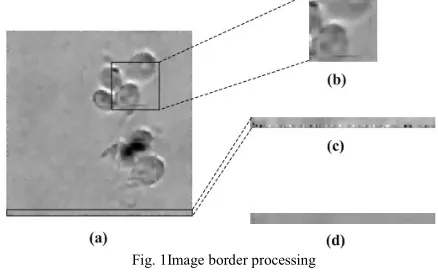
the border parts. Fig.1(c) shows the enlarged lower border of Fig. 1(a). From Fig. 1(c) we can see that the irregular gray levels present on the border. Hence border processing must be taken into consideration during the process of image block to prevent jumping of gray level on border areas of the image blocks. As shown in 1(b), gray level jumping presents in border areas of blocks. To solve it, we copy the neighboring pixels to fill the image border so as to preserve the smoothness, as shown in Fig.1 (d).
Fig. 1Image border processing
IV. EXPERIMENTPROCESSAND ANALYSIS
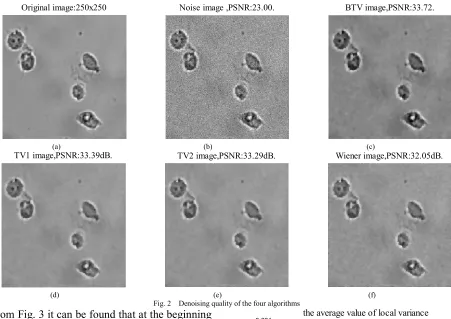
The object of the study is cell image. We capture several gray images of nasopharynx cancer cell using optical microscope, from which we pick out a representative one as original image (Fig. 2(a), 250×250 pixels), and introduce a Gaussian noise with mean value 0 and variance 0.01 (Fig. 2(b)). The size of one image block is set as 50×50 pixels. To verify the feasibility of our algorithm, we implement the process in Matlab 2010b, which can be summarized as follows:
1.Input : f, u and β>0;
2.Image blocking: f={Bk},k=1,2…K;
3.If :gk _
>aG_
TV is isotropic; Else
TV is anisotropic;
4.While k=1:K,and “not converged”;
f=Bk;
Compute w-subproblem; Compute u-subproblem; End do
We employ peak signal to noise ratio (PSNR) as the denoising effect assessment function, which is defined as:
) ( )] , ( ) , ( [ 1
255 log
10
1 1
2 2
10 dB
j i f j i u MN
PSNR M
i N
j
(8)
In general, the higher the PSNR value, the better the denoising quality. However PSNR cannot reflect the quality of edged regions; in particular, when edged region of the image to be assessed and that of the original image slightly move during processing, obvious difference would present. In essence, such slight moves exert no influence on the whole visual effect of the image. Hence, we introduce the average value of local variance (ALV) as auxiliary index for denoising effect assessment [17]. The local variance of the kth image block window D is defined as:
2 )
, (
2 1
( ( , ) ( , ))
D j i
k N f i j i j
(9)
Where μ is the average gray value of window D:
D j
i f i j
N ( , ) ( , ) 1
(10) Where N denotes the pixel size of window D,
f(i, j) is the gray value of image f at pixels (i, j). Then the ALV of window D can be expressed as:
K
k k
K 1 2 _
2 1
(11) To calculate, we define the size of window D
used to set local variance and average gray value be equal to that of image block Bk, i.e., D=Bk. ALV can in fact reflect the noise level of an image. Lower ALV means lower noise of image and better denoising quality of the processing.
International Journal of Computer Techniques -– Volume 3 Issue 4, July - Aug 2016
(a) (b) (c)
(d) (e) (f) Fig. 2 Denoising quality of the four algorithms
From Fig. 3 it can be found that at the beginning of iteration, the BTV ALV result is higher than that of TV1 and TV2, while at the stage of convergence, the local variance of BTV is obviously lower than that of TV1 and TV2 due to BTV’s effective process on border in each iteration. Meanwhile we can see from Fig. 2 and Table I that the image denoised by classic Wiener Filter has the lowest PSNR and the highest ALV, indicating that Wiener Filter may not be suitable for cell image denoising. Also we can find that the denoising effect of TV1 algorithm and TV2 algorithm almost be same to each other from Table I, though the isotropic diffusion which blurs the edged region makes TV2 algorithm weaker than TV1 algorithm in terms of denoising quality. Finally, comparing the PSNR of the BTV algorithm in Table I, it is not hard to see that the denoising algorithm we proposed is better than other algorithms attributed to that our BTV algorithm not only combines the merits of both TV1 and TV2, but also improved border processing.
Fig.3 Change curves of ALV with number of iteration TABLEI
PSNRANDALVOFTHEFOURALGORITHMS
Image(Size:250×250) PSNR(dB) ALV
Fig2(b) Noise Image 23.00 0.0959 Fig2(c) BTV Image 33.72 0.0577 Fig2(d) TV1 Image 33.39 0.0583 Fig2(e) TV2 Image 33.29 0.0588 Fig2(f) Wiener Image 32.05 0.0618
V.CONCLUSIONS
Combining the merits of the two traditional total variation denoising models, namely TV1 and TV2,
Original image:250x250 Noise image ,PSNR:23.00. BTV image,PSNR:33.72.
TV1 image,PSNR:33.39dB. TV2 image,PSNR:33.29dB. Wiener image,PSNR:32.05dB.
0 2 4 6 8 10 12 14 0.057
0.058 0.059 0.06 0.061 0.062 0.063
0.064 the average value of local variance
the number of iterations
A
LV
International Journal of Computer Techniques -– Volume 3 Issue 4, July - Aug 2016
We propose an algorithm of image block denoising suitable for cell image processing based on adaptive total variation. The algorithm uses image block method to segment the cell images into flat region and edged region, and adaptively choose denoising models in accordance with local gray mean grads. To prevent from meaningless pixel and application error during border processing, we copy the neighboring pixels to fill the image border so as to overcome the shortage of border processing occurred in traditional total variation algorithm. The result of experiments show that, when adding Gaussian noise of 0 mean and variance of 0.01 to the blurred image, the method of BTV (our method) can increase the Peak Signal-to-noise Ratio (PSNR) of the noise image by 10.72dB and effectively solve the defects lying in the traditional total variation denoising algorithm that is sensitive to noise and easy to blur. Compared with traditional denoising algorithms, namely TV1, TV2 and Wiener filter, our algorithm not only protects the texture details of cell images' edge regions better, but also efficiently suppresses the noise of flat regions.
ACKNOWLEDGMENT
This work is supported in part by Strategic Emerging Industries Project of Guangdong Province (No.2011912027).
REFERENCES
[1] WANG YAN.Research on Algorithm of X-CT Medical Image Denoising [D]Tianjin Medical University,2014
[2] Yu Chunyan.Research on Image Processing of Biological Information Based on Partial Differential Equations[D].Dalian Maritime University. 2012
[3] Rafael C G,Richard E W. Digital Image Processing. 2nd Edition. Upper Saddle River,USA: Prentice Hall,2002
[4] Shapiro L G,Stockman G C.Computer Vision. Upper Saddle River, USA: Prentice-Hall, 2001
[5] Chang S G, Yu B. Adaptive Wavelet Thresholding for Image Denoising and Compression. IEEE Trans on Image Processing, 2000, 37( 7) : 940-946
[6] Lim J S. Two-dimensional signal and image processing [J].
Englewood Cliffs Nj Prentice Hall P, 1990, 34(1):6–8.
[7] Nodes T, Gallagher N Jr, Mathews V J. Median Filter: Some Modifications and Their Properties. IEEE Trans on Acoustics, Speech and Signal Processing,1982,30( 5) : 739-746
[8] Rudin L I, Osher S, Fatemi E. Nonlinear total variation based noise removal algorithm [J]. Physica D-nonlinear Phenomena, 1992, 60(1-4):259-268.
[9] Wang Y, Yang J, Yin W, et al. A New Alternating Minimization Algorithm for Total Variation Image Reconstruction [J]. Siam Journal on Imaging Sciences, 2008, 1(3):248--272.
[10] Bing Song. Topics in Variational PDE Image Segmentation, Inpainting and Denoising [D]. USA: University of California LosAngeles, 2003.
[11] ZHANG Hongying, PENG Qi-cong. Adaptive image denoising model based on total variation [J]. Opto-Electronic Engineering, 2006, 33(3):50-53.
[12] Hou Y Q, Zhang H, Shi J, et al. An improved adaptive image denoising model based on total variation [J]. Journal of Northwest University, 2008, 38(3):371-373.
[13] Tao M, Yang J. Alternating direction algorithms for total variation deconvolution in image reconstruction [J]. TR0918, Department of Mathematics, Nanjing University, 2009.
[14] Ng M K, Weiss P, Yuan X. Solving constrained total-variation image restoration and reconstruction problems via alternating direction methods [J]. SIAM journal on Scientific Computing, 2010, 32(5): 2710-2736.
[15] Yang J, Yin W, Zhang Y, et al. A fast algorithm for edge-preserving variational multichannel image restoration [J]. SIAM Journal on Imaging Sciences, 2009, 2(2): 569-592.
[16] LI Yong, FAN Cheng-yu, SHI Dong-feng. Atmospheric Turbulence-Degraded Image Blind Restoration Method Using the Accelerated and Regularized RL Algorithm [J].Journal of Atmospheric and Environmental Optics,2011,05: 342-350.