Design a cutter prototype to separate date palm leaflets from
fronds (Rachis)
Nahed K. Ismail
(Senior Researchers at Agricultural Engineering Research Institute, Agricultural Research Center, Egypt)
Abstract: This study was carried out, at Dept. of Agric. Eng., Faculty of Agric., Mansoura Univ., Egypt during 2014 spring season, to design and evaluate a cutting prototype performance and production as a date palm leaves components (fronds, leaflets and spines). The tested treatments include saw speed (167.5, 251.2, 334.9 and 418.7 rad s-1), saw teeth inner spacing (4, 5 and 8 mm) and feeding speed ratio (1:1, 1:1.25, 1:1.67 and 1:2.50). The study concluded that the optimum operation conditions of saw speed of 334.9 rad s-1, saw teeth inner spacing of 8 mm and 1:1.25 feeding speed ratio achieved cut fronds productivity of 1051.5 m h-1, cut leaflets and spines productivity of 183.86 kg h-1, cutting leaflets efficiency of 99.32%, leaflet losses of 0.68 %, frond cleaning quality of 100.03% and specific energy requirement of 0.08 kW h m-1. The research recommended that the designed machine could be used for cutting date palm leaflets in a large scale to suitable amount for process palm wood, crina, baskets, fodder, and pectin extraction.
Keywords: date palm leaves, leaflet, frond, efficiency, circle saw, losses, energy
Citation: Ismail, N. K. 2017. Design a cutter prototype to separate date palm leaflets from fronds (Rachis). Agricultural Engineering International: CIGR Journal, 19(2): 51–61.
1 Introduction
Egypt is considered as one of the pioneer countries in date palm cultivation, where the total number of planted palm tree is 16 million (Ministry of Agricultural and Land Reclamation, 2013). The date palm tree has an average production life of 150 years. In order to enhance dates quality, the trees are pruned to eliminate broken leaves annually. Its manual process is very difficult because of the largest amount of palm leaves (whereas one tree produces about 20 leaves yearly (Ibrahim, 2009)). The date palm leaf is a pinnate shaped of 2.5-5.0 m length. The leaf base and tip are 180 and 5.0 mm in width, respectively. The leaf consists mainly of a rachis which connects with about 100 - 250 leaflets that are attached laterally and supported by a stiff midrib (frond) (Ibrahim, 2009, Ibrahim, 2011 and Ghaleb, 2013). El-Mously (2005) indicated that, in Egypt, the total annual date palm pruning residues amount is about 328.3 Gg. This biomass
Received date: 2016-09-30 Accepted date2017-01-04 Biographies: Ismail, N. K., Senior Researchers at Agric. Eng. Res. Inst., Agric. Res. Center, Egypt. Email: [email protected].
currently has not been efficiently and effectively used. So, burning and land filling is one of some of the current practices, while it will create significant environmental problems. Chandrasekaran and Bahka (2013) reported that the raw material from palm waste and residues is likely to be highly flammable if it left on the ground for a long time.
Thus, innovative ways of using this abundant renewable resource should be applied, such as in pulp and paper (Khiari et al., 2011), composite products (Nasser, 2012), chemicals, feed-stocks, and energy source (Nasser et al., 2014).
The cutting process by using circular saws have many factors that influence on power consumption, such as material of the cutting tool, its geometry and optimal cutting forces (cutting speed Cs, feed rate F). The cutting
power is a very important factor of power consumption
(KovÁč and Mikleš, 2010). To sum up, the specific
Orlowski et al., 2013). In contrast, when chip thickness comes closer to the existing cutting edge radius under very small feeds per tooth, the hyperbolic increase in the specific cutting resistance occurs, which was also known as the so-called size effect (Atkins, 2003). Knowing the cutting and feed forces the necessary cutting power and forces affecting the workpiece and the tool. Not only is the model useful to the technologists who work in the field of wood processing, but also to designers for designing new saw blades (Zdeněk, et al., 2014). In the case of wood sawing with circular saw blades, material- and energy-savings are dependent on total overall set of teeth (theoretical kerf) and teeth position accuracy of the workpiece. Hence, it is necessary to achieve a decrease of both raw material and energy losses by using narrow-kerf saw bladesand an increase of sawing accuracy. The realization of economical wood sawing with circular saw blades seems not to be viable until the whole system of sawing fulfil the defined requirements. The examined industrial achieved: an increase of about 18% in the amount of side lumber, roughly 16% less sawdust (as an effect of kerf reduction) and about 16% lower values of the cutting power consumption (Roman et al., 2012). Ismail and Gaadi (2006) developed AC-operated portable machine to mechanize the pruning operation conducted on the petioles of palm trees using a saw technique. The performance of the machine was tested in the laboratory on petioles at different petiole moisture content. They concluded that the average time and energy required at a petiole MC range of 60% to 75% were 3 s cm-2 and 32 W s cm-2, respectively. However, the values of the two variables were 0.9 s cm-2 and 12 W s cm-2, respectively, at lower petiole MC range (7% to 20%). Results also demonstrated that the an average power values of 12 and 30 W cm-2 were required at high levels of petiole MC (60% to 75%) and low levels of petiole MC (7% to 20%), respectively.
The common method for cutting leaflets from date palm fronds is still conducted manually which wastes manpower and expends more time. The changing economic patterns in most date producing countries including increased labor costs and scarcity, leaflets industries have been degraded.
The aim of the research is to evaluate a designed prototype performance and to product quality as a date palm leaves parts (fronds, leaflets and spines).
2 Theoretical considerations
To achieve the best results, by cutting leaflets and/or spines from Hayani date-palm fronds sides, the relationship between the speeds of leaves feed and saws disc cutting speed must be in the dynamic harmony. Therefore, several steps must be identified that will help to scrutinize the design of a leaflet cutting prototype.
1) Measuring the fronds (rachis), leaflets and spines dimensions,
2) Determining the length of amplitude leaflets and spines and number attributed per unit length (cm),
3) Measuring the presence range of leaflets and spines on both sides of frond,
4) Determining the distance between leaflets; and 5) Finding the connecting angle leaflet with frond. There are a widely diversity among those specifications. For a reason it can not be relied upon when determine the dimensions element of the leaflet cutting prototype. So during the study, it relied on the maximum characteristic values for palm leaves through establish the prototype specifications, so that it can fit in all leaves. Consequently, theoretical can divided as follows:
2.1 Cut leaflet length (L)
According to Srivastava (2006), Ismail (2012) and Orlowski et al. (2013), the leaflet cutting length (L, m) determined as Equation (1):
2 R
L Φ
Z
π λ
= ⋅ (1)
where, π = Constant (3.14); R = Saw radius, mm; Z = Number of saw teeth; λ = Speed ratio (feed speed “u”
(mm s-1) / saw speed “v” (mm s-1) u
v
= ; Φ = Shear rate,
F AS
= ; F = Shear force, N; A = Area of cutting material,
mm2; S = Shear modules, N mm-2 (JIS, 2000). 2 R v F 1
L
Z u A S
π
= ⋅ ⋅ ⋅ (2)
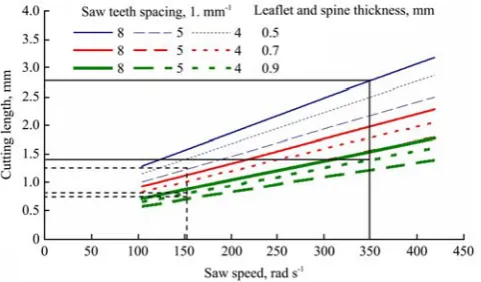
predicted as shown in Figure 1. The saws speeds is directly proportional to the cut leaflet length, while, saw teeth spacing (one tooth/8, one tooth/5 and one tooth/4 mm) and thickness of material are inversely proportional to the cut leaflet length.
Figure 1 shows that saw speed of 150 rad s-1 achieved cut leaflet length of 1.02 mm, which is increasing about 2.79 times at 350 rad s-1 using 0.5 mm leaflet thickness. On another side, increasing the saw speed from 150 to 350 rad s-1 increased the cutting length from 0.63 to 1.77 mm at saw teeth spacing of 1/8 mm and leaflet thickness of 0.9 mm. In addition, as the leaflet thickness increased from 0.5 to 0.9 mm, the cut leaflet length moved up from 1.48 to 2.71 mm at the same previous variable levels.
Figure 1 The relationship between cutting length and saw speed
2.2 Cutting power requirements
The cutting power requirement (P) of a saw-blade during cutting process can be expressed as Equation 3 as cited by Orlowski et al. (2013):
c s s
P n= × ×k F × ×L P (3)
where, nc = Number of teeth cutting at the same time; k =
Kerfs width, m; Fs = Feed speed, m s-1; L = Cutting path
length, mm, and Ps = Specific cutting work that depends
on the saws species and kerf size, J m-3 (JIS, 2000). Using Equation (3) the theoretical cutting power is ranging from 0.59 to 18.50 W at different levels of saw speed, saw teeth spacing and feeding speed. Then total power requirement for a set of saw-blades is Equation (4):
Total
P = ×n P (4)
where, PTotal = Total cutting power, W, and n = Number
of saw-blades, (two blades).
2.3 Leaflet losses
Leaflets losses could be determined by cutting the
leaflet using a vertical knife (Me) then, the leftover is cut and weight. The theoretical losses (Th) are estimated by dividing the percentage of leaflet area via the leftover area. As shown in Figure 2 the measured losses are ranging from 0.47 to 1.95% but the theoretical are ranging from 0.64% to 3.8%. The fit curve shows the regression equations of the measured and theoretical losses as follows:
Me=7E-05s3–0.0043s2+0.1141s R2=0.8044
Th=0.0003s3–0.0133s2+0.2027s R2=0.9547
Figure 2 The measured and theoretical calculated leaflet losses via different frond width
3 Material and methods
3.1 Date palm leaves, fronds and, leaflets and spines
characteristics
At Meet Ali Village, El-Dakhlia Governorate, Egypt, two matured female date palm trees of Hyani variety were pruned at the green state during 2014 spring season. Five samples of the pruning residues were selected randomly to determine some date palm leaves, fronds, leaflets and spines characteristics as follows:
1) Mass: was determined using an electronic balance reading to 0.01 g (Table 1).
2) Principle dimensions: i.e. length, width and thickness were measured using a scaled ruler (Table 1).
3) Leaflets and spines spacing: were measured using a scaled ruler (Table 1).
4) Moisture content: (w.b. %) was determined using the oven method at 70°C according to the procedure of ASAE Standard (1998).
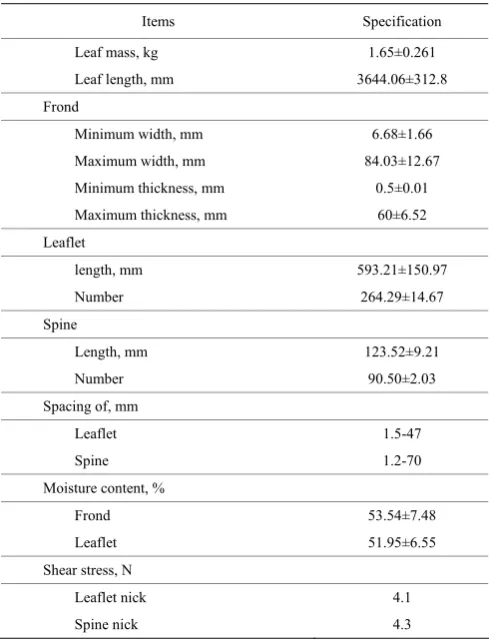
Machines device as a maximum force to cut the leaflet at the point attached with the frond. Along the frond, the measuring points were selected at 0-10 as first step (Figure 3a), 198-208 as the second step (Figure 3b) and 285-295 cm as the third steps (Figure 3c) from the free frond end, having 4, 35 and 57 mm spacing/3 leaflets, respectively. The measured values of the previous characteristics are indicated in Table 1 and Figure 3.
Table 1 Some characteristics of date palm leaves, fronds, leaflets and spines for Hyani variety
Items Specification
Leaf mass, kg 1.65±0.261
Leaf length, mm 3644.06±312.8
Frond
Minimum width, mm 6.68±1.66
Maximum width, mm 84.03±12.67
Minimum thickness, mm 0.5±0.01
Maximum thickness, mm 60±6.52
Leaflet
length, mm 593.21±150.97
Number 264.29±14.67
Spine
Length, mm 123.52±9.21
Number 90.50±2.03 Spacing of, mm
Leaflet 1.5-47 Spine 1.2-70
Moisture content, %
Frond 53.54±7.48
Leaflet 51.95±6.55 Shear stress, N
Leaflet nick 4.1
Spine nick 4.3
3.2 Date palm leaflets and spines cutting prototype
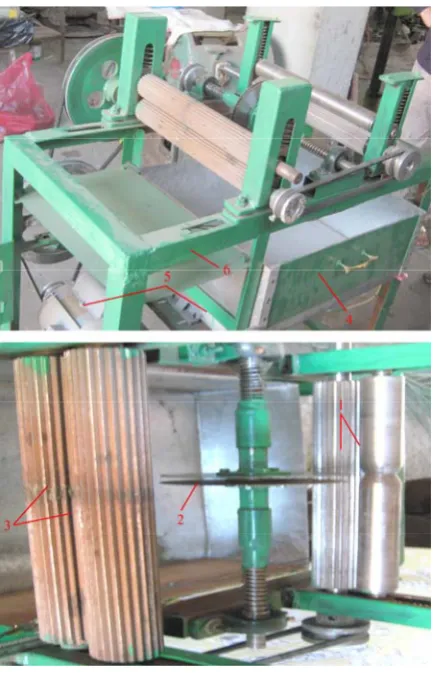
The designed leaflet and spine cutting prototype was manufactured in a private workshop at Meet Ali Village, El-Dakhlia Governorate, Egypt. As drawn in Figure 4 and photographed in Figure 5, it consists of the following components:
1) Frame: It was made from angle steel with 50 mm width and 4 mm thickness. The frame length, width and height are 1000, 500 and 900 mm, respectively.
2) Power source: A single-phase electric motor of 1400 rpm and 0.75 kW power is used to drive drag drums through switch key, while a single-phase electric motor of 3000 rpm and 0.75 kW power is used to drive the saws through other switch key.
a
b
c
Figure 3 Shear stress distribution along the frond
1. Feeding unit 2. Cutting unit 3. Drag unit 4. Store unit 5. Motors 6. Frame
Figure 5 Photograph of designed date palm leaflets cutting prototype
3) Feeding unit: Date palm fronds are fed manually to the prototype feeding unit which consists of two drums of 500 mm length. The smooth upper drum of 48 mm diameter is idler. At the center of the upper drum, a cavity was holed. It has a nick of 7 mm wide to ease the passage of the palm leaf thin end. While, the lower corrugated drum of 50 mm diameter rotates with a speed of 140 rpm (0.37 m s-1). The vertical clearance between the drums at the center is 9 mm. Two groups of helical springs of 0.32×10³ N m-1 stiffness which are fixed at the drum sides to keep the date palm frond is continuously pressed between the drums.
4) Cutting unit: It consists of a transmission shaft of 50 mm diameter. The shaft ends were supported on two ball bearings which award the rotary movement to the shaft. Two vertical saws disc shaped were fastened with a hole pipes of 22 mm diameter that was inserted in the transmission shaft. Also, the saws were belayed at a hollow shaft with a square cross-section which was secured with the transmission shaft. Tow helical springs
at horizontal position of 0.09×10³ N m-1 stiffness were used to allow moves the saws spacing from 7.0 to 200 mm according to the width of date palm leaf base. A hollow sleeve of 9 mm width is established between the saws to ease the passage of the frond thin end.
5) Dragging unit: It consists of two corrugated drums of 500 mm length and 50 mm diameter. The upper drum is idler, while, the lower one rotates with a speed of 140.0, 175.0, 233.3 or 350 rpm that equalizes the peripheral speed of 0.37, 0.46, 0.61 or 0.92 m s-1 peripheral speed, respectively. Two groups of springs with 3.55×10³ N m-1 stiffness are fixed at the drum sides to keep the upper drum which is pressing the other drum.
6) Storage unit: The cut leaflets and spines are collected and stored at a box of 600×500×210 mm length, width and height, respectively.
3.3 Treatments and statistical design
The experiment of cutting date palm leaflets using the designed prototype was carried out at Department of Agricultural Engineering, Faculty of Agriculture, Mansoura University, Egypt during 2014 spring season. For all the duration of the experiment the following treatments were tested:
1) Saw speed “Ss”: It included the saw speed levels of 1600, 2400, 3200 and 4000 rpm (167.5, 251.2, 334.9 and 418.7 rad s-1).
2) Saw teeth spacing “SN”: It included the saw teeth spacing around the saw periphery levels of tooth/8 mm, tooth/5 mm and tooth/4 mm that represent 72, 80 and 100 teeth for three saws of 180, 125 and 125 mm diameter, respectively.
3) Feeding speed ratio “Fr”: It included the feeding speed ratio of drag to feeding drums levels of 1:1, 1:1.25, 1:1.67 and 1:2.50.
3.4 Prototype productivity
3.4.1 Fronds (PM)
It is determined using the standard Equation (5) as:
-1
, m h
M
LL P
T
= (5)
where, LL: Date palm leaf length, m; T: Actual time of date palm leaf passes from prototype, h.
3.4.2 Leaflets and spines (PL)
It is determined using the following Equation (6):
-1
, kg h
m L
M P
T
= (6)
where, Mm: leaflet and spines mass, kg.
3.5 Leaflets cutting efficiency (ηp)
It is determined according to Tagare, et al. (2013) as follows Equation (7):
100, %
m p
f
M M
η = × (7)
where, Mf= Leaflet mass must be cutting, kg.
3.6 Leaflet losses (Lp)
It is calculated according to Srivastava, et al. (2006) as follows Equation (8):
100, %
m f d
p
f
M t t L
M + +
= × (8)
where, tf = Soft thread fiber mass, kg and td = Dust mass,
kg.
3.7 Frond quality (Fq)
It is determined according to Tagare, et al. (2013) as follows Equation (9):
100, % fm q ff M F M
= × (9)
where, Mfm = Actual frond mass, kg and Mff = Frond mass
must be obtained (after manual cleaning from the remained leaflets), kg.
3.8 Specific energy requirements
The cutting specific energy requirements; the power consumed (Pc), kW for separate palm tree leaflets from
fronds is determined according to Soliman and Abd-Elmaksoud (2001) claimed as follows Equation (10):
cos
C
P = φ× ×V I (10)
where, cosφ = Power factor (being equal to 0.85); V= Voltage (220 V); I = Line current strength in Amperes.
Then, the required specific energy for cutting date
palm leaflets (SEc, kW h m-1) is estimated as follows Equation (11):
1
, kW h m -C
M
P SEc
P
= (11)
3.9 Mathematical and regression analysis
Microsoft Excel 2010 computer software is used to employ the mathematical and multi regression analysis and to represent the effect of saw speed, saw teeth spacing and feeding speed ratio on each of prototype fronds productivity, leaflets and spines productivity, cutting leaflets efficiency, leaflet losses and ratio of frond quality.
4 Results and discussion
4.1 Prototype fronds productivity
Figure 6 indicates that the higher prototype fronds productivity value of 1215.26 m h-1 was obtained using feeding speed ratio of 1:1.25, saw speed of 418.7 rad s-1 and saw teeth spacing of tooth/8 mm. While, when feeding speed ratio of 1:1, saw speed of 167.5 rad s-1 and saw teeth spacing of tooth/5 mm the lower prototype fronds productivity value accomplished 297.71 m h-1.
As demonstrated in Figure 6, the prototype fronds productivity increased from 587.15 to 664.20 m h-1 with the saw speed increasing from 167.5 to 418.7 rad s-1. This trend may explain that leaflets have not crowded front the saw teeth as saw speed increased. The ascending of feeding speed ratio from 1:1 to 1:2.5 moved up the prototype fronds productivity from 383.39 to 679.94 m h-1. This tendency may be explained that the decreased feeding speed ratio accumulates more fronds amount against saw teeth and that resulted in cutting lower leaflets and spines amount per unit time. As the saw teeth spacing diminished from tooth/8 mm to tooth/4 mm, the prototype fronds productivity decreased from 722.01 to 632.42 m h-1. It may be demonstrated that the saw teeth spacing of tooth/8 mm has a longer tooth depth that passes upon, penetrates and cuts more leaves per unit time.
The regression analysis shows the relation between prototype frond productivity (PF) and saw speed (Ss),
PF=514.43+0.286Ss +89.07Fr–1.420 SN (12)
The regression analysis declares that the factors affected the prototype frond productivity may be arranged as the following ascending on relative to analysis of
variance as follow: feeding speed ratio (the p-value from analysis as Px2 = 0.087) < saw speed (the p-value from analysis as Px1 = 0.361) < saw teeth spacing (the p-value from analysis as Px3 = 0.567).
Figure 6 Effect of saws speed on prototype productivity of fronds
4.2 Prototype leaflets and spines productivity
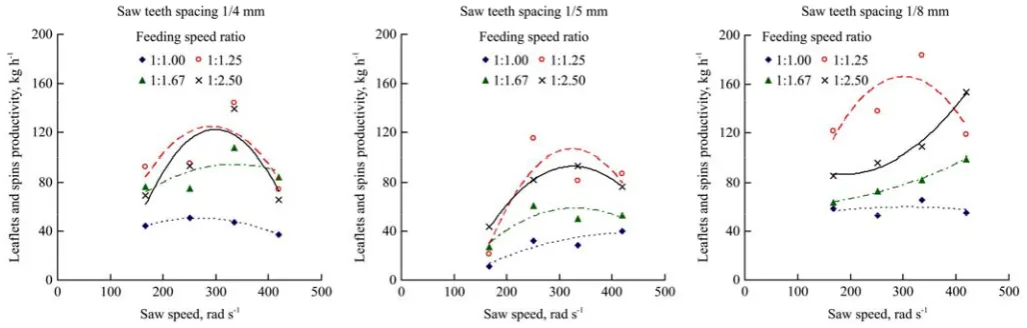
Data presented in Figure 7 shows that the higher prototype cut leaflets and spines productivity value of 183.86 kg h-1 was recorded using saw speed of 334.9 rad s-1, feeding speed ratio of 1:1.50 and saw teeth spacing of
tooth/8 mm. While, when saw speed of 167.5 rad s-1, feeding speed ratio of 1:1.25 and saw teeth spacing of tooth/5 mm, it achieved the lower prototype cut leaflets and spines productivity value of 11.52 kg h-1.
Figure 7 Effect of saws speed on prototype productivity of cut leaflets and spines
As revealed in Figure 7, leaflets and spines productivity raised from 59.45 to 94.32 kg h-1 with the augmentation of saw speed from 167.5 to 334.9 rad s-1. Then, it dropped to be 78.59 kg h-1 as saw speed reached to be 418.7 rad s-1. This observation may be attributed to the higher cut action which accompanied with the saw speed until it reaches to saw speed of 334.9 rad s-1. Then,
as saw speed reached to be 418.7 rad s-1, when it
represented a critical point, the rate of cutting leaflets and spines per unit time diminished. Meanwhile, the decreased feeding speed ratio from 1:1 to 1:1.25
furnished the leaflets and spines productivity from 43.50 to 92.18 kg h-1. This behavior may be due to higher cutting action per unit time that referred to more amount of the fed leaves per unit time. The increment of saw teeth spacing from tooth/5 mm to tooth/8 mm ascended the leaflets and spines productivity from 56.33 to 97.21 kg h-1. This phenomena is due to the higher number of teeth per unit time that saw more amount of leaflets as the teeth spacing decreased.
at different feeding speed ratio “Fr” and saw teeth spacing “SN” as follows Equation (13):
PL= aSs2+ bSs+C (13)
The constants (a, b and C) and regression coefficient (R2) are plotted in Table 2.
Table 2 The values of constants and regression coefficient of Equation (13)
SN
1/8 1/5 1/4
Fr
a b C (R2) a b C (R2) a b C (R2)
1 : 1 –0.0002 0.110 42.61 0.0780 –0.0003 0.294 –26.4 0.8239 –0.0006 0.321 6.959 0.9971
1 : 1.25 –0.0029 1.742 –95.48 0.6341 –0.0031 2.029 –222.6 0.6966 –0.0026 1.545 –100.5 0.4997
1 : 1.67 0.0003 –0.023 59.71 0.9974 –0.0011 0.703 –57.7 0.7264 –0.0008 0.538 4.033 0.4149
1 : 2.5 0.0012 –0.453 128.7 0.9827 –0.0020 1.292 –117.7 1.0000 –0.0035 2.086 –189.5 0.7043
4.3 Prototype leaflets cutting efficiency
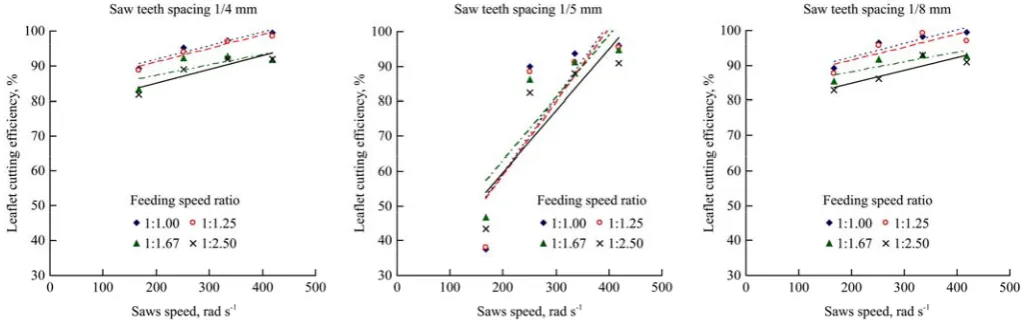
Figure 8 shows that leaflets cutting efficiency is harmonious with saws speed. As saw speed increased
from 167.5 to 418.7 rad s-1, the prototype cutting
efficiency moved up from 71.12% to 94.91%. This occurrence is due to the proportional of number of teeth per unit time with saw speed that leads to higher cutting efficiency with saw speed. The decreased feeding speed ratio from 1:1 to 1:2.5 reduced the prototype cutting efficiency from 90.17% to 84.35%. This happening may
be clarified that increased feeding speed ratio offers extra amount of fed leaves that may restricts the cutting action. Whilst, the prototype leaflets cutting efficiency raised from 78.29% to 92.42% with lowering of saw teeth spacing from one teeth/8 mm to one teeth/5 mm, then, it reduced to be 92.14% with decreasing saw teeth spacing to tooth/4mm. It is due to the higher number of teeth that increases the hitting action until reaching to a critical point at teeth spacing of one teeth/4 mm, then, the hitting action decreases with the teeth spacing.
Figure 8 Effect of saws speed on leaflet cutting efficiency
The following fit equation explain the correlation between leaflet efficiency (ηp) and saws speed (Ss) at
different feeding speed ratio “Fr” and saw teeth spacing “SN”:
ηp=aSs+b (14)
The constants (a and b) and regression coefficient (R2) are plotted in Table 3. The analysis showed that the leaflet efficiency (ηp) was directly proportional to saw speed “Ss”.
Table 3 The values of constants and regression coefficient of Equation (14)
Fr
1 : 1 1 : 1.25 1 : 1.67 1 : 2.5
SN
a b (R2) a b (R2) a b (R2) a b (R2)
tooth/4 mm 0.039 83.83 0.932 0.039 83.10 0.934 0..031 81.01 0.535 0.040 76.88 0.810
tooth/5 mm 0.213 16.72 0.685 0.209 16.92 0.702 0.179 27.24 0.749 0.177 24.20 0.747
4.4 Leaflet losses
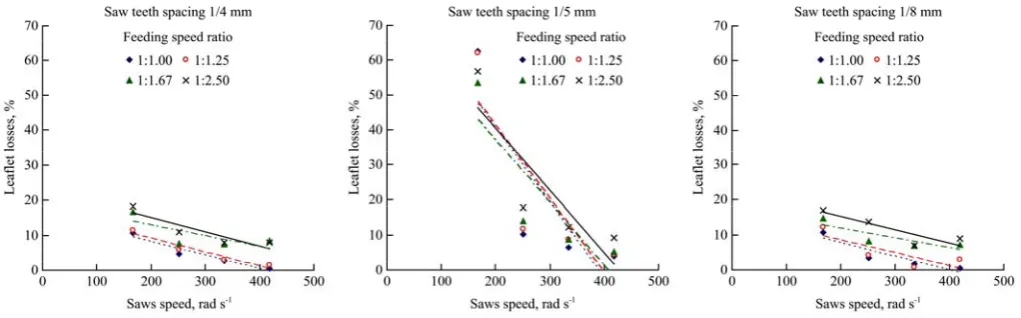
As indicated in Figure 9, the increased saw speed from 167.5 to 418.7 rad s-1 decreased leaflets losses about five times. Whilst, the descending of feeding speed ratio
from 1:2.5 to 1:1 increases leaflets losses from 9.83% to 15.65%. At the same time, as the saw teeth spacing decreased from tooth/8 mm to tooth/4 mm, the leaflets losses ascended from 7.58% to 21.71%.
Figure 9 Effect of saws speed on leaflet losses
These findings reveals that the leaflets looses is inversely proportional with saw speed, feeding speed ratio and saw teeth spacing. The increment of saw speed, feeding speed ratio and saw teeth spacing moved up the saw teeth cutting action per unit time and per unit frond length, resulting in higher values of leaflets looses.
The regression analysis shows the following relationship between leaflet losses (LL) and saw speed(Ss),
feeding speed ratio (Fr) and saw teeth spacing (SN) as Equation (15):
LL = 42.70–0.089Ss –0.125Fr +3.93SN (15)
The regression analysis declares that the factors affected the leaflet losses may be arranged as the following ascending on relative to analysis of variance as follow: saw teeth spacing (the p-value from analysis as
Px3 = 0.413) > feeding speed ratio (the p-value from analysis as Px2=0.215) > saw speed (the p-value from
analysis as Px1=0.000)
4.5 Frond cleaning quality
Figure 10 declares that as the saw speed increased from 167.5 to 334.9 rad s-1, the frond cleaning quality value decreased from 111.44% to 106.20%, then, it increased to be 107.86% at saw speed of 418.7 rad s-1. At feeding speed ratio of 1:1.25, the higher frond quality value of 109.94% was recorded, then, it decreased to the lower quality value of 107.45% as the feeding speed ratio decreased to be 1:1.50. As the saw teeth spacing increased from tooth/4 mm to tooth/8 mm, the frond cleaning quality descended from 110.26% to 107.06%.
These results show that decrement of saw speed with increment of feeding speed ratio with diminishing of saw teeth spacing allows the backlog most leaflets towed the saw, then higher resistance against the cutting action followed by lowering the frond quality.
The fit equation shows that correlation between frond cleaning quality (Fq) and saws speed (Ss) at different feeding speed ratio “Fr” and saw teeth spacing “SN” could be indicated as follows Equation (16):
Fq=aSs+ b (16)
The constants (a and b) and regression coefficient (R2)
are plotted in Table 4. The analysis showed that the frond cleaning quality (Fq) was inversely proportional to saws speed “Ss” at different feeding speed ratio (Fr) and saw teeth spacing (SN) except that at feeding speed ratio of 1:2.5 and all saw teeth spacing, it has a directly proportional.
Table 4 The values of constants and regression coefficient of Equation (16).
Fr
1:1 1:1.25 1:1.67 1:2.5
SN
a b (R2) a b (R2) a b (R2) a b (R2)
tooth/4 mm -0.032 119.8 0.651 -0.023 115.32 0.684 -0.029 117.14 0.739 0.022 100.51 0.237
tooth/5 mm -0.015 115.6 0.400 -0.017 113.95 0.330 -0.023 118.81 0.869 0.014 105.61 0.176
tooth/8 mm -0.042 120.5 0.770 -0.027 112.50 0.594 -0.043 120.60 0.750 0.023 100.83 0.312
4.6 Specific energy requirements
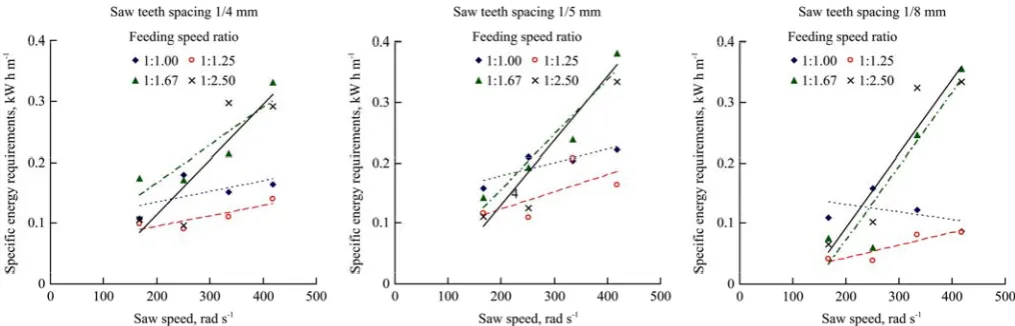
Figure 11 exhibits that the lower specific energy requirements value of 0.037 kW h m-1 was obtained at saw speed of 251.2 rad s-1, feeding speed ratio of 1:1.50 and saw teeth spacing of tooth/4 mm. However, the higher specific energy requirements value of 0.381 kW h m-1 was found at saw speed of 418.7 rad s-1, feeding speed ratio of 1:2.50 and saw teeth spacing of tooth/5 mm.
These results indicate that the specific energy requirements for cutting leaflets and spines is proportional with saw speed, feeding speed ratio and saw teeth spacing. As the increased saw speed, feeding speed ratio and saw teeth spacing, the number of saw teeth strikes ascended per unit time and per unit frond length, leading to higher leaflets and/or spines cutting resistance.
Figure 11 Effect of saws speed on specific energy requirements
5 Conclusion
The obtained results could be concluded that using the cutting leaflets prototype could achieve suitable results at saw speed of 334.9 rad s-1, feeding speed ratio of 1:1.25 and saw teeth inner spacing of 8 mm. At these conditions it can achieved cut fronds productivity of 1051.5 m h-1, cutting leaflets and spines productivity of 183.86 kg h-1, cutting leaflets efficiency of 99.32%, leaflet losses of 0.68%, frond cleaning quality of 100.03% and specific
energy requirement of 0.08 kW h m-1.
It is recommended to apply the designed prototype for cutting date palm leaflets in a large scale to suitable amount for process palm leaves in some environmental manufacture as wood, crina, etc. and modern manufacture as pectin extraction and furfural.
References
and moisture content: 384. St. Joseph, Mich.: ASAE.
Atkins, A. G. 2003. Modeling metal cutting using modern ductile fracture mechanics: Quantitative explanations for some longstanding problems. International Journal of Mechanical Sciences, 45(2): 373–396.
Chandrasekaran, M., and A. H. Bahka. 2013. Valorization of date palm (Phoenix dactylifera) fruit processing by-products and wastes using bioprocess technology-Review. Saudi Journal Biological Sciences, 20: 105–120.
El-Mously, H. I. 2005. Palm fibers for reinforcement of polymer composites: prospects and challenges. Misr Journal Agricultural Engineering (MJAE), 22(3): 748–774.
Ghaleb, H. H. 2013. Service operations for date palm tree. Available at: www.iraq-datepams.net.
Ibrahim, A. O. 2009. Date palm life tree “Palm head service processes”. Available at: www.iraq-datepams.net.
Ibrahim, A. O. 2011. System in order of date palm leaves (fronds). Available at: www.iraqi-datepalms.net.
Ismail, Z. E. 2012. Specifications and operation. In Basics of power and farm machinery. Part one. 103–127. Mansoura University. Ismail, K. M., and K. A. Al-Gaadi. 2006. Development and testing of a portable palm tree pruning machine. International Journal of Agricultural Research, 1(3): 226–233.
JIS, B. 2000. Spring calculations. Technical Data, Excerpts from JIS B, 2704, 2813–2814.
Khiari, R., E. Mauret, M. N. Belgacem, and F. Mhemmi. 2011. Tunisian date palm rachis used as an alternative source of fibers for papermaking applications. Bio Resources, 6(1): 265–281.
KovÁč, J., and M. Mikleš. 2010. Research on individual parameters for cutting power of woodcutting process by circular saws. Journal of Forest Science, 56(6): 271–277. Ministry of Agriculture and Land Reclamation Economic Affairs
Sector. 2013. Bulletin of an Agric Statistics, Part (2), Summer
and Nile Crops, 344–368.
Nasser, R. A. 2012. Physical and mechanical properties of three-layer particleboard manufactured from the tree pruning of seven wood species. World Applied Sciences Journal, 19(5): 741–753.
Nasser, R. A., M. Z. M. Salem, H. A. Al-Mefarrej, M. A. Abdel-Aal, and S. S. Soliman. 2014. Fuel characteristics of vine prunings (Vitis vinifera L.) as a potential source for energy production. Bio Resources, 9(1): 482–496.
Orlowski, K. 2010. The fundamentals of narrow-kerf sawing: Mechanics and quality of cutting. Technical University in Zvolen. 1-123.
Orlowski, K., T. Ochrymiuk, A. Atkins, and D. Chuchala. 2013. Application of fracture mechanics for energetic effects predictions while wood sawing. Wood Science Technology, 47(5): 949–963.
Roman, W., A. O. Kazimierz, and S. Stanislaw. 2012. Economical wood sawing with circular saw blades of a new design. Drvna Industrija, 63(1): 27–32.
Soliman, N. S., and M. A. F. Abd El Maksoud, 2001. Performance study of meat chopper. Misr Journal Agricultural Engineering (MJAE), 18(1): 131–150.
Srivastava, A. K., C. E. Goering, and R. P. Rohrbach. 2006. Engineering Principles of Agricultural Machines. 2nd Ed. USA: ASABE Pub.
Tagare, V. S., V. B. Patil, S. P. Talaskar, and S. D. Wadar. 2013. Design and manufacturing of sugar cane peeling machine. International Journal of Advanced Scientific and Technical
Research, 3(3): 70-83. Available at
http://www.rspublication.com/ijst/ index.html.