RESEARCH
The SAGA/TREX‑2 subunit Sus1 binds
widely to transcribed genes and affects mRNA
turnover globally
Varinia García‑Molinero
2,9, José García‑Martínez
3, Rohit Reja
4,10, Pedro Furió‑Tarí
5,
Oreto Antúnez
6, Vinesh Vinayachandran
4, Ana Conesa
5,7,8, B. Franklin Pugh
4, José E. Pérez‑Ortín
6and Susana Rodríguez‑Navarro
1,2*Abstract
Background: Eukaryotic transcription is regulated through two complexes, the general transcription factor IID (TFIID) and the coactivator Spt–Ada–Gcn5 acetyltransferase (SAGA). Recent findings confirm that both TFIID and SAGA contribute to the synthesis of nearly all transcripts and are recruited genome‑wide in yeast. However, how this broad recruitment confers selectivity under specific conditions remains an open question.
Results: Here we find that the SAGA/TREX‑2 subunit Sus1 associates with upstream regulatory regions of many yeast genes and that heat shock drastically changes Sus1 binding. While Sus1 binding to TFIID‑dominated genes is not affected by temperature, its recruitment to SAGA‑dominated genes and RP genes is significantly disturbed under heat shock, with Sus1 relocated to environmental stress‑responsive genes in these conditions. Moreover, in contrast to recent results showing that SAGA deubiquitinating enzyme Ubp8 is dispensable for RNA synthesis, genomic run‑on experiments demonstrate that Sus1 contributes to synthesis and stability of a wide range of transcripts.
Conclusions: Our study provides support for a model in which SAGA/TREX‑2 factor Sus1 acts as a global transcrip‑ tional regulator in yeast but has differential activity at yeast genes as a function of their transcription rate or during stress conditions.
Keywords: Sus1, SAGA, Transcription, GRO, ChIP‑exo
© The Author(s) 2018. This article is distributed under the terms of the Creative Commons Attribution 4.0 International License (http://creativecommons.org/licenses/by/4.0/), which permits unrestricted use, distribution, and reproduction in any medium, provided you give appropriate credit to the original author(s) and the source, provide a link to the Creative Commons license, and indicate if changes were made. The Creative Commons Public Domain Dedication waiver (http://creativecommons.org/ publicdomain/zero/1.0/) applies to the data made available in this article, unless otherwise stated.
Background
Expression of protein-coding genes is a coordinated pro-cess that consists of a series of linked steps in mRNA fate: transcription, processing, export to the cytoplasm, translation and degradation. Regulation of gene expres-sion is essential to cellular metabolism and to adapta-tion to stress and developmental processes. A key step in eukaryotic transcription is the binding of a sophisticated repertoire of regulators that collectively function to con-trol the timing of expression of each gene. Eukaryotic
RNA polymerase II (RNAPII) genes have been classically divided into two main groups attending to the presence or absence of the TATA sequence in their promoters [1]. While transcription of all genes requires the loading of the TATA-binding protein (TBP) onto their promoter sequences, differences exist in the co-regulators that are used. TATA-like containing genes are mainly dependent on the general transcription factor IID (TFIID), while the SAGA coactivator (Spt–Ada–Gcn5 acetyltrans-ferase) plays a relatively greater role in the expression of TATA-box genes [2, 3]. Accordingly, yeast genes have been called TFIID- and SAGA-dominated, depending on which complex has the strongest influence on their transcription [2]. The SAGA complex is widely conserved from yeast to humans and acts during different stages of gene expression (reviewed in [4–6]). Interestingly, and in
Open Access
*Correspondence: [email protected]
1 Gene Expression and RNA Metabolism Laboratory, Instituto de Biomedicina de Valencia, Consejo Superior de Investigaciones Científicas (CSIC), Jaime Roig 11, 46010 Valencia, Spain
contrast to SAGA, TFIID seems to play a role restricted to preinitiation events. In addition to SAGA, a similar coactivator, referred to as SLIK (SAGA-LIKe), has also been described [2, 3, 7–9]. The subunit composition is identical to that of SAGA, except that in SLIK the Spt7 subunit is C-terminally truncated by proteolytic cleavage, leading to release of the Spt8 subunit.
SAGA and SLIK are organized in submodules [4–6, 10] and have two inherent catalytic activities on nucleosomal histones: histone acetyltransferase activity (HAT) [11, 12] and histone H2B deubiquitylation (DUB) [13–15]. Both activities are essential for the post-translational modi-fication of the histone tails, which provokes a shift from compact/inactive to open/active chromatin states [16]. SAGA is formed by distinct modules that work together to localize the HAT and DUB activities of the complex in the gene promoter, a necessary step for enhancing tran-scriptional activation, facilitating elongation and promot-ing nucleosome eviction.
Apart from SAGA-dependent events affecting histone modifications during transcription initiation, several studies have identified SAGA roles other than those of upstream regions. In fact, yeast SAGA subunits are not restricted to promoters, as they also localize to coding sequences of specific genes [17–19]. In these locations, SAGA subunits co-transcriptionally promote nucleo-some eviction through Gcn5’s HAT activity and the deubiquitylation of H2B by Ubp8. Furthermore, SAGA interacts functionally and physically with TREX-2 (tran-scription and export complex 2), a nuclear pore-asso-ciated complex involved in genome stability, mRNA biogenesis and export [20–23]. Through components of the SAGA deubiquitylation module, SAGA and TREX-2 co-localize at the nuclear periphery [24]. Sus1, a shared SAGA/SLIK/TREX-2 factor, also localizes to promot-ers and coding regions of some SAGA-dominated genes (ADH1 and GAL1), where it promotes the interaction with export factors, contributing to the coupling of tran-scription and mRNA metabolism [25].
Deciphering how SAGA’s different enzymatic activi-ties control the expression of their target genes is a major challenge in fundamental transcription research. Classi-cal results from genome-wide approaches suggested that SAGA binds to a subset of promoters in yeast [26–30] that are downregulated in SAGA mutants [2]. SAGA predominates at promoters of highly regulated stress-responsive TATA-box-containing genes, which comprise about 10% of the genome. Interestingly, there is not a clear correlation between the binding of SAGA and the misregulation of bound genes [28, 31, 32]. In fact, it has been shown that > 99% of the expressed yeast genome is positively regulated by the overlapping involvement of TFIID and SAGA [2]. Moreover, enzymatic activities of
SAGA subunits, i.e. histone acetylation and deubiqui-tylation, seem to play roles that go beyond the transcrip-tional initiation of SAGA-dominated genes. For example, a previous study showed that SAGA acetylates histones at promoter regions as well as deubiquitylates histone H2B from transcribed region of all expressed RNAPII genes [33]. Furthermore, the separated roles of SAGA and TFIID in the regulation of containing and TATA-like genes have recently been reconsidered. New results confirm that transcription of nearly all genes is depend-ent on TFIID [34] and that SAGA may act as a general co-factor required for RNAPII transcription in Saccharo-myces cerevisiae [35]. In contrast, other studies indicate that SAGA is not a general transcription factor in flies and mammals [36–38].
In this study, we show for the first time the genome-wide recruitment of the SAGA/TREX-2 factor, Sus1, to RNAPII-transcribed genes. Sus1 accumulates at upstream activator sequences (UASs) at a variety of gene classes: ribosomal protein (RP), SAGA-dominated and TFIID-dominated genes. The amount of Sus1 binding is correlated with the transcription rate (TR) of target genes. Analyses of Sus1 chromatin recruitment under heat shock revealed that while this stress scarcely affected Sus1 binding to TFIID-dominated genes, the binding pat-tern at SAGA and RP genes was substantially affected. Consistent with the genome-wide association of Sus1 to UAS, we found that transcription rates and stabilities of most yeast transcripts are changed in the absence of Sus1. Lastly, we demonstrate that both SAGA and SLIK partici-pate in Sus1 recruitment to SAGA-dominated genes. In sum, our results support a model in which Sus1 is inti-mately tied to the expression of yeast RNAPII genes.
Results
Sus1 is recruited genome‑wide to promoters of RNAPII‑transcribed genes
b
Sus1 binds near both 5′ and 3′ gene ends, whereas in RP genes the association of Sus1 corresponds mainly to 5′ end (Fig. 1a). To better study Sus1-binding pattern, we joined in a metagene representation the 5′-end pro-files of shifted sequencing reads—representing points of cross-linking from Sus1-WT at 25 °C (blue) and the nucleosome (MNase) traces at 25 °C (grey fill) taken from [39] (Fig. 1b). Both profiles were plotted around the tran-scription start site (TSS) oriented to the right. Specific Sus1 binding to RP, SAGA and TFIID genes is depicted in three independent panels. Generally, we found that Sus1 binds preferentially to the UAS which overlaps with nucleosome-free regions (NFRs) of all these three gene classes. Under standard conditions, most Sus1 binding overlaps the − 1 nucleosome at position ~ − 200 and part of the NFR in all cases. These results were validated by ChIP-qPCR on a subset of TFIID genes using a different tagged version of Sus1 (Additional file 1: Fig. S1).
Sus1 association to UAS depends on growth conditions Distinct mobilization of SAGA- and TFIID-linked reg-ulators occurs during acute heat shock [28, 30]. The heat-shock response in yeast involves transient changes in transcriptional rate, mRNA levels and mRNA stabili-ties of approximately 1000 genes within 15 min of the stress [40–42]. Different gene clusters showed accumu-lation of different complexes that regulate transcription, and SAGA-dominated genes had the largest increase in occupancy of many regulators [28]. To study the extent to which the genome-wide association of Sus1 to all gene classes is affected by heat shock, we conducted ChIP-exo experiments of Sus1 binding at 37 °C (Fig. 1a, red line) and compared to data at 25 °C (Fig. 1a, blue line). We discovered that while heat shock barely affected Sus1 binding to TFIID genes, it significantly shifted the Sus1-binding pattern at SAGA and RP genes. While Sus1 binding to RP genes was significantly reduced, the pres-ence of Sus1 at SAGA-dominated genes was augmented. Examples of Sus1 association to each class of genes at both temperatures are shown in Fig. 1c. Gene set enrich-ment analysis (GSEA) of the Gene Ontology (GO) terms
of the top in the ordered list of bound genes at each tem-perature indicated that at 25 °C Sus1 preferentially binds to cytoplasmic translation and ribosomal subunit genes, while at 37 °C protein folding and response to heat genes are most associated with Sus1 (Additional file 2: Fig. S2).
Sus1 affects the synthesis and stability of mRNAs at a genome‑wide level
In the light of our ChIP-exo results, we decided to re-investigate the genome-wide role of Sus1 in transcrip-tion. In a previous study, we showed that the deletion of SUS1 affects the steady-state levels of around 10% of mRNAs [20]. In that work, total RNA was obtained from
sus1Δ and wild-type (WT) cells and gene expression lev-els were analysed using DNA arrays. However, as the final amount of any transcript is determined by the balance between its transcription and degradation rates [43], we conducted new genomic run-on (GRO) experiments [44] and obtained the nascent transcription rate (TR) for each transcript in WT and sus1Δ cells (see details at Materials and Methods). In addition, we used previously published relative mRNA abundance (RA) estimates [20] for com-parative purposes. We found that the TRs of sus1Δ and WT cells were much less correlated (R= 0.71; Fig. 2a)
than their RAs (R= 0.92; Fig. 2b). To evaluate how the
absence of Sus1 affects the TR, we represented the mutant versus WT ratio of TR values against TR in the WT. This analysis showed that the absence of Sus1 pro-vokes a genome-wide decrease in TR (most data points are below the ratio 1) and that this effect increases with the absolute TR (Fig. 2c). GSEA of genes ranked by their TR ratios (sus1Δ/WT) revealed that translation-related genes tend to have high TR ratios, while energy deriva-tion genes are at the lowest TR ratios (Additional file 3: Fig. S3).
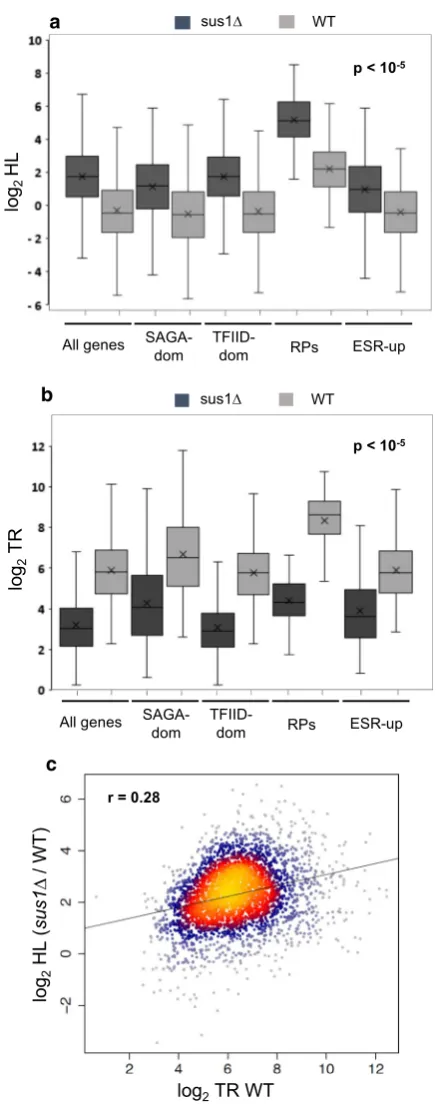
Lower TRs can be compensated by global mRNA stabi-lization, giving rise to similar RAs [43]. To understand the role of Sus1 on mRNA stability, the distribution of RA/ TR ratios (a proxy of mRNA half-lives, HL) between the mutant and WT strains was compared. We found that, globally, SUS1 deletion increased global mRNA stability (See figure on previous page.)
Fig. 1 Positional organization of Sus1 before and after heat stress. a Heat map showing shifted 5′‑end sequencing reads (tags) for Sus1‑WT at 25 °C (blue) and after 15 min at 37 °C (red), aligned by the midpoint in between transcription start site (TSS) and transcription end site (TES). Data presented are divided into three subgroups: ribosomal protein genes (RP, n= 137), SAGA‑dominated genes (SAGA, n= 471) and TFIID‑dominated genes (TFIID, n = 4351) genes and sorted by gene length in each subgroup. The results of two replicates are shown. As a control, the signal of an isogenic strain bearing no‑tagged Sus1 was also monitored (No‑tag). b Gene‑averaged 5′‑ends of shifted relative read counts (representing points of cross‑linking) of Sus1‑WT at 25 °C (blue line) and at 37 °C (red line) around the transcription start site (TSS) in three gene classes: ribosomal pro‑ tein (RP) genes, SAGA‑dominated genes and TFIID‑dominated genes, with TSS oriented to the right. Nucleosomes (based on MNase ChIP‑seq) are plotted and based on values from [39]. Abrupt heat shock at 37 °C (yellow line) and 25 °C (grey fill) is shown. The resulting normalized ratios were plotted. Note that ordinate scales vary for the three gene classes due to differences in the number of genes in each class. c) Signal tracks, showing unshifted ChIP‑exo tag 5′‑end reads for Sus1‑wt at 25 °C and 37 °C at RP‑dependent gene RPL11 (upper panel), at SAGA‑dependent gene CDC19
(Fig. 3a, all genes), but the magnitude of the effect was different for distinct gene classes. While SAGA- and TFIID-dominated genes increased their HL ratio by 3.3 and 4.73 times, respectively, in the sus1Δ mutant, the effect in RP genes was higher (7.7 times), while envi-ronmental stress-response upregulated (ESR-up) [40] transcripts behaved similarly to SAGA- and TFIID-dom-inated genes (Fig. 3a). These results tend to compensate the differences in TR observed in absence of Sus1 for each set of genes (Fig. 3b) and suggest that Sus1 causes increased mRNA turnover when genes are transcribed more frequently. To verify this observation, we plotted fold change in HL in sus1Δ versus WT against TR in WT and observed a positive trend, indicating that Sus1 is more effective at destabilizing mRNA of highly expressed genes (Fig. 3c). Similarly to TR ratios, GSEA analysis of HL sus1Δ/WT ratios found a statistically significant over-representation of translation-related GO categories within the most stabilized mRNAs, and reciprocally, of energy derivation-related GOs within the less-stabilized ones (Additional file 4: Fig. S4). We conclude that Sus1 destabilizes RNAPII-transcribed mRNAs, with its impact being generally greater the more a gene is expressed.
Sus1 binding shows a positive correlation with transcriptional rate
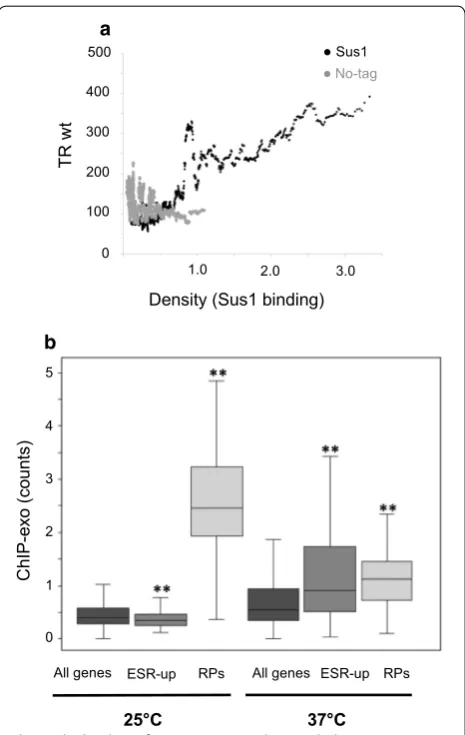
Since our results showed a positive relationship between HL fold change and TR levels affected by Sus1 deletion (Fig. 3c), we next investigated to which extent Sus1 bind-ing correlates with transcriptional activity by plottbind-ing the number of Sus1 ChIP-exo reads at UAS versus TR val-ues obtained from our GRO experiment through a slid-ing window representation. We found a positive trend of increasing Sus1 binding with the increase in TR for all genes (Fig. 4a, black dots), that was not observed for the no-tag ChIP-exo data (Fig. 4a, grey dots).
Our analyses revealed that upon heat shock Sus1 binding to RP genes was significantly reduced, while its a
b
c
Fig. 2 Genomic effects of Sus1 depletion on mRNA turnover. a Plot of the transcription rates (TR) of 3757 yeast genes in the sus1Δ dele‑ tion mutant versus the wild‑type strain. b Plot of the mRNA levels (RA) of 5216 yeast genes in the sus1Δ deletion mutant versus the wild‑type strain. c Plot of the fold change of TR of 3757 yeast genes in the sus1Δ mutant against the TR level of the WT. Note that all graphs are in log2 scales of arbitrary units. Pearson R of the cloud to a linear
presence at SAGA-dominated genes was augmented (Fig. 1b). It has been shown that many SAGA-dominated genes are part of the ESR-up transcripts [2, 40, 45–48], whereas RP genes are a fundamental part of the ESR-down response. Therefore, we hypothesized that Sus1 would release from RP genes and associate preferen-tially to ESR-up genes upon stress [30]. To confirm this hypothesis, the binding of Sus1 to RP and ESR-up genes was studied before and after this temperature shift. As shown in Fig. 4b, Sus1 binding to ESR-up genes was lower than the global genome average in a wild-type strain at 25 °C. In contrast, association of Sus1 to ESR-up genes was significantly augmented upon heat shock. In con-trast, Sus1 binding to RP genes dropped abruptly when cells were incubated at 37 °C for 15 min (Fig. 4b). These results support an active role for Sus1 in the transcrip-tional regulation of the environmental stress response in yeast.
SLIK participates in Sus1 recruitment to SAGA‑dominated genes
We previously addressed the contribution of SAGA and TREX-2 to Sus1 chromatin association via investigat-ing Sus1 recruitment to ARG1 in ubp8Δ (SAGA) and in
sac3Δ (TREX-2) mutants [18]. The experiments showed that Sus1 binding to both complexes was required for correct recruitment to the ARG1 UAS [18]. Sus1 is also part of SLIK [49]. The functional differences between SAGA and SLIK are not fully understood, and some stud-ies have proposed that they could play different roles at promoter or coding sequences [8]. Since our results high-lighted a global chromatin association pattern for Sus1, we wondered whether this remains true for Sus1 as part of SLIK. To this end, we analysed the ChIP-exo genome-wide binding profile of Sus1 in spt8Δ and Spt7 C-termi-nal-truncated mutant (spt7-1180) in which SLIK, but
not SAGA, exists [9, 49, 50], at 25 °C and at 37 °C. Heat maps showing Sus1 in spt7-1180 and spt8Δ strains at 25 °C (blue) and after 15 min at 37 °C (red) were aligned to RP, SAGA-dominated and TFIID-dominated gene classes. Similar to the results observed for Sus1 in a WT
a
b
c Fig. 3 Genomic effects of Sus1 depletion on changes in mRNA half‑
lives. a Box‑and‑whisker plot of the changes in mRNA stability half‑lives (HL) in sus1Δ mutant (dark grey) and the wild‑type strain (light grey). All comparisons show a statistically significant HL increase of sus1Δ in relation to wild‑type strains (Wilcoxon signed‑rank test p value < 10−5).
Note that SAGA‑ and TFIID‑dominated genes have similar average increase in HLs (3.3‑ vs. 4.73‑fold) but that ribosomal protein‑coding genes (RP) are much more increased in HLs (7.7‑fold) than environ‑ mental stress response activated (ESR‑up) genes (2.75‑fold). b Box‑and‑ whisker plot of the changes in TR in the sus1Δ mutant (dark grey) and the wild‑type strain (light grey). All comparisons show a statistically sig‑ nificant TR decrease of sus1Δ in relation to wild‑type strains (Wilcoxon signed‑rank test p value < 10−5). Note that the decrease in RP genes is
much higher (19.4‑fold) than in SAGA (5.5‑fold), TFIID (7.1‑fold) or ESR‑ up (4.4‑fold) genes. c Plot of the fold change in HL in the sus1Δ mutant against the TR level of each gene in the WT strain. Note that both axes are in log2 scales of arbitrary units. Pearson R of the cloud to a linear fitting is shown
background (Fig. 1a), Sus1 in spt8Δ and Spt7 C-termi-nal-truncated mutant (spt7-1180) bound to both 5′ and 3′ gene ends, whereas at RP genes the association corre-sponded mainly to the 5′-end (Fig. 5a). Figure 5b shows the metagene 5′-ends profiles of shifted sequencing reads of Sus1-WT, Sus1 in spt7-1180 and spt8Δ strains at 25 °C (blue line) and upon heat shock (red line). Data are plotted around the transcription start site (TSS) ori-ented to the right, together with nucleosome (MNase) traces at 25 °C (grey fill) and after heat shock (yellow trace) from [39]. Sus1 recruitment is slightly diminished
at SAGA-dominated genes when only SLIK is present, indicating that both SAGA and SLIK participate in Sus1 recruitment to SAGA-dominated genes.
Discussion
In this study, we demonstrate a general role for Sus1 in transcription and mRNA stability in yeast cells. Sus1 is recruited to the upstream activation sequences of many genes and is necessary for mRNA synthesis of a large number of transcripts independently of the presence of a TATA sequence. The classical model of the role of SAGA/TFIID in regulating transcription states that they possess distinct but overlapping selectivity for promot-ers, thereby fostering a cascade of events that leads to the correct expression of their targeted genes. In classi-cal studies, TATA-containing genes were relatively more dependent on SAGA, whereas TATA-like genes were rel-atively more dependent on the general transcription fac-tor TFIID [2]. Numerous ChIP studies of SAGA factors revealed a picture of confined recruitment of SAGA to specific promoters and to some coding sequences [17–19,
28, 30, 51]. However, recent work that tried to delimit the specificity of SAGA regulation concluded that TFIID and SAGA are more equivalent than initially thought [34, 35]. These studies reported that SAGA-associated enzymatic activities act more widely at all transcribed genes [33]. In particular, it was shown that histone acetylation and deu-biquitylation mediated by the SAGA-associated proteins Gcn5 and Ubp8, respectively, occur genome-wide, sug-gesting that SAGA has a broader role in gene expression. However, we suggest that contributions from subcom-plexes that are not part of SAGA could not be excluded. The current view is further supported by two recent pub-lications describing TFIID and SAGA as general cofac-tors for RNAPII transcription in yeast [34, 35]. SAGA factors Spt7, Spt3, Spt8 and Ubp8 were reported to asso-ciate with UASs at a majority of genes, which contrasts with recent results showing much more restricted local-ization [30]. Sus1 (this study) and SAGA ([30]) recruit-ments are enriched for highly transcribed genes and peak in the -150/-200-bp region coinciding with the UAS and NFR of many yeast genes, with particular enrichment of SAGA subunits at RP and SAGA-dominated genes. Fur-ther work is needed to resolve the discrepancy between the discordant studies.
Seminal studies that established the regulatory role of SAGA and the functional clustering of its subunits measured steady-state RNA levels, without differentiat-ing between transcription and degradation rates [2, 31]. In this work, we measured separately transcriptional rate and mRNA abundance, and discovered that i) the absence of SUS1 has a strong negative effect on the tran-scription rate and ii) mRNAs were generally more stable a
b
∆
ain the sus1Δ mutant. Similar phenotypes have recently been described for the SAGA/SLIK structural mutants
spt7Δ and spt20Δ [33] and for some other SAGA subunits [35]. The GRO analyses of sus1Δ presented here comple-ment these observations, suggesting that Sus1 is part of the SAGA-related factors that influence the stability of RNAPII-transcribed mRNAs. However, since Sus1 is a shared component of SAGA/SLIK and TREX-2, we can-not attribute unambiguously the observed Sus1-depend-ent effect on transcription only to SAGA/SLIK. Further work is required to study the contribution of TREX-2 to this phenotype.
We observe that genes more stabilized by absence of
SUS1 tend to have higher TR. This could reflect a com-pensatory crosstalk mechanism in which the general reduction in TR by SUS1 deletion is compensated by increase in HL in order to maintain mRNA levels, or vice versa. Such effect has previously been reported for decay factors [52, 53] and for transcription factors [54, 55]. In this way, Sus1 would participate in the co-transcriptional imprinting on mRNA molecules that regulates transcript fate [52, 56]. The fact that Sus1 is also involved in mRNA export, which is known to be coupled to upstream events [57], makes it an excellent candidate to participate in the mRNA imprinting of dif-ferent classes of transcripts. Although the stability of all types of mRNAs (SAGA, TFIID and RP) depends on Sus1, we observed differences among them. On aver-age, Sus1 absence affects more the HL of RPs mRNAs than TFIID-dominated and SAGA-dominated ones. RP and TFIID-dominated genes require a higher increase in HL to buffer for a global mRNA homoeostasis which is expected under standard conditions. Sus1 association to TFIID-dominated genes is barely affected by heat, probably because relative few TFIID genes are heat-shock-induced. In contrast, upon stress Sus1 relocates preferentially to promoters of SAGA-dominated genes. This change is maximal for promoters that are part of the environmental stress response (ESR-up). Since the RP genes are a fundamental part of the ESR-down response, a reallocation of Sus1 from RP genes to ESR-up genes as part of the heat-shock ESR is expected. This behaviour is consistent with the observation that Sus1 associates with
elongating RNAPII [18], which is reallocated from RP to ESR-up genes upon stress. One possibility is that this phenotype is imposed by the chromatin organization of each gene class, being ESR-up genes controlled by SAGA to allow fine-tuned transcriptional changes. We specu-late that SAGA-dependent histone modifications might become more crucial in these chromatin contexts than in genes that require less expression plasticity (for instance, constitutive TFIID genes). Additionally, data indicate that SAGA and TFIID have different functional spectra, and while TFIID is exclusively involved in PIC assembly, SAGA subunits also participate in transcript elongation [33]. Consequently, the SAGA pathway provides a greater dynamic range of mRNA output and more opportunities for transcriptional regulation [28].
SAGA and SLIK share all but two of their compo-nents: Spt8 and full Spt7. The distinctive roles of the two complexes are still not clear and are difficult to address because of this high degree of overlap. We examine here an “ONLY-SLIK” phenotype by using mutants of spt8Δ
and truncated spt7-1180. We addressed the contribution of SLIK to Sus1 recruitment by demonstrating that SLIK contributes to recruitment of Sus1 genome-wide, along with SAGA. Therefore, these results provide insights into the shared roles of SAGA and SLIK.
Conclusions
We propose here that under standard conditions Sus1 is recruited at a basal level to the UAS regions of expressed RP, SAGA-dominated and TFIID-dominated genes, at levels that reflect their transcriptional activity. Upon heat stress, Sus1 is preferentially associates with promoters of SAGA-dominated genes (especially ESR-up genes) in parallel with gene activation. Since Sus1-dependent deu-biquitylation is genome-wide [58], Sus1 could facilitate the “fast” binding of the SAGA-DUB module in all these genomic locations, supporting a transient interaction between at least some SAGA/SLIK subunits and cod-ing regions. Furthermore, since Sus1 is part of TREX-2 whose presence is enriched towards 3′ ends [23], Sus1 could contact TREX-2 to ensure a correct coupling between the different steps of the gene expression pro-cess. This is consistent with our detection of Sus1 also at Fig. 5 Positional organization of Sus1 in SLIK‑constitutive mutants. a Heat map showing shifted 5′‑end sequencing reads (tags) for Sus1 in spt71180
the 3′ end of genes. Last, a common feature of SAGA and TFIID is the presence of a shared set of TAFs [59]. A pro-vocative hypothesis is that a preassembled core of these shared TAFs serves as a scaffold for assembly or switch-ing between TFIID, SAGA or SLIK complexes at yeast genes promoters.
Methods
Yeast strains, recombinant DNA work and microbiological techniques
The yeast strains used in this study are listed in Additional file 5: Table S1. Chromosomal integration of TAP (URA3
marker) and MYC (HIS3 marker) as C-terminal tags was performed as previously described [60, 61]. For gene dis-ruption, the indicated gene was deleted by high-efficiency transformation using a PCR product amplified from the plasmid pRS400-KanMX4. All deletions and genomically tagged strains were confirmed by PCR and/or western blot analysis. Strains were grown under standard conditions.
Chromatin immunoprecipitation (ChIP)
ChIP was performed as described [62] with minor modi-fications. Fifty millilitres of exponential-phase cultures grown in YPD at 25 °C was cross-linked with 1% of for-maldehyde solution (Sigma) for 20 min at room tempera-ture. The reaction was quenched with 125 mM glycine. Cells were collected and washed with Tris–saline buffer. Cells were broken in lysis buffer with glass beads, and cell extracts were sonicated in a Bioruptor (Diagenode). Ten microlitres of extract was reserved as the input, and the rest was incubated with Dynabeads® Pan Mouse IgG for 2 h. Immunoprecipitates (IP) were washed, and samples were eluted at 65 °C for 20 min with 100 µL of elution buffer. Inputs and immunoprecipitation samples were incubated at 65 °C overnight to reverse the cross-linking. Samples were treated with proteinase K, and DNA was purified with phenol/chloroform/isoamyl alcohol extraction and etha-nol precipitation. The list of primers for ChIP analysis and RTqPCR can be found in the Additional file 6: Table S2).
ChIP‑exo and data analyses
Two biological replicates of each ChIP-exo of Sus1-MYC-tagged protein and a no-tag strain were performed. Cells were grown in YPD at 25 °C. The experiments were per-formed as in [30]. The heat-shock treatment was per-formed at 37 °C for 15 min. Prechilled formaldehyde was added to achieve a final concentration of 1%. Reactions were quenched and cells collected by centrifugation. Solubilized sonicated chromatin was prepared from cell extracts to yield a DNA fragment size of < 500 bp. For map-ping nucleosomes, data from [39] were used. DNA was trimmed in the 5–3 direction with lambda exonuclease, until stopped by formaldehyde cross-link. The resulting
DNA was subjected to deep sequencing. Sequencing reads were mapped to yeast genome (sacCer3) using BWA (ver-sion 0.5.9-r16). For all figures, reads were shifted in the 3′ direction by 6 bp and strand information was removed to better reflect the point of cross-linking. To compare mock and heat-shock data sets, data were normalized to have equal number of reads. The set of SAGA-/TFIID-domi-nated genes were obtained from [2] (Additional file 7).
Genomic run‑on
Genomic run-on (GRO) for WT and sus1Δ was done and analysed as described in [44]. This method allows for the determination on nascent transcription rates genome-wide because it labels nascent mRNAs in elongating RNA poly-merases. Values were transformed into true mRNA synthe-sis rates (TR) by dividing by the cell volume (see [43] for a detailed explanation). Aliquots of the same cell samples were used to determine mRNA levels for all yeast genes as described in [40]. Total mRNA concentration in WT and
sus1Δ cells was determined [40] and used for normalization of mRNA levels (RA). In this way, mRNA half-lives (HL) for all mRNAs were calculated, assuming steady-state condi-tions, as the ratio between RAs levels and TRs.
Additional files
Additional file 1: Fig. S1. Sus1 occupancy at TFIID‑dependent genes was monitored by ChIP analysis of Sus1‑TAP in a wild‑type strain (Sus1‑ TAP). As a control, the signal of an isogenic strain bearing no‑tagged Sus1 was monitored (No‑tag). The occupancy level was calculated as the signal ratio of IP samples in relation to the input signal and relative to an internal control. The resulting normalized ratios were plotted. Error bars represent the SD from at least three independent experiments. Differences in means were assessed by Student’s independent‑samples t test. P values < 0.05, indicated with an asterisk, were considered to be statistically significant. Additional file 2: Fig. S2. Gene set enrichment analysis (GSEA) for the highest ChIP‑exo reads. The genes were ranked according to the number of mapped reads and searched for GO terms enriched at the top of the list in comparison with the rest of the list using GSEA. The resulting list of over‑represented GO terms was reduced and visualized with the ReviGO web server (http://revigo.irb.hr/). a) Binding at 25 °C. Left: Results at the Biological Process GO; right: Results at the Cellular Component GO. b) Binding at 37 °C, results are given for the Biological Process GO. The Cel‑ lular Component GO gave no results. The size of the circle for each GO term is proportional to the number of genes included, and the red colour intensity is proportional to the p value.
Additional file 3: Fig. S3. Gene set enrichment analysis (GSEA) of TR ratios (sus1Δ/WT). Gene Ontology (GO) terms (filtered by means of ReviGO software, see Fig, S2) over‑represented at the top and at the bottom of the ranked list of TR ratio values.
Additional file 4: Fig. S4. Gene set enrichment analysis (GSEA) analysis of HL ratios (sus1Δ/WT). Gene Ontology (GO) terms (filtered by means of ReviGO software, see Fig, S2) over‑represented at the top and at the bot‑ tom of the ranked list of HL ratio values.
Additional file 5: Table S1. Is a table listing strain used in this study. Additional file 6: Table S2. Is a table listing Primers for ChIP analysis and RT‑qPCR.
Abbreviations
TFIID: transcription factor IID; SAGA: Spt–Ada–Gcn5 acetyltransferase; RNAPII: RNA polymerase II; SLIK: SAGA‑like complex; HAT: histone acetyltransferase activity; DUB: deubiquitylation; TREX‑2: transcription and export complex; RP: ribosomal protein; ESR: environmental stress response; WT: wild‑type; GRO: genomic run‑on; GSEA: gene set enrichment analysis; TR: transcription rate; RA: relative mRNA abundance; ChIP‑exo: chromatin immunoprecipitation‑ exonuclease; TSS: transcription start site; TTS: transcription termination site.
Authors’ contributions
SR‑N, JEP‑O and BFP designed the research. VG‑M, JG‑M, OA and VV performed the experiments. RR, VG‑M, JG‑M, BFP, PF‑T and AC analysed the genomic data. SR‑N and JEP‑O wrote the paper. BFP and AC edited the manuscript. All authors read and approved the final manuscript.
Author details
1 Gene Expression and RNA Metabolism Laboratory, Instituto de Biomedicina de Valencia, Consejo Superior de Investigaciones Científicas (CSIC), Jaime Roig 11, 46010 Valencia, Spain. 2 Gene Expression and RNA Metabolism Labora‑ tory, Centro de Investigación Príncipe Felipe (CIPF), Eduardo Primo Yúfera 3, 46012 Valencia, Spain. 3 Departamento de Genética and E.R.I. Biotecmed, Facultad de Biología, Universitat de València, C/Dr. Moliner 50, 46100 Burjassot, Spain. 4 Department of Biochemistry and Molecular Biology, Center for Eukary‑ otic Gene Regulation, The Pennsylvania State University, Pennsylvania, PA 16802, USA. 5 Genomics of Gene Expression Laboratory, Centro de Investi‑ gación Príncipe Felipe (CIPF), Eduardo Primo Yúfera 3, 46012 Valencia, Spain. 6 Departamento de Bioquímica y Biología Molecular and E.R.I. Biotecmed, Facultad de Biología, Universitat de València, C/Dr. Moliner 50, 46100 Burjas‑ sot, Spain. 7 Microbiology and Cell Science Department, Institute for Food and Agricultural Sciences, University of Florida, P.O. Box 110700, Gainesville, FL 32611‑0700, USA. 8 Genetics Institute, University of Florida, 2033 Mowry Road, Gainesville, FL 32610, USA. 9 Present Address: Inserm Avenir: ‘Biology of Repeti‑ tive Sequences’‑Institute of Human Genetics, CNRS UPR1142, Montpellier, France. 10 Present Address: Genentech Inc., South San Francisco, CA, USA.
Acknowledgements
We are grateful to present and past members from the Rodríguez‑Navarro laboratory for scientific comments and Dr. Antonio Jordán‑Pla for his help with graphical representations.
Competing interests
The authors declare that they have no competing interests.
Availability of the data and accessions numbers
Gene Expression Omnibus (GEO) database references are GSE65902 for ChIP‑ exo data and GSE63769 for GRO data.
Consent for publication
Not applicable.
Ethics approval and consent to participate
Not applicable.
Funding
VG‑M was supported by the FPU program from MEC (AP2009‑0917). This study was supported by funds from MINECO (BFU2011‑23418 and BFU2014‑57636 to SR‑N, BIO2012‑40244 to AC and BFU2016‑77728‑C3‑3‑P to JEP‑O) and GV (PROMETEO/2012/061, PROMETEO/2016/093 and ACOMP/2014/061 to SR‑N, and PROMETEOII/2015/006, ACOMP/2014/253 to JEP‑O). The contributions of PF‑T and AC were supported by the FP7 Project STATegra 306000. BFP was supported by NIH GM059055. BFP has a financial interest in Peconic, LLC, which utilizes the ChIP‑exo technology implemented in this study and could potentially benefit from the outcomes of this research.
Publisher’s Note
Springer Nature remains neutral with regard to jurisdictional claims in pub‑ lished maps and institutional affiliations.
Received: 18 January 2018 Accepted: 23 March 2018
References
1. Basehoar AD, Zanton SJ, Pugh BF. Identification and distinct regulation of yeast TATA box‑containing genes. Cell. 2004;116:699–709.
2. Huisinga KL, Pugh BF. A genome‑wide housekeeping role for TFIID and a highly regulated stress‑related role for SAGA in Saccharomyces cerevisiae. Mol Cell. 2004;13:573–85.
3. Lee TI, Young RA. Transcription of eukaryotic protein‑coding genes. Annu Rev Genet. 2000;34:77–137.
4. Rodríguez‑Navarro S. Insights into SAGA function during gene expres‑ sion. EMBO Rep. 2009;10:843–50.
5. Koutelou E, Hirsch CL, Dent SYR. Multiple faces of the SAGA complex. Curr Opin Cell Biol. 2010;22:374–82.
6. Weake VM, Workman JL. SAGA function in tissue‑specific gene expres‑ sion. Trends Cell Biol. 2012;22:177–84.
7. Pray‑Grant MG, Schieltz D, McMahon SJ, Wood JM, Kennedy EL, Cook RG, et al. The novel SLIK histone acetyltransferase complex functions in the yeast retrograde response pathway. Mol Cell Biol. 2002;22:8774–86. 8. Sterner DE, Belotserkovskaya R, Berger SL. SALSA, a variant of yeast SAGA,
contains truncated Spt7, which correlates with activated transcription. Proc Natl Acad Sci USA. 2002;99:11622–7.
9. Wu PY‑J, Winston F. Analysis of Spt7 function in the Saccharomyces cerevi-siae SAGA coactivator complex. Mol Cell Biol. 2002;22:5367–79. 10. Lee KK, Sardiu ME, Swanson SK, Gilmore JM, Torok M, Grant PA, et al.
Combinatorial depletion analysis to assemble the network architecture of the SAGA and ADA chromatin remodeling complexes. Mol Syst Biol. 2011;7:1–12.
11. Grant PA, Duggan L, Côté J, Roberts SM, Brownell JE, Candau R, et al. Yeast Gcn5 functions in two multisubunit complexes to acetylate nucleosomal histones: characterization of an Ada complex and the SAGA (Spt/Ada) complex. Genes Dev. 1997;11:1640–50.
12. Sterner DE, Grant PA, Roberts SM, Duggan LJ, Belotserkovskaya R, Pacella LA, et al. Functional organization of the yeast SAGA complex: distinct components involved in structural integrity, nucleosome acetylation, and TATA‑binding protein interaction. Mol Cell Biol. 1999;19:86–98.
13. Daniel JA, Torok MS, Sun Z‑W, Schieltz D, Allis CD, Yates JR, et al. Deubiq‑ uitination of histone H2B by a yeast acetyltransferase complex regulates transcription. J Biol Chem. 2004;279:1867–71.
14. Henry KW, Wyce A, Lo W‑S, Duggan LJ, Emre NCT, Kao C‑F, et al. Transcriptional activation via sequential histone H2B ubiquitylation and deubiquitylation, mediated by SAGA‑associated Ubp8. Genes Dev. 2003;17:2648–63.
15. Daniel JA, Grant PA. Multi‑tasking on chromatin with the SAGA coactiva‑ tor complexes. Mutat Res. 2007;618:135–48.
16. Suganuma T, Workman JL. Crosstalk among histone modifications. Cell. 2008;135:604–7.
17. Govind CK, Zhang F, Qiu H, Hofmeyer K, Hinnebusch AG. Gcn5 promotes acetylation, eviction, and methylation of nucleosomes in transcribed coding regions. Mol Cell. 2007;25:31–42.
18. Pascual‑García P, Govind CK, Queralt E, Cuenca‑Bono B, Llopis A, Chavez S, et al. Sus1 is recruited to coding regions and functions during tran‑ scription elongation in association with SAGA and TREX2. Genes Dev. 2008;22:2811–22.
19. Wyce A, Xiao T, Whelan KA, Kosman C, Walter W, Eick D, et al. H2B ubiquit‑ ylation acts as a barrier to Ctk1 nucleosomal recruitment prior to removal by Ubp8 within a SAGA‑related complex. Mol Cell. 2007;27:275–88. 20. Rodríguez‑Navarro S, Fischer T, Luo M‑J, Antúnez O, Brettschneider S,
Lechner J, et al. Sus1, a functional component of the SAGA histone acety‑ lase complex and the nuclear pore‑associated mRNA export machinery. Cell. 2004;116:75–86.
21. Gonzalez‑Aguilera C, Tous C, Gomez‑Gonzalez B, Huertas P, Luna R, Aguilera A. The THP1–SAC3–SUS1–CDC31 complex works in transcription elongation‑mRNA export preventing RNA‑mediated genome instability. Mol Biol Cell. 2008;19:4310–8.
22. Santos‑Pereira JM, García‑Rubio ML, González‑Aguilera C, Luna R, Aguilera A. A genome‑wide function of THSC/TREX‑2 at active genes prevents transcription–replication collisions. Nucleic Acids Res. 2014;42:12000–14. 23. García‑Oliver E, García‑Molinero V, Rodríguez‑Navarro S. mRNA export
• We accept pre-submission inquiries
• Our selector tool helps you to find the most relevant journal
• We provide round the clock customer support
• Convenient online submission
• Thorough peer review
• Inclusion in PubMed and all major indexing services
• Maximum visibility for your research
Submit your manuscript at www.biomedcentral.com/submit
Submit your next manuscript to BioMed Central
and we will help you at every step:
24. Cabal GG, Genovesio A, Rodríguez‑Navarro S, Zimmer C, Gadal O, Lesne A, et al. SAGA interacting factors confine sub‑diffusion of transcribed genes to the nuclear envelope. Nature. 2006;441:770–3.
25. Pascual‑García P, Rodríguez‑Navarro S. A tale of coupling, Sus1 function in transcription and mRNA export. RNA Biol. 2009;6:141–4.
26. Vermeulen M, Eberl HC, Matarese F, Marks H, Denissov S, Butter F, et al. Quantitative interaction proteomics and genome‑wide profiling of epigenetic histone marks and their readers. Cell. 2010;142:967–80. 27. Bian C, Xu C, Ruan J, Lee KK, Burke TL, Tempel W, et al. Sgf29 binds histone
H3K4me2/3 and is required for SAGA complex recruitment and histone H3 acetylation. EMBO J. 2011;30(14):2829–42.
28. Venters BJ, Wachi S, Mavrich TN, Andersen BE, Jena P, Sinnamon AJ, et al. A comprehensive genomic binding map of gene and chromatin regula‑ tory proteins in saccharomyces. Mol Cell. 2011;41:480–92.
29. Weake VM, Dyer JO, Seidel C, Box A, Swanson SK, Peak A, et al. Post‑ transcription initiation function of the ubiquitous SAGA complex in tissue‑specific gene activation. Genes Dev. 2011;25:1499–509. 30. Vinayachandran V, Reja R, Rossi MJ, Park B, Rieber L, Mittal C, et al. Wide‑
spread and precise reprogramming of yeast protein–genome interac‑ tions in response to heat shock. Genome Res. 2018;28:357–66. 31. Lenstra TL, Benschop JJ, Kim T, Schulze JM, Brabers NACH, Margaritis T,
et al. The specificity and topology of chromatin interaction pathways in yeast. Mol Cell. 2011;42:536–49.
32. Lenstra TL, Holstege FCP. The discrepancy between chromatin factor location and effect. Nucleus (Austin TX). 2012;3:213–9.
33. Bonnet J, Wang CY, Baptista T, Vincent SD, Hsiao WC, Stierle M, et al. The SAGA coactivator complex acts on the whole transcribed genome and is required for RNA polymerase II transcription. Genes Dev. 2014;28:1999–2012.
34. Warfield L, Ramachandran S, Baptista T, Devys D, Tora L, Hahn S. Transcrip‑ tion of nearly all yeast RNA polymerase II‑transcribed genes is dependent on transcription factor TFIID. Mol Cell. 2017;68:118–129.e5.
35. Baptista T, Grünberg S, Minoungou N, Koster MJE, Timmers HTM, Hahn S, et al. SAGA is a general cofactor for RNA polymerase II transcription. Mol Cell. 2017;68:130–43.
36. Bardot P, Vincent SD, Fournier M, Hubaud A, Joint M, Tora L, et al. The TAF10‑containing TFIID and SAGA transcriptional complexes are dis‑ pensable for early somitogenesis in the mouse embryo. Development. 2017;144:3808–18.
37. Wang L, Koutelou E, Hirsch C, McCarthy R, Schibler A, Lin K, et al. GCN5 regulates FGF signaling and activates selective MYC target genes during early embryoid body differentiation. Stem Cell Rep. 2018;10:287–99. 38. Li X, Seidel CW, Szerszen LT, Lange JJ, Workman JL, Abmayr SM. Enzymatic
modules of the SAGA chromatin‑modifying complex play distinct roles in Drosophila gene expression and development. Genes Dev. 2017;31:1–14. 39. Shivaswamy S, Bhinge A, Zhao Y, Jones S, Hirst M, Iyer VR. Dynamic
remodeling of individual nucleosomes across a eukaryotic genome in response to transcriptional perturbation. PLoS Biol. 2008;6:e65. 40. Gasch AP, Spellman PT, Kao CM, Carmel‑Harel O, Eisen MB, Storz G, et al.
Genomic expression programs in the response of yeast cells to environ‑ mental changes. Mol Biol Cell. 2000;11:4241–57.
41. Causton HC, Ren B, Koh SS, Harbison CT, Kanin E, Jennings EG, et al. Remodeling of yeast genome expression in response to environmental changes. Mol Biol Cell. 2001;12:323–37.
42. Castells‑Roca L, García‑Martínez J, Moreno J, Herrero E, Bellí G, Pérez‑Ortín JE. Heat shock response in yeast involves changes in both transcription rates and mRNA stabilities. PLoS ONE. 2011;6:e17272.
43. Pérez‑Ortín JE, Medina DA, Chavez S, Moreno J. What do you mean by transcription rate? The conceptual difference between nascent transcrip‑ tion rate and mRNA synthesis rate is essential for the proper understand‑ ing of transcriptomic analyses. BioEssays. 2013;35:1056–62.
44. García‑Martínez J, Aranda A, Pérez‑Ortín JE. Genomic run‑on evaluates transcription rates for all yeast genes and identifies gene regulatory mechanisms. Mol Cell. 2004;15:303–13.
45. Zapater M, Sohrmann M, Peter M, Posas F, de Nadal E. Selective requirement for SAGA in Hog1‑mediated gene expression depending on the severity of the external osmostress conditions. Mol Cell Biol. 2007;27:3900–10.
46. Nagy Z, Tora L. Distinct GCN5/PCAF‑containing complexes function as co‑activators and are involved in transcription factor and global histone acetylation. Oncogene. 2007;26:5341–57.
47. van Voorst F, Houghton‑Larsen J, Jønson L, Kielland‑Brandt MC, Brandt A. Genome‑wide identification of genes required for growth of Saccharo-myces cerevisiae under ethanol stress. Yeast. 2006;23:351–9.
48. Roberts GG, Hudson AP. Transcriptome profiling of Saccharomyces cerevisiae during a transition from fermentative to glycerol‑based respira‑ tory growth reveals extensive metabolic and structural remodeling. Mol Genet Genomics. 2006;276:170–86.
49. Spedale G, Mischerikow N, Heck AJR, Timmers HTM, Pijnappel WWMP. Identification of Pep4p as the protease responsible for formation of the SAGA‑related SLIK protein complex. J Biol Chem. 2010;285:22793–9. 50. Mischerikow N, Spedale G, Altelaar AFM, Timmers HTM, Pijnappel WWMP,
Heck AJR. In‑depth profiling of post‑translational modifications on the related transcription factor complexes TFIID and SAGA. J Proteome Res. 2009;8:5020–30.
51. Ghosh S, Pugh BF. Sequential recruitment of SAGA and TFIID in a genomic response to DNA damage in Saccharomyces cerevisiae. Mol Cell Biol. 2010;31:190–202.
52. Haimovich G, Medina DA, Causse SZ, Garber M, Millán‑Zambrano G, Barkai O, et al. Gene expression is circular: factors for mRNA degradation also foster mRNA synthesis. Cell. 2013;153:1000–11.
53. Sun M, Schwalb B, Pirkl N, Maier KC, Schenk A, Failmezger H, et al. Global analysis of eukaryotic mRNA degradation reveals Xrn1‑dependent buffer‑ ing of transcript levels. Mol Cell. 2013;52:52–62.
54. Schulz D, Pirkl N, Lehmann E, Cramer P. Rpb4 subunit functions mainly in mRNA synthesis by RNA polymerase II. J Biol Chem. 2014;289:17446–52. 55. Garrido‑Godino AI, García‑López MC, García‑Martínez J, Pelechano V,
Medina DA, Pérez‑Ortín JE, et al. Rpb1 foot mutations demonstrate a major role of Rpb4 in mRNA stability during stress situations in yeast. Biochim Biophys Acta. 2016;1859:731–43.
56. Choder M. mRNA imprinting: additional level in the regulation of gene expression. Cell Logist. 2011;1:37–40.
57. Rodríguez‑Navarro S, Hurt E. Linking gene regulation to mRNA produc‑ tion and export. Curr Opin Cell Biol. 2011;23:302–9.
58. Bonnet J, Devys D, Tora L. Histone H2B ubiquitination: signaling not scrapping. Drug Discov Today Technol. 2014;12:e19–27.
59. Grant PA, Workman JL. Transcription: a lesson in sharing? Nature. 1998;369:410–1.
60. Longtine M, McKenzie A, Demarini D, Shah N, Wach A, Brachat A, et al. Additional modules for versatile and economical PCR‑based gene dele‑ tion and modification in Saccharomyces cerevisiae. Yeast. 1998;14:953–61. 61. Gavin A‑C, Bösche M, Krause R, Grandi P, Marzioch M, Bauer A, et al.
Functional organization of the yeast proteome by systematic analysis of protein complexes. Nature. 2002;415:141–7.