An Educational Robotics Lab to Investigate Cognitive
Strategies and to Foster Learning in an Arts and
Humanities Course Degree
https://doi.org/10.3991/ijoe.v13i04.6962Lorella Gabriele
Università della Calabria, Arcavacata di Rende, Cosenza, Italy [email protected]
Davide Marocco
Università degli Studi di Napoli Federico II, Napoli, Italy [email protected]
Francesca Bertacchini
Università della Calabria, Arcavacata di Rende, Cosenza, Italy [email protected]
Pietro Pantano
Università della Calabria, Arcavacata di Rende, Cosenza, Italy [email protected]
Eleonora Bilotta
Università della Calabria, Arcavacata di Rende, Cosenza, Italy [email protected]
Abstract—The research aimed at presenting learning results on an Educa-tional Robotics Lab carried out with university students that attended an Arts and Humanities Course Degree. In particular, cognitive abilities put into action by learners in using a Robotics Serious Game have been investigated and data has been collected by administering a pre and a post-test on motivation and us-ing Project Based Learnus-ing (PBL) methodology. Significant results have been acquired on: (1) students’ motivation in relation to their performance; (2) team work strategy, analyzing the PBL; and (3) learning results. Findings showed that “intrinsic motivation” of the participating students, gathered with a specific questionnaire, was high since the beginning of the Lab experience, corroborat-ing the hypothesis that these cognitive activities are able to stimulate curiosity, interest, enjoyment and to foster the learning also in humanities careers.
1
Introduction
In recent years, a growing body of research papers, in the realm of education, deal with Robotics experiences. This latter field also known as Educational Robotics fore-sees the use of commercial robotics kits as well as robotics simulation software (Seri-ous Games), to allow students without specific knowledge in robotics or computer science, to design, build and program robotic artifacts or to evolve robots’ behaviour. As Lund and Pagliarini [1] highlight, these activities enable students to develop ad-vanced cognitive skills: problem solving [2], thinking strategies and the acquisition of new concepts. Educational robots belong to the "cognitive technologies family" [3], which are tools designed to be as "intellectual partners" for students able to engage and facilitate critical thinking and high-level cognitive processes [4], [5], [6], [7]. According to the constructivist and constructionist perspective [8], [9], [10], students’ learning significantly improves when they are actively involved in the construction of meaning. This construction is more effective if it does not happens only at a mental level, but is supported by a “real” construction, such as handling hardware and soft-ware artefacts. Paraphrasing Papert [9], we might say that artefacts, both real - robots - and virtual – simulation software- are objects helping us to think. They are useful tools that help us to reproduce parts of the existing problems in the real world. How-ever, different studies [11, 12] highlighted the innovative aspects of Educational Ro-botics as a means able to promote the developing skills and to support the learning process.
The ambition of this study is to: engage students of an Arts and Humanities Course Degree in learning different Robotics concepts during an Educational Robotics Lab; to investigate the cognitive skills put into action by students in using the educational tools BrainFarm (a Serious Games based on robotics simulation), through a systemat-ic methodology. By administering a pre and post-test on motivation and using a group Project Based Learning methodology, significant results have been acquired regard-ing: (1) the motivations of the students and how these motivations affect the final results; (2) the work strategies adopted by each group toward the solution of encoun-tered problems; and (3) the learning results. Findings show that “intrinsic motivation” of students in learning robotics concept was high since the beginning of the experi-mentation, corroborating the hypothesis that these kind of activities stimulate curiosi-ty, interest and enjoyment for the task itself.
The paper is organized as follows: Section 2 discusses the related work about the use of robotics in different educational contents. Section 3, the Method section, de-scribes Aims, Participants, Materials, and Procedures adopted, as well as the data collection and analysis methodology; Section 4 reports the results; Section 5 contains Conclusions and Future work.
2
Related work
gained across different subject topics. Moreover, they investigated the students’ initial experiences, attitudes and opinions towards the integration of robotics as an educa-tional tool. Yilmaz, Ozcelik, Yilmazer, Nekovei [31] verified the positive impact of the project-based robotics curriculum in stimulating student interest and how competi-tion-driven environment can significantly improve student activities and creativity as well as [32] and [33]. As suggested by literature, the Robotics Laboratory adopted a constructivist approach and the project-based learning to collect data.
3
Related work
3.1 Aims
The purpose of this study is aimed to verify whether individuals’ motivations affect the learning results of students with a humanistic background, engaged in experienced different Robotics concepts during an Educational Robotics Lab. A pre and post-test on motivation and the Project Based Learning methodology, allowed us to collect different data regarding: (1) the motivations of the students; (2) the work strategies adopted by each group toward the solution of encountered problems; and (3) the learning results.
3.2 Participants
The sample is composed by 136 students (M=8, F=128) enrolled at the first year of Cognitive Psychology at the Arts Faculty of the University of Calabria. The age of participants spans between 19 and 28 years (mean age 21.08). The 45% attended a Humanistic High School, 26% attended a Scientific High School, 7% attended a Technical High School, 23% Professional High School.
3.3 Procedure: Educational Robotics Laboratory organization
explained the tasks: each workgroup had “to train a robot able to move in an arena where are present boundary walls and an obstacle (a cylinder)” and to present a pro-ject at the end of the Laboratory. In the propro-ject, each group had to document the lab activities, specifying all the procedures that guided them in understanding and solving the assigned task (problem). Hands-on stage (simulation): during this stage (students have had 4 weeks to complete the assignment), students worked on the robot training and on the report. The students had to report the working methods adopted by the group in the planning the strategies adopted to solve the assigned task, and state which changes they made on each evolution run of the software. In the last meeting (1 hour) the motivation questionnaire [34] has been administered again. This second administration of the questionnaire was meant to evaluate any motivation changes in the students after the Lab.
3.4 Materials
The software used for the present research was BrainFarm: a serious game designed by [35] to introduce students in evolutionary robotics field. The software allows to design the architecture of robots’ brains (artificial neural networks) and to control their behaviour by using a those neural networks with architectures of different com-plexity. In BrainFarm robots can be trained by means of genetic algorithms or learn-ing algorithms. In a very easy e intuitive way, users have to: (1) choose one of the four types of robots available; (2) set the network parameters; (3) select the training modalities and the environment in which the robots will evolve. Finally, by loading a project file, users can train the network. The system will create a neural network that will have as input the robot's sensors reading. The output of the network will be trans-lated into motors activations. The neural network can be downloaded and tested onto several real robots: Lego Next, Khepera and E-puck robots (see Figure 1).
4
Data collection and Methods of analysis
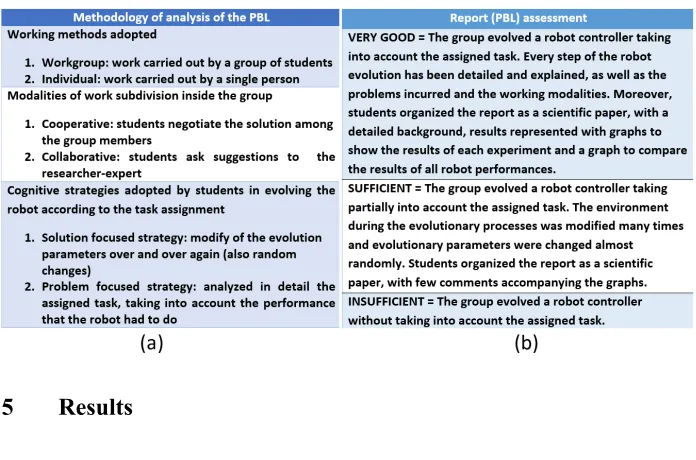
The entry questionnaire was made of six closed questions useful to collect some de-mographic data and to assess the level of computer science knowledge of the students. The questions were analysed from a quantitative point of view, calculating the fre-quencies for each answer and using SPSS®. The Science Motivation Questionnaire II [34] has been administered at the beginning (pre-test) of the research and at the end (post-test) to understand if motivational features (such as intrinsic motivation, self-determination, self-efficacy, career motivation, and grade motivation) might affect the students’ performance. Moreover, to understand Working methods, Modalities of work subdivision inside the group and Cognitive strategies adopted by students in evolving the robot according to the task assignment, the report (Project Based Learn-ing) [36] has been analysed according to Table 1 (a) and (b).
Table 1. Methodology of analysis of the Project Based Learning – PBL (a) and Report (PBL) assessment (b)
5
Results
5.1 Results of Entry Questionnaire
5.2 Results of Science Motivation Questionnaire
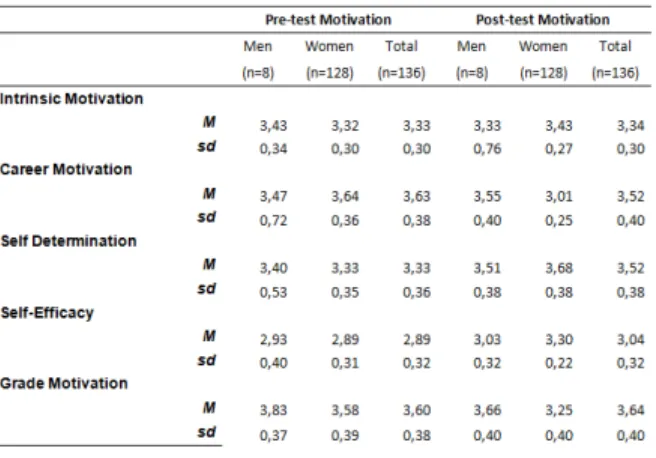
Since the objective of the research is to investigate how motivation affect learning, the Science Motivation Questionnaire II [34] has been administered at the begin (pre-test) and after the Robotics Lab (post-(pre-test). Cronbach alphas value has been calculated for the pre (.923) and the post-test motivation questionnaires (.934) and an excellent internal consistency for both tests emerged. We ran Mean and Standard Deviations on Pre and Post-Test Motivation questionnaire for each of the five following indicators (Table 2) Intrinsic Motivation, Career Motivation, Self Determination, Self-Efficacy, Grade Motivation. We have no meaningful gender differences, since a lower number of males (n=8) composed the sample.
Table 2. Mean value obtained by students in Pre and Post-test M-Mean and Standard Devia-tions on Pre- Post Test Motivation questionnaire
soft-ware (13%) and to discover the educational aspects of robotics. The same sample underlined the negative aspects of the Robotics Lab. 19% of the students judged the topic really complex, some students reported some difficulties regarding the project work (13%), and the software usability (42%). Finally, 26% of the students have experienced no negative aspects whatsoever.
6
Results of Project- Based Learning
Analyzing the project (PBL) developed by each workgroup, we obtained very inter-esting information. With regard to the “Working method adopted”, students freely chose the modality. In particular, 132 students worked in group (17 groups were com-posed by 2 persons, 18 groups were comcom-posed by 3 persons, 7 groups by 4 persons, 2 groups by 5 persons, 1 group by 6 persons), 4 students worked individually.
As concerning the “Modalities of work subdivision” inside the group, two ap-proach has been individuated: “Cooperative” and “Collaborative”. 17 groups adopted a Cooperative approach, in which students divided equally the work among the members of the group. In case of problems, they discusses within the group “what to do” and “how to solve” them cooperatively and negotiated the solution accordingly. At the end of the workgroup, students all together assessed the robot performances and opted whether or not to run further experiments. They used online resources or the scientific papers given during the course to support the completion of the workgroup. The other 28 workgroups adopted a Collaborative approach, in which students organized and negotiated efforts in the group. Problems were generally dis-cussed with the researcher-expert. At the end of the work, students all together as-sessed the robot performance. Also in this case, participants seek researcher-expert suggestions in order to decide whether or not to run further robot experiments. With regards to the students that worked individually, 3 of them asked several suggestions and explanations to the researcher-expert, while 1 of them ended the assigned task without asking further explanation and solving “through internet support” or “search-ing scientific papers” when problems occurred.
With respect to the Cognitive strategies adopted by students in evolving the robot according to the task assignment, we identified two main strategies: 1) Solution fo-cused strategy: Based on modifications of the evolutionary parameters over and over again (trials and errors); 2) Problem focused strategy: Based on detailed analysis of the assigned task, taking into account the performance that the robot had to do.
7
Conclusions and Future Plans
As the literature highlights (Section 1 and 2), the potentials of using robotics as an educational tool are really huge. However, according to Benitti [37], only a small number of researches applied a systematic methodology and standardized assessment tools, as well as low cost robotics tools. This paper adopted a systematic methodology for collect data on motivation, with the purpose to verify whether individuals’ motiva-tions affect the learning results of students with a humanistic background, engaged in experienced different Robotics concepts during an Educational Robotics Lab.
Concerning the motivation, a positive statistical correlation (Person product moment) has been recorded between Pre – and Post-test in the “Self-Efficacy” indicator, how-ever the value is too low to assume that a significant change has been produced by the laboratory activities. Nevertheless, this latter indicator (self-efficacy) refers to the students’ belief that students are firmly persuaded they can achieve good results in a "robotics lab". Hence, we could assume that students’ motivation is already higher at the beginning of the Robotics Lab course (as “Intrinsic motivation” value show) and no significant change can be recorded. In fact, the Robotics Lab is not mandatory in the Psychology course, and students freely chosen to attend it. Interestingly, the same students, in the open-ended questions (post-test motivation questionnaire) assert that “these activities stimulate curiosity”. For what concerns the proposed methodology, we think that the use of the Project Based Learning methodology allows the research-er to collect a great variety of data, since it engages students in exploring and investi-gating new concepts. Students do not feel to be evaluated and they feel free to write and express their opinions. However, we also asked them to supply some key infor-mation, such as the work modalities or to explain the different steps of the work. The learners that adopted a “solution focused” working strategy started by setting the robot’s and evolutionary parameters without analyzing in detail the assigned task. Indeed, they modified the robot over and over again, as well as the environment and the evolution parameters, changing also the type of robot and its internal memory. This approach is characterized by random changes. They simply compared the mean fitness values of each experiment at the end of the experiments. Students proceeded in the work for trials and errors. Learners who adopted a “problem focused” working strategy analyzed in detail the task assigned. Then, as first step, they defined the envi-ronment according to the given task, and then they chose a specific robot for all the experiments. They set the evolution parameters, as “explained in the report” and they changed the parameters one-by-one in order to correlate the results obtained to the parameters setting. As stressed by the results, we observed that a higher percentage of the groups took advantage from cooperation, using the group to discuss and to solve problems.
However, the results of this study are limited to one group. Further experimenta-tion are necessary with the inclusion of a control group in addiexperimenta-tion to the experimental one. In our opinion, it would be really interesting to verify how motivation changes the educational paradigm, administrating a pre and post-test both in a control group and in experimental one and how motivation affects learning results in both groups.
8
References
[1] Lund, H. H., & Miglino, O., 1998. Evolving and Breeding Robots. Proceedings of first Eu-ropean Workshop on Evolutionary Robotics, Paris, pp. 200-204. https://doi.org/10.1007/3-540-64957-3_73
[2] Faraco, G., & Gabriele, L. (2007). Using LabVIEW for applying mathematical models in representing phenomena. Computers and Education, 49 (3), pp. 856-872. https://doi.org/10.1016/j.compedu.2005.11.025
[3] Salomon, G., Perkins, D. N., & Globerson, T (1991). Partners in cognition: Extending hu-man intelligence with intelligent technologies. Educational Researcher, 20, pp. 2-9. https://doi.org/10.3102/0013189X020003002
[4] Caci, B., D’Amico, A., & Chiazzese, G. (2013). Robotics and Virtual Worlds: An experi-ential learning lab. In Biologically Inspired Cognitive Architectures 2012 (pp. 83-87). Springer Berlin Heidelberg. https://doi.org/10.1007/978-3-642-34274-5_19
[5] Gaudiello, I., & Zibetti, E. (2016). Learning Robotics, with Robotics, by Robotics: Educa-tional Robotics. John Wiley & Sons. https://doi.org/10.1002/9781119335740
[6] Bilotta, E., Gabriele, L., Servidio, R. C., & Tavernise, A. (2009a). Edutainment Robotics as Learning Tool. Lecture Notes in Computer Science (including subseries Lecture Notes in Artificial Intelligence and Lecture Notes in Bioinformatics), 5940 LNCS, 2009, pp. 25-35, https://doi.org/10.1007/978-3-642-11245-4_3
[7] Bilotta, E., Gabriele, L., Servidio, R. C., & Tavernise, A. (2009b). Edutainment robotics as learning tool. 4th International Conference on E-Learning and Games, Edutainment 2009; Banff, AB; Canada; 9 August 2009, 5670 LNCS, 2009, pp. 422. https://doi.org/10.1007/978-3-642-03364-3_50
[8] Piaget, J. (1967). Lo sviluppo mentale del bambino. Torino: Einaudi.
[9] Papert, S. (1991). Situating constructionism. In I. Harel & S. Papert (Eds.), Construction-ism (pp. 1–11). Norwood, NJ: Ablex Publishing.
[10] Gabriele, L., Tavernise, A., Bertacchini, F. (2012). Active learning in a robotics laboratory with university students. Cutting-Edge Technologies in Higher Education, 6 (PARTC), pp. 315-339. https://doi.org/10.1108/S2044-9968(2012)000006C014
[11] Ospennikova, E., Ershov, M., & Iljin, I. (2015). Educational Robotics as an Inovative Edu-cational Technology. Procedia-Social and Behavioral Sciences, 214, 18-26. https://doi.org/10.1016/j.sbspro.2015.11.588
[12] Tochá!ek, D., Lape", J., & Fuglík, V. (2016). Developing technological knowledge and programming skills of secondary schools students through the educational robotics pro-jects. Procedia-Social and Behavioral Sciences, 217, 377-381. https://doi.org/10.1016/ j.sbspro.2016.02.107
[13]Bertacchini F., Bilotta E., Pantano P. (in press). Shopping with a robotic companion, Com-puters in Human Behavior, https://doi.org/10.1016/j.chb.2017.02.064
[15]Abdechiri M., Faez K., Amindavar H., Bilotta E. (in press). The chaotic dynamics of high-dimensional systems. Nonlinear Dynamics, 87, 2597-2610. https://doi.org/10.1007/ s11071-016-3213-3
[16]Bilotta E., Pantano, P., Vena, S. (in press). Speeding up cellular neural network processing ability by embodying memristors. IEEE Transactions on Neural Networks and Learning Systems. https://doi.org/10.1109/TNNLS.2015.2511818
[17]Lombardo M. C., Barresi R., Bilotta E., Gargano F., Pantano P., Sammartino M. (in press). Demyelination patterns in a mathematical model of multiple sclerosis. J. Math. Bi-ol. https://doi.org/10.1007/s00285-016-1087-0
[18] Rodríguez, J. C. R., Martín-Pulido, E., Padrón, V. J., Alemán, J. A., García, C. R., & Que-sada-Arencibia, A. (2016, September). Ciberlandia: An Educational Robotics Program to Promote STEM Careers in Primary and Secondary Schools. In International Conference on Interactive Collaborative Learning (pp. 440-454). Springer, Cham.
[19] Sullivan, F. R. (2017). Creativity, Technology, and Learning: Theory for Classroom Prac-tice. Routledge.
[20] Agatolio, F., Pivetti, M., Di Battista, S., Menegatti, E., & Moro, M. (2016, November). A Training Course in Educational Robotics for Learning Support Teachers. In International Conference EduRobotics 2016 (pp. 43-57). Springer, Cham.
[21] Bers, M.U., Flannery, L., Kazakoff, E. R., & Sullivan, A. (2014). Computational thinking and tinkering: Exploration of an early childhood robotics curriculum. Computers & Educa-tion, 72, 145-157. https://doi.org/10.1016/j.compedu.2013.10.020
[22] Schneider, F. E., Wildermuth, D., & Wolf, H. (2012). Professional Ground Robotic Com-petitions From an Educational Perspective A Consideration Using the Example of the Eu-ropean Land Robot Trial (ELROB), Intelligent Systems (IS), 2012 6th IEEE International Conference, Sofia, 6-8 Sept. 2012, pp. 399 – 405.
[23] Bertacchini, F., Gabriele, L., Tavernise, A. (2011). Bridging educational technologies and school environment: Implementations and findings from research studies, Educational Theory, pp. 63-82.
[24] Kärnä-Lin, E., Pihlainen-Bednarik, K., Sutinen E., & Virnes, M. (2006). Can Robots Teach? Advanced Learning Technologies, 2006. Sixth International Conference on, pp.319,321, 5-7 July 2006
[25] Valadão, C., Bastos, T.F., Bôrtole, M., Perim, V., Celino, D., Rodor, F., Gonçalves, A., & Ferasoli, H. (2011). Educational Robotics as a Learning Aid for Disabled Children. Bi-osignals and Biorobotics Conference (BRC), Jan. 2011, pp. 6-8. https://doi.org/10.1109/ brc.2011.5740667
[26] Buiu, C. (2008). Hybrid Educational Strategy for a Laboratory Course on Cognitive Ro-botics, IEEE TRANSACTIONS ON EDUCATION, 51(1), 100 – 107. https://doi.org/10.1109/TE.2007.906605
[27] Alimisis, D. Frangou, S. Papanikolaou K. (2009). A Constructivist Methodology for Teacher Training in Educational Robotics: the TERECoP Course in Greece through Train-ees’ Eyes. Advanced Learning Technologies, 2009. ICALT 2009. Ninth IEEE Internation-al Conference on, pp.24-28, 15-17 July 2009, https://doi.org/10.1109/ICALT.2009.86 [28] Correll, N., Wing, R., Coleman, D. (2013). A One-Year Introductory Robotics Curriculum
for Computer Science Upperclassmen. IEEE TRANSACTIONS ON EDUCATION, 56 (1), 54 – 60. https://doi.org/10.1109/TE.2012.2220774
[30] Eteokleous-Grigoriou, N., & Psomas, C. (2013). Integrating Robotics as an Interdiscipli-nary-Educational Tool in Primary Education. In R. McBride & M. Searson (Eds.), Pro-ceedings of Society for Information Technology & Teacher Education International Con-ference 2013 (pp. 3877-3881). Chesapeake, VA: AACE.
[31] Yilmaz, M., Ozcelik, S., Yilmazer, N., & Nekovei, R. (2013). Design-Oriented Enhanced Robotics Curriculum, IEEE TRANSACTIONS ON EDUCATION, 56 (1), 137-144. [32] Gabriele, L., & Bilotta E. (2013). ROBOT FOR THINKING: COGNITIVE STRATEGIES
TO EXPERIMENT THE USE OF EDUCATIONAL ROBOTICS IN CLASSROOM, EDULEARN13 Proceedings, pp. 5801-5810.
[33] Bertacchini F., Bilotta E., Gabriele L., Servidio R., 2010. USING LEGO MINDSTORMS IN HIGHER EDUCATION: Cognitive strategies in programming a quadruped robot, The 18th International Conference on Computers in Education, ICCE 2010, November 29, 2010 (Monday) to December 3, 2010 (Friday) Putrajaya, Malaysia.
[34] Glynn, S. M., Brickman, P., Armstrong, N., & Taasoobshirazi, G. (2011). Science Motiva-tion QuesMotiva-tionnaire II: ValidaMotiva-tion with science majors and nonscience majors. Journal of Research in Science Teaching, 48, 1159-1176. https://doi.org/10.1002/tea.20442
[35] Gigliotta, O. Petrosino, G., Schembri, M. (2011). BrainFarm: Cervelli robotici a portata di mouse. Atti dell’ottavo Convegno Nazionale Associazione Italiana di Scienze Cognitive, AISC’11 (edited by), Rubinacci, F. Rega, A., Lettieri, N., Milano 1-2 dicembre 2011. [36] Chu, S. K. W., Tse, S. K., & Chow, K. (2011). Using collaborative teaching and inquiry
project based learning to help primary school students develop information literacy and in-formation skills. Library & Inin-formation Science Research, 33(2), 132–143. https://doi.org/10.1016/j.lisr.2010.07.017
[37]Benitti, B. F. V., (2012). Exploring the educational potential of robotics in schools: a sys-tematic review. Computers & Education, 58(3), 978–988 https://doi.org/10.1016/j.comp edu.2011.10.006
9
Authors
Lorella Gabriele is with the Physics Department, University of Calabria, Rende, Italy. She is a post-doc Fellow and is interested in the following topics: psychology of programming, educational technologies and their use in didactic context, learning, techniques of Human Computer Interaction, communications systems and their use for educational purposes. She is an occasional referee of the journals Computers & Education, Scientific Research and Essays, and member of the Editorial Board of the Journal of Applied Research in Higher Education (JARHE). She worked in different national and international projects ([email protected]).
Davide Marocco received his PhD in Artificial Intelligence at the University of Calabria, Italy, in 2004. He is currently Associate Professor in Psychometric at the University of Naples Federico II. He was previously Reader on Cognitive Robotics and Intelligent Systems at the University of Plymouth, UK. His research interests are focused on alternative assessment of human and artificial systems performances, cognitive robotics and evolutionary robotics models of behavior (e-mail: [email protected]).
member of the research group ESG (http://galileo.cincom.unical.it/), and works in the Laboratory of Psychology and Cognitive Science at University of Calabria, designing educational-entertaining environments for science communication and education. Among her research interests we can cite the followings: Educational Technologies, Art & Science, Scientific Visualization, Psychology of Music ([email protected]).
Pietro Pantano is with the Physics Department, University of Calabria, Rende, Italy. He is a full Professor of Physics and Mathematics at University of Calabria. His main research interests concern several topics according to an interdisciplinary ap-proach, among which we can cite the followings: e-Learning systems; Scientific communication; Artificial life. He is a member of several national and international scientific communities, scientific committees and organized several congresses and workshops. From 2011 is the director of a Doctoral School at University of Calabria. He participated in national and international projects as responsible of local research unit as well as international coordinator ([email protected]).
Eleonora Bilotta is with the Physics Department, University of Calabria, Rende, Italy. She is a full professor of General Psychology at University of Calabria, Italy, where she is also the director of the Cognitive Psychology Laboratory. Her research interests concern various scientific topics from an interdisciplinary point of view and comprise the following areas: Human Computer Interaction, Psychology of Pro-gramming, Information and communication technologies, Educational Technologies. She published more than 200 scientific papers and is the author of various books. She was the coordinator of (or participated in) national and international projects. Moreo-ver, she is a member of several national and international scientific communities ([email protected]).
![Fig. 1. A screenshot of BrainFarm software [35]](https://thumb-us.123doks.com/thumbv2/123dok_us/580319.2057268/5.595.139.457.484.677/fig-screenshot-brainfarm-software.webp)