Evidence from randomised controlled
trials does not support current dietary
fat guidelines: a systematic review
and meta-analysis
Zoë Harcombe,1Julien S Baker,1James J DiNicolantonio,2Fergal Grace,1 Bruce Davies3
To cite:Harcombe Z, Baker JS, DiNicolantonio JJ,
et al. Evidence from
randomised controlled trials does not support current dietary fat guidelines: a systematic review and meta-analysis.Open Heart2016;3: e000409. doi:10.1136/ openhrt-2016-000409
Received 15 January 2016 Revised 20 April 2016 Accepted 1 July 2016
1Institute of Clinical Exercise and Health Science, University of the West of Scotland, Lanarkshire, UK 2Saint Luke’s Mid America Heart Institute, Kansas City, Missouri, USA
3University of South Wales, Pontypridd, UK
Correspondence to Zoë Harcombe;
ABSTRACT
Objectives:National dietary guidelines were
introduced in 1977 and 1983, by the USA and UK governments, respectively, with the ambition of reducing coronary heart disease (CHD) mortality by reducing dietary fat intake. A recent systematic review and meta-analysis by the present authors, examining the randomised controlled trial (RCT) evidence available to the dietary committees during those time periods, found no support for the recommendations to restrict dietary fat. The present investigation extends our work by re-examining the totality of RCT evidence relating to the current dietary fat guidelines.
Methods:A systematic review and meta-analysis of
RCTs currently available, which examined the relationship between dietary fat, serum cholesterol and the development of CHD, was undertaken.
Results:The systematic review included 62 421
participants in 10 dietary trials: 7 secondary prevention studies, 1 primary prevention and 2 combined. The death rates for all-cause mortality were 6.45% and 6.06% in the intervention and control groups, respectively. The risk ratio (RR) from meta-analysis was 0.991 (95% CI 0.935 to 1.051). The death rates for CHD mortality were 2.16% and 1.80% in the intervention and control groups, respectively. The RR was 0.976 (95% CI 0.878 to 1.084). Mean serum cholesterol levels decreased in all intervention groups and all but one control group. The reductions in mean serum cholesterol levels were significantly greater in the intervention groups; this did not result in significant differences in CHD or all-cause mortality.
Conclusions:The current available evidence found no
significant difference in all-cause mortality or CHD mortality, resulting from the dietary fat interventions. RCT evidence currently available does not support the current dietary fat guidelines. The evidence per se lacks generalisability for population-wide guidelines.
INTRODUCTION
US public health dietary advice was
announced by the Select Committee on Nutrition and Human Needs in 19771 and was followed by UK public health dietary
advice issued by the National Advisory Committee on Nutritional Education in 1983.2 Dietary recommendations in both cases focused on reducing dietary fat intake, specifically to (i) reduce overall fat consump-tion to 30% of total energy intake and (ii)
KEY QUESTIONS
What is already known about this subject? ▸ Dietary recommendations were introduced in the
USA (1977) and in the UK (1983) to (i) reduce overall fat consumption to 30% of total energy intake and (ii) reduce saturated fat consumption to 10% of total energy intake. We recently reported, in a previous meta-analysis, that the available randomised controlled trial (RCT) evi-dence did not support the introduction of these dietary fat guidelines. Further, we reported that the RCTs were undertaken on 2467 men from exclusively or largely secondary prevention studies.
What does this study add?
▸ RCT evidence currently available does not support the current recommendations to restrict dietary fat. The lack of generalisability of current evidence prevails. This study finds that only one primary prevention RCT, including men and women, is available to inform public health advi-sors and that this was without statistical significance.
How might this impact on clinical practice? ▸ Public health advice on dietary fat has prevailed
since 1977/1983 in the absence of supporting evidence from RCTs. The US 2015 draft dietary guidelines exclude recommendations for total fat for the first time, but maintain the advice to restrict saturated fat. The current evidence does not support this recommendation. The UK advice has not changed since 1983. Clinicians would be justified in taking a more cautionary approach to their advising of patients on these dietary fat recommendations.
on September 12, 2020 by guest. Protected by copyright.
reduce saturated fat (SFA) consumption to 10% of total energy intake.
The recommendations were intended to address mor-tality from coronary heart disease (CHD). We recently published a systematic review and meta-analysis,3 which reported that evidence from randomised controlled trials (RCTs), available to the dietary guideline commit-tees, did not support the introduced dietary fat recom-mendations. This systematic review and meta-analysis extends this work by re-examining the totality of RCT evidence, currently available, relating to the present dietary fat guidelines.
While no previous study had reviewed the evidence available to the 1977 and 1983 committees, a number of meta-analyses have reviewed RCT and/or epidemio-logical evidence available at their respective times of publication.4–11 None has found any significant result for dietary fat intervention and mortality: all-cause, car-diovascular disease (CVD) or CHD mortality.
A meta-analysis by Skeaff and Miller in 2009 included 28 US and European cohorts (6600 CHD deaths among 280 000 participants) and found no clear relationship between total or SFA intake and CHD events or deaths.4
In 2010, Siri-Tarinoet al5undertook a meta-analysis of 21 prospective cohort studies involving 347 747 partici-pants, evaluating the association of SFA with CVD. They reported that there is no significant evidence for con-cluding that dietary SFA is associated with an increased risk of CHD or CVD.
Hooper et al6 7 examined RCT evidence in 2011 and 2015 and found no significant difference for total mor-tality or cardiovascular mormor-tality resulting from modified dietary fat intake, reduced dietary fat intake or com-bined modified and reduced dietary fat intake.
Chowdhuryet al’s8meta-analysis of RCTs and prospect-ive cohort studies found no association of dietary SFA intake, nor of circulating SFAs, with CHD.
Schwingshackl and Hoffmann examined RCTs that reduced or modified dietary fat with regard to all-cause mortality, CVD mortality and CVD events, in participants with established CHD. They concluded that there was no evidence for benefit of reduced/modified fat diets in the secondary prevention of CHD.9
Mozaffarian et al10 reported evidence that consuming polyunsaturated fats in place of SFAs reduced CHD events, not mortality, in RCTs.
A number of these reviews have been challenged. Stamler posed questions following the Siri-Tarino et al publication.12 Chowdhury et al’s8 meta-analysis received a number of letters of response, which led to the ori-ginal article being amended. Mozaffarian et al’s review was criticised13 for excluding two unfavourable trials14 15 and for including the non-randomised, cross-over trial excluded by other reviews.16 17
The most recent meta-analysis by Hooper et al7 sug-gested that reduction of SFA intake may result in a small but potentially important reduction in cardiovascular risk, not mortality.
There were two important findings of Harcombe
et al:3first, the evidence available to the dietary commit-tees did not support the introduced guidelines; second, the evidence available had serious limitations and was inappropriate to use for population-wide recommenda-tions. The six studies available in 198314 15 18–21 had reviewed 2467 men and no women. Five of the six
studies were secondary prevention; one included
primary and secondary prevention subjects.21
Based on these secondary findings, selection criteria for meta-analysis to inform population-wide recommen-dations should be restricted to RCTs, of sufficient size and duration, with primary prevention subjects, man and woman. There is only one study meeting these cri-teria,22 the Minnesota Coronary Survey, and the results of this were not significant.
As a meta-analysis cannot be undertaken on the one primary prevention, both-sex, study available, this follow-up study retains the selection criteria and thus limitations of Harcombe et al3 to re-examine dietary guidelines, for total and SFA, to assess their evidence base against the RCT evidence currently available.
METHODS
A systematic review and meta-analysis was conducted in accordance with the Preferred Reporting Items for
Systematic Reviews and Meta-Analyses (PRISMA)
guidelines.23
Search strategy
A search was undertaken to identify RCTs that examined the relationship between modified or reduced dietary fat intake, serum cholesterol and mortality from CHD and all-causes. Exclusion criteria were as follows: study being observational; non-randomised and/or multi-factorial in design. Inclusion criteria were as follows: ran-domised dietary intervention study; study hypothesis relating to a reduction or modification of dietary fat; participants were human adults; study was a minimum of 1 year in duration; primary study outcome was all-cause and CHD mortality; and data on all-cause mortality, CHD mortality and cholesterol measurements were available.
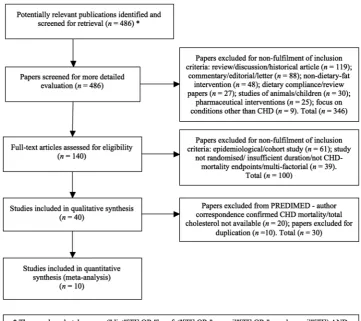
Searches were performed of the literature using MEDLINE, Embase and the Cochrane Library. AMED and SIGLE (grey literature sources) were not relied upon, as their periods covered were not compatible: 1985 and 1992, respectively24 25(figure 1).
Selection of studies
Of 486 identified articles, 346 were rejected on review of the title and abstract. Of these, 119 were rejected for being review, discussion or historical articles. In total, 88 were commentaries, editorials or letters. A total of 48 were rejected for having an intervention relating to a particular food or supplement, rather than dietary fat. There were 30 studies where animals or children/
on September 12, 2020 by guest. Protected by copyright.
adolescents were the primary focus. A further 27 papers considered the design and challenges of dietary inter-ventions, for example examining the difficulties of achieving compliance. In total, 25 were rejected for being surgical and/or pharmacological interventions. Nine related to conditions other than CHD, such as cancer and stress. Finally, 140 papers remained, of which 61 were rejected on closer inspection of the paper for being epidemiological/cohort studies and 39 were rejected for not meeting the inclusion criteria.
The remaining 40 papers covered 11 trials, once dupli-cation was resolved. In total, 10 RCTs met the inclusion criteria: Rose Corn Oil Trial;14 Research Committee
Low-fat Diet;19 Medical Research Council (MRC)
Soya-bean Oil Trial;18 LA Veterans Study;21 the Oslo Diet-Heart Study;20 26 the Sydney Diet Heart Study;15
the dietary fat intervention from the Diet and
Reinfarction Trial (DART);27 the Minnesota Coronary Survey;22 the St Thomas’ Atherosclerosis Regression Study (STARS);28 and the Women’s Health Initiative (WHI).29 Following correspondence, the PREvención
con DIeta MEDiterránea (PREDIMED) study30 was
rejected for non-availability of CHD mortality and total cholesterol data.
To ascertain the validity of eligible randomised trials, a pair of reviewers (ZH and BD) worked independently to determine which studies met the inclusion criteria. The same 10 were agreed on. Risk of bias was further assessed using the Cochrane Collaboration assessment tool31 for selection bias (random sequence generation, allocation concealment); performance/detection bias (blinding of participants and personnel, blinding of outcome assessment); attrition bias (incomplete data outcome); and reporting bias (selective reporting) (figure 2). Additionally, the meta-analyses for all-cause mortality (figure 3) and CHD deaths (figure 4) were tested for sensitivity analysis of the exclusion of any one study.
Data extraction
Table 1 details data extraction including study name, duration, year of publication and confirmation of study Figure 1 Summary of systematic review profile. CHD, coronary heart disease; PREDIMED, PREvención con DIeta
MEDiterránea study.
on September 12, 2020 by guest. Protected by copyright.
design; participant characteristics; details of intervention and comparison diet; and outcomes relating to all-cause mortality, CHD-related deaths and changes in mean serum cholesterol levels. Where a study contained more than one intervention, both were included,14 22 which resulted in 12 interventions for review.
Statistical analysis
The overall pooled effect was calculated using
random-effects meta-analysis. Heterogeneity and bias
were quantified using the I² and T² calculations, I2=100%×(Q−df )/Q, where Q is Cochran’s heterogen-eity statistic and df is the degrees of freedom. Funnel plot methodology and Egger’s regression intercept32 33
were calculated. Analyses were performed using
Comprehensive Meta-Analysis.34
RESULTS
Participants and study design
The 10 identified RCTs included a total of 3888 deaths from all-causes and 1218 deaths from CHD among 62 421 participants (table 1). The most recent trial, the WHI, dominated the data pool with 78% of the partici-pants,29 but the results remained non-significant with the exclusion of this study. Excluding this study leaves 13 586 participants and results in a risk ratio (RR) for all-cause mortality from meta-analysis of 1.005 (95% CI 0.922 to 1.097) and a RR for CHD mortality from meta-analysis of 0.962 (95% CI 0.850 to 1.089) (both random-effects methodology).
The WHI trial was a primary and secondary preven-tion trial for women only. The Minnesota Coronary Survey was a primary prevention study, with data for men and women reported separately.22 The LA Veterans Study21 comprised one-fifth secondary and four-fifths primary prevention subjects. The remaining studies were secondary prevention studies with exclusively male participants.
The mean duration of the 10 trials was 4.7±3.3 years. The weighted mean duration ( person years by partici-pants) was 6.8±2 years.
All trials were parallel and randomised, avoiding selection bias (figure 2).31 Two studies reported
alloca-tion concealment;14 29 the remaining eight were
unclear for this aspect of selection bias. Eight were blinded for outcome assessment14 18 19 21 22 27–29 and thus at low risk of detection bias. Two were open, with no, or unclear, blinding on either side,15 20 at high risk of performance and detection bias. The LA Veterans Study21 was reported as double blinded, but the dietary changes were so substantial that this was Figure 2 Methodological quality summary: review authors’
judgements about each methodological quality item for each included study. DART, Diet and Reinfarction Trial; MRC, Medical Research Council; STARS, St Thomas’
Atherosclerosis Regression Study; WHI, Women’s Health Initiative.
Figure 3 Estimates of total mortality (95% CIs) from meta-analysis for all deaths. DART, Diet and Reinfarction Trial; MRC, Medical Research Council; STARS, St Thomas’
Atherosclerosis Regression Study; WHI, Women’s Health Initiative.
on September 12, 2020 by guest. Protected by copyright.
Figure 4 Estimates of total mortality (95% CIs) from meta-analysis for CHD deaths. DART, Diet and Reinfarction Trial; MRC, Medical Research Council; STARS, St Thomas’
Atherosclerosis Regression Study; WHI, Women’s Health Initiative.
Table 1 Outcome data from included trials of diet and events for intervention (Int) and control (Ctrl) groups
Study
Participants Intervention Outcomes
Int/Ctrl Type Years Diet
All deaths Int/Ctrl
CHD deaths Int/Ctrl
Change in mean serum cholesterol Int/Ctrl (%)
Rose Corn oil Rose Olive oil14
28/26* (M under 70)
26/26* (M under 70)
S 2 64 g corn oil/day 58 g olive oil/day + many banned foods
5/1* 3/1*
5/1* 3/1*
−7.6/−1.2 −0.4/−1.2
Low-fat Diet19 123/129 (M under 65)
S 3 40 g fat/day 20/24 17/20 −16.9/−12.4
MRC
Soya-bean Oil18
199/194 (M under 60)
S 3.4 85 g soya-bean oil/ day + many banned foods
28/31 27/25 −16.9/−5.9
LA Veterans Study21
424/422 (M age 55+)
P/S 8 40% calories from fat, 2/3 fat from veg oils
174/177 41/50 −18.0/−14.1
Oslo Diet-Heart Study20
206/206 (M 30– 64 years)
S 11 40% calories from fat, 72% fat from
soya-bean oil
101/108 79/94 −17.6/−3.7 (5-year data)
Sydney Diet Heart Study15
221/237 (M 30– 59 years)
S 5 10% sat/15% poly vs 14% sat/9% poly
39/28 35/25 −11.0/−7.1
DART Fat advice27
1018/1015 (M under 70)
S 2 Total fat 30% P/S=1 111/113 97/97 −2.8/+1.2
Minnesota Coronary Survey22 Men Women
4393 M
4664 W (all ages) 2197/2196 2344/2320
P 1 Ctrl: 39% calories fat (18% sat; 5% poly; 16% mono) Int: 38% calories fat (9% sat; 15% poly; 14% mono)
158/153 111/95
62/54 43/47
Cholesterol not reported separately for men/women
−15.5/−1.9
STARS28 27/28 (M under 66)
S 3.25 27% calories fat (8–10% sat; 8% poly)
1/3 1/3 −14.0/−1.8
WHI29 19 541/29 294 (W 50–79 years)
P/S 8.1 20% calories fat; 7% calories sat fat
950/1454 158/234 −4.4/−3.4 (3-year data)
Total 26 354/36 067 1701/2187 568/650 Mean−11.4%/−4.7%
SD 6.5/4.8
In‘Int/Ctrl’: M, men; W, women.
In‘Type’: P, primary prevention study; S, secondary prevention study.
In‘Diet’: P/S, polyunsaturated:saturated fat ratio; poly, polyunsaturated fat; sat, saturated fat. *Control not double counted.
DART, Diet and Reinfarction Trial; MRC, Medical Research Council; STARS, St Thomas’Atherosclerosis Regression Study; WHI, Women’s Health Initiative.
on September 12, 2020 by guest. Protected by copyright.
implausible (egg consumption quantified, vegetable oils added and animal fats restricted). The Minnesota Coronary Survey was reported as double blinded and this was plausible given the dietary intervention.22 The open enrolment and departure in the LA Veterans and Minnesota institutions21 22 produced attrition bias. The STARS28 was judged unclear for attrition bias for the relatively high number of dropouts in small participant numbers. All studies were judged low risk for reporting bias, as there was no evidence of any data being with-held (figure 2).
The meta-analyses for all-cause mortality (figure 3) and CHD deaths (figure 4) were tested for sensitivity analysis of the exclusion of any one study. There were no circumstances in which the exclusion of any one study made the overall effect size significant.
There was little evidence for between-study heterogen-eity. For all deaths, the Q-value was 7.915 (11 df ), but this was not statistically significant; p=0.721. I² was 0.000 and T² was 0.000, indicating no difference in true effects. For CHD deaths, the Q-value was 9.173 (11 df ), but this was also not statistically significant; p=0.606. I² was 0.000 and T² was 0.000.
Visual inspection of the funnel plots revealed that one study was touching the outside of the SE funnel for the meta-analysis of all deaths and CHD deaths. The two, small, oil interventions14 produced asymmetry on the lower right-hand side of the funnel, which was countered by the small STARS representation on the lower left-hand side.28 The Egger’s regression test indi-cated no statistically significant asymmetry for all-cause mortality and CHD deaths. The Egger’s regression intercept was 0.337 (95% CI, two-tailed, −0.489 to 1.163) (one-tailed p=0.192; two-tailed p=0.384) for all-cause mortality and 0.380 (95% CI, two-tailed, −0.756 to 1.517) (one-tailed p=0.237; two-tailed p=0.473) for CHD deaths.
Interventions and comparisons
A total of 6 of the 10 RCTs did not examine either of the introduced dietary guidelines: a total fat consump-tion of 30%; or a SFA consumpconsump-tion of 10%, of energy intake.14 18–21 29Four trials examined the administration of vegetable oil,14 18 20 21 to effect reduced intake of animal fat. The Research Committee Low-fat Diet19 and
the WHI29 studied an approximate 20% fat diet.
Woodhill et al15 and Frantz et al22 reviewed the conse-quence of a 10% SFA diet, without the total fat dietary guideline restriction. Woodhillet alreported higher inci-dence of all-cause mortality and CHD deaths in the intervention group. Frantz et al recorded no difference in all-cause mortality or CHD deaths. The DART27 tested a 30% total fat diet although this was not a con-trolled variable, as the intervention also tried to achieve a 1:1 polyunsaturated to SFA ratio. The STARS28 was the
first to examine targets approximating to those set by dietary guidelines with a total fat consumption of 27% and an 8–10% SFS intake.
Outcomes: all-cause mortality
Across 10 studies, containing 12 dietary interventions, involving 26 354 participants in the intervention groups and 36 067 participants in the control groups, there were 1701 deaths in the intervention and 2187 deaths in the control groups. All-cause mortality was 6.45% in the intervention groups and 6.06% in the control groups.
For all-cause mortality, the WHI study29 carried the greatest weight, 54.35% (figure 3; random-effects meth-odology). Three studies, comprising four interventions, carried a combined weight of 35%.20–22 The Roseet al14 corn and olive oil interventions had negligible impact on the overall effect, with weights of 0.04% and 0.07%, respectively, as did the STARS with a weight of 0.07%.28 The RR for all 12 interventions was 0.991 (95% CI 0.935 to 1.051). The overall effect measurement lies on the line of no effect. There was no statistically significant dif-ference between dietary interventions and all-cause mortality.
CHD mortality
The 12 interventions recorded 568 deaths from CHD among 26 354 participants in the intervention groups and 650 deaths from CHD among 36 067 participants in the control groups. The death rates for CHD mortality were 2.16% and 1.80% in the intervention and control groups, respectively. The forest plot for the dietary
inter-ventions and deaths from CHD produced the
meta-analysis shown in figure 4 (random-effects
methodology).
For CHD mortality, the WHI study29 carried the great-est weight, 27.59% (figure 4; random-effects method-ology). The Oslo study20 was comparable with a weight of 21.36% and the DART27 contributed 15.56% to the weighting. The Rose et al14 corn and olive oil interven-tions had negligible impact on the overall effect, with weights of 0.14% and 0.24%, respectively, as did the STARS with a weight of 0.23%.28The RR for all 12 inter-ventions was 0.976 (95% CI 0.878 to 1.084). The overall effect measurement lies on the line of no effect. There was no statistically significant difference between the dietary interventions and heart deaths.
Serum cholesterol levels
Mean serum cholesterol levels decreased in all groups, control and intervention, except for the DART,27 where cholesterol levels were 1.2% higher in the control group after 2 years. This was unlikely to be clinically relevant.35 None of the reductions in mean serum cholesterol levels exceeded the critical difference of 19%, calculated by Fraser and Fogarty35as the requirement for significance ( p<0.05).
Three studies alone15 27 28 reported SDs and signifi -cance for the start and end-of-study mean serum choles-terol levels. The one figure reported as statistically significant was the 14% reduction in mean serum chol-esterol levels in the intervention group in the STARS ( p<0.001).28 The 8-year WHI study29 reported the
on September 12, 2020 by guest. Protected by copyright.
reductions in mean serum cholesterol levels in the inter-vention and control groups as 10.2±32.0 mg/dL and 6.9 ±31.9 mg/Dl, respectively, and reported the difference between the reductions, 3.26 mg/dL, as significant at p<0.05 from a 2-sample test.
The standardised mean difference in serum choles-terol levels, for the 10 trials (12 interventions) com-bined, was −11.4%±6.5% for the intervention groups and −4.7%±4.8% for the control groups (table 1). The effect size was 1.18.
DISCUSSION
The main findings of our systematic review and
meta-analysis are that currently available RCT evidence does not support the current dietary fat guidelines. RCT evidence indicates that dietary modification may reduce serum cholesterol to a marginally greater extent in inter-vention groups, compared with controls. However, this reduction in serum cholesterol does not appear to trans-late into an improved survival from all causes or CHD.
Design limitations
As noted in the introduction, the fundamental design limitation of dietary fat interventions available to inform public health advice is that only one study22 has been undertaken involving men and women without previous heart disease. All other RCTs have been single-sex and/or secondary prevention studies.
The method of extracting dietary information was a limitation of all studies. Dietary recall is generally unreli-able and 24-hour recall may not be representative of usual diet.36 37 Dietary surveys, where food is weighed at the time of being recorded, are also unreliable.38 39
Woodhill et al noted that it is ‘insuperable’ to isolate dietary factors in a secondary prevention study. This is a
flaw of all secondary prevention studies, not a unique
flaw of this study. The study noted that changes in smoking habit, dietary pattern, body weight, lifestyle and physical activity before and after entry to the trial may have had a significant effect on prognosis ( page 326).15
There are some additional design limitations among the available RCTs, which may confound interpretation. A number of studies14 18 19 28 impaired assessment of the primary dietary intervention by adding other dietary restrictions, such as the avoidance of processed foods. This would impact industrially produced trans fat intake, which is associated with CHD.8 40 The low-fat diet19 resulted in the calorie intake in the intervention group ranging between 330 and 780 calories fewer than that of the control group. At the largest differential, observed after 4 years of the study, the diet group was consuming 70% of the calorie intake of the control group. This study reported mean weight loss as 7.5% in the interven-tion group and 4.8% in the control group. This may have favoured the intervention outcomes. The STARS28 may also have favoured the intervention group by restricting participants to 1200 kcal daily until a body
mass index (BMI) of 25 was achieved. Further, dietetic counselling and suitable foods were given to participants in the intervention group who did not achieve or main-tain serum cholesterol reductions of 15%, making serum cholesterol levels a target, not an outcome.
The LA Veterans Study21 recorded the lowest RR for CHD deaths for the intervention group: 0.816 (95% CI 0.552 to 1.206) (figure 3). However, there were import-ant differences in the groups at study entry, favouring the intervention outcomes: 2.8% of the intervention group were octogenarians, compared with 5% in the control group; 11% of the experiment group were heavy smokers (more than one pack a day) compared with 17% of the control group.
Additional limitations were the short duration (1 year) of the second largest study, the Minnesota Coronary Survey with 9057 participants.22 Two of the studies were small,14 28 although meta-analysis weights this accord-ingly. Leren20 benefited from trial length, but the study discussion noted that the test groups were too small to be significant for fatal incidences. The summary also reported that CHD mortality was correlated with age, blood pressure, body weight, smoking habits and a com-bination of these factors, meaning that the association with diet alone could not be isolated.
The WHI study29 was of substantial size and duration, but with a number of confounding variables. It was limited in its focus on postmenopausal women, aged between 50 and 79, and who were not already consum-ing dietary fat below 32% of total calorie intake. Participants were additionally invited to receive hormone therapy and participation in a calcium/ vitamin D supplement trial was offered after 1 year. This study alone included cholesterol-lowering medication, which was taken by 12% of participants in the interven-tion and control groups.
A limitation of the meta-analysis of the 10 studies com-bined was that all RCTs differed in duration; number of participants; nature of intervention; other factors held constant and subject age groups, undermining possible conclusions, although the statistical homogeneity helps to mitigate concerns.
Study conclusions
Only one of the 10 RCTs presented a case for dietary guidelines. The STARS28 claimed that its findings sup-ported the use of a lipid-lowering diet in men with CHD. The 5-year review of the Oslo Diet-Heart Study26 concluded that the cholesterol-lowering diet reduced the incidence of total CHD relapses. The conclusion after 11 years was more reserved: that sudden death in survivors of myocardial infarction was uninfluenced by diet.20
Four studies were neutral in their findings.18 22 27 29 The MRC study found no evidence from the London trial that the relapse rate in myocardial infarction is materially affected by the unsaturated fat content of the diet.18 The DART27 made no claim for dietary fat
on September 12, 2020 by guest. Protected by copyright.
reductions, but concluded that two to three portions of fatty fish each week may reduce mortality in men who have recovered from a myocardial infarction. The Minnesota Coronary Survey22 found no differences between the treatment and control groups for cardiovas-cular events, cardiovascardiovas-cular deaths or total mortality. The WHI29 reported that an 8.2% energy decrease in total fat intake had been achieved and a 2.9% energy decrease in SFA intake, but that this did not reduce risk of CHD.
The other four studies issued cautions about the safety and/or efficacy of their interventions.14 15 19 21 Rose et al14 reported that corn oil was most unlikely to be beneficial, and was possibly harmful. The Research Committee19 concluded that a low-fat diet has no place in the treatment of myocardial infarction. Daytonet al21 noted the absence of any benefit for longevity and expressed concern about toxicity of the intervention. Woodhill et al15 reported that survival was significantly better in the control than the diet group.
This meta-analysis of 10 RCTs, in comparison with Harcombe et al’s review of 6 RCTs,3 increased the number of people studied from 2467 to 62 447. It increased the number of women studied from 0 to 53 499, the majority. It increased the number of primary prevention subjects from 67621to 56 291. However, 83% of the primary prevention subjects were postmenopausal women, so the concern about generalisability remains for guidelines introduced for whole populations.
Review of dietary guidelines
The US dietary guidelines advisory committee (DGAC) report was published in February 2015.41 The recom-mendation to limit dietary cholesterol intake to 300 mg a day has prevailed in the USA since 1977.1The DGAC stated that they will not bring forward this recommenda-tion, because available evidence shows no appreciable relationship between consumption of dietary cholesterol and serum cholesterol.41 The UK did not introduce dietary cholesterol targets in the original guidelines2 42 and they have not been introduced since.43
The DGAC advice demonstrated further movement away from the original dietary guidelines by containing no total fat recommendation and a change in position on dietary fat and CVD. The advisory report documen-ted the findings of the meta-analyses by Skeaff,4 Siri-Tarino,5 Hooper6 and Chowdhury,8 and concluded that reducing total fat does not lower CVD risk.41 The SFA guideline was reiterated, however, with the recom-mendation to consume <10% of total calories from SFA per day.41
The UK does not review dietary guidelines at regular intervals. The target for total fat remains 30% of daily total energy intake and 10% for SFA.43
Dietary fat guidelines were introduced with the inten-tion of reducing CHD mortality. No meta-analysis has found any significant difference for dietary fat
inter-ventions and all-cause mortality or deaths from
CHD.3–8 10 44All but one study22is of single-sex and/or secondary prevention subjects. Even in men who have already suffered a myocardial infarction, evidence does not support dietary recommendations; yet they have been issued for millions of citizens for three to four decades.
The most recent meta-analysis,7 with the same single-sex, secondary prevention limitations, suggested that there may be a small reduction in cardiovascular risk on reduction of SFA intake. It was further suggested that replacing the energy from SFA with polyunsaturated fat appeared to be a useful strategy, while replacement with carbohydrate appeared less useful and replacement with monounsaturated fat unclear. Of the 11 interventions contributing to this conclusion, only one documented both SFA reduction and reported that this was mainly replaced with polyunsaturated fat.21
The future will undoubtedly consist of the tailoring of diets and lifestyle to individual genomic make-up.45This will require the understanding of the genomic structure of circulating lipid profiles and replicable data on genes and diet interaction. Caution will be required in translat-ing contemporary research on gene diet and lifestyle into public health advice.
It is important that we learn from the study limitations and lack of evidence on which current guidelines are based and not make the same mistake with future guide-lines or suggestions. Harcombe et al3 found that the dietary fat guidelines were not evidence based. This
paper reiterates the finding and recommends that
national dietary advice needs urgent review.
Twitter Follow Zoe Harcombe at @zoeharcombe
Contributors ZH conceived of the study and was the major contributor to data extraction, writing of the manuscript and the meta-analysis. BD was involved in data extraction, writing of the manuscript and the meta-analysis. Other authors were involved in critical evaluation of content.
Competing interests The authors confirm that they have no conflicts of interest regarding the funding or outcomes of the above study. The study was not funded (either in full or in part) by any private, charitable or government institutions. No financial payments were received for any aspect of the above work. There are no financial relationships with any third party entities relating to the above work, nor are there any patents (either submitted or planned) relating to the study. In addition to the above, ZH receives income from writing and from two small self-employment businesses: The Harcombe Diet Co. and Columbus Publishing.
Provenance and peer review Not commissioned; externally peer reviewed. Data sharing statement No additional data are available.
Open Access This is an Open Access article distributed in accordance with the Creative Commons Attribution Non Commercial (CC BY-NC 4.0) license, which permits others to distribute, remix, adapt, build upon this work non-commercially, and license their derivative works on different terms, provided the original work is properly cited and the use is non-commercial. See: http:// creativecommons.org/licenses/by-nc/4.0/
REFERENCES
1. Select Committee on Nutrition and Human Needs.Dietary goals for the United States. 1st edn. Washington: U.S. Govt. Print. Off, 1977. 2. National Advisory Committee on Nutritional Education (NACNE).
A discussion paper on proposals for nutritional guidelines for health education in Britain. London: The Health Education Council, 1983.
on September 12, 2020 by guest. Protected by copyright.
3. Harcombe Z, Baker JS, Cooper SM,et al. Evidence from randomised controlled trials did not support the introduction of dietary fat guidelines in 1977 and 1983: a systematic review and meta-analysis.Open Heart2015;2:e000196.
4. Skeaff CM, Miller J. Dietary fat and coronary heart disease: summary of evidence from prospective cohort and randomised controlled trials.Ann Nutr Metab2009;55:173–201.
5. Siri-Tarino PW, Sun Q, Hu FB,et al. Meta-analysis of prospective cohort studies evaluating the association of saturated fat with cardiovascular disease.Am J Clin Nutr2010;91:535–46.
6. Hooper L, Summerbell CD, Thompson R,et al. Reduced or modified dietary fat for preventing cardiovascular disease.Cochrane Database Syst Rev2011;(7):CD002137.
7. Hooper L, Martin N, Abdelhamid A,et al. Reduction in saturated fat intake for cardiovascular disease.Cochrane Database Syst Rev 2015;(6):CD011737.
8. Chowdhury R, Warnakula S, Kunutsor S,et al. Association of dietary, circulating, and supplement fatty acids with coronary risk: a systematic review and meta-analysis.Ann Intern Med 2014;160:398–406.
9. Schwingshackl L, Hoffmann G. Dietary fatty acids in the secondary prevention of coronary heart disease: a systematic review, meta-analysis and meta-regression.BMJ Open2014;4:e004487. 10. Mozaffarian D, Micha R, Wallace S. Effects on coronary heart
disease of increasing polyunsaturated fat in place of saturated fat: a systematic review and meta-analysis of randomized controlled trials.PLoS Med2010;7:e1000252.
11. Ravnskov U. The questionable role of saturated and polyunsaturated fatty acids in cardiovascular disease.J Clin Epidemiol
1998;51:443–60.
12. Stamler J. Diet-heart: a problematic revisit.Am J Clin Nutr 2010;91:497–9.
13. Ravnskov U, DiNicolantonio JJ, Harcombe Z,et al. The questionable benefits of exchanging saturated fat with polyunsaturated fat. Mayo Clin Proc2014;89:451–3.
14. Rose GA, Thomson WB, Williams RT. Corn oil in treatment of ischaemic heart disease.BMJ1965;1:1531–3.
15. Woodhill JM, Palmer AJ, Leelarthaepin B,et al. Low fat, low cholesterol diet in secondary prevention of coronary heart disease. Adv Exp Med Biol1978;109:317–30.
16. Turpeinen O, Karvonen MJ, Pekkarinen M,et al. Dietary prevention of coronary heart disease: the Finnish mental hospital study. Int J Epidemiol1979;8:99–118.
17. Miettinen M, Turpeinen O, Karvonen MJ,et al. Dietary prevention of coronary heart disease in women: the Finnish mental hospital study. Int J Epidemiol1983;12:17–25.
18. Medical Research Council. Controlled trial of soya-bean oil in myocardial infarction: report of a research committee to the Medical Research Council.Lancet1968;292:693–700.
19. Research Committee. Low-fat diet in myocardial infarction: a controlled trial.Lancet1965;2:501–4.
20. Leren P. The Oslo Diet-Heart Study. Eleven-year report. Circulation1970;42:935–42.
21. Dayton S, Pearce ML, Hashomoto S,et al. A controlled clinical trial of a diet high in unsaturated fat in preventing complications of atherosclerosis.Circulation1969;40:II-1–II-63.
22. Frantz ID, Dawson EA, Ashman PL,et al. Test of effect of lipid lowering by diet on cardiovascular risk. The Minnesota Coronary Survey. Arteriosclerosis1989;9:129–35.
23. Moher D, Liberati A, Tetzlaff J,et al. Preferred reporting items for systematic reviews and meta-analyses: the PRISMA statement. J Clin Epidemiol2009;62:1006–12.
24. National Institute of Clinical Excellence (NICE). Journals and databases. Secondary Journals and databases. 2014. http://www. library.nhs.uk/help/resource
25. Wood DN, Smith AW. SIGLE: A Model for International Co-operation. Interlending & Document Supply 1993;21:18–22. 26. Leren P. The effect of plasma-cholesterol-lowering diet in male
survivors of myocardial infarction. A controlled clinical trial.Bull N Y Acad Med1968;44:1012–20.
27. Burr ML, Fehily AM, Gilbert JF,et al. Effects of changes in fat, fish, and fibre intakes on death and myocardial reinfarction: Diet and Reinfarction Trial (DART).Lancet1989;2:757–61.
28. Watts GF, Lewis B, Brunt JN,et al. Effects on coronary artery disease of lipid-lowering diet, or diet plus cholestyramine, in the St Thomas’Atherosclerosis Regression Study (STARS).Lancet 1992;339:563–9.
29. Howard BV, Van Horn L, Hsia J,et al. Low-fat dietary pattern and risk of cardiovascular disease: the women’s health initiative randomized controlled dietary modification trial.JAMA 2006;295:655–66
30. Estruch R, Ros E, Salas-Salvadó J,et al. Primary prevention of cardiovascular disease with a mediterranean diet.N Engl J Med 2013;368:1279–90.
31. Higgins JPT, Altman DG, Gøtzsche PC,et al. The Cochrane Collaboration’s tool for assessing risk of bias in randomised trials. BMJ2011;343:d5928.
32. Egger M, Smith G, Schneider M,et al. Bias in meta-analysis detected by a simple, graphical test.BMJ1997;315:629–34 33. Sterne JAC, Sutton AJ, Ioannidis JPA,et al. Recommendations for
examining and interpreting funnel plot asymmetry in meta-analyses of randomised controlled trials.BMJ2011;343:d4002.
34. Borenstein M, Hedges L, Higgins J,et al. Comprehensive Meta Analysis Version 2. 2 ed. Biostat, Englewood, 2005.
35. Fraser CG, Fogarty Y. Interpreting laboratory results.BMJ 1989;298:1659–60.
36. Willett WC. Nutritional epidemiology issues in chronic disease at the turn of the century.Epidemiol Rev2000;22:82–6.
37. Beaton GH, Milner J, McGuire V,et al. Source of variance in 24-hour dietary recall data: implications for nutrition study design and interpretation. Carbohydrate sources, vitamins, and minerals. Am J Clin Nutr1983;37:986–95.
38. Cook A, Pryer J, Shetty P. The problem of accuracy in dietary surveys. Analysis of the over 65 UK National Diet and Nutrition Survey.J Epidemiol Community Health2000;54:611–16. 39. Archer E, Pavela G, Lavie CJ. The inadmissibility of what we eat in
America and NHANES dietary data in nutrition and obesity research and the Scientific Formulation of National dietary guidelines. Mayo Clin Proc2015;90:911–26.
40. de Souza RJ, Mente A, Maroleanu A,et al. Intake of saturated and trans unsaturated fatty acids and risk of all cause mortality, cardiovascular disease, and type 2 diabetes: systematic review and meta-analysis of observational studies.BMJ2015;351:h3978. 41. Dietary Guidelines Advisory Committee. Scientific Report of the
2015 Dietary Guidelines Advisory Committee. In:Department of Health and Human Services (HHS), ed. 2015:571.
42. Committee on Medical Aspects of Food Policy (COMA). Diet and cardiovascular disease: report of the panel on diet in relation to cardiovascular disease, 1984.
43. Department of Health. Dietary Reference Values for Food Energy and Nutrients for the United Kingdom. In: Department of Health, ed.Report of the Panel on Dietary Reference Values of the Committee on Medical Aspects of Food Policy. The Stationery Office, 1991:212.
44. Hooper L, Summerbell CD, Higgins JPT,et al. Dietary fat intake and prevention of cardiovascular disease: systematic review.BMJ 2001;322:757–63
45. Stegemann C, Pechlaner R, Willeit P,et al. Lipidomics profiling and risk of cardiovascular disease in the prospective population-based Bruneck study.Circulation2014;129:1821–31
on September 12, 2020 by guest. Protected by copyright.