ISSN 1473-2866 (Online) ISSN 2052-1499 (Print) www.ephemerajournal.org volume 18(2): 341-361
Undisclosed off-list reference checks: Violating
the human to manage the resource
Michael Y. Moon
abstract
This note’s primary focus is the unnecessary harm that the undisclosed ‘backdoor’ or off-reference-list reference check, termed here undisclosed off-list reference check, inflicts on the human to manage the resource in public university faculty and other personnel searches. Off-list references are individuals not included on a job applicant’s CV reference list and whom prospective employers seek out as sources for background screening. By definition, the prevalence of this veiled practice is difficult to determine, yet sources anecdotally indicate widespread use and a common sense that ‘everyone does it’. Consequently, the method’s absence from the HRM literature is surprising, and more so since the closely related reference check is a conventional personnel selection method. Ironically, using undisclosed off-list reference checks in faculty searches authorizes concealed methods and suppressed information within an institutional context of scholarship that requires data and methodology transparency and participant consent to be considered ethical and legitimate. Its use in faculty searches violates long established norms of university faculty status and shared governance by incrementally establishing coercive conditions through incursions of institutional systemic and symbolic violence. Incidents of off-list reference checks at my institution are briefly described. Inherent hazards of bias raise critical questions about the method’s validity. In response, I introduce recommended guidelines to address the problems, while retaining appropriate benefits, of undisclosed off-list reference checks and provide checklists to promote job applicant and prospective off-list reference participation.
Introduction
focus in this note, many of the concerns raised also apply outside of academia. Discussions about off-list reference checks are absent from the extensive literature on job applicant background screening methods, which is surprising because reference verification is universally accepted as a crucial and routine stage of the personnel selection process (Bouchard, 1980; Edwards and Kleiner, 2002; Levashina and Campion, 2009; Taylor et al., 2004). This gap in the literature belies the import of the practice for human resources management (HRM). The undisclosed off-list reference check is an ethically and legally questionable covert HRM tactic that, when used in university faculty searches, prevents fair and equitable consideration of job candidates whose scholarship, opinions, and/or other aspects of the persons may not be in favor among decision makers in the hiring process.
The undisclosed off-list reference check is a background screening and verification procedure that involves: 1) secretive, undocumented, and unrestricted searches for individuals acquainted with the applicant but not included on the applicant’s submitted list of professional references; 2) possible contact with select off-list sources without clearing them in advance with the applicant and without disclosing to the applicant and others who, if anyone, was contacted; and 3) the prospective employer’s choice to make hiring decisions based on information obtained from off-list sources. The use of unregulated concealed methods and suppression of evidence in undisclosed off-list reference checks for faculty hiring is particularly disturbing and ironic within an institutional context of scholarship that requires data transparency and verified methods as well as participant consent to be recognized as ethical and legitimate. Anecdotally this screening method appears to be commonly used in academic searches and its use has been observed at the institution where I am a faculty member.
Overview of on-list and off-list reference checks with consequences for
public university faculty searches
As a commonly used verification method in the recruiting process and one stage of the background check, reference checks generally supplement a job applicant's self-reported information. A job applicant’s on-list references are typically work associates who are included on the applicant’s reference list (e.g., on a CV). Off-list references are individuals not named as on-list references whom prospective employers identify, contact, and include as a source of information about the applicant. The applicant may or may not be informed about who, if anyone, has served as an off-list reference. For the purposes of this note, prospective employers’ use of cybervetting, the scrutiny of Internet social media activity (Berkelaar and Buzzanell, 2014), is not considered a form of reference check because it lacks direct responses to the checker’s inquiries. The Internet can be searched for prospective off-list references, however.
Reference checks are one among a variety of personnel selection methods. Because each method involves inherent tradeoffs in validity, reliability, and cost/effort, the overall objective in the recruiting process is to choose a combination of selection methods that collectively offset their respective methodological weaknesses and lead to the hire of the most qualified, most promising candidate for the position of interest. Telephone on-list reference checks share features with applicant interviews, such as the ability to probe for additional details and clarification, that can enhance both overall validity and the prospective employer’s understanding of how the applicant works and relates as a colleague (Taylor et al., 2004). To be valid, however, the same protocol must be used for every applicant who reaches this stage of the selection process.
In practice, this method of personnel background verification has broad consequences because it violates trust in and ethical integrity of individuals and the institution. Merely condoning the use of undisclosed off-list reference checks mutilates the institution with prospective organizational violations and intimidation (Hearn, 2003; Westwood, 2003; Žižek, 2008). For example, accepting the practice condones a persecutory dynamic in which employers routinely suspect applicants of material deception and to expose it requires reciprocated deception by administering intrusive and secretive methods of information surveillance and extraction (Samier, 2014). In contrast, as argued in this note, the public university is better served by a collaborative pursuit to ensure that faculty recruitment HRM practices are consistent with the institution’s inclusive educational heritage based in collaborative inquiry, knowledge sharing, and democratic values.
Moreover, public higher education has been recast over the past several decades into competing market-oriented organizations that operate under a people procurement and people processing logic of consumption. Thus, given the context of academic consumerism (Gumport, 2000) and HR practices that generally engage employees as both consumers and consumed (Dale, 2015), obtaining satisfaction reviews and personal testimonials, albeit potentially unscrupulous, from candidates’ managers and other colleagues with undisclosed off-list reference checks is understood to be the consumer-administrator’s prerogative – even obligation – before making a hiring decision.
the market-driven logics ‘[render] irrelevant or undervalued the notion of higher education as a place for dissent and unpopular ideas, for creativity and the life of the mind, for caring and relationships, except as inefficiencies that will likely be deemed wasteful or unaffordable’ (Gumport, 2000: 76).
Given this context of institutional violations and market-orientation, undisclosed off-list reference checks advance patterns of domination in the form of what in this note are called administrative incursions. When examined as dimensions of transgression, the concept of administrative incursions exposes hazards of an administrative practice or, in other words, helps discern patterns in the polyphony of organizational activity to foreground administrative methods that incrementally and collectively overstep the functional bounds of their traditionally accepted authority. Recurring attacks on faculty rights and the diminishing faculty claims on shared governance are two consequences, which violate long established norms of faculty status specified in AAUP recommendations (AAUP Redbook 11th ed., 2015: 121, 124, 164-166). Four administrative incursions are described in introductory sketches for this note: the ‘managementization’ incursion, the denial of group paradox incursion, the privacy violation incursion, and the censorship incursion.
The managementization incursion
The managementization incursion expands administrative purview over outside-of-work lifestyle and personal choices of faculty and other employees (Maravelias, 2011). Recent debate about the authority of university administrators to determine employment status of faculty based on their conduct outside of university business (e.g., Schmidt, 2014) may be an intimation of more frequent attempts to assess faculty members’ personal free spheres as if to better understand the professional spheres. The mere possibility of administrators’ open-ended discovery expeditions about job applicants as with off-list reference checks can have a chilling effect as a managerialist panopticon (Berdayes, 2002) and establish an expansive standard of managerialist performativity (Ball, 2003).
The denial of group paradox incursion
subgroups as apart from and as a part of each other (Smith and Berg, 1987). Asserting that undisclosed off-list reference check results are conclusive without evidence or explanation in faculty hiring decisions denies group paradox and thus pre-empts alternative points of view by adopting a ‘pure’ administrative approach. Denial of group paradox rarely leads to sustainable solutions (Lewis, 2000; Schneider, 1999).
The privacy violation incursion
The privacy violation incursion is an administrative exploit that invades constitutive privacy (Solove, 2006) and imposes harms that not only involve possible ‘mental pain and distress’ for individuals but also have potential to, as Solove puts it, ‘affect the nature of society and impede individual activities that contribute to the greater social good’ (ibid.: 488). A common belief about privacy and a primary justification for authorizing undisclosed off-list reference checks is that each of us has nothing to worry about if we have nothing to hide (Solove, 2011). In practice, the nothing-to-hide argument is flawed because it assumes that only troublemakers are implicated. The predominant hazard is in the inadvertent mishaps that occur with information gathered from a variety of sources about persons who did not engage in suspected wrongdoing yet is misinterpreted, resulting in false positives. As Solove points out, the nothing-to-hide justification applies an Orwellian surveillance-focused metaphor whereas a more applicable Kafkaesque information gathering and processing metaphor conveys the actual problem in the current age of Internet exposure and largely unchecked data gathering. Solove writes:
Kafka's novel [The Trial] centers around a man who is arrested but not informed why…The Trial depicts a bureaucracy with inscrutable purposes that uses people's information to make important decisions about them, yet denies the people the ability to participate in how their information is used…The harms are bureaucratic ones – indifference, error, abuse, frustration, and lack of transparency and accountability. (2006: 488)
The mere possibility that administrators secretly gather and interpret information about a job applicant without allowing discussion about how it is used (e.g., Mael, 1998) is an incursion on faculty privacy and rights concerning faculty status and shared governance.
The censorship incursion
check requires purposeful concealment through selective administrative omission and suppression of documentation as calculated maneuvers to impose consensus by controlling information about the administrator’s methods and data collection. While every other phase of the faculty search process is formally documented – and a matter of public record in the public university – the undisclosed off-list reference check introduces an arbitrary phase in the recruitment process with consequences for hiring decisions. Examples of such consequences are presented in the next section.
Extent and manner of use
The veiled and covert nature of undisclosed off-list reference checks makes the extent of their use difficult to determine, although they are generally recognized and discussed anecdotally. In anonymous online comments regarding a news article about my presentation on undisclosed off-list reference checks at the 2015 American Association of University Professors Annual Conference (Flaherty, 2015) readers volunteered knowledge of the practice at other universities, with some commenters presuming its widely understood pervasive use in faculty searches. Similarly, many administrators and faculty members I have spoken to share what they believe is common sense that ‘everyone does it’ as discretionary protocol.
For a practice apparently so widely understood and purportedly adopted, it is striking that almost without exception administrators maintain public silence – even denial – about their use of undisclosed off-list reference checks when making hiring decisions. I have not found any publicly accessible reports or descriptions – aside from rare passing mention – about the method. In other words, this known and likely prevalent practice is signified through strategically ambiguous absence. For example, the news article about the AAUP presentation quotes a spokesperson from the university where I teach claiming that ‘faculty searches only involve off-list references with the candidate’s consent’ (Flaherty, 2015), leaving unaddressed whether information obtained from those reference checks are documented beyond administrative purview (they are not). The spokesperson added that ‘the university has not in recent memory vetoed a faculty search committee’s preferred candidate’, which continues to fail to address the issue of undisclosed checks while introducing inaccuracies regarding faculty searches conducted in 2012-2015.
and Administration. The department offers two degree programs, a Masters of Public Administration (MPA) and a Masters of Science in Health Care Administration (MS-HCA). We wished to fill two newly created assistant professor positions in the MS-HCA program. The department has traditionally been committed to social purpose, the public interest, and inclusive problem solving since its founding in the early 1970s. Our faculty advocate persistent critical awareness among public administrators to advance democratic practices and social justice through effective, participative, and accountable stewardship of public institutions. That is to say, the department’s values are exemplified in this note.
The range of years included, 2012-2015, is intended both to maintain job applicants’ anonymity and to demonstrate that the practice was routinely used for years leading up to the spokesperson’s misleading statement about ‘recent memory’. Prior to the commencement of each faculty search process, I requested that the faculty committees have access to the information obtained from off-list reference checks and each year the request was denied. In a couple of searches, imminent hires received only requests to conduct undisclosed off-list reference checks, for reasons explained below, while in another case the undisclosed checks were completed and used to override the search committee’s hiring recommendations. Information of varying degrees of specificity from these checks was occasionally shared verbally with the department Chairperson who subsequently verbally relayed the information to the faculty search committee. We were told repeatedly that none of this information is documented.
administrators about the candidate even though they had not corroborated the information nor requested the candidate’s explanation.
These cases of undisclosed off-list reference checks observed at a public university highlight particular ways that this troubling practice can undermine the otherwise careful deliberation of a faculty search process. Problems with collecting and using information in this way are analyzed further in the next section on invalid methodology.
The problem of invalid methodology
The primary question addressed in this section is whether the undisclosed off-list reference check is a valid screening practice. That is, does it reliably yield accurate, actionable information about the job applicant as intended? If decision changes based on the results of undisclosed off-list reference checks cannot be justified, then no reason exists to conduct them in the first place.
The methodology problems with undisclosed off-list reference checks can be understood in terms of two interrelated issues: data collection and data interpretation (processing). Data collection refers to how a prospective employer searches for, locates, approaches, and obtains information from off-list references. Data interpretation involves the sensemaking activities to accommodate the data collected during off-list reference check conversations with what is already known and also with what the prospective employer would like to know. As explained above, the purpose of using any selection method is to increase the validity of gathered information about the job applicant’s future job performance (Taylor et al., 2004). However, the use of off-list reference checks to confirm a prospective employer’s suspicions or to simply act on their curiosity establishes an a priori attitude, akin to researcher’s bias, that increases the risk of compromising data collection reliability and interpretation validity, such as questionable criterion and predictive validity (Lievens, 2001; Schmitt et al., 2003; Taylor et al., 2004) and confirmation bias (Nickerson, 1998; Oswald and Grosjean, 2004). The tendency to selectively find supporting evidence for one’s preferred outcomes is strong even among researchers who are extensively trained and constantly vigilant about such experimental risks (Hergovich et al., 2010).
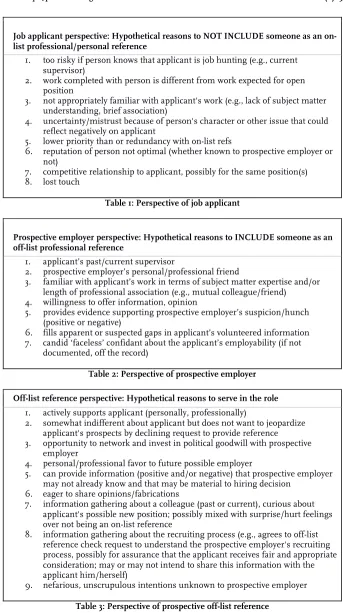
Job applicant perspective: Hypothetical reasons to NOT INCLUDE someone as an on-list professional/personal reference
1. too risky if person knows that applicant is job hunting (e.g., current supervisor)
2. work completed with person is different from work expected for open position
3. not appropriately familiar with applicant's work (e.g., lack of subject matter understanding, brief association)
4. uncertainty/mistrust because of person's character or other issue that could reflect negatively on applicant
5. lower priority than or redundancy with on-list refs
6. reputation of person not optimal (whether known to prospective employer or not)
7. competitive relationship to applicant, possibly for the same position(s) 8. lost touch
Table 1: Perspective of job applicant
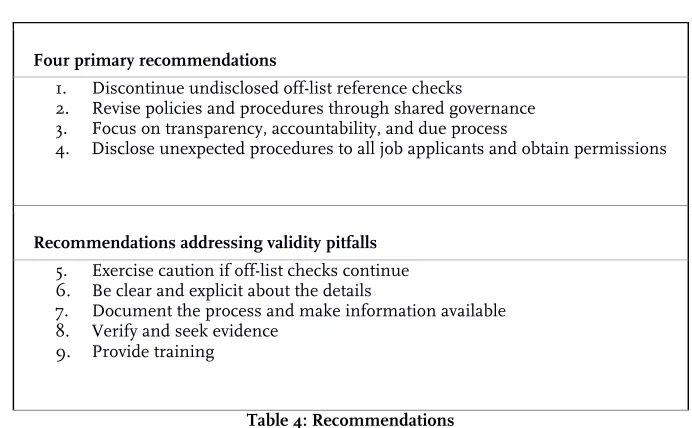
Prospective employer perspective: Hypothetical reasons to INCLUDE someone as an off-list professional reference
1. applicant’s past/current supervisor
2. prospective employer’s personal/professional friend
3. familiar with applicant’s work in terms of subject matter expertise and/or length of professional association (e.g., mutual colleague/friend) 4. willingness to offer information, opinion
5. provides evidence supporting prospective employer’s suspicion/hunch (positive or negative)
6. fills apparent or suspected gaps in applicant’s volunteered information 7. candid ‘faceless’ confidant about the applicant’s employability (if not
documented, off the record)
Table 2: Perspective of prospective employer
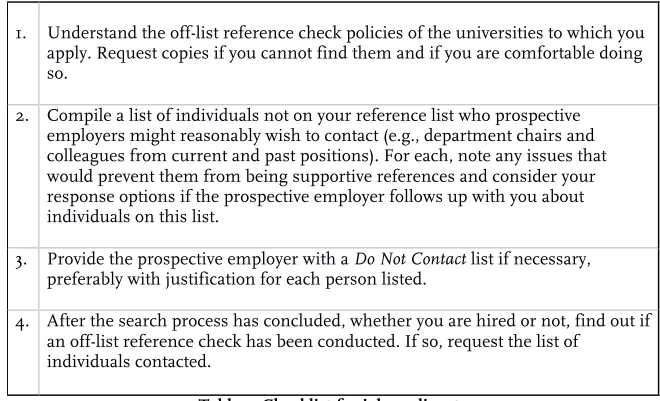
Off-list reference perspective: Hypothetical reasons to serve in the role 1. actively supports applicant (personally, professionally)
2. somewhat indifferent about applicant but does not want to jeopardize applicant's prospects by declining request to provide reference 3. opportunity to network and invest in political goodwill with prospective
employer
4. personal/professional favor to future possible employer
5. can provide information (positive and/or negative) that prospective employer may not already know and that may be material to hiring decision
6. eager to share opinions/fabrications
7. information gathering about a colleague (past or current), curious about applicant's possible new position; possibly mixed with surprise/hurt feelings over not being an on-list reference
8. information gathering about the recruiting process (e.g., agrees to off-list reference check request to understand the prospective employer's recruiting process, possibly for assurance that the applicant receives fair and appropriate consideration; may or may not intend to share this information with the applicant him/herself)
9. nefarious, unscrupulous intentions unknown to prospective employer
Table 1 itemizes an applicant’s hypothetical reasons for not including individuals as her or his (on-list) personal and professional references, who by definition are the pool of potential off-list references; the two remaining tables itemize a prospective employer’s and potential off-list reference’s hypothetical reasons for selecting an off-list reference and for volunteering as an off-list reference, respectively. Although the reasons of each perspective are not exhaustive nor mutually exclusive, they characterize the varieties of almost entirely undeclared strategic considerations that are weighed when personal and professional references are decided. Multiple considerations likely apply for each of the participants.
A striking implication is the unknowable complexity of factors involved when reference checks are open-ended and veiled in secrecy, which presents an unresolvable conundrum for validating data interpretation. Data collection missteps concomitant with prospective employer actions can include:
• Selection bias in the search for and identification of prospective off-list
references (e.g., prospective employer’s personal/professional friend),
• Confirmation bias in selecting off-list references (e.g., willingness to offer
information, opinion; readily provides evidence supporting suspicions), and
• Asking leading questions or otherwise influencing the respondents (e.g.,
fills apparent or suspected information gaps when prompted; opens up as a candid ‘faceless’ confidant).
Corresponding questions arise about the data quality and how such data are to be interpreted:
• How do we know that the chosen off-list reference is the best suited to
serve in this capacity? (How might the job applicant respond to this question, and why?)
• Given a priori expectations in the prospective employer’s mind, were
off-list references and the questions that were asked chosen to fairly balance the chances of obtaining evidence that either does support or does not
support the expected information (hunches, suspicions; i.e., addressing possible confirmation bias)?
• Related to the prior question, were off-list references for all of the job
case-by-case basis that focused on particular expectations about each job applicant (confirmation bias)?
• Other than the reference checker and the off-list references, who has the
necessary access to review the collected data and details substantiating each interpretation (who checks the checker)?
Compounding these ambiguities introduced by prospective employer choices, the individual serving as a veiled off-list reference might introduce her or his own unreliable motives and questionable designs on the transaction. Data collection missteps concomitant with actions of individuals who serve as off-list references can include:
• Making unverified and unverifiable statements about the job applicant
(e.g., eager to share opinions/fabrications; nefarious intentions),
• Collusion with a prospective employer’s bias which the prospective
employer accepts as corroborating evidence (e.g., personal/professional favor; can provide information that prospective employer may not already know),
• The off-list reference’s own personal biases and interests that influence
her or his responses and, in turn, influence the prospective employer (e.g., eager to share opinions; can provide information that prospective employer may not already know; nefarious intentions), and
• Relatively informal discussions given mutual promises of strict anonymity
that would be inappropriate for a standard ‘on record’ reference check (e.g., eager to share opinions; personal/professional favor; can provide information that prospective employer may not already know; information gathering about the job applicant who is a current/former colleague).
As with missteps related to prospective employer actions, corresponding questions arise about the quality of these data and how such data are to be interpreted:
• With no formal process to ensure response accuracy or fairness, how will
data collected from off-list reference checks be weighted and reconciled relative to other data collected during the selection process?
• Within the anonymous, off-the-record confines of the off-list reference
• Are prospective off-list references allowed sufficient chances to recuse
themselves after they fully assess the appropriateness of their participation in the role/How to determine whether they are correct in their eventual decision to recuse themselves or not?
• Is the decision of those individuals who decline to serve as off-list
references itself included as data and, if included, how is it fairly interpreted?
These methodological compromises to validity introduce a degree of ambiguity that is unacceptable at any other stage of the selection process. Results from this method of data collection and interpretation cannot be considered conclusive or actionable without additional formal review by other participants in the selection process (possibly including the job applicant, as discussed in the section below on recommendations). Despite constructive intentions, its use is spurred principally by a need for information that is suspected or otherwise imagined – itself a bias. Throughout the typical faculty search process, formal and deliberately systematic procedures are enforced to minimize the likelihood that any individual will inordinately bias the eventual hiring decision. Yet, despite these efforts to maintain integrity and rigor, collusive acceptance of undisclosed off-list reference checks has contravened the care and attention otherwise devoted to the search process. Moreover, the collected information is tautologically legitimized for having met a need while bypassing the concern that it may be spurious. Therefore, returning to the conditional statement at the beginning of this section, it is now clear that decision changes based on the results of undisclosed off-list reference checks cannot be justified, so no reason exists to conduct them.
To summarize, the methodology pitfalls of conducting undisclosed off-list reference checks are unmanageable risks to validity. These risks are akin to the potential for researcher bias in social sciences research. Thus, many of the ethical and procedural principles designed to minimize bias and to protect the interests of research participants (analogous to job applicants) should be thoughtfully applied when conducting off-list reference checks. These pitfalls will be taken into account in the following section on recommended guidelines for alternative approaches.
Recommended guidelines for alternative approaches
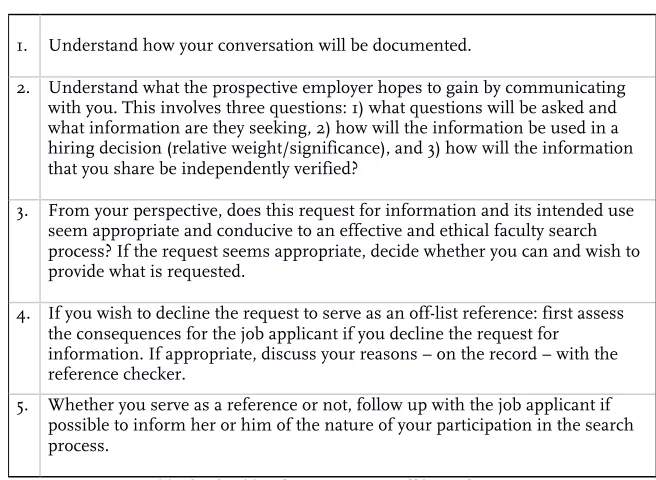
The purpose of this section is to clear a practical path for the verification of job applicant information, including any legitimate concerns that hiring committees and others may have about the applicant, while seeking remedies for the violations perpetrated through undisclosed off-list reference checks. Moreover, with this practical focus I hope to enhance the potential of critical performativity (Spicer et al., 2009) for academia, in contrast to managerialist performativity associated, for example, with the administrative incursions. Some of the following recommendations allow the use of transparent and accountable well-documented off-list reference checks (see Table 4: Recommendations). While lack of disclosure is especially problematic, other aspects also warrant corrective measures. Finally, to supplement these recommendations for prospective employers and their institutions, complementary checklists for job applicants and prospective off-list references are provided as guideposts to begin thinking through their respective responsibilities and concerns.
Four primary recommendations
1. Discontinue undisclosed off-list reference checks
2. Revise policies and procedures through shared governance 3. Focus on transparency, accountability, and due process
4. Disclose unexpected procedures to all job applicants and obtain permissions
Recommendations addressing validity pitfalls 5. Exercise caution if off-list checks continue 6. Be clear and explicit about the details
7. Document the process and make information available 8. Verify and seek evidence
9. Provide training
Table 4: Recommendations
Before considering remedies for the validity pitfalls, four primary recommendations are proposed that underpin the remaining recommendations.
• Recommendation 1: Discontinue undisclosed off-list reference checks.
• Recommendation 2: Revise policies and procedures through shared
governance. Establish formal policies and procedures, developed in collaboration with elected faculty representatives from a faculty governance body, such as an Academic Senate, that: 1) replace undisclosed off-list reference checks, 2) apply uniformly to all faculty searches, and 3) meet at least the minimum ethical standards of the institution. (As a sample benchmark, consider whether the implementation of these policies can serve as a case study of admirable ethical standards for students at your institution to read.) This recommendation addresses the validity hazards created with non-standard protocols and criteria by establishing uniform procedures for all faculty searches.
• Recommendation 3: Focus on transparency, accountability, and due
process. Each should be held as a core principle when deciding how information about a job applicant will be obtained and managed. Throughout the policy revision process and where procedural variance may be required in special cases, these core principles should be upheld to maintain the integrity and validity of the search process. Consider including a university ombudsperson or someone else responsible for independent review and mediation to conduct a periodic audit of procedures.
• Recommendation 4: Disclose unexpected procedures to all job applicants
and obtain permissions. If the job applicant is likely to consider the revised procedures unusual or unexpected, share a disclosure statement with all job applicants who submit a completed application explaining the procedures and rationale (as a commitment to the core principles in Recommendation 3). If some form of the off-list reference check is still used, request permission from each job applicant and make documentation and disclosure routinely available to the job applicant before and after each off-list reference check is completed.
Recommendations addressing validity problems
The methodology pitfalls are primarily risks of intentional and unintentional bias introduced by prospective employers and individual off-list references. In addition to the first four recommendations, above, the following guidelines are recommended to address these validity pitfalls of undisclosed off-list reference checks.
• Recommendation 5: Exercise caution if off-list checks continue. If off-list
with Recommendation 3 (‘Focus on transparency, accountability, and due process’) must be evaluated for the Recommendation 2 (‘Revise policies and procedures through shared governance’) process.
• Recommendation 6: Be clear and explicit about the details. Develop clear
and explicit reasons for seeking information from off-list references. Also, if appropriate, establish standard methods including relative weighting of information and the criteria for using the information in an eventual hiring decision.
• Recommendation 7: Document the process and make information
available. The process should assume a standard of transparency that matches the other stages of a search. Within legal and other HRM bounds, including those established for on-list reference checks, document information for appropriate access (implementation of Recommendation 3 ‘Focus on transparency, accountability, and due process’, and 4 ‘Disclose unexpected procedures to all job applicants and obtain permissions’); include with Recommendation 2 (‘Revise policies and procedures through shared governance’). If conversations must be private, log verifiable details about the exchange in the faculty search records such as person contacted, date and time, and the topic of communication. A comprehensive formal third party review of the entire search process and materials should be possible given this recommendation.
• Recommendation 8: Verify and seek evidence. Unless verified, any
personal risks of raising a sensitive or otherwise controversial issue with a job applicant are not taken lightly, however, and should be addressed. At any rate, because of the information processing hazards of privacy violations (Solove, 2006; 2011), safeguards and carefully considered protections against egregious information misinterpretation should be conscientiously developed along with Recommendation 2.
• Recommendation 9: Provide training. Mandatory workshops for
administrators and faculty search committee members should raise awareness about hazards of imposing administration-centric policies on the university. Case studies and plans for facilitated discussions based on the particular institution in which the workshops occur should be developed to allow for vivid examples and deeper experiential understanding.
Checklists
The purpose of providing checklists that follow from these employer institution recommendations is to clarify the practical implications for the other two categories of participants: the job applicants and prospective off-list references. Each participant is responsible for engaging in the process to enact critical performativity mentioned at the beginning of this section. The two checklists, Table 5: ‘Checklist for job applicants’ and Table 6: ‘Checklist for prospective off-list references’, are generic and should be tailored appropriately to the specifics of each search process.
1. Understand the off-list reference check policies of the universities to which you apply. Request copies if you cannot find them and if you are comfortable doing so.
2. Compile a list of individuals not on your reference list who prospective employers might reasonably wish to contact (e.g., department chairs and colleagues from current and past positions). For each, note any issues that would prevent them from being supportive references and consider your response options if the prospective employer follows up with you about individuals on this list.
3. Provide the prospective employer with a Do Not Contact list if necessary, preferably with justification for each person listed.
4. After the search process has concluded, whether you are hired or not, find out if an off-list reference check has been conducted. If so, request the list of
individuals contacted.
1. Understand how your conversation will be documented.
2. Understand what the prospective employer hopes to gain by communicating with you. This involves three questions: 1) what questions will be asked and what information are they seeking, 2) how will the information be used in a hiring decision (relative weight/significance), and 3) how will the information that you share be independently verified?
3. From your perspective, does this request for information and its intended use seem appropriate and conducive to an effective and ethical faculty search process? If the request seems appropriate, decide whether you can and wish to provide what is requested.
4. If you wish to decline the request to serve as an off-list reference: first assess the consequences for the job applicant if you decline the request for information. If appropriate, discuss your reasons – on the record – with the reference checker.
5. Whether you serve as a reference or not, follow up with the job applicant if possible to inform her or him of the nature of your participation in the search process.
Table 6: Checklist for prospective off-list references
Conclusion
The undisclosed off-list reference check is a widely recognized background verification method that also appears to be commonly used in faculty searches. By first critically analyzing the practice in this note and following up with a set of recommendations, the objective has been practical: root out the principally troubling aspects and revisit the method with potentially workable guidelines for more ethical, equitable, and inclusive outcomes. To continue in this spirit, I recognize that further developing and eventually implementing the ideas presented in this note depend on the work of others. It is work that I hope individuals and institutions will take up in solidarity for the good of academia and those who benefit from it.
references
AAUP (2015) Policy documents and reports (11th ed.). Baltimore, MD: The Johns Hopkins University Press.
Alderfer, C.P. (1987) ‘An intergroup perspective on group dynamics’, in J. Lorsch (ed.) Handbook of organizational behavior. Englewood Cliffs, NJ: Prentice Hall.
Ball, S. (2003) ‘The teacher’s soul and the terrors of performativity’, Journal of Education Policy, 18(2): 215-228.
Berdayes, V. (2002) ‘Traditional management theory as panoptic discourse: Language and the constitution of somatic flows’, Culture and Organization, 8(1): 35-49.
Berkelaar, B.L. and M. Buzzanell (2014) ‘Cybervetting, person–environment fit, and personnel selection: Employers’ surveillance and sensemaking of job applicants’ online information’, Journal of Applied Communication Research, 42(4): 456-476.
Bévort, F. and F. Poulfelt (2015) ‘Human resource management in professional services firms: Too good to be true? Transcending conflicting institutional logics’, Zeitschrift für Personalforschung (German Journal of Human Resource Management), 29(2): 102-130.
Bouchard, R.A. (1980) Personnel practices for small colleges. Washington, DC: National Association of College and University Business Officers / College and University Personnel Association.
California State Auditor (2017) California State University: Stronger oversight is needed for hiring and compensating management personnel and for monitoring campus budgets (Report 2016-122). [ https://www.auditor.ca.gov/reports/2016-122/index.html].
Dale, K. (2012) ‘The employee as “dish of the day”: The ethics of the consuming/consumed self in human resource management’, Journal of Business Ethics, 111(1): 13-24.
De Baets, A. (2011) ‘Taxonomy of concepts related to the censorship of history’,
Research in Social Problems and Public Policy, 19: 53-65.
Denhardt, J.V. and R.B. Denhardt (2015) The new public service: Serving, not steering
(4th ed.). New York, NY: Routledge.
Edwards, R.M. and B.H. Kleiner (2002) ‘Conducting effective and legally safe background and reference checks’, Managerial Law, 44(1/2): 136-150.
Federal Trade Commission (2016) Background checks: Tips for job applicants and employees. Washington, DC: Federal Trade Commission
[https://www.consumer.ftc.gov/articles/pdf-0044-background-checks.pdf].
Flaherty, C. (2015) ‘Going off list’, Inside Higher Ed,
[https://www.insidehighered.com/news/2015/06/12/aaup-session-discusses-list-reference-checks].
Gumport, P.J. (2000) ‘Academic restructuring: Organizational change and institutional imperatives’, Higher Education, 39(1): 67-91.
Hearn, J. (2003) ‘Organization violations in practice: A case study in a university setting’, Culture and Organization, 9(4): 253-273.
Hergovich, A., R. Schott and C. Burger (2010) ‘Biased evaluation of abstracts depending on topic and conclusion: Further evidence of a confirmation bias within scientific psychology’, Current Psychology, 29(3): 188-209.
Levashina, J. and M.A. Campion (2009) ‘Expected practices in background checking: Review of the human resource management literature’, Employee Responsibilities and Rights Journal, 21(3): 231-249.
Lewis, M. (2000) ‘Exploring paradox: Toward a more comprehensive guide’,
Academy of Management Review, 25(4): 760-776.
Lievens, F. (2001) ‘Assessor training strategies and their effects on accuracy, interrater reliability, and discriminant validity’, Journal of Applied Psychology, 86(2): 255-264.
Mael, F.A. (1998) ‘Privacy and personnel selection: Reciprocal rights and responsibilities’, Employee Responsibilities and Rights Journal, 11(3): 187-214.
Maravelias, C. (2011) ‘The managementization of everyday life – work place health promotion and the management of self-managing employees’, ephemera, 11(2): 105-121.
Moore, N. (2013) ‘Censorship is’, Australian Humanities Review, 54(1): 45-65.
Nickerson, R.S. (1998) ‘Confirmation bias: A ubiquitous phenomenon in many guises’, Review of General Psychology, 2(2): 175-220.
Oswald, M.E. and S. Grosjean (2004) ‘Confirmation bias’, in R. Pohl (ed.) Cognitive illusions: A handbook on fallacies and biases in thinking, judgement and memory. New York, NY: Psychology Press.
Samier, E.A. (2014) Secrecy and tradecraft in educational administration: The covert side of educational life. New York, NY: Routledge.
Saunders, D.B. (2010) ‘Neoliberal ideology and public higher education in the united states’, Journal for Critical Education Policy Studies, 8(1): 41-77.
Schmidt, P. (2014) ‘Twitter casualty: Steven G. Salaita’, The Chronicle of Higher Education, [http://chronicle.com/article/Twitter-Casualty-Steven-G/150853/].
Schmitt, N., J.M. Cortina, M.J. Ingerick and D. Wiechmann (2003) ‘Personnel selection and employee performance’, in W.C. Borman, D.R. Ilgen and R.J. Klimoski (eds.) Handbook of psychology: Industrial and organizational psychology
Schneider, S. (1999) ‘Human and inhuman resource management: Sense and nonsense’, Organization, 6(2): 277-284.
Smith, K.K. and D.N. Berg (1987) Paradoxes of group life: Understanding conflict, paralysis, and movement in group dynamics. San Francisco, CA: Jossey-Bass Publishers.
Solove, D.J. (2006) ‘A taxonomy of privacy’, University of Pennsylvania Law Review, 154(3): 477-564.
Solove, D.J. (2011) ‘Why privacy matters even if you have nothing to hide’, Chronicle of Higher Education, 15 May.
Taylor, P.J., K. Pajo, G.W. Cheung and P. Stringfield (2004) ‘Dimensionality and validity of a structured telephone reference check procedure’, Personnel Psychology, 57(3): 745-772.
Waugh Jr., W.L. (2003) ‘Issues in university governance: More “professional” and less academic’, The Annals of the American Academy of Political and Social Science, 585(1): 84-96.
Westwood, R. (2003) ‘Economies of violence: An autobiographical account’,
Culture and Organization, 9(4): 275-293.
Žižek, S. (2008) Violence: Six sideways reflections. New York, NY: Picador.
the author
Michael Y. Moon, Ph.D. is an Associate Professor in the Department of Public Affairs and Administration at California State University, East Bay. He has published articles on bottom-up change and common sense in organizations.