Nursing and
Midwifery Studies
Healthcare / Nursing / Midwifery / Nursing Management
The Effect of the Breathing Technique With and Without Aromatherapy on
the Length of the Active Phase and Second Stage of Labor
Katayon Vakilian
1, *, Afsaneh Keramat
21 Midwifery Department, Arak University of Medical Sciences, Arak, IR Iran 2 Nursing Department, Shahroud University of Medical Sciences, Shahroud, IR Iran
* Corresponding author: Katayon Vakilian, Midwifery Department, Arak University of Medical Sciences, Arak, IR Iran. Tel: +98-8614173524, Fax: +98-8614173524, E-mail: [email protected].
A B S T R A C T
Background: Long and hard labor is a common complication of labor, which forms an important part of emergency Caesarean deliveries. Labor duration is an influencing factor on the pregnancy outcome and the injuries involving the mother and her fetus, such as infection, hemorrhage, and fetal distress.
Objectives: This study was conducted intending to measure the duration of the first and the second stages of labor in mothers using the breathing techniques with lavender aroma.
Materials and Methods: The project was a randomized trial study that was carried out with two groups of 60 respondents, where both used the breathing technique, one with and one without lavender essence. This study was done in Fatemieh hospital in Shahroud. The laboring mothers, being participated in the study, were candidates for vaginal delivery. The duration of the first stage of labor was recorded from cervical dilatation of three centimeters. The second stage of labor also was recorded from the full cervical dilatation time until child birth. The breathing technique was such that when the contraction began, a deep breath was taken and exhaled. Then fast shallow breathings, being 1.5 times more than ordinary breathing per minute, were performed. The mothers in the experimental group were asked to put the mask on their faces and inhale the lavender essence. In the control group, only the breathing technique was used. T-Test was used to compare the mean lengths of active phase and second phase of labor and demographic variables. Chi square test was used for nominal variables such as education and job.
Results: The mean age in breathing technique with lavender and breathing technique alone were 25.5 ± 4.3 and 26 ± 4.9, respectively .Two groups were comparable in this regards (P = 0.6), but the length of active phase in interventional group was 7.85 ± 3.85 hours and in the control group it was 9.88 ± 6.65 hours. The decrease of the length of labor in the active phase was higher in the experimental group than that in the control group (P = 0.04). In the second stage, length of labor was 16.5 ± 5.7 and 28.9 ± 17.4 minutes in the experimental and control groups, respectively. Difference in length of labor was significant too (P = 0.001).
Conclusions: The research showed that aromatherapy can be used to reduce labor duration.
Keywords: Respiration; Lavandula; Complementary Therapies
Copyright © 2013, Kashan University of Medical sciences.
Article type: Research Article; Received: 20 Dec 2012, Revised: 13 Jan 2013, Accepted: 20 Jan 2013; DOI: 10.5812/nms.9886
Implication for health policy/practice/research/medical education:
Breathing Technique with and without Aromatherapy can be used to facilitate the process of delivery, where midwives can be edu-cated to apply this method.
Please cite this paper as:
Vakilian K, Keramat A. The Effect of the Breathing Technique With and Without Aromatherapy on the Length of the Active Phase and Second Stages of Labor. Nurs Midwifery Stud. 2013;2(1):115-9. DOI: 10.5812/nms.9886
Copyright © 2013, Kashan University of Medical sciences.
1. Background
Long and hard labor is a common complication of la-bor, which forms an important part of emergency Cae-sarean deliveries (1). On average, prolonged labor rate is 3-8 percent, and this percentage is 3 times more com-mon acom-mong those with their first time labor than those with previous experience in labor (2). Labor duration is an influencing factor on the pregnancy outcome and the injuries involving the mother and the fetus. The exces-sive prolonging of parturition leads to a proportional crease in the probability of infection, physical-nervous in-juries, the death of the fetus and the infant, the risk of the mother bleeding and after childbirth infection, and also derangement due to anxiety, insomnia, and fatigue (3). The most common behavioral technique for labor man-agement is using relaxation, which increases pain toler-ance through some mechanisms including reduction of anxiety, decreased response to catecholamine, increased uterine blood flow, and decreased muscle tension (4). Most educational classes held before childbirth present relaxation techniques along with rhythmic breathing patterns intended to provide distraction from labor pain. Breathing patterns are used to enhance a woman’s sense of control in own muscle and labor pain. In a survey on 1583 American women, 61% was applied breathing tech-nique. Among the respondents, 69% rated the breathing techniques as very helpful, and 30% rated it as not helpful in labor pain management (5). The studies showed that severe labor pain and anxiety in the active phase of labor can increase catecholamine and cortisol levels; and sub-sequently, they lead to the decreased strength of uterine contractions, which become uncoordinated; and finally, they prolong labor duration (6). Also in labor manage-ment nowadays, obstetrics broadly use complemanage-mentary medicine practices, one of which is the approach of us-ing aromatherapy (7). Aromatherapy is carried out by the use of essential oils distilled from aromatic plants (5), such as lavender, jasmine, and geranium. Also massage techniques are used as an effective technique during the labor (4). When the diffused essential oil such as laven-der is breathed by the lungs between contractions, the endorphins produced in the body are used to alleviate the natural pain. At the time of uterine contractions and when the cervix is opened , 30-minute or more of laven-der bath would advance labor in this phase and signifi-cantly reduce the need for analgesic medication. The cold compress of lavender and garden sage can reduce pain, fatigue, and revitalize (8). Lavender consists of linalool, alcohol, ketones, esters, and aldehydes. The ketones in lavender effectively decrease pain and inflammation, and contribute to falling asleep. Esters prevent muscle spasms, and reduce tension and depression (9, 10). Laven-der is originally a Mediterranean plant, but tourists and travelers who came from oversea areas have transferred this plant to their own lands due to its pleasant aroma and its special effects. The Lavender aromatherapy is used
to treat depression, amenorrhea, vaginitis, insomnia, and pain. Lavender was used in ancient medicine to treat cough; and was used as a diuretic, carminative, and anti-spasmodic sedative (11). Analgesic property of lavender has been previously reported in labor pain by Vakilian et al. (12) , and episiotomy wound healing has been also re-ported by Vakilian et al. (13) .To the best of our knowledge, however, there is no similar study in Iran to assess labor duration by utilizing aromatherapy during breathing technique .
2. Objectives
The aim of this study was to measure the duration of the active phase and the second stage of labor in mothers us-ing the breathus-ing techniques with lavender aroma.
3. Materials and Methods
and end of each contraction, participants were reminded to take a deep, cleansing, and relaxing breath. Breathe was done through the mouth in fast shallow breaths at a rate of 15-20 breaths in 10 seconds, throughout the con-traction. All the participants were educated in prenatal educational classes how to use breathing technique dur-ing labor. Mothers inhaled lavender via nebulizer that was connected to a mask. In the control group, only the breathing technique was used, without any aroma. The duration of the active phase of labor was recorded from cervical dilatation of 4 centimeters. The second stage of
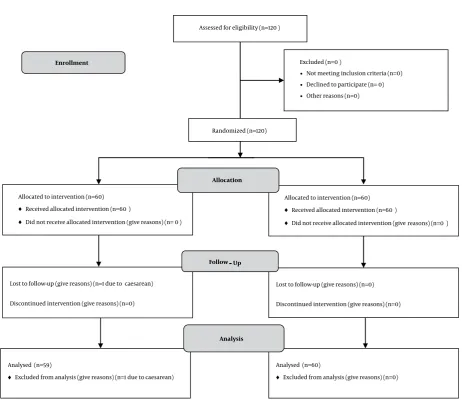
labor also was recorded from the full cervical dilatation time until the baby is completely out. Due to Caesarean, one laboring mother was excluded from the experimen-tal group (Figure 1). No side effect was observed over the labor and all of the mothers were satisfied to use it. SPSS software version18 was used for data analysis. T-Test was used to compare the mean lengths of active phase and second phase of labor and demographic variables, such as age and weight of newborn. Chi square test was used for nominal variables such as education and job.
Assessed for eligibility (n=120 )
Excluded (n=0 )
• Not meeting inclusion criteria (n=0) • Declined to participate (n= 0) • Other reasons (n=0)
Analysed (n=59)
Excluded from analysis (give reasons) (n=1 due to caesarean) Lost to follow-up (give reasons) (n=1 due to caesarean)
Discontinued intervention (give reasons) (n=0) Allocated to intervention (n=60)
Received allocated intervention (n=60 )
Did not receive allocated intervention (give reasons) (n= 0 )
Lost to follow-up (give reasons) (n=0)
Discontinued intervention (give reasons) (n=0) Allocated to intervention (n=60)
Received allocated intervention (n=60 )
Did not receive allocated intervention (give reasons) (n=0 )
Analysed (n=60)
Excluded from analysis (give reasons) (n=0)
Allocation
Analysis Follow
-
UpRandomized (n=120)
Enrollment
Figure 1. The Study Design
3.1. Ethical Considerations
This study was approved by the Research Ethics Com-mittee of Shahroud University of Medical Sciences. Also
re-searchers tried to observe all the participants rights in ac-cordance to the Helsinki ethical convention.
4. Results
The mean age of participants in experimental and con-trol groups were 25.5 ± 4.3 years and 26 ± 4.9 years, respec-tively (P = 0.6). The mean number of pregnancy of moth-ers in the breathing technique group with aromatherapy was 1.31 ± 0.72 and in the breathing technique group alone was 1.22 ± 0.91, and there was no significant difference between them (P = 0.58). The average birth weight of the baby in the breathing technique group with lavender was 3084.9 ± 434.24 g and in the breathing technique
group without lavender was 3165.56 ± 289.38 g, and the difference was not significant (P = 0.26). In total, 3 (5.1%) in the experimental group and 11 (22%) in control group were illiterate; and 23 (39%) in the experimental group and 13(26%) in the control group had diplomas, and the difference was significant (P = 0.03). But the length of ac-tive phase in interventional group was 7.85 ± 3.85 hours and in the control group it was 9.88 ± 6.65 hours. The decrease of the length of labor in the active phase was higher in the experimental group than that in the con-trol group (P = 0.04). In the second stage, length of labor was 16.5 ± 5.7 and 28.9 ± 17.4 minutes in the experimental and control groups, respectively. Difference in length of labor was significant too (P = 0.001) (Table 1).
Table 1. Mean length of Active Phase and Second Stage of Labor in Experimental and Control Groups Variables Breathing
tech-nique with laven-der, Mean ± SD
Breathing technique without lavender, Mean ± SD
95% Confidence Interval of the Dif-ference
P value t value
Length of active phase, h 7.85 ± 3.85 9.88 ± 6.65 -4.06, -0.005 0.04 1.98
Length of second stage, min 16.5 ± 5.7 28.9 ± 17.4 7.33, 17.34 0.001 4.88
5. Discussion
The present study indicated that the duration of the first and second stages of labor in the group having the breathing technique with lavender had a significant re-duction in comparison to the group having the breath-ing technique alone. The reduction of the childbirth du-ration was probably due to the anxiolytic and sedative effects of the substance (14), and this obviates the vicious cycle of anxiety-spasm-pain; and in this way it contrib-utes to the more natural procedure of uterine contrac-tions. Studies show that Lavender consists of linalool, which has analgesic and spasmolytic effects on smooth muscles (15). However, in the study done by Alavi et al., the experimental group received 0.1 milliliter of lavender essential oil mixed with 1 milliliter of distilled water, via tissues attached to their gown close to their nostrils, and the control group received just 2 milliliters of distilled water via the same way. In that study the researchers con-cluded that aromatherapy with lavender did not affect the duration of labor phases (16). In the present study we used aromatherapy through a nebulizer and it seems that this method is more effective than what was reported in the study of Alavi et al. Burns et al. carried out aroma-therapy in childbirth by modes of application included acupressure points, taper, compress, footbath, massage, or birthing pool. They reported that aromatherapy was not significantly effective on the duration of the first and the second stages of labor (17). According to another study, the women taking a 30-minute sitting bath with the above essential during the first stage of labor had a better labor progress and their need for analgesic
medi-cation was significantly reduced (18). The results of the research done by Slade presented that these techniques reduce pain less than what is imagined (19). Mehdizadeh also reported that although most of studies indicated the helpful and positive effects of the breathing techniques and neuromuscular exercises, but there are still incon-sistencies between studies (20). For example, Pugh et al. argue that using the breathing techniques make labor-ing women tired and result in the delay of the delivery process (21). However, lavender consists of linalyl acetate and linalool that can have sedative and local anesthetic effects (22). It seems that increased secretion of epineph-rine, may results in severe uterine pain and reduce the number, frequency, and strength of uterine contractions, and may cause prolongation and disruption in delivery (5). This study shows that lavender essential oil aroma could be used to decrease the length of the delivery. Also the study had some limitations, such as not having attained the first stage of labor. Also mothers had posi-tions such as sitting or standing during labor that the re-searchers were not able to control them. We recommend midwives to use this kind of aromatherapy in labor. Also we propose other researches to find out other herbs that can help mothers in reducing labor length.
Acknowledgments
Authors’ Contribution
Katayon Vakilian prepared the first draft of the manu-script and Afsaneh Keramat made critical revisions to the paper and translated it into English language. Both authors had equal roles in the study design and data col-lection and analysis.
Financial Disclosure
There are no conflicts of interest among the authors of the study.
Funding/Support
None declared.
References
1. Cunningham F, Leveno K, Bloom S, Hauth J, Rouse D, Spong C. Williams Obstetrics: 23rd Edition. McGraw-Hill Education; 2009. 2. Kolas T, Hofoss D, Daltveit AK, Nilsen ST, Henriksen T, Hager R, et
al. Indications for cesarean deliveries in Norway. Am J Obstet Gy-necol.2003;188(4):864-70.
3. Khoda Karami N, Safarzadeh A, Fathizadeh N. Effect of Massage Therapy on Severity of Pain and Outcome of Labor in Primipara. Iranian J Nurs Midwifery Res.2008;12(1):6-9.
4. Davidson MR, London ML, Ladewig PW. Olds’ Maternal-newborn Nursing & Women’s Health Across the Lifespan. Pearson; 2012. 5. Simkin P, Bolding A. Update on nonpharmacologic approaches
to relieve labor pain and prevent suffering. J Midwifery Womens Health.2004;49(6):489-504.
6. Brown ST, Douglas C, Flood LP. Women's Evaluation of Intrapar-tum Nonpharmacological Pain Relief Methods Used during La-bor. J Perinat Educ.2001;10(3):1-8.
7. Duddridge E. Using complementary therapies during the child-bearing process. British J Midwifery.2002;10(11):699-704. 8. Maddocks-Jennings W, Wilkinson JM. Aromatherapy practice in
nursing: literature review. J Adv Nurs.2004;48(1):93-103.
9. Allaire AD. Complementary and alternative medicine in the la-bor and delivery suite. Clin Obstet Gynecol.2001;44(4):681-91. 10. Tournaire M, Theau-Yonneau A. Complementary and alternative
approaches to pain relief during labor. Evidence-Based Comple-mentary Altern Med.2007;4(4):409-417.
11. Iran IPdao. Medical Education minster. Medical Education minis-ter press.; 2002.
12. Vakilian K, Karamat A, Mousavi A, Shariati M, Ajami ME, Atarha M. The Effect of Lavender Essence via Inhalation Method on Labor Pain. Shahrekord Univ Med Sci J.2012;14(1):34-40.
13. Vakilian K, Atarha M, Bekhradi R, Chaman R. Healing advantages of lavender essential oil during episiotomy recovery: a clinical trial. Complement Ther Clin Pract.2011;17(1):50-3.
14. Habanananda T. Non-pharmacological pain relief in labour. J Med Assoc Thai.2004;87 (Suppl 3):S194-202.
15. Cline M, Taylor JE, Flores J, Bracken S, McCall S, Ceremuga TE. Investigation of the anxiolytic effects of linalool, a lavender ex-tract, in the male Sprague-Dawley rat. AANA J.2008;76(1):47-52. 16. Alavi N, Nemati M, Kaviani M, Tabatabaii MH. [Lavender
Aroma-therapy on the Pain Intensity Perception and Intara partum Out-comes in Primipare]. Armaghan Danesh.2010;15(1):31-5. 17. Burns E, Zobbi V, Panzeri D, Oskrochi R, Regalia A.
Aroma-therapy in childbirth: a pilot randomised controlled trial. BJOG.2007;114(7):838-44.
18. Simkin PP, O'Hara M. Nonpharmacologic relief of pain during labor: systematic reviews of five methods. Am J Obstet Gyne-col.2002;186(5 Suppl Nature):S131-59.
19. Slade P, MacPherson SA, Hume A, Maresh M. Expectations, expe-riences and satisfaction with labour. Br J Clin Psychol.1993;32 (Pt 4):469-83.
20. Mehdizadeh A, Roosta F, Chaichian S, Alaghehbandan R. Evalua-tion of the impact of birth preparaEvalua-tion courses on the health of the mother and the newborn. Am J Perinatol.2005;22(1):7-9. 21. Pugh LC, Milligan RA, Gray S, Strickland OL. First stage labor
man-agement: An examination of patterned breathing and fatigue. Birth.1998;25(4):241-5.