C
CO
ON
NS
ST
TR
RU
UC
CT
TI
IO
ON
N
O
OF
F
A
A
B
BR
RO
O
YD
Y
DE
EN
N-
-L
LI
I
KE
K
E
M
ME
ET
TH
HO
OD
D
F
FO
OR
R
N
NO
ON
NL
LI
I
NE
N
EA
AR
R
S
SY
YS
ST
TE
EM
MS
S
O
O
F
F
E
EQ
QU
UA
AT
TI
IO
ON
NS
S
I
I
.
.
A
A
.
.
O
O
s
s
i
i
n
n
u
u
g
g
a
a
,
,
S
S
.
.
O
O
.
.
Y
Y
u
u
s
s
u
u
f
f
f
f
Federal University of Agriculture, P.M.B. 2240, Department of Mathematics, Abeokuta, Niheria
Corresponding Author: I. A. Osinuga, [email protected]
ABSTRACT: Broyden-like methods (or hybrid Broyden methods) are one of the efficient modifications of the classical Broyden method proposed to solve nonlinear systems of equations and to overcome the deficiencies of the classical Newton method. In this work, a variant of the Broyden-like method is proposed using the weighted combination of the Trapezoidal, Simpson and Midpoint quadrature rules. Hence a new hybrid Broyden method known as TSMM has been created based on these rules. The numerical tests confirm that TSMM is promising when subjected to comparison with other Broyden-like methods.
KEYWORDS: Broyden method, quadrature formula, predictor corrector, nonlinear systems, convergence, numerical examples.
1.
INTRODUCTIONOver the past decades, there has been a growing need and interests for the solution of nonlinear systems. Nonlinear systems of equations may arise for example, in sciences, engineering, mathematics, medicines, robotics as well as in phenomenon such as weather and chaos. Hence, solving such equations is becoming more essential. Since there is no exact solution can be found for vast majority of practical problems involving nonlinear phenomenon, therefore numerical or iterative methods are usually employed to approximate the solutions.
Let us consider numerical schemes for solving nonlinear systems of the form:
0 ) , , , , , ( . . . 0 ) , , , , , ( 0 ) , , , , , ( 1 1 2 1 1 n n n n x x f x x f x x f (1)
The above equation can be compactly denoted by F(x) = 0; where is continuously differentiable. The classical Newton method is one of the commonly used iterative
schemes for the solution of equation (1) but confronted with many demerits from the need to calculate and invert the Jacobian matrix J(x) at each iteration.
Among the successful modifications proposed by researchers to reduce the computational cost of the classical Newton, is the quasi-Newton method. The most successful and simplest quasi-Newton method for solving nonlinear systems of equations is the Broyden method [MW15]. Broyden methods [Bro65] are another revised quasi-Newton method to reduce the amount of calculation at each iteration but subsequently lead to an increase in the number of iterations to be performed to converge to a solution.
Several efforts have been made recently to improve classical Newton methods and its variants. These methods devised some techniques such as Newton-like schemes [WF00, FS03, SDK10, DS11, Dha14], matrix-free secant method [WLM12], quadrature formulas [CT06, CT07, SAN08, FS04], and composition scheme [CTV12]. Authors such as [MMW13, MMW14, MW15] and the references therein proposed quadrature based Broyden-like methods to solve systems of non-linear equations. For example, [MMW14] devised a Broyden-like method using the Trapezoidal rule in order to reduce the number of iterations of the classical Broyden method. [MW15] used the weighted combination of the Midpoint and Simpson quadrature formulas to achieve the same goal as above.
The rationale behind the use of the Broyden-like methods by [MMW14, MW15] and the need to avert the shortcomings of the classical Newton methods especially on large scale problems are motivations behind this work.
2. DERIVATION PROCESS OF TSMM
Let x* be a root of the nonlinear equation F(x) = 0; where F is sufficiently differentiable. Newton method originates from the Taylor's series expansion of the function (of a single variable) f(x) about the point :
where f, and its first and second derivatives, and are calculated at . For multiple variable function F; from the above equation, it is obvious that
(2)
Authors such as [MMW14] and [MW15] have approximated the indefinite integral in Equation (2) with different quadrature rules and obtained a nice and better refinement of the classical Newton method. In the same view, approximating the integral in Equation (2) by the weighted combination of Trapezoidal, Simpson and Midpoint quadrature rules yields:
(3) Replacing by respectively using the same procedure as in ([CT06, CT12, HB12]).
(4) which is an implicit equation because we have on both sides. In order to avoid the implicit nature of this equation, we use the (k+1)th iteration of the Broyden method in the right hand side. Thus we have
(5) where is given as
(6) so we have
(7)
for . Suppose we set , then we have
(8) Hence, with the formulation above and selecting Predictor-Corrector of Broyden method we have the following two-step iterative scheme of the Trapezoidal-Simpson-Midpoint method for solving Equation (1). For a given using initial matrix , compute the approximates solution by the iterative schemes
(9)
for
Algorithm for TSMM
1. Given initial guess let k = 0 and 2. Compute if is satisfied stop, Else go to step 3,
3. Compute from Equation (6). 4. Compute using.
Where
5. Compute using
where
6. Compute from Equation (7) 7. Set k = k + 1 and go to step 2.
where
3. CONVERGENCE RESULT OF
TRAPEZOIDAL, SIMPSON AND MID-POINT METHOD
The local convergence properties of the proposed method are presented here. We have the following standard assumptions on the nonlinear function F: Assumptions
1. is differentiable in an open convex set . 2. There exists such that and is nonsingular and continuous for every x. 3. is Lipschitz continuous and hence satisfies the Lipschitz condition of order 1 such that there exists a positive constant such that
Definition 3.1 (q-superlinearly convergence) [Kel95]
Let and Then is q-superlinearly if
Lemma 3.1 [RL03]
Let be continuously differentiable on an open convex set . If is Lipschitz continuous with Lipschitz constant , then for any Moreover, if is invertible, then there exists and such that for all for which Lemma 3.2 [RL03]
Let . If converges q-superlinearly to then
Herein, we present the main result which is a modified result in [MW15] to prove that the local order of convergence analysis is superlinear.
Theorem 3.3
Let satisfy the hypothesis of Lemma 3 on the set D: Let be a sequence of nonsingular matrices in the space of real matrices of order n. Suppose for some the sequence generated by Equation (8) remains in D and where for each Then converges q-superlinearly to and if and only if
(10)
where and
Proof
Suppose Equation (10) holds; then Equation (8) becomes
Take the norm of both sides to have:
Using vector norm properties, we have;
Divide through by to have;
Using Lemma 3.1, we have;
But is nonsingular, thus by Lemma 3.1 , such that we have;
For all , Equation (12) and Equation (13) gives
And
This implies that
Therefore converges q-superlinearly to . Conversely, suppose that converges q-superlinearly to and Then by Lemma 3.1, there exist a such that we have
Then
Using lemma 3.2, we have
From equation (11), we have
Since converges to then
which proves that
4. NUMERICAL RESULTS AND DISCUSSION
In order to evaluate the performance of the proposed method, we apply the method to solve eight (8) benchmark problems using eight (8) dimensions ranging from 5 to 1,065 variables. A comparison of the numerical test results of our new method is made with those of the following three well-known methods:
Classical Broyden Method
Trapezoidal Broyden Method ([MMW14])
Midpoint-Simpson Broyden Method ([MW15])
The comparison was done on the number of iterations and the CPU time in seconds. The computational experiments were carried out using MATLAB 2012b with a double precision arithmetic. The program is designed to terminate whenever the number of iterations reaches 500 and no satisfies . A failure is reported (denoted by '-') in the tabulated result.
List of Tested Problems Problem 1 ([CTV12])
Problem 2 ([SDK10])
Problem 3 ([SDK10])
Problem 4 ([HB12])
Problem 5 ([SDK10])
Problem 6 ([SDK10])
Problem 7 ([DS11])
Problem 8 ([HB12])
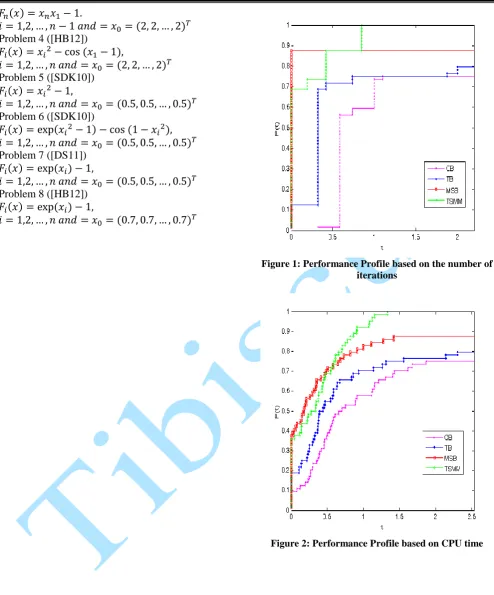
Figure 1: Performance Profile based on the number of iterations
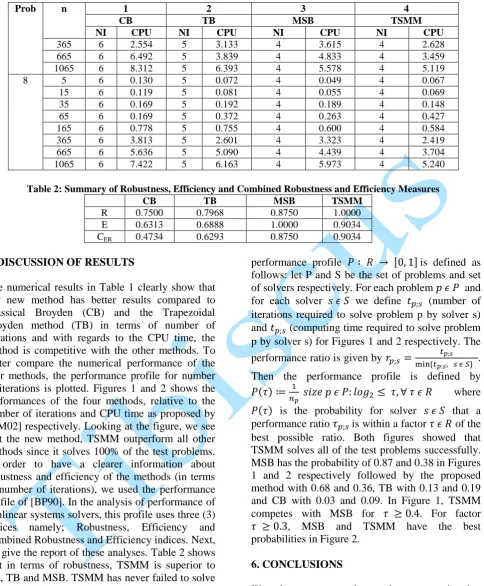
Table 1: Numerical Results for all the four Methods
Prob n 1 2 3 4
CB TB MSB TSMM
NI CPU NI CPU NI CPU NI CPU
1 5 6 0.051 4 0.048 3 0.039 4 0.051
15 6 0.066 4 0.084 3 0.062 4 0.078
35 5 0.155 5 0.164 3 0.103 4 0.142
65 5 0.215 5 0.389 3 0.247 4 0.236
165 5 0.515 5 0.574 4 0.437 4 0.482
365 5 0.515 5 0.574 4 0.437 4 0.482
665 6 2.794 5 2.469 4 2.351 4 2.126
1065 6 5.131 5 4.463 4 4.225 4 3.742
2 5 6 0.047 5 0.047 4 0.050 4 0.032
15 6 0.069 5 0.101 4 0.057 4 0.083
35 6 0.164 5 0.177 4 0.136 4 0.159
65 6 0.257 5 0.284 4 0.183 4 0.238
165 6 1.178 5 0.676 4 0.437 4 0.514
365 6 2.971 5 2.797 4 3.011 4 1.126
665 6 2.934 5 2.552 4 2.617 4 2.139
1065 6 6.884 5 4.351 4 3.894 4 3.729
3 5 - - - - 5 0.058 5 0.052
15 - - - - 5 0.063 5 0.048
35 - - - - 5 0.131 5 0.159
65 - - - - 5 0.241 5 0.392
165 - - - - 5 0.510 5 0.686
365 - - - - 5 2.598 5 1.346
665 - - - - 5 2.663 5 2.526
1065 - - - - 5 5.648 5 4.438
4 5 12 0.061 22 0.179 6 0.071 8 0.066
15 12 0.163 24 0.385 6 0.088 8 0.143
35 12 0.296 - - 6 0.175 8 0.381
65 12 1.386 24 10873 6 0.380 8 0.639
165 12 1.703 - - 6 0.739 8 1.129
365 14 6.819 - - 7 3.069 8 40157
665 14 13.169 - - 7 4.311 8 70584
1065 15 16.180 - - 7 7.489 8 11.288
5 5 6 0.053 5 0.044 4 0.078 4 0.065
15 6 0.069 5 0.134 4 0.056 4 0.125
35 6 0.143 5 0.155 4 0.179 4 0.144
65 6 1.063 5 0.333 4 0.629 4 0.607
165 6 0.895 5 0.613 4 1.019 4 1.289
365 6 3.135 5 1.784 4 2.824 4 1.414
665 6 4.059 5 3.419 4 3.441 4 3.107
1065 6 7.439 5 6.685 4 6.497 4 5.139
6 5 - - 5 0.075 - - 9 0.098
15 - - 5 0.089 - - 9 0.189
35 - - 5 0.280 - - 9 0.440
65 - - 5 0.453 - - 9 0.848
165 - - 5 0.982 - - 9 1.474
365 - - 5 3.596 - - 9 6.758
665 - - 5 6.012 - - 9 9.214
1065 - - 5 8.088 - - 9 13.845
7 5 6 0.042 5 0.067 4 0.035 4 0.048
15 6 0.072 5 0.099 4 0.073 4 0.096
35 6 0.138 5 0.162 4 0.108 4 0.137
65 6 0.388 5 0.356 4 0.857 4 0.394
Prob n 1 2 3 4
CB TB MSB TSMM
NI CPU NI CPU NI CPU NI CPU
365 6 2.554 5 3.133 4 3.615 4 2.628
665 6 6.492 5 3.839 4 4.833 4 3.459
1065 6 8.312 5 6.393 4 5.578 4 5.119
8 5 6 0.130 5 0.072 4 0.049 4 0.067
15 6 0.119 5 0.081 4 0.055 4 0.069
35 6 0.169 5 0.192 4 0.189 4 0.148
65 6 0.169 5 0.372 4 0.263 4 0.427
165 6 0.778 5 0.755 4 0.600 4 0.584
365 6 3.813 5 2.601 4 3.323 4 2.419
665 6 5.636 5 5.090 4 4.439 4 3.704
1065 6 7.422 5 6.163 4 5.973 4 5.240
Table 2: Summary of Robustness, Efficiency and Combined Robustness and Efficiency Measures
CB TB MSB TSMM
R 0.7500 0.7968 0.8750 1.0000 E 0.6313 0.6888 1.0000 0.9034 CER 0.4734 0.6293 0.8750 0.9034
5. DISCUSSION OF RESULTS
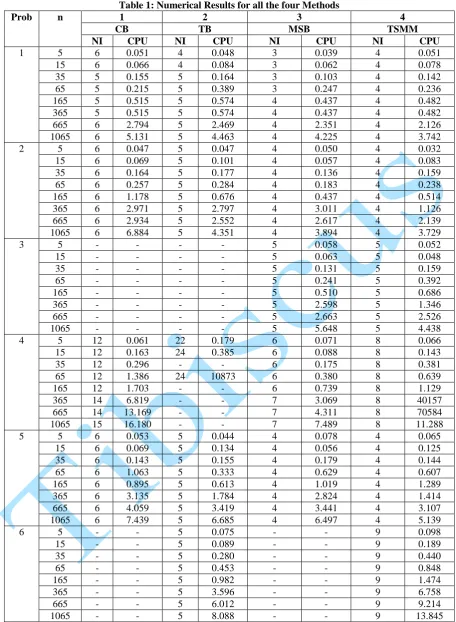
The numerical results in Table 1 clearly show that our new method has better results compared to Classical Broyden (CB) and the Trapezoidal Broyden method (TB) in terms of number of iterations and with regards to the CPU time, the method is competitive with the other methods. To better compare the numerical performance of the four methods, the performance profile for number of iterations is plotted. Figures 1 and 2 shows the performances of the four methods, relative to the number of iterations and CPU time as proposed by [DM02] respectively. Looking at the figure, we see that the new method, TSMM outperform all other methods since it solves 100% of the test problems. In order to have a clearer information about robustness and efficiency of the methods (in terms of number of iterations), we used the performance profile of [BP90]. In the analysis of performance of nonlinear systems solvers, this profile uses three (3) indices namely; Robustness, Efficiency and Combined Robustness and Efficiency indices. Next, we give the report of these analyses. Table 2 shows that in terms of robustness, TSMM is superior to CB, TB and MSB. TSMM has never failed to solve any of the tested benchmark problems. However, in terms of Efficiency, the TSMM is just competitive compared to MSB but performed better then CB and TB. Hence, these observations further authenticate the superiority of the proposed method to CB and TB for solving large scale systems of nonlinear equations. The performance profile of each of the methods for small value of , the best possible ratio are shown in Figures 1 and 2. We assume that we have ns solvers and np problems, the
performance profile is defined as follows: let P and S be the set of problems and set of solvers respectively. For each problem and for each solver we define (number of iterations required to solve problem p by solver s) and (computing time required to solve problem p by solver s) for Figures 1 and 2 respectively. The performance ratio is given by
. Then the performance profile is defined by where is the probability for solver that a performance ratio is within a factor of the best possible ratio. Both figures showed that TSMM solves all of the test problems successfully. MSB has the probability of 0.87 and 0.38 in Figures 1 and 2 respectively followed by the proposed method with 0.68 and 0.36, TB with 0.13 and 0.19 and CB with 0.03 and 0.09. In Figure 1, TSMM competes with MSB for . For factor , MSB and TSMM have the best probabilities in Figure 2.
6. CONCLUSIONS
We have presented another approximation alternative to Jacobian matrices via the Trapezoidal, Simpson and Midpoint quadrature formulas and preserved the local order of convergence of the classical Broyden method. The numerical tests for the benchmark functions show that the method is robust and competitive.
REFERENCES
[Bro65] C. G. Broyden - A class of methods for solving nonlinear simultaneous equations. Math Comput; 19: 577-593, 1965.
[BP90] I. Bogle, J. Perkins - A new sparsity preserving quasi-Newton update for solving nonlinear equations. SIAM Journal on Scientific and Statistical Computing. 11(4): 621-630, 1990. [CT06] A. Cordero, J. R. Torregrosa -
Variants of Newton's method for functions of several variables. Appl Math Comput; 183: 199-208, 2006. [CT07] A. Cordero, J. R. Torregrosa -
Variants of Newton's method using fifth-order quadrature formulas. Appl. Math. Comput. 190, 686-698, 2007. [CTV12] A. Cordero, J. R. Torregrosa, M. P.
Vassileva - Pseudocomposition: a
technique to design
predictor-corrector methods for systems of nonlinear equations. Appl Math Comput; 218: 11496-11504, 2012. [Dha14] A. Dhamacharoen - An efficient
hybrid method for solving systems of nonlinear equations. J. Comput Appl Math; 263: 59-68, 2014.
[DM02] E. D. Dolan, J. J. More -
Benchmarking optimization software with performance profiles. Math. Program Ser. A; 91: 201-213, 2002. [DS11] M. T. Darvishi, B. Shin-High-Order
Newton-Krylov Methods to Solve Systems of Nonlinear Equations. J. KSIAM, 15, 19-30, 2011.
[FS03] M. Frontini, E. Sormani - Some variants of Newton's method with third order convergence and multiple roots. J. Comput. Appl. Math. 156, 345-354, 2003. [FS04] M. Frontini, E. Sormani - Third
order methods for quadrature
formulae for solving system of nonlinear equations. Appl. Math. Comput. 149, 771-782, 2004.
[HB12] M. A. Hafiz, S. M. Bahgat - An efficient two-step iterative method for solving system of nonlinear equations. Journal of Mathematical Research; 4, 28-34, 2012.
[Kel95] C. T. Kelly - Iterative Methods for Linear and Nonlinear Equations. Philadelphia, PA, USA: SIAM, 1995. [MW15] H. Mohammad, M. Y. Waziri - On
Broyden-like update via some
quadratures for solving nonlinear systems of equations, Turkish Journal of Mathematics, 39: 335-345, 2015. [MMW13] K. Muhammad, M. Mamat, Y. M.
Waziri - A Broyden's-like Method for
Solving Systems of Nonlinear
Equations. World Applied Sciences Journal 21 (Special Issue of Applied Math): 168-173, 2013.
[MMW14] M. Mamat, K. Muhammad, M. Y. Waziri - Trapezoidal Broyden Method for Solving Systems of Nonlinear Equations. Applied Mathematical Sciences, 8, 251-260, 2014.
[SDK10] B. C. Shin, M. T. Darvishi, C. H. Kim - A comparison of the Newton-Krylov method with high order
Newton-like methods to solve
nonlinear systems. Applied
Mathematics and Computation, vol. 217, no. 7, 3190-3198, 2010.
[SAN08] A. R. Soheili, S. A. Ahmadian, J. Naghipoor - A Family of Predictor-Corrector Methods Based on Weight Combination of Quadratures for
Solving Nonlinear Equations.
International journal of Nonlinear Science, 6, 29-33, 2008.
[RL03] B. Van De Rotten, S. V. Lune - A Limited Memory Broyden Method to Solve High-Dimensional Systems of Nonlinear Equations, Technical Report MI 2003-2006. Leiden, the Netherlands: University of Leiden, 2003.
[WLM12] M. Y. Waziri, W. J. Leong, M. Mamat - A Two-Step Matrix-Free Secant Method for Solving Large-Scale Systems of Nonlinear Equations. Journal of Applied Mathematics, Article ID: 348654, 2012.