Hist. Geo Space Sci., 10, 45–72, 2019 https://doi.org/10.5194/hgss-10-45-2019 © Author(s) 2019. This work is distributed under
the Creative Commons Attribution 4.0 License.
from
diff
erent
spheres
to
a
common
globe
IUGG evolves (1940–2000)
Jo Ann Joselyn1,*and Alik Ismail-Zadeh2,3
1Space Environment Center, National Oceanic and Atmospheric Administration, Boulder, Colorado, USA 2Karlsruhe Institute of Technology, Institute of Applied Geophysics, Karlsruhe, Germany
3International Union of Geodesy and Geophysics, Secretariat, Potsdam, Germany *retired
Correspondence:Jo Ann Joselyn ([email protected]) and Alik Ismail-Zadeh ([email protected])
Received: 7 November 2018 – Accepted: 22 December 2018 – Published: 16 April 2019
Abstract. The International Union of Geodesy and Geophysics (IUGG) began anew after World War II with a new governance and membership structure. The technologies developed during the war were brought to bear in the extraordinary global scientific effort that was the International Geophysical Year (1957–1958). Major changes in the geopolitical landscape have brought about further changes in IUGG’s structure. International sci-entific campaigns encompassing multiple disciplines became commonplace, and international scisci-entific bodies were organized and networked. During this time period (1940–1999), 15 general assemblies and 2 extraordinary general assemblies were held, each in a different international venue. Summaries of each general assembly are presented, as well as overviews of the changes in IUGG’s structure, finances, membership, and publications. The scientists, who led the Union and contributed to the development of the Union, are also presented.
1 Introduction
After 2 decades of international scientific collaboration through the development and growth of the International Union of Geodesy and Geophysics (IUGG), World War II (WWII) brought the Union’s activity to a standstill. In this paper, we describe the evolution of the Union for the period from the end of WWII to the end of the 20th century. The most important scientific program in the life of the Union in the 1950s was the International Geophysical Year (IGY, 1957–1958), an initiative of IUGG and some other scientific unions and national members of the International Council of Scientific Unions (ICSU), which was co-sponsored by ICSU and the World Meteorological Organization (WMO). During 1940–1999, 17 IUGG General Assemblies including two ex-traordinary assemblies were held in Cambridge (UK in 1946, an extraordinary assembly), Oslo (Norway, 1948), Brus-sels (Belgium, 1951), Rome (Italy, 1954), Toronto (Canada, 1957), Helsinki (Finland, 1960), Berkeley (USA, 1963), Zurich (Switzerland, 1967), Moscow (USSR, 1971), Greno-ble (France, 1975), Durham (UK, 1977, an extraordinary as-sembly), Canberra (Australia, 1979), Hamburg (Germany,
1983), Vancouver (Canada, 1987), Vienna (Austria, 1991), Boulder (USA, 1995), and Birmingham (UK, 1999). Ma-jor changes in the geopolitical landscape have brought about further changes in IUGG’s structure. International scientific campaigns encompassing multiple disciplines became com-monplace, and international scientific bodies were organized and networked. Also, we overview the changes in IUGG’s structure, finances, publications, and membership, and high-light the leaders of the Union, who contributed significantly to the promotion of international scientific cooperation dur-ing this time period.
2 IUGG 1940–1960
of Secretaries General Harold St. J. L. Winterbotham (UK; 1930–1946) and James Stagg (UK; 1946–1951). Even be-fore WWII began, Winterbotham took steps “to safeguard the Union’s funds and contrived to keep an emergency organisa-tion running until the end of hostilities” (Stagg, 1947). Stagg also noted that some of the work of maintaining the organiza-tion was carried out in a distributed manner through the asso-ciations: “Some of the associations, on their side, continued their work in some measure throughout the War, supporting themselves on the annual subscriptions from their own and neighbouring countries” (Stagg, 1947). Both Winterbotham and Stagg were instrumental in post-war reconstruction, as-suring the continuation of IUGG and restarting its develop-ment.
2.1 Extraordinary General Assembly
(29 July–2 August 1946, Cambridge, UK)
An extraordinary GA was called in 1946 to put the Union on its post-war feet. Held in Cambridge, UK, it was attended by delegates from 16 Member countries. IUGG Statutes and By-laws were adopted. A radical change in the method of sub-scription by Member countries was introduced that allowed the countries to choose one of eight categories of member-ship. The only proviso was that the category selected had to be formally approved by IUGG’s Council, on which every country had one representative. The category of member-ship determined the annual dues to be paid, and the voting rights in Council discussions involving finance. Delegates to the GA also discussed and endorsed the agreement made be-tween IUGG and the United Nations Educational, Scientific and Cultural Organization (UNESCO). By this agreement, the Union agreed to disseminate information on geodetic and geophysical subjects in countries where contacts on scientific matters were few, and in return, UNESCO agreed to promote international cooperation by financial support for publica-tions and meetings, and geodetic and geophysical services (Stagg, 1947).
2.2 VIII General Assembly (19–28 August 1948, Oslo, Norway)
IUGG President Bjørn Helland-Hansen (Norway) could not attend the GA due to his state of health, and Vice Pres-ident Niels E. Nørlund (Denmark) acted on behalf of the President. James Stagg was Secretary General. The Open-ing Ceremony was attended by H.M. the KOpen-ing of Norway and H.H. the Crown Prince. The Government of Norway, the municipality, and the University of Oslo extended gen-erous hospitality to the Union. Two public lectures were presented: “Geophysics, Vocation or Avocation?” by Merle Antony Tuve (USA) and “The Eruption of Mount Hekla, 1947–48” by Sigurdur Thorarinsson (Iceland), who showed a color film on the volcano’s eruption (Stagg, 1948). At this GA, the office of Vice President was restored, and the first
Finance Committee President was named: John Tuzo Wilson (Canada). Member countries were urged to set up National Committees, if they had not already done so. Each Associa-tion held its own scientific assembly during the GA. Cooper-ation with the InternCooper-ational Astronomical Union (IAU) and the International Telecommunication Union (ITU) in top-ics of geodetic astronomy was highlighted, as was the im-portance of the International Meteorological Organization (IMO) to serve as a clearinghouse for ideas and to link to-gether the various meteorological research bodies through-out the world. The Joint Inter-Association Committee on the Physics of the Earth’s Interior replaced the Union Commit-tee on Continental and Oceanic Structure (Proudman, 1948). The Joint Committee on the Ionosphere proposed a third In-ternational Polar Year in 1957–1958. There were seven per-manent services such as one on Standard Sea Water Service. IUGG was represented at the 1948 and 1950 meetings of the Pan American Institute of Geography and History (PAIGH).
2.3 IX General Assembly (21–31 August 1951, Brussels, Belgium)
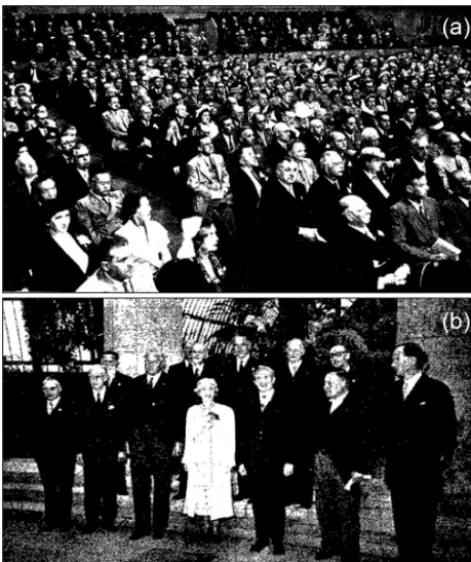
President Felix Andries Vening-Meinesz (the Netherlands) presided. Vice Presidents were Sydney Chapman (UK) and Leason J. Adams (USA), and James M. Stagg (UK) was Secretary General. H.M. Queen Elisabeth of Belgium at-tended the Opening Ceremony. The Assembly host was the Belgian Committee for Geodesy and Geophysics, chaired by J. F. Cox. It was noted that IUGG had been “born” in Brussels 32 years prior. The attendance of 918 people at the Palais des Beaux-Arts indicates that scientific activities were once again a national priority (Fig. 1). Accounts were man-aged by the Secretary General and were denominated in En-glish Pounds. The International Polar Year 1957–1958 was approved “in principle”, and the immediate formation of a steering committee was urged in order to allow a full 5 years to make the arrangements. The name of the International sociation of Seismology was changed to the International As-sociation of Seismology and Physics of the Earth’s Interior (IASPEI). Twenty-four resolutions were adopted by the GA (Cox, 1951).
2.4 X General Assembly (14–25 September 1954, Rome, Italy)
pro-Figure 1.IX General Assembly of IUGG.(a)Opening Ceremony
at the Palais des Beaux-Arts, Brussels.(b)Members of the IUGG
Bureau, the Belgian National Committee for Geodesy and Geo-physics, and the Association Presidents meeting H.M. Queen Elis-abeth of Belgium at Château Royal de Laeken (Cox, 1951).
grams of the inter-governmental agencies, especially WMO. Its predecessor IMO was founded in 1873 to facilitate the exchange of weather information across national borders. WMO became a specialized agency of the United Nations in 1951 addressing areas of meteorology (weather and climate), operational hydrology, and related geophysical sciences. Re-lations between WMO and IUGG were formalized by the signing of a working agreement in 1953 whereby IUGG is recognized by WMO as the international forum for the ad-vancement of meteorology while WMO is recognized by IUGG as having the primary responsibility for the interna-tional organization of meteorology. WMO and IUGG agreed to keep each other “advised of all developments and pro-jected activities” within the WMO and IUGG fields of in-terest (WMO, 2002).
Many advances in geophysics, meteorology and iono-spheric physics, ultra-high-frequency and microwave radars, jet propulsion, V2 rockets (long-range guided ballistic mis-siles), new techniques in nuclear physics, solar radio noise, radio astronomy, and radio aeronomy were made during WWII. While there is very little information available about the proceedings of the General Assembly, Joint Commis-sions reporting at the Assembly included those on Solar
and Terrestrial Relationship (with IAU and the International Union of Radio Sciences – URSI); on the Ionosphere (with IAU, URSI, and the International Union of Pure and Ap-plied Physics – IUPAP); on Oceanography (with the In-ternational Union on Biological Sciences – IUBS); and on Radio-Meteorology (with URSI). These were busy years for IUGG President Chapman, who was also the President of the Special Committee for the International Geophysical Year (Comité Spécial de l’Année Géophysique Internationale – CSAGI) set up in 1952.
The significance of the International Geophysical Year for IUGG
The International Geophysical Year (IGY) that lasted from 1 July 1957 to 31 December 1958 has a special place in the history of international scientific cooperation of the 20th century (e.g., Launius et al., 2010). “The spectacularly suc-cessful International Geophysical Year, run by the Interna-tional Union of Geodesy and Geophysics, had received ac-claim from the scientific world at large” (Harrison, 1978). The IGY was a remarkable project not only because of its outstanding accomplishments and the involvements of thou-sands of scientists, who contributed to the IGY success, but also because the year gave rise to several major international initiatives (Ismail-Zadeh, 2016).
Figure 2. Stamps dedicated to the IGY and produced by the USA (the upper left stamp), Norway (the upper right stamp), and the Soviet Union. The texts in Russian of the Soviet stamps read “The pioneer artificial Earth satellite launched by the Soviet Union” (the lower left panel) and “According to the Interna-tional Geophysical Year program, the Soviet Union launched on 15 May 1958 the third artificial Earth satellite of 1327 kg to a height of 1880 km” (the lower right panel). The images of the stamps are from the Internet (https://www.mysticstamp. com/Products/United-States/1107/USA/\T1\textbackslash#, https: //colnect.com/es/stamps/stamp/48850-International_Geophysical_
Year-International_Geophysical_Year-Noruega, https:
//en.wikipedia.org/wiki/Sputnik_1\T1\textbackslash#/media/File: Sputnik-stamp-ussr.jpg, and https://zvonmoneta.ru/mark-2586, last access: 30 January 2019).
satellite program to place instruments in Earth orbit (Sulli-van, 1961).
The IGY’s impact can be measured in several ways. First, a staggering number of scientific advancements were achieved during the 18-month period. Ultimately involving some 60 000 scientists from 67 nations, the IGY, through numerous installations and field expeditions, made possible the synoptic collection of observational data on an unprece-dented global scale. It emphasized a data-driven style of re-search, stimulated new graduate training programs, helped establish Earth science programs in many developing and newly independent countries, and made IUGG assemblies a key venue for coordinating and communicating scientific in-vestigations. The IGY made possible a great number of sci-entific advancements. For example, the 1957 launch of Sput-nik by the USSR initiated the Space Age (Fig. 2). The Special Committee on Ocean Research (SCOR – later renamed the Scientific Committee on Ocean Research to reflect its more permanent status) was established in 1957 to address
inter-disciplinary science questions related to the ocean. Associ-ated with the IGY, a number of interdisciplinary scientific bodies were established in 1958, including the Committee on Space Research (COSPAR) and the Scientific Committee on Antarctic Research (SCAR). The IGY provided a model and inspiration for the Upper Mantle Project, the Interna-tional Indian Ocean Expedition, and the InternaInterna-tional Years of the Quiet Sun. The World Data Center system, created to safeguard and share IGY data, reflected a shared desire for scientific internationalism (Aranova et al., 2010; Collis and Dodds, 2008; Korsmo, 2007).
Second, the IGY had a profound effect on geopolitics, and it deeply reflected the politics and political realities of the Cold War from which it emerged (Needell, 2000). Vir-tually all fields of geophysics became important to mili-tary leaders in the aftermath of WWII, as effective utiliza-tion of guided missiles and submarines required greatly ex-panded knowledge involving physical oceanography, terres-trial magnetism, isostasy, seismology, meteorology, iono-spheric physics, and solar–terrestrial relationships. IGY ar-chitect Lloyd Berkner had written a secret supplement to a high-level report on international science he prepared for the U.S. State Department when the IGY was conceived that stressed the importance of international scientific contacts for intelligence-gathering – and IUGG assemblies in the 1950s and 1960s included covert intelligence agents. IGY research was also valued for providing useful environmental sciences data about the Arctic (deemed a potential East–West battle-ground, positioned dead center between the USA and the So-viet Union). At the same time, Antarctica was established as a continent for science, resolving long-standing sovereignty claims. Cold War tensions limited national involvement in the IGY (for instance, mainland China ultimately did not take part) and kept certain data from reaching the international data centers. When existing global seismic stations were aug-mented to create the World-Wide Standard Seismographic Network crucial for verifying the Limited Nuclear Test Ban Treaty of 1963 – a natural extension of IGY-style programs – it was a further reminder that the IGY was simultaneously a triumph of scientific internationalism and an undertaking made possible by national funding decisions reflecting Cold War anxieties (Korsmo, 2007).
So-viet Academy of Sciences to join the IGY. Although several top scientists, including the Academy’s President Alexan-der Nesmeyanov, worked hard to join the IGY program and IUGG, until the death of the leader of the Soviet Union Josef Stalin in March 1953 and consequent political changes, no response to the invitation was received by ICSU. In early 1954, the Soviet Academy decided to take part in the IGY, and also to join IUGG; Nesmeyanov sent Chapman the first indication that this was about to happen. The So-viet Academy’s decision in favor of the IGY and IUGG was a part of a larger process of the post-Stalin perestroika and science diplomacy efforts (Bedritskii et al., 1997; Bulkeley, 2008).
2.5 XI General Assembly (3–15 September 1957, Toronto, Canada)
IUGG President Kalpathi Ramanathan (India) presided. Other members of the Bureau were J. Tuzo Wilson (Canada), the solitary Vice President, and Secretary Gen-eral Georges R. Laclavère (France). The GenGen-eral Assembly, the second in North America, was hosted by the National Research Council (NRC) of Canada (the Canadian National Committee for Geodesy and Geophysics) and the University of Toronto. The Prime Minister of Canada, John G. Diefen-baker, and the President of the NRC, Edgar W. R. Steacie, greeted the delegates from more than 50 countries. Public lectures were given by ICSU President Lloyd V. Berkner on “Scientific Aspects of the Instrumented Earth Satellite” and by Yevgeny I. Tolstikov on “The Arctic and Antarctic Pro-gram of the IGY”.
At this GA, the Statutes and By-laws of the Union first adopted in 1946 were revised; for the first time, IUGG Bu-reau members were elected. The Bulletin, begun by La-clavère in 1952, was split into two publications in 1956. The Chronicle, containing information about programs and pro-ceedings, began in May 1957; and scientific articles were published separately. An International Journal of Geodesy and Geophysics was proposed (but never happened), as was an International Bibliography of Geophysics and a Directory of Geodesists and Geophysicists. Already there was concern to engage larger numbers of young scientists in IUGG activi-ties. The International Association for Terrestrial Magnetism and Electricity (IATME) became the International Associa-tion for Geomagnetism and Aeronomy (IAGA; note that an initial suggestion was the International Association for Geo-magnetism and Physics of the Ionosphere). A committee was formed by the International Association of Geodesy (IAG), IAGA, and IASPEI to organize the World Magnetic Survey. There were inter-Association (joint) commissions on the Up-per Atmosphere (International Association of Meteorology – IAM and IAGA) and Atmospheric Electricity (also IAM and IAGA).
Planning for the IGY was a priority during the period. Par-ticularly, IUGG (along with URSI and IAU) had an
impor-tant role in establishing the Federation of Astronomical and Geophysical Permanent Services (FAGS) in 1956, funded substantially by UNESCO. Some of the nine permanent ser-vices and their related Associations were the International Gravimetric Bureau (of IAG), the Bureau for Geomagnetic Indices (of IAGA), and Mean Sea Level (of the International Association of Physical Oceanography –IAPO). IUGG be-came a member of SCOR as well as the Joint Commissions on Solar-Terrestrial Relationships; the Ionosphere; Radio-Meteorology; and Applied Radioactivity. ICSU initiated a Special Committee on the Biological Effects of Nuclear Ra-diation. IUGG began attending meetings of the Cartographic Office of the UN in 1955. A permanent liaison was estab-lished with PAIGH in 1954 and WMO in 1957.
Twenty-three Union resolutions were published in French, English, and Russian (IUGG Archives, 1957). They dealt with issues concerning combined membership of the German national committees, the Chinese national committees, and Cuba; adoption of a standardized value for the speed of light; the need and methodology for geodetic and gravity measure-ments; the need to deep drill into ocean sediments and fur-ther into the Mohorovicic discontinuity; that ICSU restore a budget cut to the International Seismological Summary; that improved observations and analysis of atmospheric ozone be supported; that countries use alternating current electric power because direct current for railways hinders geomag-netic measurements; that the World Maggeomag-netic Survey be sup-ported and the data published; that a permanent Service on the Variations of Mean Sea Level be created; that quantita-tive data on chemical substances dissolved in water from land surfaces be collected; and that volcanoes be reported, rocks collected, and volcanic gasses analyzed.
2.6 XII General Assembly (26 July–6 August 1960, Helsinki, Finland)
IUGG President J. Tuzo Wilson (Canada) presided. Vice Presidents were Vladimir V. Beloussov (USSR) and Wikko Heiskanen (Finland), Secretary General Georges R. La-clavère (France) and members George Deacon (UK), J. Wal-lace Joyce (USA), and Tsuji Chuboi (Japan). The Govern-ment of Finland and University of Helsinki hosted the As-sembly. The President of the Republic and the Minister of Education attended the Opening Ceremony. The GA was at-tended by scientists from 58 member countries and observers from 10 non-member countries.
ter-minate membership. Voting rules were prescribed: all dele-gates had one vote on the topics of scientific matters, paid-up members could vote on administrative matters, and the num-ber of units of memnum-bership was counted for financial matters. There would be a General Assembly every 3 years. The new Statutes and By-laws were printed in French, English, and Russian.
The inter-Association bodies were Geophysical Bibliogra-phy; Upper Mantle Project; Tsunami; and the Committee on Space Research (CSR). The IUGG CSR was a response to COSPAR, the ICSU Committee on Space Research, which seemed to be encroaching on IUGG interests and expertise. The Committee on Geophysical Bibliography decided to em-ploy existing Bibliographic services, and dissolved. IUGG endorsed the ICSU Policy on non-discrimination. Three In-ternational Scientific Unions (IUGG, IAU, and IUPAP) sup-ported ICSU’s Special Committee for Geophysics (Comité Internationale de Géophysique – CIG). The CIG approved three projects: the World Magnetic Survey, the Upper Mantle Project, and the International Years of the Quiet Sun. ICSU also approved the constitutions of the Inter-Union Commit-tees on Radio Meteorology (IUCRM), on the Ionosphere (IUCI), and on Solar Terrestrial Relationships (IUCSTR). FAGS acquired two new services: the International Time Bu-reau (BuBu-reau International de l’Heure) and General Bathy-metric Chart of the Oceans.
Twenty-one Union resolutions were passed (IUGG Archives, 1960). They concerned the IUGG Publication of-fice; that metric units were recommended for use in all scientific papers; that the Committees on Space Research, Near Shore Oceanography, Meteorology of the Upper Atmo-sphere, and Dynamical Meteorology should be formed; that there should be increased support for the International Lat-itude Service and that a permanent service should be estab-lished on the General Bathymetric Chart of the Oceans; that meteorological data should be made available for research; that the Tsunami Committee should establish a warning sys-tem; that lunar influences on geophysical processes should be investigated; that a document, “Codification of rules for protection from Volcanic eruptions”, should be printed and distributed, as well as a quarterly “Bulletin of Volcanic Erup-tions”; that seismological research be done in central and South America and eastern Europe, and that a catalog of earthquakes from 1801 to 1900 be prepared; that programs of gravity measurements should be accelerated; and that satel-lites with flashing lights and devices for electronic tracking be launched.
3 IUGG 1960–1999
The period of time between the 12th General Assembly (1960) and the 22nd General Assembly (1999) was marked by profound shifts, both scientifically and politically. The legacies of the IGY and the realization that the best
scien-tific outcomes come from both international and interdis-ciplinary cooperation extend to today. The discoveries in Earth and space sciences (e.g., the extent and morphology of Earth’s magnetic field) and the observations of Earth as a planet have irrevocably shaped every discipline within the IUGG purview. Simultaneously, geopolitical forces reshaped the geographic landscape. A comparison of the 58 national Members adhering to IUGG in 1963, with the 76-Member roster in 1999, shows the growth in the number of Member countries of the Union (Appendix A). 49 Members remained, some had relinquished membership, three had ceased to exist as a single entity (Czechoslovakia, USSR, and Yugoslavia), and “new” countries had appeared. Thirteen of those had not existed in 1960, and the others were countries that had built the capacity to take their rightful place in geophysical so-ciety. Twelve other countries were briefly members during those 36 years. These countries acquired membership after 1963, but were removed from the membership list before 1999; examples are the Democratic Republic of Germany, and the Republic of China, whose memberships were can-celled because of the reunification of Germany in 1990, and the admission of the People’s Republic of China in 1977, re-spectively. These were a noteworthy 39 years of global as well as IUGG history.
3.1 Inter-Union Scientific Campaigns and Programs
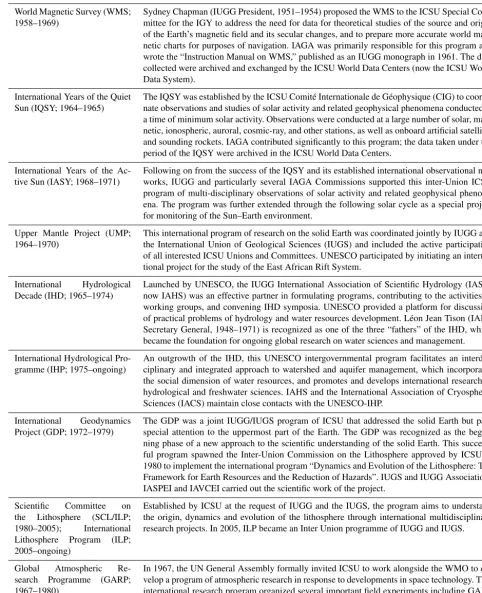
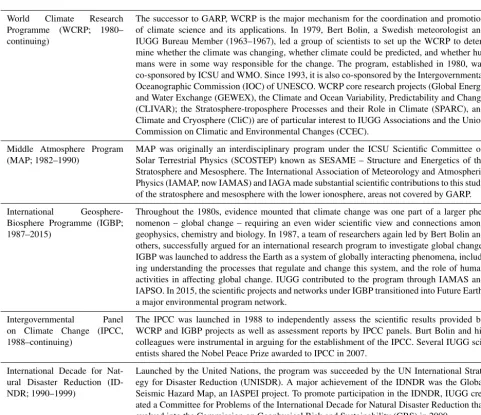
Throughout this time of evolution, IUGG was strongly guided by ICSU as well as by developing relationships with other governmental and non-governmental national and international bodies. While these relationships are intro-duced chronologically in Table 1, the major inter-Union grams of interest to IUGG are summarized first. These pro-grams illuminate the overarching geophysical scientific focus through these years.
Throughout the years, the Associations and inter-Association bodies have sponsored numerous topical scien-tific symposia, many intentionally convened in developing countries. The records of the Union list these symposia that educated and promoted progress in the various disciplines of study. IUGG often provided support for these meetings, espe-cially to ensure the attendance of young scientists and those from financially disadvantaged countries.
3.2 IUGG Structure
Table 1.International Scientific Programs and IUGG involvement. World Magnetic Survey (WMS;
1958–1969)
Sydney Chapman (IUGG President, 1951–1954) proposed the WMS to the ICSU Special Com-mittee for the IGY to address the need for data for theoretical studies of the source and origin of the Earth’s magnetic field and its secular changes, and to prepare more accurate world mag-netic charts for purposes of navigation. IAGA was primarily responsible for this program and wrote the “Instruction Manual on WMS,” published as an IUGG monograph in 1961. The data collected were archived and exchanged by the ICSU World Data Centers (now the ICSU World Data System).
International Years of the Quiet Sun (IQSY; 1964–1965)
The IQSY was established by the ICSU Comité Internationale de Géophysique (CIG) to coordi-nate observations and studies of solar activity and related geophysical phenomena conducted at a time of minimum solar activity. Observations were conducted at a large number of solar, mag-netic, ionospheric, auroral, cosmic-ray, and other stations, as well as onboard artificial satellites and sounding rockets. IAGA contributed significantly to this program; the data taken under the period of the IQSY were archived in the ICSU World Data Centers.
International Years of the Ac-tive Sun (IASY; 1968–1971)
Following on from the success of the IQSY and its established international observational net-works, IUGG and particularly several IAGA Commissions supported this inter-Union ICSU program of multi-disciplinary observations of solar activity and related geophysical phenom-ena. The program was further extended through the following solar cycle as a special project for monitoring of the Sun–Earth environment.
Upper Mantle Project (UMP; 1964–1970)
This international program of research on the solid Earth was coordinated jointly by IUGG and the International Union of Geological Sciences (IUGS) and included the active participation of all interested ICSU Unions and Committees. UNESCO participated by initiating an interna-tional project for the study of the East African Rift System.
International Hydrological
Decade (IHD; 1965–1974)
Launched by UNESCO, the IUGG International Association of Scientific Hydrology (IASH; now IAHS) was an effective partner in formulating programs, contributing to the activities of working groups, and convening IHD symposia. UNESCO provided a platform for discussion of practical problems of hydrology and water resources development. Léon Jean Tison (IAHS Secretary General, 1948–1971) is recognized as one of the three “fathers” of the IHD, which became the foundation for ongoing global research on water sciences and management. International Hydrological
Pro-gramme (IHP; 1975–ongoing)
An outgrowth of the IHD, this UNESCO intergovernmental program facilitates an interdis-ciplinary and integrated approach to watershed and aquifer management, which incorporates the social dimension of water resources, and promotes and develops international research in hydrological and freshwater sciences. IAHS and the International Association of Cryospheric Sciences (IACS) maintain close contacts with the UNESCO-IHP.
International Geodynamics
Project (GDP; 1972–1979)
The GDP was a joint IUGG/IUGS program of ICSU that addressed the solid Earth but paid special attention to the uppermost part of the Earth. The GDP was recognized as the begin-ning phase of a new approach to the scientific understanding of the solid Earth. This success-ful program spawned the Inter-Union Commission on the Lithosphere approved by ICSU in 1980 to implement the international program “Dynamics and Evolution of the Lithosphere: The Framework for Earth Resources and the Reduction of Hazards”. IUGS and IUGG Associations IASPEI and IAVCEI carried out the scientific work of the project.
Scientific Committee on
the Lithosphere (SCL/ILP;
1980–2005); International
Lithosphere Program (ILP;
2005–ongoing)
Established by ICSU at the request of IUGG and the IUGS, the program aims to understand the origin, dynamics and evolution of the lithosphere through international multidisciplinary research projects. In 2005, ILP became an Inter Union programme of IUGG and IUGS.
Global Atmospheric
Re-search Programme (GARP;
1967–1980)
Table 1.Continued.
World Climate Research
Programme (WCRP; 1980–
continuing)
The successor to GARP, WCRP is the major mechanism for the coordination and promotion of climate science and its applications. In 1979, Bert Bolin, a Swedish meteorologist and IUGG Bureau Member (1963–1967), led a group of scientists to set up the WCRP to deter-mine whether the climate was changing, whether climate could be predicted, and whether hu-mans were in some way responsible for the change. The program, established in 1980, was co-sponsored by ICSU and WMO. Since 1993, it is also co-sponsored by the Intergovernmental Oceanographic Commission (IOC) of UNESCO. WCRP core research projects (Global Energy and Water Exchange (GEWEX), the Climate and Ocean Variability, Predictability and Change (CLIVAR); the Stratosphere-troposphere Processes and their Role in Climate (SPARC), and Climate and Cryosphere (CliC)) are of particular interest to IUGG Associations and the Union Commission on Climatic and Environmental Changes (CCEC).
Middle Atmosphere Program (MAP; 1982–1990)
MAP was originally an interdisciplinary program under the ICSU Scientific Committee on Solar Terrestrial Physics (SCOSTEP) known as SESAME – Structure and Energetics of the Stratosphere and Mesosphere. The International Association of Meteorology and Atmospheric Physics (IAMAP, now IAMAS) and IAGA made substantial scientific contributions to this study of the stratosphere and mesosphere with the lower ionosphere, areas not covered by GARP.
International
Geosphere-Biosphere Programme (IGBP; 1987–2015)
Throughout the 1980s, evidence mounted that climate change was one part of a larger phe-nomenon – global change – requiring an even wider scientific view and connections among geophysics, chemistry and biology. In 1987, a team of researchers again led by Bert Bolin and others, successfully argued for an international research program to investigate global change. IGBP was launched to address the Earth as a system of globally interacting phenomena, includ-ing understandinclud-ing the processes that regulate and change this system, and the role of human activities in affecting global change. IUGG contributed to the program through IAMAS and IAPSO. In 2015, the scientific projects and networks under IGBP transitioned into Future Earth, a major environmental program network.
Intergovernmental Panel
on Climate Change (IPCC, 1988–continuing)
The IPCC was launched in 1988 to independently assess the scientific results provided by WCRP and IGBP projects as well as assessment reports by IPCC panels. Burt Bolin and his colleagues were instrumental in arguing for the establishment of the IPCC. Several IUGG sci-entists shared the Nobel Peace Prize awarded to IPCC in 2007.
International Decade for Nat-ural Disaster Reduction (ID-NDR; 1990–1999)
Launched by the United Nations, the program was succeeded by the UN International Strat-egy for Disaster Reduction (UNISDR). A major achievement of the IDNDR was the Global Seismic Hazard Map, an IASPEI project. To promote participation in the IDNDR, IUGG cre-ated a Committee for Problems of the International Decade for Natural Disaster Reduction that evolved into the Commission on Geophysical Risk and Sustainability (GRS) in 2000.
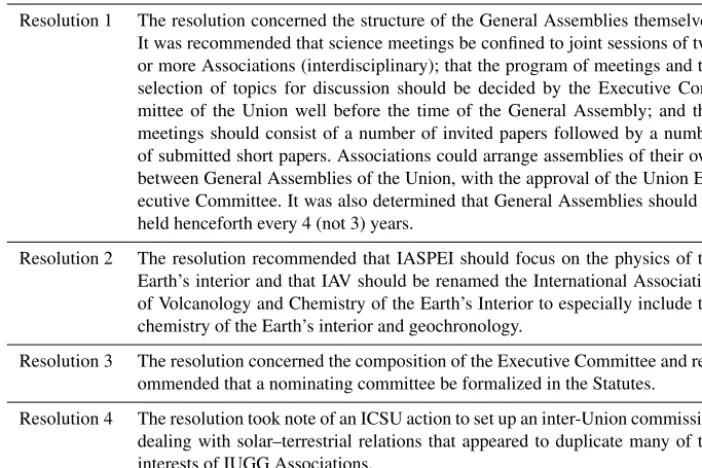
were named; a “Committee of 4” composed of four people appointed by the incoming President; and a “Committee of 14” composed of 14 people (7 people were appointed by As-sociations, each of them had one representative in the com-mittee, and 7 people were appointed by the IUGG Council) and this committee did not include members of the Bureau. Each IUGG National Committee and each IUGG Associa-tion was requested to submit recommendaAssocia-tions for consider-ation to the first committee. In the fall of 1964, the “Com-mittee of 4” issued a report with an appendix that included copies of all material submitted by National Committees and Associations. In January 1966, the “Committee of 14” met in Paris and affirmed that any reorganization should preserve the autonomy and freedom of action that the Associations had always enjoyed. The “Committee of 14” then issued four Resolutions (Table 2).
Table 2.Four resolutions by the “Committee of 14”.
Resolution 1 The resolution concerned the structure of the General Assemblies themselves.
It was recommended that science meetings be confined to joint sessions of two or more Associations (interdisciplinary); that the program of meetings and the selection of topics for discussion should be decided by the Executive Com-mittee of the Union well before the time of the General Assembly; and that meetings should consist of a number of invited papers followed by a number of submitted short papers. Associations could arrange assemblies of their own between General Assemblies of the Union, with the approval of the Union Ex-ecutive Committee. It was also determined that General Assemblies should be held henceforth every 4 (not 3) years.
Resolution 2 The resolution recommended that IASPEI should focus on the physics of the
Earth’s interior and that IAV should be renamed the International Association of Volcanology and Chemistry of the Earth’s Interior to especially include the chemistry of the Earth’s interior and geochronology.
Resolution 3 The resolution concerned the composition of the Executive Committee and
rec-ommended that a nominating committee be formalized in the Statutes.
Resolution 4 The resolution took note of an ICSU action to set up an inter-Union commission
dealing with solar–terrestrial relations that appeared to duplicate many of the interests of IUGG Associations.
IUGG in the negotiations and in March 1970 a proposal was offered that would combine the present responsibili-ties of IUCSTP, URSI, IUGG into nine “associations” that would cover, without duplication, the separate responsibili-ties of (i) Radiophysics, (ii) Geomagnetism, (iii) Aeronomy, (iv) Geodesy, (v) Seismology, (vi) Volcanology, (vii) Meteo-rology, (viii) Oceanography, and (ix) Hydrology. It was pro-posed that these units could be then federated into one, two, or three separate Unions within ICSU. However, at the 1971 IUGG General Assembly in Moscow, the IUGG Council re-ceived word that URSI had rejected all of the proposals in-cluding the ideas of federation. In 1972, ICSU changed IUC-STP to a Special Committee for the purpose of coordinat-ing short-term programs requircoordinat-ing the cooperation of several ICSU bodies and the direct participation of national groups. In 1978, IUCSTR became an ICSU Scientific Committee on Solar Terrestrial Physics (SCOSTEP), to which IUGG main-tains a liaison to the present day.
At the 1975 GA in Grenoble, France, a subcommittee un-der the control of the Bureau was formed to consiun-der IUGG’s structure. A “radical” reorganization of IUGG was proposed in the late 1980s, in which IUGG would be divided into two “Super-associations”, one for the fluid Earth (International Association of Hydrological Sciences (IAHS), the Interna-tional Association of Meteorology and Atmospheric Physics (IAMAP), the International Association of the Physical Sci-ences of Oceans (IAPSO), and parts of IAGA) and the other for the solid Earth (IAG, IASPEI, the International Asso-ciation of Volcanology and Chemistry of the Earth’s Inte-rior (IAVCEI), and other parts of IAGA). These two “Super-associations” would operate independently of each other,
with general guidance from the Union. The idea was rejected by IAGA because splitting IAGA into fluid Earth and solid Earth parts would not accommodate the study of planets. Fur-thermore, the interests of the National Members might not be served under this arrangement and the notion was discarded. In 1989, President Vladimir Kellis-Borok convened an Advisory Board on Scientific Policy to look at the goals of the Union and make recommendations concerning its mis-sions and objectives. In 1991, the Board was expanded to include the Presidents of the Associations and was chaired by IUGG Vice President Peter J. Wyllie. The Board gave a report at the 1995 GA in Boulder, Colorado, USA, and pro-posed revisions to the Statutes.
clar-ified at the 1999 GA in Birmingham, especially with regard to nominations at the time of the General Assembly.
Over time, there has been natural tension between the As-sociations and the Union, with respect to the autonomy of the Associations and the benefits of being a common Union. Such tension has risen at certain times and has been resolved at others. At the 1971 GA in Moscow, it was noted that sev-eral Associations had held their own assemblies and elected officers. This had not been visualized as a possibility, but it seemed not to cause difficulties. At the 1979 GA in Canberra, the IUGG By-law stating that Associations could not hold their own scientific sessions during IUGG General Assem-blies was removed. Beginning after the 1983 GA in Ham-burg, a review of the Associations was initiated. A “Fluid Earth Sciences Committee” was established in 1991, com-prised of the Presidents of IAMAP, IAHS, and IAPSO and chaired by the IUGG President; it was disbanded in 1995. IAPSO did not attend the 1995 GA in Boulder, Colorado, USA, choosing instead to meet separately in Hawaii. At the 1995 GA in Boulder, it was agreed that there would be no Association sessions during Union Lectures. Following this GA, the concerns and tensions between the Associations and the Union, including any possibility of splitting the Union into “solid” and “fluid” parts, were reconciled.
3.3 IUGG finance
Since 1946, the Union has been funded primarily by pay-ments by its National Members according to category of membership (which carry prescribed numbers of units). As-sociations are funded by subventions from the Union as well as by grants and direct support for specific programs from ICSU, UNESCO, and other bodies. Needless to say, the fi-nances of IUGG, especially in terms of the price of a unit of membership and the distribution of funds to the Associations, have been under constant discussion.
IUGG finances were kept in British pounds until 1960; after that the accounts were denominated in US dollars. In 1963, the IUGG Council decided that a Member Coun-try could raise its category of membership unilaterally, but that a vote of the Council was required to reduce it. At the 1971 GA in Moscow, the unit of membership was in-creased to USD 600, and there was considerable discussion about how IUGG funds were allocated to the Associations. At the 1975 GA in Grenoble, the unit of subscription was raised to USD 800 effective in January 1977. Regarding fi-nancial allocations to the Associations, it was decided that IAG and IAGA would be considered large associations and should receive equal annual allocations of approximately USD 19 000; IASPEI, IAMAP, and IAPSO medium-sized as-sociations that should receive equal annual allocations of ap-proximately USD 14 000; and IASH and IAVCEI two small associations that should receive equal annual allocations of approximately USD 10 000. At the 1983 GA in Hamburg, due to a worsening financial outlook, the allocations to the
Associations were reduced by 20 %, and it was decided, amid strong objections from some national members, to raise the IUGG dues to USD 850 in 1985 and then to USD 900 in 1986. In 1983, the GA in Hamburg approved two higher cat-egories of membership (11 and 12, with 35 and 40 units, re-spectively). By the 1987 GA in Vancouver, the finances of the Union were deemed acceptable and the value of a unit, USD 900, was maintained as were the allocations to the As-sociations. The GA registration fee came under discussion as being too high (the Vancouver GA ended with a small sur-plus). At the 1991 GA in Vienna, the IUGG Council decided to raise the unit of membership annually in 10 % steps up to USD 1200 in 1995, and the Finance Committee moved that USD 20 be added to the registration fee for the next GA and then distributed to the Associations on the basis of participa-tion. At the 1995 GA in Boulder, the Council decided to au-tomatically increase the unit of subscription annually based on the OECD consumer price index.
Registration fees and financing of the General Assemblies became an issue at the 1995 GA in Boulder. At this assem-bly, fees for attending just 1 week of what was normally a 2-week Assembly were introduced, but there was no Geo-host program – a pool of money from which the registration fees of scientists from developing countries could be paid. It had been thought that support could be found for scien-tists from the former Soviet Union but that failed to hap-pen. The American Geophysical Union (AGU) reported a deficit for the Boulder Assembly and the invitation for the 1999 Assembly in the UK came with a condition: the UK did not want to accept financial responsibility. Ultimately, the issue was resolved through special arrangements, includ-ing the formation of an Oversight Committee. The 1995 GA resolved that detailed invitations must reach the Secretary General not later than 3 months before the GA preceding the GA of the invitation, and should include efforts to subsidize travel, registration fees, and other expenses of scientists from developing countries and of young scientists from all coun-tries. At the 1999 GA in Birmingham, the IUGG Council re-solved that the host countries for general assemblies should henceforth carry the financial burden. A memorandum, “On invitations for IUGG General Assemblies”, was developed.
3.4 IUGG publications
Chroni-cles as well as other scientific papers became such that at the 1971 GA in Grenoble, it was decided to discontinue the pub-lishing of monographs. In addition, a committee chaired by Georges Laclavère was appointed to consider the future of the IUGG Publication Office because his retirement from his former government post would limit the facilities available to him. By 1981, the IUGG directory (the Yearbook) was published every 4 years as one or two issues of the Chron-icle. The Yearbook for 1989 was published as Chronicle is-sues 195–196, but also on a diskette. The Publications Office closed in 1990. Former IUGG Secretary General Paul Mel-chior (1973–1991) continued the Chronicles from his office in Belgium until publication ceased in 1995.
3.5 IUGG membership
At the conclusion of the 1999 GA in Birmingham, the Union had three categories of membership: Regular (with the right to vote), Observer, and Associate, but this had not always been the case. Until 1991, a National Member either paid its dues or it was not a member. In 1991, an Observer category was defined for Member countries whose payments were temporarily in arrears. Associate membership was added at the 1999 General Assembly. As a result of these options, the membership in the Union changed annually as countries either met the qualifications of membership, changed cate-gory, or departed from membership. One special case was that of the Federal Republic of Germany (FRG) and the Ger-man Democratic Republic (GDR). The FDR joined in 1951; the GDR applied for membership in 1952 and at the IUGG General Assemblies in 1957, 1960, and 1963 they shared a vote. In 1967, the GDR acquired independent membership. At the end of 1990, the GDR and FRG reunited, so the num-ber of Memnum-ber countries decreased by one. Another special case was that of the memberships of the Republic of China (ROC) and the People’s Republic of China (PRC). This case resulted in an Extraordinary General Assembly in 1977, de-scribed in more detail below. At that time, the PRC replaced the ROC; in 1995 the IUGG Statutes and By-laws were re-vised to permit two Adhering Bodies for China.
Before 1979, all of the attendees of the General Assembly had been asked to approve the decisions of the Council. But that was removed and replaced by a requirement for a ple-nary session that has been subsumed into the Opening and Closing Plenaries. Also in 1979, a provision was added that the Council could be convened between General Assemblies if requested by a simple majority of the Executive Commit-tee. In 1983, voting rules, especially with regard to a quorum and the numbers needed for a positive outcome, were added to the By-laws.
4 Highlights of IUGG General Assemblies (1963–1999)
4.1 XIII General Assembly (19–31 August 1963, Berkeley, California, USA)
IUGG President Vladimir V. Beloussov (USSR) presided. Vice Presidents were Julius Bartels (F. R. Germany) and Joseph Kaplan (USA); Georges R. Laclavère (France) was Secretary General and Maharajapuram S. Krishnan (India) and Takesi Nagata (Japan) were Bureau Members. The US National Academy of Sciences issued the invitation. The Assembly was co-hosted by the US National Com-mittee for IUGG (Tom Malone, Chair) and the University of California. The American Geophysical Union handled the general arrangements, and David K. Todd of University of California led the Local Organizing Committee. Harri-son Brown, Foreign Secretary of the National Academy of Sciences, spoke and a welcoming message from US Presi-dent John F. Kennedy was read. Jerome Wiesner, Director of the Executive Office of Science and Technology, addressed the Opening Ceremony. Participation in the General Assem-bly was enhanced by an International Symposium on the IGY, held at the University of California at Los Angeles pre-ceding the assembly.
The Council received the first Treasurer’s report. Reports were received from the Tsunami Commission as well as from FAGS and the liaisons to SCAR, SCOR, and COSPAR. A special committee was appointed to clarify rules for admis-sion of new countries, especially applications from the ROC and the GDR. Other IUGG scientific committees included those on Geophysics Bibliography, Space Research, the Up-per Mantle Project, the International Hydrographic Decade, Problems of Geochemistry, and an Inter-Association Heat Flow Committee. IAG changed its organizational structure as a result of the availability of artificial satellites for geode-tic applications.
Representatives were named to the Inter-Union sion on the Ionosphere (IUCI), replacing the Mixed Commis-sion on the Ionosphere (dissolved in 1958); the Joint Com-mittee on Solar Terrestrial Relationships; and the Inter Union Commissions on Radio-Meteorology (IUCRM), Applied Ra-dioactivity, and an Ad hoc Committee on Problems of Geo-chemistry. Liaisons were appointed to UNESCO, the UN Cartographic Office, WMO, PAIGH, and the Pacific Science Association (PSA). A liaison to the Pan Indian Ocean Sci-ence Association (PIOSA) was discontinued following this Assembly.
system for tsunamis be regarded as the nucleus of an Inter-national Tsunami Warning System; that improved heat flow measurements be taken; that more aeromagnetic surveys be done and improved ground-based magnetic measurements be made; that a joint Panel of Experts on Oceanographic Tables and Standards be supported; that UNESCO should call upon IUGG to serve as the scientific advisor of the International Hydrological Decade; and that a Permanent Service on the Fluctuation of Glaciers be formed.
4.2 XIV General Assembly
(25 September–7 October 1967, Zurich, Switzerland)
IUGG President Joseph Kaplan (USA) presided. Other mem-bers of the Bureau were Vice Presidents Keith E. Bullen (Australia) and Jean Coulomb (France), Secretary Gen-eral George Garland (Canada), Treasurer Einar Ander-sen (Denmark), and members Bert Bolin (Sweden) and Valery Troitskaya (USSR). The invitation from the Swiss Academy of Sciences (Schweizerische Akademie der Natur-wissenschaften) to host the General Assembly was not re-ceived until 1965. To accommodate the Assembly, meetings of Council and Plenary Sessions were held in Zurich and Association programs were distributed across Zurich (the International Association of Volcanology (IAV), IASPEI), Bern (IASH, IAPO), St. Gall (IAGA), and Lucerne (IAG, IAMAP). Fritz Kobold was Chair of the Swiss Local Orga-nizing Committee; the green–blue–white logo representing the Earth, the ocean, and the atmosphere that IUGG uses to-day originated with the Swiss local organizing committee for this Assembly (Fig. 3). Once again, no venue for the 1971 General Assembly was apparent, and the matter was left to the incoming officers.
During the quadrennium, ICSU created the Committee on Water Research (COWAR) to promote contacts between the Unions dealing with water issues. IUGG became instru-mental in the Upper Mantle Project. The Union Committee on Problems of Geochemistry was (temporarily) disbanded and absorbed into the newly renamed International Associ-ation on Volcanology and Chemistry of the Earth’s Interior (IAV became IAVCEI). IAPO also changed their name to IAPSO (“Physical Sciences of the Ocean” instead of “Physi-cal Oceanography”).
Twenty-five Union resolutions were passed (IUGG Archives, 1967). They urged establishment and continuation of geophysical observatories for water resources, heat flow, seismology, volcanology (especially in Iceland and Italy), and geomagnetism; support of the Upper Mantle Project, the International Active Sun Years, the International Geologi-cal Correlation Programme (IGCP), an inter-agency Work-ing Group on Statistical Data on Wind and Waves (already concerned with maritime pollution), the Geodetic Reference System 1967, and development of a world volcanology map. The assembly approved the charter for the Central Bureau
Figure 3.Elena Lyubomova (USSR delegate) at the General As-sembly in Zurich. Note the badge with the IUGG logo used for the first time (photo: courtesy of Seiya Uyeda).
for Satellite Geodesy and IUGG’s participation in the Global Atmospheric Research Programme.
4.3 XV General Assembly (2–14 August 1971, Moscow, USSR)
IUGG President Jean Coulomb (France) presided. Other members of the Bureau were Vice Presidents Hisashi Kuno (Japan, 1967–1969) and Liviu Constantinescu (Romania, 1969–1971), Secretary General George Garland, Treasurer Einar Andersen (Denmark), and members Liviu Constanti-nescu (Romania, 1967–1969), Thomas Malone (USA), and Alexei Oboukhov (USSR). The President of the Soviet Orga-nizing Committee was Alexandar P. Vinogradov; the Open-ing Ceremony was held in Kremlin Congress Hall (Fig. 4) and scientific meetings were at the Moscow State Univer-sity. It was noted that delegates from the People’s Republic of China were unable to get visas to attend the assembly be-cause of the Sino-Soviet ideological split between the Com-munist parties of PRC and of USSR and ongoing border mil-itary conflict.
Figure 4. XV General Assembly in Moscow, USSR.(a)
Open-ing ceremony and (b) delegates attending the ceremony in
the Kremlin Congress Palace Hall (photos a and b:
cour-tesy of Alik Ismail-Zadeh). (c) The USSR produced a stamp
on the occasion of the IUGG General Assembly (photo: https://commons.wikimedia.org/wiki/File:The_Soviet_Union_ 1971_CPA_4005_stamp_(Satellite_over_Globe).jpg, last access: 30 January 2019).
The Union established a Working Group on Advice to Developing Countries, to coordinate with the ICSU Com-mittee on Science and Technology in Developing Coun-tries (COSTED). A new Union Committee on Geochem-istry found support. Because considerable progress had been made in the understanding of hydrological processes, IASH became IAHS (“Hydrological Sciences” instead of “Scien-tific Hydrology”); its Statutes and By-laws were revised and its scientific structure was reorganized. The inter-Association Committee on Mathematical Geophysics (CMG) was estab-lished at this General Assembly. It originated with the former Upper Mantle Committee’s Working Group on Geophysi-cal Theory and Computers. The CMG, under the leadership of Vladimir I. Keilis-Borok, continued to organize symposia such as the eight annual symposia on geophysical theory and
computer applications that had been held from 1964 through 1971.
Twenty-one Union resolutions were passed (IUGG Archives, 1971). They supported adoption of the Interna-tional Gravity Standardization Net 1971 (correcting a 1909 datum), and continuations of the work begun by the In-ternational Magnetospheric Study and the Global Atmo-spheric Research Programme, and approval of an interna-tional and inter-Union study group under the auspices of IAG to strengthen cooperation on lunar laser ranging exper-iments and theory. Several resolutions emphasized the need for new geophysical measurements such as for ozone (both with ground-based and satellite instruments), boundary-layer phenomena (oceanic and atmospheric), high-altitude (about 50 km) wind and air temperatures, lunar and tidal effects on the magnetosphere, the solar constant, the optical properties of aerosols and clouds, active and dormant volcanoes to study the potential benefits of geothermal energy, tide gauge mea-surements (mean sea level), and the absolute density and con-ductivity of seawater. Resolution 20 sought an understand-ing of Planet Earth and supported a United Nations Confer-ence on the Human Environment (June 1972) and declara-tion of a special Environmental Period to “start the process of bringing together the environment and man into a harmo-nious state.”
4.4 XVI General Assembly
(25 August–6 September 1975, Grenoble, France)
IUGG President Henry Charnock (UK) presided. Other members of the Bureau were Vice President Attia Ashour (Egypt); Secretary General George Garland (Canada, until 1973) and Adjoint Secretary General Paul Melchior (Bel-gium, 1971–1975), Treasurer Elvin Kejlso (Denmark), and members William Ackermann (USA), Liviu Constantinescu (Romania), and Nikolai Shebalin (USSR). The Assembly was held on the campus of the University at Saint Mar-tin D’Hères and hosted by the French National Commit-tee for Geodesy and Geophysics (of the French Academy of Sciences), chaired by Georges Laclavère. Participants in-cluded guests from UNESCO, WMO, and the International Atomic Energy Agency (IAEA). There were Union Lec-tures, and more than thousand papers were presented. There were reports from the Inter-Union Commission on Geody-namics; the inter-Association Committee for Advice to De-veloping Countries, CMG, the Tsunami Committee and the Commission on Geochemistry. A Joint IASPEI-IAGA Inter-Association Commission on Planetary Sciences was initi-ated.
strato-spheric composition and recommended that nations monitor and evaluate long-term trends. Several resolutions addressed adoption of uniform values (the speed of electromagnetic ra-diation in vacuo) and terminology, including use of SI units in geodesy and geophysics and standard legends in hydrolog-ical maps. Recommendations included changes in the consti-tution of the IUCRM and inclusion of radio oceanography, and a volcanology research center in the Pacific. The Union supported the work of the IAHS International Commission for Snow and Ice to produce a World Inventory of Perennial Snow and Ice Masses, the need for a better determination of the solar constant, improved polar motion measurements us-ing Doppler satellite trackus-ing, and low-altitude satellite mag-netic survey data.
4.5 Meeting of the Council and Extraordinary General Assembly (6 August 1977; Durham, UK)
IUGG President Attia Ashour (Egypt) presided. Other mem-bers of the Bureau were Vice President George Garland (Canada), Secretary General Paul Melchior (Belgium), Trea-surer Elvin Kejlso (Denmark), and members Nicolai She-balin (USSR), Henri Lacombe (France), and Carl Kisslinger (USA). Forty-six Member countries were represented, and nine countries voted by correspondence on a three-part mo-tion to admit the People’s Republic of China (PRC) into membership. The motion passed by a vote of 47 to 7 with 1 abstained. The motion also indicated that “the representation assumed until now by the Taiwan delegation must be can-celled”. This was because the IUGG Statutes did not permit more than one Adhering Body per member country.
To briefly describe the circumstances that led up to the Ex-traordinary General Assembly (EGA), the Republic of China (ROC) became a constitutional entity in 1912, but national and international conflicts resulted in a division in 1949 such that most of the land mass became part of the PRC, based in Beijing. There had been discussions as early at 1956 that the PRC should be invited to apply for membership in IUGG (they were a participating country in the IGY). However, it was the ROC that first submitted an application in 1957 and after much discussion, the ROC was admitted at the IUGG General Assembly in Zurich (1967). In 1971, the United Na-tions expelled the ROC as a member, accepting instead the PRC. Several other nations followed suit and cancelled diplo-matic recognition of the ROC. In 1974, the PRC formally re-fused to participate in ICSU programs because the ROC had not been expelled from ICSU membership.
Because Australia did not recognize the ROC, no visas could be issued to any Taiwanese visiting scientists at the IUGG General Assembly in Canberra (1979) “other than in a private capacity”. In addition, in 1976 the International Union of Geological Sciences had voted to cancel the IUGS membership of the Republic of China, and approved an ap-plication for membership by the People’s Republic of China.
So it is no surprise that IUGG took the measures they did – but the story does not end there.
ICSU had long upheld non-discriminatory policies with regard to the rights of scientists. An ICSU resolution passed in 1958 affirmed the right to participate in scientific activi-ties “without regard to race, religion or political philosophy.” A resolution on the Free Circulation of Scientists passed in 1963 asked that its member Unions, with regard to all scien-tific meetings, “ensure the fundamental right of participation, without any political discrimination”. This policy was reaf-firmed in 1966 and 1972 and was incorporated in the ICSU Statutes in 1972. At the ICSU Assembly in Washington D.C., USA (1976), a resolution on the Principle of Universality was passed which expressed “eagerness” to welcome the sci-entific community of the People’s Republic of China while recommending that Unions provide for adherence by scien-tific communities through an appropriate scienscien-tific institution “provided they can be listed under a name that will avoid misunderstanding about the territory represented.”
In 1982, the 19th General Assembly of ICSU (Cambridge, UK) admitted the China Association for Science and Tech-nology (CAST) while affirming that the “Academy located in Taipei, China, shall retain its present membership in ICSU”, and urged amendment to Union Statutes that would “pro-mote the universality of science.” In 1995, the IUGG Council changed Statutes 4 and 5 so that “under extraordinary cir-cumstances, the Council of IUGG . . . may admit a suitably designated additional Adhering Body for a country.” Conse-quently, “the Academy of Sciences located in Taipei, China” was admitted as a member in Category IV, and remains a member today.
4.6 XVII General Assembly (3–15 December 1979, Canberra, Australia)
IUGG President Attia Ashour (Egypt) presided, and the members of the Bureau were the same as for the 1977 Ex-traordinary General Assembly. The Australian Academy of Sciences hosted the Assembly; Peter V. Angus-Leppan was Chair of the Organizing Committee and Bruce P. Lambert was Executive Director. This was the first General Assem-bly of the Union in the Southern Hemisphere, and was held on the campus of the Australian National University. Sir Zel-man Cowen, Governor-General of Australia, addressed the Opening Ceremony. The program featured Union Lectures, inter-Association symposia, and scientific committee meet-ings.
was expanded to include Radio-Oceanography. Apropos to the business of the EGA in 1977, the delegates were asked if they were in favor of an ICSU proposal to replace the word “country” with “territory” in the Statutes, which would then permit both the ROC and the PRC to be members. The vote failed.
Seventeen Union resolutions were passed (IUGG Chron-icles, 1980). The resolutions supported the (now Ab-dus Salam) International Center for Theoretical Physics in Trieste, Italy; the Alpine Experiment within GARP/WCRP; the International Polar Motion Service; financial aid by FAGS to the Service for Mean Sea Level; and an IAU res-olution that the IAU Working Group on the Determination of the Rotation of the Earth be reconstituted to be joined with IUGG. The Union recommended that Geodetic Refer-ence System 1980 replace an earlier version; that the IAU reconsider its choice of a nutation series to determine Earth orientation parameters; that ICSU encourage UNESCO to es-tablish a Natural Hazards Unit; and again urged that a center for volcanology research be established in the Pacific. The Union endorsed continued development and application of space methods for geodetic observations and requested that COSPAR formally include the IAG Commission on Interna-tional Coordination of Space Techniques for Geodesy and Geodynamics within its structure. The Union acknowledged the contributions of the U.S. Navy Navigation Satellite Sys-tem to geodetic studies. IUGG also passed several resolu-tions of instruction to itself. These included asking its mem-ber countries to balance support of basic research in the geo-sciences with practical applications, and to establish National Committees and Correspondents to the Associations; pub-lishing a list every 2 years of international scientific pro-grams sponsored entirely or in part by IUGG and its Associ-ations; inviting the incoming Bureau to make changes in the Statutes to permit admission of adhering bodies “necessary for the complete representation of the geodesists and geo-physicists of any country”; and planning the scientific pro-gram at General Assemblies such that both interdisciplinary symposia and understandable Union lectures and Associa-tion symposia in their own specific fields are presented.
4.7 XVIII General Assembly (15–27 August 1983, Hamburg, Federal Republic of Germany)
IUGG President George D. Garland (Canada) presided. Other members of the Bureau were Vice President Niko-lai Shebalin (USSR), Secretary General Paul Melchior (Bel-gium), Treasurer Ole Bedsted Andersen (Denmark), and members James Dooge (Ireland), Henri Lacombe (France), and Carl Kisslinger (USA). The German National Commit-tee for Geodesy and Geophysics hosted the Assembly, which was chaired by Wolfgang Torge. There were greetings from Karl Carstens, President of the Federal Republic of Germany, and Heinz Riesenhuber, Federal Minister of Research and Technology. The Federal Republic of Germany produced the
Figure 5.Stamp celebrating the XVIII IUGG General Assembly in Hamburg in 1983 (photo: https://commons.wikimedia.org/wiki/ File:DBP_1983_1187_GeodC3A4sie_und_Geophysik.jpg, last ac-cess: 30 January 2019).
stamp (Fig. 5) on the occasion of the IUGG General Assem-bly in Hamburg in 1983.
Twenty-one inter-disciplinary symposia were organized, including one on the ocean and CO2climate response. For the first time, the number of participants adhering to each Association was recorded. Each Association had convened their own scientific assembly between Union Assemblies and it was agreed that the Associations could arrange their own programs within a GA. The Union Committee on Geochem-istry was disbanded and the Committee for Advice to Devel-oping Countries was restructured. IUGG named a liaison to the International Hydrographic Organization.
a center for volcanological studies; participation in several ICSU programs on solar–terrestrial interactions; calibrated radiation energy exchange observations in data-poor regions for studies of climate systems; and that compilations of cli-mate data be made available in convenient format at conces-sional rates especially to scientists in developing countries.
4.8 XIX General Assembly (9–22 August 1987, Vancouver, Canada)
IUGG President Devendra Lal (India) presided. Other mem-bers of the Bureau were Vice President Carl Kisslinger (USA), Secretary General Paul Melchior (Belgium), Trea-surer Ole Bedsted Andersen (Denmark), and members James Dooge (Ireland), Vladimir Keilis-Borok (USSR), and Helmut Moritz (Austria). The Canadian National Research Council (Larkin Kerwin, President) and the University of British Colombia (David W. Strangway, President) were the primary co-hosts for the Assembly. The Chair of the Cana-dian National Committee for Geodesy and Geophysics was Gordon A. McBean. The Assembly took place on the campus of the University of British Columbia. AGU agreed to pub-lish 10 IUGG volumes in its Geophysical Monograph series based on the presentations by Union Lecturers and selected talks at 20 inter-Association symposia (see Appendix B). Poster sessions were encouraged at the Assembly. In his opening address, President Lal referenced the observed de-pletion of ozone in the Antarctic and dramatic changes in atmospheric CO2and temperature.
The Union Committee on the Study of the Earth’s Deep Interior (SEDI) was established in 1987 to cut across the tra-ditional discipline-oriented bounds of the Associations (es-pecially IAG, IAGA, IASPEI, and IAVCEI) to develop a co-herent and consistent picture of the workings of the Earth’s interior. The only other two Union Committees reporting were the CMG and the Committee for Advice to Devel-oping Countries. In cooperation with the IAU, IUGG es-tablished in 1988 the International Earth Rotation Service (IERS). Numerous inter-Union relationships continued and there was a plea to extend the termination date of the In-ternational Program on the Lithosphere. A workshop was proposed to consider the possible contributions of IUGG to the International Geosphere-Biosphere Programme (IGBP), a new ICSU interdisciplinary program. The generous sup-port of UNESCO to the Associations was acknowledged. SCOPE published a seminal report, “The greenhouse ef-fect, climatic change and ecosystems”, which summarized the scientific findings of a 1985 conference on the “Assess-ment of the Role of Carbon Dioxide and of Other Green-house Gases in Climate Variations and Associated Impacts” co-sponsored by ICSU, WMO, and the United Nations Envi-ronmental Program (UNEP). This was the first comprehen-sive international assessment of the environmental impact of atmospheric greenhouse gases.
Nine resolutions were passed (IUGG Archives, 1987). They supported decisions by URSI and IAU to approve the Bureau International des Poids et Mesures (BIPM) as the au-thority for International Atomic Time; the establishment of the International Decade for Natural Hazard Reduction for the period 1990 to 2000; and IGBP activities. IUGG recom-mended installation of new and recalibrated tide gauges to include telemetered measurements of atmospheric pressure and geodetic position; and the launch of a dedicated satellite gravity mission by the mid-1990s. IUGG urged moderniza-tion of ICSU data management systems; and reconsideramoderniza-tion by countries planning to close down long-standing geophys-ical observatories and stations.
4.9 XX General Assembly (11–24 August 1991, Vienna, Austria)
IUGG President Vladimir I. Keilis-Borok (USSR) presided. Other members of the Bureau were Vice President Carl Kisslinger (USA), Secretary General Paul Melchior (Belgium), Treasurer Soren Gregersen (Denmark), and mem-bers Gordon McBean (Canada), Helmut Moritz (Austria), and Ye Duzheng (China). This was Paul Melchior’s last Gen-eral Assembly; he had served as IUGG Secretary GenGen-eral and Adjoint Secretary General for 20 years. The Austrian Na-tional Committee of Geodesy and Geophysics hosted the As-sembly at the Technical University of Vienna. Hans Sünkel was the Chair of the local organizing committee. Maria Fek-ter, Secretary of State and Minister of Economic Affairs ad-dressed the Opening Ceremony. AGU continued to publish the Union Lectures and Symposia as IUGG volumes in its Geophysical Monograph series, and eight volumes were pub-lished during 1992–1994 (see Appendix B).
During this GA, a political upheaval occurred in the USSR that was of great concern to the delegates at the Assembly from that country, some of whom feared they could not go home. It would be remiss not to include this memory of the General Assembly and the personal impact it had on all of the delegates. While the worst outcome did not happen then, ultimately, the ramifications of this event changed the very structure of IUGG. The USSR delegates left their country for Vienna to attend the IUGG General Assembly, and returned to their country in political chaos, which would disintegrate in a few months into 15 independent states. In 1992, Russia replaced the USSR as a member of IUGG, and four other countries of the former Soviet Union joined the Union later: Armenia, Azerbaijan, Estonia, and Georgia.