e-ISSN: 2278-7461, p-ISSN: 2319-6491
Volume 5, Issue 5 [May. 2016] PP: 104-108
Fingerprint Identification Using Radon Transform
BMG Prasad
1, J S V R S Sastry
2, V. Veeresh
31Working as Professor in Holy Mary Institute of Technology and Science, Keesara, Affiliated to JNTU-
Hyderabad, T.S, India.
2,3Working as Assistant Professor in Holy Mary Institute of Technology and Science, Keesara, Affiliated to
JNTU- Hyderabad, T.S, India.
Abstract: In this paper, a new method for fingerprint identification based on Radon transform is proposed as an alternative to minutiae-based approaches. Since existing methods based on these local characteristics “minutiae” have attained a level of success rate saturation, this paper aims a different approach for analyzing fingerprints. This approach offers a fine analysis from global characteristics via the generated Radon profiles. A global structural similarity based on these directional features is then derived. This new approach does not require any pre-processing and treatments as in classical fingerprint identification methods
Keywords: About five key words in alphabetical order, separated by comma
I.
INTRODUCTION
The increasing need for security has generated considerable interest in the use of biometry technology. Various biometric techniques have been already developed, including face, fingerprint, hand geometry, hand vein, iris, retinal pattern, signature, voice print, and facial thermo grams. Fingerprint identification is one of the most reliable and flexible method for personal identification since there is no more than one person with the same fingerprint. Moreover, each fingerprint remains unchanged over a lifetime and is easy to acquire. The aim of fingerprint identification is to find for a given set of fingerprint features the corresponding one in a collection of a pre- registered database. Currently, an increasing number of applications uses fingerprint for identification. This technique has been extensively studied compared to other existing biometric solutions. It also offers good matching performances. Many efforts have been then devoted to the development of automatic fingerprint identification systems. It is evident that the problem discussed in this paper is very well known and several solutions exist providing a good quality. However, all these identification approaches are based on the local Characteristics of fingerprints (minutiae), but many of the existing identification systems suffer from some drawbacks. Their performance strongly depends on theacquisition conditions. Many complex and low pre- treatment are often necessary to overcome this difficulty in minutiae based fingerprint identification systems. In a standard fingerprint identification system, the main steps for minutiae extraction are: smoothing, local ridge orientation estimation, ridge extraction, thinning and minutiae detection. It could be noticed that the performance of the overall system depends strongly on each step. Various approaches, such as energetic methods based on Gabor filters or Wavelets, have been developed to over-come these weaknesses. We propose in this paper a different approach for extracting global structure from each image. Rather thanusing the traditional features such as minutiae, the proposed method uses new features and does not require any pre-processing. This new method is based on the Radon transform.In this paper, the Radon transform is used as a tool for extracting global features from fingerprint images. These features could be used in the computation of a structural similarity measure. Indeed, the fingerprint image can be considered as a set of various oriented features.
II.
.RADON
TRANSFORM
In recent years, the Radon transform and the Hough transform have received much attention in many fields of research. These two transforms are able to decompose an image into a set of possible line parameters. Each line in the image gives a peak at the corresponding line parameters.
Radon transform represents an image as a collection of projections along various directions. The Radon transform g(θ,ρ) of a two dimensional image f(x, y) is defined as its line integral along a line oriented at direction θ from the x-axis and at a distance ρ from the origin as shown in figure 1.
For a 2D function f(x,y), defined in R2 it is expressed as follows:
In the case where ρ and θ are discrete, the Radon transform is equivalent to the Hough transform for a line.
Figure 1 - Illustration of Radon transform.
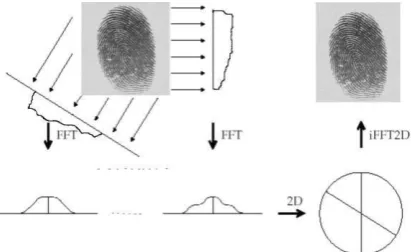
Radon transform is defined for an image with unlimited support. In practice, the image is confined to [ Lx, Lx] [ Ly, Ly] . According to Fourier slice theorem, this transformation is invertible. Fourier slice theorem states that for a 2-D function f (xy), the 1-D Fourier transforms of the Radon transform along r , are the radial samples of the 2-D Fourier transform of f (x, y) at the corresponding angles. Rotation of the input image corresponds to the translation of the Radon transform along θ .
Figure 2 - Block diagram of image reconstruction using the Radon transform.
Figure 2 illustrates the use of Radon transform for image reconstruction. Indeed, the projection-slice theorem states that by exploring all the directions one can recover the original signal f(x,y). However, in practice a limited number of projections is used.For each orientation of projection, the Fourier transform is computed along the same orientation. The reconstruction of the original image is obtained by the inverse Radon transform. The precision of this reconstruction increases with the number of projection directions. In order to reconstruct perfectly the original image, the Radon transform requires an infinite number of projections along all possible directions. This approach has the advantage of being robust to zero mean additive noise.
III.
METHOD DESCRIPTION
\
Figure 3 - Fingerprint and its Radon profiles.
As shown in figure 4, the curves corresponding to various acquisitions of the same fingerprint are very close. Whereas, two fingerprints corresponding to different people present distinct Radon profiles as shown in the figure 5.Here, we propose the correlation as a measure of the similarity degree between two Radon profiles. Correlation is one of the most widely used similarity measures. Therefore, maximum correlation corresponds to maximum similarity between two profiles. This objective measure could be used as an index of fingerprint similarity.Among the various fingerprint images, and for each selected orientation, we compute the correlation between the Radon profiles corresponding to different fingerprint images. By analyzing the correlation function, the identification of a person could be then achieved. Indeed, the correlation function attains its maximum when the similarity between two fingerprint images is high. It could be also noticed that this approach is non-sensitive to noise since it is based on the correlation function.
IV. SIMULATION RESULTS AND DISCUSSION
Figure 4: Correlation Plots for same fingerprint image at different angles
Figure 5: Correlation Plots for different fingerprint image at different angles
All typical fingerprint images of the database DB1 of international competition FVC2002, are used to evaluate the discrimination ability of the proposed method. The images given in the FVC2002 databases are not easy to identify since some additional perturbations have been voluntarily introduced in
order to test the robustness of the developed algorithms. The images were taken from untrained people and no efforts were made to assure a minimum acquisition quality.The fingerprints were acquired by using a low-cost optical sensor. The sensor platens were not systematically cleaned (as usually suggested by the sensor vendors). The image size is 240*480. The fingerprints are mainly from 20 to 30 year-old students (about 50% male). The acquired fingerprints were manually analyzed to assure that the maximum rotation is negligible (no alignment problem), and that each pair of impressions of the same finger has a non-null overlapping area. The database DB1 contains 10 person samples (fingers from 101 to 110) and 8 impressions per person (101_1, 101_2, ..., 101_8), 80 fingerprints in all. To illustrate the experiment, we used the whole set of samples of this database.At first, for each individual, we chose randomly an image from the corresponding samples. The same applies to the fingerprint we want to identify.Many tests have been
performed on a different set of fingerprint images. The obtained results confirmed the discrimination ability of the proposed technique.In order to identify automatically the fingerprint using
these Radon profiles, we use the correlation measure between the different profiles for a given orientation.
IV.
CONCLUSION
In this paper, a new method for identifying fingerprint based on Radon transform is proposed. The idea behind the use of Radon transform is that the most important feature in any fingerprint image is the orientations of the ridges and valleys. The Radon transform has the ability to capture these orientations. The obtained results clearly demonstrate that the proposed approach offers an appropriate tool for extracting the directional features of fingerprint images. The proposed method is flexible and simple. Furthermore, it does not require any pre- processing such as the method based on the minutiae extraction. The simulation tests have been performed on FVC2002 DB1 database, where several perturbations have been deliberately introduced on the fingerprint images. The results show that the method is not sensitive to the acquisition quality of the fingerprint image. It could be noticed that image alignment assumption limits the usefulness of the proposed method. The used database contains generally aligned images. To make the method more attractive for any database, image registration should be incorporated into the system. The further work is going on using the combination of wavelet transform and the radon transform. Also the time complexity can be obtained.
REFERENCES
[1] R. Clarke, “Human identification in information systems: Management challenges and public policy issues,” in Info. Technol. People, vol. 7, no. 4, pp. 6–37, 1994.
[2] J. G. Daugman, “High confidence visual recognition of persons by a test of statistical independence,” in IEEE Trans. Pattern Anal. Machine Intell, vol. 15, no. 11, pp. 1148–1161,
[3] 1993.
[4] S. G. Davies, “Touching Big Brother: How biometric technology will fuse flesh and machine,” in Info. Technol. People, vol. 7, no. 4, pp. 60–69, 1994.
[5] K. Jain, L. Hong, S. Pankaty and R. Bolle, “An Identity-Authentication System Using Fingerprints,” in Proceedings of the IEEE, vol. 85, no. 9, pp. 1366-1388, 1997.
[6] E. Kaymaz, S. Mitra, “Analysis and matching of degraded and noisy fingerprints,” Proceedings of the SPIE the international society for optical engineering, vol. 1771, pp. 498-509, 1993.
[7] S. Kasaei, M. Deriche and B. Boashash, “Fingerprint feature extraction using blockdirection on reconstructed images,” in Proceedings of IEEE Brisbane Autralia. TENCON’ 1997, 1997.
[8] Chih-Jen Lee; Sheng-De Wang, “Fingerprint feature extraction using Gabor filters,” in Electronics Letters, Vol. 354 , pp. 288 -290, 18
[9] Feb. 1999
[10] Jain, A.K.; Prabhakar, S.; Lin Hong, “A multichannel approach to fingerprint classification,” in Pattern Analysis and Machine Intelligence, in IEEE Transactions on Pattern Analysis and Machine Intelligence, vol. 21 4 , pp. 348 -359 , April 1999.
[11] Woo Kyu Lee; Jae Ho Chung, “Automatic real- time identification of fingerprint images using wavelet transform and gradient of Gaussian,” in IEEE Asia Pacific Conference on Circuits and Systems, pp. 508 -511, 1996.
[12] M. Poulos, A. Evangelou, E. Magkos, S. Papavlasopoulos, “Fingerprint verification based on image processing segmentation using an onion algorithm of computational geometry,” in WSPC Proceedings, February 21, 2004.
[13] Beghdadi and M. Deriche, “Features extraction from fingerprints using frequency domain analysis,” in Proc WOSPA, 14-15 December, 2000.
[15] R. V. S. N. Prabhakar, C. V. K. Rao, “A parallel algorithm for fingerprint matching”, in TENCON '89 Fourth IEEE Region 10 International Conference, pp. 373 -376, 1989.
[16] P. Toft, “The Radon transform theory and implementation”, Ph.D. Thesis, Technical University of Denmark, June 1996.
[17] V. Chappelier, Thesis, “Codage progressif d’images par ondelettes orientées,” IRISA/TEMICS, Université de Rennes1, 2005.
[18] M.P. Queluz, “Authentication of digital images and video: generic models and a new contribution,” in Signal Processing: Image Communication, pp. 461–475, 16 (5) (January 2001).
[19] J. S. Seo, J. Haitsma, T. Kalker, C. D. Yoo, “A robust image fingerprinting system using the Radon transform,” in Signal Processing: Image Communication, pp. 325–339, 19 (2004).
[20] S. Ourseline, ”Recalage d’images médicales par appariement de régions,” Ph.D Thesis, Université de Nice Sophia Antipolis, 2002.