Effects of Equivalence Ratio on Performance and
Emissions of Diesel Engine with Hydrogen and
Water Injection System at Variable Injection Timing
R.Adnan
1,*, Z. Sabri Adlan
1, F.A.Munir
1,
T.M.Indra
2, H.H.Masjuki
31)Department of Mechanical Engineering, Universiti Teknikal Malaysia Melaka, 76100 Durian Tunggal, Melaka, Malaysia
2)Department of Mechanical Engineering, Universiti Tenaga Nasional, 43009 Kajang, Selangor, Malaysia 3) Department of Mechanical Engineering, University of Malaya, 50603 Kuala Lumpur, Malaysia
Abstract-- This paper aims to develop a comprehensive
development and research for performance and emissions of diesel engine fueled with hydrogen and water at variable injection timing. Experiments have been conducted to compare the performance and emissions between diesel alone, diesel with hydrogen and hydrogen-diesel and water injection pressure. addition of hydrogen into diesel engine resulted in higher pressure which lead to huge indicated work. Furthermore, injecting water into diesel engine with hydrogen mixture indicated a desirable outcome. Existence of water in combustion slightly decreased the amount of emissions but opposite in term of performance. The fact is water injection exist in combustion will absorb a portion of heat release which will result low in combustion process thus lead to low in performance production otherwise production of NOx emission is low. In conclusion, humidification in combustion engine is a great idea toward a high performance and low in emissions production compared to diesel alone operation which leads to a green technology production.
Index Term--Air Fuel Ratio, Hydrogen Fuel, Diesel Engine.
I. INTRODUCTION
The worldwide use of diesel engines with their low fuel consumption, high durability and efficiency outcomes increase nitrogen oxide (NOx) emissions every day. Higher efficiency and lower fuel costs makes diesel engines a clear choice in applications requiring relatively large amounts of power such as in large ships, heavy trucks and power generation units [8]. Regularly, diesel engines used both on and off roads due to their low hydro carbon, high thermal efficiency and carbon monoxide emissions which contribute to large NOx emissions and particulate matter [1,19]. Besides that, elevated oxygen levels increase the maximum temperature during combustion and accelerate NOx formation [15].
Due to stricter emissions standards for diesel engines with respects to NOx and carbon dioxide (CO2) emissions and fuel
consumption, there are major concerns about the applicability of clean energy technologies [5]. Nitrogen oxide emissions from diesel engines cause unavoidable damage on environment and people health [9]. Higher numbers of smaller particles emerged from internal combustion engines are relatively more harmful to human health compared to smaller number of larger particles because smaller particles penetrate deeper into human lungs [13]. Plus, the rapid growth of vehicle usage increases the
rate of pollution which mostly come from diesel engine [14]. Therefore, there is strong initiative in looking for alternative fuels for different applications, including that for motor vehicles [18].
Hydrogen is one of the initiative renewable fuel for internal combustion engines [16]. It has the potential advantages of ultra-low pollutions, high efficiency and long-term availability [2]. In addition, hydrogen has some unique features compared to hydrocarbons, such as high mass and thermal diffusivity, wide range of flammability limits, low minimum ignition energy, and high stoichiometric air-to-fuel ratio [7]. There are some experimental investigations that have been conducted by other researcher to investigate the effect of hydrogen addition on the performance and emissions of single-cylinder diesel engines [11].
In a super-charged diesel engine, high level of hydrogen addition was attempted and has been confirmed that up to 90% substitution of diesel fuel energy by hydrogen could be achieved which contributed to ultra-low smoke, carbon monoxide and hydrocarbon emissions [10]. In fact, in other study, they verified that delayed injection timing and exhaust gas recirculation combined with hydrogen addition could achieve low temperature combustion so as to reduce both smoke and NOx emissions [6].
Another paper claimed that the hydrogen addition narrowed the operational compression ratio range and increased he knocking tendency, but NOx emissions decreased with no significant influence on hydrocarbon emission [4]. Furthermore, an experimental study on a turbo-charged common-rail split-injection light-duty diesel engine, found that NOx reduced by 25% compared with diesel fuel operation with 31% of exhaust gas recirculation ratio and 10% of total fuel energy substitution by hydrogen [12]. Other research investigated that for hydrogen enrichment of 5 and 10 Nm, the peak cylinder pressure decreased respectively, whereas pressure rise was almost the same with that of diesel [3]. Moreover, a study has identified that the cylinder pressure and heat release rate first increased and then decreased with the enhancement of H2 addition, nitric oxide emissions increased,
of 17% H2 [17]. Adnan et al. [20] found that hydrogen addition
caused an increment in hydrogen monoxide, nitrogen dioxide and nitric acid during lean combustion.
II. METHODOLOGY
Diesel engine is one of internal combustion engine which applied a high compression pressure to ignite combustion for energy production, in simple words, this type of engine requires no spark to ignite the fuel. Auto ignition occurred in the cylinder due to the high temperature is caused by high pressure during compression stroke. Diesel fuel which contains low octane number, thus it will straight away self-ignite once the temperature inside the cylinder exceeding the temperature of diesel which it may combust automatically. In addition, the diesel engine has the highest thermal efficiency instead of any type of internal combustion engine ever existed. Hence, application of diesel engine throughout the industry is getting popular due to its advantages. Majority industries have been involved in developing the diesel engine to become more efficient and reliable. Now automotive industries have focus more on developing diesel engine as primary power generation toward an environmental awareness as well. This research used a single piston diesel engine and these engine specifications are listed below.
Table I
Yanmar engine specifications
Model L100N5
Type
Air-cooled 4 cycle diesel engine
Bore x Stroke 86mm x 70mm
Maximum RPM 3600 RPM
Displacement volume 435 cm3
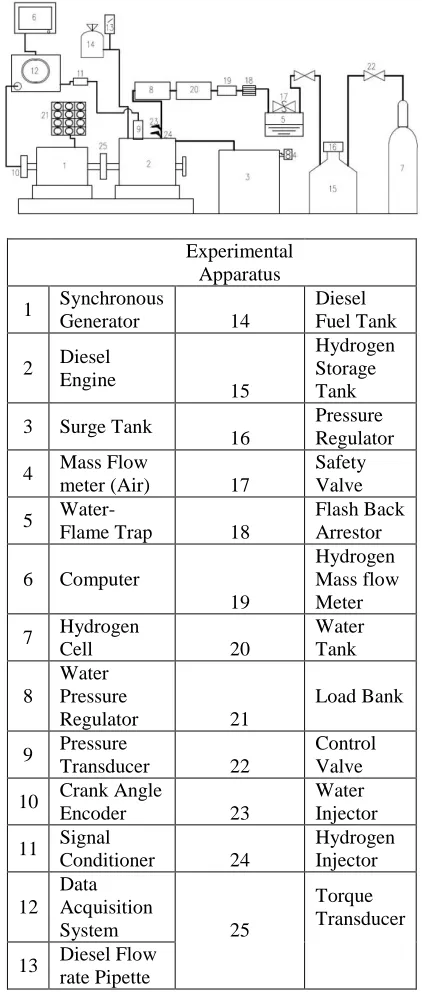
This engine is provided with air cool system in which there is no radiator attach on the engine to cool down cylinder temperature. All cooling process is done by cooling fan which attached at the front of the engine fins. Air is generated automatically from cooling fan that is connected to the crankshaft. The schematic diagram of the engine can be seen in Figure 1.
Experimental Apparatus
1 Synchronous
Generator 14
Diesel Fuel Tank
2 Diesel Engine
15
Hydrogen Storage Tank
3 Surge Tank
16
Pressure Regulator
4 Mass Flow
meter (Air) 17
Safety Valve
5
Water-Flame Trap 18
Flash Back Arrestor
6 Computer
19
Hydrogen Mass flow Meter
7 Hydrogen
Cell 20
Water Tank
8
Water Pressure
Regulator 21
Load Bank
9 Pressure
Transducer 22
Control Valve
10 Crank Angle
Encoder 23
Water Injector
11 Signal
Conditioner 24
Hydrogen Injector
12 Data Acquisition
System 25
Torque Transducer
13 Diesel Flow
rate Pipette
Fig. 1. Schematic diagram of experimental setup
sample into digital numeric values that can be manipulated by a computer.
Data acquisition is important to convert analog signal produced by pressure transducer and crank angle encoder to a readable signal. This electronic device is a medium for computer to read in term of digital signal. Gas analyzer is used to determine the content of residual gas flow through exhaust manifold. Data obtained from the gas analyzer can be used to compare the amount of gas in diesel alone, hydrogen diesel and hydrogen- diesel-water tests. The main purpose of using the gas analyzer is to determine the NOx reduction by injecting water
in diesel-hydrogen compare to diesel alone. Since this research is about finding the effects of emission to equivalence ratio, the most suitable way to probe the percentage of emission content is through gas analyzer which it can simply tracking the amount of emission. Types of gas analyzer used for this experiment are Bacharach Model 300 and AutoChex.
Equivalence ratio is determined by the ratio of the mass flow rate of the air to the fuel supplied to the engine. As the speed of the engine increased, the air flow rate will increase significantly compare to diesel supply as well. The mass flow rate of the air is determined by placing a mass flow gauge or meter at the air intake during the experiment. As the engine starts, the piston will pull more air into the cylinder for combustion. To increase the mass flow rate of air, the throttle body of the engine was adjusted by increasing the area of air that can be pulled by the piston during intake stroke. As the throttle body area increased, the engine speed will increase as well. Hence, it increased the mass flow rate of the engine. As for diesel fuel, by using manual calculation, the mass of flow rate is calculated by measuring the volume differences in the tank for certain amount of time. Lastly, as for hydrogen measurement, supplement of hydrogen was done by using electronic flow meter device namely Omega.
First case expressed an experimental set up for diesel and hydrogen mixture with water injection combustion process taken place at 20º CA (Crank angle) after top dead center. In other words, the addition of hydrogen at 30 ml/sec and water mist was injected into diesel fuel combustion during the intake valve of diesel engine opening at 20º CA after top dead center, but it will end in different period of crank angle. End process of hydrogen addition is taken place after crank angle travel at 20º. Next, the second case reported about the start of injection (SOI) of hydrogen and water which was taken place at 20º CA after top dead center. In other word, addition of hydrogen at 30 ml/sec and water was injected into diesel combustion during intake valve of diesel engine opening at 20º CA, but it stopped in different period. Lastly, the third case shows the addition of hydrogen in diesel alone. SOI for hydrogen was taken place during intake valve opening at 20º CA after top dead center and stopped after travelling 40º CA.
III. RESULTS AND DISSCUSSION
Comparison between the performance produced by diesel alone, addition of the hydrogen and addition of water injection are shown in this section. The performance consists of engine speeds, peak pressure, indicated power and thermal efficiency. Lastly, the emissions of carbon dioxide (CO2), carbon
monoxide (CO) and nitrogen oxides (NOx) are reported in this
project.
A. Equivalence ratio analysis
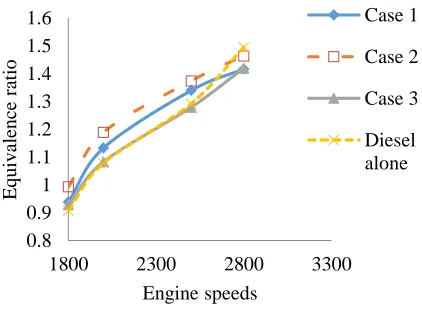
Figure 2 shows a graph illustration for equivalence ratio versus engine speed. The graph tells that the increment of engine speed affected the equivalence ratio. Equivalence ratio is a dimensionless number and it can be explained that the graph trend line for all set up are pointing upward. The highest ranking is diesel alone, followed by other three cases which are Case 2, Case 1 and Case 3. Diesel alone has the highest equivalence ratio content even at similar engine speed throughout different set up. The equivalence ratio for diesel alone are almost similar to the other cases starting from 1800 to 2500 rpm. Significant changes can be seen at 2800 rpm. This is because the higher engine speed required a large opening of fuel throttle since the amount of air intake is almost similar. The lowest reading among the rank is Case 3. This is because hydrogen itself acting as high burning rate compared to diesel. Hydrogen required a low usage of diesel at higher engine speed operation even the engine speed is shoot to a higher speed.
Fig. 2. Equivalence ratio against engine speeds
Peak pressure against equivalence ratio is shown in Figure 3. The highest peak pressure is Case 3. The value recorded is 64.4 at Ø = 1.42 (equivalence ratio) and the value lies within the range of 64 to 65 bar which seems to be normal for hydrogen addition into diesel behavior. But, the equivalence ratio is in the range of rich condition, in simple words, the existence of hydrogen does not affect much to the equivalence ratio compared to diesel alone. Amount of hydrogen supplied was 30 ml/sec and crank angle opening period set for supplying hydrogen is longer enough in such way it can generate high pressure in combustion. In addition, hydrogen is known as
0.8 0.9 1 1.1 1.2 1.3 1.4 1.5 1.6
1800 2300 2800 3300
E
q
u
iv
alen
ce
r
atio
Engine speeds
Case 1
Case 2
Case 3
flammable fuel and containing high burning rate which is very sensitive to produce high combusting pressure.
Fig. 3 Peak pressure versus equivalence ratio
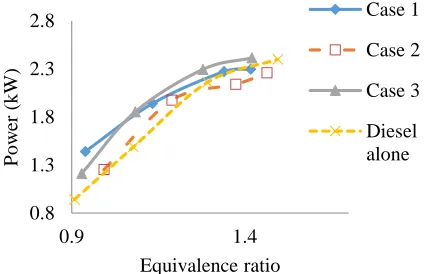
Figure 4 shows the power against equivalence ratio. Whenever indicated power increased, the equivalence ratio increased as well. The value of power recorded is approximately 2.5 kW at 1.4 equivalence ratio compared to diesel alone which recorded 2.4 kW at 1.5 equivalence ratios. By introducing hydrogen in diesel combustion, it will result a higher pressure difference in volume displacement that will lead to large indicated work and finally slightly increased in power production. Case 2 produced the lowest power around 1.4 equivalence ratio. Water injection in Case 2 leads to low combustion process. Moreover, according to the principle of heat absorption process, any fluid in high elevated temperature will move to lower temperature region.
Fig. 4. Pindicated versus equivalence ratio
Figure 5 shows the indicated thermal efficiency against equivalence ratio. Case 3 has the highest thermal efficiency compared to other cases. Hydrogen contains higher burning rate of combustion, even a small spark will lead to auto combust. Dimitriou and Tsujimura [21] reported that the break thermal efficiency of diesel engine fueled with hydrogen increased by 12.9% compared to diesel alone. Pressure is required mostly to determine indicated work, the higher differences in pressure will lead to higher indicated work which is represented in P-V diagram.
Fig. 5 Thermal efficiency versus equivalence ratio
Meanwhile, graph illustration of CO2 versus equivalence
ratio is shown in Figure 6. Case 1 has the highest percentage of CO2 compared to other cases. This is due to excessive water
injection in the combustion which lead to low combustion process. Water injection will absorb portion of heat released by diesel and hydrogen in order to evaporate. The heat transferred was taken place due to large gap of temperature. Thus, it will eventually affect overall combustion and heat required for complete combustion.
Fig. 6. CO2 versus equivalence ratio
Figure 7 shows CO emissions against equivalence ratio. Case 2 has the highest CO emissions. CO content is higher than diesel alone and hydrogen mixture. This is due to the addition of water mist in combustion which reduced combustion process. Water will absorb heat released by diesel and hydrogen combustion in evaporation phase which will lead to incomplete combustion process. Case 3 has the lowest CO emissions. This is due to addition of hydrogen in diesel engine which resulted in lean combustion. Hydrogen is known as a flammable fuel and it contains high burning rate which is very sensitive to produce high combustion process. These will result in less CO content in combustion.
58 59 60 61 62 63 64 65
0.9 1.4 1.9
P
ea
k
p
ress
u
re
(B
ar
)
Equivalence ratio
Case 1
Case2
Case 3
Diesel alone
0.8 1.3 1.8 2.3 2.8
0.9 1.4
P
o
w
er
(
k
W
)
Equivalence ratio
Case 1
Case 2
Case 3
Diesel alone
25 30 35 40 45
0.9 1.1 1.3 1.5
T
h
er
m
al
ef
ficien
cy
(
%)
Equivalence ratio
Case 1
Case 2
Case 3
Diesel alone
0.5 0.7 0.9 1.1 1.3 1.5 1.7 1.9 2.1
0.9 1.1 1.3 1.5 1.7
CO
2
(%)
Equivalence ratio
Case 1
Case 2
Case 3
Fig. 7 CO versus equivalence ratio
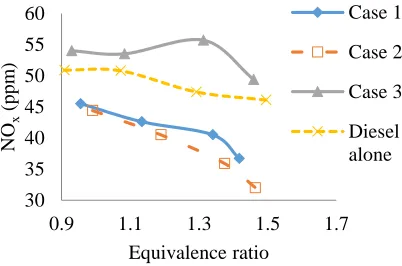
Lastly, Figure 8 shows NOx emissions against equivalence
ratio. Case 3 indicates the highest NOx emissions. NOx
formation is related to high temperature taken place in combustion process. Hydrogen fuel has a high burning rate of combustion compared to diesel alone, it has a rapid propagation of combustion which will lead to high peak pressure. Thus, it will result in high indicated work indicated. Furthermore, it contributes in high heat release rate during combustion. High burning rate will result in large production of heat generation. Hence, it will lead to high temperature production and NOx
formation. Meanwhile, water injection in diesel and hydrogen mixture resulted in heat absorption of water to evaporate.
Fig. 8 NOx versus equivalence ratio
IV. CONCLUSIONS
Diesel engine has become one of the major engine development sector in internal combustion engine industries. Companies have tried to improve the system of diesel engine because there are many beneficial possibilities can be obtained from diesel engine. The real concern of diesel engine is the amount of emissions from diesel engine which affects the environment. Dangerous gaseous and particulate matters are produced diesel engine.
Water injection does not affect a lot in engine performance, but it contributes a lot in low production of NOx. Hydrogen
combustion generates higher in indicated power production compared to others. In term of efficiency, water injection is more efficient compared to diesel alone. Therefore, water
injection will save a lot of fuel usage due to less incomplete combustion and it produces.
Emissions analysis indicates that water injection within diesel and hydrogen combustion reduced CO and NOx
emissions. Hydrogen addition contributes majorly in reduction of CO emissions due to high burning rate and high combustion propagation of hydrogen. Besides that, it also leads to lean combustion. Meanwhile, water injection resulted in lower peak pressure and combustion process. Low combustion process caused an insufficient heat formation to complete combustion. In addition, hydrogen and water are carbonless element which produces less CO formation during the combustion. Absence of carbon content in water element leads towards low in CO production.
As for NOx emissions, water injection reduced the NOx
emissions in the gas exhaust. This due to water element which acts as heat absorption during hydrogen and diesel combustion. Existence of water reduced the temperature due to the high combustion propagation of hydrogen. This phenomenon is clearly related to the water which has low energy content that absorbs some heat from hydrogen and diesel combustion in evaporation phase in order to change into steam. Therefore, heat transfer process is done from high region to low region of heat content which leads to temperature reduction and finally reduced the NOx emissions.
In conclusion, equivalence ratio with variable injection timing improved the performance and emissions of diesel engine with presence of water injection system in diesel and hydrogen. However, it affected better in emission analysis.
REFERENCES
[1] Alrazen, H. A., Talib, A. A., & Ahmad, K. A. (2016). A two-component
CFD studies of the effects of H2, CNG, and diesel blend on combustion
characteristics and emissions of a diesel engine. International Journal of
Hydrogen Energy, 10483-10495.
[2] Bicakova, O., & Straka , P. (2012). Production of hydrogen from
renewable resources and its effectiveness. International Journal Of
Hydrogen Energy, 11563-11578.
[3] Dhole , A. E., Lata, D. B., & Yarasu, R. B. (2016). Effect of hydrogen
and producer gas as secondary fuels on combustion parameters of a dual
fuel diesel engine. Applied Thermal Engineering, 764-773.
[4] Guo, H., & Neill, W. S. (2013). The effect of hydrogen addition on combustion and emission characteristics of an n-heptane fuelled HCCI
engine. International Journal of Hydrogen Energy, 11429-11437.
[5] Kumar, S., Cho, J. H., Park, J., & Moon, I. (2013). Advances in diesel–
alcohol blends and their effects on the performance and emissions of
diesel engines. Renewable and Sustainable Energy Reviews, 46-72.
[6] Miyamoto, T., Hasegawa, H., Mikami, M., Kojima, N., Hajime, K., & Urata, Y. (2011). Effect of hydrogen addition to intake gas on combustion and exhaust emission characteristics of a diesel engine. International
Journal of Hydrogen Energy , 13138-13149.
[7] Pan, H., Pournazeri, S., Princevac, M., Miller, J. W., Mahalingam, S., Khan, M. Y., Welch, W. A. (2014). Effect of hydrogen addition on criteria
and greenhouse gas emissions for a marine diesel engine. Internataional
Journal of Hydrogen Energy, 11336-11345.
[8] R. Adnan, H.H. Masjuki, & T.M.I. Mahlia. (2012). Performance and emission analysis of hydrogen fueled compression ignition engine with variable water injection timing. Energy, 416-426.
0 0.02 0.04 0.06 0.08 0.1 0.12 0.14
0.9 1.4 1.9
C
O
(%)
Equivalence ratio
Case 1
Case 2
Case 3
Diesel alone
30 35 40 45 50 55 60
0.9 1.1 1.3 1.5 1.7
NO
x
(p
p
m
)
Equivalence ratio
Case 1
Case 2
Case 3
[9] Resitoglu, I. A., & Keskin, A. (2017). Hydrogen applications in selective catalytic reduction of NOx emissions from diesel engines. Internation
Journal of hydrogen energy, 23389-23394.
[10] Roy, M. M., Tomita, E., Kawahara, N., Harada, Y., & Sakane, A. (2010).
An experimental investigation on engine performance and emissions of a
supercharged H2-diesel dual-fuel engine. International Journal of
Hydrogen Energy, 844-853.
[11] Saravanan, N., & Nagarajan, G. (2009). An experimental investigation on
manifold-injected hydrogen as a dual fuel for diesel engine system with different injection duration. International Journal of Energy Research, 1352-1366.
[12] Shin, B., Cho, Y., Han, D., Song, S., & Chun, K. M. (2011). Investigation of the effects of hydrogen on cylinder pressure in a split-injection diesel
engine at heavy EGR. International Journal of Hydrogen Energy,
13158-13170.
[13] Singh, A. P., Pal, A., & Agarwal, A. K. (2016). Comparative particulate
characteristics of hydrogen, CNG, HCNG, gasoline and diesel fueled engines. Fuel, 491-499.
[14] Syed, J., Baig, R. U., Algarni, S., Murthy, Y. S., Masood, M., & Inamurrahman, M. (2017). Artificial Neural Network modeling of a hydrogen dual fueled diesel engine characteristics: An experiment
approach. International Journal of Hydrogen Energy, 14750-14774.
[15] Tutak, W., Jamrozik, A., Pyrc, M., & Sobiepanski, M. (2017). A comparative study of co-combustion process of diesel-ethanol and biodiesel-ethanol blends in the direct injection diesel engine. Applied
Thermal Engineering, 155-163.
[16] Verhelst, S., & Wallner, T. (2009). Hydrogen-fueled internal combustion
engines. Progress in Energy and Combustion Science, 490-527.
[17] Yang, Z., Chu, C., Wang, L., & Huang, Y. (2015). Effects of H2 addition
on combustion and exhaust emissions in a diesel engine. Fuel, 190-197.
[18] Zhou, J. H., Cheung, C. S., & Leung, C. W. (2014). Combustion, performance, regulated and unregulated emissions of a diesel engine with
hydrogen addition. Applied Energy, 1-12.
[19] Alrazen, H. A., AbuTalib, A. R., Adnan, R., & Ahmad, K. (2016). A review of the effect of hydrogen addition on the performance and
emissions of the compression – Ignition engine. Renewable and
Sustainable Energy Reviews, 785-796.
[20] R. Adnan, Masjuki, H. H., & Mahliah, T. (2011). Mathematical modeling
on the effect of equivalence ratio in emission characteristics of
compression ignition engine with hydrogen substitution. Applied
Mathematics and Computation, 6144-6158.
[21] Dimitriou, P., & Tsujimura, T. (2017). A review of hydrogen as a
compression ignition engine fuel. International Journal of Hydrogen
Energy, 24470-24486.