Page 145 www.ijiras.com | Email: [email protected]
Investigation And Evaluation Of Physico-Legal Evidence Of Least
Observed Provision Of Building Law: A Quantitative Judgment Of
Planning Law Practitioner In Calabar Metropolis, Nigeria
Offiong, Victor Eyo
LL.B, M.Sc, Ph.D, Building/Planning Law Legal Unit, Department of Urban and Regional Planning, CRUTECH, Nigeria
I. INTRODUCTION
Development planning control has become one of the greatest challenges facing the world today. In an effort to solve the problem, governments of different developing countries have taken to the global challenge by providing Laws, under their respective Town and Country Planning laws, to ensure the maintenance of a well-planned liveable environment. From her long history and evolution of the problems of gross violations to preceding urban development
control schemes, the Government of Nigeria passed the Urban And Regional Planning Decree of 1992 (Decree No. 88) into law [1]. The Cross River State Government was not left out. It enacted its own Law titled The Cross River State Building Law of 1984 as amended in 1987. The Cross River State Environmental Sanitation Enforcement (Urban Area) Law 2003, and the Land Use and Allocation Act of 1978 are amongst such Laws currently enforced in the State.
An important purpose of building Laws is to provide for the health, safety and welfare of people in and around Abstract: This study was carried out to investigate and evaluate the physico-legal evidence of the least observed provision of the building Law among owners of buildings across the residential districts of Calabar Metropolis in Cross River State. The major types of data collected for the study were data on the physical variables of the buildings, provided for under the Cross River State Building Law of 1984 as amended in 1987 and from questionnaires issued to owners of the building. The physical measurement was to determine the level of compliance with the ten building variables that have direct bearing with the safety and health of people living in, and around buildings so as to identify the least observed provision of the Law. The data obtained were evaluated and analysed using Statistical Package (SPSS) version 11.0. The study employed a one way multivariate analysis of variance which involves the use of descriptive statistic to calculate the mean compliance level to the ten provisions as provided by the building law, across the thirteen (13) residential district of Calabar Metropolis. From the study, it was found that building plan approval provision was the building Law provision with the lowest mean compliance (6.16), meaning that the Law prescribing that building plan must be approved before commencement of any building was the least observed provision (5.999 < x < 6.331), and therefore, the most violated of all the provisions. The study recommended that human and material resources for planning Law enforcement activities must be improved towards ensuring compliance with obtaining building plans in the study area and essentially areas yet to be built up.
It is also recommended that before commencement of work the building engineer should, on behalf of the owner apply in writing to the authority for official inspection first, to ensure there is an approved plan and secondly, to ensure building is in line with the approved plan. Failure to do so should also be inserted into the law as an offence punishable by a suspension order of not less than one year.
Page 146 www.ijiras.com | Email: [email protected] buildings [5]. For Cross River State the legislative objective
of its planning law under consideration was to ensure a liveable environment by providing standards for approved buildings, location of buildings, types and uses, building lines and setbacks. Others include Laws for spaces around buildings to allow convenient areas for air circulation, services and facilities, built up areas, size of rooms, dimension of ceiling height, ventilation to allow for air circulation, drainage and disposal system, and other building specifications to which all occupiers, users and owners of land are expected to comply. Compliance here refers to building in line with the requirements of the selected provisions of the Cross River State building Law of 1984 as amended in 1987. Essentially, to ensure, under the Law, compliance with building Law, procurement of approved building plan is made a pre-condition. This is principally because to be safe and liveable, building constructions must be done according to plan, without which there can be guarantee of standard compliance as to all other minimum requirements under the Law. It is logical that although all the provisions are important, explanation can be offered why of all, only one or two are mostly violated by developers. And from the reconnaissance survey, it was found that most developers commenced buildings without first obtaining an approved building plan as required under S. (2)A (4) of the State’s building Law and Regulation. Once violated, it is doubtful whether other requirement as to minimum standard can be easily met.
It is observed that despite the good intentions of the law and the efforts of the existing Town Planning Department in Calabar, the rate at which violations to approval requirement persist is high, even in the face of on-going demolition exercises. This study, therefore, sought to investigate the most violated provision of the building Law here referred to as the least observed provision of the building Law across Residential districts in Calabar Metropolis.
II. MATERIALS AND METHODS A. STUDY AREA
Calabar is the capital city of Cross River State. The city is located in the southern part of Cross River State. It lies between longitude 080 26 East of the Greenwich meridian and latitude 040 58 North of the equator and longitude 08022 East. It has a total surface area of 159.65 square kilometres. It is bounded by the great Qua River and Calabar River. Calabar was the first city in the then Eastern Nigeria. It has remained more than 300 years as an urban centre [3].
Based on the 1996 population projection, the population of Calabar was 379,605. At the 2006 Nigeria population census, the population had grown to 461,796 according to (Geo Names) Geographical Database, making its growth rate more than 3 per cent. The city had a population density of 134/ sqkm in 1991 and in 2006, the population density rose to 293 sqkm in 2006, obscured the rather grave situation in Calabar [6].
At 2016, the number of buildings on separate stand/yard in Calabar metropolis stood at 15,894 , Nigeria’s population and Housing census drawn from the thirteen (13) metropolis
residential areas being studied. As rightly observed by (Ebong 1983),housing has become the thorniest problem facing its inhabitants.in an attempt to contend with the housing problems, housing are springing up in disregard to the requirement as to building plan, with attendant consequences on land use planning. One unique characteristics of the study area is that it is contiguous to the completely built areas in the municipal capital but whether or not these built up area complies with government approval is another question. A greater percentage of completed houses are done without prior consideration of access to roads. However, it can be easily observed that more than 50% of districts already designated as residential locations are yet to be fully built up. These include settlements and suburbs such as Ikot Ekpa, Ikot Effiom, Eyamba,Obot Okoho, Bacoco, Awkada,Adebyo Ikot Omin, Ekaobo, Ikot Nkebre, Ikot Enobong, Ikot Omin, Ine Udo, Ndito Okobo, Ine Akpan Ufana, Ine Udo, all surrounding the completely built up area but hindered by a near absence of access roads.
B. TYPES OF DATA AND SOURCE
The data utilized in this study were based on the spatial level of compliance with the least observed provision of the building Law among owners of building across the residential district. These set of data were needed so as to relate building structures to the level of compliance with building Laws.
The observed provisions used in this study were based on ten provisions as provided by the Cross River State building Law of 1984 as amended in 1987, displayed in Table 1.These set of data were needed so as to relate building owners level of compliance with least observed provision of the building Laws.
S/N Sections Long Title
1. S.2(A) (4) Building Plan: Building must be with approved building plan 2. S.5 Building line: At least 12 meters
from road centre. 3. S.13 (6) Ceiling height: Minimum
dimensions shall be 2.88meters 4. S.6(3) Set Back: Minimum permissible
distance between a bungalow and other building not less than 4.5
meters.
5. S.7 Building size restrictions: Not more than 50percent of land size should
be built up.
6. S. 13(b) Size of living room: Shall be 12.96 square meters with width not less
than 3.00 meters
7. S. 16(3) Height of ground floor: Shall not be less than 0.15 meters above the level
of adjacent ground. 8. S.19(1) (2) Ventilation: Buildings shall have
adequate cross ventilation with windows size not less than 1/8 of the
Page 147 www.ijiras.com | Email: [email protected] 9. S. 6 (1) Space around buildings: A
minimum distance of 1.5 meters shall be allowed from the property
boundaries not facing any road. 10. S.13 (d) Corridor dimension: The minimum
width shall be 1 meter.
Source: Cross River State Building Laws 1984 as amended in 1987
Table 1: Provisions of the Cross River State Building Laws, 1984 as amended in 1987 used for the study
C. PROCEDURES FOR DATA COLLECTION/
INVESTIGATION
The collection of data was established using seven hundred and ninety four questionnaires (794) administered to seven hundred and ninety four questionnaires (794) respondents/owners of the five per cent of buildings on separate stand, measured with the help of skilled field assistants. After measurement of each variable the researcher and his field assistants recorded the data on the counterpart part of the questionnaire provided for that purpose. The data so obtained in the field were used for the analysis.
The population of study is made up of Metropolis Residential buildings/houses on separate stand and their owners in the thirteen residential areas of Calabar Metropolis. There are about 15,894 completed buildings on separate stands in the 13 residential districts of the study area.
The measurement of the buildings was done considering the 5 per cent of buildings on separate stand selected using systematic random sampling technique in each of the 13 metropolis residential districts that made up the study area. Copies of the questionnaire were distributed to owners of the buildings measured. From the study, out of 794 questionnaires administered, 742 copies of the questionnaires representing 93 per cent were successfully retrieved. This number was representative enough for the study. Table 2 shows the residential districts and number of buildings measured in the Study Area.
Source: 2006 Population and Housing Population Data Bank, Nigerian’s National Population Commission
Table 2: Residential districts and number of buildings measured in the Study Area
Sample size: Researcher’s Field Work 2016.
The method of investigation involved a multi-stage sampling technique. In stage 1, purposive sampling of residential districts was done, to satisfy the researchers’ desire to study only buildings within the metropolis residential districts which are adjacent to the completely built up area in the Calabar Municipality. The districts so captured include Akim Qua Town, Ediba Qua Town, Essien Town, Ishie Town, Ikot Ansa, University Satelite Town, Ikot Efa, Esuk Utan, Ekorinin, Nyangasang and Edim Otop; secondly, to capture only buildings on separate stand/yard.
Further types of housing units were sampled, these include; informal improvised dwelling (0.6percent), semi-detached (7.3percent), flat in block of flats (10.4percent), Traditional Hut structure (9.5percent), others (0.4percent). At Stage 2, systematic sampling was done. A sample frame was defined for each street at the interval of 20 buildings according to the number of buildings on separate stand/yard with a target of not less than 5percent in mind. Stage 3 involved repeated systematic sampling in districts where the minimum 5percent was not met at first time due to repeated absence or outright refusal to allow measurement or supply needed information by owners of buildings within the frame.
D. DATA ANALYSIS / EVALUATION
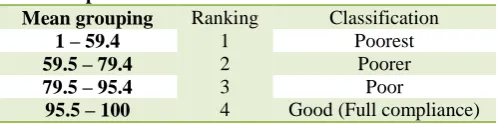
The ten provisions considered for the investigation was provided by the Cross River building Law 1984 as amended in 1987. This include: Building line, Ceiling height, Building Plan, Set Back, Building size restrictions, Size of living room, Height of ground floor, Ventilation, Space around building and Corridor dimension. The compliance classification is shown in the Table 3
Compliance
Mean grouping Ranking Classification
1 – 59.4 1 Poorest
59.5 – 79.4 2 Poorer
79.5 – 95.4 3 Poor
95.5 – 100 4 Good (Full compliance)
Source: Researcher’s Field Work 2016
Table 3: Compliance classification
In subjecting the data for evaluation, one-way multivariate analysis of variance was done in order to identify the least observed provision of the building Laws across the 13 residential districts of the study area. It involved the computation of various descriptive statistics, variance components and tests for significance utilizing the Pilla’s trace, Wilks Lambda, Hotelling’s Trace, Roys largest root, the F-ratio and LSD test statistics in the general linear model from data obtained from the field.
The descriptive statistics for the ten provisions of the law for the 13 districts are presented as Tables 4 and 4.1
III. RESULTS AND DISCUSSION
To determine the least observed provisions out of the ten provisions used for the study, the descriptive statistics were
S/N Residential Districts No.of Buildings
No. of buildings measured/ questionnaire administered.
Questionnaires Retrieved.
Percentage retrieved
(%)
1. Akim Qua Town 2020 101 99 98
2. Ediba Qua Town 1837 92 82 90
3. Big Qua Town 2361 118 117 99
4. Essien Town 1942 97 97 100
5. Ishie Town 2627 131 112 85
6. Ikot Ansa 1722 86 73 84
7. University Satellite Town
750 38 38 100
8. Ikot Efa 414 21 18 85
9. Esuk Utan 204 10 10 100
10. Ekorinim 441 22 22 100
11. Esuk Atu 240 12 12 100
12. Nyangasang 720 36 36 100
13 Edim Otop 616 30 25 83
Page 148 www.ijiras.com | Email: [email protected] computed for the ten provisions of the building Laws in each
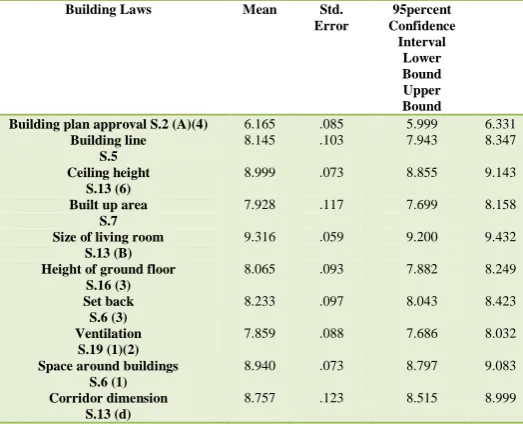
of the thirteen distribution of the study area. Results are presented in Table 4 and 4.1. The table also gives the summary of the findings, mean, standard error of estimate and confidence interval (95percent).
Building Laws Mean Std.
Error 95percent Confidence Interval Lower Bound Upper Bound Building plan approval S.2 (A)(4)
Building line S.5 Ceiling height
S.13 (6) Built up area
S.7 Size of living room
S.13 (B) Height of ground floor
S.16 (3) Set back
S.6 (3) Ventilation
S.19 (1)(2) Space around buildings
S.6 (1) Corridor dimension S.13 (d) 6.165 8.145 8.999 7.928 9.316 8.065 8.233 7.859 8.940 8.757 .085 .103 .073 .117 .059 .093 .097 .088 .073 .123 5.999 7.943 8.855 7.699 9.200 7.882 8.043 7.686 8.797 8.515 6.331 8.347 9.143 8.158 9.432 8.249 8.423 8.032 9.083 8.999
Dependent variable: Level of compliance with building Laws Source: Researcher’s field work, 2016
Table 4: Mean and Standard Error of the ten provisions of the building Laws
According to the result in Table 4, it shows that building plan approval provision was the building Law provision with the lowest mean compliance (6.16), meaning that the Law prescribing that building plan must be approved before commencement of any building was the least observed provision (5.999 < x < 6.331). Table 4.1 below show the preliminary multivariate test carried out for the provisions.
Effect Test Value F Hypothesi
s df Error df Sig Interc ept Pilla’s Trace Wilks’ Lambda Hotelling’s Trace
Roy’s Largest Root .986 .014 71.210 71.210 5127.142a 5127.142a 5127.142a 5127.142a 10.000 10.000 10.000 10.000 720.000 720.000 720.000 720.000 .000 .000 .000 .000 Distri ct Pilla’s Trace Wilks’ Lambda Hotelling’s Trace
Roy’s Largest Root 1.355 .201 1.940 .701 9.523 10.733 11.612 42.570 120.000 120.000 120.000 12.000 7290.000 5602.705 7182.000 729.000 .000 .000 .000 .000 Extract statistic
The statistic is an upper bound on F that yields a lower bound on the significance level.
Design: Intercept+district.
Source: Researcher’s fieldwork, 2016.
Table 4.1: Preliminary multivariate Test
IV. CONCLUSION/ JUDGMENT AND RECOMMENDATION
Curiously, the researcher finds as a fact that of all the regulations under the Law, the least observed was the regulations regarding that building plan must first be drawn and approval issued before any construction work can commence. This is considered very critical to the overall
compliance under the Law as non-plan at all is as bad as no approved building notwithstanding its aesthetics and beauty.
The data used in this investigation were analysed based on the target objective, which was primarily to investigate and evaluate evidence obtained from the field with regards to the least observed provision of the building Law among owners of building across the residential districts of Calabar Metropolis. As a result, solutions which will generally improve compliance with the least observed provision of the building law, as now discovered by this investigation, will be imperative. This will be necessary in order to improve the level of compliance with the least observed Building regulations in Calabar, occasioned by the present level of compliance of Building owners with the regulation on approval plan. Furthermore, as both plan approval and site inspection have a significant effect on compliance with the law in the study area, It is also recommended that before any construction work is commenced, the owner should apply in writing to the authority for official inspection first to ensure there is an approved plan and secondly to ensure building is in line with the approved plan. Failure to do so should also be inserted into the law as an offence punishable by a suspension order of not less than one year. Failure on the part of the authority should also be considered under the law as a breach of duty. For effective implementation of these recommendations, the state government should recruit more staff into the enforcement unit of the Town Planning Department to help brace up with the envisaged challenge of shortage of staff in this area. As a result, it is recommended that a certificate of site inspection and a clean bill of compliance at the foundation, DPC, windows and roof levels should be part of building documents to be issued by the authority.
A very important measure to use in ensuring compliance with approved plan which is the least observed provision of the building Law, is to ensure that only professionals are allowed to handle building projects in the study area. In collaboration with the Nigerian Council Calabar Chapter, the Town planning Authority should rise to the occasion by ensuring that Buildings have approved plan and that only trained builders should supervise approved buildings. This can be achieved by insisting that approved plan should be accompanied with not less than three registered trained builders, one of whom shall eventually be selected by the developer-owner to supervise the building construction. Owners of buildings who fail to comply with the directive can be penalised by imposing a punitive fine to serve as a deterrent to other developers. The builder council should be made to realize that apart from the fact that it is loss of revenue to their accredited members, it is also loss of credibility to the profession if it lacks the will to enforce best practice in the field.
The enforcement unit of the planning department should be saddled with the responsibility of ensuring that the supervision is actually done by one of the named registered builders. This can be achieved by the task force paying a surprise visit to the sites.
Page 149 www.ijiras.com | Email: [email protected] building supervisor can be penalized also. Depending on the
level of violation, the penalty can range from fine, suspension of practice for a certain period to outright withdrawal of license. By these stringent measures the supervisor will not be able to transfer the blame to the owners of the building for not making available, enough funds, or for not supplying standard materials. By this measure also, the supervisor would have been co-opted into quasi-enforcement by being expected to report erring owners of building to the Town Planning Authority.
Since the findings also revealed that construction sites that were visited and inspected by the Town Planning Inspectors tended to comply more than those that were not inspected. It is recommended, therefore, that more regular visits to construction sites should be encouraged as it is done with the judiciary officers to enhance effective and speedy dispensation of justice, a system of returns in which cases successfully determined by Judges are recorded or reported as a basis for promotion, should be adopted for enforcement officials of the town planning department. Visits to construction sites at least thrice before completion of buildings should be an additional condition for promotion for officers of the enforcement units, while the job of regular inspection to construction sites should be left in the hands of specialised professionals, to be officially referred to as “site inspectors”. These sites inspectors should be professionals who should be
given special oath of office to ensure effective and uncompromising discharge of their duties.
More graduates professionals should be employed as site inspectors to help boost the workforce. If the work of enforcement is to be accorded its deserved importance, Government should vote more funds to enforcement activities. This should begin with by ensuring plan approval, embarking on regular site visits and inspection.
REFERENCES
[1] Cross River State Building Law of 1984 as Amended in 1987.
[2] Ebong, M. O. (1983) The Perception Of Residential Quality: A Case Study Calabar, Nigeria. Third World Planning Review, 5(3), 273-285.
[3] Offiong V. (2007). Promoting Environmental Law Consciousness within residential district in Calabar Journal of Law and Diplomacy Vol. No. 1 International Research and Development Institute.