M O DIFIED BASES BY POST-SYNTHETIC SUBSTITUTIO N
AND APPLICATION OF M ODIFIED DNA TO THE STUDY
OF PROTEIN-DNA INTERACTION
b y
QINGUO ZHENG
A thesis subm itted for the degree of Doctor of Philosophy
in the U niversity of London
Department of Biochemistry and Molecular Biology
University College London
All rights reserved
INFORMATION TO ALL USERS
The quality of this reproduction is dependent upon the quality of the copy submitted.
In the unlikely event that the author did not send a complete manuscript and there are missing pages, these will be noted. Also, if material had to be removed,
a note will indicate the deletion.
uest.
ProQuest 10044460
Published by ProQuest LLC(2016). Copyright of the Dissertation is held by the Author.
All rights reserved.
This work is protected against unauthorized copying under Title 17, United States Code. Microform Edition © ProQuest LLC.
ProQuest LLC
789 East Eisenhower Parkway P.O. Box 1346
B ecause o f the lim itations o f m ost m ethods for m odified o ligo nucleotid e synthesis, an alternative strategy (post-synthetic substitution strategy) w as developed for synthesis o f DNA with modification on the 4-position o f thym ine and the 6-position o f guanine. T his w as achieved by incorporation o f versatile nucleotides into D N A w hich contain a leaving group which is sufficiently stable to w ithstand the conditions of D N A synthesis but can be substituted by nucleophiles, after synthesis, to produce a series o f oligomers each containing a different modified base.
4-T riazo lo th ym id in e phosph oram idite w as p rep ared and inserted into the dodecanucleotide A G CG A A X TC G C T (X standing for 4-triazolothym ine). B y treating the ohgom er with different nucleophiles the parent ohgom er containing thym ine (T) and o ther fiv e o ligom ers w ere prepared each co n tain in g a d ifferen t m o dified base: 0 4 -m e th y lth y m in e (TOMe), O ^ -eth y lth y m in e (TOEt)^ 5 -m eth y lcy to sin e (TNH2)^ N4-dimethylamino-5- methylcytosine (TDH)^ or 4-thiothym ine (TS).
As a further developm ent o f the above method, a fully deprotected and purified versatile oligo nu cleo tide containing 4 -p hen ylth io thy m ine w as prepared w ith the advantage o f m aking oligonucleotides containing very labile m odified thym ines. O lig o m ers co n tain in g 5-m ethyl-N 4, N 4 -ethano cytosine or 4 -azid o th y m in e w ere prepared by treating the versatile oligom er with ethyleneim ine or sodium azide (N aN g), respectively.
investigated by a photochem ical cross-linking approach using 2 1 m er oligonucleotides containing the sequence o f the 0 R 3 operator of X-phage in w hich one o f guanine or
A C K N O W L E D G E M E N T S
F irst and forem ost, I w ould like to thank my supervisors, D rs P eter Sw ann and Y ao-Zhong X u, for their tuition, guidance, and support throughout the course o f this project. I am also grateful to the Cancer Research Cam paign for their financial support.
I w ould like to thank Drs Tim W aters and H w ee Boom Tan for their assistance and useful discussions, M r Raym ond M ace for proof reading this m anuscript, and all my colleagues for creating a stimulating environm ent in our group.
Thanks are also due to D r Brian C oles for the peptide sequencing, M rs Jill M axw ell for running iH and 3 i? N M R spectra, and D r Alex D rake for m easuring the CD spectra.
C O N T E N T S
A b s t r a c t ... i
A c k n o w l e d g e m e n t s ... iii
C o n t e n t s ... iv
L is t o f F i g u r e s ... xii
L is t o f T a b l e s ... xviii
A b b r e v i a t i o n s ... xix
C H A P T E R 1. I N T R O D U C T I O N ... 1
1.1. TH E NEED FOR M O D M E D O L IG O N U C L E O T ID E S ... 1
1.2. TH E STRUCTURE OF DNA ... 1
1.3. CH EM IC A L SYNTHESIS O F OLIGON UCLEO TID ES ... 4
1.3 .1 . B rief History of DNA S y n th e s is ... 4
1.3.2. S olid-phase Supports for O ligonucleotide S y n th e s is ... 6
1 .3 .3 . Protection o f the 5'-Hydroxyl Function o f N u c le o tid e s ... 8
1 .3 .4 . Protection of Exocyclic Amino Groups of Heterocyclic B a s e s 9 1 .3 .5 . M ethods for Oligonucleotide Synthesis ... 11
1.3.5.1. P hosphodiester M e th o d ... 11
1.3.5.Ü. PhosphotriesterM ethod ... 12
1.3 .5 .111. H -phosphonate M e th o d ... 14
1 .3 .5 .iv . Phosphoram idite M e th o d ... 15
1.4. CH EM IC A L SYNTHESIS OF OLIGONUCLEOTIDES CO N TA IN IN G M ODIFIED BASES AND TH EIR A PPLICATIO N S . 21 1.4.1. O ligonucleotides for Study of DNA-Protein In te ra c tio n s ... 21
1.4.1.1. Base A nalogue Approach ... 22
1.4.1.Ü. Photo-Cross-Linking A p p r o a c h ... 37
1.4.1.111. C hem ical Cross-Linking A p p r o a c h ... 44
1.4 .1.v. Oligom ers Labeled W ith NMR-Sensitive Atoms ... 51
1.4 .2 . Oligoucleotides for Study of DNA-Damage Produced by Alkylating A g e n ts ... 53
1.4.3. A s A ntisense O ligonucleotides for Therapeutic P u rp o s e s ... 59
1 .4 .4 . A s Non-isotopic Oligonucleotide Probes ... 62
1.5. A IM S O F THIS P R O J E C T ... 64
C H A P T E R 2. S Y N T H E S IS O F O L IG O N U C L E O T ID E S C O N T A IN IN G 4 -S U B S T IT U T E D T H Y M IN E S B Y I N C O R P O R A T I O N O F 4 -T R IA Z O L O T H Y M IN E IN T O DNA A N D P O S T -S Y N T H E T IC S U B S T IT U T IO N O F T H E T R IA Z O L O G R O U P ... 68
2.1. IN T R O D U C T IO N ... 6 8 2.2. M ATERIALS AND M E T H O D S ... 71
2.2.1. Chem icals and G eneral M e th o d s ... 71
2.2.2. Preparation o f 5 '-0 -(4 , 4'-dim ethoxytriphenylm ethyl)-2'-deoxy-4-triazolothym idine-3'-0-(2-cyanoethyl-N ,N - di-isopropylam ino)-phosphoram idite (Ttn M o n o m e r ) ... 72
2.2.3. Synthesis o f Oligonucleotides ... 72
2 .2 .3 .1. Oligonucleotides Containing Triazolothymine Bound to C P G -S upport ... 73
2.2.3.Ü. Oligonucleotides Containing 5-M ethylcytosine (5-M e-C) ... 73
2.2.4. Preparation o f M odified Oligomers from the O ligom er Containing T riazo lo th y m in e... 74
2.2.4.1. Oligom ers Containing 04-m ethyl thy mine (TOMe) and 04-ethylthym ine (T O E t)... 74
2.2.4.Ü. Oligom ers Containing 4-Thiothymine ( T S H ) ... 75
2 .2 .4 .iii. Oligom ers Containing Thym ine ( T ) ... 75
2 .2 .4 .iv . Oligomers Containing 5-M ethylcytosine (5 -M e -C )... 76
2 .2 .5 . Purification of O lig o n u c le o tid e s... 76
2.2.6. Base Composition Analysis of Oligonucleotides ... 77
2 .2 .7 . D N A Synthesis on a Template Containing N 4-dim ethylam ino-5-m ethylcytosine (TD H )... 78
2 . 2 . 1 .
5 -3 2 ? L a b e lin g ... 782.2.7.Ü. D uplex P re p a ra tio n ... 78
2.2.1.m.
E longation ... 792.2.7.iv. G el E lectrophoresis ... 79
2.2.8. M elting Curve M easurement ... 79
2.3. R ESU LTS AND D IS C U S S IO N S ... 80
2.3.1. Synthesis o f Versatile Thym ine M onom er ... 80
2.3.2. Synthesis and Conversion of O ligonucleotides ... 80
2.3.2.1. Oligom ers Containing O^-methyl thy mine (TOME) or O^-ethylthymine (T O E t)... 81
2.3.2.Ü. Oligom ers Containing Thym ine ( T ) ... 83
2.3.2.iii. O ligom ers Containing 5-M ethylcytosine ( 5 -M e - C ) ... 84
2.3.2.iv. O ligom ers Containing N 4-Dim ethylam ino-5-m ethylcytosine (TDH) . . . 85
2.3.2.V. Oligom ers Containing 4-Thiothymine (TSH) ... 8 6 2.3.3. Purification o f O lig o n u c le o tid e s ... 8 8 2.3.4. Base Com position A n a ly s is ... 89
2 .3 .5 . Base-pairing Properties of O hgom ers Containing N 4 -d im ethylam ino-5-m ethylcytosine (TD H )... 91
C H A P T E R 3. S Y N T H E S IS O F O L IG O N U C L E O T ID E S C O N T A IN IN G L A B I L E 4 -S U B S T IT U T E D T H Y M I N E S ... 95
3.1. IN T R O D U C T IO N ... 95
3 .2 . M ATERIALS AND M E T H O D S ... 96
3.2.2. Synthesis, Conversion, and Purification of O lig o n u c le o tid e s... 96
3.2.2.1. O ligom ers Containing 4-Triazolothymine (T>i) B ound to C P G -s u p p o rt... 96
3.2.2.Ü . O ligom ers Containing 4-Phenylthiothym ine (TSPh) ... 96
3.2.2.111. O ligom ers Containing 5-Methyl-N4, N^-ethanocytosine (T©) or 4-Azidothym ine (TN3) ... 97
3.2.3. Base Composition Analysis of Oligonucleotides ... 97
3.2.4. 4-T riazolo thy m idine... 98
3.2.5. 4-(Phenyl)thiothym idine, 5-M ethyl-N4, N4-ethanocytidine, and 4 -A z id o th y m id in e... 99
3.2.6. Ethyleneimine (Aziridine) ... 99
3.3. R ESU LTS AND D IS C U S S IO N S ... 100
C H A P T E R 4. S Y N T H E S IS O F O L IG O N U C L E O T ID E S C O N T A IN IN G 6 -S U B S T IT U T E D G U A N I N E S ... 107
4.1. IN T R O D U C T IO N ... 107
4 .2 . M ATERIALS AND M E T H O D S ... 109
4 .2 .1 . Chem icals and E n z y m e s ... 109
4 .2 .2 . C h ro m a to g ra p h y ... 109
4.2.3. Synthesis o f 5 '-0 -(4 , 4'-dim ethoxytriphenylm ethyl)-N 2-isobutyryl-2'-deoxy-6-(2, 4-dinitrophenyl)thioguanosine-3'-0- (2-cyanoethyl-N , N -diisopropylam ino)phosphoram idite ( 1 7 7 ) ... 109
4 .2 .3 .I. 5 '-0 -(4 , 4'-dim ethoxytriphenylm ethyl)-N 2-isobutyryl-2’-deoxy-6-thioguanosine ( 1 7 3 ) ... 109
4.2.3.Ü . 5 '-0 -(4 , 4'-dim ethoxytriphenylm ethyl)-N 2-isobutyryl-2'-deoxy-6-(2, 4-dinitrophenyl)thioguanosine ( 1 7 6 ) ... 110 4 .2 .3 .111. 5 '-0 -(4 , 4'-dim ethoxytriphenylm ethyl)-N 2-isobutyryl-2'-deoxy-
4-dinitrophenyl)thioguanosine-3'-0-(2-cyanoethyl-N , 4-dinitrophenyl)thioguanosine-3'-0-(2-cyanoethyl-N -d iisopropylam ino)phosphoram idite(177)... I l l 4.2.4. Synthesis of 5 '-0 -(4 , 4'-dim ethoxytriphenylm ethyl)-N
2-phenylacetyl-2'-deoxy-6-(2, 4-dinitrophenyl)thioguanosine-3'-0-
(2-cyanoethyl-N, N -diisopropylam ino)phosphoram idite ( 1 8 5 ) ... I l l 4.2.4.1. 3', 5'-D iacetyl-N 2-phenylacetyl-2'-deoxyguanosine (180) ... I l l 4.2.4.Ü. 3’, 5'-D iacetyl-N 2-phenylacetyl-2'-deoxy-6-thioguanosine (181) . . . . 112 4.2.4.111. N 2-phenylacetyl-2'-deoxy-6-thioguanosine (182) ... 113 4.2.4.1v. N 2-phenylacetyl-2'-deoxy-6-(2, 4-dlnltrophenyl)thloguanoslne (183) . 113 4.2.4.V . 5 '-0 -(4 , 4'-dlm ethoxytrlphenylm ethyl)-N 2-phenylacetyl-2'-deoxy-
6-(2,
4-dlnltrophenyl)thloguanoslne-3'-0-(2-cyanoethyl-N , N -dllsopropylam lno)phosphoram ldlte ( 1 8 5 ) ... 114 4.2.5. Stability T e s t s ... 114 4.2.5.1. Stability o f Compound (183) and (184) Tow ards the Conditions
Used In Oligonucleotide A s s e m b ly ... 114 4.2.5.11. Stability of 2'-Deoxy-6-tbloguanoslne Tow ards Cone. A m m onia
a t 2 5 ° C a n d 5 5 ° C ... 115 4.2.6. Rem oval o f N2-pbenylacetyl Group from
N 2-pbenylacetyl-6-tblodeoxyguanoslne (182) ... 115 4.2.7. Synthesis of Oligonucleotides ... 115 4.2.8. Conversion and Purification of O lig o n u c le o tid e s... 116 4.2.8.1. Preparation o f Oligom ers Containing O ^-m etbylguanlne (QOMe) 116 4.2.8.11. Preparation of Oligomers Containing G uanine
from the G^0 O lig o m e r... 116 4.2.8.111. Preparation o f Oligom ers Containing 6-Tbloguanlne ( G S ) ... 116 4.2.8.1v. Preparation o f O ligom ers Containing 2, 6-D lam lnopurlne (GNH2) . _ . 117 4 .2 .8.V. Preparation of Ohgomers Containing 2-A m lno-6-m etbylam lnopurlne
(G N M e )... 117
4.2.10. M elting Curve Measurement ... 117
4.3. R ESU LTS AND D IS C U S S IO N S ... 118
4 .3 .1 . D esign and Preparation of V ersatile G uanine M o n o m e r... 118
4.3.2. R em oval o f N 2-phenylacetyl G roup from C om pound ( 1 8 2 ) ... 125
4 .3 .3 . The Stability o f 2'-D eoxy-6-(2,4-D initrophenyl)thioguanosine M onom er to the Conditions of DNA S y n th e s is ... 125
4.3.4. Synthesis and Conversion of Oligonucleotides ... 126
4.3.4.I. O ligom ers Containing 6-Thioguanine ( G S )... 127
4.3.4.Ü. O ligom ers Containing 2, 6-Diaminopurine (GNH2) ... 130
4.3.4.iii. O ligom ers Containing 2-A m ino-6-m ethylam inopurine (G ^ M e ) 132 4.3.4.iv. O ligom ers C ontaining O ^-m ethylguanine (GOMe)... 132
4 . 3 . 4 . V . O ligom ers Containing Guanine I t s e l f ... 1 3 4 4 .3 .5 . Purification o f O lig o n u c le o tid e s... 134
4.3.6. Base Composition Analysis of Oligonucleotides ... 135
4.3.7. Stability of DNA Duplexes Containing 6-Thioguanine and 4 -T h io th y m in e... 137
C H A P T E R 5. S T U D IE S O N T H E IN T E R A C T IO N S B E T W E E N À -P H A G E C R O R E P R E S S O R A N D IT S O P E R A T O R DNA B Y P H O T O C H E M I C A L C R O S S - L I N K I N G ... 141
5.1. IN T R O D U C T IO N ... 141
5.2. M ATERIALS AND M E T H O D S ... 148
5.2.1. M aterials and E n z y m e s ... 148
5.2.2. High Perform ance Liquid Chrom atography ... 148
5.2.3. Polyacrylam ide Gel Electrophoresis ... 148
5.2.3.Ü. SDS Polyacrylam ide Gel Electrophoresis (S D S - P A G E ) ... 149
5.2.4. Preparation and Characterization of O lig o n u c le o tid e s ... 151
5.2.4.1. Synthesis and Purification of Oligonucleotides ... 151
5.2.4.Ü. Base Analysis and Melting Tem perature (Tm) M easurem ent o f Oligomers ... 151
5.2.4.111. Circular Dichroism (CD) Spectroscopy of O lig o n u cleo tid es... 151
5.2.5. Preparation of D ouble Stranded O lig o n u c leo tid es... 152
5.2.5.1. 5'-32P-labeling o f O lig o n u c leo tid es... 152
5.2.5.Ü. Strand Hybridization ... 152
5 .2 .6 . A, Cro Preparation ... 152
5.2.6.1. Cell G r o w t h ... 153
5.2.6.Ü . Cell Lysis and Crude Extract P r e p a r a tio n ... 154
5.2.6.111. Phosphocellulose Colum n Chrom atography o f Cro R e p r e s s o r 154 5.2.6.iv. Gel Filtration Colum n Purification o f Cro Protein ... 155
5 . 2 . 6 . V . H ydroxyapatite Colum n Chrom atography of
X
Cro P r o te i n ... 1 5 5 5.2.6.vi.X
Cro Concentration D e te rm in a tio n ... 1565.2.7. Equilibrium Repressor-Operator Binding Assay ... 156
5.2.8. Photo-cross-linking of Cro to Oligonucleotides Containing M odified B a s e s ... 157
5.2.9. Isolation o f Cross-linked C o m p le x e s ... 157
5.2.10. Proteolytic Digestion o f Cross-linked Complexes ... 158
5.2.11. H PLC Purification of Peptide-DNA Com plexes ... 158
5.2.12. Peptide Sequence Analysis ... 159
5 .3 . R E S U L T S ... 160
5.3.1. Preparation and Characterization of O lig o n u c le o tid e s ... 160
5.3.2. Preparation of Cro P r o te in ... 165
L IS T O F F IG U R E S
Figure 1.1. The primary structure of D NA showing the four com m on bases . . 2
Figure 1.2. The secondary structure of B-D NA in (a) ball and tick representation; (b) space filling representation; (c) structure o f Z-D N A in space filling rep resen tatio n ... 3
F igure 1.3 W atson-Crick base-pairing for C:G (left) and T:A (right) ... 3
Figure 1.4. The first chemical synthesis of a dinucleotide ... 4
F igure 1.5. Chem istry of phosphodiester method for D N A synthesis ... 12
F igure 1.6. Chem istry of phosphotriester method for DNA synthesis ... 13
F igure 1.7. Chem istry of H-phosphate m e t h o d ... 15
F igure 1.8. Chem istry of phosphite triester method ... 16
F igure 1.9. Solid-phase synthesis of D N A by phosphite triester method . . . . 16
F igure 1.10. Synthesis of methyl N, N -dim ethylam inophosphoram idites of n u c le o s id e s ... 17
F igure 1.11. Chem istry of automated solid-phase phosphoram idite approach for DNA synthesis ... 20
Figure 1.12. Potential sites for the introduction o f modification in DNA ... 22
Figure 1.13. Chem ical synthesis o f 7-deaza-2'-deoxyguanosine phosphoramidites ... 24
Figure 1.14. Chem ical synthesis of phosphoram idite o f 2-am inopurine nucleoside ... 25
Figure 1.15. Chem ical synthesis of 6-thio-2'-deoxyguanosine phosphoramidite ... 28
Figure 1.16. Chem ical synthesis of phosphoramidite of 4-th io th y m id in e 29 Figure 1.17. Chem ical synthesis o f 2-thiothymidine p h o sp h o ra m id ite... 31
F igure 1.19. Chemical synthesis of phosphoramidite of
5-methyl-2-pyrimidinone n u c le o s id e ... 33 F igure 1.20. Proposed mechanism o f photocross-linking o f D N A containing
5-BrdU with a protein ... 38 F igure 1.21. Chemical synthesis of azido-labeled oligonucleotide analogues
on the 5-position of deoxyuridine via a l i n k e r ... 42 F igure 1.22. Chem ical synthesis o f oligomers containing a photoreactive aryl
azide group linked to the 5-thiol group o f 5-thiodeoxyuridine . . . 43 F igure 1.23. Chem ical synthesis of oligomers containing 5-fluorocytosine
by am monolysis of oligomers cairying
4 - 0 - ( 2 ,4, 6-trim ethylphenyl)-5-fluorouracil... 45 F igure 1.24. Proposed catalytic mechanism of enzymatic DNA
cytosine-C5 methyltransferase ... 47 F igure 1.25. Graphic representation of the complex o f M. Hhal covalently
bound to a 13-mer DNA duplex containing
methylated 5 -flu o ro cy to sin e... 48 F igure 1.26. Chem ical synthesis of oligonucleotides containing
N4, N4-ethanocytosine or 5 -m eth y l-N \ N ^-ethanocytosine . . . . 49 F igure 1.27. Chem ical synthesis o f the site-specific cross-linked duplex
via formation of an interstrand disulfide b o n d ... 50 F igure 1.28. Cross-linking o f D N A duplex by the formation o f disulfide bond
directly between th io b a s e s ... 51 F igure 1.29. C hem ical synthesis o f 0-m eth yl-2'-deo xy gu an osine
phosphoramidite ... 54 F igure 1.30. Strategies for modified DNA synthesis ... 65 F igure 2.1. Chem ical synthesis of triazolothymidine phosphoram idite from its
thymidine c o u n te rp a rt... 80 F igure 2.2. The post-synthetic conversion of the 4-triazolothym idine oligom er
Figure 2.3. The time courses of deprotection of an oligom er
A GCG A AX TCG CT (X: TTn) protected with PAC groups ... 84 Figure 2.4. FPLC profiles o f crude AGCGAATDHTCGCT (a) and HPLC
base analysis of the purified oligom er ( b ) ... 8 6 F igure 2.5. UV spectra o f (AGCGAATSHTCGCT) (a),
(AGCGAATTCGCT) (b), and 4-thiothym idine (c) ... 87 Figure 2.6. FPLC profiles o f crude modified oligom ers A G CG A A X TCG CT,
(a) X = TOMe, (b) X = 5-M e-dC, (c) X = T, and (d) X = TSH . . . 90 Figure 2.7. Tautomeric isomers of
N^-dimethylamino-5-methylcytosine (TD H )... 93 F igure 2.8. Tm curves o f DNA duplexes (a-e), and the first derivative of
the Tm curve (a) [(f)] ... 94 Figure 2.9. A utoradiograph showing incorporation o f dA TP or dGTP
opposite TDH in the template strands ... 93 Figure 3.1. The post-synthetic conversion o f the versatile oligom er (179) into
different oligonucleotides containing modified th y m in e s ... 103 Figure 3.2. HPLC traces of crude oligonucleotides containing TSPh (a).
Te (c), or TN3 (e); and of base com position analysis
o f oligom ers containing TSPh (b), T® (d), or TN3 ( f ) ... 106 Figure 4.1. Reaction scheme for (i) protecting the 6-thio function o f
6-thiodeoxyguanosine with 2, 4-dinitrophenyl group; and (ii) removing the protecting group from 6-(2, 4-dinitrophenyl)-
thiodeoxyguanosine with 2-m ercap to eth an o l... 1 2 0 Figure 4.2. The synthetic route for N
2-isobutyryl-6-(2,4-dinitrophenyl)-thiodeoxyguanosine phosphoramidite ... 1 2 2 Figure 4.3. The synthetic route for N2-phenylacetyl-6-(2, 4-dinitrophenyl)
F igure 4.5. Reverse-phase HPLC showing the rate o f rem oval o f the
phenylacetyl group from N2-phenylacetyI-6-thiodeoxyguanosine . 125 F igure 4.6. Conversion o f the oligonucleotide containing GS0 into a series o f
oligonucleotides containing different m odified g u a n i n e s ... 127 F igure 4.7. U V spectrum o f d(AGCGSAATTCGCT) (a),
o f d(A GCG A ATTCG CT) (b), and o f 6-thiodeoxyguanosine (c) . 129 F igure 4.8. Possible reaction routes of the versatile oligom er containing
6-(2,4-dinitrophenyl)thioguanine with conc. am m onia at 55°C . . 131 F igure 4.9. FPLC profiles of unpurified 12 mer AGC GO^eAA TTC G C T
prepared by post-synthetic substitution with M eO H/DBU
a t2 5 ° C ( a ) ,a n d a t3 5 ° C ( b ) ... 133 F igure 4.10. FPLC profiles o f Nensorb column purified (a-e) and FPLC purified (f-j) 12 m er (AGC Y A ATTCGCT) prepared by post-synthetic substitution, (a) and (f); Y = GNH2, (b) and (g): Y = GNHMe, (c) and (h): Y =GOMe, (d) and (i): Y = G, (e) and (j): Y = GS ... 136 F igure 4.11. HPLC profile of the base analysis o f FPLC purified 12 m er
(AGCGSAATTCGCT) measured at 260 nm (a) and
at 335 nm (b) ... 137 F igure 4.12. Tm curves o f DNA duplexes containing 6-thioguanine and
4-thiothymine and their parent d u p le x e s ... 140 F igure 5.1. Amino acid sequence o f Cro protein ... 146 F igure 5.2. Three dim ensional structure o f Cro repressor, (a) Structure o f Cro
m onom er, (b) Structure of Cro dim er ... 147 F igure 5.3. A schematic diagram of the interaction of Cro with DNA showing
Figure 5.4. Sequences o f DNA duplex used in this experim ent. (a) Sequence of DNA containing 0 R 3 operator.
(b) Sequence of CRP binding s i t e ... 162 Figure 5.5. Base com position analysis by H PLC o f the purified oligom ers
5'-nTATCCCTTGCGGTGSATAGA-3’
m easured at260
nm (a)and
340
nm (b), and5'-TCTATCACCGCAAGGGATSAAA-3*
measured at260
nm for four norm al bases and then at340
nmfor 4-thiothym idine in one run ( c ) ... 163 Figure 5.6. Tm curves o f DNA duplexes T/B, T+3/B, and T/B. 4 ... 164 Figure 5.7. CD spectra o f operator DNAs T/B, T /B+ 3 , and T+g/B ... 164 Figure 5.8. SD S-PA G E o f crude Cro protein, (a) Crude extracts o f cells
carrying plasmid DNA pcro l. (b) SDS-PAGE of selected
fractions from the gel filtration purification of Cro p r o t e i n 166 Figure 5.9. U V absorbance of fractions collected from phosphocellulose
colum n purification ... 167 Figure 5.10. U V absorbance of fractions collected from the gel filtration of Cro
p r o t e i n ... 167 F igure 5.11. U V absorbance of fractions collected from the hydroxyapatite
colum n purification o f Cro protein ... 168 Figure 5.12. SD S-PA G E of fractions from the hydroxyapatite colum n
purification of Cro p r o te i n ... 168 F igure 5.13. A utoradiogram of gel retardation analysis of Cro protein for
determination o f equilibrium c o n s ta n ts ... 172 F igure 5.14. D eterm ination o f the equilibrium dissociation constant (Kd).
(a) D N A binding of Cro protein as a function o f C ro concentration. (b) G raph of [Cro-DNA] as a function of [Cro-DNA]/[Cro] . . . . 172 F igure 5.15. A nalysis o f cross-linking formation by SDS-PAGE between
Figure 5.16. Autoradiogram of an SDS polyacrylam ide gel showing that the efficiency of photocross-linking o f DNA (T/B.g) to Cro protein is dependent upon the concentration o f the protein ... 173 Figure 5.17. Control experiment of cross-linking between Cro and D N A . . . . 174 F igure 5.18. Time course of cross-link formation between T/B. 6 and Cro . . . . 174 F igure 5.19. Gel retardation assay o f UV iixadiated sam ples showing that Cro
protein was still bound to DNA after being irradiated for 4 h . . . . 175 Figure 5.20. Isolation o f cross-linked Cro-T/B.g operator com plex
with preparative S D S -P A G E ... 178 F igure 5.21. FPLC trace of UV irradiated Cro-T/B.^ c o m p le x ... 179 Figure 5.22. Radiolabel profile of the fractions collected from the FPLC
isolation o f the cross-linked com plex ... 179 F igure 5.23. SDS-PA GE analysis of the selected fractions from Figure 5.21 . . 179 Figure 5.24. FPLC trace o f non-irradiated complex containing same com ponents
as that used for UV irradiation showing no corresponding peak
to the peak 3 in Figure 5 . 2 1 ... 180 Figure 5.25. Proteolysis o f the cross-linked complex between the DNA T /B. 6
and C r o ... 180 Figure 5.26. FPLC trace of the digested sample ... 181 Figure 5.27. Schematic representation o f the presumed sequence-specific
interactions between Cro and the parts o f base pairs exposed
L IS T O F T A B L E S
T able 2.1. The yield and purity o f synthetic oligonucleotides ... 8 8 Table 2.2. Tm values of DNA duplexes ... 93 Table 4.1. Base com position of the FPLC purified oligonucleotides
determined as described in section 4.2.9 ... 137 Table 4.2. The melting temperature values of DNA duplexes containing
6-thioguanine and 4-thiothymine and their differences
from the parent o n e s ... 139
Table 5.1. The six operators found in the
X
phage DNA ... 146Table 5.2. Tm values, equilibrium dissociation constants, and cross-linking
A B B R E V IA T IO N S A BSA 8-BrdA 5-B rdU C CD C P G D M T (Cl) DNA dA DBU dC dG DTT Fmoc FPLC G GNH2 GNMe GOMe GS GS4)
H PL C H PTLC 5-IdU IPT G
adenine
bovine serum albumin
8-brom o-2'-deoxyadenosine 5-brom o-2'-deoxyuridine cytosine
circular dichroism controlled-pore-glass
4, 4'-dim ethoxytriphenylm ethyl (chloride) deoxyribonucleic acid
2'-deoxyadenosine
1, 8-diazabicyclo (5, 4, 0) undec-7-ene 2'-deoxycytidine
2'-deoxyguanosine dithiothreitol
9-fluorenylmethoxycarbonyl fast protein liquid chromatography guanine
2, 6-diam inopurine
2-amino-6-methylaminopurine Q6-methylguanine
6-thioguanine
6-(2, 4-dinitrophenyl)thioguanine
high performance liquid chrom atography high perfomance thin layer chrom atography 5-iodo-2'-deoxyuridine
M s-Cl mesitylenesulfonyl chloride
oxime E-2-nitrobenzaldoxime
PAC phenoxyacetyl
PA G E polyacryamide gel electrophoresis Px-Cl 9-chloro-9-phenylxanthene
SAM S-adenosyl-L-methionine
SDS sodium dodecyl sulphate
T thymidine or thymine
TDH 4-(2, 2-dim ethyl)hydrazino-5-m ethyIpyrim id-2-one [i.e. N4-dimethylamino-5-methylcytosine]
Te 5-methyl-N4, N ^-ethynocytosine TEMED N, N, N', N '-tetram ethylenediam ine
TLC thin layer chromatography
Tm melting temperature
TM G N i, N i, N3, N 3-tetram ethylguanidine
TN3 4-azidothymine
TNH2 5-methylcytosine
TOEt CH-ethylthymine
TOMe CH-methylthymine
T PS-C l 2 ,4 , 6-triisopropylbenzenesulfonyl chloride
TSH 4-thiothymine
TSPh 4-phenylthiothymine
TTri 4 -(l, 2 , 4-triazolyl)thym ine
C H A P T E R 1 IN T R O D U C T IO N
1.1. TH E N EED FO R M ODIFIED O LIG ON UCLEO TID ESi
O ver the last fifteen years, the developm ent o f efficient and sim ple m ethods for D N A synthesis has led to numerous applications of oligonucleotides. For exam ple, the oligonucleotides have been widely used for cloning and synthesizing genes (G roger
et
a l,
1988), as prim ers for sequencing D N A and various PC R applications (A m helm and L evenson, 1990), as potential therapeutic drugs (U hlm ann and Peym an, 1990; M arshall and Caruthers, 1993), site-directed m utagenesis o f genes (Leatherbarrow and F ersh t, 1986), ex am in atio n o f nu cleic acid -p ro tein in teractio n s (H arriso n and A ggarw al, 1990), and for studies on structures o f nucleic acids (K ennard and H unter, 1989). D uring these studies, people discovered that if synthetic D N A was m odified the potential applications could be w idened, and even m ore significantly, som e research could be done w hich otherw ise w ould be im possible to carry out. F or exam ple, the therapeutic use o f synthetic, unm odified oligonucleotides faces the following problem s (Englisch and G auss, 1991): (a) oligonucleotides do not easily pass through the m ainly lipophilic cell m em brane since they carry one negative charge per phosphate group; (b) m any nucleases rapidly cleave oligonucleotides; (c) the stability o f com plexes form ed betw een the oligonucleotides and their com plem entary target is not very high under p h ysiolog ical conditions. H ow ever, these problem s can be overcom e, or at least partially overcom e, by use o f m odified oligonucleotides (M arshall and C aruthers, 1993). Inevitably such discoveries have stim ulated the developm ent o f the chem istry for synthesizing m odified DNA.1.2. T H E STR U C TU R E OF DNA
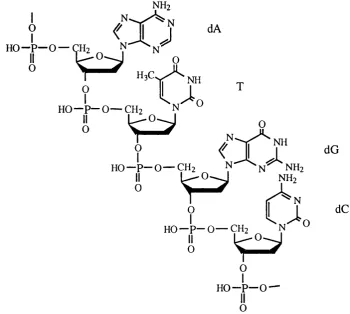
T he prim ary structure o f DNA has each nucleoside jo in ed by a phosphodiester
1 O ligonucleotide, nucleotide, and nucleoside are often used to refer to both ribo- and deoxyribo- derivatives. The abbreviations oligonucleotide, nucleotide, and
ph o sp h o d iester from its 3'-hydroxyl group to the 5 '-hydroxyl group o f its other neighbour and so on (Figure 1.1). U nlike RN A w hich contains a num ber o f m odified n u c le o s id e s , th e o n ly n u c le o sid e s in D N A are 2 '-d e o x y a d e n o s in e (d A ), 2'-deoxyguanosine (dG), 2'-deoxycytidine (dC), and thym idine (T).
NH2
I
N
?
<M I
HO —P — O — ÇH2 N
HO— P — O — CH2 N NH2
NH2
HO—P — O —
Figure 1.1. The prim ary structure o f DNA showing the four com m on bases.
degree, hence, the helical structure repeats after ten residues on each chain.
(b) (c)
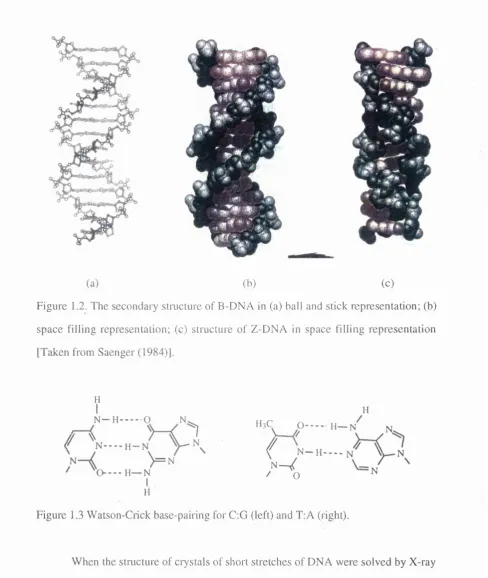
Figure 1.2. The secondary stiiicture of B-DNA in (a) ball and stick representation; (b) space filling representation; (c) structure of Z-DNA in space filling representation [Taken from Saenger (1984)].
H
I
N H
f V H
-II3C /
H
0 _ - - . j-j— jvj
I
H
> = N
/ N - Y / O
0
-N — H ^
II— N N
N N
Figure 1.3 Watson-Crick base-pairing for C:G (left) and T:A (right).
com pletely new form o f DNA that was a left-handed helix (W ang
et a i,
1979; W anget
a i,
1981) now know n as Z-D N A (Figure 1.2c). Even oligonucleotides that had overall B-D N A structure showed considerable deviations from classical uniform B -D N A at the local level as reviewed recently by Calladine and Drew (1992).1.3. CH EM ICA L SYNTHESIS OF O LIG ON UCLEO TID ES
1.3.1. B rief History of DNA Synthesis
T h e firs t su c c e ssfu l sy n th e sis o f a d in u c le o tid e c o n ta in in g a 3 '-5' intem ucleotide linkage identical to natural DNA was achieved by M ichelson and Todd (1955). The dinucleotide phosphate was prepared by coupling 5'-0 -acetylthy m idine- 3'-(benzylphosphorochloridate) (1) with 3'-0 -acety lth y m id in e (2) in the presence o f 2,6-lutidine to give the fully protected dinucleotide (3). S ubsequent rem oval o f the protecting groups gave the dimer TpT (4) (Figure 1.4)
AcO
HO AcO
HO
OH OAc
0 = p - Cl o
(1) OCHzPh 2,6-Lutidine 0 = p — OCHzPh
OAc (3) (
4
)(2)
Figure 1.4. The first chem ical synthesis o f dinucleotide.
synthesis w hich becam e the routine for the next two decades. One m ajor disadvantage relating to this approach was the ionic nature o f the starting m aterial and the various condensation products w hich had to be separated by tedious and tim e consum ing ion-exchange chromatography.
To alleviate this inconvenience, the phosphotriester approach introduced by M ichelson and Todd (1955) (see Figure 1.4), in w hich the three phosphate bonds were m asked during synthesis, w as reinvestigated by L etsinger and O gilvie (1967; 1969). T hrough the years, this m ethod w as constantly im proved by the efforts o f m any organic chem ists and gradually it replaced the ph osph od iester chem istry fo r the synthesis of oligonucleotides Using this method, the first biologically active genetic elem ent, the lac operator D NA , was synthesized and cloned (B ahl
et a l,
1976). Subsequently, genes encoding other chem ically im portant proteins such as insulin (Goeddelet a i,
1979) and interferon (Edgeet al
. , 1981) w ere synthesized via the same technique.The use of an organic polym er as a support for the synthesis of oligonucleotides w as first investigated by L etsinger and M ahadevan (1966). S ubsequently, K oster (1972) introduced inorganic carriers such as silica gel as an alternative to sw ellable organic supports for the preparation of synthetic oligonucleotides. A lthough these approaches m et with only m oderate success, they laid the foundation for the subsequent developm ent of the solid-phase m ethodology for the synthesis of oligonucleotides.
p ro b lem s, B eaucage and C aruthers (1981) d ev elop ed the d eo x y rib o n u cleo sid e phosphoram idites as a new class of interm ediates for the synthesis o f oligonucleotides. T hese interm ediates w ere isolated as stable pow ders and could be stored for prolonged periods o f time. W ith the further m odification and im provem ent through the years, this so called phosphoram idite approach has been the predom inant m ethod for solid-phase synthesis o f oligonucleotides and the basis for m ost com m ercial autom ated D N A synthesizers.
1.3.2. Solid-phase Supports for O ligonucleotide Synthesis
Oligonucleotides, both modified and unm odified, can be m ade in solution or by solid phase synthesis. DNA synthesis in solution begins w ith the coupling o f one appropriately protected m onom er unit with another and separation o f products and unreacted starting materials on a column o f silica gel. Rem oval o f a protecting group at one or other end gives a dim er block, w hich is coupled w ith another block to give a tetram er, and so on, to give larger protected fragm ents. Each coupling step requires a chrom atographic purification and, although a skilled person can do this fairly quickly, adequate resolution of long chains is difficult and the method is heavily labour intensive and tim e-consum ing. H ow ever, when large quantities of oligonucleotides are needed (hundreds o f m illigram s), solution-phase chem istry may be advantageous because reactions are mixed in equim olar amounts to maximize yields and to reduce costs.
1963; 1965) at the Rockefeller Institute. This sim ple technique was initially applied to the synthesis o f polypeptides. Because of this significant developm ent he w as awarded the N obel P rize for chem istry in 1984. Soon after the solid phase m ethod had been show n to be valuable for peptide synthesis, the technique was applied to the synthesis o f oligonucleotides (Letsinger and M ahadevan, 1966). Since then num erous polym er su p p o rts h ave been tested for o lig o n u cleo tid e sy n th esis, from p o ly sty re n e to p o ly te tra flu o ro e th y le n e and silic a gel. T o d ay the s o lid -p h a se sy n th e s is o f oligonucleotide, especially on sm all-scale synthesis, is m ainly carried out on specially defined glass beads, so-called controlled pore glass (CFG) support since this m aterial does not swell or contract in various solvents and also possesses m echanical properties that offer distinct advantages as a polym er support for synthesis. M ore im portantly, it gives faster and m ore efficient coupling than other polym er supports.
The m ost com m only used CFG supports have pores of 500 Â and 1000 Â. The pore size is o f im portance during the synthesis of relatively long oligonucleotides. An abrupt term ination of chain propagation was observed when the synthesis o f oligom ers longer than 100 bases w as attem pted on CFG with a pore size o f 500 Â (Efcavitch
et
al.,
1987). This term ination w as caused by the steric crow ding o f grow ing oligom er chains which, presumably, reduced the diffusion o f the reagents through the matrix. By contrast, CFG support with a pore size of 1000 Â w as satisfactory for the synthesis o f large oligonucleotides, and it is now thought that CFG support with a pore size o f 1000 Â should be used whenever the oligomers are longer than 50 bases.(5)
1.3.3. The Protection of the 5 -Hydroxyl Function of Nucleotides
A s m entioned above (1.2), an oligonucleotide is a single-stranded chain in which nucleosides are linked by phosphodiester bridges between the 3'-hydroxyl group of one nucleoside and the 5'-hydroxyl group of another. The specific and sequential fo rm ation o f this 3'-5' phosphodiester linkage is the key step in the synthesis of oligonucleotides. Since a nucleoside contains two hydroxyl groups, one m ust be chem ically protected w hile the other is phosphorylated (or phosphitylated). For a n u m b e r o f reaso n s it is p referab le fo r n u cleo sid e to be p h o sp h o ry lated (or phosphitylated) at the 3'-position. H ence there is a need for tem porary protection o f the 5'-hydroxyl group.
P rotection of the 5 '-hydroxyl group w ith 4, 4'-dim ethoxyltrityl (D M T ) (6), w hich w as introduced by K horana et al. (Sm ith
et a i ,
1962), has becom e alm ost standard in today's oligonucleotide synthesis. This group is introduced on to the 5'-position o f the N -protected nucleosides by reaction w ith 4, 4'-dim etho xy ltrityl c h lo rid e in th e p re se n c e o f a m ild ly basic c a ta ly s t su ch as p y rid in e or 4-dim ethylam inopyridine. The reaction is regioselective for the prim ary 5'-hydroxyl group com pared to the secondary 3'-hydroxyl function partly because of the bulk o f the D M T group. This selective incorporation is one o f the m ain reasons for the popularity o f the D M T group for the protection of the 5'-hydroxyl function. The group is removed by treatm ent with acids such as dichloroacetic or trichloroacetic acid in a non-aqueous solvent.thus m aking these interm ediates m uch easier to purify by chrom atography. Second, since the DMT+ produced on acid-catalyzed rem oval o f the group is intensely coloured the efficiency of the chain elongation step can be evaluated by sim ply m easuring the released carbonium ions by spectrophotom eter. Third, since the lipophilic 5 '-0 -trity l on the term inal base is not removed by the basic conditions used to deprotect synthetic oligom ers the desired sequence, which has the 5 '-0 -trity l protected, can be separated by H PLC easily from the failure sequences generated during the synthesis.
1.3.4. Protection of Exocyclic Amino Groups of Heterocyclic Bases
B efore introduction o f the D M T group the exo cy clic am ino functions of adenine, cytosine and guanine nucleosides m ust be protected to p revent these from being trity lated as w ell. F urtherm ore, protection is also necessary to avoid side reactions w ith these exocyclic am ino groups during the phosphorylation and chain elongation reactions.still widely used today.
N.
OH
(7) R = Ph
NHCOR
N N .
H O . h o. N"
Y°~j
Y^
(10) R = P h O C lt
(13) R = t-B u P h O C H 2
OH
O
^ NHCOR' HO
(9) R’ =(CH3)2CH
(11) R' = P hO C It
(14) R '= t-BuPhOCI^
NHCOR"
N
OH
(8) R" = Ph
(1 2) R"=(CH3)2CH
(15) R" = t-B uP h O C lt
am m onia at room temperature in two hours.
1.3.5. M ethods for Oligonucleotide Synthesis
Several m ethods have been developed for the synthesis o f oligonucleotides, m ainly differentiated by the way in which the phosphate ester bond is formed. They are term ed as the phosphodiester, phosphotriester, phosphoram idite, and H -phosphonate. S ince the phosphoram idite procedure gives better overall yields, and is the only chem istry reliable beyond 50 residues, and is the m ethod m ost w idely used today for synthesis o f oligonucleotides, it will be discussed in detail. H owever, an understanding o f other m ethods is also important.
1.3.5.i. Phosphodiester M ethod
Even though the first chem ical synthesis of a dinucleoside phosphate w as by a phosphotriester m ethodology (M ichelson and Todd, 1955), the m ethod m ost w idely used in the early stage o f developm ent o f D N A synthesis w as the phosphodiester approach w hich w as developed, and investigated m ainly by K horana's team (Gilham and K horana, 1958; Khorana, 1968; A garwal
et a l,
1972). This m ethod involves the cou plin g o f a nucleoside w ith a free 3'-hydroxyl group and a 5 '-hy dro xy l group protected by the acid-sensitive trityl group (16) with a nucleoside 5’-phosphate having a 3'-hydroxyl function blocked usually with an acetyl group (17). The condensation occurs in the presence o f a condensing agent such as m esitylenesulfonyl chloride (M s-C l) (18a) or 2, 4, 6-triiso p ro p y lb en ze n esu lfo n y l ch lo rid e (T P S -C l) (18b). E xtension o f the chain involves rem oval o f the 3'-protecting group from (19) and coupling w ith another suitably protected nucleoside 5'-phosphate (Figure 1.5.).p u rified by the sim ple tech n iq u es o f o rg an ic c h em istry su ch as ad so rptio n chrom atography on silica gel or
Oiiufh
To purify interm ediates an anion-exchange chrom atography such as D EA E-Sephadex or D EA E-C ellulose has to be used w hich limits the scale of preparative reactions; (c) the w hole process o f purification is tedious and tim e-consum ing, synthesis o f an oligo nu cleotid e o f 10-15 resid ues takes a specialist organic chem ist several month to complete.DMTO
HO DMTO
(16) Pyridine
O— p— O
AcO
O— P—
(18) a. R = C l t , b .R = (C H3 ) 2 (19)
AcO
(17)
Figure 1.5. Chem istry o f phosphodiester method for D NA synthesis.
C learly, the way to overcom e these problem s w ould be to devise a method in w hich the internucleotide linkages are protected. Thus the phosphotriester method o f o lig o n u cleo tid e synth esis first introdu ced by M ichelso n and T odd (1955) w as re in v e stig a te d and im p rov ed, and b ecam e a m ature m etho d for sy n th esis o f oligonucleotides.
I.3.5.Ü. Phosphotriester M ethod
e-3’-(arylphosphate) (20) is coupled to a nucleoside (21) attached through its 3'-position to a solid support. The coupling agent is m esitylenesulphonyl 3-n itro -l, 2 , 4-triazolide (22). It activates the nu cleo sid e-3 '-p h o sp h o d iester and allow s reactio n w ith th e 5'-hydroxyl group o f the nucleoside on the support. To extend the chain, th e D M T group is rem oved by treatm ent with acid to liberate the 5'-hydroxyl group read y for further coupling (Figure 1.6). Since the product (23) is a phosphotriester and thus is protected from further reaction w ith phosphorylating agents the yield is m uch better than w ith the phosphodiester method. However, some side reactions are im portant. In particular there is com petitive sulphonylation of the 5'-hydroxyl group by the coupling agent w hich reduces the efficiency o f the coupling.
DMTO
w
? ^ dM TO- 1 b'
A K ) _ L o ®
O (2 2) 1
(20)
Pyridine/N-methylimidazole
HO
(B
o,
(23)or
Cl
Q-
Cl(21)
Figure 1.6. Chem istry o f phosphotriester m ethod for D N A synthesis.
alm ost com pletely fulfil the requirem ents above and are readily cleaved by oxim ate reagents (Reese and Zard, 1981).
1.3.5.iii. H -phosphonate M ethod
A lthough this chem istry was introduced by Todd and his co-w orkers to prepare dirib on ucleo tid e phosphate alm ost four decades ago (H all
et a i,
1957), it w as successfully applied in oligonucleotide synthesis only recently (G aregget al.y
1985; Froehleret ai,
1986; Andruset ai,
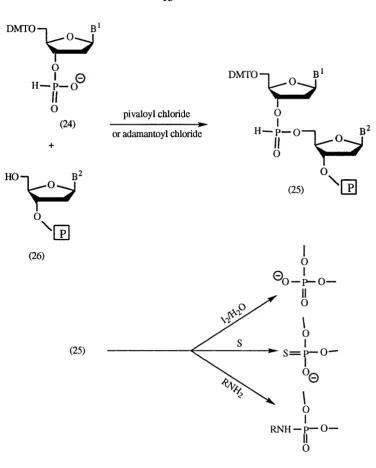
1988). A protected nucleoside H -phosphonate (24) is converted into a dinucleoside hydrogen phosphonate (25) by reaction with the 5 -OH o f a nucleoside (26) in the presence of a condensing agent such as pivaloyl chloride (F roehler, 1986 #79) or, preferably, adam antoyl chlorid e (A ndruset a i,
1988). O xidation o f all the phosphorus centres is carried out sim ultaneously at the end o f the synthesis since the intem ucleoside H -phosphonate bond is stable enough to w ithstand the conditions o f synthesis and so the chain can be extended w ithout prior oxidation (Figure 1.7).O ne advantage o f this chem istry is that oxidation is subject to general base catalysis and this allows nucleophiles other than w ater to be used at the “oxidation" step to give a range o f oligonucleotide analogues. A nother advantage is that no phosphate protecting group is needed since the internucleoside H -phosphonate diester link is relatively inert to the conditions of coupling.
DMTO
0
1 0 H— p - c r
II
o
(24)
HO
i
ç
j
O
(26)
DMTO
O. B
pivaloyl chloride
►
or adamantoyl chloride
O
Figure 1.7. Chem istry o f H -phosphate method.
O
(25)
O O —P—o —
(25) ^ S = p — o —
I
RNH — P— O—O
1.3.5.iv. Phosphoram idite M ethod
Under optimal conditions, (30) was prepared within 1 h in 82% isolated yield.
CI3CCH2OPCI2 I MMTO (29) y
0 = P - OCH2CCI3
pyridinemiF I
OCH2CCI3
(28) MMTO
(30)
Figure 1.8. Chemistry of phosphite triestcr method.
At the beginning of the eighties, Caruthers (1980; 1981) adapted this chem istry to solid-phase oligonucleotide synthesis. In their approach a deoxyribonucleoside methoxychlorophosphite (31) or a methoxymonotetrazolphosphite (32) was coupled with a nucleoside (33) covalently linked to a silica support. The dinucleoside phosphate triester (34) was generated in a yield greater than 95% (Figure
1.9). A decanucleotide was prepared and isolated in a 30% yield.
DMTO
DMTO HO
1. c o u p lin g I
2 . h l l h O * 0 = f — O
OCH3
(33) (34)
(31) X = CI
(32) X = N I
\ ^ N
Figure 1.9. Solid-phase synthesis of DNA by phosphite triester method.
so lid -p h a se synthesis o f o lig o n u cleo tid es w as still g en erally p ro b lem atic. T he preparation o f these reagents from reactive bifunctional phosphitylating agents had to be perform ed at low temperature in the absence of m oisture and under inert atmosphere. In addition to being contam inated by variable am ounts o f undesired (3'-3')-dinucleoside phosphite triester, the nucleoside chlorophosphites and /o r corresponding tetrazolides w ere sensitive to hydrolysis and, hence, difficult to handle. A lthough these synthons enabled the rapid formation of a large num ber of DNA segm ents on sihca support, their relative instabihty prevents their reliable use in automated system.
DMTO-i B
DMTO-|^ ^ ^ B
CH
3 0P(C
1)N(CH
3)2OH (35a-d)
EtN(Pr-i) 2 / CHC% 9
C H 30^ N(CH3)2 (36a-d)
a, B = T; b, B = c, B = A^z; d, B = G' Bu
F ig u re 1.10. S y n th esis o f m ethy l N , N -d im e th y la m in o p h o sp h o ra m id ite s of nucleosides.
T hese w ere stored under an inert atm osphere at 20°C for at least a m onth w ithout significant decomposition.
W ith these m onom ers and IH -tetrazole as an activator, various dim ers w ere synthesized by solid-phase in yields from 93-100% (B eaucage and C aruthers, 1981). This approach was then applied to the synthesis of m uch larger oligonucleotides (up to 45 bases ) w ith autom ated system (Josepheson
et a l,
1984). C oupling yields ranged from 85-100% .In spite o f the usefulness o f these m onom ers (36 a-d) in the solid-ph ase synthesis o f oligonucleotides, their application in autom ated system w as unreliable because their stability in anhydrous acetonitrile varied from hours to w eeks depending on their purity. To overcom e this problem , M cBride and C aruthers (1983) and A dam s et al (1983) investigated a series of related m ethyl N, N -dialkylam inophosphoram idites. F ro m th ese in v e stig a tio n s it ap p ea red that m e th y l N , N -d iiso p ro p y la m in o - p h osphoram idites o f the four com m on b ase-protected nucleosides (37 a-d) w ere, regarding their stability and reactivity, the m ost useful interm ediates for the synthesis of oligonucleotide by the phosphoram idite approach, and hence w ere used extensively in the autom ated synthesis of oligonucleotides afterwai ds.
DM TO -i B DMTO-I B
? 9
/ P s .
CHgO^ N(Pr-i) 2 NCCHzCHzO'^ N(Pr-i) 2
(3 7a-d) (38a-d)
a, B = T; b, B = C^z; c, B = ABz; d, B = Gi-Bu
p h o s p h o ra m id ite s (3 7 a-d ) hav e b een s u p e rc e d e d by 6-c y a n o e th y l N , N - diisopropyiam inophosphoram idites (38 a-d) w hich w ere introduced by Sinha e t al (1983; 1984).
The cyanoethyl group is stable during D N A synthesis, but can be rem oved by a
6-elim ination u nder the sam e basic conditions required for the deprotection and c le a v a g e o f o lig o n u c le o tid e s from the solid su p p o rt. T h e 6-c y a n o e th y l N, N -d iiso p ro p y lam in o p h o sp h o ram id ite s h ave been by far the m o st w id ely used m onom ers for the autom ated so lid-p hase syn th esis o f o lig o n u cleo tid es and are commercially available from many companies.
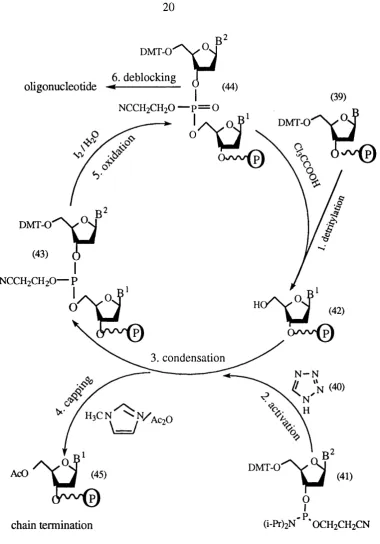
T he chem istry o f autom ated solid -p h ase p h o sp h o ram id ite tech n iq u e for oligonucleotide synthesis using the phosphoram idites (38a-d) is illustrated in Figure 1.11. The first step of the cycle is the rem oval o f D M T group from the 5'-hydroxyl of the nucleoside (39) covalently attached the support . The coupling reaction is catalyzed by tetrazole (40), w hich protonates the N, N -diisopropylphosphoram idite (41), and converts the diisopropylamino moiety into a good leaving group. The protonated amino group is displaced by the 5'-hydroxyl group of the support-bound nucleoside (42) and the dim er (43) is form ed. A fter a capping step (see below ) the dim er is oxidized with aqueous iodine to convert the phosphite triester into a m ore stable phosphate triester (44). T he average coupling efficiency is about 98.5% and sequences in excess o f 100 bases can be prepared. H ow ever, in each cycle around 1.5% o f the oligonucleotide chains on the glass beads fail to react with the activated m onom er and if this situation w ere ignored, a com plex m ixture o f truncated sequences w ould accum ulate, the m ajority o f which would be only one nucleotide shorter than the correct product. These im purities w ould obviously have sim ilar properties to the desired oligonucleotide and purification w ould be very difficult. H ence the capping step is perform ed to term inate the extension of these unw anted oligomers (45).
oligonucleotide
DMT-0
6. deblocking
? P
-
9
(44)(
39
)NCCH2CH2O — p= 0
DMT-O
DMT-O'
(43)
NCCH2CH2O— P
3. condensation
DMT-O
AcO (45) (41)
(i-Pr)2N '^ 'O C H2CH2CN chain termination
F igure 1.11. C hem istry of autom ated solid-phase phosphoram idite approach for DNA synthesis (Taken from Engels and Uhlmann, 1989).
1.4 C H E M IC A L S Y N T H E S IS O F O L IG O N U C L E O T ID E S C O N T A IN IN G M ODIFIED BASES AND THEIR APPLICATIONS
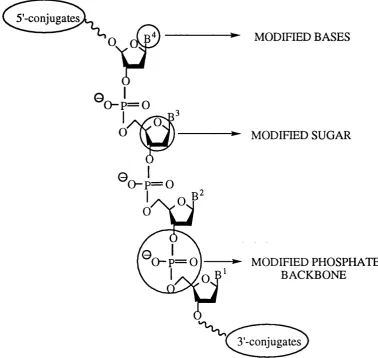
An inspection o f D N A suggests several potential sites for the introduction o f modification. These include the sugar, base and phosphate backbone of these molecules and the 3'- and 5'- ends (Figure 1.12). B ecause o f the im portance o f these m odified oligonucleotides for studies related to carcinogenesis, m utation, D N A repair and for investigation o f protein-D N A interaction, and for their use as probes, inhibitors and cytotoxic drugs (for review s see: Basu and Essigm ann, 1988; Swann, 1990; Englisch and G auss, 1991; M arshall and Caruthers, 1993), many m ethods have been recently dev elop ed fo r sy nthesizing differen t m o dified oligo m ers (E ck stein , 1991). The particular interest o f our lab in base-m odified oligonucleotides has m eant that this p ro jec t focuses on dev elop in g m ethods for sy n th esizin g th is so rt o f m odified oligonucleotides and investigating their applications. Hence, the follow ing discussion will focus on ohgonucleotides containing modified bases, especially, those widely used for study o f D N A -protein interactions, w hich is a part o f this project, and those used for investigation of D N A dam age by alkylating agents, which is the main interest of our lab.
1.4.1. Oligonucleotides for Study of DNA-Protein Interactions
approaches is the preparation o f suitable base analogues and their incorporation into ohgonucleotides.
5'-conjugates
, I O - p= 0
M ODIFIED SUGAR
Q - p — O
M ODIFIED PHO SPHA TE BA CK B O N E
" S . ^
'- c o n ju g a te ^
Figure 1.12. Potential sites for the introduction o f m odification in DNA.
I.4 .I.i. B ase Analogue A pproach
This approach consists o f the deletion o f one o f the potential contact sites o f natural bases by replacem ent o f an atom or a functional group, e.g. a ring nitrogen, an exocyclic am ino group on 0 , C, A, and the m ethyl group o f T. Ideally, the alteration should be subtle enough so that it only affects the protein contact at that particular point and does not cause major conformational changes in the DNA structure.
oligo nu cleotides by Seela and D riller (1985). The m odified n ucleoside (47) w as o b tain ed by ph ase-tran sfer g ly co sylatio n o f 2 -a m in o -4 -m e th o x y -7 H -p y rro lo (2 , 3 -d )p y rim id in e (48) w ith l- c h lo r o - 2 '- d e o x y - 3 ,5 - d i- 0 - p - to lu o y l- D - e r y th r o - pentofuranose (49) followed by dém éthylation of m ethoxynucleoside (50). T reatm ent o f (47) w ith isobutyric anhydride follow ed by selective deprotection w ith sodium hydroxide at 0°C resulted in the form ation of the N 2-isobutyrylated com pound (51). T reatm ent o f (51) w ith 4, 4'-dim ethoxytrityl chloride and then w ith m ethyl N , N - d iis o p ro p y lc h lo ro p h o s p h o ra m id ite o r 2 -c y a n o e th y l N , N -d iis o p ro p y lc h lo ro - phosphoram idite produced phosphoram idites (46a-b) (Figure 1.13) w hich w ere then incorporated into oligomers by automatic solid-phase synthesis. Subsequently, using a sim ilar strategy, the oligonucleotides containing 7-deaza-2'-deoxyadenosine w ere also prepared via the phosphoramidites (52a-b) (Seela and Kehne, 1985).
NHBz
DMTO
0 1
p
RO^ "N(Pr-i
)2
(52) a. R = CH3
b. R = CH2CH2CN
N(Bz) 2
DMTO
N C C H 2 C H 2 0 ^ N(Pr-i)2
(53)
inserted in oligonucleotides containing the Eco RV endonuclease recognition sequence d(GATATC) by automated solid-phase synthesis. M elting tem perature of the oligomers showed that the modified base had little effect on the thermal stability o f the duplexes.
OCH3
H2N N ^
OCH3
l.(t-Bu)4NHS0 4/Na0 H ^
Cl --- ► 2. CH3 0Na
HN
i-BuHN
HO
30%HBr/CH3COOH
O
l.(i-BuC0 ) 2 0
2. NaOH
OH (51)
O
HN
OH 1. DMTCI
2. R0P(Cl)N(Pr-i)2 (47)
HN
i-BuHN
DMTO
0 1
(46) a R = CH3
b R = CH2CH2CN
p
RO" 'N(Pr-i)2
Figure 1.13. Chem ical synthesis of 7-deaza-2'-deoxyguanosine phosphoram idites.
HN
BzHN
O
BzO
OBz
(55)
O
l
”>
T - ^
OBz (57)
AgzO
1.NaOH 2. DMTCI
3.CNCH2CH20P[N(Pr-i)2]2
BzHN
Oc>
DMTO
O
r
o=s=o
BzHN
O
BzO
■>»
>
OBz
NH2NH2
J
(54)
BzHN
BzO
OBz
(56)
(i-Pr)2N OCH2CH2CN
(58)
Figure 1.14. Chem ical synthesis o f phosphoram idite of 2-am inopurine nucleoside.
protected 2-am inopurine nucleoside derivative (57). D eprotection o f the carbohydrate residue and subsequent tritylation and phosphitylation produced the phosphoram idite (58) (Figure 1.14). It w as incorporated into oligonucleotides on an autom atic D N A s y n th e s iz e r in e x a c tly the sam e m a n n er as th e fo u r co m m o n n u c le o sid e phosphoram idite monom ers with no observable difference in couphng efficiency.
i-BuHN ^ N
DMTO
P ^ " V o - P - Ô E t g N H CH3O'' 'N(Pr-i) 2 ^ C l O
(59) (60)
S ynthesis o f olig onu cleo tides containing 2, 6-diam in op urin e, a stru ctural guanine analogue, in w hich the 6-carbonyl group is replaced by an am ino group, has been reported by C ho llet et al. (1986). By in sertion o f phosp ho ram idite (59) or phosphotriester (60), oligom ers up to 27 bases in length, containing up to five 2,
6-diam inopurines, w ere synthesized with coupling yields o f 95-99% . H ow ever the two am ino-protecting groups w ere difficult to rem ove and severe deprotection conditions, such as conc. am m onia at 65°C for 7 days or 0.1 M NaOH at 40°C for 72 hours w ere necessary. T he therm al stabilities o f the o ligo nu cleotid e duplexes co n tain in g 2,
6-diam ino pu rine show ed th at the introduction o f 2, 6-d iam in o p u rin e into D N A sequences stabilized duplex form ation with com plem entary sequences since an extra hydrogen bond is formed between the modified base and thymine.
the 6-k eto oxygen w ith su lp h u r should give a probe valuable in the stu d y o f D N A -protein interactions. The first report o f chem ical synthesis of oligonucleotides c o n ta in in g 6-th io g u an in e w as from R ap p ap o rt (1988). 6-T h io d eo x y g u an o sin e phosphotriester (61) w as incorporated into oligom ers using phosphotriester chem istry w ithout the protection of the 6-thio function. Because o f the great difficulty in removing the protecting groups on the bases and lack of evidence that loss o f the sulphur had not taken place during deprotection, this method was soon superseded by other methods.
SH
BzHN
(61) DMTO
O
O—p= o
^ C 1
I ®
NH(Et)3
RHN
DMTO
0
1
NCH2CH2CO N(Pr-i) 2
(66) R = Bz
(67) R = CF3CO
(6 8) R = i-BuCO
could destroy 6-thioguanine.
HN
HzN H O ^
HN
PAcHN
O
HO
OH
(62)
OH
BrCH2CH2CN (63)
l.D M T C l
2.NCCH2CH2 0P[N(Pr-i)2 ] 2 PAcHN
PAcHN
DMTO HO
OH
(64)
(65)
Figure 1.15. C hem ical synthesis of 6-thio-2'-deoxyguanosine phosphoram idite.
F or the pyrim idines, the base analogues prepared for study o f D N A -protein interactions generally involve the deletion or alteration of the N 4-am ino group, the 0 4
-and Q2-carbonyl groups -and the C-5 methyl group. The deletion o f the thym ine methyl group can be achieved simply by replacement o f thymidine with com m ercially available 2'-deoxyuridine. O ther m odifications can only be achieved by carefully designed m odified base analogues.
can be rem oved with dithiothreitol (DTT). Further reaction of (72) with 2-cyanoethyl N , N -diisopropylchlorophosphoram idite gave thiothym idine phosphoram idite (73) su itab le for olig o n u cleo tid e sy nthesis (F igure 1.16). T h e p h o sp h o ram id ite w as incorporated into d(G A CG ATATCGTC). a self-com plem entary dodecam er containing the EcoR V recognition site (underlined) in place of the two T residues w ithin this site w ith alm ost th e sam e coupling efficiency as that on unm odified base addition. But, because of the instability o f the S-SCH3 bond to H+ and I2 during the elongation steps, the yield o f oligonucleotides was only 10-15% com pared to 60% for the unm odified dodecamer.
h
j
V’
Lawesson's reagent™V’
^JJ
1. CH30Na“
î
V’
Ü
O Ï --- 2. DMTCl - O ^ NB z O 'V -0 --S ^
B2O OBz
(69)
OBz
(70)
IIL.1 I
OH (71)
CH3SO2SCH3
A ^ o J
DMTO
9
NCCH2CH2 0^^^N (Pr-i) 2 (73)
S-SCH3
rV"
NCCH2CH2 0P(Cl)(Pr-i) 2S-SCH3
O N / \ ^ 0 - J DMTO
OH
(72)
Figure 1.16. Chem ical synthesis of phosphoram idite o f 4-thiothym idine.
protected oligomers with a 0.3 M C H3COSK solution in EtOH at 55°C. T he purity and the yield of the oligonucleotides thus obtained w ere much greater than those obtained with -SCH3 protection. Later, the cyanoethyl group was used to mask the sulphur atom in the 4-thiothym idine (76) (N ikiforov and C onnolly, 1992b). D ep ro tectio n o f S-cyanoethyl group was easily effected by treatm ent of protected oligom ers with a 0.3 M solution o f 1, 8-diazabicyclo (5 ,4 , 0)undec-7-ene (DBU) in dry acetonitrile at room tem p eratu re for 1 h. U sing the sam e pro tectio n group, o lig o m ers co n tain in g 4-thio-2'-deoxyuridine were also synthesized via the phosphoram idite (77) (N ikiforov and Connolly, 1992b).
SR
i T
O N
TOL
DMTO DMTO
?
9
NCH2CH2C O '' 'N (P r-i) 2 NCH2CH2C O ''^ 'N ( P r - i)2 NCH2CH2C O " N(Pr-i)2
(74). R = Ph, (75). R = P-NOzPh, (84) R = CHj
(76).R = NCCH2CH2 (85) R = H
..-V™
J
(Pho)3PCH3lH
„V"’
CHjCOOAg ^J)
O N --- O N ► O N HN'
o '
GAc
(80)
GAc
(79)
GAc
G
I
(81)
HzS
HN
HN
l.DMTCl HN
NCCH2CH2GPN(Pr-i) 2 DMTG
DMTG HG
GH NCCH2CH2G ^ "N(Pr-i) 2
(78)
GAc
(83) (82)
Figure 1.17. Chem ical synthesis of 2-thiothym idine phosphoram idite.
U sing the sim ilar strategy, R aju r and M cL aughlin (1992) also p rep ared oligonucleotides containing 2-thiothym idine . In contrast to the results of C onnolly and N ew m an (1989), it w as found that 2-thiothym idine w as generally unstable to the oxidation conditions em ployed in DNA synthesis and that protection of sulphur atom at the 2-position is necessary. This has been firm ly supported by a recent rep ort o f K uim elis and N am biar (1994). T hey dem onstrated that pure oligom ers containing
2-thiothym idine or 2-thiodeoxyuridine can be obtained only by the incorporation o f the phosphoram idites (84) or (85) which w ere protected with toluoyl group at either N3- or O ^-position of the thionucleoside. This protecting group w as readily cleav ed by standard post-synthetic am monia treatment.
the protected deoxycytidine (87) via a hydrazino derivative (8 8). A fter rem oval o f pro tection groups from (8 6), the pyrim idinone nucleoside (89) w as reacted w ith 9-chloro-9-phenylxanthene and subsequently phosphitylated w ith 2 -cyanoethyl N, N -diisopropylchlorophosphoram idite to produce (90) (Figure 1.18). B ecause o f the lability o f 2-pyrim idinone nucleoside to acid and base catalyzed hydrolysis, the m ore acid labile 9-phenylxanthene (Px) group was used in place o f the m ore com m on D M T g roup. S elf-co m p lem en tary olig om ers c o n tain in g the Eco RI re c o g n itio n site (G AA TTC) substituted by the pyrim idinone residue w ere synthesized on a C FG solid support with no observable change in coupling efficiency com pared to unm odified base additions. H ow ever, double H PLC isolations w ere necessary in order to adequately purify the modified oligomers.
NHBz
BzO BzO
OBz OBz
OBz
(87) (88) (86)
1. CHsONa 2. Px-Cl , H
NCCH2CH20P[N(Pr-i)2]2
N‘
PxO
PxO
01
OH
(89) N
(90)
Figure 1.18. Chem ical synthesis of phosphoram idite of 2-pyrim idinone nucleoside.