www.nat-hazards-earth-syst-sci.net/11/2913/2011/ doi:10.5194/nhess-11-2913-2011
© Author(s) 2011. CC Attribution 3.0 License.
Natural Hazards
and Earth
System Sciences
Rogue waves in 2006–2010
I. Nikolkina1,2and I. Didenkulova2,3
1University of the French West Indies and Guiana, Guadeloupe, France
2Institute of Applied Physics, Russian Academy of Sciences, Nizhny Novgorod, Russia 3Institute of Cybernetics, Tallinn University of Technology, Tallinn, Estonia
Received: 17 April 2011 – Accepted: 18 May 2011 – Published: 4 November 2011
Abstract. The evidence of rogue wave existence all over the world during last five years (2006–2010) has been collected based mainly on mass media sources. Only events associ-ated with damage and human loss are included. The waves occurred not only in deep and shallow zones of the World Ocean, but also at the coast, where they were manifested as either sudden flooding of the coast or high splashes over steep banks or sea walls. From the total number of 131 re-ported events, 78 were identified as evidence of rogue waves (which are expected to be at least twice larger than the signif-icant wave height). The background signifsignif-icant wave height was estimated from the satellite wave data. The rogue waves at the coast, where the significant wave height is unknown or meaningless, were selected based on their unexpectedness and hazardous character. The statistics built on the selected 78 events suggests that extreme waves cause more damage in shallow waters and at the coast than in the deep sea and can be used for hazard assessment of the rogue wave phe-nomenon.
1 Introduction
Since the XV century rogue waves have been widely reported all over the world. For a long time they were thought to be a part of marine folklore, but with the development of instru-mental measurements their existence has become evident and has been scientifically proven.
The New Era of rogue wave science started with the 25.6 m “New Year wave” recorded in the North Sea at the Statoil-operated “Draupner” platform on 1 January 1995. This wave of an enormous crest height (18.5 m) luckily did
Correspondence to: I. Nikolkina ([email protected])
not cause substantial damage, but attracted attention of the public and insurance agencies to this problem. After this ground-breaking record numerous high-cost accidents of oil-platforms and ships have been linked to the rogue wave oc-currence. It is believed by now that rogue waves have been a major cause of more than 200 accidents over the past two decades, including the loss of supertankers and con-tainer ships exceeding 200 m in length (ABC Science Online, 2011). It has been documented that extreme waves can lead to a ship accident (Toffoli et al., 2005).
Another important milestone in the understanding of rogue wave dynamics occurred in 2001, when two European Space Agency satellites detected more than 10 individual giant waves over 25 m high during only three weeks of monitor-ing of the world’s ocean (Rosenthal et al., 2003; Lehner et al., 2005). This evidence demonstrated that rogue events are not unique and/or highly improbable but occur regularly in the random wave field.
The data of extreme water waves and, more recently, of rogue waves that have occurred worldwide has been actively collected and studied (Mallory, 1974; Torum and Gudmes-tad, 1990; Lavrenov, 1998; Olagnon and Athanassoulis, 2001; Mori et al., 2002; MaxWave, 2003; Dysthe et al., 2008; Kharif et al., 2009). Recently (Liu, 2007) has proposed the chronicle of worldwide rogue waves for 1498–2007. His cat-alogue includes 51 events. Most cited collections considered the rogue wave events in the deep ocean.
Nowadays rogue waves are frequently registered all over the world by various instrumental measurements (range find-ers installed on offshore platforms or deployed buoys, SAR image processing, etc.). They are confirmed to exist in both deep and shallow areas of the World Ocean and even at the coast. Usually coastal rogue events result in a short-time sudden flooding of the coast, or strong impact upon the steep bank or coastal structures. Such events may lead to human losses and damage of the coastal infrastructure and marine transport. Some descriptions of these accidents are given in above-mentioned reviews and in Dean and Dalrym-ple (2002). In densely populated areas such events are of-ten observed by eyewitnesses. The relevant descriptions, al-though at times suffering from too emotional character, are still very important as they considerably broaden the under-standing of possible rogue wave occurrence.
Although there exist hundreds of instrumental freak wave records, the pool of existing data is still insufficient to build reliable statistics and to give a definite answer concerning the nature of rogue waves. Therefore, it is important to further collect and to analyse all existing data of rogue wave events. It can bring us to new ideas of their nature and mechanisms of formation.
An attempt to create a catalogue of freak waves that oc-curred in the World Ocean in 2005 was made by Didenkulova et al. (2006), who analysed all freak events reported in the mass media in 2005 and selected 9 cases that could be associ-ated with the rogue wave phenomenon. Liu (2007) published a history of all known rogue wave encounterings.
This paper is a continuation of these studies and represents a catalogue of rogue waves reported in mass media and as-sociated with damage in 2006–2010. This time interval con-tains 78 reliable rogue wave events, an amount that is large enough to draw preliminary conclusions about statistics of rogue events. Following Didenkulova et al. (2006), we in-clude characteristics of rogue waves in different zones (in shallow and deep waters and at the coast) and the hazards associated with them.
2 Data
The catalogue of rogue waves has been constructed using quantitative and qualitative information about extreme wave parameters found in mass media. Only events associated with damage or human loss have been selected. The data for the catalogue have been found mainly in daily newspa-pers, and different chronicles and collections (e.g. Liu, 2007; Cargo Law, 2011; Cruise Junkie, 2011; Freak waves, 2011; Freaque waves, 2011).
As the collection includes rogue wave events of com-pletely different kinds (including those observed at the coast), we applied different criteria to different kind of waves in order to specify if they were “rogue”.
For events that occurred in the sea (both in deep and shal-low waters) we have used the traditional definition of the rogue wave. The height of a rogue waveHrshould at least twice exceed the significant wave height Hs (Hr/Hs>2). The latter is defined as the average of 1/3 of the largest wave heights. The height of the rogue wave has been estimated from qualitative and quantitative information given in mass media sources (for example, “the wave, estimated between 40 ft and 50 ft high...” or “the wave was as big as a double-storey house”). The significant wave height at the site and time of the rogue event has been determined by altimeter data produced by Ssalto/Duacs and distributed by Aviso (AVISO, 2011). It should be noted that the satelliteHsis calculated by averaging in space, which is different from the average of the 1/3 of the highest waves in time series, calculated from the buoy data, and is dependent on the satellite data calibration. It has been shown that the maximum wave height calculated from the space information is higher than the one obtained from the time series (Piterbarg, 1996; Forristall, 2006). That is why in our analysis we treated the exceedence of 2Hs obtained from the satellite data more as a general indicator rather than a strict law to follow. For example, if the rogue wave height was 1.8Hs or 1.9Hs we still considered these waves as rogue.
In general, the average significant wave height over an area 2◦×2◦hosting the rogue event was used to determine the maximum value of the significant wave height in the re-gion (Tables 1–2). Sometimes the data on significant wave height was unavailable for the required date and place. In these cases the corresponding values for days before and af-ter the required date have been treated. If data from several satellites were available in the region we used the maximum of them for reference.
For rogue waves at the coast the significant wave height is usually unknown and sometimes even irrelevant as the height of single waves is limited by the depth. In this case the runup height of the particular wave was compared against signif-icant runup height. In coastal conditions this measure bet-ter characbet-terises the potential hazardous nature of the wave than the wave height. Indeed, for marine structures the wave steepness is particularly critical and waves become danger-ous for marine structures when they get steep, but, unfortu-nately, there were no mentions about rogue wave steepness in the mass media sources. That is why here we define the rogue wave as a wave that is either unexpectedly high or causes substantial damage (human fatalities and injuries, ship loss, and damage to coastal engineering structures).
For the 5 yr period (2006–2010), descriptions of a total of 131 events were considered. From this set, for 78 events it was possible to find enough information to apply the de-scribed criteria and to ensure that the rogue wave definition basically applies to them. These cases are called true events below.
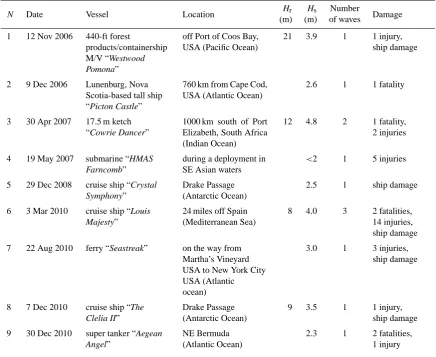
Table 1. Deep water rogue waves occurred in 2006–2010 yr (hereinafterHris rogue wave height,Hsis significant wave height).
N Date Vessel Location Hr Hs Number Damage
(m) (m) of waves
1 12 Nov 2006 440-ft forest
products/containership M/V “Westwood Pomona”
off Port of Coos Bay, USA (Pacific Ocean)
21 3.9 1 1 injury, ship damage
2 9 Dec 2006 Lunenburg, Nova Scotia-based tall ship “Picton Castle”
760 km from Cape Cod, USA (Atlantic Ocean)
2.6 1 1 fatality
3 30 Apr 2007 17.5 m ketch “Cowrie Dancer”
1000 km south of Port Elizabeth, South Africa (Indian Ocean)
12 4.8 2 1 fatality, 2 injuries
4 19 May 2007 submarine “HMAS Farncomb”
during a deployment in SE Asian waters
<2 1 5 injuries
5 29 Dec 2008 cruise ship “Crystal Symphony”
Drake Passage (Antarctic Ocean)
2.5 1 ship damage
6 3 Mar 2010 cruise ship “Louis Majesty”
24 miles off Spain (Mediterranean Sea)
8 4.0 3 2 fatalities, 14 injuries, ship damage
7 22 Aug 2010 ferry “Seastreak” on the way from Martha’s Vineyard USA to New York City USA (Atlantic ocean)
3.0 1 3 injuries, ship damage
8 7 Dec 2010 cruise ship “The Clelia II”
Drake Passage (Antarctic Ocean)
9 3.5 1 1 injury, ship damage
9 30 Dec 2010 super tanker “Aegean Angel”
NE Bermuda (Atlantic Ocean)
2.3 1 2 fatalities, 1 injury
inhomogeneous and several areas contain a large number of rogue wave phenomena (for example, Great Britain; the south-east of Australia and Tasmania; the south coast of Africa; Northern California, USA). A part of this pattern obviously reflects the density of ship traffic (Toffoli et al., 2005) and coastal population. Another feature that evidently affects the distribution is that only the most significant events are reflected in the main newspapers all over the world and are included into our database, but small accidents are very often mentioned briefly in the local news and in the local lan-guage. Therefore, it is not unexpected that the largest density of rogue waves occurs for the English speaking countries.
The mechanism of rogue wave generation and propaga-tion is recognized to differ in different zones of the World Ocean. In deep water the nonlinear self-modulation is com-monly believed to be the most probable cause of rogue wave generation (see, for example, Kharif et al., 2009), while in shallower water the effects of dispersion, basin geometry and bathymetry, and (both linear and nonlinear) wave-coast and
Fig. 1. Geographic distribution of rogue wave events in 2006–2010.
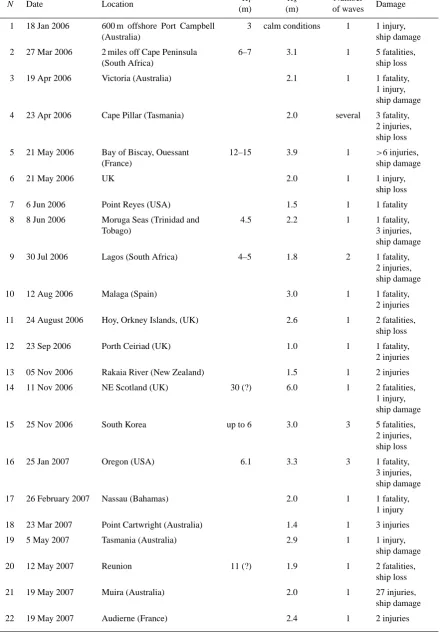
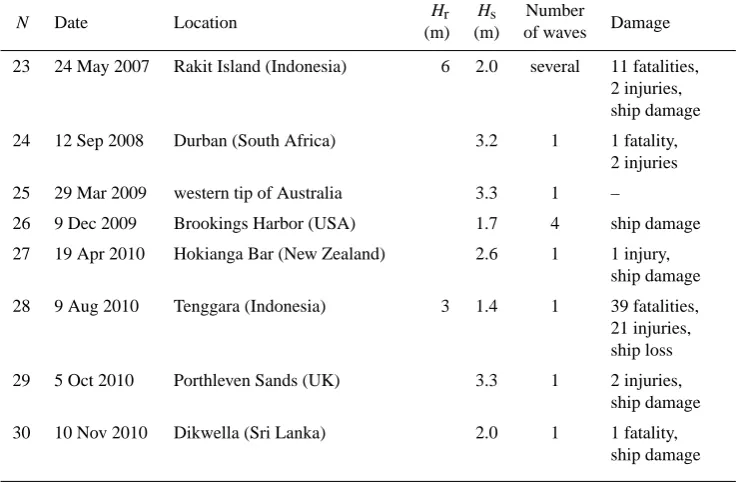
Table 2. Shallow-water rogue waves in 2006–2010 (numbers followed by brackets indicates authors’ estimation).
N Date Location Hr Hs Number Damage
(m) (m) of waves
1 18 Jan 2006 600 m offshore Port Campbell (Australia)
3 calm conditions 1 1 injury, ship damage
2 27 Mar 2006 2 miles off Cape Peninsula (South Africa)
6–7 3.1 1 5 fatalities, ship loss
3 19 Apr 2006 Victoria (Australia) 2.1 1 1 fatality, 1 injury, ship damage
4 23 Apr 2006 Cape Pillar (Tasmania) 2.0 several 3 fatality, 2 injuries, ship loss
5 21 May 2006 Bay of Biscay, Ouessant (France)
12–15 3.9 1 >6 injuries, ship damage
6 21 May 2006 UK 2.0 1 1 injury,
ship loss
7 6 Jun 2006 Point Reyes (USA) 1.5 1 1 fatality
8 8 Jun 2006 Moruga Seas (Trinidad and Tobago)
4.5 2.2 1 1 fatality, 3 injuries, ship damage
9 30 Jul 2006 Lagos (South Africa) 4–5 1.8 2 1 fatality, 2 injuries, ship damage
10 12 Aug 2006 Malaga (Spain) 3.0 1 1 fatality, 2 injuries
11 24 August 2006 Hoy, Orkney Islands, (UK) 2.6 1 2 fatalities, ship loss
12 23 Sep 2006 Porth Ceiriad (UK) 1.0 1 1 fatality, 2 injuries
13 05 Nov 2006 Rakaia River (New Zealand) 1.5 1 2 injuries
14 11 Nov 2006 NE Scotland (UK) 30 (?) 6.0 1 2 fatalities, 1 injury, ship damage
15 25 Nov 2006 South Korea up to 6 3.0 3 5 fatalities, 2 injuries, ship loss
16 25 Jan 2007 Oregon (USA) 6.1 3.3 3 1 fatality, 3 injuries, ship damage
17 26 February 2007 Nassau (Bahamas) 2.0 1 1 fatality, 1 injury
18 23 Mar 2007 Point Cartwright (Australia) 1.4 1 3 injuries
19 5 May 2007 Tasmania (Australia) 2.9 1 1 injury, ship damage
20 12 May 2007 Reunion 11 (?) 1.9 1 2 fatalities, ship loss
21 19 May 2007 Muira (Australia) 2.0 1 27 injuries, ship damage
Table 2. Continued.
N Date Location Hr Hs Number Damage
(m) (m) of waves
23 24 May 2007 Rakit Island (Indonesia) 6 2.0 several 11 fatalities, 2 injuries, ship damage
24 12 Sep 2008 Durban (South Africa) 3.2 1 1 fatality, 2 injuries
25 29 Mar 2009 western tip of Australia 3.3 1 –
26 9 Dec 2009 Brookings Harbor (USA) 1.7 4 ship damage
27 19 Apr 2010 Hokianga Bar (New Zealand) 2.6 1 1 injury, ship damage
28 9 Aug 2010 Tenggara (Indonesia) 3 1.4 1 39 fatalities, 21 injuries, ship loss
29 5 Oct 2010 Porthleven Sands (UK) 3.3 1 2 injuries, ship damage
30 10 Nov 2010 Dikwella (Sri Lanka) 2.0 1 1 fatality, ship damage
Fig. 2. The definition of the shallow-, deep-, and coastal rogue
waves.
To provide a credible study of selected rogue waves, we divide the area of occurrence of rogue events into three zones: deep-water area, shallow-water regions, and the coast (Fig. 2). Here we define the shallow water zone as the sea areas with depths≤50 m. This estimate is based on char-acteristic parameters for the North Sea. Deep waters are associated with water depths exceeding 50 m. The coastal rogue events include unexpected and hazardous waves of ex-treme height or runup that occurred at the shoreline. The typical consequence of such a coastal event is that tourists or holiday-makers are washed off into the sea by an unexpect-edly large wave.
The majority of hazardous rogue waves have been reported in the shallow water zone (Fig. 3) and at the coast that are densely populated and/or host heavy marine traffic. This
Fig. 3. The number and proportion of rogue waves occurrence in
deep and shallow waters and at the coast in 2006–2010.
feature is not unexpected: the density of population and the active use of these areas naturally lead to the larger probabil-ity to meet a rogue wave in these zones compared to the deep water, where the rogue waves can be only observed from a ship or an oil platform. Moreover, in many cases conse-quences of coastal rogue waves can be observed only after the impact has occurred.
3 Deep water rogue waves
In total, in 2006–2010 , 9 ship collisions with rogue waves in deep waters were reported (Table 1). These events caused 6 fatalities and 27 injuries.
damaged electronics, forcing vessel to seek temporary shel-ter in Coos Bay, Oregon, US (Herald Scotland, 2011).
On 9 December 2006 the ship “Picton Castle” was struck by rogue wave 760 km from Cape Cod, USA in the Atlantic Ocean. The impact caused one fatality (CBC News, 2011).
The 17.5 m ketch “Cowrie Dancer” was hit twice by waves up to 12 m at a distance of 750 nautical miles south-east of the South African coast on 30 April 2007. Three West Aus-tralian men who were aboard were seriously injured (Porch-light International, 2011).
The submarine “HMAS Farncomb” met a rogue wave dur-ing the deployment in SE Asian waters on 19 May 2007. The event resulted in 5 injuries (The Australian, 2011).
The cruise ship “Crystal Symphony” was hit by a large wave in the Drake Passage resulting in a broken stateroom window on a deck on 29 December 2008. It resulted in wa-ter damage in the stawa-teroom and adjacent hallways and other nearby staterooms (Cruise Junkie, 2011).
The largest number of human losses (2 fatalities and 14 in-juries) is associated with the accident of the cruise ship “Louis Majesty” that occurred 24 miles off the coast of Cabo de San Sebastian near the Spanish town of Palagrugell, the Mediterranean Sea, on 3 March 2010 (Fig. 4). The cruise ship was hit by three giant waves so-called “three sisters” (Cruise Junkie, 2011).
Three people were injured when the ferry “Seastreak” had a collision with the large wave on the way from Martha’s Vineyard (USA) to New York City (USA) in the Atlantic Ocean on 22 August 2010 (Cargo Law, 2011).
A large wave slammed into an Antarctic cruise ship “The Clelia II” with 88 passengers and 77 crew members aboard on 7 December 2010 near South Shetland Islands. The vessel declared an emergency when it lost power and communica-tions, after a 30-foot wave washed over the deck and took out windows on the bridge (Cruise Junkie, 2011).
The super tanker “Aegean Angel” was hit by a big wave at the NE off Bermuda in the Atlantic Ocean on 30 De-cember 2010; 2 fatalities and ship damage were reported (Freaque waves, 2011).
Rogue waves have been observed in the Mediterranean Sea, in the Pacific, Atlantic, and Indian Ocean. As the ex-act location of one event (the submarine collision with the rogue wave) is unknown, we use the significant wave height over a larger sea area (see above) to characterise the event. SinceHswas relatively small (<2 m), it is natural to assume that the wave which caused 5 injuries was substantially larger than the backgroundHs. In other cases where the height of the wave is unknown, we also assume it to be at least twice larger thanHs, since the involved ships and ferries are rather large and a wave which could cause damage to such a ship or lead to human injuries and fatalities should be at least 6 m high, while the significant wave height for all these events was less than 3 m.
Fig. 4. The cruise ship “MS Louis Majesty” (previous name “Norwegian Majesty”) hit by rogue waves on 3 March 2010. The red arrow indicates the location of the wave hit (© 2011 carnet-maritime.com).
4 Shallow water rogue waves
In the light of contemporary knowledge about freak waves, it is highly probable that most of seemingly anecdotal mariners’ stories about destructive waves that appear sud-denly for a short period of time and hit fishing boats in the nearshore correspond to shallow water rogue waves. The coastal waters, which correspond to the shallow water area in our classification, hold the largest concentration of ocean biomasses and, hence, mostly fishing boats are expected to sail in these territories.
A total of 30 shallow-water rogue wave events were re-ported in 2006–2010 (Table 2), 14 of them led to the damage of the vessel and 7 events – to its loss. These events are also associated with an extremely high number of human fatali-ties (79 persons) and injuries (90 persons).
August 2010 the ship carrying 60 people (only 21 rescued) capsized and sank minutes before arriving in Lembata, Teng-gara (Cargo Law, 2011). Another large loss of lives (11 fatal-ities) occurred in this area when a fishing boat “Jaya Baru” was engulfed by 6 m waves on 24 May 2007 (Cargo Law, 2011).
The largest wave was reported on 11 November 2006 when the 42 000-tonne oil tanker “FR8 Venture” was hit by a 100 ft (about 30 m) wave while passing through the Pent-land Firth off the coast of northeast ScotPent-land. Two crewmen were killed and one seriously injured during the accident. The background significant wave heightHs was about 6 m (Freaque waves, 2011). Here we should comment that the mentioned rogue wave height seems for us unrealistic, since the water depth in that region is less than 50 m. We would rather believe that the height of the rogue wave was 15 m. That is why we put a question-mark for this event in Table 2.
5 Rogue waves at the coast
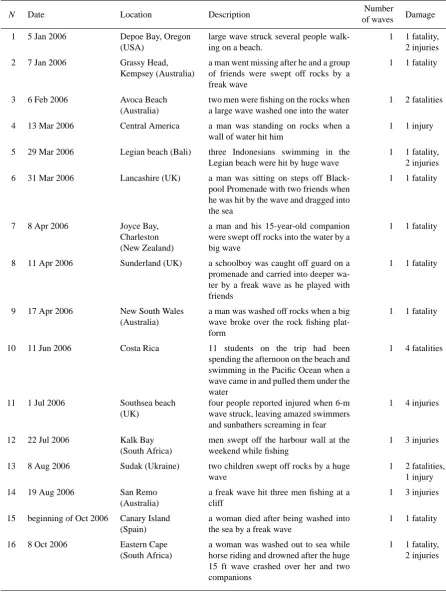
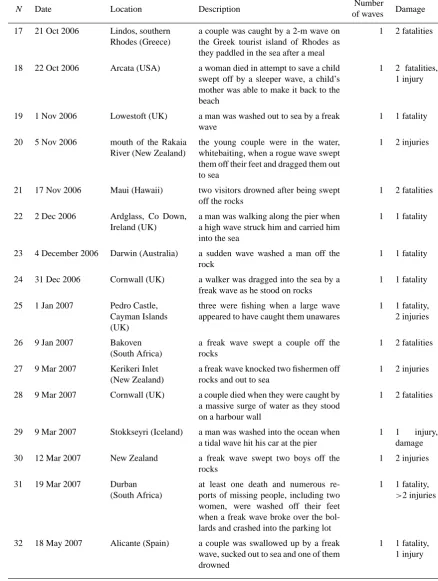
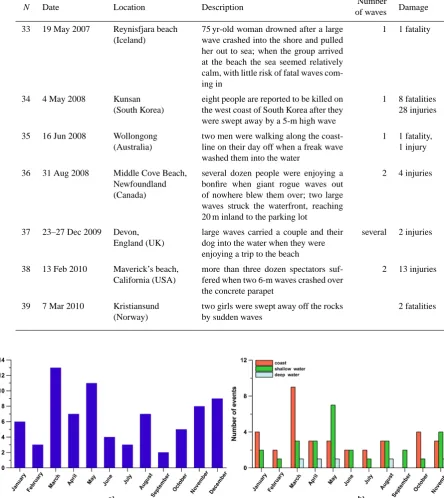
Rogue waves at the coast constitute a real danger to people. Totally, during 2006–2010, 39 such events were reported, which caused 46 fatalities and 79 injuries (Table 3). We also provide the necessary description of selected events, based on waves which we identified as rogue. Usually such waves appear unexpectedly in calm weather conditions and result in the washing of persons off to sea.
A terrible freak accident occurred on 11 June 2006 when three students and a teacher were killed during an educational trip to Costa Rica. Students had been spending the afternoon on the beach when an unexpected wave came in and pulled them under the water. The students described it as a per-fect afternoon for swimming until the unexpected wave came (The University Daily Kansan, 2011).
On 4 May 2008 eight people died after a very short event when a 5 m high wave swept tourists and fishing people along Kunsan, South Korea (Yoo et al., 2010).
One of the most recent events took place on 13 Febru-ary 2010 when a rogue wave “wiped out” spectators at Mavericks surfing competition in California, USA (Fig. 5). At least 13 spectators received significant injuries, including broken legs and hands, when the crowd was knocked off the wall by two unexpected 6-m waves (The Times, 2011).
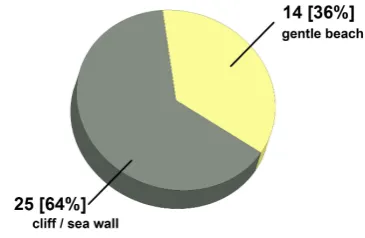
It is also interesting to note that 14 of 39 coastal rogue accidents (36 %) occurred at gently sloping beaches and 25 (64 %) at high rocks or cliffs or sea walls (Fig. 6).
6 Discussion
The seasonal variability of rogue waves in 2006–2010 does not demonstrate any preferable season for rogue wave oc-currence (Fig. 7). There is one clearly identified peak for shallow water rogue waves in May, but near months April
Fig. 5. Rogue wave off Maverick’s, USA in 2010 (© Scott
Ander-son).
Fig. 6. Statistics of rogue wave occurrence at the coast.
Table 3. Rogue waves at coast in 2006–2010 yr.
N Date Location Description Number Damage
of waves
1 5 Jan 2006 Depoe Bay, Oregon (USA)
large wave struck several people walk-ing on a beach.
1 1 fatality, 2 injuries
2 7 Jan 2006 Grassy Head, Kempsey (Australia)
a man went missing after he and a group of friends were swept off rocks by a freak wave
1 1 fatality
3 6 Feb 2006 Avoca Beach (Australia)
two men were fishing on the rocks when a large wave washed one into the water
1 2 fatalities
4 13 Mar 2006 Central America a man was standing on rocks when a wall of water hit him
1 1 injury
5 29 Mar 2006 Legian beach (Bali) three Indonesians swimming in the Legian beach were hit by huge wave
1 1 fatality, 2 injuries
6 31 Mar 2006 Lancashire (UK) a man was sitting on steps off Black-pool Promenade with two friends when he was hit by the wave and dragged into the sea
1 1 fatality
7 8 Apr 2006 Joyce Bay, Charleston (New Zealand)
a man and his 15-year-old companion were swept off rocks into the water by a big wave
1 1 fatality
8 11 Apr 2006 Sunderland (UK) a schoolboy was caught off guard on a promenade and carried into deeper wa-ter by a freak wave as he played with friends
1 1 fatality
9 17 Apr 2006 New South Wales (Australia)
a man was washed off rocks when a big wave broke over the rock fishing plat-form
1 1 fatality
10 11 Jun 2006 Costa Rica 11 students on the trip had been spending the afternoon on the beach and swimming in the Pacific Ocean when a wave came in and pulled them under the water
1 4 fatalities
11 1 Jul 2006 Southsea beach (UK)
four people reported injured when 6-m wave struck, leaving amazed swimmers and sunbathers screaming in fear
1 4 injuries
12 22 Jul 2006 Kalk Bay (South Africa)
men swept off the harbour wall at the weekend while fishing
1 3 injuries
13 8 Aug 2006 Sudak (Ukraine) two children swept off rocks by a huge wave
1 2 fatalities, 1 injury
14 19 Aug 2006 San Remo (Australia)
a freak wave hit three men fishing at a cliff
1 3 injuries
15 beginning of Oct 2006 Canary Island (Spain)
a woman died after being washed into the sea by a freak wave
1 1 fatality
16 8 Oct 2006 Eastern Cape (South Africa)
a woman was washed out to sea while horse riding and drowned after the huge 15 ft wave crashed over her and two companions
Table 3. Continued.
N Date Location Description Number Damage
of waves
17 21 Oct 2006 Lindos, southern Rhodes (Greece)
a couple was caught by a 2-m wave on the Greek tourist island of Rhodes as they paddled in the sea after a meal
1 2 fatalities
18 22 Oct 2006 Arcata (USA) a woman died in attempt to save a child swept off by a sleeper wave, a child’s mother was able to make it back to the beach
1 2 fatalities, 1 injury
19 1 Nov 2006 Lowestoft (UK) a man was washed out to sea by a freak wave
1 1 fatality
20 5 Nov 2006 mouth of the Rakaia River (New Zealand)
the young couple were in the water, whitebaiting, when a rogue wave swept them off their feet and dragged them out to sea
1 2 injuries
21 17 Nov 2006 Maui (Hawaii) two visitors drowned after being swept off the rocks
1 2 fatalities
22 2 Dec 2006 Ardglass, Co Down, Ireland (UK)
a man was walking along the pier when a high wave struck him and carried him into the sea
1 1 fatality
23 4 December 2006 Darwin (Australia) a sudden wave washed a man off the rock
1 1 fatality
24 31 Dec 2006 Cornwall (UK) a walker was dragged into the sea by a freak wave as he stood on rocks
1 1 fatality
25 1 Jan 2007 Pedro Castle, Cayman Islands (UK)
three were fishing when a large wave appeared to have caught them unawares
1 1 fatality, 2 injuries
26 9 Jan 2007 Bakoven (South Africa)
a freak wave swept a couple off the rocks
1 2 fatalities
27 9 Mar 2007 Kerikeri Inlet (New Zealand)
a freak wave knocked two fishermen off rocks and out to sea
1 2 injuries
28 9 Mar 2007 Cornwall (UK) a couple died when they were caught by a massive surge of water as they stood on a harbour wall
1 2 fatalities
29 9 Mar 2007 Stokkseyri (Iceland) a man was washed into the ocean when a tidal wave hit his car at the pier
1 1 injury, damage
30 12 Mar 2007 New Zealand a freak wave swept two boys off the rocks
1 2 injuries
31 19 Mar 2007 Durban (South Africa)
at least one death and numerous re-ports of missing people, including two women, were washed off their feet when a freak wave broke over the bol-lards and crashed into the parking lot
1 1 fatality,
>2 injuries
32 18 May 2007 Alicante (Spain) a couple was swallowed up by a freak wave, sucked out to sea and one of them drowned
Table 3. Continued.
N Date Location Description Number Damage
of waves
33 19 May 2007 Reynisfjara beach (Iceland)
75 yr-old woman drowned after a large wave crashed into the shore and pulled her out to sea; when the group arrived at the beach the sea seemed relatively calm, with little risk of fatal waves com-ing in
1 1 fatality
34 4 May 2008 Kunsan (South Korea)
eight people are reported to be killed on the west coast of South Korea after they were swept away by a 5-m high wave
1 8 fatalities 28 injuries
35 16 Jun 2008 Wollongong (Australia)
two men were walking along the coast-line on their day off when a freak wave washed them into the water
1 1 fatality, 1 injury
36 31 Aug 2008 Middle Cove Beach, Newfoundland (Canada)
several dozen people were enjoying a bonfire when giant rogue waves out of nowhere blew them over; two large waves struck the waterfront, reaching 20 m inland to the parking lot
2 4 injuries
37 23–27 Dec 2009 Devon, England (UK)
large waves carried a couple and their dog into the water when they were enjoying a trip to the beach
several 2 injuries
38 13 Feb 2010 Maverick’s beach, California (USA)
more than three dozen spectators suf-fered when two 6-m waves crashed over the concrete parapet
2 13 injuries
39 7 Mar 2010 Kristiansund (Norway)
two girls were swept away off the rocks by sudden waves
2 fatalities
Fig. 7. Seasonal variability of rogue waves in 2006–2010: (a) all zones; (b) different zones.
Another important factor is the number of waves in the rogue event or wave grouping. Sometimes the rogue event is manifested by two or three (so-called “three sisters”) con-secutive waves of extreme height (Kharif et al., 2009). We extracted available information on the number of observed abnormal waves for each rogue accident (Fig. 8) for rogue wave statistics in 2006–2010. In most of cases (83 %) only one wave was observed. This conclusion remains the same
Fig. 8. Number of rogue waves during each event: (a) all events; (b) coast; (c) shallow water; (d) deep water.
appears in 16 % of the cases. These statistics slightly vary depending on the type of the rogue event. In deep waters a group of rogue waves was observed in 22 % cases, in shallow water – in 20 % cases and at the coast – only 10.5 %. This is consistent with the current understanding of the physical mechanisms of rogue wave generation (Kharif et al., 2009). Wave grouping is usually associated with the nonlinear self-modulation, which is claimed to be the most probable cause of rogue wave generation in deep water, while in shallow wa-ter it does not work.
The discussed statistics has obvious limitations and differ-ent reliability for differdiffer-ent zones due to the differdiffer-ent num-ber of events registered in deep, shallow, and coastal areas.
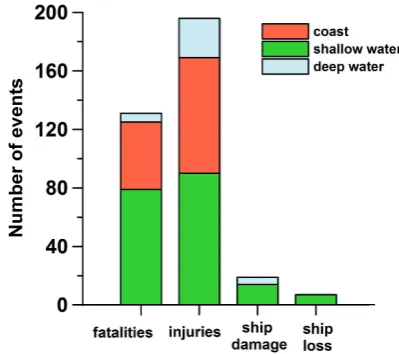
Fig. 9. Damage caused worldwide by rogue waves in 2006–2010.
The largest number of rogue wave accidents was registered at the coast 50 % (39 events) and in shallow waters 38.5 % (30 events) and the rest 11.5 % (only 9 events) in deep wa-ters. As mentioned above, this particular proportion can be simply a result of a more dense population in the coastal and shallow water areas.
On the other hand, the presence of dense population in the coastal areas increases the risk of rogue wave hazard. Fig-ure 9 suggests that the number of injuries and fatalities in shallow waters and coastal zones is exceptionally high. In total, during 2006–2010, 131 lives were lost and 196 per-sons were injured. On top of that, seven ships were lost and 19 damaged. Among them 79 people were killed by rogue waves in shallow waters and 46 at the coast. The number of injuries has basically the same proportion: 90 persons in-jured in shallow waters and 79 at the coast. For comparison, the number of human losses in the deep water area is signifi-cantly less: 6 fatalities and 27 injuries. These statistics are in line with the perception that rogue waves in the coastal area eventually have much larger devastating potential (Soomere, 2010) than their deep-water sisters. Surprisingly, even ship damages occur mostly in the shallow region. Seven ship losses and 14 ship damages were reported in shallow wa-ters, while in deep waters only five accidents resulted in the ship damage. These statistics demonstrate that it is essential to consider the rogue wave hazard for shallow and coastal areas.
Although our focus was on hazardous manifestations of the rogue wave phenomenon, the phenomenon itself apparently is much more frequent and calls for systematic studies under different wave conditions.
Acknowledgements. The altimeter products were produced by Ssalto/Duacs and distributed by Aviso, with support from Cnes (http://www.aviso.oceanobs.com/duacs/). Partial support from the targeted financing by the INTERREG III and CPER 2007-2013, the Estonian Ministry of Education and Research (grant SF0140007s11), Estonian Science Foundation (grant 8870), the EC Programme FP7-PEOPLE-2009-IIF under grant agreement No 254389, Russian Foundation for Basic Research (Grants 11-05-00216, 11-05-92002 and 11-02-00483), Russian President Program (MK-4378.2011.5) and ESF DoRa 5. The authors thank Alexey Slunyaev, Efim Pelinovsky and Tarmo Soomere for their valuable comments and suggestions. The comments and suggestions of Paul Liu and another anonymous referee are greatly acknowledged.
Edited by: E. Pelinovsky
Reviewed by: P. Liu and another anonymous referee
References
ABC Science Online: Seas awash with monster waves, available at: http://www.abc.net.au/science/news/space/SpaceRepublish 1161681.htm, last access: 15 April 2011.
AVISO: available at: http://www.aviso.oceanobs.com/duacs/, last access: 15 April 2011.
Cargo Law, The Law Offices of Countryman and McDaniel: avail-able at: http://www.cargolaw.com/, last access: 15 April 2011. CBC News: available at: http://www.cbc.ca/, last access:
15 April 2011.
Chien, H., Kao, C.-C., and Chuang, L. Z. H.: On the characteristics of observed coastal freak waves, Coast. Eng. J., 44(4), 301–319, 2002.
Cherneva, Z., Petrova, P., Andreeva, N., and Guedes Soares, C.: Probability distributions of peaks, troughs and heights of wind waves measured in the black sea coastal zone, Coastl. Eng., 52, 599–615, 2005.
Cruise Junkie: available at: http://www.cruisejunkie.com/, last ac-cess: 15 April 2011.
Dean, R. G. and Dalrymple, R. A.: Coastal Processes with Engi-neering Applications, Cambridge, Cambridge University Press, 2002.
Didenkulova, I.: Shapes of freak waves in the coastal zone of the Baltic Sea (Tallinn Bay), Boreal Environ. Res., 16, 138–148, 2011.
Didenkulova, I. and Pelinovsky, E.: Rogue waves in nonlinear hy-perbolic systems (shallow-water framework), Nonlinearity, 24, R1–R18, 2011.
Didenkulova, I. and Anderson, C.: Freak waves of different types in the coastal zone of the Baltic Sea, Nat. Hazards Earth Syst. Sci., 10, 2021–2029, doi:10.5194/nhess-10-2021-2010, 2010. Didenkulova, I. I., Slunyaev, A. V., Pelinovsky, E. N., and Kharif,
C.: Freak waves in 2005, Nat. Hazards Earth Syst. Sci., 6, 1007– 1015, doi:10.5194/nhess-6-1007-2006, 2006.
Dysthe, K., Krogstad, H. E., and Muller, P.: Oceanic rogue waves, Ann. Rev. Fluid. Mech., 40, 287–310, 2008.
Forristall, G.: Maximum wave heights over an area and the air gap problems, Proc. OMAE2006, Hamburg, Germany, 2006. Freak waves, unusually high tides: available at: http://
actionsbyt.wordpress.com/2007/11/29/freak-waves/, last access: 15 April 2011.
Freaque waves: available at: http://freaquewaves.blogspot.com/, last access: 15 April 2011.
Herald Scotland: available at: http://www.heraldscotland.com/, last access: 15 April 2011.
Kharif, C., Pelinovsky, E., Slunyaev, A.: Rogue waves in the ocean, Springer, 2009.
Lavrenov, I.: The wave energy concentration at the Agulhas current of South Africa, Nat. Hazards, 17, 117–127, 1998.
Lehner, S., G¨unther, H., and Rosenthal, W.: Extreme wave obser-vations from radar data sets, Ocean Waves Measurements and Analysis, 5th Int. Symp. WAVES 2005, Madrid, paper 69, 2005. Liu, P. C.: A chronology of freaque wave encounters, Geofizika, 24,
57–70, 2007.
Mallory, J. K.: Abnormal waves on the south-east of South Africa, Int. Hydrogr. Rev., 51, 89–129, 1974.
MaxWave, Rogue Waves: Forecast and Impact on Marine Struc-tures, GKSS Research Center, Geesthacht, Germany, 2003. Mori, N., Liu, P., and Yasuda, T.: Analysis of freak wave
mea-surements in the Sea of Japan, Ocean Eng., 29(11), 1399–1414, 2002.
Olagnon, M. and Athanassoulis, G. A. (Eds.): Rogue Waves 2000, Ifremer, France, 2001.
Porchlight International: available at: http://z10.invisionfree.com/ usedtobedoe/index.php?act=idx/, last access: 15 April 2011. Piterbarg, V. I.: Asymptotic Methods in the Theory of Gaussian
processes and Fields, AMS 1 Transl. of Math. Monographs, 148, Providence, R.I., 1996.
Rosenthal, W., Lehner, S., Dankert, H., Guenther, H., Hessner, K., Horstmann, J., Niedermeier, A., Nieto-Borger, J. C., Schulz-Stellenfleth, J., and Reichert, K.: Detection of extreme single waves and wave statistics, in: Rogue Waves: Forecast and Im-pact on Marine Structures, GKSS Research Center, Geesthacht, Germany, 2003, Papers WP 1, 3, 2003.
Soomere, T.: Rogue waves in shallow water, Eur. Phys. J.-Spec. Top., 185, 81–96, 2010.
Soomere, T. and Engelbrecht, J.: Weakly two-dimensional inter-action of solitons in shallow water, Eur. J. Mech. B-Fluid, 25, 636–648, 2006.
Toffoli, A., Lefevre, J. M., Bitner-Gregersen, E., and Monbaliu, J.: Towards the identification of warning criteria: analysis of a ship accident database, Appl. Ocean Res., 27, 281–291, 2005. Torum, A. and Gudmestad, O. T. (Eds.): Water Wave Kinematics,
Kluwer, Dordrecht, 1990.
The Australian: available at: http://www.theaustralian.com.au/, last access: 15 April 2011.
The Times: available at: http://www.thetimes.co.uk/, last access: 15 April 2011.
The University Daily Kansan: available at: http://www.kansan. com/, last access: 15 April 2011.