Themed Section: Science and Technology
A Comparative Study of Employee Training and Development
Program of Selected Private and Public Hospitals
Bharti Sharma (BPT, MPT)
Department
of Physiotherapy, Baba Mastnath University, Asthalbohar, Rohtak, Haryana, India
ABSTRACT
The investigation centers around human asset development through worker training and development rehearses. This exploration reveals insight into the connection between worker training and development rehearses with workers' presentation and occupation fulfillment. The reason for training and the executives development projects is to improve worker abilities and hierarchical abilities. The point of the present research is to think about worker training and development practices followed in chosen public and private hospitals in metropolitan urban communities. It gives thought regarding different training and development programs conveyed in the hospital, sort of training gave to hospital workers and its advantages. It additionally centers around representatives' desire and inclusion in such kind of training program. The goal of the investigation is to break down the execution of training and development rehearses in chosen hospitals and its effect on impression of representatives which prompts execution improvement and occupation fulfillment. Training speculation is returned as progressively gainful and compelling representatives. Training and development projects might be centered around individual execution or group execution. It is seen that those hospitals following efficiently and deductively training and development practices make high occupation fulfillment level inside workers. These workers are increasingly dedicated towards better execution. The creation and execution of training ought to be founded on training need examination. Data acquired could be helpful for development of training and development rehearses in hospitals. Variables that can influence the viability of training and development rehearses in the hospitals incorporate, absence of help from top administration and friends, representatives' individual frames of mind, work related elements and furthermore the inadequacies in training practice.
Keywords: Training, Development, Public Hospital, Private Hospital
I.
INTRODUCTIONHospitals are the social frameworks, which join science, individuals and innovation and are structure based on common interests. HR have been depicted as "The core of the wellbeing framework in any nation". Human asset development in the hospital is coordinated by different physical and mental variables. Current examines have demonstrated that not just fine materials, advanced innovation, great working conditions gain for ground and viability of an
association however representatives inspiration, execution, capacities and aptitudes assumes an essential job in deciding the adequacy of association. In present day hospitals, various classes of staff work in various limits.
administrations upto their desires. In hospital, representatives need to work in various conditions and utilize diverse sort of innovation. Ulrich (1998) 1 recommends that natural and relevant changes, for example, globalization, innovation, gainfulness through development, scholarly capital and persistent change; present various aggressive difficulties to associations that imply that HR must be engaged with structure new capacities.
Background of the study
Hospitals need to manage improving the patient experience as a long haul vital objective that prompts proceeded with development. Improvement in patient experience and fulfillment in social insurance associations is significant for future survival. The speed at which change is happening, the accessibility of innovation expected to convey quality consideration, and the mastery and style of medicinal services asset the board accessible may likewise impact quality. In the connection between human asset the board and execution, Guest et al. (2000b) 2 demonstrated that the HR methodology, HR practices and HR viability are interrelated and it impacts on nature of merchandise and ventures, efficiency and execution. Section level information, abilities and understandings of hospital workers are influenced by the nature of the essential instructive framework, the connections between the wellbeing training and hospital industry and the degree to which the instructive framework advances keeping learning aptitudes.
II.
MATERIALS AND METHODSGeographical details of the Study area:
The Mahabubnagar district is located between 15° 55′ and 17° 29′ N latitudes and between 77° 15′ and 79° 15′
E longitudes in Telangana state, India. To evaluate the diversity of AM fungi in rhizosphere soils and its association with roots of Dicoma tomentosa, the root
samples and rhizosphere soils were collected from 10 different mandals (Achampet, Amrabad, Gopalpet, Kodair, Kollapur, Nagarkurnool, Pebbair, Veldanda, Waddepally and Wanaparthy). The soil type of this area is sandy loam soils and clay loam soils.
Human resource management
Human resource management is worried about workers both as people and as a gathering in accomplishing objectives. It is additionally worried about conduct, passionate and social parts of work force. It is worried about the development of human resources i.e., information, capacity, expertise, possibilities and accomplishing and going to representative objectives, including work fulfillment. Human resource management is unavoidable in nature; it is worried about the management of human resources of an association comprising of all people occupied with any of the associations exercises at any dimension. HRM covers all dimensions for example low, center and top and classifications of workers, for example, incompetent, semiskilled, gifted, specialized, proficient, administrative, administrative and non administrative. It covers both composed and chaotic representatives.
Training and development of hospital employees
force both at undergrad and postgraduate dimensions. The Hospital Authority assumes a vital job in structuring, arranging and conveyance of training courses. Cost isn't a worry for the arrangement of training administrations. Precise needs appraisals and assessment of learning accomplishments and effects on execution of work force and hospitals are utilized to control the procedure.
Hospitals provide facilities like:-
1. Consultation by Doctors on Diseases. 2. Diagnosis for diseases.
3. Providing treatment facility.
4. Facility for admitting Patients (providing beds, nursing, medicines etc.)
5. Immunization for Patients/Children.
6. The HR department in hospitals must conduct staff training such as:
1) Entry training / New-hire training /orientation training
2) Job training
3) On-going training / continuing education 4) Training for promotion
5) Refresher training
Need of technical training programs for hospital employees:
The essential point of hospitals is to give patient consideration of the most astounding quality. An oftenoverlooked truth is that effective patient-care creates not from current therapeutic hardware and medications alone but rather from the work power, a gathering of well-remunerated and persuaded medicinal, paramedical, talented and incompetent faculty. The gathering of these faculty, who are focused on institutional objectives and their satisfaction, isn't simply a question of shot. It is the consequence of sound proficient organization and genial human relations. Management of human
resources in wellbeing is a noteworthy test to wellbeing frameworks development.
This incorporates getting ready for, creation, arrangement and usage of wellbeing faculty. Despite the fact that various measures have been initiated to address this difficulty, extensive holes still remain. Creating compelling social insurance associations is progressively perplexing because of statistic changes, globalization, and developments in medication. In the time of globalized economy and intense deficiency of prepared work force, hospital managers can raise physical and monetary resources with certain endeavors, however the key factor for any hospital intending to give superlative execution depends on its human capital.
Need of behavioral training programs for hospital employees
Hospitals give restorative consideration to the wiped out and penniless. They are not in the matter of assembling products but rather for rendering administration and are undeniably more needy than different associations upon their representatives' resolve and duty. Workers in such establishments are always confronting the public. Establishments which give medicinal consideration are by and large condemned more for the frames of mind of their work force than for the nature of the consideration.
Rational of study
The hospital industry, as different enterprises has encountered significant changes during the previous quite a few years. One noteworthy imperative in accomplishing all inclusive access to wellbeing administrations is the non-accessibility of talented and prepared human resources. The world wellbeing report (2006) 21reported the worldwide lack of doctors. It evaluated that 57 nations have a flat out deficiency of 2.3 million doctors, medical caretakers and birthing assistants. The worldwide medicinal services workforce is encountering a noteworthy nursing deficiency.
The nursing deficiency is an overall test, influencing each nation on the planet. With this lack, patients are enduring on the grounds that the social insurance workforce isn't set up to arrangement with their wellbeing needs. Inside every nation, the nursing deficiency is brought about by various elements that at last reason a decline in the nature of social insurance got. In any case, little is thought about the worldwide reasons for a contracting proficient medical caretaker workforce. Hospitals are missing satisfactorily prepared work force. This lack and the risks it presents, growing social insurance needs. It is an essential issue that has just prompted the weakening of hospital benefits in India. Nursing, as a human services calling and a noteworthy segment of the social insurance conveyance framework, is essentially influenced by movements in the medicinal services industry. What's more, nursing has been and will keep on being a significant power in forming the fate of the medicinal services framework.
Objectives of the study:
The main objectives of the research study are:
1. To find out existing status of employee training and development programs followed in hospitals. 2. To study and analyze data collected from various
hospitals to find out employee training and development practices in the organization.
3. Comparative analysis of present employee training and development practices followed in hospitals and its impact on organizational as well as individual growth.
4. To suggest few measures to improve existing training and development practices in the hospitals for enhancing the quality of employees.
Hypothesis of the study:
Keeping in view the above objectives, this study proceeds to test the following hypotheses.
H1: Better training and development practices improve functional efficiency and performance of employees.
H2: Training & development practices help to enhance job satisfaction of employees.
H3: There is no difference in employee training and development practices conducted in public and private hospitals.
III.
RESULTS
1. Gender of respondents:
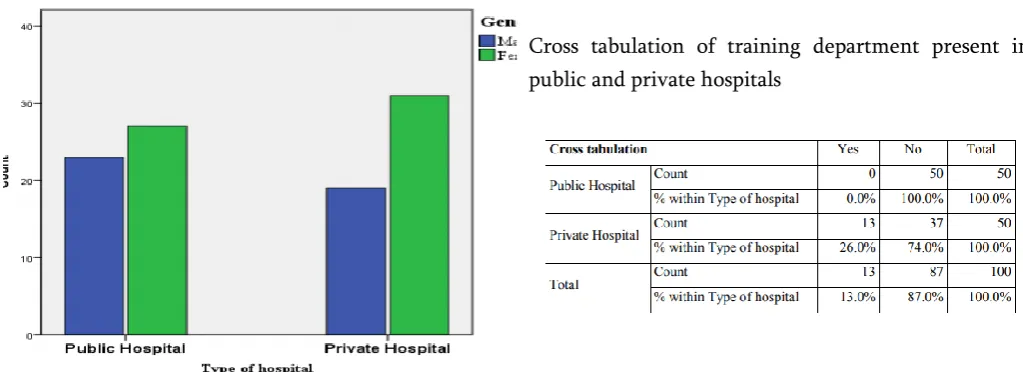
Cross tabulation of Gender wise distribution of managerial employees in public and private hospitals
Gender wise distribution of managerial employees in selected hospitals
2.Age group of employees:
Table 5.2 shows analysis of age wise distribution of managerial employees in public and private hospitals. The age group of managerial staff is presented in Figure 5.2.
Age wise distribution of managerial employees in public and private hospital
3.Training department
4.Special library for hospital staff:
5. Objectives of hospital regarding training and development
Cross tabulation showing Organizational growth as an objective of hospital regarding training and development
IV.
CONCLUSION
Hospital serves to all individuals from the general public and the important capacity of a hospital is patient consideration. In the hospital patient is the last client so the adequacy of the hospital identifies with arrangement of good patient consideration as expected. The patient fulfillment shows the proficiency of hospital organization along these lines, patients' experience is imperative to quantify the achievement of administration that hospital gives. Training and development can be connected to all dimensions of an association. A sound, productive and well-arranged training and development framework is fundamental for a steady and important development of individual and hospital association.
All other human resources framework, for example, execution management framework and human resources condition, work fulfillment, inspiration and so forth relies upon the adequacy of representative training and development framework. It is vital that hospitals ought to give advance training to their workers to adapt up to a procedure of modernization in hospital industry. Today the whole world is changing and India is likewise constructing itself past the desires for some on the planet. The hospital framework in India is in creating stage to achieve the desires for the patients and public. Hospital industry in all over India is confronting a noteworthy issue of talented work deficiency.
Hospital segment in PCMC is additionally confronting a similar issue. It is hard to get and hold talented, prepared and experienced representatives in hospitals. Hospitals have done speculation on training and development of hospital representatives till the hospitals need to spend more in different development training programs with increment in the quantity of training programs yearly. Mechanical headway in hospital industry is exceptionally high so hospital representatives need to refresh their insight for development of usefulness of the hospitals. Patients' desires contrast on the grounds that each patient has various musings, emotions and needs in this manner assurance of patients genuine inclination is extremely troublesome. It is the obligation of the hospital staff to proceed with a patient.
V.
REFERENCES
[1]. Akinpelu, B. (1999). “Educational Technology
and Teaching - Learning Process in the 21st
century” in Adesomowo, P.O. (Ed), Basic of
Education, Lagos Triumph Books publishers. [2]. Armstrong, Michael (2000). Human Resources
[3]. ArunMonappa and Mirza Saiyadain (1991). Personnel Management, Tata McGraw Hill Publishing Co., Ltd., New Delhi,
[4]. Dale S. Beach (1980). Personnel : The Management of People at Work, Macmillan Publishing Company, New York pp. 244 [5]. Dale S. Beach, (1991). Personnel Management,
McMillan, New York.
[6]. AACN (2005) AACN standards for establishing and sustaining healthy work environments: A Journey to Excellence, American Association of Critical-Care Nurses. www.aacn.org
[7]. Adeniyi, O.I. (1995). “Staff training and
development” in Ejiogu, A; Achumba, I. Asika
(eds). Reading in Organizational Behaviour in Nigeria, Lagos. Maltho use Press Ltd, pp. 159-167.
[8]. Administration Department, Akurdi Municipality Hospital. 4. Administration Department, Dhanwantari Hospital.
[9]. Administration Department, Moraya Hospital. 6. Administration Department, Padmashree Dr. D. Y. Patil Medical College, Hospital and Research Centre.
[10]. American Society for Healthcare Human Resources Administration, (2001). Building a framework for workforce solutions. American Hospital Association.
[11]. Annual Report to the People on Health (2011) Government of India, Ministry of Health and Family Welfare
[12]. Baru R. (2003). Private health sector in India: raising inequities. In: Gangolli L, Duggal R, Shukla A, editors. Review of Health Care in India. Mumbai: CEHAT; 2005. P.269–77. [13]. Bombay Nursing Home Registration Act 1949.
Government of Maharashtra. Public Health Department. Directorate of Health Services. [14]. Health Resources and Services Administration
(HRSA) (2002), Projected supply, demand, and shortages of registered nurses: 2000-2020
(2002) U.S. Department of Health and Human Services, Bureau of Health Professions, National Center for Health Workforce Analysis
[15]. Hospital report, Administration Department, Talera Hospital. 19. Hospital report, Administration Department, YashwantraoChavan Memorial Hospital [16]. Human Resource Wheel (1983). American
Society for Training and Development, Models for Excellence (ASTD) p.23 21. Indian Hospital Services Market Outlook by RNCOS Industry Research Solutions.
[17]. Indian Public Health Standards (IPHS) (2012) Guidelines for District Hospitals (101 to 500 Bedded).
[18]. International Society for Performance Improvement (ISPI), www.ispi.org
[19]. Ministry of Statistics and Programme Implementation, India (1996). National Sample Survey Organization 52 nd round. New Delhi.
[20]. Ministry of Statistics and Programme Implementation, India (2004). National Sample Survey Organization 60th round. New Delhi 26. National Health Policy, (2002). Government of India
Cite this Article
Bharti Sharma, "A Comparative Study of Employee Training and Development Program of Selected Private and Public Hospitals", International Journal of Scientific Research in Science and Technology (IJSRST), Online ISSN : 602X, Print ISSN : 2395-6011, Volume 4 Issue 5, pp. 1923-1929, March-April 2018.