
STABILITY OF CODEINE: CHARACTERIZATION OF OXIDATION PRODUCTS OF CODEINE FORMED IN AQUEOUS SOLUTION
6
0
0
Full text
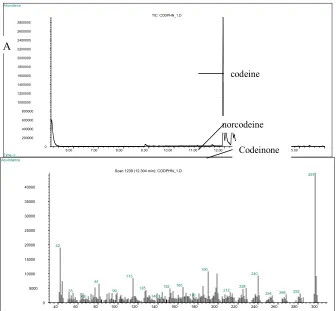
(2) El-ahajBabiker Mohamed et al. Int. Res. J. Pharm. 2013, 4 (7) Codeine-containing syrups: extraction of codeine and GC-MS analysis The pH of 5 ml of syrup containing codeine phosphate, pseudoephedrine and triprolidine (10 mg/5 ml) was adjusted to ~10 with conc. ammonia. The solution was extracted with a 9/1 mixture of dichloromethane/isopropanol (10 ml). A 100 ml aliquot of the organic layer was diluted to 1 ml with the dichloromethane/isopropanol mixture and a 2 ml aliquot was injected into the GC-MS. The solvent was then evaporated off the remaining solution under nitrogen at 45oC and the residue was heated with BSTFA/1% TMCS (100 ml) at 60oC for 10 min. The reaction mixture was diluted to 1 ml with ethyl acetate and a 2 ml aliquot was injected into the GC-MS.. GC-MS instrumentation and analytical conditions GC-MS analyses were conducted on an Agilent (HP) series 6980 GC interfaced with a 5973 HP quadruple mass selective detector (MSD) (Palo Alto, CA, USA) using a HP 5MS capillary column (Cross-linked 5% methyl phenyl silicone, 30 m x 0.25 mm i.d., 0.25 mm film thickness; HewlettPackard, Palo Alto, CA, USA). Analytical conditions: The injector port and transfer line were maintained at 250oC and 280oC, respectively. Helium was used as the carrier gas at a flow-rate of 1 ml/min. A 2-mlsplitless injection was performed with the following oven program: an initial temperature of 100oC held for 2 min and then ramped at 20oC/min to 280oC, with a final hold time of 7 min. The total run time was 18 min. Electron impact (EI) analysis was performed with the ionization energy set at 70eV. Data were acquired in the scan mode over a range of m/z 50-550 at a rate of 2 scans/second. The ion source temperature was 230oC.. Opium sample solutions: preparation and GC-MS analysis The solutions were prepared assuming that the opium seizures contained ~1% w/w of codeine. A suspension of powdered dry opium or of resinous opium cut into small pieces (1 g) in 10% ammonia solution (10 ml) was shaken with a 9/1 mixture of dichloromethane/isopropanol (10 ml) for 10 min. After centrifugation at 3000 rpm for 5 min, the organic layer was separated and extracted with 1M hydrochloric acid (10 ml). The aqueous layer was separated and basified to pH 10 with conc. ammonia and then extracted with dichloromethane/isopropanol (10 ml). The organic layer was then separated and filtered through a phase separator filter paper containing anhydrous sodium sulphate. After evaporation of the solvent from a 100 mL aliquot under nitrogen at 50oC, BSTFA/1% TMCS (100 ml) was added and the reaction mixture was heated at 60oC for 10 min; a 2 ml aliquot was injected into the GC-MS.. Database mass spectral libraries Three database mass spectral libraries were available for characterization of unknown compounds: Wiley7N.l, Nist98.l and PMW_Tox3.l. NCH3. OH. C H 3O. O. Figure 1: codeine. Figure 2: Thebainone-A. Abundance TIC: CODPHN_1.D 2800000 2600000. A. 2400000 2200000 2000000 1800000. codeine. 1600000 1400000 1200000 1000000 800000 600000. norcodeine. 400000 200000 0. 6.00. 7.00. 8.00. 9.00. 10.00. 11.00. Codeinone. 12.00. 13.00. Time-->. 14.00. 15.00. Abundance Scan 1239 (12.304 min): CODPHN_1.D. 297. 40000. 35000. 30000. 25000. 20000. 42. 15000 190 10000. 240. 115 81. 5000. 128. 99. 55. 40. 60. 165. 80. 100. 120. 140. 228. 212. 254. 178. 140. 68 0. 152. 160. 180. 200. 220. 240. 260. 268. 282. 280. 300. m/z-->. Figure 3: A: Total ion chromatogram obtained from a neutral-pH solution of codeine exposed to sunlight or in dark.. Page 50.
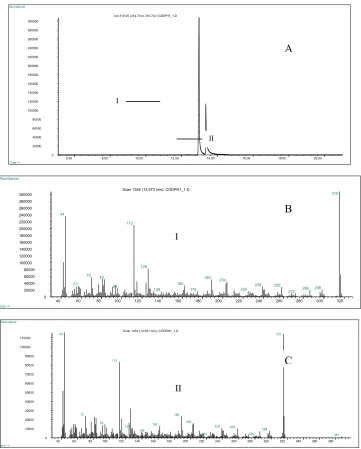
(3) El-ahajBabiker Mohamed et al. Int. Res. J. Pharm. 2013, 4 (7) B: Mass spectrum of codeinone. Abundance Ion 315.00 (314.70 to 315.70): CODPH1_1.D 300000 280000 260000. A. 240000 220000 200000 180000 160000 140000. I. 120000 100000 80000 60000. II. 40000 20000 0. 6.00. 8.00. 10.00. 12.00. 14.00. 16.00. 18.00. 20.00. Time-->. Abundance Scan 1354 (12.973 min): CODPH1_1.D. 315. 300000 280000. B. 260000 44. 240000 220000. 112. 200000. I. 180000 160000 140000 120000 100000. 126. 80000 70. 60000 40000. 83. 57 0. 40. 189 162. 96. 20000 60. 80. 100. 120. 204 239. 139 140. 160. 258. 225. 175 180. 200. 286. 272. 220. 240. 260. 280. 298 300. 320. m/z-->. Abundance Scan 1419 (13.351 min): CODPH1_1.D. 44. 315. 110000 100000. C. 90000 112 80000 70000 60000. II. 50000 40000 30000 70. 189. 20000. 94. 10000. 204. 162. 128. 239. 146. 258. 40. 60. 80. 100. 120. 140. 160. 180. 200. 220. 298 282. 223 0. 240. 260. 280. 387 300. 320. 340. 360. 380. m/z-->. Figure 4: A: Ion chromatogram at m/z 315, obtained from aqueous acidic-pH solution of codeine exposed to sunlight B and C: Mass spectra of compounds I and II as per labels. Abundance. A. Ion 459.00 (458.70 to 459.70): HOCOD_2.D 500000 450000. III. 400000 350000 300000 250000 200000 150000. IV. 100000 50000 0. 6.00. 7.00. 8.00. 9.00. 10.00. 11.00. 12.00. 13.00. 14.00. 15.00. 16.00. 17.00. Time-->. B III. Page 51.
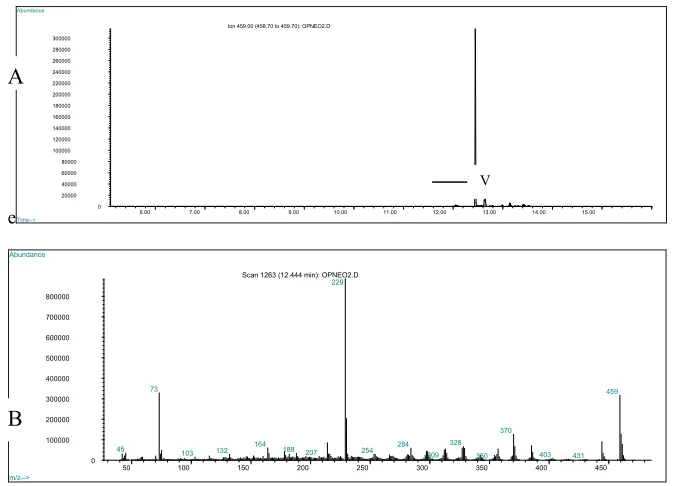
(4) El-ahajBabiker Mohamed et al. Int. Res. J. Pharm. 2013, 4 (7) Abundance Scan 1406 (13.126 min): HOCOD_2.D. 73 600000 550000 500000 450000. 196. 400000 459. 350000 300000 250000 200000 150000 94. 100000. 256. 234 50000 0. 40. 60. 80. 100. 120. 370. 171. 129. 55. 152 140. 160. 180. 200. 220. 260. 280. 431. 342. 294 240. 402. 312. 275. 216. 300. 320. 340. 360. 380. 400. 420. 440. 460. m/z-->. Abundance Scan 1454 (13.400 min): HOCOD_2.D. 73 550000 500000 450000. 196. 400000 350000. 459 300000 250000 200000 150000 100000. 94 256. 234. 50000 0. 129. 55 40. 60. 80. 100. 120. 171. 152 140. 275. 216 160. 180. 200. 220. 240. 260. 280. 300. 402. 370. 312. 431. 342. 294 320. 340. 360. 380. 400. 420. 440. 460. m/z-->. Figure 5: A: Extractedion chromatogram at m/z 459, obtained from aqueous acidic-pH solution of codeine exposed to sunlight B and C: Mass spectra of compounds III and IV as per labels. The GC-MS analysis was carried out after TMS derivatization Abundance Ion 459.00 (458.70 to 459.70): OPNEO2.D 300000 280000. A. 260000 240000 220000 200000 180000 160000 140000 120000 100000 80000 60000. V. 40000 20000. e. 0. 6.00. 7.00. 8.00. 9.00. 10.00. 11.00. 12.00. 13.00. 14.00. 15.00. Time-->. Abundance Scan 1263 (12.444 min): OPNEO2.D 229 800000 700000 600000 500000 400000 73. 459. 300000. B. 200000 370 100000 45 0. 50. 103 100. 164. 132 150. 188. 207 200. 254 250. 328. 284 309 300. 350 350. 403 400. 431 450. m/z-->. Figure 6: A: Extractedion chromatogram at m/z 459, obtained from TMS-derivatized basic-pH extract of opium. B: mass spectrum of the compound V. Page 52.
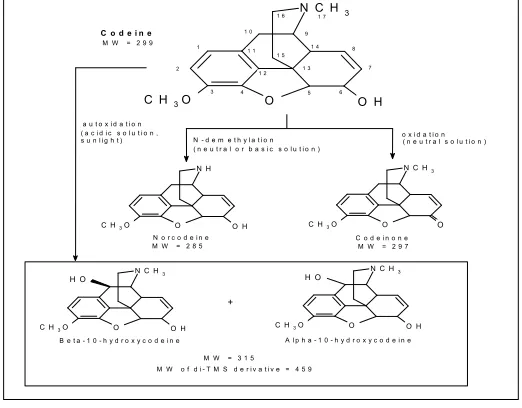
(5) El-ahajBabiker Mohamed et al. Int. Res. J. Pharm. 2013, 4 (7) N C H. 16. C o d e in e M W. = 299. 1. C H. 3. 9 14. 11. 2. O. a u t o x id a t io n ( a c id ic s o lu t io n , s u n lig h t ). 4. 8. 15 7. 13. 12 3. 3. 17. 10. 6. 5. O. O H o x id a t io n ( n e u t r a l s o lu t io n ). N - d e m e t h y la t io n ( n e u t r a l o r b a s ic s o lu t io n ). N C H. N H. C H. 3. O. O. C H. O H. 3. O. N C H. H O. O. O. N o r c o d e in e M W = 285. 3. C o d e in o n e M W = 297. N C H. 3. H O. 3. + C H. 3. O. O. C H. O H. M W M W. 3. O. O. O H. A lp h a - 1 0 - h y d r o x y c o d e in e. B e t a - 1 0 - h y d r o x y c o d e in e = 315. o f d i- T M S d e r iv a t iv e = 4 5 9. Figure 7: Chemical structures of oxidation and autoxidation products of code. RESULTS AND DISCUSSION Codeine In aqueous solution, codeine exhibited different behaviors according to the state of protonation of the molecule, as governed by the pH of the solution, and the presence or absence of photo effects. The results are depicted in Figure 3, 4 and 5. In neutral/basic-pH solutions, exposed to sunlight or kept in the dark, codeine was N-demethylated to norcodeine (Figure 3 and 7), which is a known product of microbial oxidation4,5. In the neutral solution, exposed to light or kept in the dark, codeine was oxidized to codeinone (Figure 3 and 7), which is a known product of chemical andmicrobial 6 oxidation of codeine. Both norcodeine and codeinone have been characterized by database mass spectral libraries. At the end of the reaction time, i.e. 100 hours, the two degradation products were estimated to have been formed in approximately 17% concentrations of that of codeine as measured from peak heights in the corresponding chromatogram (Figure 3). In acidic solutions kept in the dark, codeine did not undergo any change; however, in the acidic solutions exposed to sunlight, it behaved in a different way to the neutral/basic solutions. At the end of the reaction time, i.e. 100 hours, almost all of the codeine was oxidized to a mixture of two hydroxycodeines of identical mass spectra (compounds I and II, Figure 4). The formation of the hydroxycodeines has been judged from: (a) increase of the molecular weight of codeine by 16 (i.e. the atomic weight of oxygen) giving rise to both compounds I and II (Figure 4) and (b) formation of di-trimethylsilyl derivatives of compounds I and II (compounds III and IV respectively, Figure 5). The identical mass spectra of compounds I and II (Figure 4) and of their corresponding TMS derivatives, compounds III and IV (Figure 5) indicate that the two compounds are diastereomeric. Hydroxylation of candidate compounds exposed to light for a long time is an autoxidation reaction7. The role of light is to generate free radicals to which molecular oxygen adds to form hydroperoxides (ROOH), which will react further to give alcohols8. Mechanistically, the two most favoured auto hydroxylation sites in the codeine molecule are the secondary-benzylic C10 and the tertiary allylic C14 (Figure 1) which is due to their high reactivity towards free radical formation. The latter carbon was excluded as the site of hydroxylation in. compounds I and II based on observed differences in the mass spectra: the m/z of the base-peak ions of the TMS derivatives of compounds I and II and that reported for 14hydroxycodeine8 were 196, 196 and 229, respectively. Therefore, compounds I and II could be designated as 10hydroxycodeine formed in two diastereomeric (a and bepimeric) forms (Figure 7). Epimerization is a process that takes place in compounds in aqueous solutions whereby a functional group at a chiral carbon undergoes partial inversion of configuration9. Usually, epimeric forms of a substance in aqueous solution exist in equilibrium10. It may be of interest to note that chemical hydroxylation of codeine by hydrogen peroxide had been reported11 to take place at the aromatic ring; however, the authors did not give evidence of this nor did they specify the position of the hydroxy group. Analytical artifactual formation of the codeine degradation and autoxidation products under the experimental conditions used in this study was ruled out by analyzing fresh solutions of codeine phosphate; none of the degradation products was detected. Furthermore, contrary to previous reports12, none of the degradation products found in this study was an isomer of codeine. Neither norcodeine nor codeinone was detected in syrups of codeine that had been stored in the dark for more than two years suggesting that other ingredients present in the syrups had played an antioxidant role. Although it is unlikely that codeine pharmaceutical preparations will be formulated at the acidic conditions that favor autoxidation in the presence of light, catalysis by excipients may not be completely ruled out and should be investigated. Opium As early as 1911, opium was reported to contain a hydroxycodeine13. The data shown in Figure 6 confirm this and almost certainly indicate the presence of 14hydroxycodeine upon comparing the mass spectrum with that reported in the literature8. Since position 14 in opium is allylic and represents an active site for autoxidation, 14hydroxycodeine in opium may be an autoxidation product the formation of which is influenced by the natural matrix of opium. Generally, the processing of opium involves, in its early stages, sun drying of the latex, which is an aqueous suspension. Page 53.
(6) El-ahajBabiker Mohamed et al. Int. Res. J. Pharm. 2013, 4 (7) Morphine As a matter of interest, the same experiments performed with codeine were repeated with morphine. No oxidation products of morphine analogous to those of codeine found in this work were detected for morphine. CONCLUSION Light and pH of aqueous solutions are two important parameters to consider in stability investigations of medicinal substances in their pharmaceutical preparations and processed natural sources. Generally, the presence of compounds with antioxidant properties will help avert oxidation and autoxidation of pharmacologically active ingredients in pharmaceutical dosage forms and natural products. It is recommended that stability studies should involve investigations of antioxidants with the aim of their inclusion in pharmaceutical formulations of the subject substance. The dependence of the chemical nature of degradation of a compound on the state of protonation of the molecule in aqueous solution is an interesting subject for exploration. REFERENCES 1. Sweetman S. Martindale: The Complete Drug Reference. 33rd ed. Sweetman SC, the Pharmaceutical Press, London; 2002. p. 25 2. Al Amri AM. Marker compounds in urine for opiate product use. A Doctoral thesis, Department of Chemistry, Loughborough University, England; 2004. 3. Thomas N. Encyclopedia of alcohol and drug abuse. Brown Walker Press, Parkland, Florida, USA; 2002. 4. Garrido JMPJ, Delerue Matos C, Borges F, Macedo TRA, Oliveira Brett AM. Voltammetric Oxidation of Drugs of Abuse II Codeine and. 5.. 6. 7.. 8. 9.. 10.. 11.. 12. 13.. Metabolites. Electroanalysis 2004; 16(17): 1427-1433. http://dx.doi.org/ 10.1002/elan.200302967 Long MT, Hailes AM, Kirby GW, Bruce NC. Transformation of morphine alkaloids by Pseudomonas putida M10. Applied and Environmental Microbiology 1995; 61(10): 3645-3549. PMid:7487001 PMCid:PMC167664 Findlay SP, Small LF. The preparation and properties of codeinone. J Am Chem Soc 1950; 3247. http://dx.doi.org/10.1021/ja01163a126 Kunz DA, Reddy GS, VatvarsA. Identification of transformation products arising from bacterial oxidation of codeine by Strepromyce sgriseus. Applied and Environmental Microbiology 1985; 831-836. PMid:3936418 PMCid:PMC291756 Smith MB, March J. March’s Advanced Chemistry, Reactions, Mechanisms and Structure. 5thed, John Wiley and Sons, Inc., New York; 2000. p. 770-773 PMid:11147435 Bruce NC, Wilmot CJ, Jordan KN, Stephens LD, Lowe CR. Microbial degradation of the morphine alkaloids. Purification and characterization of morphine dehydrogenase from Pseudomonas putida M10. Biochem J 1991; 274: 875-80. PMid:2012614 PMCid:PMC1149991 Cerami J, Gala D, Hou D, Kalliney S, Mas JL, Nyce P, Peer L, Wu G. Dilevalol via resin-mediated epimerization: A case study. Reaction mechanism to reactor design to a viable process. Org Proc Res Dev 2000; 4: 107-121. http://dx.doi.org/10.1021/op990185y Tanaka R, Iio S, Chinaka N, Takayama KH. Analysis of reaction products of morphine and codeine with hydrogen peroxide by high performance liquid chromatography/mass spectrometry. Analytical Science 2003; 19: 163-165. http://dx.doi.org/10.2116/analsci.19.163 PMid:12558043 Gundermann P, Pohloudek Fabini R. Analysis and the stability of codeine Phosphate. Pharmazie 1983; 38: 92-94. PMid:6856666 Opium, B.P. in the British Pharmaceutical Codex, The British Pharmaceutical Society of Great Britain, London, 1911. www.ibiblio.org/herbmed/electric/bpc1911/papaver.html. Cite this article as: El-ahajBabiker Mohamed, ShehabNaglaa Ahmed and Ali Heyam Saad. Stability of codeine: Characterization of oxidation products of codeine formed in aqueous solution. Int. Res. J. Pharm. 2013; 4(7):49-54 http://dx.doi.org/10.7897/2230-8407.04711. Source of support: Nil, Conflict of interest: None Declared. Page 54.
(7)
Figure
Related documents
Systolic is the top number and it represents the maximum pressure in your arteries as your heart contracts to pump blood to the body from the left ventricle of your heart..
Furthermore, the Public Service Commission (2007:6-10) stated that the concept of implementing income generating projects and developing SMMEs for poverty alleviation
The emission limits in MACT Subpart EEE will be removed from the permit when the facility submits a Title V air quality permit application pursuant to 15A NCAC 2Q .0504 for the
Trade facilitation interventions include trade policy and regulation support, trade-related infrastructure support and trade development but do not include
Joseph (San Giuseppe) for preventing a famine in Sicily during the Middle Ages. According to legend, there was a severe drought at the time, and the people prayed for their
Tujuan guru meminta siswa membuat Mind Map yaitu sebagai pendukung pengembangan kemampuan berpikir analitis siswa melalui penerapan model PBL dalam menemukan dan
At first step, we study the long range dependence in different exchange rates including the developed, developing and emerging countries in a wider sense of long memory
Classification with the use of VMCM in terms of assessing the friendliness of EU countries for newly established enterprises (for real pattern – Denmark and Malta as anti-pattern)
