University of Pennsylvania
ScholarlyCommons
Publicly Accessible Penn Dissertations
1-1-2015
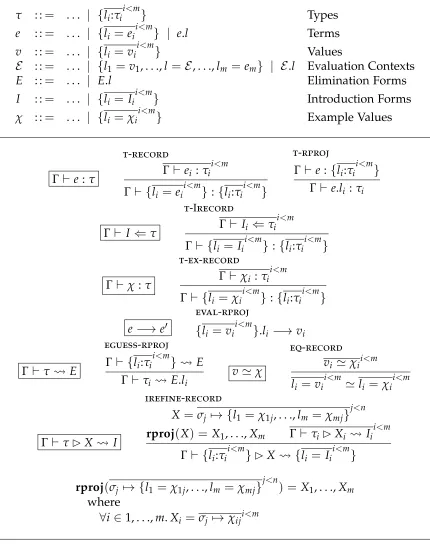
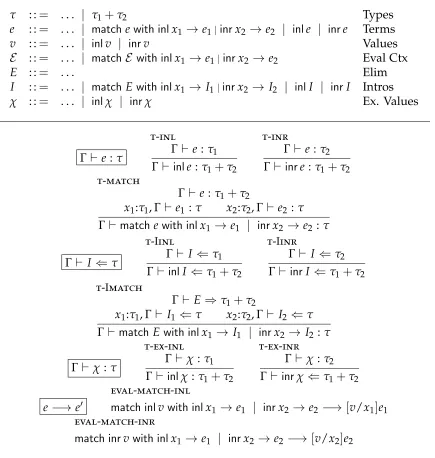
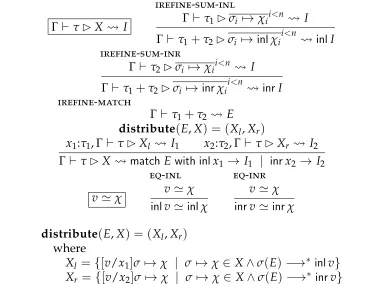
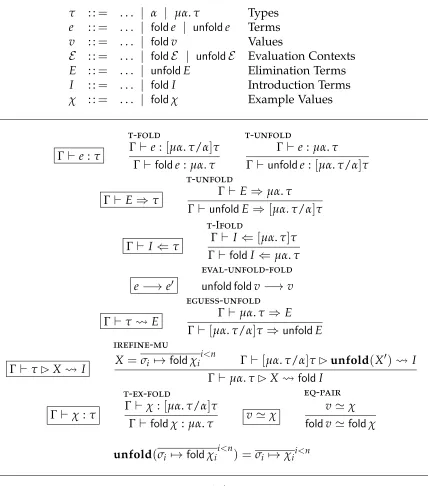
Program Synthesis With Types
Peter-Michael Santos Osera
University of Pennsylvania, [email protected]
Follow this and additional works at:http://repository.upenn.edu/edissertations
Part of theComputer Sciences Commons
This paper is posted at ScholarlyCommons.http://repository.upenn.edu/edissertations/1926
For more information, please [email protected].
Recommended Citation
Osera, Peter-Michael Santos, "Program Synthesis With Types" (2015).Publicly Accessible Penn Dissertations. 1926.
Program Synthesis With Types
Abstract
Program synthesis, the automatic generation of programs from specification, promises to fundamentally change the way that we build software. By using synthesis tools, we can greatly speed up the time it takes to build complex software artifacts as well as construct programs that are automatically correct by virtue of the synthesis process. Studied since the 70s, researchers have applied techniques from many different sub-fields of computer science to solve the program synthesis problem in a variety of domains and contexts. However, one domain that has been less explored than others is the domain of typed, functional programs. This is
unfortunate because programs in richly-typed languages like OCaml and Haskell are known for ``writing themselves'' once the programmer gets the types correct. In light of this observation, can we use type theory to build more expressive and efficient type-directed synthesis systems for this domain of programs? This dissertation answers this question in the affirmative by building novel type-theoretic foundations for program synthesis. By using type theory as the basis of study for program synthesis, we are able to build core synthesis calculi for typed, functional programs, analyze the calculi's meta-theoretic properties, and extend these calculi to handle increasingly richer types and language features. In addition to these foundations, we also present an implementation of these synthesis systems, Myth, that demonstrates the effectiveness of program synthesis with types on real-world code.
Degree Type
Dissertation
Degree Name
Doctor of Philosophy (PhD)
Graduate Group
Computer and Information Science
First Advisor
Steve Zdancewic
Keywords
Programming Languages, Program Synthesis, Proof Search, Type Theory
Subject Categories
PROGRAM SYNTHESIS WITH TYPES
Peter-Michael Osera
A DISSERTATION
in
Computer and Information Science
Presented to the Faculties of the University of Pennsylvania
in
Partial Fulfillment of the Requirements for the
Degree of Doctor of Philosophy
2015
Supervisor of Dissertation
Steve Zdancewic Professor of CIS
Graduate Group Chairperson
Lyle Ungar Professor of CIS
Dissertation Committee
Stephanie Weirich (Professor of CIS, Committee Chair)
Benjamin Pierce (Professor of CIS)
Rajeev Alur (Professor of CIS)
PROGRAM SYNTHESIS WITH TYPES
COPYRIGHT
2015
Peter-Michael Osera
This work is licensed under a Creative Commons Attribution 4.0 International License. To view a copy of this license, visit
Acknowledgements
A dissertation is a long journey, but it is one not treaded alone (contrary to what the front page of this document says). I am greatly indebted to every person that has helped me along the way. Every professor, student, software developer, and colleague that I have interacted with has taught, guided, and challenged me in some way to become a better computer scientist. Without their assistance, this dissertation would have never seen the light of day.
However, several people deserve special mention. First, my deepest thanks go out to my advisor, Steve Zdancewic, for his guidance and insight over the last seven years. In addition to giving me the freedom to pursue whatever research I found interesting, he has been an excellent mentor and friend throughout this whole process. Whether it was a paper deadline, the academic job market, scheming new ways to improve the undergraduate curriculum, or identifying the best TV shows for our young daughters to watch, he has always been there to help me out whenever I needed it.
I also thank the remaining professors that make up the PLClub research group— Stephanie Weirich and Benjamin Pierce. In addition to the advice and encourage-ment that they have given me, they are responsible for maintaining the excellent quality of life within the group. Starting graduate school with a newborn in tow was an absolutely terrifying prospect, one that I would not have managed if the programming languages research group at Penn was not as warm, inviting, and caring (on top of being rigorous and hard-working) as it has been during my stay.
Related, I thank all the graduate students, post-docs, and undergraduates that have been a part of PLClub while I was at Penn, including: Nate Foster, Jeff Vaughan, Aaron Bohannon, Karl Mazurak, Jianzhou Zhao, Michael Greenberg, Chris Casinghino, Richard Eisenberg, Hongbo (Bob) Zhang, Arthur Azevedo de Amorim, Justin Hsu, Leonidas Lambropoulos, Jennifer Paykin, Robert Rand, Antal Spector-Zabusky, and Dmitri Garbuzov.1 You have all been a constant source of information, inspiration, and motivation. I also especially thank the members of my research cohort—Daniel Wagner, Brent Yorgey, and Vilhelm Sjöberg—for being amazing human beings and friends. We made it, guys!
I have been honored to collaborate with some amazing people whose feedback
and input were instrumental in making this particular line of work on program synthesis as high quality as it could be. Thank you David Walker, Jonathan Frankle, and Rohan Shah for all the hours of brainstorming, idea-batting, and work you have put into this project.
Even though this dissertation is about program synthesis with types, I consider myself a computer science educator as much as I consider myself a programming languages theorist. Thank you Chris Murphy, Swapneel Sheth, Arvind Bhusnur-math, Benedict Brown, Katie Gibson, and Lili Dworkin, among others, for being my CS education outlet at Penn.
I thank my family for their love and support throughout this process. The road to a dissertation is every bit emotional as it is intellectual, and I could not have kept it together without them. Thank you to my wife and dearest friend, Victoria, for moving out with me to the East coast—away from all the friends and family we have ever known—to pursue this dream. And thank you to my kids—Talia and Felicity, and soon-to-be, Eliana and Selena—for your love, patience, and understanding while daddy was away at work for so long to finish writing his book. This dissertation, as well as everything else I do, is dedicated to you all—always.
Finally, my work at Penn has been supported by a pair of grants that I would like to acknowledge:
• NSF Award CCF-1138996—Expeditions in Computer Augmented Program Engineering: ExCAPE: Harnessing Synthesis for Software Design.
ABSTRACT
PROGRAM SYNTHESIS WITH TYPES
Peter-Michael Osera
Steve Zdancewic
Program synthesis, the automatic generation of programs from specification,
promises to fundamentally change the way that we build software. By using
syn-thesis tools, we can greatly speed up the time it takes to build complex software
artifacts as well as construct programs that are automatically correct by virtue of
the synthesis process. Studied since the 70s, researchers have applied techniques
from many different sub-fields of computer science to solve the program synthesis
problem in a variety of domains and contexts. However, one domain that has been
less explored than others is the domain of typed, functional programs. This is
unfortunate because programs in richly-typed languages like OCaml and Haskell
are known for “writing themselves” once the programmer gets the types correct.
In light of this observation, can we use type theory to build more expressive and
efficient type-directed synthesis systems for this domain of programs? This
dis-sertation answers this question in the affirmative by building novel type-theoretic
foundations for program synthesis. By using type theory as the basis of study for
program synthesis, we are able to build core synthesis calculi for typed, functional
programs, analyze the calculi’s meta-theoretic properties, and extend these calculi
to handle increasingly richer types and language features. In addition to these
foundations, we also present an implementation of these synthesis systems, Myth,
that demonstrates the effectiveness of program synthesis with types on real-world
Contents
1 Introduction 1
1.1 The Landscape of Program Synthesis . . . 3
1.1.1 Methodologies . . . 4
1.2 Program Synthesis With Types . . . 7
1.2.1 Foundations . . . 8
1.2.2 Metatheory . . . 9
1.2.3 Implementation . . . 9
1.2.4 Statement of Contributions . . . 9
2 A Simple Synthesis Calculus 11 2.1 Generatingλ-terms . . . 11
2.1.1 Enumerating Normal Forms . . . 15
2.2 Specifyingλ-terms . . . 16
2.2.1 Examples as Specification . . . 17
2.2.2 Example Specification inλ→ . . . 18
2.3 λsyn: A Program Synthesis Calculus . . . 19
2.3.1 Integrating Search and Specification . . . 19
2.3.2 Introducingλsyn . . . 22
2.3.3 Example Worlds . . . 22
2.3.4 Synthesis inλ→syn . . . 23
2.3.5 Synthesis Examples . . . 26
2.4 Related Work . . . 29
2.4.1 Example Refinement . . . 29
2.4.2 Forwards and Backwards Search . . . 30
2.4.3 Type-directed Synthesis Systems . . . 31
3 The Metatheory ofλ→syn 32 3.1 Soundness . . . 32
3.2 Completeness . . . 35
4 Simple Type Extensions 39 4.1 Products . . . 39
4.2 Records . . . 44
4.2.1 Subtyping and Synthesis . . . 46
4.3 Sums . . . 48
4.3.1 Example: Boolean Operators . . . 51
4.3.2 Efficiency of Sums . . . 53
4.4 Let Binding . . . 55
5 Recursion 56 5.1 µ-types . . . 56
5.1.1 Non-determinism . . . 58
5.2 A Functional Synthesis Programming Language . . . 59
5.2.1 Static and Dynamic Semantics of MLsyn . . . 61
5.2.2 Synthesis in MLsyn . . . 67
5.2.3 Structural Recursion in Synthesis . . . 71
5.3 Examples in MLsyn . . . 72
5.3.1 Specification for Multi-argument Functions . . . 72
5.3.2 Example: TheAndFunction . . . 73
5.3.3 Example: TheStutterFunction . . . 74
5.3.4 Trace Completeness . . . 77
5.4 Related Work . . . 79
5.4.1 Example Rewriting . . . 79
5.4.2 Examples and Generalization . . . 80
6 The Metatheory of MLsyn 81 6.1 Auxiliary Lemmas . . . 81
6.2 Soundness . . . 83
6.3 Completeness . . . 85
6.3.1 Partial Functions Approximating Recursive Behavior . . . 85
6.3.2 Partial Functions as Values . . . 86
7 Implementation 88 7.1 Synthesis Trees . . . 88
7.2 Collection Semantics . . . 90
7.2.1 The Minimum Program Principle . . . 94
7.2.2 Restricting the Search Space with Examples . . . 95
7.3 Optimizing The Synthesis Procedure . . . 97
7.3.1 Invertible Rules . . . 97
7.3.2 Reigning in Matches . . . 98
7.3.3 Refinement Trees . . . 103
8 Evaluating Myth 115
8.1 Search Parameter Tuning . . . 116
8.1.1 Search Strategy . . . 118
8.2 Example Development . . . 119
8.3 Benchmark Suite . . . 122
8.3.1 Analysis . . . 124
8.3.2 Context Size and Performance . . . 129
8.4 Extended Examples . . . 132
9 Polymorphism 138 9.1 From System F to Polymorphic Program Synthesis . . . 139
9.2 Synthesizing Type Applications . . . 140
9.3 Examples for Polymorphic Values . . . 141
9.3.1 Polymorphic Constants . . . 141
9.3.2 Polymorphic Instances . . . 145
9.4 The Metatheory of Polymorphism . . . 147
10 Conclusion 149 10.1 Future Directions . . . 150
10.1.1 Synthesis with Richer Types . . . 150
10.1.2 Additional Specification . . . 152
10.1.3 Enumeration Modulo Equivalences . . . 154
10.1.4 Applications of Program Synthesis with Types . . . 155
A The Implementation of Myth 157 B The Myth Test Suite 162 B.1 Contexts . . . 162
B.2 Benchmark Suite . . . 164
List of Figures
2.1 λ→ definition . . . 12
2.2 Closedλ-term counts . . . 13
2.3 λ→ typed term generation . . . 14
2.4 λ→ typed normal-form term generation . . . 16
2.5 λ→syn syntax and typechecking . . . 21
2.6 λ→syn synthesis and equivalence . . . 23
4.1 λ→syn products . . . 40
4.2 λ→syn records definitions . . . 45
4.3 λ→syn sums definitions . . . 47
4.4 λ→syn sums: synthesis rules . . . 49
5.1 λ→syn µ types . . . 57
5.2 MLsyn syntax . . . 60
5.3 MLsyn external language type checking . . . 62
5.4 MLsyn internal language type checking . . . 63
5.5 MLsyn evaluation and compatibility rules . . . 66
5.6 MLsyn synthesis . . . 67
5.7 MLsyn synthesis auxiliary functions . . . 68
7.1 Example synthesis tree . . . 89
7.2 MLsyn collection semantics . . . 92
7.3 MLsyn term generation . . . 93
7.4 MLsyn raw-term collection semantics . . . 103
7.5 Example refinement tree . . . 106
7.6 MLsyn refinement tree creation . . . 107
7.7 Relevant E-term generation . . . 112
7.8 Relevant I-term generation . . . 113
8.1 Example Mythprogram: stutter . . . 119
8.2 Mythbenchmark suite performance results . . . 125
8.3 Mythbenchmark suite graphs—counts . . . 126
8.4 Mythbenchmark suite timing graph . . . 128
8.6 Mythbenchmark suite performance results in context . . . 130
8.7 Mythbenchmark suite graphs in context . . . 131
8.8 Mythextended examples results . . . 132
9.1 λ∀syn syntax and typechecking . . . 139
9.2 λ∀syn synthesis rules . . . 143
A.1 Refinement tree creation and E-guessing . . . 159
A.2 Relevant E-term generation . . . 160
Chapter 1
Introduction
Type systems are the most ubiquitous form of formal verification tool present in programming languages today. They provide a number of important benefits for programmers, for example, static checking of errors and opportunities for opti-mizations. However, one of the most often overlooked benefits is that type systems also help programmers design programs more efficiently. In particular, typed, functional programming languages like ML and Haskell provide a compelling combination of rich types coupled with a succinct, yet powerful set of languages features. Programmers that use these languages frequently comment that once they figure out the types of their program, the program just writes itself!
Let’s investigate this point in more detail. Consider writing a simple program, say themapfunction over lists, in a ML-like language. First, let’s establish the type of the overall function: map is a higher-order function that takes (1) a function that transforms a single element of a list into some other type, (2) a list of the first type, and produces a list of the second type. This means thatmap has type
(0a →0b)→0alist→0blistwhere 0alistis ML’s way of writing down apolymorphic orgenericlist. Here,0ais a type variable that represents the type of elements of that list, itscarrier type. Now, let’s develop this function incrementally in atype-directed manner by keeping close track of the types of expressions we need to fill in at each point of the program. Initially, we have the following goal,
: (0a→0b) →0alist →0blist,
where represents our goal—the hole in the program we need to fill with an expression. Because the hole is at arrow type, it makes sense to introduce a function:
let rec map (f:0a→0b)(l:0alist) : 0blist =: 0blist.
constructing a non-empty0blist. The only other value we can provide is the empty list which means mapwould produce the empty list for any pair of inputs which is not correct. We need more information to make progress, and we obtain that information by pattern matching:
let rec map(f:0a →0b)(l:0alist): 0blist=
match lwith
| Nil→: 0blist
| Cons(x,l0) →: 0blist.
By pattern matching, we perform case analysis on some value. In this case, we know that a list in ML has two possibleconstructors or ways of making a value of typelist: Nilrepresenting the empty list andConsrepresenting the list composed of a single element xfollowed by the rest of the list l0. We are left with two goal expressions to fill in, both of type 0blist, corresponding to the branches of the pattern match.
In the Nil branch, we know the input l is the empty list at this point in the program, so it is sensible to produce the empty list. In the Consbranch, we know that the listhas at least one element x of type0alistand we have a handle on the rest of the listl0. With x, we now have a way of manufacturing a 0blist: applying x to f. With this, we can transform the head of list l and the cons that onto the result of recursively mapping over the tail ofl. Thus, the final program is:
let rec length(l:list) :nat=
matchl with
| Nil→Nil
| Cons(x,l0) →Cons(f x,mapl0).
At the end, we needed some ingenuity to recognize how to break down the mapping operation over a list in terms of its components. However, we can see how types guided our development process by constraining the allowable set of programs at different points of the program. The question is simple: can we automate this sort of type-directed reasoning? Given a type, and perhaps some additional specification of how a program should behave, can we derive a program of the appropriate type that meets this specification?
2015; Kitzelmann, 2010b; Summers, 1976], and partial programs [Alur et al., 2013; Singh et al., 2013; Solar-Lezama, 2008], among others. Regardless of the mode of specification we choose, the search and specification components of synthesis frequently inform each other; specification helps refine the space of possible programs, making search tractable, and different search techniques are more amendable to particular kinds of specification.
As you can imagine, program synthesis is a very difficult problem—we are still writing programs by hand, after all—and undecidable in the general case. However, it is worth pursuing because the benefits of program synthesis technology are immense. By synthesizing a program from a specification, we guarantee that the program agrees with that specification by virtue of the synthesis process. If that specification includes properties such as correctness or safety, then the program will enjoy those properties automatically. Furthermore, it is often easier to write down a specification of how a program should work than to write the program itself, especially if that specification is partial, for example, a collection of input/output examples or a demonstration of how the program should work. Program synthesis then becomes a tool that makes the power of computer programs more accessible to people, especially non-programmers, who can signify their intent, but do not know how to translate that intent into a program. Finally, because computer programs are general-purpose, synthesizing programs means synthesizing methods of solving any task we can express as a program. This might mean deriving a complex program to determine the trajectory of a rocket or simply automating the task of entering data into a spreadsheet [Gulwani, 2011].
In this work, we develop atype-theoretic interpretationof program synthesis. Type theory [Martin-Löf, 1984] provides a constructive foundation for all of mathematics. Programming language researchers leverage these foundations through the Curry-Howard Isomorphism [Curry-Howard, 1980] which equates proofs of propositions with programs of some type. By studying program synthesis through the lens of type theory, we hope to bring to bear the large body of work on type systems and proof search onto the program synthesis problem to enable efficient synthesis of typed, functional programs.
1.1
The Landscape of Program Synthesis
have all been applied to the program synthesis. Today, the field has seen a large resurgence in interest due to a number of factors:
1. General computational power has increased at an exponential rate over the last four decades. [Moore, 1965]
2. The rise of domain-specific languages, and more targeted programming domains such as protocols [Alur et al., 2005; Udupa et al., 2013], concurrent programs [Prountzos et al., 2012; Solar-Lezama et al., 2008; ˇCerný et al., 2011], education [Singh et al., 2013], and strings and spreadsheets [Gulwani, 2011] has given synthesis tools smaller, more tractable domains to operate over.
3. Related to the first point, the rise of sophisticated solver technology, in particular SAT and SMT solvers [Barrett et al., 2008] have helped make once intractable problems of search more feasible in practice.
Here we briefly survey the field of program synthesis1 to get a sense of what approaches have been previously studied and how they contrast with our own type-theoretic style. We defer discussion of how these approaches contrast with our own until after we present the details of how our type-directed program synthesis systems operate in the presence of various types (Section 2.4 and Section 5.4).
1.1.1
Methodologies
AI and Logic-based Techniques The earliest methods for program synthesis were developed from the automated theorem proving community. These re-searchers were motivated by the promise of generating programs from specifica-tions that were provably correct by virtue of being derived from specification. Some methods used techniques lifted from early automated theorem prover technology, such as Green’s resolution-based QA3 system, to translate programs from logical specification [Green, 1969]. These specifications took the form of complete axiomi-tizations of the problem space in first-order logic solved using resolution-based proof search techniques. Others took to direct rewriting tactics over the specifica-tion, for example, Manna and Waldinger’s Deadalussystem which rewrote logical specification [Manna and Waldinger, 1979] and Summers’s Thesyssystem which rewrote examples [Summers, 1976]. Later, efforts from researchers such as Manna and Waldinger sought to unify the use of provers and transformation rules [Manna and Waldinger, 1980]. Because all of these early works were rooted within theorem proving, the target language for synthesis was universally (a purely functional subset of) Lisp.
These methods were technically innovative, but ultimately lacked in practicality. In particular, the logical specifications demanded by these tools were far removed from the reasoning styles that programmers understood. They were also highly constrained in the sorts of program symbols they were allowed to utilize. Finally, they were extremely heavyweight and did not scale past anything but the smallest of example programs [Kreitz, 1998].
Regardless, Thesys is particularly note worthy in that it is one of the first
inductive programming synthesis systems [Kitzelmann, 2010a] where it is able to generate programs in the presence of partial specification such as examples. Examples form a partial specification because most programs of interest have an infinite range and a finite set of concrete examples can only specify a finite subset of that range. More modern systems such as Igor2 have evolved from this line of work, and have overcome many of issues listed above [Hofmann et al., 2010; Kitzelmann, 2010b]. Igor2 uses a combination of examples, background knowledge, and program schemes—program skeletons that capture recurring patterns of program behavior such as folds or maps—to derive target functions by discovering patterns in the examples and deriving a set of recursive rules for generating them.
In contrast, other inductive programming systems do not perform manipulation of the examples directly. Rather they employ aguess-and-checkapproach where they enumerate candidate programs and evaluate them to verify that they satisfy the examples. For example Katayama’s MagicHaskeller [Katayama, 2012] enumer-ates programs according to a set of logical rules and permitted components and evaluates them against user-provided input/output examples. And Albarghouthi’s Escher[Albarghouthi et al., 2013] builds up increasingly complicated components from atoms (i.e., variables and constants) and tests whether those atoms satisfy the examples. Notably, when the system requires additional examples, such as when it evaluates a recursive function call, Escherqueries the user to provide additional examples. LaSy [Perelman et al., 2014] provides an example-driven framework for synthesizing programs in expert-written domain-specific languages. Finally, Feser’s λ2system [Feser et al., 2015] also enumerates programs and checks them against examples. However, unlike previous efforts, they refineexamples as they synthesize expressions, producing new examples appropriate for synthesizing the sub-expressions of this overall expression. Notably, these final approaches blur the line between the AI/logical tradition of program synthesis born from the original literature from the 70s and the more modern verification-based tradition that we see today.2
Note that while not directly related to program synthesis, because they explore the search space of programs through term enumeration, these guess-and-check
inductive programming approaches share many concerns with automatic test gener-ation[Claessen et al., 2014; Grygiel and Lescanne, 2013; Rodriguez Yakushev and Jeuring, 2010]. In particular when enumerating terms, we want to avoid generating redundant or otherwise unnecessary terms, in particular, terms that are equivalent to previously generated terms.
Machine Learning Techniques Bridging the gap between logic and machine learning areinductive logic programming(ILP) [Muggleton and Raedt, 1994] tech-niques that apply machine learning to problems expressed in first-order logic,i.e., Prolog programs. Inductive logic programming is an umbrella term representing an entire sub-field of machine learning that employs this methodology for solving learning-based problems.Researchers that study inductive logic programming synthesis [Flener and Yilmaz, 1999] apply these techniques specifically to program synthesis. For example, Sankaranarayanan et al. [2008] use ILP to mine library specifications by running unit tests on a library to gather information about the operations of the library. This information is then processed using ILP to produce Prolog specifications of the library’s behavior.
Other approaches rooted in machine learning have been applied to program synthesis as well. For example, genetic programming techniques have been used by Briggs and O’Neill [2008] to synthesize combinator expressions in a typed, functional programming language and by Weimer et al. [2009] to automatically locate bugs and derive patches in legacy C code. Gulwani and Jojic [2007] used probabilistic inference to synthesize imperative programs from input/output examples. And finally, Lau [2001] in her thesis developed version space algebras to synthesize text editor macros from examples—here, demonstrations by the user of the text macro they intended for the system to synthesize.
Verification-based Techniques The most recent efforts in program synthesis lie in the programming languages community. In particular, as off-the-shelf SAT and SMT solver technology like the Z3 theorem prover [De Moura and Björner, 2008] rapidly matured over the last decade, the verification community has been quick to take advantage of their power. With respect to program synthesis, this means transforming the specification given by the user into a series of constraints that can be discharged by the solver. The output of the solver can then be used to guide the search process accordingly.
that uses solver technology in synthesis includes Bodik et al. [2010]’s work to support incremental program develop with holes and examples, called angelic nondeterminismand Torlak’s Rosettewhich supports the development of solver-aided domain specific languages [Torlak and Bodik, 2014].
In many of these situations, we can refine the problem domain sufficiently that we can restrict the syntax of allowed programs to a small subset, an approach calledsyntax-guided synthesis [Alur et al., 2013]. For example, Singh et al. [2013] use this approach in the context of generating automatic feedback for introductory programs. The restricted syntax, provided by an instructor using their system, captures the likely set of mistakes that a student might make on an assignment. Gulwani [2011] also use a restricted synthesis domain to capture string processing behavior. This synthesis technology is used, in turn, to implement the FlashFill feature of Microsoft Excel.
In addition to satisfiability solvers, other verification technology has been re-appropriated for the purposes of program synthesis. In particular, techniques that leverage types, the focus of this dissertation, have been explored to some degree. For example Djinn[Augustsson, 2004] synthesizes Haskell programs from highly refined type signatures. Prospector [Mandelin et al., 2005], Perelman’s auto-completion tool for C# programs [Perelman et al., 2012], and InSynth [Gvero et al., 2013] all leverage types to accomplish code auto-completion. Most recently, λ2 [Feser et al., 2015] uses types to refine the input/output examples that they receive, and Scherer and Rèmy [2015] phrase program synthesis in terms of type inhabitation.
1.2
Program Synthesis With Types
From Section 1.1, we see that a multitude of approaches to program synthesis have been previously explored, each with their own strengths and weaknesses. However, no single system has the combination of features necessary to fully capture the type-directed programming style that motivated our journey into program synthesis to begin with. In particular, this style requires support for higher-order functions, recursive functions, and algebraic data types. Many of the prior systems focus on languages that do not support one of more of these features as they are based on variants of Lisp, C, or Java. Furthermore, many of the systems that use solver technology are not capable of handling higher-order and/or recursive data as these solvers work over first-order logics. Of the systems that most closely target this space of language features:
• Escher [Albarghouthi et al., 2013] synthesizes recursive functions using input/output examples, but in a Lisp-like untyped setting.
but they cannot handle higher-order functions. In particular, Leon’s reliance on solver technology keeps them from handling higher-order functions. Igor2 allows for usage of higher-order function components but it does not appear to synthesize functions that take higher-order functions as arguments.
• λ2[Feser et al., 2015] synthesizes recursive functions over algebraic data types using input/output examples. However, is is entirely component driven—λ2 only synthesizes the composition of function applications efficiently—and cannot pattern match over algebraic data types.
Furthermore, it is not clear whether any of these systems scale up to richer type systems such as linear types [Girard, 1987], refinement types [Freeman and Pfenning, 1991], and dependent types [Martin-Löf, 1984].
1.2.1
Foundations
To address these concerns, we create a theoretical foundation for program synthesis using types. With this foundation, we answer several key questions:
• How can we take advantage of rich types in order to prune the search space of possible programs?
• How can we use types to incremental refine the specification provided by the user in step with the program that we synthesize?
• What are the meta-theoretic properties of synthesis systems based on types? In particular, are they sound and complete?
The basis of our foundation is a technique for transforming a programming language’s type system into a type-directed, example-powered program synthesis system for that language. This transformation allows us to gain immediate insight into how to synthesize programs and refine examples of particular types. In some cases, this insight alone is sufficient to integrate a new type into our synthesis systems; in others, we must address additional issues that arise when synthesizing programs of these types.
1.2.2
Metatheory
We use our core calculi—λ→syn, MLsyn, andλ∀syn—to study the meta-theoretic prop-erties of program synthesis with types. In particular, we are concerned with two key properties of synthesis systems:
• Soundness: does the synthesized program obey our input specification? • Completeness: can we synthesize all programs?
We first study the soundness and completeness ofλ→synin full detail (Chapter 3). By doing so, we extract the key lemmas that we must prove to show that soundness and completeness holds of the whole synthesis calculus. We then prove these lemmas for our simple extensions to λ→syn (Chapter 4) as well as polymorphism (Chapter 9). MLsyn proves to be much more complex due to recursion, so we also investigate its metatheory in full detail (Chapter 6).
1.2.3
Implementation
The synthesis calculi we develop in our work give us a basic understanding of the design and behavior of type-directed synthesis systems, but they are not practical synthesis algorithms as-is because they are both unoptimized and highly non-deterministic. Consequently, in addition to understanding type-directed program synthesis from a theoretical perspective, we would like to know empirically how these systems behave on real-world examples.
To do this, we take the calculus closest to a real-world typed, functional pro-gramming language, MLsyn, and transform it into an actual program synthesizer, Myth, for a core subset of the OCaml programming language (Chapter 7). Because our program synthesizer is type-theoretic, we are able to adapt several proof search techniques for our domain—various caching schemes and search pruning heuristics—to greatly optimize the synthesis procedure. Furthermore, thanks to our theoretical foundations, we are able to analyze the impact of these optimiza-tions on the soundness and completeness of our system. Finally, we evaluate Myth’s effectiveness on a benchmark suite of functional programs and explore Myth’s behavior on these examples (Chapter 8).
1.2.4
Statement of Contributions
Chapter 2
A Simple Synthesis Calculus
Program synthesis is an undecidable problem, so when building practical synthesis tools, we must resort to approximations and heuristics to not only make the problem solvable, but also tractable. However, this reality is frequently at odds with building a system that is understandable, as the approximations and heuristics frequently bleed together so that their individual contributions are not clear. Ideally, we would like to build synthesis systems in such a way that we know precisely the impact of each feature and design choice. For example, does ruling out a certain class of programs impact the completeness of the synthesis algorithm? If so, are these programs relevant or are they safe to ignore for practical purposes?
To this end, we begin by constructing a theoretical foundation for program synthesis with types. In typical programming language theory style, we strip away everything but the essential components of typed, functional programming languages by starting with the simply-typed lambda calculus, λ→. Fromλ→, we build a generator for well-typedλ-terms and then integrate a notion of specification into the system to create a program synthesis calculus,λ→syn.
λ→synitself is far removed from a usable implementation of a program synthesizer. However, it allows us to deeply study how to synthesize programs with types, and the procedure’s meta-theoretic properties. For example, the synthesis judgment of λ→syn is sound and complete with respect to synthesis. In successive chapters, we evolve λ→syn into a practical program synthesizer for ML-like programs, sacrificing some of these properties to handle advanced types and gain efficiency.
2.1
Generating
λ
-terms
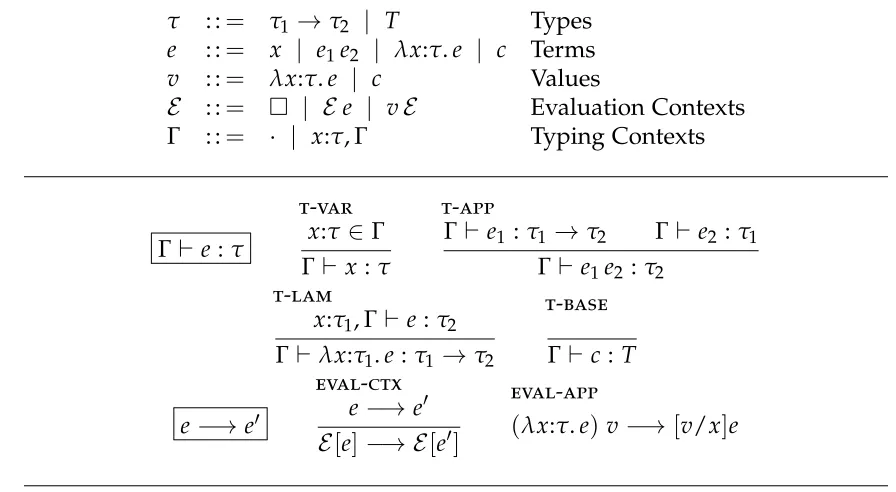
τ : := τ1 →τ2 | T Types e : := x | e1e2 | λx:τ.e | c Terms v : := λx:τ.e | c Values
E : := | E e | vE Evaluation Contexts
Γ : := · | x:τ,Γ Typing Contexts
Γ` e: τ
t-var x:τ ∈ Γ Γ ` x: τ
t-app
Γ` e1 : τ1 →τ2 Γ ` e2: τ1
Γ ` e1e2 : τ2 t-lam
x:τ1,Γ` e :τ2 Γ` λx:τ1.e : τ1→ τ2
t-base
Γ` c : T
e −→e0
eval-ctx e−→ e0 E[e]−→ E[e0]
eval-app
(λx:τ.e) v−→ [v/x]e
Figure 2.1: λ→ definition
T isomorphic to the standard Unit type—they allow us to synthesize interesting programs. We also define a small-step, call-by-value operational semantics for the language using evaluation contextsE which capture the standard congruence rules for call-by-value evaluation.
To generate λ→ terms, we could simply enumerate terms according to the grammar given in Figure 2.1, perhaps in order of increasing term size. We’ll define the size of a term to be the number of abstract syntax tree (AST) nodes used to represent the term. For example, the termλx:T.y xhas size 5 because the typeT has size one, the applicationy x has size 3, and the lambda itself contributes one additional AST node.
However, simple enumeration is not very practical, especially when we have the type system at our disposal. To see why, consider the number of closed λ→ -terms—terms generated from the empty typing context—at a given size. Figure 2.2 gives the number of such untyped terms, well-typed terms, and well-typed terms at type T when there are two constantsc1 and c2 of type T. For example:
• c1(λx:T.x)is a syntactically valid, yet ill-typed term of size five.
• c2is a well-typed term of type T and size one.
2 4 6 8 10 12 14 100
101 102 103 104 105 106 107
Size (AST nodes)
Count
All Untyped All Typed Type T→ T Normal Forms
Figure 2.2: Number of closed untyped terms, typed terms, terms of type T →T, and normal forms of type T →T inλ→ with two constants of typeT.
In contrast, if we limit ourselves to only the well-typed terms, we save an order of magnitude of work; there are only 1,439,481 well-typed terms of size 15 inλ→. Finally, if we consider only well-typed programs, we may as well further refine our search to programs of a particular type that we are interested in. The savings here is even larger; if we are trying to find terms of typeT →T, we only have to search 6,205 terms.
We could refine our term generation strategy by enumerating syntactically well-typed terms and then filtering out terms that fail to type check. This has the benefit of ensuring that any terms that we keep around will be well-typed. However, we still pay the time and space overhead of generating such terms and then type checking them, even if we end up throwing them away in the end. This is undesirable in the presence of the steep combinatorial explosion of terms as their size increases, for example, Grygiel and Lescanne [2013] show that there are approximately 2219 closed-terms in the simply-typed lambda calculus of size 50. Rather than type check after the fact, we shouldintegratetype checking into term enumeration so that we only ever consider well typed terms.
To arrive at such an algorithm, we start with the type checking relation pre-sented in Figure 2.1:
Γ` e: τ.
Γ` τ e
gen-var x:τ ∈ Γ
Γ ` τ x
gen-app
Γ` τ1 →τ2 e1 Γ `τ1 e2
Γ `τ2 e1e2
gen-lam
x:τ1,Γ `τ2 e
Γ` τ1 →τ2 λx:τ1.e
gen-base
Γ` T c
Figure 2.3: λ→ typed term generation
Γ `τ e, describes the possible ways we can generate a termeof type τ.
Figure 2.3 gives the rules for λ→ well-typed term enumeration. A complete derivation in this judgment corresponds to how we generate a particular term of a given type. Therefore, searching for all the valid derivations for a particular Γand τ is equivalent to enumerating all programs of typeτ underΓ.
As a concrete example, we generate the well-typed closed term (λx:T → T.x) (λx:T.c1) through the following derivation:
x:T→ T ∈ x:T → T x:T →T ` T →T x
· `(T →T) →(T →T) (λx:T →T.x)
x:T ` T c1 · `(T →T) (λx:T.c1) · ` T→ T (λx:T →T.x) (λx:T.c1)
Note that the derivation for term enumeration is identical to the derivation for type checking! This is because the rules for well-typed term enumeration mirror the rules for type checking.1 This observation leads to two natural properties of our term enumeration judgment:
Theorem 2.1.1 (Soundness ofλ→ term enumeration). IfΓ `τ e then Γ` e: τ.
Theorem 2.1.2 (Completeness ofλ→ term enumeration). If Γ ` e : τ then Γ `
τ e.
Proof. Both theorems follow from straightforward inductions on the given term-enumeration or type-checking derivations, respectively.
Theorem 2.1.1 states that enumerated terms are well-typed, and Theorem 2.1.2 states that we are able to enumerate the well-typed terms. By combining both theorems, we know that well-typed term enumeration producesexactly the set of well-typed terms, i.e., the “All Typed” dataset from Figure 2.2.
2.1.1
Enumerating Normal Forms
By restricting term generation to well-typed terms, we substantially reduce the search space of programs. However there are still many redundant terms that we could generate. For example, the following terms are redundant:
• (λx:T.x)c1
• (λx:T →T.x) (λy:T.y).
These terms evaluate, according to our call-by-value semantics, to the values c1 andλy:T.y, respectively. In general, any term that is not a value, i.e., not innormal form, is redundant with the value that it evaluates to. We say that the two terms are β-equivalent, taking the standard definition of β-equivalence as the smallest equivalence relation that contains our evaluation relation (−→).2
By restricting our search to these normal forms, we narrow the search space of programs even further! Returning to Figure 2.2, we see that the number of closed normal forms of size 15 and type T → T is another order of magnitude smaller than the number of terms of type T → T (1,489 versus 6,205 such terms). To do this, we restrict terms so that they cannot contain pending β-reductions. Inλ→, the only β-reduction available is function application which applies whenever we have a term of the form(λx:τ.e) v. We avoid this situation by splitting expressions into two sets of sub-terms.
E: := x | E I
I: :=E | λx:τ.I | c
E-forms include variables andeliminationforms, and I-forms includeintroduction forms. For example, lambdas introduce values of arrow type, and function appli-cation eliminates these values. In contrast, the base type T is introduced by its constants c1, . . .,ck and have no corresponding elimination forms.
With this syntax, I and Eterms are in normal form by construction! To see this, note that function application requires that the head of a function application is an E, and the syntax ofEs bottoms out at variables. Therefore, all applications will be of the form x I1. . .Im where a variable is always at the head of the application. Arguments, in contrast, are allowed to be any I-term which includes Es because Es are included in the definition of I.
2This is true of
λ→because it is strongly normalizing. In the presence of non-termination, this
Γ` τ E E
gen-Evar x:τ ∈ Γ
Γ ` τ E x
gen-Eapp
Γ` τ1 →τ2 E E Γ `τ1 I I
Γ `τ2 E E I
Γ `τ I I
gen-Ielim
Γ `τ E E
Γ `τ I E
gen-Ilam
x:τ1,Γ` τ2 I I Γ ` τ1→ τ2 I λx:τ1.I
gen-Ibase
Γ` T I c
Figure 2.4: λ→ typed normal-form term generation
This technique of splitting the syntax of expressions into introduction and elimi-nation forms has several useful effects. In proof search, this syntax is useful for gen-erating normal form proofs which, by the Curry-Howard Isomorphism [Howard, 1980], is equivalent to generating normal form programs in our setting. Dividing the syntax in this manner also facilities a description of bidirectional type check-ing [Pierce and Turner, 2000] where we explicitly state when a type is an input or output in the type checking judgment. This distinction becomes very useful when we talk about refining specification in the context of full program synthesis in Section 2.3.
Figure 2.4 gives the rules for generating λ→ terms in this restricted term language. Because there are two syntactic forms, we introduce two judgments to synthesize E- and I-terms, E and I , respectively. Note that the judgments are mutually recursive because the definitions ofEand I terms are mutually recursive. The rulegen-Ielimallows us to generate an Ewhere ever anI is expected (because
Es are a proper subset of the Is). And the rulegen-Eapp generates the function as anE and its argument as an I. Otherwise, the rules are identical to thee-term generation judgment given in Figure 2.3.
2.2
Specifying
λ
-terms
2.2.1
Examples as Specification
There are trade-offs involved in choosing examples as our means of specification over other options. Examples typically act as incomplete specifications—for exam-ple, a finite set of input/output example pairs can only specify a finite subset of a function’s behavior. This is a significant limitation because many non-equivalent programs satisfy a set of examples, and the synthesizer must choose among them by inferring the intent of the user. For example, if the synthesizer is provided with the single input/output example
c1 ⇒c2 ⇒c1
that states the synthesized program should returnc1when givenc1andc2as input, it isn’t clear if the user wanted the program that always selects its first argument
λx:T.λy:T.x,
or the program that always returns c1,
λx:T.λy:T.c1.
or some more elaborate function. To solve this problem, the user must specify more examples which is burdensome, or the synthesizer must resort to heuristics to choose a final program, e.g., choosing the smallest program with the fewest number of variables. Thankfully, heuristics like this tend to work well in practice. Furthermore, this ambiguity can be mitigated by smart interface design decisions, e.g., displaying the top five synthesis results rather than a singular result and allowing the user to choose.
In exchange for being incomplete, examples can be less burdensome for the user to specify. Because examples are typically concrete instances of a function’s behavior, they allow the user to reason more aboutwhattheir function ought to do rather than howthe function ought to go about doing it. This is favorable because the “how” is usually the sticking point for a user to create a program on their own, whether it is because they do not understand the syntax of programming language or the algorithms necessary to produce the desired behavior.
For example, consider the set of input/output examples specifying a function in a language extended with natural numbers and lists:
[] ⇒[] [0] ⇒[0] [0, 1] ⇒[1, 0] [0, 1, 2] ⇒[2, 1, 0]
synthesize a function that sorts a list of natural numbers. In contrast, consider a logical specification of how this function ought to behave:
sorted(l) =∀x :: l0 vl. ∀y∈ l. x<y
The sortedpredicate states that for all sub-lists (v) ofl, the head xof that sub-list is the least element of that sub-list. While this logical specification more precisely describes the behavior of any function that sorts a list, it takes a bit of ingenuity to come up with this specification.
Finally and most importantly, we use examples because they decompose natu-rally with types. For example, the input/output example[0, 1] ⇒[1, 0]decomposes according to the arrow typelist→list. We know that when the synthesized func-tion’s argument has the value [0, 1], the body of that function must evaluate to
[1, 0]. In contrast, it is not clear how to decompose thesorted predicate according to the type of the function we are synthesizing.
2.2.2
Example Specification in
λ
→To adopt example specifications into λ→, we need to account for the presence of higher-order functions. Therefore, we adopt the following grammar of example valuesχ that we use as our specification:
χ: :=c | vi ⇒χii<m
For each type ofλ→, we include a term that stands in as an example of that type. As we extend our language with additional features, we’ll find that most of the time this term is simply the value form for that type,e.g., the constants ck for base type T. However, lambdas serve as a poor example value for arrow types because providing a function value is tantamount to describing exactly how the function ought to behave! Instead, we make sets of input/output pairs first-class example values with partial functionterms written:
v1⇒χ1 | . . . | vm ⇒χm
higher-order arguments as doing so has surprising effects on the metatheory of the system; we explore this in more detail in Chapter 6 where we lift this restriction to handle more advanced language features. For shorthand, we write the above partial function as vi ⇒χii<m where the partial function containsm input/output pairs.
As a concrete example within λ→, consider the following synonyms for the church encodings of booleans over base type T:
bool=def T →T →T
true =def λt:T.λf:T.t
false =def λt:T.λf:T. f Then the following partial function:
true ⇒c1 ⇒c2⇒ c1 | false ⇒c1 ⇒c2⇒ c2
specifies the if function of type bool→ T →T →T, usually defined as:
if =def λb:bool.λt:T.λf:T.b t f
Note that the convenience of specifying arguments to higher-order functions as lambdas allows us to usetrueand falsedirectly in the input/output examples.
2.3
λ
syn: A Program Synthesis Calculus
So far, we modified the type checking judgment of λ→ to create a type-directed term enumeration judgment and defined a grammar of example values to serve as our specification. Let’s combine these two into a synthesis calculus, λ→syn, that synthesizesλ→ terms.
2.3.1
Integrating Search and Specification
How do we use our example values in tandem with term enumeration? A simple strategy is to simply enumerate terms as per Figure 2.4 and check each term to see if it satisfies the example values. However, we waste effort with this approach because example values ought to help rule out programs duringterm generation rather than help us filter programs after the fact. For example, if we have following input/output pairs in a partial function:
We should never need to generate the constant functions λx:T.c1 and λx:T.c2 because the examples rule them out.
To develop a more robust strategy that uses examples in a productive way, let’s imagine how we might synthesize a function by hand using input/output examples. Consider synthesizing the if function of type bool→T →T →T that we discussed in Section 2.2.2 whereboolis shorthand for the typeT →T →T. We were given the partial function
true →c1 →c2→ c1 | false →c1 →c2→ c2
as our example value with true and false of type bool serving as shorthand for λt:T.λf:T.t and λt:T.λf:T. f, respectively.
Assuming that we have no top-level bindings to work with (i.e., we are operating in a closed context), we know from the desired goal type,bool→T →T → T, that the synthesized program should have the shape:
λb:bool.λt:T.λf:T.
where the body of the function, denoted by the hole, must be filled in with an expression of typeT. When considering what to fill in for, we note that our two input/output examples from our partial function give rise to two possible states:
b =true,t=c1, f =c2,=c1 b =false,t=c1, f =c2,=c2
Each state orexample worldcorresponds to an imaginary execution of the function being synthesized using each of the input/output examples. The first world corresponds to the example where we select the Trueargument, and the second world corresponds to the example where we select the False argument. In each example world, we keep track of the value each argument is bound to as well as what the function should produce: =c1 and =c2, respectively.
With all this information, the correct choice of program to fill in the hole is clear. The termb t f has the correct type and satisfies our examples because we can substitute the values bound to the variables in each example world and evaluate to obtain
truec1c2 −→∗ c1
falsec1c2 −→∗ c2
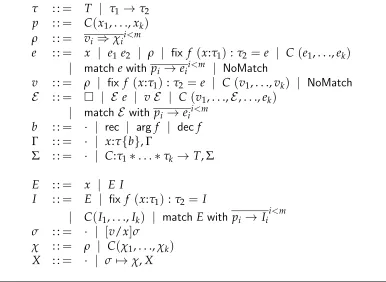
τ : := τ1 →τ2 | T Types e : := x | e1e2 | λx:τ.e | c Terms v : := λx:τ.e | c Values
E : := | E e | vE Evaluation Contexts
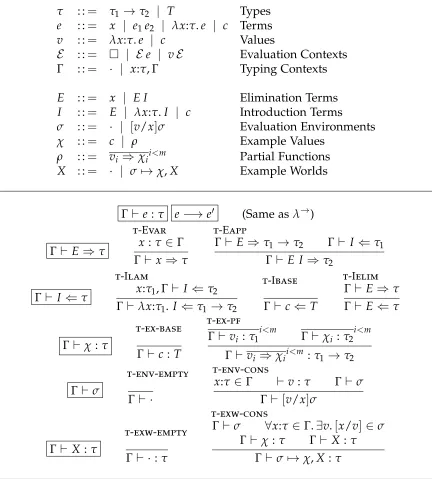
Γ : := · | x:τ,Γ Typing Contexts E : := x | E I Elimination Terms I : := E | λx:τ.I | c Introduction Terms σ : := · | [v/x]σ Evaluation Environments
χ : := c | ρ Example Values
ρ : := vi ⇒χii<m Partial Functions X : := · | σ 7→χ,X Example Worlds
Γ` e : τ e−→ e0 (Same asλ→)
Γ` E ⇒τ
t-Evar x: τ ∈ Γ
Γ` x⇒τ
t-Eapp
Γ` E⇒τ1 →τ2 Γ` I ⇐τ1
Γ ` E I ⇒ τ2
Γ ` I ⇐τ
t-Ilam
x:τ1,Γ` I ⇐τ2 Γ` λx:τ1. I ⇐τ1→τ2
t-Ibase
Γ` c ⇐T
t-Ielim
Γ ` E⇒τ
Γ ` E⇐τ
Γ` χ :τ
t-ex-base
Γ ` c: T
t-ex-pf Γ` vi : τ1
i<m
Γ` χi : τ2 i<m
Γ` vi ⇒χii<m : τ1 →τ2
Γ` σ
t-env-empty
Γ ` ·
t-env-cons
x:τ ∈ Γ ` v: τ Γ ` σ Γ` [v/x]σ
Γ` X : τ
t-exw-empty
Γ` · : τ
t-exw-cons
Γ ` σ ∀x:τ ∈ Γ.∃v.[x/v]∈ σ
Γ` χ: τ Γ ` X :τ
Γ` σ7→ χ,X : τ
2.3.2
Introducing
λ
synIn the previous example, we performed a mixture of symbolic evaluationand type-directed refinementto synthesize the program. We now formalize this process within λ→syn, a core calculus for program synthesis with types.
Figure 2.5 gives the syntax of λ→syn which features an external language of standard expressions e taken from λ→ and an internal language that splits up expressions into introduction forms I and elimination forms E. The internal language is a subset of the external language. As described in Section 2.1.1, it is precisely the normal forms of the external language that we synthesize.
Type checking and evaluation in the external language is the same as λ→. We provide additional rules for type checking the additional constructs introduced inλ→syn. In particular, Eand I terms are checked in a bidirectional type checking style [Pierce and Turner, 2000]. We note that during regular type checking, Eterms generatetypes (as an output), and Itermscheckagainst types (as an input). To make this explicit, we separateEandI type checking into two separate judgments where we generate types (E⇒τ)in the former case and check against types in (I ⇐τ) in the latter case. For example when type checking a variable (t-Evar), we can extract the type of that variable from the context. In contrast, when type checking a function (t-Ilam), while we know the type of the argument from the ascription, we have no information about the body, so we must check the body against a given input type. Type checking examples values χ, in contrast, is straightforward. Constantsck all have typeT (t-ex-base), and a partial functionvi ⇒χii<m has type τ1 →τ2 if all of thevi have type τ1 and all of theχi have type τ2 (t-ex-pf).
2.3.3
Example Worlds
Example worlds were a critical component of the synthesis process for the if function in Section 2.3.1. Recall that each example world contains not only an example value that the synthesized program must evaluate to, but value bindings for each of the free variable of the program. To codify this, we define an example world as a pair σ 7→ χ of agoal example value χ and an environment σ that maps variables to values. A collection of these example worlds is denoted with X, and when it is unambiguous to do so, we refer to these collections of example worlds as our “examples”.
When lifting typechecking of example values to example worlds, written
Γ ` X : τ, we ensure (via t-exw-cons) that for each pair σ 7→ χthat χ has type
Γ ` τ E
eguess-var x:τ ∈ Γ
Γ` τ x
eguess-app
Γ ` τ1→ τ2 E Γ` τ1B· I
Γ `τ2 E I
Γ` τBX I
irefine-arr
X =σ1 7→ρ1, . . .,σn 7→ρn
X0 =apply(x,σ1,ρ1) ++. . .++apply(x,σn,ρn) x:τ1,Γ` τ2BX0 I
Γ ` τ1→τ2BX λx:τ1.I
irefine-base
X =σ17→ ck, . . .,σn 7→ ck
Γ` TBX ck
irefine-guess
Γ` τ E E X
Γ` τBX E
I X
satisfies
∀σ7→ χ∈ X.σ(I) −→∗ v∧v'χ
I X
v'χ
eq-ctor
ck 'ck
eq-lam-pf
∀i∈ 1, . . .,m. (λx:τ.e)vi −→∗ v∧v'χi λx:τ.e'vi ⇒χii<m
apply(x,σ,vi ⇒χii<m) = [v1/x]σ 7→χ1, . . .,[vm/x]σ 7→χm Figure 2.6: λ→syn synthesis and equivalence
Lemma 2.3.1 (Consistency of Example Worlds). If Γ ` X : τ1, then ∀σ 7→ χ ∈ X.x:τ ∈ Γ↔([x/v] ∈ σ∧Γ `v : τ).
Proof. t-exw-cons enforces the → direction, and t-env-cons enforces the ← direction.
Because our synthesis strategy requires evaluation, Lemma 2.3.1 is necessary to ensure that every free variable has a (well-typed) value.
2.3.4
Synthesis in
λ
→synInλ→syn, we further refine the term enumeration judgment we derived in Section 2.1 to create a full-fledged synthesis judgment that takes advantage of example values as specification. We break up synthesis into two judgments as shown in Figure 2.6:
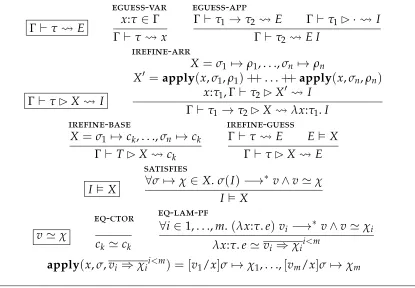
• Γ `τ E(eguess): guess an Eof type τ.
The synthesis problem in λ→syn can be characterized as follows:
Given a context Γ, goal type τ, and examples X where Γ ` X : τ, synthesize a program I of type τ that satisfies the examples X.
The two mutually recursive judgments combine to form a non-deterministic syn-thesis system where a completeirefinederivation corresponds to a solution of this synthesis problem.
Refinement In Section 2.3.2, we observed that distinguishing between introduc-tory forms I and elimination formsEhelped us identify when a type should be treated as an input or output during typechecking. This insight also applies to how we treat examples in tandem with term generation. With introduction forms, the shape of the term and its corresponding type dictate how we refine example values. For example, at base type, our example values consist of constants. irefine-base says that we can synthesize a particular constant ck if the examples all agree on that constant,i.e., the goal example value of each example world is ck. Note that if the example worlds contain differing constants, then this rule does not apply, and we would need to synthesize some other expression instead.
In contrast, at arrow type our example values consist of a set of partial functions. irefine-arrsays that we can synthesize a lambda if we are able to synthesize its body. To understand how irefine-arrrefines examples, first consider the case where X is a single example world, σ 7→ vi ⇒χii<m. The example value is a single partial function consisting of m input/output examples. In this situation, theapplymeta-function generates a collection ofmnew example worlds. The goal example value of each world is the right-hand side of each input/output example, χi. The environment of each new world consists of the original environment σ extended with a binding for the lambda’s variable, x. The value bound to that variable is the left-hand side of each input/output example, vi. We then use these new example worlds to synthesize the body of the lambda.
In general, Xmay contain nexample worlds σ1 7→ρ1, . . .,σn 7→ ρn. When there are multiple example worlds, we simply apply each of the example worlds to generate a collection X1, . . .,Xn of example worlds and then concatenate them all together to create the final collection of example worldsX0to be used to synthesize the body of the lambda. This occurs if the user specifies multiple partial functions rather than a single partial function.
Surprisingly, there is a subtle semantic distinction between a collection of partial functions and a single partial function. To see this, consider synthesizing at goal type T →T with the examples:
ρ1 =σ17→ c1 ⇒c2 | c3 ⇒c4
If we apply irefine-arr, the resulting set of example worlds that we use to synthesize the body of lambda is:
X0 = [x/c1]σ1 7→c2,[x/c3]σ17→ c4,
[x/c5]σ2 7→c6,[x/c7]σ27→ c8,[x/c9]σ2 7→ c10.
In contrast, if we combined the two examples worlds into a single partial function,
ρ =σ7→ c1 ⇒c2 | c3⇒c4 | c5⇒c6 | c7⇒ c8 | c9⇒ c10, then applyingirefine-arrresults in the following examples,
X0 = [x/c1]σ 7→c2,[x/c3]σ7→ c4,
[x/c5]σ 7→c6,[x/c7]σ7→ c8,[x/c9]σ 7→c10.
The only difference between the two cases is the original environments, σ1 and σ2 versus σ, that we extend when deriving X0. The initial environments shared among all the example worlds ought to be identical (as the values for the free variables of the program must be the same), so in our simply-typed setting, there is no practical difference between a collection of partial functions and a single partial function. However, in Chapter 5, we explore changes to irefine-arrthat make this fact no longer true.
Guessing In contrast, with E-terms, we are unable to refine the examples in this manner. This is because an E-term can be generated at any type and the shape of the E-term alone does not determine how we can decompose examples in a meaningful way. In particular, say that we try to synthesize a function application and choose a particular term E with some function type τ1 → τ2. When synthesizing I, we would like to pass refined examples X0 such that E I satisfies X. However, this requires reasoning about the behavior of E, an arbitrary function, which is difficult to do. In the presence of richer language features,e.g., recursion, this is undecidable.
Therefore, for E-terms, the eguess judgment resorts to term enumeration as developed in Section 2.1.1. The rules for generating variables (eguess-var) and application (eguess-app) merely generate a term of an appropriate type. Note that when generating the argument to an application I in eguess-app, we pass the
emptyset of examples to theirefinejudgment. When X is empty, you can see that theirefinejudgment degenerates to simple term enumeration.
that environment results in a valuevthat is compatible to the goal example value for that world. Environment or substitution application, writtenσ(I), produces an external language expressionesuitable for evaluation.
This compatibility relation3, written v ' χ, only needs to compare a value v and some goal example valueχ. At base type, vand χare constants so it suffices to ensure they are the same constant (eq-ctor). At arrow type,v is a lambda and
χ is a partial function. To ensure compatibility, it is sufficient to check for each input/output pair of the partial function that runningvon the input of the pair produces a value compatible with the output of the pair (eq-lam-pf).
2.3.5
Synthesis Examples
To better understand how λ→syn operates, let’s work through a number of examples.
Example 2.3.1. First, consider the degenerate case where the example set is empty (X =·). We claimed in Section 2.3.4 that theirefine judgment degenerates to raw term enumeration when the example set is empty. To see that this is true, let’s look at how eachirefinerule behaves with no examples. At arrow type,irefine-arr applies and passes along the empty example set (X0 =·) when synthesizing the body of the lambda. At base type,irefine-baseapplies and allows us to synthesize any constantck sinceX is empty. Finally, irefine-guessallows us to synthesize any Ebecause E· holds vacuously.
Example 2.3.2. Consider the exampleX =· 7→c1⇒ c1 | c2 ⇒c2 with goal type T → Tin the empty context. The following is a valid synthesis derivation of the identity function:
eguess-var x:T ∈ x:T x:T ` T x
satisfies
[c1/x](x) −→∗ c1∧[c2/x](x) −→∗ c2 x [c1/x] 7→c1,[c2/x] 7→c2 x:T` TB[c1/x] 7→c1,[c2/x] 7→c2 x
irefine-guess
· ` T →TB· 7→c1 ⇒c1 | c2 ⇒c2 λx:T.x
irefine-arr
With our synthesis judgments, we always make a number of irefinederivations ending in a number of eguess derivations. This observation leads to a critical implementation optimization,refinement trees, that we explore in Chapter 7.
synthesize the constant function with a simpler derivation:
X = [c1/x]7→ c1
x:T ` TB[c1/x] 7→c1 c1 irefine-base
· ` T →TB· 7→c1 ⇒c1 λx:T.c1
irefine-arr
Note that the identity function is still derivable in this context:
eguess-var x:T ∈ x:T x:T ` T x
satisfies
[c1/x](x) −→∗ c1 x [c1/x] 7→c1 x:T` TB[c1/x] 7→c1 x
irefine-guess
· `T → TB· 7→c1⇒c1 λx:T.x
irefine-arr
How might we choose one program over the other? While both programs are the same size, we may choose the program with the smaller derivation tree (the constant function), or we might choose the program that uses the most variables (the identity function). With our synthesis relation, we are only concerned with ensuring that every satisfying program has a corresponding derivation in the system, so this ambiguity is irrelevant. However, in a synthesis procedure, we will need to disambiguate between these programs in some manner, a topic we revisit in Chapter 7.
Example 2.3.4. Next, consider synthesizing the if function from Section 2.2.2. Again we use the shorthand:
booldef=T →T →T
true def=λt:T.λf:T.t
false def=λt:T.λf:T. f.
Here, we are trying to synthesize a program of typebool→T →T →T with the example set
X =· 7→true⇒c1⇒ c2 ⇒c1,· 7→false⇒c1⇒ c2 ⇒c2.
We can synthesize the desired if function inλ→syn as follows. First we can apply
irefine-arrthree times to arrive at the synthesis state:
where the example set X is:
[true/b][c1/t][c2/f] 7→c1
[false/b][c1/t][c2/f] 7→c2
Now, we applyirefine-guessto generate the application. The followingeguess derivation generates the application itself (with Γ=b:bool,t:T, f:T).
eguess-app eguess-var b:T
→T →T ∈ Γ
Γ ` T →T →T b
eguess-var t:T ∈ Γ
Γ` T t
Γ` T →T b t
f:T ∈ Γ
Γ` T f eguess-var
Γ` T b t f eguess-app
Finally, we verify that b t f satisfies the examples:
[true/b][c1/t][c2/f](b t f) −→∗ c1
[false/b][c1/t][c2/f](b t f)−→∗ c2.
Example 2.3.5. For our last example, consider what happens if we provide contra-dictory examples. Suppose that we are synthesizing a program of typeT →T and provide the partial function c1⇒c1 | c1⇒ c2. There is no function that we can synthesize that satisfies this specification asc1 is mapped to two distinct outputs. To see this within λ→syn, note that irefine-ctor will never apply because the goal example values are different, and irefine-guess will never succeed because we will never be able to generate an E that satisfies both c1 and c2 given that the argument to the function is bound toc1. Consequently there are no valid synthesis derivations in λ→syn for contradictory examples.