R E S E A R C H
Open Access
Phylogenetic and regulatory region analysis of
Wnt5
genes reveals conservation of a regulatory
module with putative implication in pancreas
development
Maria Kapasa
1,2,3, Stilianos Arhondakis
1, Sophia Kossida
1*Abstract
Background:
Wnt5
genes belong to the large
Wnt
family, encoding proteins implicated into several tumorigenic
and developmental processes. Phylogenetic analyses showed that
Wnt5
gene has been duplicated at the
divergence time of gnathostomata from agnatha. Interestingly, experimental data for some species indicated that
only one of the two
Wnt5
paralogs participates in the development of the endocrine pancreas. The purpose of this
paper is to reexamine the phylogenetic history of the Wnt5 developmental regulators and investigate the
functional shift between paralogs through comparative genomics.
Results:
In this study, the phylogeny of
Wnt5
genes was investigated in species belonging to
protostomia
and
deuterostomia. Furthermore, an
in silico
regulatory region analysis of
Wnt5
paralogs was conducted, limited to those
species with insulin producing cells and pancreas, covering the evolutionary distance from agnatha to
gnathostomata. Our results confirmed the
Wnt5
gene duplication and additionally revealed that this duplication
event included also the upstream region. Moreover, within this latter region, a conserved module was detected to
which a complex of transcription factors, known to be implicated in embryonic pancreas formation, bind.
Conclusions:
Results and observations presented in this study, allow us to conclude that during evolution, the
Wnt5
gene has been duplicated in early vertebrates, and that some paralogs conserved a module within their
regulatory region, functionally related to embryonic development of pancreas. Interestingly, our results allowed
advancing a possible explanation on why the
Wnt5
orthologs do not share the same function during pancreas
development. As a final remark, we suggest that an
in silico
comparative analysis of regulatory regions, especially
when associated to published experimental data, represents a powerful approach for explaining shift of roles
among paralogs.
Reviewers:
This article was reviewed by Sarath Janga (nominated by Sarah Teichmann), Ran Kafri (nominated by
Yitzhak Pilpel), and Andrey Mironov (nominated by Mikhail Gelfand).
Background
Wnt
genes have undergone a rapid structural and
func-tional change in a surprisingly short period of time,
<100 million years ago (MYA; 1). In particular, the
Wnt5
gene has been found to be duplicated in those
species arisen in evolution later than the divergence
time of jawed vertebrates (gnathostomata
)
from the
line-age of agnatha, including hagfish and lampreys, nearly
560 MYA [1,2]; see also Figure 1). Indeed species
belonging to
protostomia
invertebrates (
Drosophila
mel-anogaster) deuterostomia
invertebrates
(Ciona
intestina-lis)
and to the class of agnatha vertebrates (
Petromyzon
marinus
), were found to have one
Wnt5
gene, while
gnathostomata vertebrates have two, namely
Wnt5a
and
Wnt5b
. These genes encode growth factors, known to
be implicated in several developmental and tumorigenic
* Correspondence: [email protected]
1
Bioinformatics & Medical Informatics Team, Biomedical Research Foundation of the Academy of Athens, 11527, Athens, Greece
Full list of author information is available at the end of the article
processes [3,4]. Forsooth, it has been shown that Wnt5a
signaling determines the migration of insulin-positive
cells during murine pancreatic morphogenesis [5].
Moreover, an abnormal formation of pancreas in early
embryos of mice occurred after over-expression of
Wnt5a
[6]. Finally, after induction of the key
transcrip-tion factor (TF) for endocrine pancreas specificatranscrip-tion,
the Neurogenin3 (NGN3), an altered expression level
of
Wnt5a
in murine embryonic pancreas progenitors
was detected [7], whereas that of
Wnt5b
remained
unal-tered [8].
A previous study [5] showed that in some species
car-rying both
Wnt5
paralogs only one participates in cell
migration events during the endocrine pancreas
devel-opment. More explicitly, they showed that in early mice
embryos
Wnt5a
expression guides the migration of islet
cells in order to properly form the endocrine part of
pancreas, while in zebrafish embryos, the Wnt5
signal-ling is required for the proper migration of insulin
pro-ducing cells during pancreas development [5]. However,
previous studies aiming to establish the function of
Wnt5
genes, observed that, despite the similarity in
expression pattern between zebrafish ZfWnt5 and
mur-ine Wnt5a during pancreatic development [9-12], the
former was found to be characterized by a higher amino
acid sequence similarity to that of the mouse Wnt5b [3].
Taking into account the importance of
Wnt5
genes
during development of pancreas, in relation to shifting
roles between paralogs, we decided to conduct a
phylo-genetic and an
in silico
comparative regulatory region
analysis of
Wnt5
genes. Our data confirmed that the
duplication of the
Wnt5
gene, including also its
upstream region, has occurred at the divergence time of
gnathostomata from agnatha. Additionally, within this
region we identified a conserved regulatory module
binding
trans
regulators annotated to be related to
pan-creas development.
Results and Discussion
Phylogenetic Analysis
The orthologous protein sequences of
Wnt5a
and
Wnt5b
genes were identified in many species, covering a
phylogenetic distance from invertebrate
protostomia
to
vertebrate
deuterostomia
(see Materials and Methods).
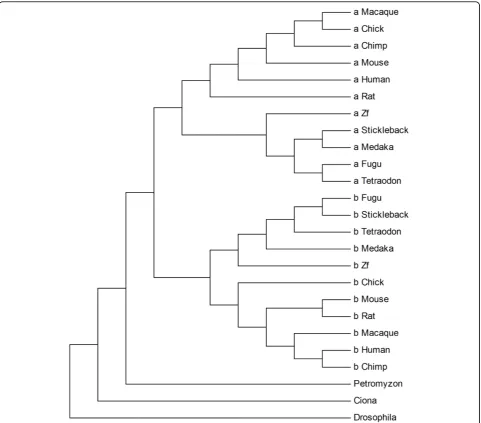
The phylogenetic relationships, as estimated from amino
acid sequence similarities, are shown in a cladogram
tree in Figure 1. According to this tree, the Wnt5
sequences of Ciona, Drosophila and of
P. marinus
(Lam-prey
)
were found at separated branches to those of the
other Wnt5a and Wnt5b proteins of the gnathostomata.
Afterwards, the syntenies for
Wnt5a
and
Wnt5b
genes
were investigated (see Figure 2; for details see Materials
and Methods). In this figure, the genomic regions
sur-rounding each
Wnt5
gene were shown to be conserved,
and only for some species partial inversions have
occurred. Summarizing, the
Wnt5a
gene was
sur-rounded by
Erc2
and
Cacna2d3
, with
Ltrm1
being in
the genomic neighbourhood of the latter (Figure 2a). On
the other hand,
Wnt5b
was surrounded by
Adipor2
and
Fbxl14
, with
Erc1
in close proximity of the latter in
most species (Figure 2b). Finally, in Figure 2c the
synte-nic regions for the
Wnt5
gene of Lamprey (
P. marinus
),
Ciona (
C. intestinalis
), and Drosophila (
D. melanogaster
)
are presented. For Petromyzon,
Cacna2d3
and
Adipor2
genes were identified (Figure 2c), both on the same side
of
Wnt5
gene. It is worth noting that these genes were
found to surround
Wnt5a
and
Wnt5b
paralogs in
spe-cies belonging to gnathostomata. In proximity to
Wnt5
in Ciona and Fruitfly,
Erc1/2
and
Fbxl14
were identified,
found also in the syntenic regions of both
Wnt5
dupli-cates in gnathostomata. The above findings suggest that
a gene duplication event has occurred approximately at
the divergence time of gnathostomata, involving the
Wnt5
gene and its neighbouring genomic region,
fol-lowed by genomic translocation.
Regulatory Region Analysis
An
in silico
analysis of the regulatory regions of
Wnt5a
and
Wnt5b
genes, was performed only for those species
having pancreas and cells producing insulin (see
Materi-als and Methods). Indeed, Ciona and Fruitfly were
excluded from the analysis [13-15], while Lamprey, the
only living representative of agnatha with known
gen-ome, having both pancreas and insulin producing cells
[16,17] was maintained. Therefore, the regulatory region
analysis was conducted only to species covering the
evo-lutionary distance from agnatha to mammals (Figure 3).
Through the application of an extensive filtering method
[18] on the selection of transcription factor binding sites
(TFBS), a conserved distant regulatory module was
iden-tified within the upstream region of some
Wnt5
genes.
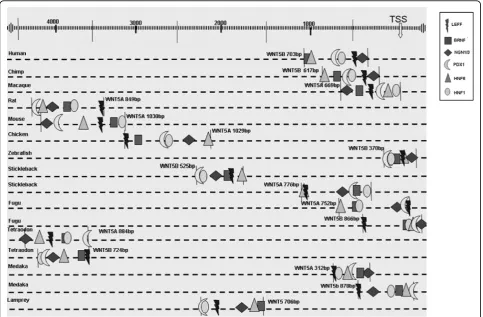
Figure 3 shows those
Wnt5
paralogs for each species in
which this module was identified, the TFBS relative
positions (in scale), and the absolute distance of the
reg-ulatory module from the transcription start site (TSS) of
each gene. Strikingly, this conserved regulatory region
covers a narrow genomic
locus
containing the binding
motifs of 6 TFs belonging to the following families:
NEUR (NGN1/3), HNF1, HNF6, BRNF (BRN2, BRN3,
BRN4, and BRN5), PDX1 (PDX1 and ISL1), and LEFF
(LEF1). The
p-values
of those TFs found to cluster
together with NEUR are given in Table 1.
Despite the variable length of this regulatory module,
its changeable distance from the TSS, and the different
order where the TFBS are found, the specific region was
conserved in all species investigated herein. Indeed,
highly conserved transcription regulators are usually
expected to be found around and within their target
genes as well as at random positions within a genome
[19-21] spanning variable distances upstream or
down-stream of the TSS [22].
It seems that selective pressure during evolution has
acted within these genomic sequences, in order to
main-tain unaltered the binding motifs of the previously
referred TFs, known to participate in pancreas
develop-ment. Explicitly, NGN3 is required for the specification
of the cells
’
subtypes of the endocrine pancreas [7]. On
the other hand, PDX1 and ISL1 regulate islet cell
devel-opment and insulin gene expression, while HNF6 and
HNF1 are both transcriptional activators of
pancreas-specific genes [23-27]. Moreover, the members of the
BRNF family (BRN2, BRN3, BRN4, and BRN5),
partici-pate in mammalian embryogenesis by regulating
differ-ent patterns of gene expression, with BRN4 involved in
cell fate determination of cells capable of producing
glu-cagon [28,29]. Finally, LEF1 mediates the effects of the
canonical Wnt signaling pathway, on which several
organogenic events depend [30].
cluster of TFBS to that of
Wnt5
was identified, although
within a region of approximately the double length. The
given findings from the above negative control
experi-ment, in relation to the documented implication in
pan-creas development of the murine
Wnt5a
and the
zebrafish
Wnt5b
[3,5], both carrying this cluster of
TFBS (Figure 3), further support the functionality of this
conserved regulatory module.
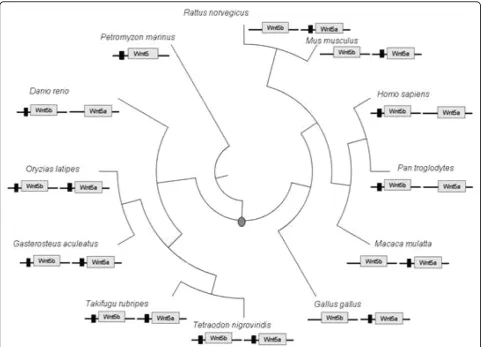
Finally, Figure 4 shows those species in which this
reg-ulatory region was identified in at least one
Wnt5
para-log. Interestingly, while this module is conserved in both
Wnt5
paralogs of gnathostomata fishes, for one
repre-sentative of this class,
Danio rerio
(zebrafish), as for
mammals and birds, it was identified in only one
para-log (Figure 4). Concerning the regulatory module
’
s loss
in the
Wnt5
of zebrafish, it has been shown that in
teleosts after gene duplication only one gene maintains
the regulatory module in its neighborhood [21].
Functional Domain Analysis
In order to understand why both
Wnt5
genes were
pre-served after the duplication event, whereas only one
maintained the regulatory module, we conducted a
func-tional domain analysis (see Material and Methods). Our
analysis revealed the presence of the same functional
domain at approximately the same position in both
pro-teins. More precisely in mice, Wnt5a and Wnt5b,
included the domain Wnt1 in the positions of their
amino acid sequences, 51-360 and 63-372, respectively,
while those of
D. rerio
in the positions, 65-374 and
54-363 (Data available upon request).
Wnt1 domain is known to be implicated at the
devel-opment of multicellular organisms, the Wnt receptor
signalling pathway, and the calcium modulating
path-way. The canonical Wnt signalling pathway (Wnt/
b
catenin pathway) is involved in cell fate specification
and proliferation [31] and the other two non canonical
(b-catenin independent) Wnt signalling pathways are
implicated into organ formation through antagonising
the canonical Wnt signalling pathway [4,32]. In
verte-brates, the latter ones regulate cell polarity and guide
cell migration events during embryogenesis leading into
endoderm patterning and more precisely in pancreas
formation (see 33 and references therein).
A recent study [33] has shown that in zebrafish while
Wnt5b activates the non canonical Wnt signalling
Figure 3The regulatory module ofWnt5. Schematic representation of the regulatory module for thoseWnt5paralogs, in which this cluster of TFBS was identified. The regions demarcating the regulatory module are indicated with vertical lines, and the ruler at the top indicates the distance from the TSS. The TF families are indicated with different symbols: the rhomb is used to depict NEUR binding sites, the triangle HNF6, the circle HNF1, the crescent PDX1, the square BRNF and the thunder LEFF TFBS.
Table 1 The
p-values
of the TF families identified in the
regulatory module
TF Family p-value
LEFF 5.1 10-6 NEUR 1.2 10-5
PDX1 2.4 10-5
HNF6 3.7 10-5
HNF1 1.1 10-3
BRNF 1.5 10-3
The first column reports the TF families of those elements identified at the conserved regulatory module and the second one the correspondingp-values
pathway, contemporaneously acts as a negative feedback
loop for the regulation of the canonical one. On the other
hand, Topol et al., 2003 [32], showed that in mouse the
inhibition of the canonical pathway is attributed to the
Wnt5a
gene. Summarizing, the conservation of both
Wnt5
paralogs after the duplication event is related to a negative
cross regulatory inhibition between the canonical and the
non canonical Wnt signalling pathways, maintaining a
responsive backup circuit [34]. From the above, we may
suggest that in the pancreatic development the expression
of mouse
Wnt5a
and zebrafish
Wnt5b
genes, both
carry-ing the conserved regulatory module, in greater amounts
than their paralogs is necessary, in order to inhibit the
canonical Wnt signalling pathway and achieve a proper
cell migration for the pancreatic islets formation.
Expression Profile Analysis
Within this section, the expression pattern of the human
and mouse
Wnt5a
and
Wnt5b
genes were investigated
in several adult human tissues and during mouse
embryonic development of pancreas. In the first case,
expression patterns of human
Wnt5
paralogs were
retrieved from GeneCards V3 database [35] and from
the publicly available data of Su et al., 2004, [36]. Both
approaches revealed a similarity between human
Wnt5
paralogs expression patterns (see Additional file 1, Panel
A and B), supporting the previously referred hypothesis
of genomic conservation related to a responsive backup
circuit [34], in which both genes participate. Indeed,
tak-ing into account that durtak-ing early somitogenesis, the
endoderm patterning initially requires suppression of
the canonical Wnt signalling, while later an increased
Wnt/beta activity is necessary [37], we understand that
both genes are implicated in the regulation of the
cano-nical and non canocano-nical Wnt signalling pathways.
On the other hand, the expression patterns of both
mouse
Wnt5
paralogs, as given from microarray
experi-ments investigating the pancreatic development in early
murine embryos from day 12.5 until 16.5, revealed
dis-tinct profiles in their expression (see Additional file 1,
Panel C). More precisely, until 13.5 days of mice
pan-creatic development the expression level of
Wnt5a
gene
(carrying the module) is higher to that of
Wnt5b
, while
at 14.5 day, where pancreatic ducts become visible [15],
both genes hold similar expression. Afterwards (until
day 16.5),
Wnt5a
gene further decreases its expression,
reaching lower levels than those of
Wnt5b
.
Summariz-ing, the above described pattern indicates that as
pan-creatic development proceeds the amount of
Wnt5a
gene gradually decreases, while that of
Wnt5b
is
main-tained constant. In this case, as we have already
described, the murine
Wnt5a
(carrier of the conserved
regulatory module) gene, controls the proper migration
of the cells in order to properly form the pancreatic
islets [5]. This last procedure, is estimated to take place
approximately during those days for which
Wnt5a
expression is higher to that of
Wnt5b
(see Additional
file 1, Panel C). Indeed in early mice embryos of 11.5
days, the insulin precursors of mature b-cells appear
[15] and afterwards they migrate along the ducts and
blood vessels in a cord like linear pattern in order to
form the islets (see 38 and references therein), where
until the 14
thday they are arrayed as single cells within
the ductal epithelium. Finally, at a 16 days old embryo,
endocrine cells begin to organize into islet like clusters,
and when the embryo reaches the 18
th-19
thday, the
islets are fully formed [39].
Summarizing, the expression patterns shown here for
Wnt5a
and
Wnt5b
, in human and mouse, represent
additional evidence on why both genes are conserved
after duplication, and indicate the functional role of this
module in the
Wnt5a
gene during mice pancreatic
development.
On the other hand, the shift of the regulatory module
in rhesus monkey
Wnt5a
compared to human
Wnt5b
,
prompted us to further investigate expression data of
Wnt5
genes in embryonic stem cells and several adult
tissues of Macaque. The obtained profiles in both
ana-lyses (stem cells and adult) showed that
Wnt5a
gene
(carrier of the module) is constantly expressed, while
Wnt5b
not (Panels A, B and C of Additional file 2).
These results indicate that the conservation of the
regu-latory module in a paralog is linked with a functional
advantage.
Conclusions
In this study, phylogenetic and regulatory region analyses
of
Wnt5
genes were conducted. A special feature of the
phylogeny in our work is the inclusion of Lamprey, the
only living representative of the agnatha (jawless), with
known genome, from which all jawed vertebrates
diverged [40]. The phylogenetic analysis confirmed that
in those species arisen after the divergence time of
gnathostomata two
Wnt5
paralogs exist, whereas in the
agnathon Petromyzon
(P. marinus)
and the
representa-tives of
protostomia
(
D. melanogaster
) and
deuterostomia
(
C. intestinalis
) invertebrates, only one (see Figure 1).
This is explained by a duplication event which has
occurred at the evolutionarily time that gnathostomata
diverged from agnatha (before 560 MYA; 1, 2).
Finally, the comparative regulatory region analysis
allowed the identification of a conserved region, where
many TFs, annotated to participate in pancreas
forma-tion, bind and regulate
Wnt5
expression. The presence
of these binding motifs, which cluster inside this
regula-tory region, might explain the implication of the
corre-sponding
Wnt5
paralog into the processes enlisted
necessarily for the pancreatic cells subtypes
’
differentia-tion. Providing the fact that the
Wnt5
gene is a member
of the
Wnt
family, it is interesting to identify LEF1, a
known mediator of Wnt signalling pathway [30], as a
regulatory factor of
Wnt5
expression, which further
guides this pathway. On the other hand, the regulation
of the
Wnt5
gene through TFs with known implication
in pancreas organogenesis, and more specifically in the
proper orchestration of cell movements, gives evidence
for the necessity of this regulatory module for the
proper differentiation of cells capable of producing
insu-lin. It is worth pointing out that, Lamprey with both
pancreas and insulin producing cells has preserved this
module inside the regulatory sequence of the
Wnt5
gene.
The conservation of this regulatory module in at least
one paralog of the species investigated in this study
(Fig-ure 4) reflects its functional importance. Indeed, the
experimental data from mouse and zebrafish reinforce a
possible relation between the presence of this regulatory
module in a
Wnt5
paralog, and its implication in
pan-creas formation [3,5]. Moreover, the presence of this
TFBS cluster in human
Wnt5b
, absent in that of the
rodents (mouse and rat), not only explains the observed
human-rodents divergence of
Wnt5b
promoters [42],
but also agrees with its implication in human type 2
dia-betes [43]. Finally, the herein examined profiles for
Wnt5
genes for two distinct cases; mice pancreatic
development and across several human adult tissues add
evidence on the functionality of this module and explain
why genic preservation has occurred respectively.
Indeed, the first case supports the fundamental role that
mouse
Wnt5a
(carrier of the regulatory module) plays
during pancreatic development. On the other hand, the
human adult tissues expression profiles reveal a low
expression divergence between
Wnt5
genes in the adult
state, which supports the preservation of
Wnt5
genes,
known to be implicated into a responsive backup circuit
[34]. Concluding, it is very likely that selective pressure
through evolution forced the coding regions of
Wnt5
paralogs to remain unaltered and maintained the
func-tionality of at least one regulatory module inside their
upstream sequence. This last point is further supported
by the expression profiles of macaque
Wnt5
genes.
Despite the fact that some issues presented herein,
might require further experimental exploration, the
approach adopted in this work managed to offer a
puta-tive explanation why either
Wnt5a
or
Wnt5b
across
dif-ferent species preserved the same function. In relation
to this, we conclude suggesting that similar analyses
associated to experimentally produced data, could
repre-sent an efficient strategy in order to investigate cases
where a shift in the functional role of paralogs has
occurred.
Materials and methods
Ortholog Identification and Phylogenetic Analysis
Wnt5a
and
Wnt5b
orthologs were identified with the
Reciprocal Best Blast Hit method [44-46], using as
refer-ence sequrefer-ences the murine Wnt5a and Wnt5b proteins,
as retrieved and extracted from Ensembl database ([47];
Ensembl release 52-Dec 08, Ensembl release 53 - Mar
2009), with accession numbers, [Ensembl: ENSMU
SP00000107891 and Ensembl: ENSMUSP00000032273]
respectively.
Syntenic genes to
Wnt5
paralogs were identified using
the same version of Ensembl database in combination
with the ortholog identification method [44-46]. Protein
alignment of the orthologous peptides was performed
using ClustalW [48]. On the basis of this alignment, and
using Bioedit and Phylip package [49] a phylogenetic
tree was reconstructed with the Maximun Parsimony
method setting a bootstrap value of 2000 [50-52]. The
commonly accepted tree of the
taxa
shown in Figure 4
was extracted from NCBI database, using the Taxonomy
Browser [53]. Trees presented in this work were
visua-lized using TreeExplorer in MEGA 4.0 [54].
Functional Domain Analysis
The functional domain identification in both Wnt5
pro-tein sequences was performed using the SMART
algo-rithm [55] and the protein sequences of Wnt5a and
Wnt5b for mouse and zebrafish as queries (mouse
accession numbers [Ensembl: ENSMUSP00000064878
and Ensembl: ENSMUSP00000112448]; zebrafish
acces-sion numbers [Ensembl: ENSDARP00000018037 and
Ensembl: ENSDARP00000041851]).
Regulatory Region Analysis
The genomic regions of the orthologous
Wnt5a
and
Wnt5b
genes, spanning 4500 bp upstream to 500 bp
downstream from the TSS were extracted from Ensembl
database [47] for the species given in Figure 3. The TSS
for every gene was annotated also at Ensembl Database
[47]. The extracted regulatory regions were submitted to
the MatInspector platform in Genomatix Database [56].
The putative TFBS for all TFs from Matrix Library 7.1
were detected using a core similarity value of 0.75, and
the
“
optimized
”
matrix similarity as cut- off parameters.
In order to increase robustness of our analysis, we
sought only the common TFBS for the orthologous
sequences of each gene. As a second filtering step we
searched the sub-regions with maximum length of 1000
bp, which contained at least one binding site for the
TFs Neurogenin1/3 (NGN1/3), clustered at the NEUR
TF family. More precisely, only those NEUR TFBS with
the highest core and matrix similarity values, inside the
regulatory sequences of every species paralogs, were
selected as anchors. This parameter was implemented
since
Wnt5a
gene has been shown to be regulated by
NGN3; a conclusion drawn by the fact that its
expres-sion levels were found to be altered after NGN3
induc-tion [9]. Considering these NEUR TFBS as anchors and
in combination with a methodology described in a
pre-vious work [18], we searched the TFBS of other
com-mon elements (TFs) in all orthologs from the species
shown in Figure 3. In conclusion, we tried to discover
regions where TFBS from TFs belonging to NEUR
family were co-localized with those of other
trans
regu-latory elements, also implicated into pancreas
differen-tiation procedures.
murine
b-actin
; [Ensembl: ENSMUSG00000029580]) for
the same number of species (Figure 3) covering the
same phylogenetic distance to those of
Wnt5
genes.
Expression Profile Analysis
Expression patterns for both
Wnt5a
and
Wnt5b
genes in
human, mouse and macaque were investigated. For the
human
Wnt5
paralogs, expression data were retrieved
from two sources: the GeneCards V3 [35] and the
data-set browser of GEO database (Gene Expression
Omni-bus; 57). More precisely, in the second source,
expression data were retrieved and compared for the
replicates of 79 physiological human tissues, provided by
Su et al., 2004 [36].
Concerning the murine
Wnt5
genes, the analysed
expression data were also retrieved from the dataset
browser of GEO database, [57] from microarray
experi-ment during mice pancreatic developexperi-ment, using the
Affymetrix Murine Genome U74 Version 2 array [58].
For the macaque, expression data were retrieved from
embryonic stem cells [59], and from several adult tissues
[60,61].
Additional material
Additional file 1: Panel A: HumanWnt5a and Wnt5bexpression profiles in healthy adult tissues.Panel B:Graphical comparative representation ofWnt5aandWnt5bexpression profiles in healthy adult human tissues.Panel C:Graphical representation ofWnt5aandWnt5b
expression profiles in early mouse embryos.
Additional file 2: Panel A: MacaqueWnt5a and Wnt5bexpression profiles in embryonic stem cells.Panel B and C:MacaqueWnt5aand
Wnt5bexpression profiles adult tissues.
Abbreviations
MYA: Million Years Ago; TF: Transcription Factor; NGN3: Neurogenin3; TFBS: Transcription Factor Binding Sites; TSS: Transcription Start Site; NGN1/3: Neurogenin 1/3.
Competing interests
The authors declare that they have no competing interests.
Authors’contributions
SK conceived the present study and designed thein silicoapproach. MK carried out the acquisition, analysis, interpretation of the data and drafted the manuscript. SA offered valuable insight to the interpretation of the results and conducted the expression profile analysis. All authors revised and approved the final version of the manuscript.
Authors’information
MK: PhD Student in the Department of Pharmacy of University of Patras and in the Biomedical Research Foundation of the Academy of Athens (BRFAA). SA: PhD, post-doc in Bioinformatics & Medical Informatics Team, in the BRFAA.
SK: DPhil, Investigator C-Assistant Professor Level, Head of Bioinformatics & Medical Informatics Team, in the BRFAA.
Reviewers’comments
First Reviewer
Ran Kafri (nominated by Yitzhak Pilpel)
Lahav Lab, Department of Systems Biology, Harvard Medical School Report
I read your manuscript and found it very interesting. Gene duplications have always been close to my heart. It was very interesting that you were able to identify both synteny and regulatory motif conservation. This conservation indicates the importance of the functional role played by Wnt and of the lack of redundancy in the time of duplication. I think that the main aspect that may improve the work is to embed it within the larger framework of current models describing duplicate gene evolution. Specifically, the fate of duplicate genes, following a duplication event, is typically described in terms of one of three possibilities (see ref 1). Neofunctionalization,
subfunctionalization and gene loss. Obviously, this above description is a form of simplification. For example, a pair of duplicates can undergo both partial subfunctionalization and neofunctionlization. Nevertheless, the ne-/ sub funcitonalization model serves a very good axis for describing fates of gene duplicates. In the case of Wnt5, which of the two processes would you say is a better descriptor of what happened?
Another meta-question that is interesting to address is why, following the gene duplication event, have both Wnt5a and Wnt5b been evolutionarily conserved? Redundancy is known to be evolutionarily instable. The fact that both duplicates have been retained throughout evolution suggests that there is a functional advantage to having both (see ref 2). What is that advantage? Maybe a guess at that question could be based on the motif analysis of both genes. Which motifs are old, which are new. What processes do these below to?
ref 1:
The evolutionary fate and consequences of duplicate genes. Lynch M, Conery JS. Science. 2000 Nov 10;290(5494):1151-5.
ref 2:
The regulatory utilization of genetic redundancy through responsive backup circuits. Kafri R, Levy M, Pilpel Y. Proc Natl Acad Sci USA. 2006 Aug 1;103 [31]:11653-8. Epub 2006 Jul 21.
Authors’response
We do agree with reviewers’comments, and we have now added in our manuscript a possible model describing Wnt5 gene duplication event, and on why both copies were preserved. We hope now to fully answer to the comments of the reviewer.
Second Reviewer
Sarath Chandra Janga (nominated by Sarah Teichmann). MRC-Laboratory of Molecular Biology. Darwin college, University of Cambridge.
Report 1
In this work the authors present an evolutionary and regulatory region analysis for the Wnt5 family of genes in different vertebrate and invertebrate genomes. Although the work is interesting and in general well-presented, I have few concerns regarding the presentation and clarity of the manuscript. Given that the manuscripts only major observations are that Wnt5 gene is duplicated early in evolution after the divergence time of gnathostomata and that in several genomes with paralogs the regulatory region corresponding to wnt5a and wnt5b paralogs appears to be conserved, the authors should consider addressing all these comments below in order to increase the readability and clarity of the manuscript.
General Comment 1
The title appears very abstract without any novel implications although the authors did carry out some meticulous first hand analysis. So I suggest changing the title to something more informative like“Phylogenetic and regulatory region analysis of Wnt5 genes reveals change in genomic context of the two paralogs [despite conservation of regulatory elements]” General Comment 2
One major concern with the study is that the authors have a series of observations with regard to the regulatory region analysis but it is not evident if what are the interpretations of these observations, as the authors never conclusively discuss them in the context of known knowledge about Wnt signalling. For instance, the authors mention very briefly an show in Figure 3 that only one of the two Wnt5 paralogs contain the regulatory module in several higher eukaryotes however it is not clear if this is due to sensitivity of the search method adopted or if this is true what are the implications in terms of the expression patterns of the other Wnt gene. These observations should be discussed in detail.
In this context, more generally how do the expression levels of wnt genes in various human and mouse tissues compare? For instance using the microarray datasets like Andrew Su et. al. PNAS for expression data do the authors see a correlation in their levels or a divergence.
General Comment 3b
It appears to me that the authors claim (and expect) at some point in the manuscript that they are both still involved in the same tissue-specific processes (these observations primarily based on previous expression studies) however the lack of regulatory module conservation with change in neighborhood suggests the opposite- So the authors should discuss their observations in light recent studies such as Janga et. al. PNAS 2008 -and De et. al. Genome Research 2008 where the authors show rewiring of regulatory networks due to change in context.
General Comment 4
The authors show in Figure 3 that NGN3 binds to wnt5b in both human and chimp but not wnt5a however the discuss in the introduction in light of references 7 and 8 that wnt5b expression is unaltered while wnt5a changes in expression due to the induction of NGN3. This has to be clarified in light of authors (apparently) contrasting observations.
General Comment 5
The authors should consider introducing/showing the phylogeny shown in Figure 1 in the introduction itself and mark the genomes into different groups of vertebrate and invertebrates on the figure to improve clarify. Do the authors see the same tree if the alignment was done by grouping wnt5a and wnt5b proteins as different groups.
General Comment 6
In most locations of the manuscript, the authors do not cite corresponding materials and methods section.
General Comment 7
What do the authors mean by“.. between the evolutionary age ofP. marinusand that of gnathostomata”towards the end of the section on phylogenetic analysis?
General Comment 8
How do the author identify the Transcription Start Site (TSS) in various genomes? are these a mix of experimental and computational predictions. This has to be detailed in the methods.
General Comment 9
Related to point 8 above the authors could use the relative locations of TSS and the binding regions of TFs to propose whether the regulatory context is indeed conserved between the paralogs across genomes analyzed. General Comment 10a
The authors should discuss the following scenarios based on their findings What is the likelihood that the paralogs for which there is conservation of regulatory module there is lack of expression/process context.
General Comment 10b
Those paralogs which don’t have the regulatory module are they expressed in general? or alternatively is it possible that they are non-functional over times.
Minor comments for revision
There are grammatical inconsistencies and lack of clarity in presentation in different parts of the manuscript, which I expect the authors to revise. Below is an incomplete list which should be corrected.
1) Introduction, Rephrase the sentence to improve clarity“.. and ciona intestinalis (deuterostome), and to early vertebrates, like agnatha, including hagfish and lampreys, were.”
2) Rephrase the sentence in Phylogenetic analysis section“The orthologous peptides for Wnt5a and for their wnt5b paralogs were identified..” 3) Page 4,“Formaly”should be“Formally”
4) In conclusions section rephrase“.., situated in close proximity one to each other, and..”
5) On page 10, para 2 change“evolutionary”to“evolutionarily” 6) Rephrase Page 11, last para,“..on why for some species different Wnt5 paralogs
7) The authors use regulatory element and module synonymously in different places. Since the search was for a set of regulatory elements, they should use regulatory module or set of associated TFBS as a common terminology throughout the manuscript in order to avoid confusion to non-specialists.
Authors’response
Answer to General Comment 1
Having taking into account the constructive suggestion concerning the title of our manuscript, we changed it to read:“Phylogenetic and regulatory region analysis of Wnt5 genes reveals conservation of a regulatory module with putative implication in pancreas development.”
Answer to General Comment 2
We agree with this comment of the reviewer. In order to test whether the presence of this module in Wnt5 genes is due to sensitivity of our method, we repeated exactly the same analysis (same parameters and for the same species) for the constitutively expressed gene of b-actin, finding absence of the module, with exception that of zebrafish. For details please see section Regulatory Region Analysis.
Answer to General Comment 3a
We agree that an estimation of a correlation in expression divergence of Wnt genes in various human and mouse tissues would be a very interesting topic. However, we believe that it would alter the main scope of our work, which is focused on investigating the implication of Wnt5 genes in pancreas development, based in the background knowledge that in mice embryonic stem cells upon Ngn3 induction (key regulator of pancreas development) Wnt5a gene shows the greatest alteration in expression compared to the other Wnt genes, i.e., Wnt4 and Wnt11 (Serafimidis et.al., 2008). Moreover, we believe that the suggested analyses by the reviewer, involving the expression divergence of several Wnt genes for only two species (mouse and human; Su et al., 2002, 2004) in adult state, would not add new elements on our study which is limited to the Wnt5 paralogs of several species during embryonic pancreas development.
Answer to General Comment 3b
Our manuscript suggests that only the Wnt5 paralog carrying the regulatory module is implicated into the endocrine pancreas formation, and not both. However, those Wnt5 genes without the element have important role in other processes and in light of some additional analyses we now explain why both copies were conserved (see new section Functional Domain Analysis). Finally, concerning the studies of Janga et al., (2008) and De et al., (2008) both reporting important observations at genomic level, in our opinion, it cannot be directly related to our work, where the paralogs of a single gene (Wnt5) across several species is investigated, and not several genes within an organism.
Answer to General Comment 4
Reference 7 and 8 are not contrasting to what is shown in Figure 3 for human and chimp, since these studies refer to murine cells.
Answer to General Comment 5
We now refer Figure 1 also in the introduction, and we added vertebrate and invertebrates indication.
We repeated the analysis with Wnt5a and Wnt5b proteins separated and results were maintained rather constant to the submitted tree (details on the results are available upon request).
Answer to General Comment 6
We have now reviewed the manuscript and where necessary it has been added (see materials and methods).
Answer to General Comment 7
We have now rephrased this section of our manuscript. Answer to General Comment 8
We now added the above in the material and methods section Answer to General Comment 9
We have now added a comment on the relative positions of TSS and the binding regions of the TFs.
Answer to General Comment 10a
In the two last paragraphs of our manuscript we clearly report that our conclusions are limited only to those organisms where experimental data support the relation between conserved modules and function, the latter one additionally supported by the results of the suggested negative control experiment. In our opinion any further discussion concerning the presence of the module and lack of its expression/process, would be purely speculative in absence of any experimental information or evidence. Answer to General Comment 10b
our work a comment on their implication in different processes, and on why both Wnt5 genes were preserved.
Answer to the Minor comments for revision We have corrected all minor comments. Report 2
Thanks for addressing some of the concerns raised by me however i still feel that the manuscript can be significantly strengthened by improving two aspects of the study
1) By improving the discussion in light of your observations by extrapolating to observations made by other groups in various tissues
2) I still feel that since the manuscript is already a very short piece (as it is) and so it warrants an in depth analysis of expression patterns at least in pancreas and related tissues if not across all the tissues for which expression data is available.
This analysis is rather easy using currently available gene centric databases such as‘genecards’for humans and i urge the authors to do this analysis and present a heatmap showing this to support the discussion part. If you are able to address these minor concerns I am willing to support the publication of your work.
Authors’response
According to your suggestions, we investigated the expression patterns of both Wnt5 genes, in several adult tissues of human and during pancreatic development of mice.
For the human Wnt5 genes, a similarity in their expression profiles was observed (for details please refer to the main text of the updated version of our manuscript, attached in this email). The high correlation in their expression profiles in adult state of human is in agreement with the conservation of both genes in order to maintain a responsive backup circuit, which controls the canonical and non canonical Wnt signaling pathways. Concerning the expression pattern of the murine Wnt5 genes during pancreatic development, we found a distinct and well maintained profile in their expression. More precisely, during those days of pancreatic
development in which the migration of those cells forming the pancreatic islets is estimated to take place, the murine Wnt5a gene (carrier of the conserved regulatory module) shows a higher expression than Wnt5b. Summarizing, the given results and observations, from the herein conducted expression analyses, agree with what we describe in the manuscript (please see attached manuscript for details).
We look forward to hearing from you and thanking you very much for your constructive comments and the time you took to review our manuscript thoroughly.
Report 3
Thank you very much for addressing the concerns which I raised in my previous round of comments. The manuscript now reads well and I think is suitable for publication.
Third Reviewer
Andrey A. Mironov (nominated by Mikhail Gelfand).
Department of Bioengineering and Bioinformatics, Moscow State University. Report 1
The paper gives some observations about evolution and regulation of Wnt5 genes. On my opinion the paper has very limited interest. Found some paralogs in some genomes, found some binding sites. So what?
Genome contains about 20k more or less conserved genes. The same work can be done almost for every gene in genome with almost the same result � some paralogs, some regulation...
At least the analysis of regulation should be extended to find co-regulated genes and to reconstruct a genetic network.
Some particular comments: Comment 1
The direction of Wnt5 genes on fig. 2 should the same on all lines. For example the line 2 on fig 2a should be presented on opposite direction. Comment 2
The analysis of regulatory modules should be given not only for species with insulin producing cells. Structure of possible modules for other organisms can be used as a control and will be able to show some possible evolution features of the system.
Authors’response
In a previous work (Kapasa et al., 2008) has been proposed a putative regulatory genetic network which leads into the differentiation of the endocrine pancreas cell sub-types. Taking into account that the extension of a similar analysis upon Wnt5 genes would not change the
previous model, we decided to focus our work on the relation between the conservation of the regulatory module and its functionality in pancreas development, as supported by experimental data. Answer to Comment 1
In Figure 2 we decided to maintain the relative direction of the syntenic genes as given by Ensembl database (5-3 or 3-5), in order to help the reader understand the modules’position, and provide information concerning the conservation of the orientation of the genes in the investigated species. Answer to Comment 2
Towards this direction, we have now performed a negative control experiment using b-actin orthologs covering the same phylogenetic distance, and including the same number of species to those for Wnt5 genes. This analysis showed absence of regulatory module, with the only exception the b-actin of Zebrafish, in which a cluster of the same TFBS was identified, in a region of approximately the double length to that of the Wnt5 in zebrafish. Moreover, for the Wnt5 genes of those organisms without pancreas and insulin producing cells (Ciona and Droshophyla) we did not found the Ngn1/3 binding sites, which is the main criterion for the identification of the regulatory modules.
Report 2
I do not change my opinion now. In current form the paper have limited interest. It gives some information but not knowledge.
Comment 1
A negative control on b-globin is useful. But to understand the quality of prediction of regulatory modules you should provide real control - to search such modules for about 1000 random selected genes.
Comment 2
Other way is to provide search such regulatory module genome-wide (In cited paper only some other Wnt genes were analysed) to find possible coregulated genes and to analyse consistency of set of coregulated genes in different genomes.
Comment 3
Fig 2: The direction of Wnt5 genes should be the same (as it is done in, for example, Strings database). In this case the evolution events of gene rearrangement will be clear. The gene orientation in genome databases is more or less random and it is not related to evolution events.
Comment 4
Fig 4: We can see something interesting: in human and chimp the regulatory module exists in upstream region of Wnt5b while very close related organism - macaque - has such module in upstream of Wnt5a. Seems the regulation is switched from one gene to another. Or may be the filter is too strong and both genes really are regulated but the PREDICTED regulatory efficiency are slightly different?
Authors’response Answer to Comment 1
Following your suggestion, we used the non-expressed in embryonic stem cells gene of b-globin, as a second negative control marker. We found absence of the regulatory module, as for actin genes (first negative control marker). The results from the negative control markers, combined with those coming from the additional analyses of Wnt5 paralogs expression profiles in several human adult tissues and during mouse embryonic development (See additional file 2 of the updated version of the manuscript), reinforce not only the functionality of this conserved module in Wnt5 genes, but also the validity of our method.
“But to understand the quality of prediction... 1000 random selected genes.” We believe that such an analysis would be justified if our study was a genome-wide study, and not a study restricted to a specific gene (Wnt5) during a specific process (pancreas development).
Answer to Comment 2
Our study is limited to the paralogs of Wnt5 gene in several species, in order to give a putative explanation for the shifting role concerning pancreas development among these genes. However, a similar regulatory region analysis in experimentally verified co-regulated genes (WIPS1 and CTGF) has been applied elsewhere with satisfactory results (see Kapasa et. al., 2008).
Answer to Comment 3
genes, as we did in figure 2 (Kawahara and Lambeth,BMC Evolutionary Biology 2007, 7:178;Jane et. al.,Nature2002,419: 512-519,Roach et al., Proc Natl Acad Sci USA. 2005, 102: 9577-9582).
Answer to Comment 4
Concerning this point, we performed an additional investigation. Strikingly, for the Wnt5 genes of Rhesus Monkey, we extracted expression data from embryonic stem cells http://www.ncbi.nlm.nih.gov/geo/query/acc.cgi? acc=GSE4446 and from several adult tissues (http://www.ncbi.nlm.nih.gov/ geo/query/acc.cgi?acc=GSE9531, and http://blast.wip.ncbi.nlm.nih.gov/geo/ query/acc.cgi?acc=GSE7094), in order to investigate their expression profiles. Our results show that in the embryonic cells and the adult organs the Wnt5a gene (carrier of the module) is constantly expressed, while Wnt5b not (Panels A, B and C of Additional file 2). This different profiles between the macaque Wnt5a (module carrier) and Wnt5b (non carrier), the former being permanently expressed, suggest a functional advantage for the observed shift of the module’s preservation within the macaque paralogs. Besides that, we have already tested the sensitivity of our method in order to identify only functional regulatory modules either in both or in only one paralog of Wnt5 gene (see figure 4).
We thank you for your constructive criticisms, and we hope through our additional analyses to have fully satisfied your remarks concerning our study. Report 3
Additional information about expression profile analysis is helpful. But I can not find the Additional File 1 (seems you mean Table 1 in figure file?).
Now I have two suggestion.
First - to change fig.2! You are speculating about sintheny region (alignment of genes) but you do not want to show the information in aligned form! Why?
Second - some speculation about contradiction of phylogeny of Wnt5a and standard evolution tree needed. This contradiction is related to structure of regulation on fig 4. Seems here we can observe some positive selection events (have you checked it?) or/and some significant aminoacid changes. On my point of view this is the most interesting result.
By now I think you can publish the paper in current form (with changed fig 2 and fixed misprint with Additional File 1).
Acknowledgements
We thank Dr. A. Gavalas for the valuable discussions on experimental results associated to pancreas development.
Author details
1
Bioinformatics & Medical Informatics Team, Biomedical Research Foundation of the Academy of Athens, 11527, Athens, Greece.2Developmental Biology
Laboratory, Biomedical Research Foundation of the Academy of Athens, 11527, Athens, Greece.3Department of Pharmacy, School of Health Sciences,
University of Patras, GR-26500 Rion-Patras, Greece.
Received: 6 February 2010 Accepted: 4 August 2010 Published: 4 August 2010
References
1. Sidow A:Diversification of the Wnt gene family on the ancestral lineage of vertebrates.Proc Natl Acad Sci USA1992,89:5098-5102.
2. Kumar S, Hedges SB:A molecular timescale for vertebrate evolution. Nature1998,392:917-920.
3. Strähle U, Ingham PW:Three Wnt genes expressed in a wide variety of tissues during development of the zebrafish, Danio rerio: developmental and evolutionary perspectives.Dev Genes Evol1996,206:3-13.
4. Westfall TA, Brimeyer R, Twedt J, Gladon J, Olberding A, Furutani-Seiki M, Slusarski DC:Wnt-5/pipetail functions in vertebrate axis formation as a negative regulator of Wnt/beta-catenin activity.J Cell Biol2003,
162:889-898.
5. Kim HJ, Schleiffarth JR, Jessurun J, Sumanas S, Petryk A, Lin S, Ekker SC:
Wnt5 signaling in vertebrate pancreas development.BMC Biol2005,3:23. 6. Heller RS, Dichmann DS, Jensen J, Miller C, Wong G, Madsen OD, Serup P:
Expression patterns of Wnts, Frizzleds, sFRPs, and misexpression in transgenic mice suggesting a role for Wnts in pancreas and foregut pattern formation.Dev Dyn2002,225:260-270.
7. Gradwohl G, Dierich A, LeMeur M, Guillemot F:Neurogenin3 is required for the development of the four endocrine cell lineages of the pancreas. Proc Natl Acad Sci USA2000,97:1607-1611.
8. Serafimidis I, Rakatzi I, Episkopou V, Gouti M, Gavalas A:Novel effectors of directed and Ngn3-mediated differentiation of mouse embryonic stem cells into endocrine pancreas progenitors.Stem Cells2008,26:3-16. 9. Gavin BJ, McMahon JA, McMahon AP:Expression of multiple novel Wnt-1/
int-1-related genes during fetal and adult mouse development.Genes Dev1990,4:2319-2332.
10. Dealy CN, Roth A, Ferrari D, Brown AM, Kosher RA:Wnt-5a and Wnt-7a are expressed in the developing chick limb bud in a manner suggesting roles in pattern formation along the proximodistal and dorsoventral axes.Mech Dev1993,43:175-186.
11. Moon RT, Campbell RM, Christian JL, McGrew LL, Shih J, Fraser S:Xwnt-5A: a maternal Wnt that affects morphogenetic movements after overexpression in embryos of Xenopus laevis.Development1993,
119:97-111.
12. Parr BA, Shea MJ, Vassileva G, McMahon AP:Mouse Wnt genes exhibit discrete domains of expression in the early embryonic CNS and limb buds.Development1993,119:247-261.
13. Sherwood NM, Tello JA, Roch GJ:Neuroendocrinology of protochordates: Insights from Ciona genomics.Comparative Biochemistry and Physiology
2006,144:254-271.
14. Kim J, Bang H, Ko S, Jung I, Hong H, Kim Ha J:Drosophila ia2 modulates secretion of insulin-like peptide.Comparative Biochemistry and Physiology
2008, ,Part A 151:180-184.
15. Slack JM:Developmental biology of the pancreas.Development1995,
121:1569-1580.
16. Elliott WM, Youson JH:Development of the adult endocrine pancreas during metamorphosis in the sea lamprey, Petromyzon marinus L. II. Electron microscopy and immunocytochemistry.Anat Rec1993,
237:271-290.
17. Plisetskaya EM, Pollock HG, Elliott WM, Youson JH, Andrews PC:Isolation and structure of lamprey (Petromyzon marinus) insulin.Gen Comp Endocrinol1988,69:46-55.
18. Kapasa M, Serafimidis I, Gavalas A, Kossida S:Identification of
phylogenetically conserved enhancer elements implicated in pancreas development in the WISP1 and CTGF orthologs.Genomics2008,
92:301-308.
19. Sandelin A, Bailey P, Bruce S, Engstrom PG, Klos JM, Wasserman WW, Ericson J, Lenhard B:Arrays of ultraconserved non-coding regions span the loci of key developmental genes in vertebrate genomes.BMC Genomics2004,5:99.
20. Lindblad-Toh K, Wade CM, Mikkelsen TS, Karlsson EK, Jaffe DB, Kamal M, Clamp M, Chang JL, Kulbokas EJ, Zody MC, Mauceli E, Xie X, Breen M, Wayne RK, Ostrander EA, Ponting CP, Galibert F, Smith DR, DeJong PJ, Kirkness E, Alvarez P, Biagi T, Brockman W, Butler J, Chin CW, Cook A, Cuff J, Daly MJ, DeCaprio D, Gnerre S,et al:Genome sequence, comparative analysis and haplotype structure of the domestic dog.Nature2005,
438:803-819.
21. Kikuta H, Fredman D, Rinkwitz S, Lenhard B, Becker TS:Retroviral enhancer detection insertions in zebrafish combined with comparative genomics reveal genomic regulatory blocks - a fundamental feature of vertebrate genomes.Genome Biol2007,8(Suppl 1):S4.
22. Davidson EH:The regulatory genome:.Gene regulatory networks in development and evolutionAcademic Press, San Diego 2006. 23. Poll AV, Pierreux CE, Lokmane L, Haumaitre C, Achouri Y, Jacquemin P,
Rousseau GG, Cereghini S, Lemaigre FP:A vHNF1/TCF2-HNF6 cascade regulates the transcription factor network that controls generation of pancreatic precursor cells.Diabetes2006,55:61-69.
24. Wilding L, Gannon M:The role of pdx1 and HNF6 in proliferation and differentiation of endocrine precursors.Diabetes Metab Res Rev2004,
20:114-123.
25. Smith SB, Gasa R, Watada H, Wang J, Griffen SC, German MS:Neurogenin3 and hepatic nuclear factor 1 cooperate in activating pancreatic expression of Pax4.J Biol Chem2003,278:38254-38259.
formation of functional transcriptional complexes.J Biol Chem2005,
280:16798-16807.
27. Miyatsuka T, Kaneto H, Kajimoto Y, Hirota S, Arakawa Y, Fujitani Y, Umayahara Y, Watada H, Yamasaki Y, Magnuson MA, Miyazaki J, Hori M:
Ectopically expressed PDX-1 in liver initiates endocrine and exocrine pancreas differentiation but causes dysmorphogenesis.Biochem Biophys Res Commun2003,310:1017-1025.
28. Heller RS, Stoffers DA, Liu A, Schedl A, Crenshaw EB, Madsen OD, Serup P:
The role of Brn4/Pou3f4 and Pax6 in forming the pancreatic glucagon cell identity.Dev Biol2004,268:123-134.
29. Hussain MA, Miller CP, Habener JF:Brn-4 transcription factor expression targeted to the early developing mouse pancreas induces ectopic glucagon gene expression in insulin-producing beta cells.J Biol Chem
2002,277:16028-16032.
30. van Genderen C, Okamura RM, Farinas I, Quo RG, Parslow TG, Bruhn L, Grosschedl R:Development of several organs that require inductive epithelial-mesenchymal interactions is impaired in LEF-1-deficient mice. Genes Dev1994,8:2691-2703.
31. Slusarski DC, Yang-Snyder J, Busa WB, Moon RT:Modulation of embryonic intracellular Ca2+ signaling by Wnt-5A.Dev Biol1997,182:114-120. 32. Topol L, Jiang X, Choi H, Garrett-Beal L, Carolan PJ, Yang Y:Wnt-5a inhibits
the canonical Wnt pathway by promoting GSK-3-independent beta-catenin degradation.J Cell Biol2003,162:899-908.
33. Stoick-Cooper CL, Weidinger G, Riehle KJ, Hubbert C, Major MB, Fausto N, Moon RT:Distinct Wnt signaling pathways have opposing roles in appendage regeneration.Development2007,134:479-489.
34. Kafri R, Levy M, Pilpel Y:The regulatory utilization of genetic redundancy through responsive backup circuits.Proc Natl Acad Sci USA2006,
103:11653-11658. 35. [http://www.genecards.org/].
36. [http://www.ncbi.nlm.nih.gov/sites/GDSbrowser?acc=GDS596].
37. Mc Lin V, Rankin S, Zorn A:Repression of Wnt/beta-catenin signaling in the anterior endoderm is essential for liver and pancreas development. Development2007,134:2207-2217.
38. Gittes G:Developmental biology of the pancreas: A comprehensive review.Developmental Biology2009,326:4-35.
39. Habener J, Kemp D, Thomas M:Minireview: Transcriptional Regulation in Pancreatic Development.Endocrinology2004,146:1025-1034.
40. Kuratani S, Kuraku S, Murakami Y:Lamprey as an evo-devo model: lessons from comparative embryology and molecular phylogenetics.Genesis
2002,34:175-183.
41. Woolfe A, Elgar G:Comparative genomics using Fugu reveals insights into regulatory subfunctionalization.Genome Biol2007,8:R53. 42. Katoh M, Katoh M:Comparative genomics on Wnt5a and Wnt5b genes.
Int J Mol Med2005,15:749-753.
43. Kanazawa A, Tsukada S, Sekine A, Tsunoda T, Takahashi A, Kashiwagi A, Tanaka Y, Babazono T, Matsuda M, Kaku K:Association of the gene encoding wingless-type mammary tumor virus integration-site family member 5B (WNT5B) with type 2 diabetes.Am J Hum Genet2004,
75(5):832-843.
44. Ye J, McGinnis S, Madden TL:BLAST: improvements for better sequence analysis.Nucleic Acids Res2006, ,34 Web Server:W6-9.
45. Wall DP, Fraser HB, Hirsh AE:Detecting putative orthologs.Bioinformatics
2003,19:1710-1711.
46. Fulton DL, Li YY, Laird MR, Horsman BG, Roche FM, Brinkman FS:Improving the specificity of high-throughput ortholog prediction.BMC
Bioinformatics2006,7:270.
47. The Ensembl Database.[http://www.ensembl.org/index.html]. 48. Larkin MA, Blackshields G, Brown NP, Chenna R, McGettigan PA,
McWilliam H, Valentin F, Wallace IM, Wilm A, Lopez R, Thompson JD, Gibson TJ, Higgins DG:Clustal W and Clustal X version 2.0.Bioinformatics
2007,23:2947-2948.
49. Felsenstein J:PHYLIP.Phylogeny Inference Package, Version 3.62002. 50. Huelsenbeck JP:Performance of phylogenetic methods in simulation.Syst
Biol1995,44:17-48.
51. Studier JA, Keppler KJ:Performance of maximum parsimony and likelihood phylogenetics when evolution is heterogeneous.Nature2004,
431:980-984.
52. Felsenstein J:Confidence limits on phylogenies: an approach using the bootstrap.Evolution1985,39:783-791.
53. The Taxonomy Browser.[http://www.ncbi.nlm.nih.gov/Taxonomy/Browser/ wwwtax.cgi?mode=Root].
54. Kumar S, Nei M, Dudley J, Tamura K:MEGA: a biologist-centric software for evolutionary analysis of DNA and protein sequences.Brief Bioinform
2008,9:299-306.
55. SMART:Simple Modular Architecture Research Tool. [http://smart.embl-heidelberg.de/].
56. The Genomatix Database.[http://www.genomatix.de/].
57. GEO Dataset Browser.[http://www.ncbi.nlm.nih.gov/sites/GDSbrowser/]. 58. GEO Accession viewer:Expression profiling of pancreas development.
[http://www.ncbi.nlm.nih.gov/geo/query/acc.cgi?acc=GSE8070]. 59. GEO Accession viewer:Transcriptional profiling of rhesus monkey
embryonic stem cells.[http://www.ncbi.nlm.nih.gov/geo/query/acc.cgi? acc=GSE4446].
60. GEO Accession viewer:Rhesus Macaque gene expression data obtained using Rhesus Macaque Array or Human Genome U133 Plus 2.0 Array.
[http://www.ncbi.nlm.nih.gov/geo/query/acc.cgi?acc=GSE9531]. 61. GEO Accession viewer:Expression data from 5 rhesus tissues at 3
centers.[http://blast.wip.ncbi.nlm.nih.gov/geo/query/acc.cgi?acc=GSE7094].
doi:10.1186/1745-6150-5-49
Cite this article as:Kapasaet al.:Phylogenetic and regulatory region analysis ofWnt5genes reveals conservation of a regulatory module with putative implication in pancreas development.Biology Direct2010 5:49.
Submit your next manuscript to BioMed Central
and take full advantage of:
• Convenient online submission
• Thorough peer review
• No space constraints or color figure charges
• Immediate publication on acceptance
• Inclusion in PubMed, CAS, Scopus and Google Scholar
• Research which is freely available for redistribution