Processing small diameter logs from
sub-tropical species
A. Zbonak, H. Bailleres, R. McGavin and K. Harding
Queensland Department of Agriculture, Fisheries and Forestry
This publication has been compiled by Anton Zbonak, Henri Bailleres, Rob McGavin and Kevin Harding of Agri-Science Queensland, Queensland Department of Agriculture, Fisheries and Forestry.
© State of Queensland, 2012.
The Queensland Government supports and encourages the dissemination and exchange of its information. The copyright in this publication is licensed under a Creative Commons Attribution 3.0 Australia (CC BY) licence.
Under this licence you are free, without having to seek our permission, to use this publication in accordance with the licence terms.
You must keep intact the copyright notice and attribute the State of Queensland as the source of the publication.
Note: Some content in this publication may have different licence terms as indicated.
Processing small diameter logs from sub-tropical species
A. Zbonak, H. Bailleres, R. McGavin and K. Harding
Horticulture and Forestry Science (H&FS), Agri-Science Queensland, Queensland Department of Agriculture, Fisheries and Forestry, Brisbane
Corresponding Author Email: [email protected]
Abstract
Small spindleless veneer lathe technology was used to produce veneer sheets as an alternative processing option to optimise the use of small log plantation resource. Thinned (300 spha) and unthinned control (1000 spha) plantings of 10.5-year-old
Corymbia citriodora ssp. variegata (CCV) and E. dunnii (Dunn’s white gum) grown in two contrasting sites from climatic regions with large annual rainfall differences were studied. Overall veneer gross recoveries ranged from 50% to 70%, which were up to 3 times higher than typical sawn green-off saw recoveries from small plantation hardwood logs of similar diameter. Major limiting factors preventing veneer from meeting higher grades were the presence of kino defects and encased knots. Splits in E. dunnii veneer also contributed to reduced grade quality.
Differences between two thinning treatments for veneer properties and grade recovery were generally small. There was significant evidence of site and species differences on veneer quality. The good quality site with higher rainfall in northern New South Wales produced denser and stiffer veneers with higher grade recoveries. CCV is a superior structural veneer species with high wood density and hardness as well as very good veneer stiffness exceeding 15,000 MPa but Dunn’s white gum has also
demonstrated good potential as a useful structural plywood resource.
Results indicate that relatively high veneer recoveries were achieved for the sub-tropical plantation hardwoods combined with very superior mechanical properties
which suggest that veneer production have suitable attributes for a range of engineered wood products including plywood and laminated veneer lumber.
Keywords: peeling, E. dunnii, CCV, veneer stiffness, veneer recovery
Introduction
Sub-tropical eucalypt plantations
established in Queensland and New South Wales total slightly less than 150,000 ha, which is 15% of Australia’s hardwood plantation estate [1]. The rate of plantings accelerated after 2000 when private forestry companies, many using managed investment schemes (MIS), became active in the region. The two most important species by area are Dunn’s white gum (Eucalyptus dunnii, DWG) and spotted
gum (Corymbia citriodora spp. variegata,
CCV), which together comprise
approximately 54,000 ha of the subtropical plantation estate. Much of the DWG plantation area was established for pulpwood production, whereas plantations of CCV have been targeted more at solid wood production [2].
Thinning trials were established by the CRC for Forestry to investigate the effect of thinning on growth response and wood
properties in CCV and E. dunnii in two
contrasting locations: drier sites near Kingaroy in south-eastern Queensland, and a wetter site near Ellangowan in north-eastern NSW. A significant increase in the rate of stem diameter growth following thinning was demonstrated for both species at both sites [3].
This paper summarises the peeling performance and veneer quality of logs from trees of both species sourced from two contrasting sites and thinning
treatments: thinned to 300 stems ha-1; and
an unthinned control. Billets from two different tree heights were peeled. This enabled the effects of site, species, thinning treatment and billet height, and their interactions to be examined.
Standing tree acoustic wave velocity was assessed before the selected trees were felled and the effectiveness of this non-destructive assessment method in
predicting veneer stiffness was evaluated.
Materials and Methods
Corymbia citriodora ssp. variegata (CCV) and Eucalyptus dunnii (DWG) logs were sourced from plantations established by
Forest Enterprises Australia in subtropical eastern Australia. Both sites had similar management histories. Reid’s plantation is located at Ellangowan, 50 km south-west of Lismore in north-east NSW; Barron’s plantation is 15 km south-west of Kingaroy in south-east Queensland, and Tingoora plantation is 40 km north of Kingaroy (Table 1). Rainfall conditions during the life of the plantations contrasted between Ellangowan and the sites near Kingaroy. The mean annual rainfall for the 2001– 2010 period at Ellangowan was 1096 mm, which is close to the long-term average (97% of long-term mean rainfall), whereas at Kingaroy, the mean annual rainfall for 2001–2010 was 783 mm, which is 23% below the long-term average for this region.
Table 1. Summary information for CCV and E. dunnii plantations in two locations
Parameters Ellangowan Kingaroy
Species CCV E. dunnii CCV E. dunnii
Site Reid’s Reid’s Tingoora Barron
Stocking prior to thinning 1050 1270 950 930
Age thinned (year, month) 7 y 9m 7y 9m 6y 9m 6y 9m
Age when harvested (year) 10.5 10.5 10.5 10.5
Mean annual rainfall (mm) 1096 1096 783 783
Elevation (m) 52 52 449 465
Thinning treatments had been
implemented at age seven years and nine months old and six years and nine months old at the Ellangowan and Kingaroy sites respectively (Table 1). For each site, the thinning treatments of 300 stems/ha and 500 stems/ha and an unthinned control treatment (with stocking in the range 950– 1270 stems/ha) were applied in a
randomised complete block design with four replicates.
Two contrasting treatments, 300 stems ha
-1
and an unthinned control, were targeted for sampling. For each species and thinning treatment, at each site, five dominant trees with above-average stem diameters were selected. The aim was to assess the potential of trees that would be retained as final crop trees for veneer
log production. From each tree, two 1.5 m long billets were removed: a butt billet
from 0.3–1.8 m above ground and a top billet from a height of approximately 5.5– 7.0 m. In total, 80 billets were cut: 2
species 2 sites 2 treatments 2 height
positions 5 trees per treatment.
Prior to sampling, a Fakopp microsecond timer was used to assess the time of flight for an acoustic signal on each selected standing tree.
The billets were transported to the
Salisbury Research Centre (Department of Agriculture, Fisheries and Forestry, Queensland) for veneer processing. The billets were heat-treated to a core
temperature of 900C prior to peeling, to
equally from both sides to reduce any end splitting).
The billets were peeled on an Omeco spindleless lathe. The full ribbon was produced with a target green thickness of 2.8 to 3.0 mm. The veneer ribbon was peeled until a core diameter of
approximately 45 mm was attained. The full length of ribbon was laid out on the conveyor for easy evaluation.
After peeling, the ribbon was
photographed, and trimmed into 1.55 m wide (tangential dimension) sheets and 0.15 m wide veneer assessment samples. The first assessment sample was
removed from the ribbon position closest to the peeler core and others removed sequentially after each 1.55 m veneer sheet.
Following peeling, the veneer sheets were dried by a commercial veneer company, Austral Ply (Brisbane), using a Jet box dryer to target final moisture content of less than 10%.
The veneer sheets were visually graded to the Australian/New Zealand Standard [4] to establish grade recovery in accordance with the existing industry standard. This standard is designed for face veneer grade segregation only, as most plywood panel products are manufactured with D-grade (the lowest D-grade) veneer. Each veneer sheet was assessed for presence and severity of defects such as knots, gum veins, holes, splits, discoloration,
compression and roughness. The final veneer grades assigned were based on the worst limiting defect. A-grade is the
highest grade followed by B-, C- and then D-grade.
Gross recovery was calculated as the percentage by volume of dried veneer, recovered from its respective green billet volume, meeting AS/NZS 2269 D-grade and higher. Grade recovery is the percentage by volume of each grade of dry veneer, assessed according to AS/NZS 2269, from its respective green billet volume.
The veneer assessment samples were conditioned to 12% equilibrium moisture content. They were analysed for veneer density and dynamic modulus of elasticity (stiffness, MOE), measured with
resonance frequency using the BING system [5].
Results
Veneer gross and graded recoveries
The gross recovery from individual billets varied substantially for individual species-site combinations (Figure 1). Overall veneer gross recoveries, as site averages, ranged from 50% to 70%. The logs from these veneer trials were younger and had smaller diameters than traditional plywood resources, so higher recoveries should be achieved from older, larger diameter logs. In this sense the veneer recoveries reported here are quite encouraging as they are 2–3 times higher than typical green off-saw recoveries from sawing logs of similar diameters [6].
30 40 50 60 70 80 90 0 V en eer g ro ss r eco ver y ( % )
Thin Unthin Mean
Ellangowan
CCV E. dun CCV E. dun Kingaroy 30 40 50 60 70 80 90 0 V e n e e r g ro s s r e co ve ry ( % )
Thin Unthin Mean
Ellangowan
CCV E. dun CCV E. dun Kingaroy
Figure 1. Veneer gross recovery for butt log (a) and top log (b) for two thinning treatments for
CCV and E. dunnii from two sites
Overall gross recovery was significantly influenced by site for both species. This effect was more pronounced for top logs, with recovery being lower from the drier Kingaroy site (Figure 1). The thinning treatment significantly affected recovery for E. dunnii only, with unthinned trees producing less veneer recovery than those from the 300 spha thinning treatment.
The main factor affecting recovery was the short radius measured at the billet’s small end (r=0.52). Recovery is expected to be less from small-diameter trees, as the diameter of the core is fixed regardless of the billet size, so proportionally less of the billet volume can produce veneer.
For comparison, green recoveries from
billets from plantation-grown E. nitens
from Tasmania, of larger diameter and aged 22 years, were around 47% for unpruned and 58% for pruned trees [7].
Thomas et al. [8] reported that green
off-lathe recovery for E. dunnii for three age
classes (12-year-old, 17-year-old and 34-year-old) ranged from 30 to 55%. However, different veneering systems were used in these other trials, and larger diameter residual cores remained after peeling, which accounts in part for the lower recoveries.
Most of the veneer recovered was D-grade, the lowest grade quality (Figure 2). This is not unexpected, given the known presence of knots and other defects in plantation eucalypt logs of the size and age processed. CCV trees from the Ellangowan site had up to 38% of C-grades and better. Slightly higher percentages of better grade were
recovered from the thinned treatments, in the majority of species-site combinations. Top billets yielded less of the higher veneer grades than butt billets, which may reflect a higher incidence of knots from branches in the upper parts of the stem.
0% 20% 40% 60% 80% 100%
Thin Unthin Thin Unthin Thin Unthin Thin Unthin
CCV E.dun CCV E.dun
Ellangowan Kingaroy
D
is
tr
ibut
ion
of
gr
a
de
s
Grade D Grade C Grade B Grade A
0% 20% 40% 60% 80% 100%
Thin Unthin Thin Unthin Thin Unthin Thin Unthin
CCV E.dun CCV E.dun
Ellangowan Kingaroy
D
is
tr
ibut
ion
of
gr
a
de
s
Grade D Grade C Grade B Grade A
b) a)
Figure 2. Proportions of different veneer grades recovered from butt logs (a) and top logs (b)
for two thinning treatments for CCV and E. dunnii from two sites.
Some of the major limiting factors preventing veneer from meeting higher grade qualities were the high presence of kino defects and encased knots. Splits
were also common in veneer from E.
dunnii and significantly degraded its quality. The average veneer grade for individual billets based on the assessment of splits was strongly correlated with average billet end split area index from both ends. A logarithmic relationship provided better fit to data from butt billets
(R2 =0.68), whereas the relationship
between log end split area and veneer
grade for top billets was better explained
by a linear relationship (R2=0.48).
Veneer properties
Average veneer air-dry density ranged
from 775 to 800 kg m-3 for CCV and 606 to
699 kg m-3 for E. dunnii. ANOVA results
indicated (p<0.001) that site was a significant factor influencing veneer
density for E. dunnii. Veneer density for
Average veneer stiffness ranged from 13.1 to 18.2 GPa for CCV and 10.3 to 16.7
GPa for E. dunnii. Surprisingly, E. dunnii
from the Ellangowan site exhibited relatively high values of veneer stiffness, similar to those of CCV, despite its significantly lower wood density. There was evidence of a significant effect of site on veneer stiffness for both species, with lower stiffness values from the drier Kingaroy site. Billet height was also shown
to be significant factor for E. dunnii with
the veneers from upper billets having greater mean stiffness. There was no significant effect of thinning treatment recorded for either species.
Despite the young age of this hardwood resource (10.5-year-old), both species display stiffness properties that are superior (or at the very least comparable) to mature plantation radiata pine, which typically has a veneer stiffness of around 10.5 GPa and is commonly used to
manufacture structural plywood. Similar comparisons can be made with other species: veneer stiffness of 22-year-old
plantation E. nitens from Tasmania
achieved a maximum 10 GPa [7] and mature 36- to 51-year-old Douglas fir from the USA averaged around 10.9 GPa [9].
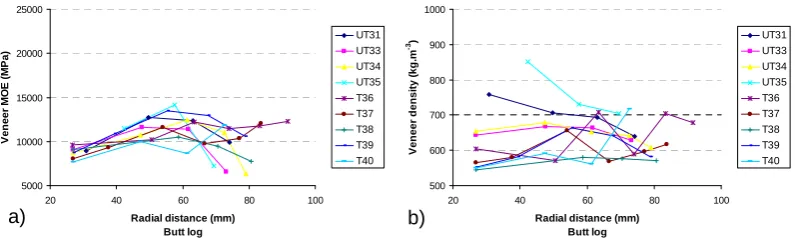
Individual trees displayed considerable radial variation in veneer stiffness (Figure 3a, 4a) and veneer density (Figure 3b, 4b). For about 90% of the samples, veneer stiffness ranged from 10.2 to 22 GPa for CCV and from 8.1 to 21.6 GPa for
E. dunnii; veneer density ranged from 660
to 900 kg m-3 for CCV and 565 to 760 kg
m-3 for E. dunnii. Radial trajectories varied
from tree to tree, however there were few major changes in ranking; trees with lower veneer stiffness adjacent to the core generally had lower outer-wood stiffness
. 5000 10000 15000 20000 25000
20 40 60 80 100 120
Radial distance (mm) Butt log Ven e e r M O E ( M Pa ) T1 T2 T3 T4 T5 UT6 UT7 UT9 UT10 500 600 700 800 900 1000
20 40 60 80 100 120
Radial distance (mm) Butt log Ven e er de ns it y ( k g .m -3) T1 T2 T3 T4 T5 UT6 UT7 UT9 UT10 b) a)
Figure 3. Example of variation in veneer properties for individual CCV trees along ribbon length from the more productive Ellangowan site: a) veneer stiffness; b) air-dry density
5000 10000 15000 20000 25000
20 40 60 80 100
Radial distance (mm) Butt log Ve ne e r M O E ( M Pa ) UT31 UT33 UT34 UT35 T36 T37 T38 T39 T40 500 600 700 800 900 1000
20 40 60 80 100
Radial distance (mm) Butt log V en eer d ensi ty ( kg .m -3) UT31 UT33 UT34 UT35 T36 T37 T38 T39 T40
a) b)
Figure 4. Example of variation in veneer properties for individual E. dunnii trees along ribbon from the drier Kingaroy site: a) veneer stiffness; b) air-dry density
Veneer stiffness and density in CCV increased from pith to bark at both sites, with no evidence of a major effect of site
on radial trajectories (Figure 3a, 3b). For
E. dunnii, stiffness and density increased radially at the Ellangowan site only. At the
drier Kingaroy site, veneer stiffness and density decreased outwards from middle radius to the billet periphery (Figure 4a, 4b). It is known that wood properties are sensitive to fluctuations in environmenta conditions. Kingaroy experienced serious drought over the period 2005-2009, so drought stress may be the cause of the decline in veneer stiffness and density in
the outer wood of E. dunnii. It appears that
l
rought conditions at Kingaroy had less V.
ht ean
t er part of the butt billet =0.81) but also from the heartwood
y
vely
y
several engineered wood roducts, including plywood and laminated
1)
, ra.
2)
lypt plantations in eastern
3)
and Nichols JD (2011): Growth
l restry 4) od– . . Standards 5) d 6) of pts h 2000, ies 7) D. neer orestry Technical 8) Australia Project 9) Journal of Forestry Science 42: 1-13.
d
influence on the wood properties of CC
Standing tree acoustic velocity
Standing tree acoustic velocity, determined by the Fakopp time of flig method, was a good predictor of m veneer stiffness from butt billet, and returned significant coefficients of
determination for CCV (R2=0.78) and E.
dunnii (R2=0.90). Fakopp provided a reliable prediction of veneer stiffness no only from the out
2
(R
zone (R2=0.74).
Conclusions
Small spindleless veneer lathe technolog is a promising processing option for producing veneer sheets from relati small diameter logs that will optimise the recovery and use of this plantation resource. Results from veneering stud indicate that relatively high veneer recoveries were achieved for the sub-tropical plantation hardwoods. When considered with the superior mechanical properties of these hardwoods, it is
suggested that the veneers have attributes that are suited to
p
veneer lumber.
References
Gavran M and Parsons M (2010): Australia’s Plantations 2010 Inventory Update. National Forest Inventory Bureau of Rural Sciences, Canber
Nichols JD, Smith RGB, Grant J, Glencross K (2010): Subtropical euca
Australia. Australian Forestry 73(1):
53-62.
Glencross K., Palmer G., Pelletier MC.
response to thinning in two subtropica hardwood species. CRC for Fo Technical Report No. 217.
Standards Australia (2008): Plywo Structural, Part 0: Specifications AS/NZS 2269:2008
Australia, Sydney.
Brancheriau L. and Bailleres H. (2003): Use of Partial Least Squares Metho with Acoustic Vibration Spectra as Grading Technique for Structural
Timber. Holzforschung 57:644–652.
Leggate W., Palmer G., McGavin R. and Muneri A. (2000): Productivity, sawn recovery and potential rates return from eucalypt plantation in Queensland. In “The future of eucaly for wood products”. Proceedings of IUFRO conference. 19-24 Marc Launceston. Forest Industr Association of Tasmania.
Blakemore P., Morrow A., Washusen R., Harwood C., Wood M. and Ngo (2010): Evaluation of thin-section quarter-sawn boards and rotary ve
from plantation-grown Eucalyptus
nitens. CRC for F Report No. 202.
Thomas D., Joe B., Austin S. and Henson M. (2009): Characterisation of plywood properties manufactured from plantation grown eucalypts. Forestry and Wood Products
No: PRB046-0809