Performance
Patrick Eugster1,2, Alex Kesselman3,
Kirill Kogan4, Sergey Nikolenko5,6, and Alexander Sirotkin7,8 1
Purdue University,[email protected] 2
Technical University of Darmstadt? 3
Google Inc.,[email protected] 4
IMDEA Networks Institute,[email protected] 5
National Research University Higher School of Economics, St. Petersburg 6 Steklov Institute of Mathematics at St.Petersburg,[email protected]??
7
International laboratory for Applied Network Research National Research University Higher School of Economics, Moscow 8
St. Petersburg Institute for Informatics and Automation of the RAS, St. Petersburg, [email protected]
Abstract. Cloud applications bring new challenges to the design of network elements, in particular accommodating for the burstiness of traffic workloads. Shared memory switches represent the best candidate architecture to exploit buffer capacity; we analyze the performance of this architecture. Our goal is to ex-plore the impact of additional traffic characteristics such as varying processing requirements and packet values on objective functions. The outcome of this work is a better understanding of the relevant parameters for buffer management to achieve better performance in dynamic environments of data centers. We consider a model that captures more of the properties of the target architecture than pre-vious work and consider several scheduling and buffer management algorithms that are specifically designed to optimize its performance. In particular, we pro-vide analytic guarantees for the throughput performance of our algorithms that are independent from specific distributions of packet arrivals. We furthermore report on a comprehensive simulation study which validates our analytic results.
1
Introduction
Cloud data centers are faced with workloads which evolve rapidly, driven by high vol-umes of end users, application types, cluster nodes, and overall data movement (e.g., big data processing [4,10]). A primary design challenge in this context consists in selecting and deploying network switches that scale application performance, in a way which is robust and cost-effective. A network switch receives packets on ingress ports, applies
?
P. Eugster was partially supported by the German Research Foundation (DFG) under project MAKI (“Multi-mechanism Adaptation for the Future Internet”).
??
specific policies to them, identifies destination ports, and sends them out through egress ports. When application-induced traffic bursts create an imbalance between incoming and outgoing packet rates for a given port, packets must be queued in the switch packet buffer. The available queue size on a port determines the port’s ability to hold packets until the egress port can emit it. When buffer queue is full, packets are dropped. The allocation and availability of buffer resources to the ports, determined by the buffering architecture, affects burst absorption capabilities and performance characteristics of the network switch. Overprovisioning in terms of buffer capacity at each network node to absorb bursty behavior is not viable, as networks do not have unlimited resources; con-versely, cloud data centers can only scale out as fast as the effective per-port cost and power consumption. These factors, in turn, are driven by the chosen buffering archi-tecture. Theshared memory switchallows to absorb traffic bursts in the best way since the whole buffer can be utilized by a same output port if needed. Since this is an actual choice in practice [13], here we focus our efforts on this type of buffer architecture.
Thebuffer management policyis a key element in meeting network design chal-lenges. It directly impacts a switch’s ability to transfer data at line rate and optimize desired objectives during congestion under various traffic conditions. Most existing buffer management policies are based on a simple characteristic such as buffer occu-pancy [9, 16], whereas traffic workloads have additional important characteristics such as processing requirements or value that are not explicitly taken into account. Efficient methods for buffer management incorporating new characteristics in admission deci-sions beyond fairnessobjective functions lead to new challenges in performance and implementation for traditional switch architectures. Inherited from the Internet, fairness is in fact a design choice which can conflict with other objectives in various economic models (e.g., utilization of network infrastructure or profit [7, 19, 20]).
big data processing [12,38,39]. Worst case results help define buffer management “rules of thumb” that are independent of specific arrival distributions.
The goal of this paper is to offer designs with proven performance guarantees for the shared memory switch; we analyze the performance of buffer management poli-cies and provide guarantees for their worst-case throughput. We consider two different traffic characteristics: (a) required processing and (b) values for packet transmission. Intuitively, they should have similar impacts on the desired objective. In the case of a single queue, both of them reach optima when all packets are ordered by required pro-cessing [21] or values with push-out9. However, generalizing them to a shared memory buffering architecture is challenging: the case of heterogeneous values was presented as an open question in SIGACT News [18, p. 22].
In the first part of this paper every incoming packet has unit value (and an output port label) but has processing requirement varying from1tok. In this case the objective comes down to maximizing the number of transmitted packets. We show that LQD is at least(n/2−o(n))-competitive for sufficiently large buffer sizeBand maximal required processingk; besides that we show that Biggest-Packet-Drop (BPD, a policy that pushes out packets with maximal processing requirement in case of congestion) degrades to at least(n+ 1)/2-competitiveness. In addition we introduce a natural Biggest-Average-Drop policy (that pushes out a packet with maximal required processing from a queue with maximal average processing requirements in the case of congestion) that achieves the same lower bound as BPD. All lower bounds hold even for PQ (priority queue-ing) processing order, where packets are ordered according to processing requirements. The main result of this work is the2-competitiveness of a semi-greedy variant of the Longest-Work-Drop (LWD) policy of [15] that holds in our general model when packets with heterogeneous processing requirements are processed in PQ order in each queue (Section 5). In addition we show that in the FIFO case of our general model, LWD is at least(logB/nk)(1−1/B) + 1-competitive. In the second part of this paper (b) we consider a model where each incoming packet has, in addition to an output port label, a heterogeneous value from1toV (and uniform processing). In this case the objective is to maximize transmitted value. Intuitively, the model with values should be similar to the model with required processing. However, we show that the Maximal-Total-Value-Drop (MTVD) policy, which is similar to LWD, is at leastV-competitive. We also turn to policies that combine several characteristics and consider the Minimal-Ratio-Drop (MRD) policy introduced in [15] that considers both queue occupancy and the average value in the same queue. MRD was conjectured in [15] to have constant competitive-ness. We show that the model with values has a different nature as a generalization from the single-queue case (where both models have optimal online algorithms) to the shared memory switch, and it is not enough to simply consider the total value. In particular, we prove that MRD is at leastV-competitive.
The paper is organized as follows. Section 2 discusses related prior art. Section 3 details the model underlying our work. Section 4 considers lower bounds of several al-gorithms for packets with heterogeneous processing requirements to understand prop-erties of an “ideal” policy. The main result of this paper — 2-competitiveness of LWD
9In case of packets with values, the optimality of the greedy algorithm with pushout is trivial:
policy for packets with heterogeneous requirements — is presented in Section 5. Sec-tion 6 considers a model with heterogeneous packet values. SecSec-tion 7 concludes the paper.
2
Related Work
Aiello et al. [28] propose a non-push-out buffer management policy called Harmonic that is at mostO(logn)-competitive and establish a lower bound ofΩ(log loglognn)on the performance of any online non-push-out deterministic policy, wherenis the number of output ports. Kesselman and Mansour [1] demonstrate that the LQD policy is at most
2- and at least√2-competitive. Both works consider homogeneous packet processing, i.e., each packet requires a single processing cycle. Eugster et al. [15] consider a lim-ited variant of our model where all incoming packets for the same output port have identical processing requirements. But even in this case it was shown there that LQD
is at least√k−o(√k)-competitive. Fortunately, in [15] a generalization of LQD, namely Longest-Work-Drop (LWD), was proposed for this limited model; LWD is at most2-competitive in case when packets are processed with minimal current required processing first (PQ order). Besides, it was shown in [15] that Biggest-Packet-Drop (BPD, a policy that pushes out packets with maximal processing requirement in case of congestion) is at leastlogkcompetitive forB > k(k+1)2 . Unlike the model in [15] the model we consider in this paper however allows for packets with heterogeneous processing requirements to be admitted to the same queue. This generalization over the model in [15] has a significant impact on the efficiency of considered policies and appli-cability to real-world scenarios. In particular, we can open a separate queue per process-ing requirement per output port but in this case the scalability of maximal number of supported queues can become a strong constraint oncekandnare growing. Our current work can be viewed as part of a larger research effort concentrated on studying compet-itive algorithms for management of bounded buffers. Surveys by Goldwasser [18] and later by Nikolenko and Kogan [36] provide an excellent overview of this field. Initiated in [26, 35], this line of research has received tremendous attention over the past decade. Various models have been proposed and studied, including QoS-oriented models where packets have individual weights [2, 14, 26, 35]. A related field that has recently attracted much attention focuses on various switch architectures and aims to design competitive algorithms for various scenarios therein (cf. [3,5,6,22–25,34]). However, none of these models cover the case of packets with heterogeneous processing requirements, and our work extends and generalizes previous models to heterogeneous processing. The sin-gle queue case with heterogeneous processing requirements is considered in [21,32,33]. Kogan et al. considered the multiple separated queues case with heterogeneous process-ing requirements in [30]. The sprocess-ingle queue case with packets containprocess-ing a combination of heterogeneous processing with packet lengths or values has considered in [11, 31].
3
Model Description
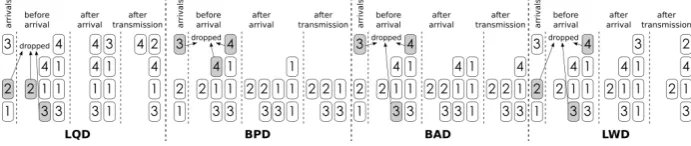
Each output port manages a single output queue, denotedQifor porti,1≤i≤n; the number of packets inQiis denoted by|Qi|. Each packetp(d, w)arriving at an input port is labeled with the output port numberdand its required workwin processing cycles (1≤d≤nand1≤w≤k), wherekdenotes the global upper bound on required work per packet. Each Qi implements either (i) priority queueing (PQ) processing order, where packets are ordered in non-decreasing order of required processing, or (ii) first-in-first-out (FIFO) processing order, where packets are ordered in the order of arrival. In what follows, we denote by w|i a packet with required workwintended for output porti; byh× w|i, a burst ofh w|i packets arriving at the same time. We also denote byrt(p)the remaining required processing of a packetpat time unitt. Time is slotted; we divide each time slot into two phases (see Fig. 1). During the (1)arrival phasea burst of new packets arrives at each input port that decides which ones should be admitted based on the state computed by each output port in the distributed manner. The arrivals are adversarial and do not assume any specific traffic distribution (more thann
arrivals are allowed at the same time slot). An accepted packet can be later dropped from the buffer when another packet is accepted instead; in this case we say that a packetpis
pushed outby another packetq, and a policy that allows this is called apush-outpolicy. During the (2)transmission phase, required work of the head-of-line packet according to the supported processing order (PQ or FIFO) at each non-empty queue is reduced by one, and every packet with zero residual work is transmitted. To facilitate our proofs, we use some properties of ordered (multi-)sets. These notions, as well as the properties we recall in this section, will enable us to compare the performance of our proposed algorithms. In the following, we consider multi-sets of real numbers, where we assume each multi-set is ordered in non-decreasing order. We will refer to such multi-sets as
ordered sets. For every1 ≤i≤ |A|, we will further refer to elementai ∈Aor toA[i] as thei-th element in the setA, as induced by the order. Given two ordered setsAand
B, we sayA≥B, if for everyifor which bothaiandbiexist,ai≥bi. The following lemma, and its corollary, will be used in our analysis; their proofs can be found in [29] (Lemma1and Corollary2).
Lemma 1. For any two ordered setsA andB satisfyingA ≥ B, and any two real numbersa, bsuch thata ≥b, if (i)b ≤b|B|or (ii)|A| ≤ |B|then the ordered sets
A0 =A∪ {a},B0=B∪ {b}satisfyA0≥B0.
Corollary 1. For any two ordered setsA, BsatisfyingA≥B, and any real numberb, if (i)b≤b|B|or (ii)|A| ≤ |B|then the ordered setB0=B∪ {b}satisfiesA≥B0.
4
The Quest for an Ideal Policy with Heterogeneous Processing
packets on which the optimal algorithm is much better than the one in question. they are easier to prove than upper bounds since it suffices to present a hard instance of an input sequence, but lower bounds can still provide important information regarding the comparative quality of online algorithms.
Longest-Queue-Drop(LQD): during the arrival of a packetpwith output porti, denote byj∗= arg max
j{|Qj|+ [i=j]}where[i=j] = 1ifi=jand0otherwise (i.e.,Qj∗is the longest queue once we virtually addptoQi; we choose one with largest
required processing if there are several); then do the following: (1) if the buffer is not full, acceptpintoQi; (2) if the buffer is full andi6=j∗, push out last packet fromQj∗
and acceptpintoQi; else dropp.
Note that the proposed here version of LQD is not fully oblivious to processing requirements since it will drop a packet with a maximal processing from the longest queue in the case of congestion. In case of homogeneous processing, LQD is at least
√
2- and at most2-competitive [1]. For heterogeneous required processing, the situation is worse. Proofs of all theorems in this section are given in the Appendix.
Theorem 1. For sufficiently largeBandk≥n(n−1), LQD is at least(n/2−o(n)) -competitive.
Proof. Over the first burst, there arriveBpackets of each of the following kinds: 1|1,
k|2, k|3 , . . . , k|n . LQD evenly distributes the packets among queues and has
B/npackets in each of its nonempty queues (throughout the proof we assume thatBis
large and is divisible by everything we need it to be). OPT accepts(B−n+ 1)× 1|1
and one each in the remaining queues. Everykprocessing cycles there arrive1× k|2,
1× k|3, . . . ,1× k|n, so OPT always has packets in these queues to work on, but there are no more 1|1 s. OPT spends(B−n+ 1)time to process all 1|1s (after that the arrival iteration is restarted); let us estimate the number of processed packets by this time. OPT will have processed(B−n+ 1)in queue1and(B−n+ 1)/kin each one ofn−1 other queues. LQD will have the same(B−n+ 1)/k processed packets in each queue but the first, and in the first queue LQD will have processed
B/nsince there are no more packets in first queue. Thus, the overall competitive ratio
is (B−n+1)+(n−1)×
B−n+1
k B
n+(n−1)× B−n+1
k
,and fork =n(n−1)we get (B−n+1)+(n−1)×
B−n+1
n(n−1)
B
n+(n−1)× B−n+1
n(n−1)
=
(B−n+1)+B−nn+1
B n+
B−n+1
n
≥(B−2n+1)B n
≈n/2.
The next two algorithms drop packets with the largest processing requirement in case of congestion.
Biggest-Packet-Drop(BPD): during the arrival of a packetpwith required workw
and output porti, denote byQj the nonempty queue that contains a packetpmaxwith the largest processing requirementwmax; then do the following: (1) if the buffer is not full, acceptpintoQi; (2) if the buffer is full andw < wmax, push outpmaxfromQj and acceptpintoQi; (3) if the buffer is full andw > wmax, dropp.
Biggest-Average-Drop(BAD): during the arrival of a packetpwith required work
Fig. 1:A sample time slot of Longest Queue Drop (LQD), Biggest Packet Drop (BPD), Biggest Average Drop (BAD), and Largest Work Drop (LWD) policies with maximal processingk= 4, n= 4output ports, and a shared buffer of sizeB = 8. Queues for each output port are shown horizontally. Shaded packets are dropped during arrival.
requirementw¯max; then do the following: (1) if the buffer is not full, acceptpintoQi; (2) if the buffer is full andw < w¯max, push out packet with maximal work fromQj and acceptpintoQi; (3) if the buffer is full andw >w¯max, dropp.
Theorem 2. BPD and BAD are both at least(n+ 1)/2-competitive.
Proof. The counterexample is as follows: every time slot, there arriveB× 1|1 fol-lowed byB× 2|2 , . . . ,B× 2|n (a full set of packets); BPD and BAD both accept onlyB× 1|1 and keep processing one packet per time slot, i.e.,2packets per2time slots, while OPT is free to accept the packets evenly and get2 + 2/2 +. . .+ 2/2packets per2time slots, getting the bound as n+12 .
Largest-Work-Drop(LWD): during the arrival of a packetpwith output portiand required processingw, denote byj∗ = arg maxj{Wj+1i=jw}where1i=j = 1if
i=jand0otherwise, andWj is the total required processing of all packets in queue
Qj (i.e.,Qj∗is the queue with the largest total required processing once we virtually
addptoQi; we choose the one with the largest single packet if there are several queues with largest work); then do the following: (1) if the buffer is not full, acceptpinto
Qi; (2) if the buffer is full andwis smaller than the required processing of at least one packet inQi, push out the largest packet fromQj∗and acceptpintoQi; else dropp.
Theorem 3. LWD with FIFO processing order is at least(logB/nk)(1−n/B) + 1 -competitive.
Proof. Consider LWD withnoutput ports and suppose thatndividesB. Leta=B/n. For every output porti, there arrive1× k|i followed by(a−1)× k/a|i. OPT discards k|i and accepts all k/a|i. After(a−1)k/aprocessing steps, LWD has
a× k/a|i in every queue and has not yet transmitted any packets, while OPT has
transmitted all (a−1) packets. The next arrival is(a−1)× k/a2|i for every i. Since the processing order is FIFO, after accepting all these packets LWD has k/a|i
(a−1)× k/a2|i in every queue. After (a−1)k/a2 processing steps, LWD has
a× k/a2|i in each queue and has not yet transmitted any packets, but OPT has transmitted all(a−1)packets. Next we repeat the above arrival sequence for packets of sizek/a3, . . . , k/am, untilk/am = 1, i.e., forlog
a(k)steps. On every step, OPT transmits(a−1)×npackets and LWD transmits nothing. After all these steps,a×1|i
has arrived in every queue, so afteraprocessing cycles both OPT and LWD transmit
B packets and finish with empty buffers. Thus, the total number of packets that LWD transmits isB, and the total number of packets transmitted by OPT isn(a−1) logak+ B, getting the ratio n·((a−1) logak)
B + 1. Recall that we hada=B/n, so the final ratio is n·(B/n−1) logB/nk
B + 1 = (logB/nk)(1−n/B) + 1.
5
Scheduling with Heterogeneous Processing
To avoid ambiguity during the arrival phase, a reference timetshould be interpreted as the arrival of a single packet. If several packets arrive at the same time slot, we consider them independently, in the sequence in which they arrive. A time slot is divided into time units; arrival of each packet is a separate time unit (so the arrival phase takes up several time units), while processing and transmission phases both use only a single time unit (we do not separate them). We introduce the class ofsemi-greedyalgorithms
SG. A semi-greedy algorithmG∈ SGaccepts a packet ifG’s buffer is not full;Gis defined by aniteration. An iteration begins during the first time unittswhenG’s buffer is congested and ends on the first time unittewhenGhas transmitted at leastBpackets sincets. To simplify analysis,Gdrops the content of its buffer at the end of an iteration at timetd,te≤td< te+ 1, without gain to its throughput; in this section we show an upper bound, so weakening the algorithm only makes things worse for us.
In what follows we consider an artificially enhanced version of OPT: (1) OPT never pushes out admitted packets (since OPT is offline, it is clear that this property can be satisfied); (2) at the end of an iteration, OPT flushes out all packets residing in its buffer with extra gain to its throughput (in this case, the throughput of OPT is no worse than any other optimal algorithm); (3) if at timet Gtransmits out of porti, the first packet
are completely new. We denote bytbthe first time unit after the end of a previous iter-ation or the time unit of the first arrival in the system. Since a semi-greedyGand OPT both clean their buffers at timetd, it suffices to compare performance ofGversus OPT only during[tb, te]. The class of semi-greedy algorithms is based on a well-structured accounting infrastructure that significantly simplifies analysis of online buffer manage-ment policies with various characteristics. The major question that we will soon answer is: is there a policy with a constant competitiveness in the model where each packet has both required processing and output port (admission of heterogeneous packets to the same queue is allowed)? Note that the processing order implemented in each queue has significant impact on the performance of a scheduling policy. We assume that every queue implements priority queueing (PQ), where all packets in the same queue are or-dered in non-decreasing order of required processing. For simplicity, we denote queue
Qiof an algorithm ALG byAi, whereAis the the first letter of the name of the consid-ered algorithm (e.g,OiandGiare thei-th queue of OPT and a semi-greedyG). We treat queues as ordered sets in the sense of Lemma 1 and correspondingly writeAi≤Bifor two queues if for every slot in the queue where bothAiandBihave packetspAandpB respectively,w(pA)≤w(pB).
ThelatencylatAt(p)of a packetp∈ Ai at timetis the number of time slots cur-rently needed to transmitpout ofAi. We define the latency of an already transmitted packet as−1and the latency of a packet that has not yet arrived as∞. Ani-th port or queue of ALG’s buffer is calledactiveat time unittif it transmits duringt; otherwise, it is calledidle. To show that OPT does not transmit more packets than a semi-greedy al-gorithmGduring[tb, ts), we formulate the following lemma (proven in the Appendix). Actually, we prove an even stronger result that will be used in the proof of the key Lemma 3. Consider an interval of timeI,I ⊆ [tb, td). We denote bySIA the set of packets transmitted by an algorithmAduringI.
Lemma 2. For a semi-greedy algorithmGwith PQ processing and time unitt∈[tb, ts)
between two consecutive iterations, (1)SOP T [tb,t] ≤S
G
[tb,t]; (2) for anyi∈[1, n], at timet Gi≤Oiand|Gi| ≥ |Oi|.
Proof. The proof proceeds by induction on the number of time units.Base:During the first arrival of a packetptoQiat timetb, sinceGis greedy,Gacceptsp, so the induction base follows.Hypothesis:Assume that the lemma holds during[tb, t),t∈[tb, ts−1].
Step:We are to show that the lemma holds duringt.
Processing and transmission:the induction step holds by induction hypothesis for all empty queues or queues with head-of-line packet whose remaining processing is at least one. Consider any active queueQjin OPT or G,1≤j ≤n. If bothOj andGj are nonempty just beforet, by the induction hypothesis we haveOj[1]≥Gj[1]. IfGj is active at time unitt+ 1, then by definition of OPT (property (3))Oj is also active (even if there are additional processing cycles in the HOL packet), and the induction step follows.
A packetparrives toQi:during the arrival phase, the number of transmitted pack-ets is unchanged, so condition (1) follows. Since there is no congestion during[tb, ts),
there is no congestion between two consecutive iterations), by Lemma 1(ii) condition (2) follows at time unit t. If OPT does not acceptptoOi, condition (2) follows by Corollary 1(ii).
Note that due to property (3) in the definition of OPT, at this point it is unclear if our version of OPT can transmit more packets than a semi-greedyGduring[tb, ts), and theoretically it can happen, so we have to prove (1) in Lemma 2. Part (2) of Lemma 2 will be used in the proof of Lemma 3.
The Largest Work Drop (LWD) policy belongs to theSGclass. The rationale behind LWD is to minimize the duration of an iteration. It can be done by optimizing a “local” state of LWD buffer, and that is why we suggest to drop packets from a queue with the largest total required processing. Our plan is as follows. By Lemma 2, between two consecutive iterations OPT does not transmit more than LWD. We denote by T the number of packets transmitted by LWD between two consecutive iterations. Later we are to show that during[ts, td)LWD transmitsBpackets no later than OPT transmits
B packets. Since attd OPT contains at mostBpackets, during[tb, te]OPT transmits at mostT + 2B, whereas LWD transmitsT+B packets. For any time intervalI0 = [ts−1, t],t ∈ [ts−1, td), during an iteration we say thatB−SILW D0 packets with
minimal latency in LWD buffer are colored in red; any other packet in LWD buffer is colored in white. Note that packets that ceased to be red are immediately recolored in white again. We denote byRi the set of all red packets inLi. Lemma 3 contains the main ideas of this upper bound; due to space constraints, its proof is given in the Appendix.
Observation 4 If a packetpj ∈Liis red then everypl∈Liis red forl∈[1, j−1].
Lemma 3. For every OPT packetpj ∈ Oi,j ∈ [1,|Oi|]andi ∈ [1, n], at time unit
t∈(ts, te)either (1) there is a red packetqj ∈Li,rt(pj)≥rt(qj)(Ri≤Oi), or (2)
for any red packetqat LWD buffer,rt(pj) +W(Ri)≥latt(q).
Proof. The proof is by induction on time units.Base:Consider time unitts−1. By definition of iteration, at the end ofts−1LWD’s buffer is full. Since LWD is semi-greedy, by Lemma 2 at timets−1Li≤Oiand, therefore,Ri≤Oifor everyi∈[1, n]. Thus, the induction base follows.Hypothesis:Assume that the lemma holds for every time unitt0∈[ts−1, t),t < td. We are to show that it holds at thet-th time unit.
Induction step.Processing and Transmission: suppose that the t-th time unit is devoted to processing all HOL packets and transmitting fully processed packets. In this case, either every nonempty queueLjis active (in this caseOj is active too regardless of how many processing cycles remains in HOL packet of Oj by definition of OPT (property (3))) or the processing cycles of HOL packets ofLiandOiare decreased by one. Assume that duringt ∈ (ts, te),Oj is active and transmits a packetp; whileLi is idle. In this case by condition (2) LWD’s buffer does not contain any red packet that means the iteration is already over, hence,t≥te, which is a contradiction.
Arrival of a packetptoQi: Note that if OPT acceptsp, its buffer has free space since by definition OPT never pushes out already accepted packets.
OPT acceptsp, but LWD rejects: LWD’s buffer is congested. Furthermore, since
pis rejected by LWD, its required processing exceeds that of any packet inLi. Suppose thatpis at thel’s position inOiafter acceptance,l ≤ |Oi|. Ifql∈Liis red, condition (1) holds (the required processing ofpis at least the required processing of any packet inLi, including all red packets inLi). Ifql ∈ Li is white or l > |Li|, assume that there is a red packet whose latency is more thanrt(p) +W(Ri). Ifl > |Li|,rt(p) +
W(Ri) = rt(p) +W(Li)that is (by definition of LWD) at least W(Lj)sincepis rejected. Thus, condition (2) holds. Ifql∈Liis white thenrt(ql) +W(Ri)≥W(Rj), for anyj ∈ [1, n](by definition of red packet);rt(ql)≤ rt(p)(otherwise, LWD will not dropp). Therefore, condition (2) holds, and the induction hypothesis holds too.
OPT and LWD acceptp: 1. Ifrt(p)is less than at least one red packet inLithen
pis recolored in red and the last red packet inLiis recolored in white. Since no new red packets are added to the queues other thanLi, condition (1) holds in these queues. By Theorem 1(i), condition (1) holds for any red packet in Ri. Next we show that condition (2) continues to hold for any OPT packet that is not covered by condition (1). Since the maximal latency among red packets does not increase for any queue except
j, condition (2) holds. Consider a packetul ∈Ojcorresponding toqlrecolored from red to white; by condition (1) of the induction hypothesis,rt(ul)≥rt(ql). Therefore,
rt(ul) +W(Rj)≥rt(ql) +W(Rj), and (2) holds.
2. If the value ofrt(p)is at least the required processing of any red packet inLithen ifrt(p) +W(Ri)is less than the latency of some red packet in LWD’s buffer, recolorp in red, but the red packetqlwith a maximal latency in LWD’s buffer recolor in white. Otherwise,premains white.
Ifpis white then condition (1) follows by induction hypothesis. Sincepis white,
rt(p) +W(Ri)is at least the latency of any red packet in LWD’s buffer (otherwise,pis recolored in red). Ifpis recolored in red, condition (2) follows similar to case 1.Since onlyQiis affected, condition (1) is satisfied for anyQm,m6=iand holds forQiby Lemma 1(ii).
OPT rejects, LWD accepts: 1. Consider the case when LWD’s buffer is not con-gested. (i) Ifrt(p)is at least the remaining processing of some white packet inQi, the set of the red packets is not changed. Also since OPT rejectspthe set of OPT’s packets is not changed also. Hence, conditions (1) and (2) hold. (ii) Otherwise, ifrt(p)+W(Ri) is less than the latency of the red packetqwith a maximal latency in LWD’s buffer then recolorpin red andqin white. Denote bypan OPT packet in the position|Ri|+ 1of
Oi. If|Oi|>|Ri|just beforepis arrived,rt(p) +W(Ri)is more than the latency ofq. Hence,rt(p) +W(Ri)> rt(p) +W(Ri)and therefore,rt(p)> rt(p). Thus, condition (1) holds. Condition (2) holds similar to case 1.2. LWD’s buffer is congested. If a white packet is pushed out, we can drop it and run the case when the congestion did not occur as in case 1. If the pushed out packet is red then recolor a new packetpin red and apply case (ii).
The main result of this section is the following theorem (see proof in Appendix).
Theorem 5. For a shared memoryn×nswitch with a bufferB, LWD is at most1 +
B
T+B-competitive, whereT is the minimal number of packets transmitted between any
Proof. By Lemma 3, during(ts, te)OPT cannot transmit more packets than LWD. Note that duringteit is possible that OPT transmitsLmore packets than LWD,0≤L < N. By definition of OPT, at the end of an iteration OPT gets all remainingB−Lpackets for free, and its buffer is empty. By Lemma 2, between two consecutive iterations OPT cannot transmit more than LWD. So if OPT transmitsT ≥ 0 packets between two consecutive iterations,P packets during the iteration, the OPT’s throughput is at most
T +P +B−L =T + 2B, whereasLW DtransmitsT +P−L= T+B. Thus, LWD is at most1 + B
T+B-competitive.
6
Scheduling with Heterogeneous Values
In this section, we consider a model with values: each incoming packet has an output port from1 ton and an intrinsic value from1 toV; in this model all packets have uniform processing requirements. The objective is to maximize the total transmitted value. Similar to the model with heterogeneous processing requirements, the work [15]
showed that in the model with values LQD is at least√3
k−o√3
k-competitive. In
Section 5, we have shown that LWD with PQ processing is2-competitive in the model with heterogeneous processing requirements. Therefore, we begin with LWD’s counter-part for this model: the Minimal-Total-Value-Drop policy (MTVD) that has packets in each queue sorted in non-increasing order of values; MTVD tries to process and trans-mit packets with maximal value first but in case of congestion MTVD drops a packet with minimal value. Proofs of all results in this section can be found in the Appendix.
Minimal-Total-Value-Drop(MTVD): during the arrival of a packetpwith output portiand valuev, (1) if the buffer is not full, acceptpintoQi; (2) if the buffer is full andv exceeds the minimal value of some packet, push out a packet with the smallest value from the buffer and acceptpintoQi; else dropp.
For a single queue, MTVD is optimal by reasoning similar to LWD. Unfortunately, this does not generalize to the shared memory switch, as the following theorem shows.
Theorem 6. The Minimal-Total-Value-Drop (MTVD) algorithm is at least V n−V(n−1) -competitive in the model with values (this isn−o(n)unlessV =o(n)).
Proof. In the first burst, there arriveB packets with valueV for output port1 andB
packets with valueV −1for every other output port2..n. MTVD acceptsBpackets to the first queue, while OPT acceptsB/npackets to each queue. InB/nsteps, MTVD will have transmitted total valueBV /n, while OPT will have transmitted total value
(V + (V −1)(n−1))B/n, and the first burst repeats, getting the bound.
Theorem 6 shows that in the model with values the total value characteristic is insufficient and additional parameters should be included if an “ideal” online policy that achieves a constant competitiveness exists. This is why the work [15] introduced the Maximal-Ratio-Drop policy that considers both buffer occupancy and values as a potential policy that achieves constant competitiveness.
Maximal-Ratio-Drop(MRD): during the arrival of a packetpwith output porti
in queuejand|Qj|is the queue length; then: (1) if buffer is not full, acceptpintoQi; (2) if buffer is full andvexceeds the minimal value of a packet from queueQj∗, push
out a packet fromQj∗with minimal value and acceptpintoQi; else dropp.
Theorem 7. The Maximal-Ratio-Drop (MRD) algorithm is at least V-competitive if
n≥B−V2+ 1.
Proof. In the first burst, there arrive2(m−1)packets of value1destined to output ports
[1, m−1],2packets per port, followed byBpackets of valueV destined to output port
m, whereB > V is the buffer size andm=B−V2+ 1. OPT accepts only packets of valueV accruing the total value ofBV. On the other hand, MRD accepts just V
packets of valueV at which point the ratio of the length to the average value becomes
1and it retainsm−1packets of value1gaining the total value ofV2+m−1. Thus, the competitive ratio of MRD isV2BV+m−1 =V.
Unfortunately, the MRD example shows that even both values and buffer occupancy together are not enough to achieve constant competitiveness. As a result, we are more pessimistic regarding the existence of a policy in this model with constant competitive-ness (the open problem posed in SIGACT News [18, p. 22]).
7
Conclusion
Over the recent years, there has been a growing interest in understanding the impact of buffer architecture on network performance. The needs and (bursty) behavior of many modern data center applications further add incentive to fill this knowledge gap. In this work, we study the tradeoffs inevitable on the path to a “perfect” policy in a shared memory switch, both analytically and with simulations. Recent research advo-cates smaller buffers in routers, aiming to reduce queueing delay in the presence of (mostly) TCP traffic; however, it sidesteps the issue that as buffers get smaller, the ef-fect of processing delay becomes much more pronounced. The majority of currently deployed admission control policies do not take into account (at least explicitly) the importance of heterogeneous packet processing. In this work, we study the impact of heterogeneous processing on throughput in the shared memory switch architecture. We demonstrate that policies attractive under uniform processing requirements perform poorly in the worst case, which provides new insights to the practice of admission con-trol policies. Our main result is a constant upper bound on the competitiveness of the LWD policy that drops packets from the queues with largest total processing in case of congestion; this is a significant improvement over [15], as our generalized model requires different proof methods. In addition, we consider a model with heterogeneous packet values and provide preliminary results on whether a policy with constant compet-itiveness can exist. Simulations confirm our analytical findings and in particular demon-strate the relevance of worst-case analysis results for understanding overall (average) performance.
References
2. William Aiello, Yishay Mansour, S. Rajagopolan, and Adi Ros´en. Competitive queue poli-cies for differentiated services. J. Algorithms, 55(2):113–141, 2005.
3. Susanne Albers and Markus Schmidt. On the performance of greedy algorithms in packet buffering.SIAM Journal on Computing, 35(2):278–304, 2005.
4. Mohammad Alizadeh, Tom Edsall, Sarang Dharmapurikar, Ramanan Vaidyanathan, Kevin Chu, Andy Fingerhut, Vinh The Lam, Francis Matus, Rong Pan, Navindra Yadav, and George Varghese. CONGA: distributed congestion-aware load balancing for datacenters. InACM SIGCOMM 2014 Conference, pages 503–514, 2014.
5. Yossi Azar and Arik Litichevskey. Maximizing throughput in multi-queue switches. Algo-rithmica, 45(1):69–90, 2006.
6. Yossi Azar and Yossi Richter. An improved algorithm for CIOQ switches.ACM Transactions on algorithms, 2(2):282–295, 2006.
7. BBC News. US Watchdog to Propose New Net Neutrality Rules, 2014. http://www. bbc.com/news/technology-27141121.
8. Allan Borodin and Ran El-Yaniv.Online Computation and Competitive Analysis. Cambridge University Press, 1998.
9. Wu chang Feng, Dilip D. Kandlur, Debanjan Saha, and Kang G. Shin. Stochastic fair blue: A queue management algorithm for enforcing fairness. InINFOCOM, pages 1520–1529, 2001.
10. Mosharaf Chowdhury, Yuan Zhong, and Ion Stoica. Efficient coflow scheduling with varys. InSIGCOMM, pages 443–454, 2014.
11. Pavel Chuprikov, Sergey I. Nikolenko, Kirill Kogan. Priority Queueing with Multiple Packet Characteristics. InINFOCOM, pages 1–9, 2015.
12. Paolo Costa, Austin Donnelly, Antony I. T. Rowstron, and Greg O’Shea. Camdoop: Exploit-ing in-network aggregation for big data applications. InProc. 9th USENIX Symposium on Networked Systems Design and Implementation (NSDI 2012), pages 29–42, 2012.
13. Sujal Das and Rochan Sankar. Broadcom smart-buffer technology in data center switches for cost-effective performance scaling of cloud applications, 2012. https://www. broadcom.com/collateral/etp/SBT-ETP100.pdf.
14. Matthias Englert and Matthias Westermann. Lower and upper bounds on FIFO buffer man-agement in QoS switches.Algorithmica, 53(4):523–548, 2009.
15. Patrick Eugster, Kirill Kogan, Sergey Nikolenko, and Alexander Sirotkin. Shared memory buffer management for heterogeneous packet processing. InICDCS, 2014.
16. Sally Floyd and Van Jacobson. Random early detection gateways for congestion avoidance. pages 397–413, 1993.
17. CAIDA The Cooperative Association for Internet Data Analysis. [Online]http://www. caida.org/.
18. Michael Goldwasser. A survey of buffer management policies for packet switches.SIGACT News, 41(1):100–128, 2010.
19. Chi-Yao Hong, Srikanth Kandula, Ratul Mahajan, Ming Zhang, Vijay Gill, Mohan Nanduri, and Roger Wattenhofer. Achieving high utilization with software-driven WAN. InACM SIGCOMM 2013 Conference, pages 15–26, 2013.
20. Sushant Jain, Alok Kumar, Subhasree Mandal, Joon Ong, Leon Poutievski, Arjun Singh, Subbaiah Venkata, Jim Wanderer, Junlan Zhou, Min Zhu, Jon Zolla, Urs H¨olzle, Stephen Stuart, and Amin Vahdat. B4: experience with a globally-deployed software defined wan. In ACM SIGCOMM 2013 Conference, pages 3–14, 2013.
22. Alexander Kesselman, Kirill Kogan, and Michael Segal. Packet mode and QoS algorithms for buffered crossbar switches with FIFO queuing. Distributed Computing, 23(3):163–175, 2010.
23. Alexander Kesselman, Kirill Kogan, and Michael Segal. Improved competitive performance bounds for CIOQ switches.Algorithmica, 63(1-2):411–424, 2012.
24. Alexander Kesselman, Kirill Kogan, and Michael Segal. Best Effort and Priority Queuing Policies for Buffered Crossbar Switches.Chicago Journal of Theoretical Computer Science, 2012.
25. Alexander Kesselman, Kirill Kogan. Nonpreemptive Scheduling of Optical Switches.IEEE Transactions on Communications,55(6): 1212-1219, 2007.
26. Alexander Kesselman, Zvi Lotker, Yishay Mansour, Boaz Patt-Shamir, Baruch Schieber, and Maxim Sviridenko. Buffer overflow management in QoS switches. SIAM Journal on Computing, 33(3):563–583, 2004.
27. Alexander Kesselman, Zvi Lotker, Yishay Mansour, Boaz Patt-Shamir, Baruch Schieber, and Maxim Sviridenko. Buffer overflow management in QoS switches. SIAM J. Comput., 33(3):563–583, 2004.
28. Alexander Kesselman and Yishay Mansour. Harmonic buffer management policy for shared memory switches.Theor. Comput. Sci., 324(2-3):161–182, 2004.
29. Kirill Kogan, Alejandro L´opez-Ortiz, Sergey Nikolenko, Gabriel Scalosub, and Michael Se-gal. Large profits or fast gains: A dilemma in maximizing throughput with applications to network processors. CoRR, abs/1202.5755, 2013.
30. Kirill Kogan, Alejandro L´opez-Ortiz, Sergey Nikolenko, Alexander Sirotkin. Multi-queued network processors for packets with heterogeneous processing requirements. In COM-SNETS, pages 1–10, 2013.
31. Kirill Kogan, Alejandro L´opez-Ortiz, Sergey Nikolenko, Gabriel Scalosub, and Michael Se-gal. Balancing work and size with bounded buffers. InCOMSNETS, pages 1–8, 2014. 32. Kirill Kogan, Alejandro L´opez-Ortiz, Sergey Nikolenko, Alexander Sirotkin, Denis
Tu-garyov. FIFO Queueing Policies for Packets with Heterogeneous Processing. InMedAlg, pages 248–260, 2012.
33. Kirill Kogan, Alejandro L´opez-Ortiz, Sergey Nikolenko, Alexander Sirotkin. A taxonomy of Semi-FIFO policies. InIPCCC, pages 295–304, 2012.
34. Kirill Kogan, Sergey Nikolenko, Srinivasan Keshav, Alejandro L´opez-Ortiz. Efficient de-mand assignment in multi-connected microgrids with a shared central grid. InSustainIT, pages 1–5, 2013.
35. Yishay Mansour, Boaz Patt-Shamir, and Ofer Lapid. Optimal smoothing schedules for real-time streams.Distributed Computing, 17(1):77–89, 2004.
36. Sergey I. Nikolenko, Kirill Kogan.Single and Multiple Buffer Processing. Encyclopedia of Algorithms, Springer 2015.
37. Daniel Dominic Sleator and Robert Endre Tarjan. Amortized efficiency of list update and paging rules. Communications of the ACM, 28(2):202–208, 1985.
38. Hung-chih Yang, Ali Dasdan, Ruey-Lung Hsiao, and Douglas Stott Parker Jr. Map-reduce-merge: simplified relational data processing on large clusters. InProc. ACM SIGMOD Inter-national Conference on Management of Data, pages 1029–1040, 2007.