The Influence
on
the
Anodic
of
Alternating
Current
Behaviour
of
Platinum
By Dr
Romuald Juchniewicz
Gdarisk Polytechnic, PolandI n this paper an investigation is described of the e$ect of superimposed a.c. on the corrosion of anodically polarised platinum in sodium chloride solutions, using capacitance and resistance measurements to study the formation and destruction of oxide jilms on the electrode surfaces. Increased corrosion was found when up to 30 per cent a.c. was super- imposed on d.c. The importance of reducing the a.c. component in rectijied currents used i n cathodic protection and electrolytic processes is shown.
The use of platinum and platinised titanium as anodic materials is rapidly growing, both in cathodic protection applications and in the field of industrial electrolysis. In view of its considerable theoretical interest and practical importance, the corrosion with superimposed a.c. of these materials in salt water at high current densities has been investigated.
In a paper presented by the author at the First International Congress on Metallic Corrosion, London, 1961 (I), the effect of a x . on the corrosion behaviour of anodically polarised platinum and platinised titanium in static sodium chloride solutions was dis- cussed. Further experimental work using both static and flowing electrolytes is now reported.
With solutions containing chlorine ions, anodes dissolve as PtCl,--, this corrosion being quantitative for low current densities. It is known that attack by d.c. is enhanced by increasing temperature, by high concentration of chlorine ions, by high acidity, and when a.c. is superimposed.
Bombara and Gherardi (2) have observed
with only d.c. that platinum-coated titanium electrodes have a limited period of usefulness which depends to some extent on the adhesion of the platinum and thus on the type of plating process used. Llopis and Sancho (3)
found a close relationship between the cor- rosion of platinum and superimposed a.c. in hydrochloric acid solutions. For d.c. high enough to passivate the electrode, corrosion is nil, until a “critical” value of the super- imposed a.c. is reached. Juchniewicz ( I ) has observed a large increase in corrosion of platinum when about 14 per cent a.c. is
superimposed on 600 mA/cm2 d.c. The
surface is covered with a yellow film and there is an associated increase in capacitance. One group of workers (4, 5, 6 ) considers that corrosion is due to the depolarising effect of a.c., while another group (7, 8) concludes that the decreasing capacitance of the double layer is largely responsible for corrosion.
was 200 ml. The ambient temperature during these experiments was 2 0 T & .'1
A d.c. of up to 1200 mA/cm2 was applied and up to 30 per cent ax. at a frequency of 500 cis was superimposed. The amount of corrosion over periods up to 1200 hours was determined by measurement of weight loss of the electrodes.
The a.c. bridge built by Cole (9) with an output of 5 mV was used for impedance
measurements. Variable resistance and
capacitance boxes in the measuring circuit
Id.c.rnA/cm2
Per cent a.c.
0
..
. .
4.5 . , .
6.5
.
.
.30
..
. . Time 1,400 hours13
. .
. .
were placed in series. The method used by Lorking (10) was applied to the present work, in which the cell used for measurements on platinum was set up in a 250 ml beaker. Three electrodes were used: the electrode under test, a length of platinum wire with surface area of 0.1 cm2 exposed to the solu- tion; a counter electrode of platinised platinum having an apparent surface area of 3200 cm2, and a plain platinum electrode for applying the polarising current. A study was made of the concentration of hypochlorous acid
65 I30 260 520
0.043 I 0.0728 0.1321 0. I700
0.101 0. I384
-
0.4785-
0. I654 0.05 I 2.030 I-
3.412-
4.92500.426 I .635 14.613 34.53 I Table I
Influence of Superimposed a x . at 50 cis on d.c. Polarisation in Static 3 per cent Sodium Chloride Solution
Id.c.mA:cme I50 300
Per cent a.c.
5 . 5 . .
. .
0.1401 0.425 Iformed during polarisation in these conditions. The principal results obtained are set out in the tables and in Figs. I and 2.
It can be seen from Table I that at con- stant d.c. density an increase in superimposed a.c. causes increased anodic dissolution. Furthermore, although the data shown in Tables I1 and IV are not strictly comparable, it is apparent that polarisation with flowing electrolyte produces significantly less corrosion than in the experiments with static solutions. The difference is probably related to the effect of hypochlorite formed under static conditions and to changes in pH.
During electrolysis hypochlorite is formed by anodic oxidation, and Table V shows that under a particular set of conditions its con- centration becomes substantially constant after 150 hours. The pH change from 5.2 to 8.6 was complete in two hours.
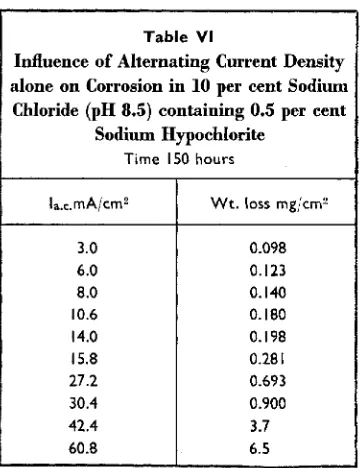
Table VI shows the influence of increasing a.c. density alone on the corrosion of platinum. It is noticeable that there is a sharp increase in weight loss at a current density of around 30 mA:cmZ.
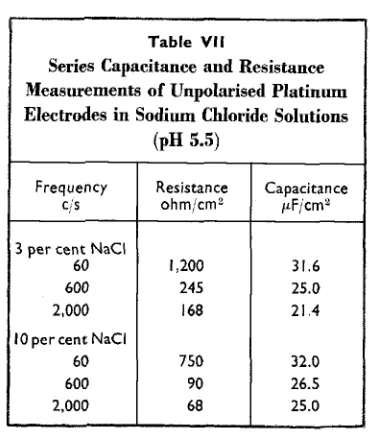
Table VII shows series capacitance and resistance measurements for unpolarised platinum in 3 and 10 per cent sodium chloride solutions. These results indicate the probable
600 1,200 3.1751 7.223 I
presence of an intact oxide film on the platinum surface.
With a.c. polarisation alone, it was found that both corrosion and capacitance increased significantly as illustrated by the results in Table VI and Fig. I. The plot of electrode potential shows two discontinuities with in- creasing a.c. Fig. I also shows that an increase of polarising time from fifteen minutes to two hours resulted in a great increase in capacit- ance with only a small change in resistance.
Fig. 2 shows that a large increase in capacitance was found after polarisation with a.c. alone, the final capacitance remaining stable for many hours. With d.c. and super- imposed a.c. after twenty-four hours polarisa- tion there was only a small increase which fell rapidly after switching off the polarising current. These results indicate that a.c. has some influence on film formation, probably through the formation of a surface layer of insoluble salt, since a yellow film was often observed on the electrode.
Titanium covered with a 3 p- platinum layer and titanium plated with platinum in a bath of chloroplatinic acid were used in the experiments. In the latter case, microscopic examination showed that the platinised layer was I ,U thick.
Id.c.rnA/cm2
Per cent a.c.
0
. .
. .
4.5
. .
. .
10
..
..14
.. ..
Table Ill Conditions the same as for Table I , but with I
75
0.05 I
0.0598 0.0664 0.0723
I50
0.0643
0.072 I
0.1 184 0.1498
l e r cent sodium chloride
300
0. I49
0. I948 0.290 I
0.400 I
600
0. I69 0.2284
0.3481
0.9964
100
I
I
I n both cases, when platinised titanium was polarised at a d.c. density of 70 mA/cm2 without a.c., no corrosion was observed after 2,000-5,000 hours. Superimposed a.c., as
with pure platinum, caused corrosion. The degree of corrosion depends on the thickness of the platinum and applied current density during the test, but a certain amount of corrosion always occurs,
I t was noted during the experiments that the thickness of the platinum layer fell to 0.1 p to 0.2 p. Below these values the electrode fails after a limited period of time. Platinised titanium wire with a 3 p layer of platinum was more resistant, and over long periods of time with superimposed a.c. up to I per cent, no corrosion was observed. More detailed research on the corrosion of platinised titanium is at present under way.
Results of this investigation indicate that up to 30 per cent superimposed a.c. causes an increase in the anodic dissolution of platinum and platinised titanium both in static and flowing electrolytes. With increase of electro- lyte concentration a decrease in corrosion was observed. It was also confirmed that d.c. alone causes corrosion of platinum (11).
Juchniewicz (I) found that if an a s . is
superimposed on a d.c. anodically polarising a platinum electrode in sodium chloride solution, the overpotential decreases, the de- polarising effect being greater as the a.c. density increases. Anodic polarisation of platinised titanium pro-passivates the titanium in the pores of the platinised layer, thus main- taining the stability of the electrodes for long periods with d.c. alone. Previous work (12,
13 and 3) had indicated that the surface of the platinum is covered by an oxide layer later identified as a PtO:PtO, film (14).
Capacitance and resistance measurements with an a x . bridge may be used to follow
Influence of 3 per eent Sodium Chloride Flowing at a rate of 1.25 litres/hour
Time 350 hours
Per cent a.c.
0.1710 0.365 I
0.3812
14 0.933 I
Table V
Increase in Sodium Hypochlorite Concentration determined during Experiments in Static 3 per cent
Sodium Chloride Solution
Direct current density 520 mA/cmz with
4.5 per cent a.c. Time
in hours
6
24 48 62
I00
I50 200 350
Per cent sodium hypochlorite
0.04 0.10
0.3 I 0.40
0.50 0.58 0.58
0.57
changes in thickness of films formed on the electrode surface. Lorking (10) in a series of experiments on aluminium has shown that for a surface covered with an intact oxide film, the capacitance is low, while the resist- ance at low frequencies is high. Other workers
(IS) have pointed out that the variation of capacitance with frequency is low while that of resistance is high.
Table VI
Influence of Alternating Current Density alone on Corrosion in 10 per cent Sodium Chloride (pH 8.5) containing 0.5 per cent
Sodium Hypochlorite
Time 150 hours
3.0 6.0
8.0 10.6
14.0 15.8 27.2 30.4 42.4 60.8
0.098 0.123
0.140
0. I80
0. I98 0.28 I
0.693
0.900
3.7
6.5
Walkiden (16) has correctly drawn attention to the fact that the amplitude and frequency of the ripple depends on the circuit used. For small currents, the supply is upally obtained from a single-phase transformer and a full-wave bridge rectifier and the main ripple component of the output has an RMS value of 47 per cent of the mean d.c. voltage and a frequency of IOO cis. For larger in- stallations a three-phase full-wave bridge rectifier is usually employed, and the main ripple component of the output has an RMS value of 4 per cent of the mean d.c. voltage and a frequency of 300 c/s. In both cases there will be smaller percentages of the
corresponding harmonic frequencies. It
would be useful to carry out further experi- ments using rectified a.c. of these two types, with and without smoothing, as the d s . source.
At 60 cis the capacitance of the unpolarised platinum electrode was found to be 31-32
p Fl cmz and this value was practically the same for 3 per cent and 10 per cent sodium
chloride solutions while the resistance was about 1000 ohm,’cm2.
It has been observed previously ( I ) that small proportions of a.c. superimposed for short times do not cause any decrease in capacitance and therefore corrosion is prob- ably negligible. The high oxidation state of the platinum electrode opposes the effect of small ripple of a.c.
I n 10 per cent sodium chloride solution the change in capacitance with superimposed a.c. was more marked than in 3 per cent solution. This might be explained by the increase in chloride ion concentration or a decrease in concentration of dissolved oxygen.
Table Vll
Series Capacitance and Resistance Measurements of Unpolarised Platinum Electrodes in Sodium Chloride Solutions
Frequency c; 5
3 per cent NaCl
60
600 2,000
10 per cent: NaCl 60 600 2,000
Resistance
ohm/cm*
I ,200
245
I68
750
90
68
Capacitance
pFjcm2
31.6
25.0
21.4 32.0 26.5
25.0
weeks to drop to its original value. Platinised titanium gave lower values of capacitance and resistance than platinum, and when cor- rosion started a decrease of capacitance was observed. These studies on the corrosion of platinum in sodium chloride solutions have shown that:
I. With up to 30 per cent superimposed a s . the corrosion increases with increase in a.c.
2. Corrosion is dependent upon the con- centration of electrolyte, increasing tem- perature, hypochlorite formation, p H of electrolyte, “critical” value of the super- imposed a.c., and the circuit used for
superimposition of
ax.3. From capacitance and resistance measure- ments, the platinum surface is covered by an intact film which is destroyed by a s . 4. With a.c. alone, or with a high super-
imposed a.c., there is a similar influence on capacitance causing a large increase when polarisation is cut off. The be- haviour of platinised titanium differs from that of platinum in these conditions. 5. After the longest time of polarisation, a
long period without polarisation was required for the capacitance to regain its original value. This is probably related to the re-establishment of an oxide film.
6 . The superimposition of a.c. on d.c. has a depolarising effect increasing with mag- nitude of a.c. However, this effect is not so significant as the changes in capacit- ance which occur. I t would appear that depassivation of platinum electrodes during the negative semi-cycle is not the main cause of corrosion.
A practical consequence of these results is the importance of incorporating sufficient inductance in cathodic protection installa- tions involving platinum and platinised titanium to reduce the a.c. component in rectified currents to a harmless level.
References
I R. Juchniewicz, First International Congress
on Metallic Corrosion, London, April 1961. Preprints 436-439
2 G. Bombara and D. Gherardi, L a Metallurgia ltaliana, 1959, 51, (10), 462
3 J. Llopis and A. Sancho, J . Electrochem. SOC., 1961, 108, (8), 720-726
4 A. Rius, J. Llopis and F. Colom, CITCE, 1954, 6, 306 (Butterworths, London) J. Llopis and F. Colom, Ann. Real. Sac. Esp.
Fis. Y Quim., 1955, 51 By (6), 379-394
5 R. Bentley and T. R. Prentice, J . Appl. Ckem.,
6 M. Margules, Wied. Ann. Pkys., 1898, 65, 629; 1899,66, 540; R. Ruer, Z . Electrochem., 1903, 9, 235; J. C. Ghosh, J. Anzer. Ckem.
SOC., 1915, 37,733-752; A. Hickling, Trans. F a r d a y Sot., 1945, 41, (6), 333-339 7 B. V. Ershler, Comptes rend. (Doklady) Acad.
Sci. U.R.S.S., 1942, 37, 226-229; Acta
Pkysicochim. U.R.S.S., 1944, 19, 139-147;
Disc. Faraday Soc., 1947, I, 269-277 8 J. N. Sarmousakis and M. J. Prager,J. Electro-
9 M. Cole, Ph.D. Thesis, 1954, Cambridge I957,7, 619-626
them. Soc., 1957, 104, 454-459
University
10 K. F. Lorking. In the press 1959
11 U. R. Evans, Metals and Metallic Compounds, Vol. 11, 1923, 238 (Arnold, London) 12 G. Grube and B. Dulk, Z. Electrochem., 1918,
24,237
1 2 S Altmann and R. H. Busch, Trans. Faraday
- _ I
sot.,
1949, 459 (8), 720-724S. E. S. El Wakkad and S. H. Emara, J . Ckenz.
Soc., 1952, Part 1, 461-466
14 F. C. Anson and J. L. Lingane, J . Amer.
15 D. C. Grahame,?. Amer. Ckem. Soc., 1942, 639 (5)j 1207-1215; 1942,64,(7)> 1548-1552; L. Young, Trans. Faraday SOC., 1954,jO, (z),
153-171; J. N. WanklynandD. R. Silvester, J . Elecirochem. SOC., 1958, 10 j, 647-654 16 6. W. Walkiden, First International Congress
on Metallic Corrosion, London, April 1961. Discussion