United Kingdom ISSN 2348 0386 Vol. VII, Issue 10, October 2019
Licensed under Creative Common Page 147
http://ijecm.co.uk/
EFFECT OF CASH BUDGETING ON FINANCIAL
PERFORMANCE OF MICRO AND SMALL ENTERPRISES AT
ELDORET TOWN IN UASIN GISHU COUNTY, KENYA
Jeremiah Kiplagat Kibor
Department of Economics, Accounting and Finance, School of Business, Jomo Kenyatta University of Agriculture and Technology, Kenya
Kimani E. Maina
Department of Economics, Accounting and Finance, School of Business, Jomo Kenyatta University of Agriculture and Technology, Kenya
Abstract
Micro and small enterprises (MSEs) are significant to the development of every country’s
economy especially the developing economies. This study evaluated the relationship between
cash budgeting and financial performance of micro and small enterprises at Eldoret Town,
Uasin Gishu County, Kenya. This study was founded on the hypothesis that there was no
significant relationship between cash budgeting and financial performance of MSEs. Related
theory of this study was risk based budgeting theory. The study utilized descriptive survey
research design. Stratified random and simple random sampling techniques were employed
whereby a sample of 381 MSEs was drawn from accessible population of 20,399 registered
small enterprises in Eldoret Town, Uasin Gishu County. Primary data were collected through the
use of questionnaires and secondary data were collected from municipal office, department of
small enterprise development. Cronbach’s alpha coefficient was used to test the reliability of
research instrument while validity of the content of research instrument was tested through
content validity test. Data was analyzed by use of both descriptive and inferential statistics. The
study found out that Cash budgeting (β1=0.209; p < 0.05) positively and significantly influence
Licensed under Creative Common Page 148 significant and positive effects to the financial performance of MSEs. The study is significant to
the government in policy making on economic development, micro and small entrepreneurs
understandings cash budgeting and its effects to financial performance. The study
recommended that cash budgeting should be incorporated in cash management practices for
MSEs.
Keywords: Budgeting, Cash Flow, Cash Management, Micro Enterprises, Small Enterprises
INTRODUCTION
Micro and small-scale enterprises (MSEs) are significant to the development of every country’s economy especially the developing economy. Micro and small enterprise can be regarded as income generating business that employs 1-5 workers (Daniels, 2010). According to the Micro and Small Enterprise Authority (MSEA), (2012) micro enterprise is a business with a sales turnover of less than Kshs. 500,000 a year, or has 1-9 people working in the business. A small enterprise is a business that has sales of between Kshs. 1,000,000 and Kshs. 5,000,000 in a year, or has 10-50 people working the enterprise. Micro and small business face similar opportunities and challenges, especially when compared with bigger businesses. The SMEs range from those unregistered, known as Jua Kali enterprises, to those formally registered small-scale businesses, such as supermarkets, wholesale shops and transport companies (Warue & Wanjira, 2013). MSEs are also said to be responsible for driving innovation and competition in many economic sectors (Petrakis & Kostis, 2012).
MSEs are regulated under the micro and small enterprise Act No. 55 of 2012 laws of Kenya. Because of their small size, a simple management mistake is likely to lead to closure of a small enterprise, as there is no chance for management to learn from its past mistakes (Oluoch, 2016). Department of Micro and Small Industries (MSI) play significant role in promoting MSEs by promoting entrepreneurship culture, growth and graduating of MSEs, creation of conducive business environment for MSEs, value addition and utilization of local raw materials, productivity and competitiveness of MSEs, linkages of MSEs with sources of finance, technology and markets, providing business development services for MSEs and coordination of industrial field services (Micro & Small Enterprises Act,2012).
Licensed under Creative Common Page 149
flows. A business may be profitable and yet without cash to meet its obligation as they fall due will be forced to close down (Enow, 2015). Cash management practices are one of the factors contributing toward the success of MSEs. Lack of collateral, poor accounts preparation and poor cash management procedure are the challenges faced by MSEs (Naidu & Chand, 2011; Lobel, 2013; & Okatch, 2011).
The reason for the preparation of cash budget is to establish whether the business has enough cash balance to meet out its short-term cash requirements. According to Muthama, (2016) cash budgets assist in making cash flow projections and ensure budgetary control. Budgets provide a useful yardstick for evaluating employee performance and for rewarding good results to motivate employees (Kelly, 2015).According to Elmblad, (2018) envelope budgeting is a simple, systematic way of saving to pay bills while maintaining a personal budget. Envelope system of budgeting is where the name is labeled, with average costs per month and the respective bill on the front of an envelope. According to Sidoti, (2011) 50-30-20 rule involves working out how much income you have after-tax, and writing it at the top of the page, probably with a big black pen to keep you on-task. Significance of digital budgeting includes; cost effectiveness, data is driven and quickly adjustable, coverage is large and credibility is reached. Incremental budgeting is budgeting based on slight changes from the preceding period's budgeted results or actual results (Braggs, 2017). Advantages of incremental budget include simplicity, funding stability and operation stability.
Companies in world market must be able to generate sufficient cash to be able to meet immediate obligations and therefore continue trading (Kasim, Mutula & Antwi, 2015). While losses and layoffs at large firms are making headlines, many micro, small and medium-sized enterprises are also severely affected by the global economic slump of 2008-2009 (World Bank Report, 2014).In Jordan SMEs comprise 98.5% from the total number of registered companies, and 60% of formal jobs, in addition to 50% of the GDP in 2013 and they are the engines of solving the unemployment. Based on the establishment of the fact that the financial performance of SMEs in Northern region had a low average, with majority of the SMEs describing their performance to be either deteriorating or failing. All the time there is optimal cash where there are strategies to be in place during minimal cash and surplus cash since either of the side will contribute to liquidity risks. Cash management is an essential aspect that the owners of the businesses have to ensure for better performance (Smirat, 2016).
Licensed under Creative Common Page 150
management practices of MSEs in Cape Town, South Africa manage their cash effectively. However, only a minority of these entities invests their surplus cash gainfully, by employing computers for managing their cash, which is rather surprising given the proliferation of computers at a low cost in South Africa and SMEs did not understand what financial planning is (Mutanda, 2014).
Republic of Kenya Economic survey report (2012) indicates that in 2011, about 520,100 new employment opportunities were created by MSEs in the Kenyan economy. Out of these, 86% were in the informal sector and only 14% in the formal sector. In Kenya, the MSEs contributed over 50% of new jobs created in 2005 and contributed estimated 18 per cent of GDP, up from 3 per cent in 2010 (GoK, 2012). The banks in Kenya are currently offering microfinance to the SMEs without demanding for collateral securities (Kyendo, 2010). SMEs usually use proper and petty cashbooks in financial recording and that optimum cash balance is always maintained (Oluach, 2016). Decline in economic performance leads to unemployment in Kenya, which as a result leads to social injustices and crime (RoK, 2013). Population growth is increasing alarmingly in Kenya and this has negative impact to the economic growth in the country due to increase in urbanization resulting to unemployment and decline in salaries and wages to those who are already employed.
Statement of the Problem
Licensed under Creative Common Page 151
MSEs. Problems in cash management practices occur when the management takes for granted the importance of managing cash (Gilbert, Nellson & Nicholas, 2013). In order to break the gap this research focused on MSEs and cash management practices at Eldoret Town narrowing down to cash budgeting, cash transfers and cash flow tracking and took into consideration the techniques of every variable.
Research objective
To determine the effect of cash budgeting on financial performance of micro and small enterprises at Eldoret Town in Uasin Gishu County.
Research hypothesis
There is no significant relationship between cash budgeting and financial performance of micro and small enterprises at Eldoret Town in Uasin Gishu County.
LITERATURE REVIEW
Risk Based Budgeting Theory
Licensed under Creative Common Page 152
performance standards and reflect managerial objectives. Most of the interest rates risks are based on loans and other financial services which MSEs do not qualify due to insufficient or lack of ability hence application of interest rates are minimal and rarely attracts application of risk based budgeting theory.
Cash Budgeting and Financial Performance of MSEs
A number of studies have been done in line with cash budgeting and financial performance. Maduekwe and kamala (2016) studied the use of budgets by SMEs in Cape Metropolis, South Africa. The study aimed to determine the types of budgets used, methods of budgeting employed, purpose for which budgets are used, perceived effectiveness of budgets used and factors that may inhibit SMEs from using budgets. Data were collected using a questionnaire and analyzed using both descriptive and inferential statistics. The findings of this study revealed that most of the SMEs sampled used budgets. The findings also revealed that budgets were mostly used for monitoring, measuring business performance, future planning and control purposes.
Akande, Olusola and Oluwaseun (2014) studied the influence of budgeting system on entrepreneurial business performance a perspective of small business owners in Lagos, Nigeria. Multi-stage probability sampling technique was used. A sample of 120 entrepreneurs were selected from a list of 4,585 registered SMEs in Lagos state as at the end of March, 2014 out of which 104 (86 %) usable questionnaires were analyzed, summarized, and interpreted accordingly with the aid of descriptive statistical technique using simple percentages. A non-parametric statistical test and Chi-square was used to test the formulated hypothesis. The finding of the study was that there is a significant relationship between budgeting practices and MSEs financial performance.
Mulani, Chi and Yang (2015) studied the impact of budgeting on the performance of SMEs in India. Impact of budgeting on firm performance in these firms was tested through detailed analysis. Questionnaires and other statistical tools were used for analysis of the problem statement. A sample of two 168 firms was selected from SME sector of India. The sample was selected from 3 districts of Mumbai, Pune and Solapur. The researcher found that the performance of SMEs of India is further affected by the characteristics of the budget goals and the higher performance can be achieved through more clear goals.
Licensed under Creative Common Page 153
strata were based on the nature of the business conducted by the SME in the Hospitality industry. The sample of 104 was shared proportionately among the 526 SMEs in Hospitality industry in the CBD. The researcher found that budgeting, participation of workers, firm size, ownership ,skills and manpower and computerized accounting contribute significantly to the budgeting process and in general performance of SMEs.
Hoque (2017) studied mental budgeting on the financial management of SMEs in India. Interviews using a structured questionnaire and the data analyzed using descriptive statistics. Principal component analysis and ordinal logistic regression survey of SME owners’ were used. The samples of 201 SMEs were randomly selected from the city of Chittagong, Bangladesh. The results of the study show that own savings and loans from relatives are the major sources of the business capital with micro-credit coming in the second place. The earnings from existing business were mostly used to meet family expenditures. The results also show that Mental Budgeting (MB) and its determinants like other sources of income over existing business, never spending more than a fixed amount, having an overview of checking balances; long-term future orientation and financial product knowledge have significant influences on the financial management of SMEs.
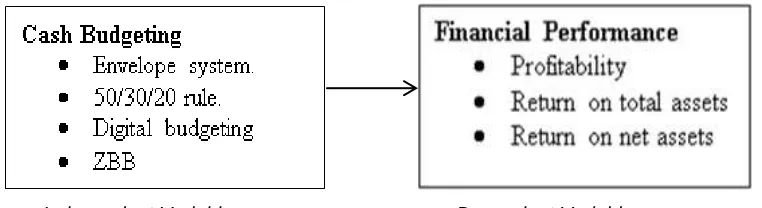
Independent Variable Dependent Variable
Figure 1: The Conceptual Framework
RESEARCH METHODOLOGY
The descriptive survey research design was used in this study. All the MSEs in Kenya were the target population of the study. Accessible population of the study constituted the 20,399 small traders registered by County government of Uasin Gishu Ministry of Trade and distributed in Eldoret Town and its estates as at August 2018.
Licensed under Creative Common Page 154
government of Uasin Gishu trade licensing department. Simple random sampling was used to select the respondents that participated in the study proportionately (Ogula, 2010). Both descriptive and inferential statistics were used for data analysis. Descriptive statistical tools included percentages, means and standard deviations. Inferential statistics included multiple regression analysis and Pearson Product Moment Correlation. The study adopted the following multiple regression model.
Y=β0+β1X1 +ε………...…………./………...…....Equation 1
Where; Where; Y represents financial performance of MSEs in Eldoret Town Uasin Gishu County, Kenya
β0 represents the y-intercept
β1, represent coefficients cash budgeting
X1 represents Cash budgeting
ε represents stochastic disturbance error term.
RESULTS AND DISCUSSION
Relationship between Cash Budgeting and Financial Performance
The relationship between Cash budgeting and financial performance of MSEs was determined. Table 1 presents the results of correlation analysis.
Table 1: Correlation Analysis for Cash Budgeting
Variable Financial Performance of MSEs
Cash Budgeting Pearson Correlation .354*
Sig. (2-tailed) .000
**. Correlation is significant at the 0.01 level (2- tailed).
Licensed under Creative Common Page 155
Table 2: Normality Test Results
Independent variables Kolmogorov-Smirnov Sig
Statistics
Cash Budgeting 1.757 0.072
The data is considered to come from a normal distribution if the significance value is greater than 0.05. Table 2 shows that all our sample values were above 0.05. This is an indication that our data is normally distributed.
Multicollinearity Assumption
The study tested multicollinearity assumption by use of tolerance and variance inflation factor (VIF). There is a potential problem if tolerance is below 0.2. Results of Analysis are shown in Table 3.
Table 3: Collinearity Statistics
Model Collinearity Statistics
Tolerance VIF
Cash budgeting 0.927 1.338
Cash budgeting had the Highest correlation with other independent variables (Tolerance= 0.927; VIF=1.338). Tolerance level was close to 1 and VIF was also close to 1. This is far from the threshold of 0.1 and 10 for Tolerance and VIF respectively.
Independence of Residuals Assumption
The study used Durbin- Watson statistic to test for autocorrelation.
Table 4: Durbin Watson statistics
R R Square Adjusted Std Error Durbin
R square of Estimates Watson
.66 .44 .43 0.591 1.942
Licensed under Creative Common Page 156
Therefore, the Durbin-Watson Coefficient of 1.942 indicates that observations are within the threshold. This implies that the observations or individual data points to be are uncorrelated.
Test of Significance
The results of Analysis of Variance (ANOVA) are shown in Table 5.
Table 5: Results of ANOVA
Model Sum of Squares df Mean Square F Sig
Regression 40.90 4 10.22 20.33 .000a
Residual 65.88 131 .50
Total 106.78 135
a. Predictors: (Constant), Cash budgeting
b. Dependent Variable: Financial performance
The findings of the study indicate that the relationship between the independent variables and the dependent variable was statistically significant (F=23.33; p< 0.05). This implies that the multiple regression model was good fit for the data. Hence cash management techniques; cash budgeting, should be put into consideration.
Regression Coefficients
The study also conducted t-test of statistical significance of each individual regression coefficient.
Table 6: Significant Test Results for Overall Model
Independent Unstandardized Standardized t Sig.
Variables Coefficients Coefficients
B Std. Error Beta
(Constant) -1.232 .322 -5.564 .000
Cash budgeting .209 .179 -.325 -1.708 .022
a. Dependent Variable: financial performances of MSEs
Licensed under Creative Common Page 157
Hypotheses Testing
Hypothesis tested at a predictable significant level of 0.05. The acceptable/ rejection criteria were determined by p-value were compared with significant level of 0.05. The objective of the study was to determine the effect of cash budgeting on financial performance of micro and small enterprises at Eldoret Town in Uasin Gishu County.
H01 stated that there is no significant relationship between cash budgeting and financial
performance of micro and small enterprises at Eldoret Town in Uasin Gishu County.
The research findings indicated that cash budgeting is significant predictor of financial performance (p=0.022<0.05). The study rejected the null hypothesis that there is no significant relationship between cash budgeting and financial performance of micro and small enterprises at Eldoret Town in Uasin Gishu County at a significant level of 5% (t=-1.708). The research concluded there is significant relation between cash budgeting and financial performance of micro and small enterprises at Eldoret Town in Uasin Gishu County.
CONCLUSIONS
A number of conclusions were made in respect of the study findings. The conclusions are in line with the study objectives. From the findings of the study, it was concluded that cash management practices has an effect to the financial performance of MSEs. Cash budgeting in consideration to the argument of risk based budgeting theory the significance of maximizing returns that is attributed to budgeting approach indicated the significance to the financial performance. All the techniques of cash budgeting have significant effect on financial performance.
RECOMMENDATIONS
The study recommends that MSEs should have cash budgeting in their cash management practice. Cash budgeting will minimize risk of overspending and promote focus one spending. It also reduces unnecessary spending and promotes efficiency. Cash budgeting reduces wastages of unnecessary spending and focus intended money for the correct use. The study recommends that MSEs should budget their funds in relation to the expected returns. It is significant that MSEs should consider growth in their businesses by considering best cash management practices are operational in their firms
Licensed under Creative Common Page 158
should come up with sensitization programs on how to acquire funding to support MSEs alongside county governments. To the owners of MSEs to take risk for high return in their business operations and seeking for financial supports that are of low cost. To financial consultants the study emphasizes on cash budgeting as significant to the financial performance of MSEs and other enterprise of the same categories.
SCOPE FOR FURTHER STUDIES
The study recommends further research on the effect of mobile transfers on financial performance and cash reserves and cash projections on performance of small businesses. The study also recommends the study on mobile loans and sustainability of small enterprises in local towns. Effects of investment strategies to financial performance of micro enterprises are of significant for further study
REFERENCES
Abogun, S. & Fagbemi, T.O. (2012). The Efficacy of Budgeting as a Control Measure in Developing Economies: A Study from Nigeria, Asian Journal of Social Science, 8 (1), 176-182. http://www.ccsenet.org/journal/index.php/ass/article/view/11335
Ahmad, M., & Abdul-Kadir, S. (2013). Characteristics of Entrepreneurs and the Practice of Islamic values in influencing the success of Small Medium Enterprises in Kelantan and Selangor. Journal of Social and Development Sciences, 4(5), 229-35.
Ahmad, S. Z., N. S. A. Rani , S. K. M. Kassim. (2011). Business Challenges and Strategies for Development of Small and Medium Sized Enterprises (SMEs) in Malaysia. International Journal of Business Competition and Growth, 1(2), 177–197.
Ahmad. K (2014) The Adoption of Management Accounting Practices in Malaysian Small and Medium-Sized Enterprises. Asian Social Science; 10, (2); Published by Canadian Center of Science and Education. https://www.edology.com/online-courses
Ahmad.N.N ,(2016). Cash Management Practices in Micro and Small Businesses in Malaysia. Department of Accounting. Journal of Education and Social Sciences, 4(2)331-335.jesoc.com
Akande, Olusola. and Oluwaseun Y.(2014). Influence of Budgeting System on Entrepreneurial Business Performance: perspective of Small business Owner in Lagos state Nigeria. Journal of Business and Management. 16(6).58-64.
Akinyomi, O. J. (2014). Effect of Cash Management on Profitability of Nigerian Manufacturing Firms. International Journal of Marketing and Technology. 4(1), 129-140. https://www.researchgate.net/publication/
Attom, E.B. (2014). Cash Management Practices by Micro and Small-Scale Enterprises at KasoaIn The Central Region Of Ghana. Asian Journal of Business and Management Sciences, 3(2), 1-12.http://www.ajbms.org/articlepdf/1ajbms201303022754.pdf
Biljon, V. (2015).SA SMEs Struggle with Cash Flow as a Result of Delayed Payment. Available at:http://www.businesspartners.co.za/media-room/press-releases/posts.
Bruwer, J.P. (2015). The Usefulness of Cash Budgets in Micro, Very Small and Small Retail Enterprises Operating in the Cape Metropolis, Expert Journal of Business and Management, 3 (1), 1-12. http://business.expertjournals.com/23446781-302/
Chelogoi K.S. and Nyagar , (2013)The Effects of the Microfinance Institutions on Small Scale Business Growth: A Survey of UasinGishu County, Kenya. Elixir Financial Management. International Journal 5, (6), 3402-13406.
Licensed under Creative Common Page 159 Enow T.S and Kamala.P.(2016). Cash Management Practices of Small, Medium and Micro Enterprises in the Cape Metropolis, South Africa. Investment Management and Financial Innovations, 13 (1), 230-236.
G.O.K (2010). Kenya Vision 2030; The Popular Version, Nairobi: Government Printer. http://vision2030.go.ke/inc/uploads/2018/05/Vision-2030-Popular-Version.pdf
Gilbert, U., Nellson, O., & Nicholas, G. O. (2013).Cash Management Utilization by Small Medium Enterprises in Northern Uganda. Merit Research Journal of Accounting, Auditing, Economics and Finance, 1(5), 67-80.
Gok. (2014). Economic Survey. Nairobi: Government Printers.
https://pdfs.semanticscholar.org/14ee/f7d9ef776b7d24b0f9b67889dc653189239d.pdf
Harvard Business Review – Analytic Services. (2011). Risk Management in a Time of Global Uncertainty. A report sponsored by Zurich Financial Services Group.https://www.zurich.de/_/media/dbe/corporate/docs/general/risk-management-in-a-time-of-global-uncertainty.pdf?la=en
Hoque.M.Z, (2017) Mental Budgeting and the Financial Management of Small and Medium Entrepreneurs. General & Applied Economics . Research Article. Cogent Economics & Finance. https://www.tandfonline.com/doi/full/10.1080/23322039.2017.1291474
Karanagh.C. S. (2011) Zero Base Budgeting. Modern Experience and Current Perspectives. Government finance officers .Association Research and Consulting center .Calgary, Alberta 1-26.http://mrsc.org/getmedia/
Kasim, H., Mutula, Z., & Antwi, K. S. (2015).Cash Management Practices and Financial Performance of SMEs in the Northern region of Ghana. International Journal of Economics, Commerce and Management, 3 (7).456-480.
Kusnadi, Y, Wei, K.C.J. (2011), The Determinants of Corporate Cash Management Policies: Evidence from Around the World. Journal of Corporate Finance, 17(3), 725-740.https://econpapers.repec.org/article/eeecorfin/
Micro and Small Enterprises Act No. 55 of 2012 .Published by the National Council for Law Reporting with the Authority of the Attorney-General .www.kenyalaw.org
Mugenda, A. G. (2008). Social Sciences Research: Theory and principles. Nairobi: Applied Research and Training Services.
Mulani.J,Chi.G. andYang.J. (2015) Effects of the Budgetary Process on SME’s Performance: An Exploratory study based on Selected SME’s in India. Research Journal of Finance and Accounting. 6 (14),135-153.
Mutanda, M. (2014). The Perception of Small & Micro Enterprises in the City of Durban Central Business District (CBD) (KZN) Towards Financial Planning, Mediterranean Journal of Social Sciences, 5 (6), 153-165.
Muthama.R.A.(2016)Effects of Cash Management Practices on Operational Performance of Selected Public Hospitals in Kisii County, Kenya.
Naidu, S. & Chand, A. (2011).“A comparative Study of the Financial Problems Faced by Micro, Small and Medium Enterprises in the Manufacturing sector of Fiji and Tonga”, International Journal of Emerging Markets, 7(3), 245-262. Oluoch .J.O (2016). The Impact of Cash Management Practices on Performance of SMEs: A Survey of SMEs in Eldoret Central Business District. Journal of Economics and Finance. 7(6), 01-07.
Onduso, E. O. (2013).The Effect of Budgets on Financial Performance of Manufacturing Companies in Nairobi County.New Business Journal, 7(8), 46-74.
Petrakis, P. E., & Kostis, P. C. (2012).The Role of Knowledge and Trust in MSEs. Journal of the Knowledge Economy, 6(1), 105-124https://ideas.repec.org/a/spr/jknowl/v6y2015i1p105-124.html
Phenya, A. (2011). An Assessment of Financial Management skill of Small Retail Business owner/manager, in Dr. J.S. Moroka Municipality, Unpublished Master’s thesis. South Africa, University of South Africa.