Unitization During Category Learning Robert L. Goldstone
Indiana University
Correspondence Address: Robert Goldstone
Department of Psychology Indiana University
Bloomington, IN. 47408
Other Correspondences: [email protected] (812) 855-4853
Abstract
Five experiments explored the question of whether new perceptual units can be developed if they are diagnostic for a category learning task, and if so, what are the constraints on this unitization process? During category learning, participants were required to attend either a single component or a conjunction of five components to correctly categorize an object. Evidence consistent with unitization was found in that the conjunctive task became much easier with practice, and this improvement was not found for the single component task, or for conjunctive tasks in which the components could not be unitized. Influences of component organization (Experiment 1), component contiguity (Experiment 2), component proximity (Experiment 3), and number of components (Experiment 4) on practice effects were found. Using a Fourier transformation method for deconvolving response times (Experiment 5), prolonged practice yielded responses that were faster than predicted by an analytic model that integrates evidence from independently perceived components.
Unitization During Category Learning Interest in the mutual interactions between our perceptual and conceptual systems has resurfaced repeatedly. In anthropology, Sapir and Whorf (Whorf, 1941/1956) posited influences of language on perception, and in psychology, the “New Look” movement (Bruner & Postman, 1949) argued that high-level cognitive processes altered people’s ability to identify objects, make discriminations between objects, and make accurate judgments of an object’s attributes. Both of these historical movements have been resurrected, as new evidence for linguistic relativity (Gumperz & Levinson, 1991) and a “New New Look movement” (Niedenthal & Kitayama, 1994) have emerged.
The research reported here explores one possible influence of conception on perception: the functional unitization of perceptual components due to categorization experience. It is generally acknowledged that our categorization judgments are driven by our perceptions, and this influence is incorporated in almost all successful models of
categorization (Nosofsky, 1986). However, it is possible that our categorizations also drive our perceptions. In particular, if a certain stimulus component is diagnostic for a required categorization, people can increase their categorization accuracy by becoming selectively tuned to the component. If the component is already part of the person’s perceptual “vocabulary,” then categorization demands can be met simply by increasing attention to the component (Kruschke, 1992; Nosofsky, 1986). However, if the component does not already exist in one’s vocabulary, then becoming tuned to the component first entails adding it to the vocabulary (Goldstone & Schyns, 1994; Schyns, Goldstone, & Thibaut, in press; Schyns & Murphy, 1994).
“Perceptual vocabulary” refers to the elementary building blocks used to create object representations. Evidence for membership in a perceptual vocabulary is typically based on functional behavior. For example, Treisman and Gelade (1980) argue for a vocabulary of features that includes color, orientation, and closure elements. These features are empirically identified by response times to targets that are not influenced by the number of distracters if the targets are distinguished by a feature, fast segregation of textures if the textures have unique features (Julesz, 1981), illusory conjunctions involving features from different objects if attention is not focused on the objects, and all-or-none disappearance of features when images are retinally stabilized (Hebb, 1949). Evidence for vocabulary elements can also be obtained by neurophysiological recordings, such as Hubel and Wiesel’s (1968) original work indicating primary visual cortex neurons selectively tuned to particular line orientations (for more recent work, see Perrett & Oram, 1993).
times on the number of distracter elements, suggesting that the conjunction of color and form features was not added as a separate vocabulary element over time. However, other research has shown an influence of life-long (Wang, Cavanagh, & Green, 1994) and laboratory-induced (Laberge & Samuels, 1974; Shiffrin & Lightfoot, 1997; Treisman, Vieira, & Hayes, 1992) experience on feature search. The research to be reported here further tests the adequacy of this “fixed vocabulary” hypothesis, not within a feature search paradigm, but in a categorization task. The particular type of vocabulary additions that I will explore are unitizations - situations where a single “chunk” is formed from perceptual components if the chunk is diagnostic.
Perceptual Consequences of Category Learning
The notion that category learning can have perceptual consequences has recently been the source of substantial empirical inquiry. Work on categorical perception has shown that our ability to make perceptual discriminations is influenced by the categories we possess (see Harnad, 1987). Specifically, discriminations involving pairs of stimuli that straddle a category boundary are more easily made than are discriminations involving stimuli that fall within the same category, equating for physical dissimilarity between the pairs. Further research has indicated that the visual categories that influence perceptual discriminability need not be innate, but rather may be learned within a laboratory context (Goldstone, 1994; Lane, 1965). Laboratory-acquired visual categories can also influence perceptually-based similarity ratings (Harnad, Hanson, & Lubin, 1994). Objects that are placed in different categories are given lower similarity judgments than the same items are when they are placed in the same Livingston, Andrews, & Harnad, 1998; Kurtz, 1996). Lin and Murphy (1997) have shown that the conceptual knowledge associated with a category, manipulated by assigning different functional descriptions to the same items, can influence participants’ speed at verifying perceptual properties. Likewise, Jonides and Gleitman (1972) found that the interpretation of an ambiguous symbol influenced how quickly visual searches were conducted when it was a target. In short,
learned categories can influence the speed and sensitivity with which perceptual properties are processed.
In addition, category learning can affect how an object is segmented into parts. Schyns and Murphy (1993, 1994) formulated a Functionality Principle whereby if a fragment of a stimulus is diagnostic for categorization (distinguishes members from non-members), then the fragment is instantiated as a unit. Consistent with this principle, they found that objects were more likely to be segmented into parts that were useful for categorizing them (see also Schyns & Rodet, 1997). Subjective segmentations were obtained by asking participants to draw outlines around the parts of objects. A similar influence of categorization on the segmentation of objects was shown by Pevtzow and Goldstone (1994). Stick figures composed out of six lines were categorized in one of two ways. Different arbitrary combinations of three contiguous lines were diagnostic for the different categorizations. After categorization training, participants made part/whole judgments, responding as to whether a particular set of three lines (a part) was present in a whole stick figure. Participants were significantly faster to determine that a part was present in a whole when the part was previously diagnostic during categorization. Whereas previous research has focused on objective properties of an object (e.g. the proximities, similarities, and shapes of the line segments) that determine how people will decompose it into segments (Palmer, 1978), the above results indicate that the person’s experience also influences how they will segment an object into parts. Such an influence of experience on segmentation is predicted by Behrmann, Zemel, and Mozer’s (1998) neural network model that groups together stimulus components that often co-occur and preferentially uses these learned groups for interpreting subsequent stimuli (see Goldstone et al, in press, for an alternative computational model).
degrees in the picture plane is much greater for specialized, highly practiced stimuli than for less specialized stimuli. For example, recognition of faces is substantially less rapid and accurate when the faces are inverted. This large difference between upright and inverted recognition efficiency is not found for less highly practiced objects. Diamond and Carey (1986) found a large inversion cost for dog breed recognition, but only for dog experts. Similarly, Gauthier and Tarr (1997; see also Gauthier, Williams, Tarr, & Tanaka, 1998) found that large inversion costs for a particular nonsense object can be created in the laboratory by giving participants prolonged experience identifying the object. They conclude that prolonged experience with an object leads to a configural representation of it that combines all of its parts into a single, viewpoint specific, functional unit. The relation between large inversion costs for recognition and configural processing is not completely clear. In addition to showing strong inversion costs, faces also show evidence of configurality in that identifying a face part is facilitated by preserving the rest of the face’s features (Tanaka & Farah, 1993). However, this advantage of identifying a part within a preserved whole rather than in isolation is not always increased with expertise (Tanaka & Gauthier, 1997) as might be expected if perceptual learning leads to greater unitization.
Unitization
The previously reviewed literature indicates that one result of category learning is to create perceptual units that combine stimulus components that are useful for the categorization. Such a process is one variety of the more phenomenon of unitization, by which single functional units are constructed that are triggered when a complex configuration arises (Goldstone, 1998). Cattell (1886) invoked the notion of perceptual unitization to account for the advantage that he found for tachistoscopically presented words relative to non-words. Gestalt psychologists proposed the perceptual principle that objects will tend to be perceived in terms of components that have acquired familiarity (Koffka, 1935). Weisstein and Harris (1974) found that briefly flashed line segments are
more accurately identified when they are part of a set of lines forming a unitary object rather than an incoherent pattern. They interpreted this effect as showing that arrangements of lines can form configural patterns that are perceived before the individual lines are perceived.
Unitization has been explored in the field of attention. Using a task where participants decided whether or not two visual objects were identical, Laberge (1973) found that when stimuli were unexpected, participants were faster at responding to actual letters than to letter-like controls. Furthermore, this difference diminished as the unfamiliar letter-like stimuli became more familiar over practice. He argued that the shape components of often-presented stimuli become processed as a single functional unit with practice.
More recently, Czerwinski, Lightfoot, and Shiffrin (1992) have referred to a process of perceptual unitization in which conjunctions of stimulus features are “chunked” together so that they become perceived as a single unit. Shiffrin and Lightfoot (1997) argued that separated line segments can become unitized following prolonged practice with the materials. Their evidence comes from the slopes relating the number of distracter elements to response time in a feature search task. When participants learned a conjunctive search task in which three line segments were needed to distinguish the target from distracters, impressive and prolonged decreases in search slopes were observed over 20 hour-long sessions. These prohour-longed decreases were not observed for a simple search task requiring attention to only one component. In addition, when participants were switched from a conjunctive task to a simple feature search task, there was initially little improvement in search times, suggesting that participants were still processing the stimuli at the level of the unitized chunk that they formed during conjunctive training. The authors concluded that conjunctive training leads to the unitization of the set of diagnostic line segments, resulting in fewer required comparisons.
arrangements of letters to occur frequently while other non-word arrangements rarely if ever occur. The evidence on whether the letters that comprise a word are unitized together into a single functional unit is mixed. In evidence favoring unitization, researchers have found that word units can be processed automatically and interfere with other processes less than do nonwords (LaBerge & Samuels, 1974; O’hara, 1980; Smith & Haviland, 1972). Results have shown that the advantages attributable to words over nonwords cannot be explained by the greater informational redundancy of letters within words (Smith & Haviland, 1972). Disrupting the standard physical appearance of a target in a lexical decision task by mixing upper and lower case letters harms word judgments more than non-word judgments, but only for brief presentations (Allen, Wallace, and Weber, 1995), a result interpreted as suggesting an initial bias to process words holistically. Words are often times identified faster than letters within words (Johnson, 1975), and this advantage disappears when the word or pattern-level information can not be unitized (Johnson, Turner-Lyga, & Pettegrew, 1986). Increasing familiarity with words can lead to people having difficulty detecting letters within the words (Tao, Healy, and Bourne, 1997), consistent with the notion that a strong word-level unit interferes with a decomposition of this unit into features.
However, other researchers have argued that results suggesting that recognition processes occur at levels higher than individual letters. Paap, Newsome, and Newell (1984) argue that using mixed cased letters (as Allen et al do above) may slow performance not by disrupting word-level shape cues, but by slowing processing at the letter level. In a review of the literature on holistic, word-level processing and analytic, letter-level processing, Besner and Johnston (1989) conclude that analytic processing is a necessary component in word recognition models. Although models of analysis and unitization in word perception are directly relevant to the current research, word perception may differ from the type of novel object perception explored here. On the one hand, the units formed during a lifetime of word learning are potentially stronger than the units learned following a few hours of
experience with a novel shape. On the other hand, the bias for analytic processing may be greater for words than for our novel “doodles” because the letters that comprise a word are clearly delineated and separable entities whereas the parts that comprise doodles are fused together and contiguous with each other. As such, the current studies have a similar objective to the above word recognition literature, to explore evidence for perceptual processes that respond to information at levels higher than the individual components, but words and novel objects may yield different results.
A New Source of Evidence for Unitization The purpose of the current set of experiments is to test whether category learning can lead to stimulus unitization, and to explore the boundary conditions on unitization related to stimulus characteristics and amount of training. The experiments explore unitization, but from a somewhat different perspective from the work in attention. First, the experiments are primarily interested in the influence of category learning on unitization, under the hypothesis that a unit will tend to be created if the parts that comprise the unit frequently co-occur, and the unit is diagnostic for categorization. Second, a new technique for analyzing response times is developed that compares response time distributions from a conjunctive categorization task to the expected distribution based on analytic models that do not incorporate unitization. Evidence for unitization is obtained if the observed response time distribution for a conjunctive categorization task contains response times that are faster than predicted by analytic models that base conjunctive responses on several individual component judgments.
be sensitized, then an implausibly large number of vocabulary items would be required under the constraint that all vocabulary items are fixed and a priori . The second objection is that no units need be formed; instead, people analytically integrate evidence from the five separate curves to make their categorizations. However, this objection will be untenable if subjects, at the end of extended training, are faster at categorizing the units than would be expected by the analytic approach. Quantifying what “faster than expected” means is the main business at hand, and will not fully be addressed until Experiment 5.
Experiment 1
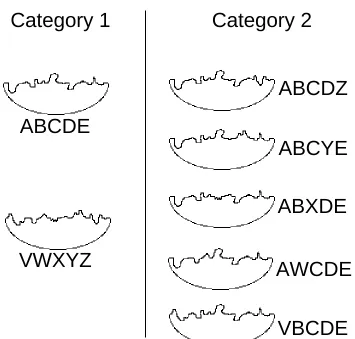
Experiment 1 explores the unitization of visual components to attain greater efficiency in a categorization task. The categorization task is designed so that evidence from five components must be received before certain categorization responses are made. For this reason, the critical categorization is a conjunctive task. The stimuli and their categorizations are shown in Figure 1. Each letter refers to a particular segment of the stimulus. Each stimulus is composed of five segments, joined below by a broad U-shape in order to create a closed object. To correctly place the stimulus labeled “ABCDE” into Category 1, all five components, “A,” “B,” “C,” “D,” and “E,” must be processed. For example, if the right-most component is not attended, then ABCDE cannot be distinguished from ABCDZ which belongs in Category 2. Not only does no single component suffice for accurate categorization of ABCDE, but two-way, three-two-way, and four-way conjunctions of components (posited by researchers such as Gluck & Bower, 1988, and Hayes-Roth & Hayes-Roth, 1977) also do not suffice. For example, the three-way conjunction “C and D and E” is contained in the stimulus ABCDE, but this conjunction does not discriminate ABCDE from AWCDE or VBCDE. Only the complete five-way conjunction suffices to reliably categorize ABCDE.
If unitization occurs during categorization, then it is possible that the stimulus ABCDE comes to be treated functionally like a single component with training. If this occurs, then participants should be able to quickly respond that this stimulus belongs to Category 1.
Instead of responding by integrating the results from separate components, the categorization response may eventually be made by consulting a single detector. As this detector unit becomes established, response times to categorize the ABCDE pattern should decrease. In the current experiment, a pronounced decrease in the time required to categorize the conjunctively defined stimulus ABCDE will be taken as evidence of unitization.
If an influence of practice on response time is in fact found, then model fits to a power function will be used to assess the nature of this influence. The power function takes the form
In order for improvements in the conjunctive task to be taken as evidence for unitization, two important control conditions are necessary. First, it is important to show that tasks that do not require unitization do not show comparable speed ups. To this end, a control task is included that allows participants to categorize the item ABCDE by attending only a single component rather than a five-way conjunction. This “One” (component) condition should not result in as much speed up as the “All” (components) condition where all components must be attended. If it does, then the speed up can be attributed to a simple practice effect rather than unitization. Second, it is important to show that stimuli that cannot be unitized also do not show comparable speed ups. For this control task, a five-way conjunction of components must be attended, but the ordering of the components within the stimulus is randomized. As such, a single template cannot serve to categorize the ABCDE stimulus. Assuming that unitization requires that the components to be chunked appear in a consistent or template-like manner (Gauthier & Tarr, 1997; Schneider & Shiffrin, 1977), these randomly ordered stimuli should not afford unitization, and thus are not expected to yield significant speed ups.
In sum, Experiment 1 explores the possibility that five curved segments, when combined together to create a contiguous, coherent object, may become treated as a single unit with practice. It is highly unlikely that the unit existed in the participants’ perceptual vocabulary prior to training because the unit is randomly selected from an extremely large set of other units (the set of all of possible ways of ordering five segments, each chosen from a set of ten segments). The potential evidence from this experiment for unitization would come from substantial improvement in a conjunctive task that involves unitizeable stimuli, but not in a conjunctive task involving hard-to-unitize stimuli, and not in a simple component detection task that does not require unitization.
Method
Participants . Seventy-two undergraduate students from Indiana University served as participants in order to fulfill a course requirement. The students were evenly split into the four between-subject conditions.
Materials . Stimuli were formed by selecting five line segments without replacement from a set of 10 segments. The displayed objects consisted of five curved lines combined together, and joined by a bowl shape. Each horizontally arranged segment was 0.8 cm long and 0.5 cm high. The entire length of a stimulus was 4 cm, and the height was 1.7 cm. The viewing distance was approximately 40 cm, yielding a visual angle of 5.7 degrees for the horizontal length of each stimulus. The starting and ending points of each segment were located at the vertical midline, and consequently, all segments could be joined with each other to create a seamless stimulus. Sample stimuli are shown in Figure 1. Each of the ten segments can be associated with a different letter of the alphabet for descriptive purposes. The assignment of segments to letters was randomized for each participant. As such, the object that is abstractly represented by “ABCDE” was composed of different segments for different participants.
Design . In the “All” task, the objects that are abstractly described as “ABCDE” and “VWXYZ” belonged to Category 1, and the objects “ABCDZ,” “ABCYE,” “ABXDE,” “AWCDE,” and “VBCDE” belonged to Category 2. This stimulus structure is shown in Figure 1. Given these category memberships, all five curves need to be attended in order to reliably place the object ABCDE into Category 1. The five members of Category 2 were created by replacing one of ABCDE’s segments with a new segment. The object ABCDE was presented four times more frequently than any of the other six objects, which were all presented equally often. Given this, the category validities (the probability of a segment, given a category) for every segment and category were equal, as were the cue validities (the probability of a category, given a segment). The item VWXYZ was included in Category 1 so that no segment, by itself, would provide probabilistic evidence in favor of Category 1 or 2.
frequently than it was in the All task, so that both categories were presented equally often. Given these categories, to categorize ABCDE as belonging to Category 1, it is only necessary to attend to a single segment. For example, if Category 2 contained the object ABCDZ, then noticing the presence of segment “E” provides sufficient evidence for a Category 1 judgment.
Procedure . Participants were given 320 categorization trials. On each trial, an object appeared on the screen, and participants pressed one of two keys to indicate the object’s category membership. The object appeared on the screen until a response was made. Participants received feedback indicating whether their guess was correct, and if incorrect, were shown the object’s correct categorization. Feedback was displayed for 400 msec, followed by an inter-trial blank interval of 400 msec. As such, there was no explicit warning signal given before the onset of each object, but participants could potentially use the 400 msec interval after the feedback to prepare for the next trial. Participants were told that both accuracy and speed were important and that they should make their responses as quickly as possible without sacrificing accuracy. Participants who made more than 5% errors on a particular block were asked to try to increase their accuracy. An equal number of Category 1 and 2 objects were displayed, randomly ordered. Each participant received a different random order.
Half of the participants were given objects generated according to the All task, and the other half were given objects generated according to the One task. Four groups of participants were obtained by combining this All versus One split with a second orthogonal split: Ordered versus Random. For the Random group, any ordering of the same components counted as the same object. As shown in Figure 2, any one of the 120 orderings of the five components A, B, C, D, and E acted as an example of ABCDE. In this condition, when an object was selected to be displayed, the spatial ordering of its five segments was randomized. In the Ordered condition, the spatial positions of the five segments was fixed. As such, the object ABCDE had the same exact appearance every time it was displayed in the ordered condition.
What object was displayed on a given trial was randomized, subject to the constraint that objects and categories were presented with their stipulated frequency over the course of the experiment. The spatial position of the object was randomized using a uniform distribution such that the object appeared within a 20 by 20 cm square positioned in the center of the screen. The 320 trials were broken down into 4 blocks of 80 trials. Rest breaks were provided between blocks. During the break, the average accuracy and response time for the preceding block of trials was displayed. In the initial instructions, participants were shown all of the objects and their correct category assignments, and viewed the objects until they felt they knew which objects belonged to which categories. At the end of the experiment, fifty-eight of the 72 participants (those participants that completed the experiment with sufficient time remaining to answer questions) were asked what strategies they used to categorize items as quickly as possible. In particular, they were asked which of the following two strategies best characterized their behavior: A) “I tried to look for each of the parts of the doodle that was important for categorizing it,” or B) “I tried to remember an overall image of what some of the doodles looked like, and used this to categorize them.” The experiment took about 55 minutes to complete.
Results
mse = 18.2, p < .01, indicating that practice increased speed of categorization.
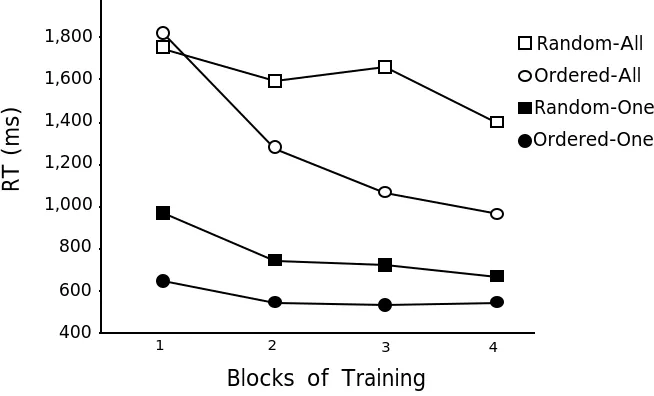
However, these main effects were modulated by a predicted three-way interaction between the ANOVA variables, F(3, 204) = 9.1, mse = 13.7, p < .01. As shown in Figure 3, the practice effect due to blocks was most pronounced for the All, Ordered condition. There was also a substantial practice effect for the All, Random condition, but it was not even half as large as it was for the All, Ordered condition. Practice effects for the two One conditions were quite small.
To assess the nature of the improvements across the conditions, power functions were fit to each participant’s response times on each of the four blocks from each of the four conditions using non-linear regression within SPSS 6.0. That is, each participant provided separate estimates for the best-fitting values for the three constants of the power function. The average best fitting functions were:
RT All, Ordered 0.468 + 1.15 N -0.942
RT All, Random = 0.491 + 0.71 N -0.33
RT One, Ordered = 0.341 + 0.107 N -4.62
RT One, Random = 0.450 + 0.316 N -1.68
Predicted response times were measured in seconds and N refers to the block number (1-4). All four of these non-linear regressions account for at least 97% of the variance in response times as a function of practice. ANOVAs on the three constants indicated no influence of condition on the best-fitting value for constant a (asymptote), F(3,204) =0.2, mse = 0.44, but influences of condition on both b (total improvement), F(3, 204) = 6.1, p < .01, mse = 0.29, and c (learning rate), F(3, 204) = 3.2, p <.01, mse = 1.06. Learning rate and total improvement are, if anything, negatively correlated, with steep learning rates belonging to the One conditions that show relatively small total amounts of improvement. One interpretation of the steep learning rates for c in the two One conditions is that general familiarization with the experiment leads to large improvements from Block 1 to Block 2, but thereafter, little improvement is observed because the simple stimuli offer little opportunity for increased processing efficiency. The most striking difference
between the All, Ordered condition and the other conditions occurs on the b value.
In the All condition, response times for the other items were faster than for “ABCDE.” Response times for the five items belonging to Category 2 were combined because these items were logically equivalent. Overall, collapsing across the ordered and random groups of participants, the Category 2 items were responded to in 1195 msec, which was significantly different from the 1354 msec required to respond to ABCDE, paired t ( 35) = 5.4, p < .01. Similarly, although ABCDE occurred more frequently than VWXYZ, the average correct response time for categorizing the latter object, 1121 msec, was significantly faster, paired t (35) = 4.9, p < .01. Presumably, the relatively fast response times for this item is because any two-way conjunction of segments suffices to make the VWXYZ categorization, whereas ABCDE requires a full five-way conjunction in the All condition if a single unit is not formed and used. Thus, the slower response time for ABCDE than VWXYZ may reflect the imperfect unitization of ABCDE; even after practice some responses to this item may be made by combining evidence from individual components. Consistent with this hypothesis, the variances within individual participants’ response times were much larger for ABCDE than VWXYZ, paired t (35) = 7.1, p < .01, suggesting that responses to ABCDE may reflect a mixture of responses based on units and explicitly combined information from individual components. Fast responses to ABCDE may reflect responses based on complex units, whereas slow responses reflect analytically combined evidence from simple components. Also relevant to the unitization hypothesis, the speed advantage of Category 2 items over ABCDE in the All condition decreases over blocks of practice, as shown by a significant Item X Block interaction, F(3, 102) = 4.6, mse = 1 3.2, p < .01.
Ordered One = 2.8%, F(3,204) = 8.4, mse = 1.4, p < .01. These error rates exhibit the same ordering as the response times with the slowest task being the most error prone. In no case was there any indication of a speed-accuracy tradeoff where one condition yielded faster response times but decreased accuracy than another condition. There was no significant interaction between condition and blocks on error rates, F(9, 612) = 0.7, mse = 2.1, p > .1.
Participants in the four different conditions differed in their self-report of strategy. The percentages of participants claiming that they used the holistic strategy of memorizing entire objects, rather than looking for particular segments, were 25%, 7%, 75%, and 7% for the Random All, Random One, Ordered All, Ordered One conditions respectively, Chi-square (3) = 23.65, p < .05. This result is consistent with the response time evidence that participants in the Ordered All task develop a single unit to recognize the Category A item rather than decomposing it into parts and recognizing it through those parts. That is, participants in the Ordered All task, the task that was hypothesized to yield the strongest unitization, were the most likely to report basing their judgments on matching items to whole stored images of objects.
Discussion
Experiment 1 provided suggestive evidence for unitization of a consistent, multi-segment stimulus in a categorization task. Unitization was suggested by the pronounced and gradual improvement in the speed of categorizing objects. This speed up was particularly striking when the object to be categorized required attention to be placed on all of its parts, and when the parts could be easily combined into a coherent image.
The first of these provisions is indicated by the far greater improvement in categorization for the All task than for the One task. In fact, after the first block of training, there was no significant improvement in the One task. This is predicted if the All task benefits from the construction of functional units that span across multiple segments, and if the construction of these units takes time. The gradual nature of unitization is supported by Czerwinski et al’s (1992) observation that improvements in a conjunctive feature search
task were found after even as much as 20 hours of practice.
The second provision, emphasizing the value of practice for unitizeable stimuli, is suggested by the comparison of the Ordered and Random conditions. The All task for both of these conditions requires attention to all five of the segments that compose a stimulus. However, when the five segments were randomly located within the stimulus, then practice effects were greatly attenuated. One explanation of this difference is that a single unit that represents an entire stimulus can only be formed when it is presented in a visually constant form. Expressed in a slightly different way, unitized representation may be photograph-like images in that they preserve the stimulus information in a relatively raw, unprocessed, spatially constrained form. This conjecture gains support from other work showing that units that are acquired over practice preserve many of the properties of actual images (Gauthier & Tarr, 1997; Shiffrin & Lightfoot, 1997). If units are constrained to be image-like representations, then randomization of the segments within an image would preclude unitization because it prevents a stimulus from being associated with a single image.
The power function modeling indicated that the unitizeable stimuli of the Ordered, All condition yield relatively large amounts of improvement in response times, rather than particularly fast overall response times or rates of improvement. Thus, the suggestion is that the hallmark of unitization should be the amount, rather than the speed, of improvement. This is consistent with the relatively gradual improvements that have been observed for conjunctively-defined targets (Shiffrin & Lightfoot, 1997).
improvement of the One task. One problem with this account is that the practice effect for the Ordered All task was more than five times greater than it was for the Ordered One task. Also, the explanation cannot be this simple because the Random All task required at least as many segment comparisons as the Ordered All task did, but did not show a comparable practice effect. In fact, the Random All task required more comparisons if some segments that were consistently placed together in the Ordered condition came to act as a single segment. Furthermore, the Random task required cognitive processes not required by the Ordered task; namely, it required a process of segment localization, in which the relative location of a particular segment within an object was determined. In sum, the pronounced practice effects in the Ordered All condition were unlikely to have been due solely to sped up processes for identifying/comparing specific segments or integrating the results from separate segment comparisons; if they were, then the Random All condition would have shown comparable practice effects. Further, the pronounced practice effect was not due to developing faster processes for locating a segment in an object; if it were, then the Random All condition would have shown larger practice effects. This analysis further suggests that the practice effects observed for the Ordered All condition were due to a process that created a single, image-like unit. This conclusion is also supported by the participants’ reports of their own strategies; the holistic strategy of comparing an item to an entire stored object was heavily used only by the Ordered All participants.
The inclusion of the Random All task also allows another account for the Ordered All practice effect to be rejected. Although the Ordered All task might be expected to demonstrate large response time improvements with practice simply because it had considerable room for improvement at first (response times on this task start at 1817 msec), the Random All task had equivalent room for improvement but did not show a comparable practice effect.
Two replications of Experiment 1 provided evidence concerning the boundary conditions on the unitization process that appears to have
occurred during the Ordered All task. In the first replication, the size of the objects was increased from 4 cm to 10 cm. This size increase resulted in a greatly reduced practice effect for the Ordered All condition. The other three conditions were hardly affected. As such, there may well be a physical size constraint on unitization, such that only segments that can be viewed clearly without saccades can be unitized. In the second replication, the U-shaped figure below the five segments was removed, with the result that the stimuli were no longer closed figures. This alteration had little effect on the response times or practice effects for the four conditions. Thus, unitization can proceed even when the unit is a line rather than a closed object.
originally used to break the whole objects into components.
In sum, Experiment 1 provides suggestive evidence that unitization of a complex stimulus occurs, but only when an image-like representation can be formed for it. The results are only suggestive because direct evidence has not yet been presented that response times are faster for the conjunctively defined object than would be predicted by an analytic model that integrates evidence from separately detected components. Unitization could produce responses that are faster than predicted by such an analytic model by requiring only a single component detection. This type of evidence will be considered in Experiment 5.
Experiment 2
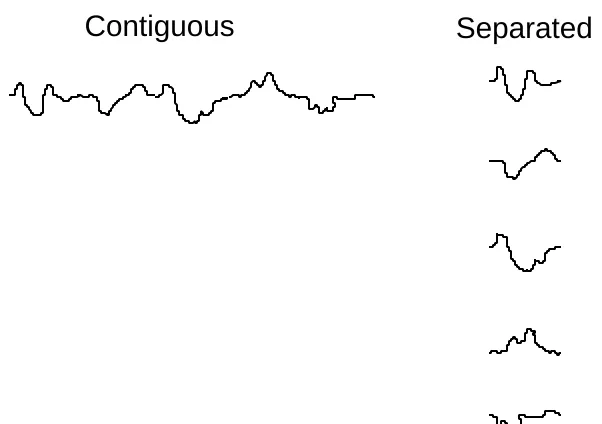
Experiment 2 explores boundary conditions on the unitization process suggested by Experiment 1. Specifically, Experiment 2 addressed the question of whether unitization requires stimulus components to be spatially connected. Whereas Experiment 1 manipulated unitizeability by presenting stimulus components in ordered versus random positions, Experiment 2 tests whether unitizeability is affected by presenting components in a contiguous versus separated fashion.
Previous research indicates that contiguity (spatial connectedness) plays a large role in perceptual parsing and organization. Palmer (1992, Palmer & Rock, 1994) has argued that one of the basic laws of perceptual organization is that stimulus parts tend to be grouped together if they are connected to one another. Baylis and Driver (1993) found that judging the relation between two points is facilitated if they come from the same object rather than separated objects.
Connectedness has also been found to influence concept learning more specifically. Shepp and Barrett (1991) found that children are better able to acquire a conjunctive categorization when the conjoined dimensions are connected together in the same object than when they are physically separated. Nahinsky et al. (1973) similarly found that physical proximity of stimulus parts facilitated acquiring concepts that involved several of the parts. Finally, Saiki and Hummel (1996) found that concepts based on the conjunction of the
shape of an object and its spatial location relative to a second object were much more easily acquired when the two objects were physically connected than when they were separated. All three of these results indicate that conjunctions of stimulus parts are more efficiently used for category learning when the parts are contiguous. Given that Experiment 1 also involved the acquisition of a concept based on the conjunction of several parts, these previous studies might be interpreted as indicating that unitization should be greater for contiguous than separated components.
The prediction derived from the literature on contiguous and separated stimuli differs from the prediction made by the “imageability” hypothesis. According to the latter hypothesis, unitization can proceed as long as a single image-like representation can be formed for the set of components, and if the components are not separated by too great a retinal distance. In fact, some previous research has indicated that contiguity is not a strict constraint on unitization. Czerwinski et al. (1992) found unitization of sets of three disconnected line segments. Although disconnected, a single image could be formed for the set of line segments because of their consistent arrangement and small visual angle subtended. Similarly, Townsend, Hu, and Ashby (1981) found little influence of feature contiguity on the pattern of dependence they observed between detected features.
Method
Participants . Seventy-six undergraduate students from Indiana University served as participants in order to fulfill a course requirement. The students were evenly split into the four between-subject conditions.
contiguous condition was equal to the distance from the top of the top-most doodle to the bottom of the bottom-most doodle in the separated condition.
Procedure . The procedural details closely followed the procedure used in Experiment 1, with the following exceptions. The participants were evenly divided into four groups created by factorially combining the two levels of stimulus appearance (Contiguous or Separated) with two levels of task type (All or One). In all cases, the stimuli were configured as they were in the Ordered condition of Experiment 1. That is, the Item ABCDE always had the same components A, B, C, D, and E in the same relative positions on each trial.
Results
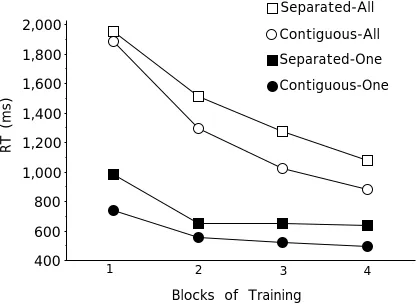
The results of primary interest concern the correct response times for categorizing the Item ABCDE into Category 1. These response times are shown in Figure 5. A 2 (Separated vs Contiguous display) X 2 (All vs One component necessary) X 4 (blocks) ANOVA was applied to these data. A main effect of display was found, F(1, 69) = 7.2, mse = 14.4, p
< .01, such that Contiguous displays were more quickly categorized than Separated displays. A main effect of task was found, F(1, 69) = 18.2, mse = 12.9, p < .01, with the One condition significantly faster than the All condition. Finally, a main effect of blocks was found, F(3, 207) = 11.9, mse = 168.2, p < .01, indicating that practice increased speed of categorization.
There was also a significant three-way interaction between these three variables, F(3, 207) = 3.3, mse = 9.5, p < .05. Although not obviously apparent in Figure 5, this interaction was due to a particularly strong practice effect in the All, Contiguous condition. The two All conditions became more separated with practice than did the two One conditions. The magnitude of this three-way interaction was several times smaller than it was in Experiment 1. If attention is restricted only to the two All conditions, a significant interaction between blocks and display was found, F(3, 71) = 3.9, mse = 11.2, p < .05. This interaction indicates that although the two All conditions appear roughly parallel after the first block of practice, the contiguous condition showed greater
improvement with practice than did the separated condition.
Although cross-experiment comparisons are not strictly appropriate, it is notable that the practice effect for the Separated displays of Experiment 2 was much more pronounced than the practice effect for the Random displays of Experiment 1, F(3, 207) = 6.8, mse = 15.9, p < .01. As such, it appears that randomizing the order of components within a stimulus interfered with learning more than did separating the components but retaining their positions.
Power functions were fit to each participant’s response times on each of the four blocks from each of the four conditions, yielding average best-fitting functions of
RT All, Contiguous = 0.150 + 1.94 N -0.528
RT All, Separated = 0.025 + 2.41 N -0.32
RT One, Contiguous = 0.426 + 0.411 N -1.93
RT One, Separated = 0.644 + 0.592 N -5.67
ANOVAs on the three constant values indicated no influence of condition on the best-fitting value for constant a (asymptote), F(3,207) =2.4, mse = 0.55, but influences of condition on both b (total improvement), F(3, 207) = 4.4, p < .01, mse = 0.41, and c (learning rate), F(3, 207) = 5.2, p <.01, mse = 1.51. Even more strikingly than in Experiment 1, the conditions that were well fit by large b values tended to be well fit by small values of c. The Contiguous and Separated All conditions required much larger values of b than were required for their respective One conditions, with the Separated condition fit by a significantly larger value of b, and non-significantly smaller value of c, relative to the Contiguous condition. Using the magnitude of b as a measure of the improvement due to unitizeability, there is no evidence for greater unitization in the Contiguous than Separated condition.
occurred more frequently than VWXYZ, the average correct response time for categorizing the latter object, 1196 msec, was significantly faster, paired t (75) = 6.4, p < .01. Consistent with the unitization hypothesis, the speed advantage of Category 2 items over ABCDE in the All condition decreased over blocks of practice, as shown by a significant Item X Blocks interaction, F(3, 103) = 8.0, mse = 11.8, p
< .01. That is, over practice, ABCDE becomes relatively quickly categorized when compared to the other items.
The response time effects were mirrored by error analyses. Across the four blocks, the percentage of errors were 6.8%, 4.3%, 3.8%, and 3.7%, F(3, 207) = 4.7, mse = 1.2, p < .01, indicating improvement from the beginning of the experiment to the end. The error rates for the four conditions were: Separated All = 5.6%, Separated One = 3.6%, Contiguous All = 5.9%, and Contiguous One = 3.5%, F(3,207) = 3.8, mse = 1.0, p < .01. These error rates exhibit the same ordering as the response times such that the slowest task was the most error prone. There was no significant interaction between condition and blocks on error rates, F(9, 621) = 1.1, mse = 1.5, p > .1.
Discussion
Overall, the results indicated unitization for displays from the All condition that had separated components. The contiguous display showed greater improvement than did the separated display, using the response time difference across blocks as a measure. The effect size of this interaction was not large, but was statistically reliable. On the other hand, the separated condition showed much more improvement with practice than did the random order condition from Experiment 1, and the best-fitting power function indicated just as large a b value for the separated as for the contiguous All condition1. The clearest
1Given that the difference between blocks’ response times was greater for the Contiguous All than the Separated All condition, the fitted b value similarly might have been expected to be larger. This was not the case because the two All
conditions did not achieve asymptotic levels by the fourth block, and the power function that was fit to the Separated All condition drops asymptotically below the Contiguous All condition’s function.
result from Experiment 2 is that physically separating components that must be integrated for a conjunctive judgment does not interfere with the unitization process to nearly as great extent as does randomly positioning these components.
The strong practice effects that were found in the separated condition support the notion that practice effects in a conjunctive task depend predominantly on establishing a consistent image-like representation for the unit to be conjoined. Consistent with Czerwinski et al’s (1992) results, the current results suggest that unitization occurs despite the lack of physical contiguity. Unitization seems to depend strongly on the consistency with which a conjunctively defined item is rendered, at least in conditions where the physical separation between the ends of the stimuli is equated across the contiguous and separated conditions. The separated condition is helpful in assessing explanations of the observed practice effects that do not posit unitization. One such explanation is that participants learn, with time, to attend to junctions between components. Given that the separated condition does not create diagnostic junctions between components, if identifying junctions were the main cause of practice effects then we would have expected large differences between the separated and contiguous conditions. Junction identification may still be occurring, and may explain the small but significant difference between the two display conditions. Still, robust practice effects do not depend on diagnostic junctions being found. As such, the results support unitization of single coherent images rather than the analytic integration of optimally diagnostic stimulus regions as the primary explanation for the strong practice effects that were observed.
Contiguous than the Separated condition. The comparable learning amounts (b parameters) and learning rates (c parameters) for these two conditions suggests that learning depends primarily on forming complex units rather than improving individual component registration times. Furthermore, by hypothesizing the same process of unitization for both conditions, an explanation is provided for their strikingly similar practice effects in terms of the amount and rate of learning.
Experiment 3
In Experiment 2, the cohesiveness of the visual components to be integrated was manipulated by physically concatenating or separating them. In Experiment 3 a second method for manipulating the ease of integrating components was implemented. In this experiment, reliable categorization required attending to information from two experimenter-defined components. These components were always found within a five-segment curved contour. For one group, the two diagnostic components were next to and touching each other. For the other group, the two components were separated by a third component. Categorization times and practice effects were thus compared between situations where components that must be attended were together or apart.
The Together and Apart conditions in Experiment 3 controlled for different stimulus aspects than were controlled in Experiment 2. Experiment 2’s separated and contiguous groups were equated for entire stimulus length, and maximal length between neighboring components. Experiment 3’s groups were equated for curve contiguity but not length. As such, Experiment 3 tested whether the physical separation of components influences their unitizeability even when the components were joined together within a physically contiguous object. Two components were separated but part of a contiguous object by inserting a nondiagnostic component between them.
If the Together and Apart conditions differ, there are reasons to think that they may differ either by an absolute amount or that the degree of difference will be modulated by practice. The Together condition may show a persistent advantage across blocks of practice given that the Apart condition requires integration of
information over a wider region. However, the Apart condition may also yield larger practice effects than the Together condition. One way of accomplishing the Apart task is to look for the conjunction of three contiguous segments -the two diagnostic components and -the nondiagnostic component that lies between them. If this occurs, then greater improvement should be found in this task than in the Together task, under the assumption that unitizing a larger number of components produces a greater amount of practice. Of course, these hypotheses are not mutually exclusive; the Together task may continue to show an advantage over the Apart condition despite a greater influence of practice on the latter task.
Method
Participants . Forty-eight undergraduate students from Indiana University served as participants in order to fulfill a course requirement.
diagnostic components of ABCDE were separated by a third nondiagnostic component that laid between them. The changes in the diagnosticity of the components of ABCDE in going from the Together to the Apart condition were made by changing the set of items in Category 2.
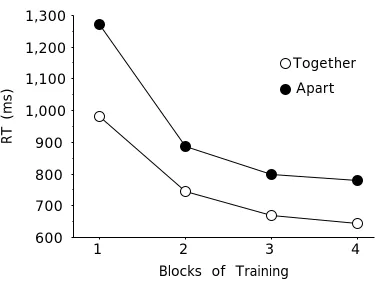
Figure 6 shows an example of the category items from the Together and Apart conditions. As shown in this figure, in the Apart condition, components D and E must be attended (or the junction between them) in order to reliably categorize ABCDE into Category 1. In the Together condition, components C and E must be attended. The labels “Together” and “Apart” thus refer to whether the two diagnostic components of ABCDE were adjacent to each other or not.
Figure 6 shows only one possible set of diagnostic components. Each participant in the Together condition was randomly assigned one of the four possible sets of adjacent segments to be the diagnostic segments, and each participant in the Apart together was randomly assigned one of the three sets of segments that were separated by one other segment: A and C, B and D, or C and E.
Procedure . The procedure closely followed that of the previous experiments. In all cases, the stimuli were configured as they were in the Ordered condition of Experiment 1. That is, the Item ABCDE always had the same components A, B, C, D, and E in the same relative positions on each trial. At the beginning of the experiment, participants were shown the objects that belonged to Category 1 and Category 2, and were asked to press a key when they had viewed the objects for a sufficient time to assure accurate categorization. Participants were given 320 trials in all. On each trial, one of the three objects was randomly selected (one in Category 1, and two in Category 2), and displayed in a random location on the screen. Participants’ speed and accuracy at categorizing the object was recorded. The experiment required about 55 minutes.
Results
As with Experiments 1 and 2, response time rather than accuracy was the more sensitive measure of participants’ performance, and analyses focused on responses to the
conjunctively defined object that belonged to Category 1. Figure 7 shows response times for correct categorizations of ABCDE. These results indicated a significant main effect of display type, F(1, 47) = 18.4, mse = 14.0, p < .01. The average response time in the Apart condition was 991 msec, compared to 757 msec in the Together condition.
A significant Block X Display Type interaction was also found, F(3, 141) = 8.3, mse = 10.4, p < .01, and is depicted in Figure 7. As shown in this figure, the Apart condition yielded a greater practice effect than did the Together condition. During the first block, the response time difference between the Apart and Together conditions was 290 msec. This difference was reduced to 165 by the final block.
Power functions were fit to each participant’s response times on each of the four blocks, yielding average best-fitting functions of
RT Together= 0.367 + 0.414 N -1.230
RT Apart = 0.535 + 0.536 N -1.841
There were no significant differences between the Together and Apart conditions on the best-fitting values for a, unpaired t(46) = 0.54, b, t(46) = 0.21, or c, t(46) = 0.68. It may seem surprising that a higher value for c was fit for the Apart than Together condition, given that more prolonged, shallow, learning might be expected for the Apart condition under the assumption that it requires the formation of a more complex, 3-component unit. One possible reason for this is that the three-way conjunction can be constructed relatively quickly. Also, the practice curves are not at asymptotic level by the fourth block, and as such, there is some tradeoff in the power function between large b values and c values; large values of both b and c can accommodate large amounts of response time reduction (normally the domain of b alone) within the four pre-asymptotic blocks.
diagnostic extreme component, whereas only 2 out of 4 of the Together configurations do.
The response time effects were directionally mirrored by error analyses but none were significant. Across the four blocks, the percentage of errors were 5.4%, 5.0%, 4.8%, and 4.4%, F(3, 141) = 1.1, mse = 1.7, p >.1. The error rates for the Together and Apart conditions were 4.7% and 5.1% respectively, F(1, 47) = 0.7, mse = 0.8, p > .1.
Discussion
A greater practice effect was found for the Apart than the Together condition, and this practice effect was not sufficient to equalize these tasks by the end of the experiment. That is, there was no evidence in the data that the practice effects were sufficiently large to eliminate the difference between display types, at least not after an hour of training. The block X condition interaction indicates that the total amount of response time improvement was greater for the Apart condition.
The primary result, that learning is greater for the Apart than Together task, is consistent with the hypothesis that participants approach the Apart task by developing units that span three components. While the Together task can be accomplished by conjoining two contiguous components, the Apart task must be accomplished by either 1) integrating evidence from two separated components, 2) creating a single unit that is not contiguous, or 3) creating a single contiguous unit that spans three contiguous components. The first possibility for the Apart task is eliminated by the pronounced practice effects that were observed. These practice effects are on the same order as those produced in Experiments 1 and 2 when unitization was possible, and are much larger than those found when responses required the integration of separate pieces of evidence. The second account for the Apart task is at odds with the results from Experiment 2. Experiment 2 did show that units could be formed from disconnected segments, however it also showed that the disconnected condition benefited less from practice than did the contiguous condition. Presumably, the attenuated practice effect was due to less coherent units being employed in the disconnected than the contiguous condition. In contrast to these results, in
Experiment 3, the Apart condition showed greater practice effects than did the Together condition. Thus, participants in Experiment 3 were probably not treating the Apart condition by unitizing disconnected segments; if they had, weaker, not stronger, practice effects would have been predicted for this condition.
As such, the remaining hypothesis, that participants come to treat the Apart task by creating a three-component unit, seems to capture the current results and their relation to previous experiments most parsimoniously. By this account, the larger practice effect in the Apart than Together condition is due to the extended practice required to fuse a greater number of components together. The results are, in one sense, opposite to those produced in Experiment 2. In Experiment 2, the easier Contiguous task showed the greatest improvement with practice, while in Experiment 3, the easier Together task improved least. The comparison of Experiments 2 and 3 show that differential practice effects are not simply due to ceiling/floor effects. Easier tasks may be either more, or less strongly, affected by practice.
This account of Experiment 3 implies that people have a bias to form coherent, contiguous units. Experiment 2 shows that units can be formed when components are not contiguous, but Experiment 3 suggests that when components can be made contiguous by including extraneous, nondiagnostic information, then participants do so. This conclusion from Experiment 3 is consistent with work on attention suggesting that there is a strong bias for attention to be allocated to spatially contiguous regions (LaBerge & Brown, 1989; Eriksen & Murphy, 1987). It is typically difficult for people to attend to two separate regions without also attending the region in between (although Kramer and Hahn, 1995, find evidence for attention to discontiguous locations under some circumstances).
probably false. Just as all primitive features may not be equally quickly processed, constructed features (units) may also differ in how quickly they are processed, and it would be surprising if the actual physical space subtended by a unit did not affect its processing time.
Experiment 4
Experiment 4 provides a parametric investigation of the relation between response time and the number of components that must be integrated to make a categorization. In essence, the intermediary cases between Experiment 1’s All and One task were introduced, wherein participants must integrate information from 2, 3, or 4 out of the 5 components present.
The first goal of the experiment was to provide boundary conditions on the unitization process. Given components of a particular level of complexity, how many components can be unitized, and how long does it take to effectively unitize them? Although any results obtained will depend critically on the level of complexity of the primitive components, useful information can be obtained by observing whether linear changes in the number of segments to be combined give rise to linear changes in response time and practice effects. An upper limit in the number of segments that can be unitized should be revealed by a flattened practice effect. That is, if units that combine a certain number of segments cannot be created because they exceed a capacity limitation, then the practice effect across blocks should resemble conditions where unitization is difficult (e.g. Experiment 1, random order).
The second goal of the experiment is to explore the hypothesis, recruited to explain the difference between Together and Apart conditions in Experiment 3, that the time course of improvement for a conjunctive categorization task is positively related to the number of components that must be conjoined. By this hypothesis, the fewer components that need to be attended, the smaller the practice effects should be.
Method
Participants . Eighty-five undergraduate students from Indiana University served as
participants in order to fulfill a course requirement, and were equally divided into the five levels of the between-participants factor “number of components.”
Materials . The materials were similar to those used in the previous experiments. All stimuli were composed out of five segments. Five conditions were included, in which the number of components that were required to make a reliably accurate Category 1 response were 1, 2, 3, 4, or 5. Thus, the “1” and “5” conditions were similar to the ordered One and All conditions from Experiment 1. The single item that belonged to category 1 can be represented as ABCDE for all five conditions; the item VWXYZ was not included. For the 1 condition, only a single item belonged in Category 2: ABCDZ. For the 2 condition, two items belonged in Category 2: ABCDZ and ABCYE. For the 3 condition, three items belonged in Category 2: ABCDZ, ABCYE, and ABXDE. For the 4 condition, four items belonged in Category 2: ABCDZ, ABCYE, ABWDE, and AVCDE. For the 5 condition, all five items shown under Category 2 in Figure 1 were used. Thus, unlike the previous experiments, the location of the diagnostic segments were not randomized. Whenever a segment was diagnostic for the item ABCDE of Category 1, all of the segments to the right of the segment were also diagnostic. In addition, the diagnostic segments always formed a contiguous curve, without any nondiagnostic intervening segments.
Procedure . As before, the participants’ task was to categorize objects into Category 1 or Category 2 as quickly as possible, while maintaining categorization accuracy of at least 95%. Prior to the experimental trials, participants were presented with the objects that belonged to the two categories and their category memberships. Participants were presented with 400 trials in all, with equal numbers of Category 1 and Category 2 trials randomly intermixed.
Results
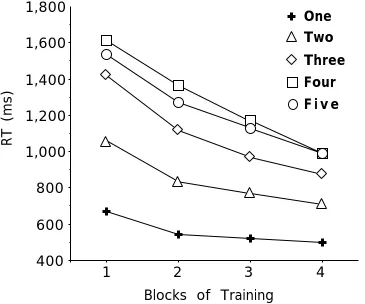
1 item were included. The response times for the five conditions, broken down by to block, are shown in Figure 8. A strong main effect of condition was found, F(4, 81) = 132, mse = 14.2, p < .01. Post-hoc tests revealed that all five conditions differed significantly from each other, p < .01. One particularly surprising result was that the 5 condition yielded significantly faster response times than did the 4 condition. Although this effect was not predicted, one explanation for it may be that participants in the 5 condition switched to the strategy of looking for the whole item “ABCDE” sooner than did participants in the 4 condition; from the instruction page itself, it would have been evident to these participants that all components were relevant for the categorization, and consequently they may not have initially attempted an analytic component-by-component integration. In addition, as Experiment 3 showed, participants were faster to respond when diagnostic components were positioned on the left- or right-most edges of the stimulus. Given that the left-most edge was diagnostic for the 5 condition but not the 4 condition, the diagnosticity of this highly salient component may have served as an additional impetus to create a unit that spanned the entire stimulus.
A strong main effect of block was also found, F(3, 243) = 87, mse = 9.5, p < .01, with all four of the blocks differing significantly from each other according to post-hoc tests. In addition to the two main effects, a significant interaction between block and condition was also found, F(12, 243) = 8.3, mse = 16.3, p < .01. As shown in Figure 8, this interaction can generally be characterized by a convergence of the five conditions over practice. There is a 946 msec difference between the conditions during the first block, and this reduces to a 490 msec difference at the final block. This difference cannot be explained away by using a ratio instead of an interval scale for evaluating practice effects. Over the course of practice, the 4 condition loses 38% of its initial value, while the 1 condition loses only 26% of its value.
Power functions were fit to each participant’s response times on each of the four blocks, yielding best-fitting functions of
RT One= 0.367 + 0.188 N -2.080
RT Two = 0.490 + 0.379 N -1.241
RT Three = 0.060 + 1.15 N -0.438
RT Four = 0.02 + 3.07 N -0.104
RT Five = 0.419 + 1.32 N -.513
There was no significant main effect of condition on the best-fitting value for constant a, F (4,81) = 1.04, mse = .465, p > .05. There were, however, significant main effects of condition on both b, F(4, 81) = 8.4, mse = 0.29, p
< .01, and c, F(4, 81) = 7.2, mse = 0.23, p < .01. The influence of condition on b can be interpreted as showing that the total amount of learning increases as the number of components to be conjoined increases. This trend is strictly monotonic except between conditions Four and Five. The influence of condition on c indicates that the learning curves tends to become steeper (higher learning rate) as the number of components to be conjoined decreases. Thus, learning becomes more prolonged as the size of the conjunction increases, both in the sense of being less steep and more substantial. As a secondary analysis, the dependent variable “falling rate” was derived by finding response time differences between adjacent blocks. Submitting falling rate to a block X condition ANOVA revealed a significant interaction, F(8, 162) = 7.1, mse = 6.2, p < .05, indicating that the falling rate for many-component tasks was particularly large, relative to few-component tasks, as blocks increased.
Across the four blocks, the percentage of errors were 5.6%, 4.7%, 4.2%, and 4.3%, F(3,243) = 2.7, mse = 0.8, p< .05, indicating improvement from the beginning of the experiment to the end. The error rates for the five conditions were: One = 3.5%, Two = 4.0%, Three = 4.7%, Four = 5.7%, and Five = 5.7%, F(4,81) = 3.8, mse = 1.3, p < .05. There was no significant interaction between condition and blocks on error rates, F(12,243) = 0.2, mse = 1.0, p > .1.
Discussion
tested parametrically in the experiment, and a nearly monotonic relation was found between the magnitude of the practice effect and the number of segments to be conjoined. The one unpredicted violation of this generalization was that the four segment task showed more facilitation with time, and longer initial response times, than did the five segment task. A post-hoc explanation for this violation may be that when a highly salient (e.g. see the results from Experiment 3) end segment is diagnostic for the conjunctive response, and all of the others segments are also diagnostic, participants have an early disposition to accomplish the task by matching each stimulus to their ABCDE image. This strategy, initiated early, may be more effective than a component-by-component integration strategy, which participants in the four-segment condition are more likely to adopt.
In addition to showing generally larger practice effects as the number of conjoined components increased, Experiment 4 also showed more protracted practice effects as the number of components increased, as indicated by the more rapid power function learning curves for tasks with few conjoined components. As such, learning is more gradual as the unitization task involves more components. This suggests one type of boundary condition/bottleneck on the unitization process. How quickly unitization can proceed depends on how much there is to unitize. This constraint argues against a radical version of the hypothesis that unitization simply involves creating a photograph-like image of the unit, and matching incoming stimuli to this image. Photographs do not take longer to develop if they involve more complex scenes, but the unitization process observed in Experiment 4 does depend on the complexity of the unit to be formed. A unit, once formed, may have image-like properties, but during its formation, it probably requires componential processing. The eventual image-like property that is observed in the units is the relative independence of categorization time from complexity, although complexity always exerts some influence. However, this end-state property seems to depend on a learning process that is quite sensitive to stimulus complexity.
It appears that there are boundary conditions on how much unitization can occur within a given period of time. The learning rates become progressively slower (smaller c values) as the number of components to combine for a conjunctive response increases. This limit on the number of components that can be integrated per trial is interesting because it stands in contrast to the lack of constraint that was observed in terms of the number of components that can be unitized. A failure of unitization would be shown by decreasing practice effects at some point, as number of components increased. Reduced practice effects were observed earlier when unitization was disrupted by randomly ordering components. The nearly monotonic trend for practice effects to increase as number of components increased suggests that if there is a limit to how many components can be unitized, it is greater than five. This result indicates an impressive unitization proficiency, given the complex nature of the components themselves.
Experiment 5