O R I G I N A L R E S E A R C H
The impact of prostate-transurethral resection on
erectile dysfunction in benign prostatic hyperplasia
This article was published in the following Dove Press journal: Research and Reports in Urology
Anak Agung Gde Oka1
Gede Wirya Kusuma Duarsa1
Putu Astri Novianti2 Tjokorda Gde Bagus
Mahadewa2
Christopher Ryalino3
1Departments of Urology, Faculty of
Medicine, Udayana University, Denpasar,
Indonesia;2Surgery, Faculty of Medicine,
Udayana University, Denpasar, Indonesia;
3Anesthesiology, Faculty of Medicine,
Udayana University, Denpasar, Indonesia
Background:Erectile dysfunction (ED) after a prostate-transurethral resection (P-TUR) is one of the problems in the treatment of benign prostatic hyperplasia (BPH) that may affect the quality of life in middle-aged and older men. The aim of this study was to investigate the impact of P-TUR on ED in BPH patients.
Methods:This study was conducted on 83 patients suffering from BPH that underwent a P-TUR. Clinically, testosterone levels, prostatic-specific antigen (PSA) levels, and prostate volume were measured before the P-TUR. Erectile function was measured prior to the P-TUR, as well as at 1 and 3 months after the P-TUR using the International Index of Erectile Function (IIEF). Suitability test of the model was done in a structural equation. Data were analyzed using the chi-square (χ2) test by Analysis of Moment Structure (AMOS) software version 21.
Results:The effects of PSA to IIEF before, 1 month after, and 3 months after P-TUR were 0.116, 0.084, and 0.097, respectively. The effects of body mass index to IIEF before, 1 month after, and 3 months after P-TUR were 0.180, 0.066, and 0.164, respectively. The effects of prostate volume to IIEF before, 1 month after, and 3 months after P-TUR were 0.049, 0.004, and 0.011, respectively. The effects of testosterone to IIEF before, 1 month after, and 3 months after P-TUR were–0.029,–0.453, and–0.415, respectively. The effects of age to IIEF before, 1 month after, and 3 months after P-TUR were –0.444, 0.921, and 0.911, respectively.
Conclusion:There was a significant improvement of erectile function in patients that under-went P-TUR who previously had preoperative ED, especially 3 months after the surgery. Keywords:age, prostate volume, testosterone, PSA, IIEF, improvement
Introduction
Clinical benign prostatic hyperplasia (BPH) with lower urinary tract symptoms (LUTS) in elderly men is one of the most common diseases.1,2The parameters of the disease progression include prostate-specific antigen (PSA), older age, prostate volume, International Prostate Symptom Score, and reduced urine flow.3The gold standard technique for surgical treatment of clinical BPH with benign prostate obstruction is the transurethral resection of the prostate (P-TUR). P-TUR is a combined visual and surgical instrument (using a resectoscope) that is inserted through the urethra. An electrical loop cuts away excess prostate tissue to improve urine flow. P-TUR is a minimally invasive surgery using high-frequency electro resection that allows better visualization of the prostate with less intraoperative bleeding when compared to classical open surgery.4,5
Both BPH and P-TUR have been associated with erectile dysfunction (ED). ED is defined as the inability to achieve or maintain an erection sufficient for satisfactory Correspondence: Gede Wirya Kusuma
Duarsa
Department of Urology, Faculty of Medicine, Udayana University, Jl. PB Sudirman, Denpasar, Bali 80232, Indonesia Tel +62 815 575 3377 Email [email protected]
Research and Reports in Urology
Dove
press
open access to scientific and medical research
Open Access Full Text Article
Research and Reports in Urology downloaded from https://www.dovepress.com/ by 118.70.13.36 on 27-Aug-2020
sexual performance.6Association between BPH and ED is very complex and the incidence increases with age. Prevalence of ED in Asia ranges widely from 2.0% to 81.8%, while in Indonesia, it ranges from 11% to 80%.7–9 The differences between countries are thought to be caused by sociocultural, economic, demographic factor, and a lack of data for evaluation of ED.
Several factors play an important role in the appear-ance of ED, like aging, diabetes, obesity, smoking, alco-hol, cardiovascular, and neurological pathologies. All of these factors trigger ED by a mechanism of endothelial dysfunction.5 Psychology also plays a role in ED. Men with BPH usually have decreased libido andfind it diffi -cult to achieve or maintain a penile erection.10
The impact of P-TUR on ED is still controversial and conflicting.11,12 Recent studies have shown a negative impact and others have shown improvement in sexual function in patients suffering from ED. The assessment of male sexual function is commonly performed by an internationally validated questionnaire known as the International Index of Erectile Function (IIEF-5). IIEF-5 containsfive questions related to penile function and has a maximum score of 25. The total score was then used to define the patient with severe, moderate, mild to moderate, mild, and normal erectile function.
The aim of this study was to assess the impact of P-TUR on IIEF before, after 1 month, and 3 months after P-TUR.
Materials and methods
This is a retrospective study conducted from June to November 2016, involving 89 patients that underwent P-TUR in four hospitals in Bali Island, Indonesia (Sanglah, Surya Husadha, Dharma Yadnya, and Balimed hospitals). This study was approved by the committee of ethical research of Udayana University. The consecutive sampling method was used for this study. All patients have provided written informed con-sent to be included in this study. The inclusion criteria were patients with BPH aged, 50–80 years old, and underwent P-TUR. The exclusion criteria include patients with diabetes mellitus, external genital anoma-lies, bladder stone, and neurogenic bladder, and the presence of neurological deficit.
Age, testosterone, the volume of prostate, body mass index (BMI), and PSA were defined as observed exogen-ous variables. Blood testosterone level was measured 1 day before surgery at 8:00–10:00 am local time. Prostate volume was measured prior to surgery using the transrectal
ultrasound (TRUS) method. The score of IIEF before P-TUR, after 1 month of P-TUR, and after 3 months of P-TUR were defined as observed endogenous variables.
The results from the microscopic prostate pathological examinations were used to define BPH. There were six patients who came up with carcinoma of the prostate, and they were excluded from the study. The characteristics of the subjects were presented using descriptive statistics, and data was analyzed using SEM (Structural Equation Modeling) program of Analysis of Moment Structure (AMOS) software version 21.
Suitability test of the model (Goodness of Fit) is done in a structural equation. The suitability tests used in this study were chi-square (χ2), probability level, root mean square error of approximation (RMSE), Tucker-Levis Index (TLI), Comparative Fit Index (CFI), Expected Cross Validation Index (ECVI), and Modified ECVI (MECVI). All tests indicated that this was afit model.
Results
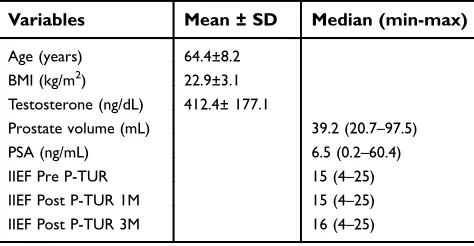
A total of 83 patients were enrolled in this study. The mean age of the subjects was 64.4±8.2 years. The age, BMI, and testosterone levels were normally distributed and presented in mean ± SD, while other variables that were not normally distributed were presented in median. The characteristic of the subjects involved is displayed in Table 1.
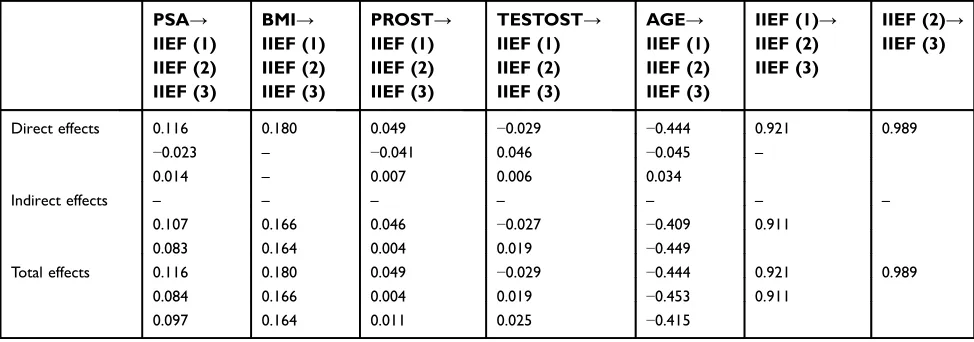
The effects between observed exogenous variables (PSA, BMI, prostate volume, testosterone, and age) against observed IIEF pre-P-TUR, 1-month post-P-TUR, and 3 months post-P-TUR were calculated for direct, indirect, and total effects (Table 2–4). Table 5 summarizes Table 2–4 showing that the effect of each observed exogenous variables to observed endogenous variables. The effects of P-TUR were shown where the effects between pre-P-TUR and
Table 1Characteristics of the study subjects (N=83)
Variables Mean ± SD Median (min-max)
Age (years) 64.4±8.2
BMI (kg/m2) 22.9±3.1
Testosterone (ng/dL) 412.4± 177.1
Prostate volume (mL) 39.2 (20.7–97.5)
PSA (ng/mL) 6.5 (0.2–60.4)
IIEF Pre P-TUR 15 (4–25)
IIEF Post P-TUR 1M 15 (4–25)
IIEF Post P-TUR 3M 16 (4–25)
Notes:IIEF Pre P-TUR = IIEF before P-TUR, IIEF Post P-TUR 1M = IIEF 1 month after P-TUR, IIEF Post P-TUR 3M = IIEF 3 months after P-TUR.
Abbreviations: BMI, body mass index; PSA, prostatic-specific antigen; IIEF, International Index of Erectile Function; P-TUR, prostate-transurethral resection.
Research and Reports in Urology downloaded from https://www.dovepress.com/ by 118.70.13.36 on 27-Aug-2020
Table 2Effects between observed exogenous variables to IIEF before P-TUR procedurea
PSA (ng/mL) BMI (kg/m2) Prostate volume (mL) Testosterone level (ng/dL) Age (years)
Direct effects 0.116 0.180 0.049 −0.029 −0.444
Indirect effects 0.000 0.000 0.000 0.000 0.000
Total effects 0.116 0.180 0.049 −0.029 −0.444
Notes:a
Chi-square test.
Abbreviations:PSA, prostatic specific antigen; BMI, body mass index; IIEF, International Index of Erectile Function; P-TUR, prostate-transurethral resection.
Table 3Effects between observed exogenous variables to IIEF after 1 month of P-TUR
PSA (ng/mL) BMI (kg/m2) Prostate volume (mL) Testosterone
level (ng/dL)
Age (years) IIEF (1)→ IIEF (2)
Direct effects −0.023 0.000 −0.041 0.046 −0.045 0.921
Indirect effects 0.107 0.166 0.046 −0.027 −0.409 0.000
Total effects 0.084 0.166 0.004 0.019 −0.453 0.921
Notes:a
Chi-square test; IIEF (1)=IIEF before P-TUR; IIEF (2)=IIEF 1 month after P-TUR
Abbreviations:PSA, prostatic specific antigen; BMI, body mass index; IIEF, International Index of Erectile Function; P-TUR, prostate-transurethral resection.
Table 4Effects between observed exogenous variables to IIEF after 3 months of P-TUR
PSA (ng/ mL)
BMI (kg/ m2)
Prostate volume (mL)
Testosterone level (ng/dL)
Age (years)
IIEF (1)→ IIEF (3)
IIEF (2)→ IIEF (3)
Direct effects
0.014 0.000 0.007 0.006 0.034 0.000 0.989
Indirect effects
0.083 0.164 0.004 0.019 −0.449 0.911 0.000
Total effects 0.097 0.164 0.011 0.025 −0.415 0.911 0.989
Notes:IIEF (1)=IIEF before P-TUR; IIEF (2)=IIEF 1 month after P-TUR; IIEF (3)=IIEF 3 months after P-TUR.
Abbreviations:PSA, prostatic specific antigen; BMI, body mass index; IIEF, International Index of Erectile Function; P-TUR, prostate-transurethral resection.
Table 5Effects between observed exogenous variables against observed endogenous variables in BPH patients
PSA→ IIEF (1) IIEF (2) IIEF (3)
BMI→ IIEF (1) IIEF (2) IIEF (3)
PROST→ IIEF (1) IIEF (2) IIEF (3)
TESTOST→ IIEF (1) IIEF (2) IIEF (3)
AGE→ IIEF (1) IIEF (2) IIEF (3)
IIEF (1)→ IIEF (2) IIEF (3)
IIEF (2)→ IIEF (3)
Direct effects 0.116 0.180 0.049 −0.029 −0.444 0.921 0.989
−0.023 – −0.041 0.046 −0.045 –
0.014 – 0.007 0.006 0.034
Indirect effects – – – – – – –
0.107 0.166 0.046 −0.027 −0.409 0.911
0.083 0.164 0.004 0.019 −0.449
Total effects 0.116 0.180 0.049 −0.029 −0.444 0.921 0.989
0.084 0.166 0.004 0.019 −0.453 0.911
0.097 0.164 0.011 0.025 −0.415
Notes:IIEF (1)=IIEF before P-TUR; IIEF (2)=IIEF 1 month after P-TUR; IIEF (3)=IIEF 3 months after P-TUR.
Abbreviations:PSA, prostatic-specific antigen; BMI, body mass index; PROST, prostate volume; TESTOST, testosterone level; AGE, age (years); IIEF, International Index of Erectile Function; P-TUR, prostate-transurethral resection.
Research and Reports in Urology downloaded from https://www.dovepress.com/ by 118.70.13.36 on 27-Aug-2020
1 month after P-TUR was 0.921, and the effects between pre-P-TUR and 3 months after pre-P-TUR were 0.911.
Discussion
This study shows a significant negative correlation between age and IIEF before P-TUR (p=0.444). Age is strongly associated with ED in many other studies. With an increased age, the IIEF value tends to decline. This can be caused by an aging process that affects human mor-phology and physiology that play a role in the develop-ment of sexual dysfunction.
The main mechanism includes vascular and physiolo-gic alteration. Vascular alteration is a vascular endothe-lium change with a regulatory function such as proliferative process, vascular tone regulation, perfusion maintenance, and inflammatory response. In a normal aging process, they will result in an accumulation of endothelial dysfunction. Most ED cases are caused by vascular alteration, and the severity of ED is related to severe endothelial dysfunction with some well-known risk factors, including hypertension, hyperlipidemia, atherosclerosis, and diabetes.
ED is also related to morphological changes based on alteration of every structure within corpus cavernosum result-ing in reduced muscle tone. Agresult-ing has reportedly caused a decrease in the number of smooth muscle fibers. Smooth muscle cells play a role in contracting and relaxing of the corpus cavernosum. It has been reported that good erectile function depends on an adequate amount of the smooth muscle cells.2 However, in a recent study of univariable and multivariable linear regression analysis, age was found to be the only risk factor associated with newly-reported ED in 12 months after P-TUR (P<0.001).13 Patients who were older than 65 years old had a higher risk of developing ED after P-TUR (P<0.001) compared with that≤65 years old.
While the goals for BPH treatment is to reduce symptoms, it should be realized that the treatment can negatively affect the patient’s quality of life. P-TUR may cause retrograde ejaculation, but the impact of P-TUR on ED remains unclear. The mechanism of a post-operative penileflaccidity is thought due to a neuropraxia or direct thermal injury on the erectile nerve that runs just beneath the prostatic capsule. This may result in increased apoptosis andfibrosis of corpus caverno-sum that leads to poor oxygenation of the cavernous due to arterial damage during the surgical procedure.14 Shorbagy et al15 found that P-TUR carries a risk in developing post-operative ED at an estimated 25.5% and the other recent studies showed the incidence between 4% and 35%.16–18
In this study, 80.7% of our subjects developed ED before the treatment and they were related to the progress of LUTS. This is similar to the study by Oelke et al10that found 70% of men with BPH were associated with ED. The discrepancy between the prevalence of ED was per-haps determined by multiple factors such as socio-economic, educational level, or sociocultural differences, which prevent people from understanding more about the disease and seeking appropriate treatment.
The total effect of 0.921 (Table 3) showed an improved significance between the correlation of the IIEF score before P-TUR and 1 month after P-TUR. The erectile ability was improved within a month and we presumed that this improvement was caused by a relief of obstructive symptoms or LUTS. This may also be related to axon regeneration and endothelial recovery after the treatment. A neuropraxia-type axonal injury will heal in a few days to 3 months, while an axonotmesis-type axonal injury, the recovery takes longer than the neuropraxia-type. In a con-dition where 20–30% of the axon is damaged, collateral branching is the primary mechanism of recovery. It begins at thefirst 4 days to 4 months following the injury. The P-TUR did not adversely affect sexual function. Pre-operative ED can be improved by P-TUR and long-term sexual function is maintained after P-TUR.19
In addition, we also found an improved significant correlation between IIEF after 1 month P-TUR and 3 months post-P-TUR. This may be related to a psycholo-gical factor, that when patients found it difficult to urinate due to BPH, they suffer from conditions that create stress and affect sexual desire. After P-TUR, the mental stress detaches and the libido becomes normal, and patients would feel their erectile ability improved.15
Considering the number of variables that affect the IIEF score, we were also looking for a correlation between the variables. Very few studies determined the correlation between prostate volume and PSA. In this study, we mea-sured prostate volume by the TRUS method. One of the parameters in detecting prostate enlargement is plasma PSA. PSA is a protein produced by the normal cells in the prostate, which the amount of the secretions can vary caused by conditions such as inflammation, benign prostatic enlargement or malignancy, digital rectal exam (DRE) or catheter instrumentation. PSA is an organ-specific, but not disease-specific, biomarker.
This study shows a significant two-way correlation between both variables (Table 3). Prostatic enlargement is proportional to the volume of the prostate. In other
Research and Reports in Urology downloaded from https://www.dovepress.com/ by 118.70.13.36 on 27-Aug-2020
words, the larger the prostate volume is, the higher the PSA level. Park et al20 found significant correlation between PSA and prostate volume in a Korean man (r=0.514; P<0.005). Several studies showed that the cor-relation between PSA and prostate volume would deter-mine the progressivity of the prostate enlargement.19,20
Erection process is clearly androgen-dependent. Testosterone plays an important role in increasing the pre-valence of male erectile function because aging and castra-tion cause a decline of serum testosterone level. Testosterone stimulates nitric oxide (NO) synthase which leads penile vasodilatation by the production of endothelial NO. Deficiency of testosterone level could lead to a reduction of penile strength.21In this study, testosterone has no significant correlation to another exogenous variable (age, prostate volume, BMI and PSA) in our BPH patients.
Current evidence suggests that BMI is one of the deter-mining factors of ED and occurrence of ED is usually asso-ciated with higher BMI from the direct mechanism in the penile vessel by reducing the production of NO synthase and loss of tissue compliance. Obesity also impacts the sexual life by decreasing the desire and the performance of the intercourse.22There was no significant correlation between BMI to exogenous variables in our study.
A small sample size is the limitation of this study. A similar study with larger sample size needs to done in the future to confirm thesefindings. Other sexual hormones like estrogen, prolactin, luteinizing hormone, and follicle stimulating hor-mone, need to be measured too, as well as the urine maximum
flow (Qmax) and the post-void residual urine test.
Conclusion
ED is a common condition in BPH patients. It is very impor-tant to assess the presence of ED on BPH patients before the surgery to compare sexual function before and after the treatment.
P-TUR as a gold standard treatment of BPH has no negative influence on the quality of erection. In fact, we found that it showed a significant improvement of erectile function on patients who previously had preoperative ED, especially 3 months after the surgery. We also found that aging is the most powerful variable compared to other variables that affect erectile function of our patients.
Disclosure
The authors report no conflicts of interest in relation to this study.
References
1. Shamloul R, Ghanem H. Erectile dysfunction.The Lancet. 2013;381 (9861):153–165. doi:10.1016/S0140-6736(12)60520-0
2. Tirado LCE, Ferrer JE, Herrera AM. Aging and erectile dysfunc-tion. Sex Med Rev. 2016;4(1):63–73. doi:10.1016/j.sxmr. 2015.10.011
3. Kardasevic A, Milicevic S. The correlation between prostate volume in patients with benign prostatic hyperplasia in relation to erectile dysfunction. Med Arch. 2016;70(6):449. doi:10.5455/ medarh.2016.70.449-452
4. Teo JS, Lee YM, Ho HSS. An update on transurethral surgery for benign prostatic obstruction. Asian J Urol. 2017;4(3):195–198. doi:10.1016/j.ajur.2017.06
5. Rastrelli G, Corona G, Vignozzi L, et al. Serum PSA as a predictor of testosterone deficiency. J Sex Med. 2013;10(10):2518–2528. doi:10.1111/jsm.12266
6. [No authors listed]. Impotence. NIH Consens Statement. 1992;10 (4):1–33. Available from: https://consensus.nih.gov/1992/1992impo-tence091html.htm. Accessed June 12, 2018.
7. Song J, Shao Q, Tian Y, et al. Association between lower urinary tract symptoms and erectile dysfunction in males aged 50 years and above: results from a multicenter community-based cross-sectional survey (BPC-BPH).Zhonghua Yi Xue Za Zhi. 2011;91(38):2706– 2709.
8. Prins J, Blanker MH, Bohnen AM, Thomas S, Bosch JL. Prevalence of erectile dysfunction: a systematic review of population-based studies. Int J Impot Res. 2002;14(6):422–432. doi:10.1038/sj. ijir.3900905
9. Wibowo S, Gofir A. Disfungsi Ereksi: Patofisiologi, Etiologi, Mekanisme, Dan Kaitannya Dengan Neuropati Diabetika. Yogyakarta: Pustaka Cendekia press; 2007.
10. Oelke M, Bachmann A, Descazeaud A, et al. EAU Guidelines on treatment and follow up of non-neurogenic male lower urinary tract symptoms including benign prostatic obstruction.Eur Urol. 2013;64 (1):118–140. doi:10.1016/j.eururo.2013.03.004
11. Zong H-T, Peng -X-X, Yang -C-C, Zhang Y. The impact of transur-ethral procedures for benign prostate hyperplasia on male sexual function: a meta-analysis. J Androl. 2011;33(3):427–434. doi:10.2164/jandrol.111.013490
12. Pavone C, Abbadessa D, Scaduto G, et al. Sexual dysfunctions after transurethral resection of the prostate (TURP): evidence from a retro-spective study on 264 patients.Arch Ital Urol Androl. 2015;87(1):8. doi:10.4081/aiua.2015.1.8
13. Favilla V, Cimino S, Salamone C, et al. Risk factors of sexual dysfunction after transurethral resection of the prostate (TURP): a 12 months follow-up.J Endocrinol Invest. 2013;36(11):1094–1098. doi:10.1007/bf03346761
14. Poulakis V, Dillenburg W, Moeckel M, et al. Laparoscopic radical prostatectomy: prospective evaluation of the learning curve. Eur Urol. 2005;47(2):167–175. doi:10.1016/j.eururo.2004.09.006 15. Choi SB, Zhao C, Park JK. The effect of transurethral resection of the
prostate on erectile function in patients with benign prostatic hyper-plasia. Korean J Urol. 2010;51(8):557. doi:10.4111/ kju.2010.51.8.557
16. Shorbagy GE, Ghoneimy ME, Feel AE, et al. Comparative study between monopolar and bipolar TURP regarding the effect on the sexual function in male patients with LUTS by the use of IIEF (self-questionnaire scoring system). J Urol. 2017;197:4. doi:10.1016/j. juro.2017.02.1065
17. Menorca RMG, Fussell TS, Elfar JC. Peripheral nerve trauma: mechanisms of injury and recovery. Hand Clin. 2013;29(3):317– 330. doi:10.1016/j.hcl.2013.04.002
18. Mackinnon SE, Novak CB. Nerve Injury and Recovery. Missouri: Washington University School of Medicine; 2001.
Research and Reports in Urology downloaded from https://www.dovepress.com/ by 118.70.13.36 on 27-Aug-2020
19. Mishriki SF, Grimsley SJ, Lam T, Nabi G, Cohen NP. TURP and sex: patient and partner prospective 12 years follow-up study. BJU Int. 2011;109(5):745–750. doi:10.1111/j.1464-410x.2011.10396.x
20. Park K, Hwang EC, Kim S-O. Prevalence and medical management of erectile dysfunction in Asia.Asian J Androl. 2011;13(4):543–549. doi:10.1038/aja.2010.131
21. Rajfer J. Relationship between testosterone and erectile dysfunction.
Rev Urol. 2000;2(2):122–128.
22. de Andrade HZ, de Brito GB, de Godoy MF, Antoniassi TS, Spessoto LCF, Facio FN Jr. Association between erectile dysfunc-tion and obesity. Int J Sci. 2017;10(6):43–45. doi:10.18483/ ijSci.1451
Research and Reports in Urology
Dove
press
Publish your work in this journal
Research and Reports in Urology is an international, peer-reviewed, open access journal publishing original research, reports, editorials, reviews and commentaries on all aspects of adult and pediatric urology in the clinic and laboratory including the following topics: Pathology, pathophysiology of urological disease; Investigation and
treatment of urological disease; Pharmacology of drugs used for the treatment of urological disease. The manuscript management system is completely online and includes a very quick and fair peer-review system, which is all easy to use. Visit http://www.dovepress.com/ testimonials.php to read real quotes from published authors.
Submit your manuscript here:https://www.dovepress.com/research-and-reports-in-urology-journal
Research and Reports in Urology downloaded from https://www.dovepress.com/ by 118.70.13.36 on 27-Aug-2020