Mode Of Action Of Ammoniating In Increasing
Nitrogen Content And In Vitro Apparent Organic
Matter Digestibility Of Forages
Dede Kardaya, Deden SudrajatAbstract— An experiment was conducted in order to repeal mode of action of ammoniating in increasing nitrogen content and in vitro apparent organic matter digestibility of forages. The experiment was accomplished under completely randomized design with two factors (2 x 4) and three replicates. The collected data were analysed with a two-factor ANOVA and, if applicable, continued with Tukey’s tests. Regression analyses were applied to repeal the incubation rate. Results showed that ammoniating treatment used 3% of urea increased crude protein content and in vitro apparent OM digestibility of rice straw significantly (P<0.05). Nitrogen originated from urea retained in rice straw materials during the consecutive incubation period could be best predicted with a cubical regression Y = 0,447 + 0,114 t – 0,52 t2
+ 0,004 t3 (R = 0.849; p = 0.002) and the highest rate of ammoniating process occurred in week 2 of the incubation period. It was an implication that disruption of lignocellulosic fractions occurred as a result of retaining N originated from urea in C1 site of reduced sugar.
Index Terms— urea, ammoniation, rice straw, in vitro digestibility.
—————————— ——————————
I
NTRODUCTIONUrea might improve the nutritive value of low quality forages although the improvement depended on the dry matter content of the forages [1][2]. The improvement of low quality forages included in crude protein and organic matter digestibility [3][4][5][6][7]. However, all of the invention above did not explain either the mode of action or chemical reaction occurred in ammoniating in such a way that crude protein and organic matter digestibility of low quality forage increased. The study attempted to reveal mode of action of ammoniating in increasing crude protein content and organic matter digestibility of low quality forages.
MATERIAL
DAN
METHOD
The experiments were conducted at the Animal Science Laboratory of Bogor Djuanda University in two phases. The first phase aimed to repeal the highest reaction rate of ammoniating process and the second phase to reveal mode of action of ammoniating in increasing crude protein content and organic matter digestibility of low quality forages.
Experiment 1
Sampling and laboratory analyses. Dried rice straws (DM 89%) were chopped in 5 cm in length and sprayed with urea solution (3% urea/kg DM; [8]. The sprayed rice straws were sampled (5 kg), packed in polyethylene bags, pressed, and fixed tightly with plastic wrap. A similar procedure was applied to dried rice straw without urea solution spraying. All samples were then incubated at room temperature with incubation periods of 2, 4, 6, and 8 weeks. At the end of each
incubation period, the rice straw samples were sub sampled and analysed for DM [9]; OM determined by ash [9]; CP obtained by total N determination using the micro-Kjeldahl technique [9] and calculated as N x 6.25; NDF [24]; ADF [9]; and sulfuric acid lignin [25]. In vitro apparent digestibility of DM and OM were analysed according to [10] for each of the consecutive incubation period.
Statistical analyses. The experiment was conducted under completely randomized design with two factors (2 x 4) and three replicates. The collected data were analysed with a two-factor ANOVA and, if applicable, continued with Tukey’s tests. Regression analyses were applied to repeal the incubation rate [11]. Samples showed the highest incubation rate would be used as samples for experiment 2.
Experiment 2
Sampling and laboratory analyses. Samples showed the highest incubation rate in experiment 1 were sub sampled (100 g), ground through a 1-mm screen in a Willey mill, and analysed for total sugar determined with Anthron method, and reduced sugar determined with Molisch reagents [12]. Nitrogen content of ammoniated rice straw originated from urea was calculated as N ammoniated rice straw – N nonammoniated rice straw.
RESULT
AND
DISCUSSION
Quality Of Ammoniated Rice Straw
NDF. NDF contents of rice straw were not affected by ammoniating treatment but were affected by an incubation period (P<0.05; Table 1). It was a tendency that ammoniating resulted in decreasing NDF contents. This result was similar to the result reported by many researchers [13] [14] [15] [16] [17] [18]. Apparently, ammoniating treatment tended to increase solute materials in NDF solution and resulted in decreasing NDF content of the straw. Among incubation periods, rice straw of week 8 showed the lowest NDF value. It was
————————————————
Dede Kardaya, Universitas Djuanda, Bogor, Indonesia, [email protected]
Deden Sudrajat, Universitas Djuanda, Bogor, Indonesia,
implicated that microbial activity increased following consecutive incubation periods.
Table 1. NDF content of rice straw Incubation
(weeks) Control (0% urea) Ammoniated (3% urea) Mean ...NDF (%) ...
2 75.24 73.60 74.42b
4 72.11 74.79 73.45b
6 73.79 73.36 73.57b
8 71.70 70.72 71.21a
Mean 73.38 72.89
Different superscript within a similar column differed significantly (P < 0.05)
ADF. ADF contents of rice straw were not affected either by ammoniating treatment or by an incubation period (Table 2). Else, it was a tendency that ammoniating resulted in decreasing NDF contents. This result was similar to the result reported by many researchers [13] [14] [15] [16] [17] but was lower than the result reported by [18]. Apparently, similar to NDF fractions, ammoniating treatment tended to increase solute materials in ADF solution and resulted in decreasing ADF content of the straw. In addition, the ADF fraction of rice straw in consecutive week of incubation was similar. It indicated that prolong the incubation period did not increase microbial access to cellulose fraction and resulted in unchanged ADF content.
Table 2. ADF contents of rice straw Incubation
(weeks) Control (0% urea) Ammoniated (3% urea) Mean ...ADF (%) ...
2 52.85 54.25 53.55
4 52.15 54.48 53.32
6 54.26 54.38 54.32
8 54.67 53.32 54.00
Mean 53.13 52.83
Cellulose and hemicellulose. Either cellulose or hemicellulose content of rice straw was not affected by ammoniating treatments but was affected by the incubation period (P<0.05; Table 3 and 4). It was a tendency that ammoniating resulted in decreasing NDF contents. In order that cellulose and hemicellulose fractions could be accessed by microbe, lignocellulose fractions must be degraded microbiologically or solubilized chemically [19]. It seemed that ammoniating treatment with 3% of urea in recent research did not show an optimal result in degrading lignocellulose matrix. This result was supported by [20] finding which reported that the effect of urea treatment on cell wall fractions showed inconsistent results.
Table 3. Cellulose contents of rice straw Incubation
(weeks) Control (0% urea) Ammoniated (3% urea) Mean ...cellulose (%) ...
2 33.47 33.63 33.55ab
4 28.83 33.77 31.30a
6 34.60 33.63 34.11b
8 32.47 31.37 31.92ab
Mean 32.42 33.01
Different superscript within a similar column differed significantly (P < 0.05)
Table 4. Hemicellulose contents of rice straw Incubation
(weeks) Control (0% urea) Ammoniated (3% urea) Mean ...hemicellulose (%) ...
2 22.39 19.35 20.87b
4 19.96 20.31 20.14ab
6 19.53 18.98 19.25ab
8 17.03 17.40 17.21a
Mean 20.25 20.06
Different superscript within a similar column differed significantly (P < 0.05)
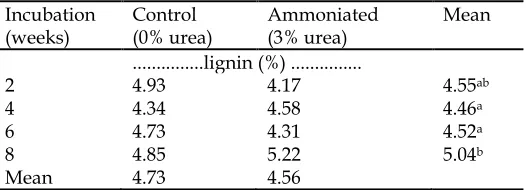
Lignin. Lignin contents of rice straw were not affected by ammoniating treatment, but were affected by an incubation period (Table 5). This result was lower (4.56%) than the result (10.0%) reported by [15] but was in the range (3.4 – 8.1%) reported by [17]. This result was inconsistent with previous result reported that the lignin content of forages decreased with ammonia or urea treatment [21][22]. Likely, ammoniating treatment with 3% of urea in recent research did not strong enough to solubilize or degrade lignocellulose matrix.
Table 5. Lignin contents of rice straw Incubation
(weeks) Control (0% urea) Ammoniated (3% urea) Mean ...lignin (%) ...
2 4.93 4.17 4.55ab
4 4.34 4.58 4.46a
6 4.73 4.31 4.52a
8 4.85 5.22 5.04b
Mean 4.73 4.56
Different superscript within a similar column differed significantly (P < 0.05)
Table 6. Crude protein content of rice straw Incubation
(weeks) (0% urea) Control Ammoniated (3% urea) Mean ...crude protein (%) ...
2 1.76 3.33 2.54c
4 1.19 1.90 1.54ab
6 0.73 1.50 1.12a
8 1.37 1.78 1.57ab
Mean 1.25a 2.16b
Different superscript within a similar row or column differed significantly (P < 0.05)
In vitro DM and OM apparent digestibility. In vitro DM and apparent digestibility of rice straw were increased (P<0.05) with ammoniating treatment but did not change with an incubation period (Table 7 and 8). This result supported the previous research [16] [18] reported that DM apparent digestibility of rice straw increased with urea or ammonia treatment. The increase in DM or OM apparent digestibility of ammoniated rice straw indicated that ammoniating treatment improved low quality forages. This result was consistent with the result reported in previous researches [18] [4] [7]. Unfortunately, the improvement in DM or OM digestibility did not occur in NDF or ADF fraction. Rahat et al. [26] claimed that ADF fraction of rice straw treated with ammonia might contain components showed a lower degradability rate than components contained in NDF fractions.
Table 7. In vitro DM apparent digestibility of rice straw Incubation
(weeks) Control (0% urea) Ammoniated (3% urea) Mean ...In vitro DM apparent digestibility (%) ...
2 12.25 12.71 12.48
4 13.69 14.32 14.00
6 11.20 15.54 13.37
8 11.78 16.07 13.93
Mean 12.09a 14.25b
Different superscript within similar row differed significantly (P < 0.05)
Table 8. In vitro OM apparent digestibility of rice straw Incubation
(weeks) Control (0% urea) Ammoniated (3% urea) Mean ...In vitro OM apparent digestibility (%) ...
2 65.32 72.24 68.78
4 63.35 67.15 65.25
6 65.25 68.56 66.90
8 64.94 67.78 66.36
Mean 65.02a 68.60b
Different superscript within similar row differed significantly (P < 0.05)
Ammoniating Rate
The Ammoniating rate of rice straw was predicted by a cubical regression model as follows:
Y = 0.447 + 0.114t – 0.52t2 + 0.004t3; R = 0.849, p = 0.002, Ynj = N contained in ammoniated straw; t = incubation period (week). The result repealed that the highest ammoniating rate occurred at week two of the incubation period (Figure 1).
0.6000
0.5000
0.4000
0.3000
0.2000
8 6
4 2
0
inku
Cubic Observed
tnu
Figure 1. The Ammoniating rate of rice straw predicted with a cubical regression curve. Inku = incubation period (week), tnu
= total of nitrogen contained in ammoniated rice straw originated from urea (mg/mg).
Disruption Of Lignocellulose Linkage
Ammoniating treatment increased (P<0.05) both total sugar and reduced sugar but decreased (P<0.05) reduced sugar percentage (Table 9). A similar result was also reported by [23] used cellulase to release reduced sugar from cellulose substrates in in vitro study. It indicated that ammoniating treatment degraded lignocellulosic fractions effectively and allowed microbial cellulase to attack cellulose fraction of rice straw. On the contrary, percentage of reduced sugar relative to total sugar decreased significantly. The decrease in percentage of reduced sugar indicated that retaining nitrogen with reduced sugar occurred, most likely in C1 site of reduced sugar. This retained reduced sugar could not be detected in determination procedure of reduced sugar content and resulted in decreasing reduced sugar content of ammoniated rice straw. This presumes was supported with the previous finding that nitrogen originated from urea was retained quantitatively in ammoniated rice straw materials (Table 6 and Figure 1).
Table 9. Total sugar and reduced sugar contained in rice straw
Sampel Total sugar, ppm Reduced sugar, ppm Reduced sugar (% of total sugar) Nonammoniated Ammoniated Nonammoniated Ammoniated Nonammoniated Ammoniated
U1 296.78 2,137.85 168.62 534.93 56.82 25.02
U2 287.48 1,874.79 156.12 444.36 54.30 23.70
U3 269.19 1,674.95 182.51 359.88 67.80 21.49
C
ONCLUSIONAmmoniating treatment used 3% of urea improved quality of rice straw by increasing crude protein content and in vitro apparent digestibility of ammoniated rice straw. Nitrogen originated from urea retained in rice straw materials could be best predicted with a cubical regression Ynj = 0,447 + 0,114 t – 0,52 t2 + 0,004 t3 and the highest rate of ammoniating process occurred in week 2 of the incubation period. It was an implication that disruption of lignocellulosic fractions occurred as a result of retaining N originated from urea in C1 site of reduced sugar.
A
CKNOWLEDGEMENTThe author would like to thank the Directorate General of Higher Education (DIKTI) of Indonesia Government, for financial support for the experiment under Fundamental Research Program.
R
EFERENCES[1] A. A. S. Kahrizsangi and M. H. Haddadi, "An Inquiry into the Challenges of Literary Translation to Improve Literary Translation Competence with Reference to an Anecdote by Heinrich von Kleist," Journal of Education and Learning, vol. 6, no. 3, p. 350, 2017.
[2] V. C. Mason, M. S. Dhanoa, R. D. Hartley and A. S. Keene, "Relationships between chemical composition, digestibility in vitro and cell-wall degradability of wheat straw treated with different amount of ammonia and water at elevated temperature," Anim. Feed Sci. Tech, vol. 27, pp. 293-306, 1990.
[3] M. S. Zaman, E. Owen and D. J. Pike, "The calculations method used for optimising conditions of treatment of barley straw with calcium hydroxide; effects of level of calcium hydroxide and urea, moisture, treatment time and temperature on in vitro digestibility," Anim. Feed Sci. Tech, vol. 45, pp. 271-282, 1993.
[4] G. Lardy and M. Bauer, Ammoniation of Low Quality Roughages., Department of Animal and range Sciences, 2003.
[5] B. Weiss and J. Underwood, Improving Lower Quality Dry Forages By Ammoniation, Columbus, Ohio: Ohio State University. Extension Department of Horticulture and Crop Science, 2002.
[6] M. Hadjipanayiotou , L. Verhaeghe, T. Goodchild and B. Shaker, "Ammoniation of straw using urea, ammonia gas or ammonium hydroxide," Livestock Research for Rural Development, vol. 5, no. 3, 1993.
[7] W. F. Brown, "Hay ammoniation and energy/protein supplementation for heifer development. In: 40th Annual Florida Beef Cattle Short Course Proceedings," in 40th Annual Florida Beef Cattle Short Course Proceedings, Gainesville, FL. University of Florida (Gainesville): Animal Science Department, 1991.
cereal straws for ruminant feeding," in The 8th AAAP Animal Science Congress Proceedings 1, 1996.
[9] AOAC, Official Methods of Analysis, Arlington, Virginia: Association of Official Analytical Chemist, 1990.
[10] J. C. Radelife, Invitro Digestibility Determination., Senior Dairy Research Officer. A compiling, 1998.
[11] R. G. D. Steel and J. H. Torrie, Principles and Procedures of Statistics, New York: McGraw-Hill Book Co, 1991. [12] AOAC, Official Methods of AnalysisAssociation of
Official Analytical Chemist, Arlington, Virginia: Association of Official Analytical Chemist, 1991.
[13] J. X. Liu, A. Susenbeth and K. H. Su dekum, "In vitro gas production measurements to evaluate interactions between untreated and chemically treated rice straws, grass hay, and mulberry leaves," J. Anim. Sci, vol. 80, p. 517–524, 2002.
[14] P. J. Weimer, D. R. Mertens, E. Ponnampalam, B. F. Severin and B. E. Dale, "FIBEX-treated rice straw as a feed ingredient for lactating dairy cows," Animal Feed Science and Technology, vol. 103, p. 41–50, 2003.
[15] L. P. Broudiscou, A. Agbagla-Dobnani, Y. Papon, A. Cornu, E. Grenet and A. F. Broudiscou, "Rice straw degradation and biomass synthesis by rumen micro-organisms in continuous culture in response to ammonia treatment and legume extract supplementation," Animal Feed Science and Technology, vol. 105, pp. 95-108, 2003. [16] J. Vadiveloo, "The effect of agronomic improvement and
urea treatment on the nutritional value of Malaysian rice straw varieties," Animal Feed Science and Technology, vol. 108, p. 133–146, 2003.
[17] R. M. Dixon, W. Karda, B. J. Hosking and A. R. Egan, "Effects of oilseed meals and grain–urea supplements fed infrequently on digestion in sheep. 2. Cereal straw diets," Animal Feed Science and Technology, vol. 110, p. 95–110, 2003.
[18] G. Abebea, R. C. Merkel, G. Animut, T. Sahlu and A. L. Goetsch, "Effects of ammoniation of wheat straw and supplementation with soybean meal or broiler litter on feed intake and digestion in yearling Spanish goat wethers," Small Ruminant Research, vol. 51, pp. 37-46, 2004.
[19] C. Gallert and J. Winter, Decomposition of organic carbon compounds in natural and man-made ecosystems. In: Jordening H.J. and Winter J. (ed.). Environmental Biotechnology. Concepts and Application, Weinhem: Wiley VCH Verlag GMBH & Co, 2005.
[20] D. Yulistiani , J. R. Gallagher and R. Van Barneveld, "Nutritive value improvement of rice straw varieties for ruminants as determined by chemical composition and in vitro organic matter digestibility," JITV, vol. 5, pp. 23-31, 2000.
or cane molasses supplementation of low quality forages," J. Anim. Sci, vol. 64, p. 1205–1214, 1987.
[23] D. Colombatto, F. L. Mould, M. K. M. Bhat, K. A. Beauchemin and E. Owen, "Influence of fibrolytic enzymes on the hydrolysis and fermentation of pure cellulose and xylan by mixed ruminal microorganisms in vitro," J. Anim Sci., vol. 81, pp. 1040-1050, 2003.
[24] J. B. Robertson and P. J. Van Soest, The Detergent System of Analysis. In: James, W.P.T. and Theander, O., Eds., The Analysis of Dietary Fiber in Food, Marcel Dekker, New York, 1981.
[25] P. J. Van Soest, J. B. Robertson and B. A. Lewis, "Methods for dietary fiber, neutral detergent fiber, and nonstarch polysaccharides in relation to animal nutrition," J Dairy Sci, vol. 74, p. 3583–3590., 1991.