www.orientjchem.org
An International Open Free Access, Peer Reviewed Research Journal
2016, Vol. 32, No. (1): Pg. 321-330
Comparative Study of Molecular Interactions in Binary
Liquid Mixtures of 4 –Methyl-2-pentanoneWith Butan-2-One,
Furfuraldehyde, Cyclohexanone At 308 K
D.UBAGARAMARY, MUTHU VIJAYAN ENOCH and KESAVASWAMY
1R & D Centre, Bharathiyar University, Coimbatore, India.
*Corresponding author E-mail: [email protected] http://dx.doi.org/10.13005/ojc/320136
(Received: February 01, 2016; Accepted: February 17, 2016)
ABSTRACT
Molecular interaction studies using ultrasonic technique in the binary liquid mixtures of 4 –Methyl-2-pentanoneWith Butan-2-One,Furfuraldehyde and Cyclohexanonehas been carried out at 308K temperature. Using the measured values of ultrasonic velocity, density and viscosity, acoustical parameters and their excess values are evaluated. From these excess parameters are used to discussing about the nature and strength of the interactions in these binary systems.
Key words: Ultrasonic velocity, adiabatic compressibility, free length, Molecular interaction parameter.
INTRODUCTION
The dielectric1 and ultrasonic studies2-4
have been provided many data in precisely understanding the molecular interactions and the structural behavior of molecules and their mixtures. During the last two decades, ultrasonic study of liquid mixtures due to its non-destructive nature was carried out in different branches of science to measure the different properties to predict the nature of molecular interactions. The formation of molecular clusters and network structures due to strong intermolecular interactions through H-bonds in alcohols results in their complicated molecular structures in liquid state. The complexities in the
EXPERIMENTAL
Experimental techniques Aspects in Theoretical Adiabatic compressibility (â)
The adiabatic compressibility is the fractional decrease of volume per unit increase of pressure, when no heat flows in or out. These changes are related to the compressibility of the medium by thermodynamic relation.
...(1) It can also be calculated from the speed of sound (U) and the density of the medium (ñ) using the equation of Newton Laplace as
...(2)
Intermolecular free length
The adiabatic compressibility of a liquid can be expressed in terms of the intermolecular free length which is the distance between the surfaces of the neighboring molecules and is given by the relation,
...(3)
Where KT is the temperature dependent constant.
Free Volume (Vf)
Free volume is one of the significant factors in explaining the variations in the physic-chemical properties of liquids and liquid mixtures. The free space and its dependent properties have close connection with molecular structure and it may show interesting features about interactions, which may occur when two or more liquids are mixed together. This molecular interactions between like and unlike molecules are influenced by structural arrangements along with shape and size of the molecules. A liquid may be treated as if it were composed of individual molecules each moving in a volume Vf in an average potential due to its neighbors. That is, the molecules of a liquid are not quite closely packed and there are some free spaces between the molecules for movement and the volume Vf is called the free
volume24.Eyring and Kincaid25 defined the free
volume as the effective volume in which particular molecule of the liquid can move and obey perfect gas laws Free volume in terms of Ultrasonic velocity (U) and the Viscosity of the liquid (ç) as
...(4) Where Meff is the effective molecular weight
in which mi and Xi are the molecular weight and the mole fraction of the individual constituents respectively). K is a temperature independent, constant which is equal to 4.28x10⁹ for all liquids.
Internal Pressure (ði)
The measurement of internal pressure is important in the study of the thermodynamic properties of liquids. The internal pressure is the cohesive force, which is a resultant of force of attraction and force of repulsion between the molecules26.Cohesion creates a pressure within the
liquid of value between 103 and 104 atmosphere. Internal pressure also gives an idea of the solubility characteristics. Dissolved solutes exist under the internal pressure of the medium and their interactions with the solvent arise through hydrogen bonding, charge transfer, Columbic (or) Vanderwaal’s interaction. The term a/v2 in Vanderwaal’s27 equation
being the measure of attractive force of the molecule is called the cohesive (or) internal pressure.
The internal pressure is the single factor which varies due to all type of solvent-solute, solute-solute and solvent-solvent interactions. A general method of measuring the internal pressure based on the Maxwell’s equation of thermodynamics5 is
...(6)
As is the internal pressure and neglecting P which is insignificantly small to ði
...(7) The final equation for the evaluation of internal pressure can be obtained by combining and rearranging the equations (6) and (7)
...(8) Where K is a constant, T the absolute temperature, ç , the viscosity in NSm-2, U, the ultrasonic velocity in ms-1, ñ, the density in kgm-3 of the liquid.
Relaxation time (ô)
Relaxation time is the time taken for the excitation energy to appear as translational energy and it depends on temperature and on impurities.
The dispersion of the ultrasonic velocity in binary mixture reveals information about the characteristic time of the relaxation process that causes dispersion. The relaxation time (ô) can be calculated from the relation.
...(9)
Acoustic Impedance (Z)
The Specific acoustic impedance is given by ...(10) Where U and ñ are velocity and density of liquid respectively.
Gibb’s Free Energy (DG*)
The relaxation time for a given transition is related to the activation free energy. The Variation of KTwith temperature can be expressed in the form of Eyring salt process theory.
...(11) The above equation can be rearranged as,
...(12) Where K is the Boltzmann constant and h is plank’s constant.
The excess values are calculated using the formula,
Where, where Ai is any acoustical parameter and Xi is the mole fraction of liquid component.
Density Measurement
The density of pure liquids and mixtures are measured using a 10ml specific gravity bottle. The specific gravity bottle with the experimental liquid is immersed in a temperature
Controlled water bath. The densities of pure liquids thus obtained are found to be in good. Agreement with standard values. The measured density was measured using the formula,
...(14) Where,
W1 is the weight of the distilled water.
W2, is the weight of the experimental liquid is the density of water.
is the density of experimental liquid.
Viscosity measurement
stopwatch with an accuracy of 0.1 sec. Viscosity was determined using the relation
Where,
is the Viscosity of water , is the time of flow of water is the density of water.
is the viscosity of the experimental liquid. is the time of flow of the experimental liquid. is the density of the experimental liquid.
Velocity Measurement
The velocity of ultrasonic waves in the liquid mixture have been measured using an ultrasonic interferometer (Mittal Enterprises, New Delhi) working at a fixed frequency of 2MHZ with a tolerance of ± 0.005%. The measuring cell is a specially designed double walled vessel with provision for temperature constancy. The high frequency generator excites a quartz crystal fixed at the bottom of the measuring cell, at its resonant frequency. The capacity of the measuring cell is 12cc. A fine micrometer screw,
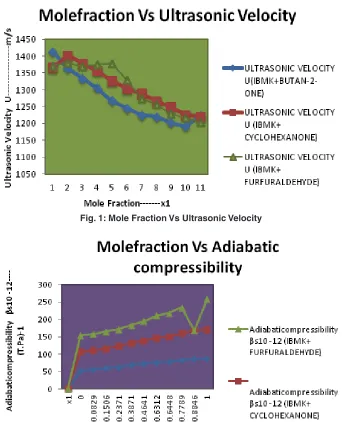
Fig. 1: Mole Fraction Vs Ultrasonic Velocity
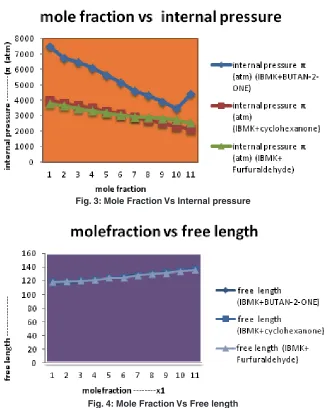
Fig. 3: Mole Fraction Vs Internal pressure
Fig. 4: Mole Fraction Vs Free length
with a least count of 0.01mmat the top of the cell, can be raised (or) lowered the reflector plate in the liquid through a known distance. The measuring cell is connected to the output terminals of the high frequency generator through a shielded cable. Ultrasonic waves, normal to quartz crystal, is reflected from the reflector plate. Stationary waves are formed in the region between reflector plate and the quartz crystal. The micrometer is slowly moved till a number of maximum readings (n) of the anode current is passed. The total distance moved by the micrometer is noted (d).The wavelength of the ultrasonic waves in the liquid is ë =2d/n. The velocity of ultrasonic waves in the liquid U = ëf .Where f is the frequency of the generator.
RESULTS AND DISCUSSION
In system 1,2 and 3 -Tables-1 (a),1(b) and1(c), it is noted that the density decreases with increase in mole fraction for 4–Methyl-2-pentanone+buyan-2-one, 4–Methyl-2-pentanone+cyclohexanone and 4–Methyl-2-pentanone+furfuraldehyde. Ultrasonic velocity and viscosity decreases with increase in mole fraction of the solute in 4–Methyl-2-pentanone+buyan-2-one, 4–Methyl-2-pentanone+cyclohexanone and 4–Methyl-2-pentanone+furfuraldehyde.
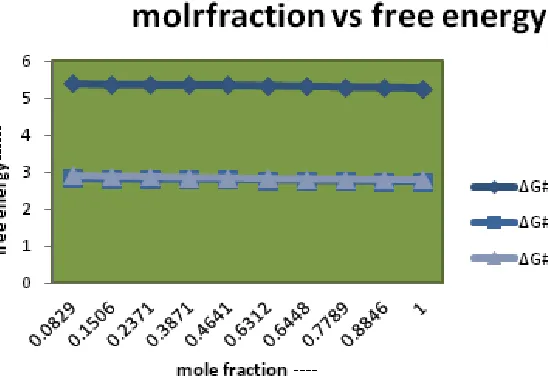
Fig. 5: Mole Fraction Vs free energy
increase in free length and adiabatic compressibility. The decrease in velocity is due to the increase in free length and adiabatic compressibility of the liquid mixtures system 4–Methyl-2-pentanonebutan-2-one, 4–Methyl-2-pentanone+cyclohexanone and 4–Methyl-2-pentanone+furfuraldehyde.. It is observed that for a given concentration as the number of CH group or chain length increases, the sound velocity increases.
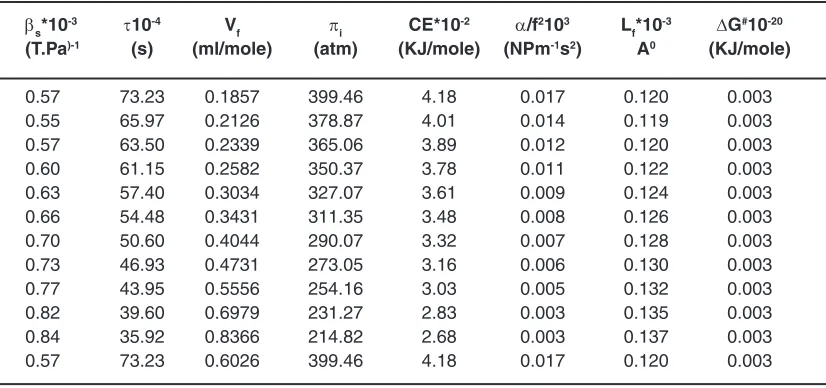
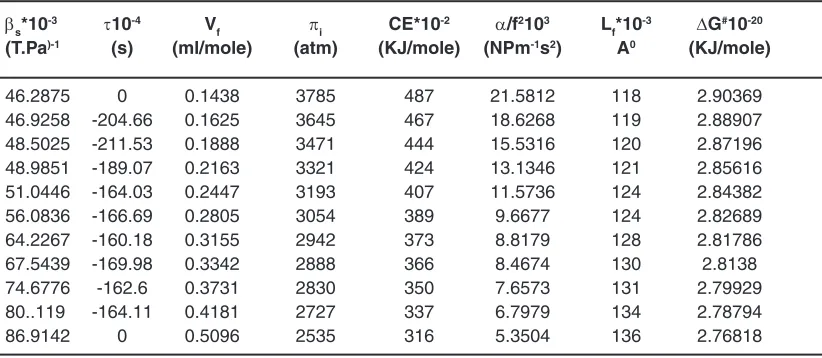
In system 1,2 and 3 -Tables-2 (a),2(b) and 2(c), The corresponding plots are given in Figs- 2 and 4. It is noted that the adiabatic compressibility and free length increases with increase of mole fraction in system 4–Methyl-2-pentanone+cyclohexanone and 4–Methyl-2-pentanone+furfuraldehyde. This may lead to the presence of specific molecular interaction between the molecules of the liquid mixture. The adiabatic compressibility and free length are the deciding factors of the ultrasonic velocity in liquid systems. The internal pressure decreases and free volume increases with increasing mole fraction.
In system 1,2 and 3 -Tables-2 (a),2(b) and2(c) and the corresponding plots are given in fig-3. it is noted that the internal pressure may give information regarding the nature and strength of forces existing between the molecules. The decrease in free volume shows that the strength of interaction decreases gradually with the increase in solute concentration. It represents that there is
weak interaction between the solute and solvent molecules.
When two liquids are mixed, there is a molecular attraction between the molecules of components and hence the cohesive energy is high. The cohesive energy and absorption coefficient values are decreased with increases in mole fractions in all the systems which may be due to weak induced dipole-induced dipole interactions in all systems..
In system 1,2 and 3 -Tables-1 (a),1(b) and1(c). Acoustic impedance decreases with increase of mole fraction in all the three systems. The relaxation time (ô) decreases with increasing concentration for all the three systems.
The dispersion of the ultrasonic velocity in the system should contain information about the characteristic time ô of the relaxation process that causes dispersion.
The relaxation time which is in the order of 10-12 sec is due to structural relaxation process28 and
in such a situation it is suggested that the molecules get rearranged due to co-operative process29.
SYSTEM:-1 4 –Methyl-2-pentanone +BUTAN-2-ONE
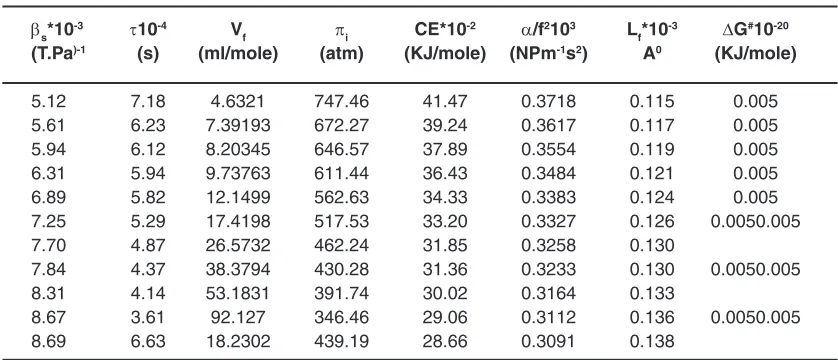
Table 2(a): adiabatic compressibility(β), relaxation time(τ), free volume(Vf), internal pressure(πi), cohesive force(CE), absorption co-efficient(α/f2), free length(L
f)& activation
energy(DG#) values at different mole fraction of chlorobenzene+ IBMK at 308K
βs*10-3 τ10-4 V
f πi CE*10-2 α/f2103 Lf*10-3 DG#10-20
(T.Pa)-1 (s) (ml/mole) (atm) (KJ/mole) (NPm-1s2) A0 (KJ/mole)
5.12 7.18 4.6321 747.46 41.47 0.3718 0.115 0.005
5.61 6.23 7.39193 672.27 39.24 0.3617 0.117 0.005 5.94 6.12 8.20345 646.57 37.89 0.3554 0.119 0.005 6.31 5.94 9.73763 611.44 36.43 0.3484 0.121 0.005 6.89 5.82 12.1499 562.63 34.33 0.3383 0.124 0.005 7.25 5.29 17.4198 517.53 33.20 0.3327 0.126 0.0050.005 7.70 4.87 26.5732 462.24 31.85 0.3258 0.130
7.84 4.37 38.3794 430.28 31.36 0.3233 0.130 0.0050.005 8.31 4.14 53.1831 391.74 30.02 0.3164 0.133
8.67 3.61 92.127 346.46 29.06 0.3112 0.136 0.0050.005 8.69 6.63 18.2302 439.19 28.66 0.3091 0.138
SYSTEM:-1 4 –Methyl-2-pentanone + BUTAN-2-ONE
Table 1(a): Mole fraction of first component (X1), Mole fraction of second component(X2), Density(ρ), viscosity(η), ultrasonic velocity(U), acoustic impedance(Z), Leonard’s Jones
potential(LJP) and Molecular interaction parameter(χu)values at different
mole fraction of IBMK + butan-2-one at 308 K
Mole Fraction ρ η*10-5 U Z*10-3 LJP χ
u*10-3
X1 X2 (Kg/m3) (NpM-2) (m/s) (Kgm-2s-1) (m/s)
0 1 977.5 5.27 1414 13.82 6 23.17
0.0829 0.9171 959.7 4.48 1363 13.08 6 19.07
0.1506 0.8494 946.8 4.35 1334 12.63 6 16.81
0.2371 0.7629 930.4 4.14 1305 12.14 6 14.62
0.3871 0.6129 902.5 3.94 1268 11.44 6 11.96
0.4641 0.5359 888.2 3.52 1246 11.07 6 10.32
0.6312 0.3688 867.4 3.17 1224 10.62 6 9.01
0.6448 0.3552 856.7 2.81 1220 10.45 6 8.71
0.7789 0.2211 832.6 2.59 1202 10.01 6 7.62
0.8846 0.1154 813.2 2.20 1191 9.69 6 7.04
1.0000 0.0000 977 5.2 1324 8.86 6 6.54
In system 1,2 and 3 -Tables-1 (a),1(b) and1(c). It is seen that the molecular interaction parameters values are more negative in system 4–Methyl-2-pentanone+cyclohexanone and 4–Methyl-2-pentanone+furfuraldehyde than 4–Methyl-2-pentanone+butan-2-one. It is suggested
that dipole-dipole interactions stronger than induced dipole-induced dipole interactions.
SYSTEM:-2 4 -Methyl-2-pentanone +CYCLOHEXANONE
Table 2(b): Adiabatic Compressibility(β), Relaxation Time(τ), Free Volume(Vf), Internal Pressure(πi), Cohessive Force(CE), Absorption Co-Efficient(α/F2), Free Length(Lf)& Activation Energy(DG#) Values At Different Mole Fraction Of IBMK + Aniline At 308 K
βs*10-3 τ10-4 V
f πi CE*10-2 α/f2103 Lf*10-3 DG#10-20
(T.Pa)-1 (s) (ml/mole) (atm) (KJ/mole) (NPm-1s2) A0 (KJ/mole)
0.57 73.23 0.1857 399.46 4.18 0.017 0.120 0.003
0.55 65.97 0.2126 378.87 4.01 0.014 0.119 0.003
0.57 63.50 0.2339 365.06 3.89 0.012 0.120 0.003
0.60 61.15 0.2582 350.37 3.78 0.011 0.122 0.003
0.63 57.40 0.3034 327.07 3.61 0.009 0.124 0.003
0.66 54.48 0.3431 311.35 3.48 0.008 0.126 0.003
0.70 50.60 0.4044 290.07 3.32 0.007 0.128 0.003
0.73 46.93 0.4731 273.05 3.16 0.006 0.130 0.003
0.77 43.95 0.5556 254.16 3.03 0.005 0.132 0.003
0.82 39.60 0.6979 231.27 2.83 0.003 0.135 0.003
0.84 35.92 0.8366 214.82 2.68 0.003 0.137 0.003
0.57 73.23 0.6026 399.46 4.18 0.017 0.120 0.003
SYSTEM:-2 4 -Methyl-2-pentanone +CYCLOHEXANONE
Table 1(b): Mole fraction of first component (X1), Mole fraction of second component(X2), Density(ρ), viscosity(η), ultrasonic velocity(U), acoustic impedance(Z), Leonard's Jones
potential(LJP) and Molecular interaction parameter(χu)values at different mole fraction of IBMK + Aniline at 308 K
Mole Fraction ρ η*10-5 U Z*10-3 LJP χ
u*10-3
X1 X2 (Kg/m3) (NpM-2) (m/s) (Kgm-2s-1) (m/s)
0.0000 1.0000 939 9.62 1366.00 12.83 41 -3.87
0.0727 0.9273 929.4 9.04 1402.00 13.03 48 -0.23
0.1115 0.8885 922.6 8.34 1378.00 12.71 43 -1.35
0.1713 0.8287 912.6 7.70 1356.00 12.37 39 -2.01
0.2916 0.7084 894.4 6.78 1327.00 11.87 35 -2.26
0.3583 0.6417 884.6 6.15 1304.00 11.54 32 -2.92
0.4853 0.5147 865.8 5.46 1289.00 11.16 31 -2.03
0.5485 0.4515 856.4 4.84 1267.00 10.85 29 -2.69
0.6949 0.3051 835.9 4.30 1249.00 10.44 27 -1.67
0.8435 0.1565 815.6 3.63 1224.00 9.98 26 -1.13
0.9179 0.0821 800.6 3.21 1220.00 9.77 25 -0.15
1.0000 0.0000 939 9.62 1204.00 12.83 24 -3.87
all the systems. This may be due to the intermediate compound formation between binary liquids. It is observed generally free energy decrease favors the formation of products from reaction. This Observation
confirms the formation of hydrogen bonding in binary mixtures.
SYSTEM:-3 4 -Methyl-2-pentanone +FURFURALDEHYDE
Table 2(c): Adiabatic Compressibility(β), Relaxation Time(τ), Free Volume(Vf), Internal Pressure(πi), Cohesive Force(CE), Absorption Co-Efficient(α/F2), Free Length(Lf)& Activation
Energy(DG#) Values At Different Mole Fraction Of IBMK + N,N-Dimethyl Aniline At 308 K
βs*10-3 τ10-4 V
f πi CE*10-2 α/f2103 Lf*10-3 DG#10-20
(T.Pa)-1 (s) (ml/mole) (atm) (KJ/mole) (NPm-1s2) A0 (KJ/mole)
46.2875 0 0.1438 3785 487 21.5812 118 2.90369
46.9258 -204.66 0.1625 3645 467 18.6268 119 2.88907 48.5025 -211.53 0.1888 3471 444 15.5316 120 2.87196 48.9851 -189.07 0.2163 3321 424 13.1346 121 2.85616 51.0446 -164.03 0.2447 3193 407 11.5736 124 2.84382 56.0836 -166.69 0.2805 3054 389 9.6677 124 2.82689 64.2267 -160.18 0.3155 2942 373 8.8179 128 2.81786 67.5439 -169.98 0.3342 2888 366 8.4674 130 2.8138 74.6776 -162.6 0.3731 2830 350 7.6573 131 2.79929 80..119 -164.11 0.4181 2727 337 6.7979 134 2.78794
86.9142 0 0.5096 2535 316 5.3504 136 2.76818
SYSTEM:-3 4 -Methyl-2-pentanone +FURFURALDEHYDE
Table 1(c): Mole fraction of first component (X1), Mole fraction of second component(X2), Density(ρ), viscosity(η), ultrasonic velocity(U), acoustic impedance(Z), Leonard's Jones potential(LJP) and Molecular interaction parameter(χu)values at different mole fraction of
IBMK + N,N-Dimethyl Aniline at 308 K
Mole Fraction ρ η*10-5 U Z*10-3 LJP χ
u*10-3
X1 X2 (Kg/m3) (NpM-2) (m/s) (Kgm-2s-1) (m/s)
0.0581 0.9419 1119 7.19 1380 1544.22 43.6364 0.0130
0.094 0.906 1101.7 6.59 1368 1507.1256 41.3793 0.0087 0.1442 0.8558 1078.2 6.09 1376 1483.6032 42.8571 0.0209 0.2533 0.7467 1030.2 5.30 1379 1420.6458 43.4389 0.0373
0.3077 0.6923 1008 4.92 1330 1340.64 35.5556 0.0073
0.4325 0.5675 962.3 4.37 1272 1224.0456 29.2683 -0.0210 0.4941 0.5059 938.5 3.93 1256 1178.756 27.9070 -0.0256
0.6501 0.3499 888 3.47 1228 1090.464 25.8065 -0.0275
0.8028 0.1972 844.1 2.99 1216 1026.4256 25 -0.0171
1 0 793.7 3.95 1204 955.6148 24.2424 0
and less dipole-dipole interaction in 2-pentanone+cyclohexanone and pentanone+furfuraldehyde than 4–Methyl-2-pentanone+butan-2-one.
ACKNOWLODGEMENT
CONCLUSION
The computed acoustical parameters and their values point to the presence of specific molecular interaction in the liquid mixtures 2-pentanone+cyclohexanone and 2-pentanone+furfuraldehyde than 4–Methyl-2-pentanone+butan-2-one. at 308 K. Hence it is concluded that the association in these mixtures is the result of strong Hydrogen bonding between the molecules & strong Dipole-Dipole
interactions 4–Methyl-2-pentanone+cyclohexanone and 4–Methyl-2-pentanone+furfuraldehyde than 4–Methyl-2-pentanone+butan-2-one in Binary liquid mixtures
The proportional studies of divergence in these systems are given by cumulative order. 4–Methyl-2-pentanone+cyclohexanone and 4–Methyl-2-pentanone+furfuraldehyde than 4–Methyl-2-pentanone+butan-2-one. These parameters will be useful in pharma and perfumes industries for handling &mixing process.
REFERENCES
1. Tabhane V A and Patki B A, Acostica, 1982, 52, 44.
2. Tabhane V A, Acoustic letters, 1988, 6, 8. 3. Marvin B L and Bhat S N, Acostica1987, 64,
155.
4. Johari G K and Misra R C Indian J Pure
&ApplPhys, 1987, 29,155.
5. Nikam P S and Hirey, Indian J Pure &ApplPhys,
1991, 29,155.
6. Gruenberg L and Nissan, Nature 1946,164, 799.
7. Manohar Murthi N and Nagbhushnam, Indian
J chem., 1984, 23, 510.
8. Khasare S B, Indian J Pure &ApplPhys, 1987,
25, 182.
9. Jacobson B, Acta chem., 1985, 6, 148. 10. Bhatti S S and Singh D P, Indian J Pure
&ApplPhys1983, 21, 506.
11. Sheshadri A T and subramanyam B, J
Physconds matter, 1990, 2, 7353.
12. Manohar Murthi N, Shivkumar K V, Rajgopal E and subramanyam S V, Acostica1981, 48 , 341.
13. MiyangaStamura K and Murakami S, Jchem.
Thermodynamics,1992,48,1767.
14. P Vigourex, Ultrasonics, Chapman and hall, London, 1952.
15. Rajgopal K and Chenthilnath, Indian J Pure
&ApplPhys, 2010, 48, 326.
16. Hirschfelder J O, Kurtiss C F and Bird R B
,Molecular theory of gases and Liquids (John
Willy, New York-01, 1954,256).
17. Sumathi T and Uma Maheswari, Indian J Pure
&ApplPhys, 2009, 47, 782.
18. Rajedren V, Indian J Pure &ApplPhys1996,
34, 52.
19. S h a n t i N , S u b r a t h i n a m P L a n d Emayavayramban M, 2010, 7, 648.
20. Bhatti S S, Vivek J S and Singh D P, Acoustica, 1982, 50, 291.
21. Palaniappan L and Thiyagarajan R, Indian J
chem., 2008, 47B, 1906.
22. Hyderkhan, V.andSubramanyam, S.V., Tras.
Parad Soc. (GB), 1971; 67,2282.
23. Temperley, H.N.V., Rawlinson, J.S. and Rush brooke, G.S., Phys. of simple liquids(John wiley,Newyork), (1968).
24. Glasstone, S., Laidler, K.J., and Erying, H., Theory of Rate Processes.
25. Mc. Graw – Hill, Newyork, 478, 479, (1950). Erying, H.and Kincaid, J.F.J.Chem.Phy., 1938; 6, 520.
26. Richards, T.W., Chem. Rev., 2,315, (1925). 27. Vanderwaals, J.d., Essay on the continuity
of the gaseous and liquid States London
1873.
28. Glasstone, S., Thermodynamic for chemist, D. van Mostrand Co., Inc., Newyork, 1947; 62. 29. Ali, A., Hyder, S. and Nain, A.K., Ind.J. Phys.,