Licensed under Creative Common Page 227
http://ijecm.co.uk/
ISSN 2348 0386
APPLICATION OF IT IN LOGISTICS ACTIVITIES: SURVEY OF
EFFICIENCY AND IMPACT ANALYSIS
Shokhrukh Odilov
Researcher of Tashkent State University of Economics, Tashkent, Uzbekistan [email protected]
Abstract
Logistics is one the leading sectors among the leading services which IT is penetrating the
technological profile. Thanks to advanced IT and satellite technologies logistics has turned to
modern face and logistic services providers have enjoyed IT’s key benefits in operating the
business and reshaping the logistics services markets. This article studied the effect of using IT
in logistics activities on operational efficiency of logistics companies in unique methods of
in-depth analysis. Obtained results revealed that use of IT in logistics positively impacts on
operational efficiency and supports the overall service supply in performance, quality, timing and
cost reduction standpoints in case of the largest logistics company in Uzbekistan.
Keywords: IT, logistics, operational efficiency, service supply, Uzbekistan
INTRODUCTION
Licensed under Creative Common Page 228 substantial impact on operational efficiency, safety and security, customer experience and new business models (See Figure 1).
Substantial impact of using IT in logistic service provision leads to improvements in the entire functioning of logistics companies. In international experience, leading logistic companies launched expansionary IT framework in order to increase operational efficiency, technological sophistication, quality enhancement, corporate decision making and overall business performance. Technological advancement and expansion enable logistics services providers to monitor, analyse and improve the working process, to control quality, performance and business operations, to optimize labour, transportation, cost structure, material use and timing, to automatize workflow and complex operations, to measure efficiency, quality, opportunities and risks.
Figure 1. Impact areas of IT in logistics
Source: Author’s illustration, 2017.
The largest impact area of IT in logistics is in asset utilization, especially in optimization of vehicle management. Logistics service providers heavily apply IT in addressing traffic related issues and monitoring fleet performance. Moreover, current technologies facilitate logistic companies to increase operational efficiency and to lower costs through resource and energy-saving smart technology solutions in monitoring. Employee performance, vehicle safety and equipment exploitation are also a widely used area of IT in logistic activity.
Licensed under Creative Common Page 229 in-depth analytical approaches and detailed analysis of IT’s impact n the operational efficiency of logistics service providers.
METHODOLOGY
In structuring the analysis, a survey was preferred to observe the effect of IT in the selected logistics company. Survey was aimed at collecting the data about attitudes of top and mid-level managers of Angren Logistics Center towards the impact of using IT in their operations. Managers were asked to answer and to assess the impact areas (operational efficiency, performance, service quality, timing, cost reduction) of IT by giving scores ranging from 1 to 5 as provided below.
Impact level Score
Highly positive 5
Positive 4
Neutral 3
Negative 2
Highly negative 1
In order to know the general preference of managers Cronbach’s alpha method is used. In consistence with Cronbach’s internal consistency theory, given variables 𝑥1, 𝑥2, 𝑥3, …, 𝑥𝑘and
𝑥0= 𝑘𝑗 =1𝑥𝑘, Cronbach’s alpha is specified as follows:
𝑘 𝑘−1
𝑐𝑜𝑣 (𝑥𝑖, 𝑘
𝑖≠𝑗 𝑥𝑗)
𝑣𝑎𝑟 (𝑥0) =
𝑘
𝑘−1 1 −
𝑣𝑎𝑟 (
𝑘
𝑗 =1 𝑥𝑗)
𝑣𝑎𝑟 (𝑥0) (1)
Here 𝑥𝑗 = 𝑡𝑗 + 𝑒𝑗 where each 𝑒𝑗 is independent from 𝑡𝑗 and all 𝑒𝑗 are independent from each
other. 𝑥0= 𝑘𝑗 =1𝑥𝑗and 𝑡0= 𝑘𝑗 =1𝑡𝑗. So the reliability of 𝑥0≥ 𝛼. Here 𝛼 is Cronbach’s alpha
coefficient.
After obtaining survey data, following equation function is tested for estimating the linear relationship between
n operational efficiency and IT’s key advantages (performance, service quality, timing, cost reduction).
𝑂𝐸𝐹 = 𝑓 𝑃𝑅𝐹, 𝑆𝑄𝐿, 𝑇𝑀𝐺, 𝐶𝑅𝐷 (2)
In the final stage, OLS equation for econometric analysis is specified on the basis of equation (2).
𝑂𝐸𝐹𝑖 = 𝛽0+ 𝛽1𝑃𝑅𝐹𝑖+ 𝛽2𝑆𝑄𝐿𝑖+ 𝛽3𝑇𝑀𝐺𝑖+ 𝛽4𝐶𝑅𝐷𝑖+ 𝜀𝑖 (3)
Here, OEF- operational efficiency, PRF – performance, TMG – timing, CRD – cost reduction, 𝜀
Licensed under Creative Common Page 230
ANALYSIS & RESULTS
We collected survey data and formed a table of responses by managers to all five impact areas (Table 1). As shown in Table 1, 22 managers out of 25 found the IT’s role in logistics services positive, while three of them evaluated IT’s added value zero. Mixed cases of evaluations were encountered with performance, quality and timing areas. Cost reduction was less supportive area of IT in managers’ evaluation. Some of them found IT’s role in reducing costs useless and counteractive.
Table 1. Responses of auditors to questionnaire
Respondents Operational
efficiency Performance
Service
quality Timing
Cost
reduction
Manager 1 4 5 4 4 4
Manager 2 5 4 5 4 4
Manager 3 4 4 3 4 2
Manager 4 4 4 4 5 5
Manager 5 5 5 4 4 3
Manager 6 3 3 3 4 4
Manager 7 5 5 5 4 4
Manager 8 3 4 4 4 4
Manager 9 5 5 4 5 4
Manager 10 3 4 3 3 2
Manager 11 4 4 4 4 4
Manager 12 5 5 3 5 4
Manager 13 5 4 4 5 3
Manager 14 4 4 4 4 4
Manager 15 5 4 5 4 4
Manager 16 4 4 5 5 5
Manager 17 5 5 5 5 5
Manager 18 4 4 5 4 3
Manager 19 4 4 4 4 5
Manager 20 4 3 3 4 4
Manager 21 5 5 5 5 5
Manager 22 4 5 4 4 4
Manager 23 4 4 3 4 4
Manager 24 4 3 3 4 4
Licensed under Creative Common Page 231 In the second stage, Cronbach’s alpha test was conducted using Real Statistics Analysis Pack 2010. Cronbach’s alpha method was used to test the individual and overall impact of IT on the selected five areas (Table 2).
Table 2. Cronbach’s alpha coefficients
Cronbach's
Alpha
Cronbach's Alpha with missing item
OEF PRF SQL TMG CRD
0,747416 0,666667 0,712203 0,68673 0,697629 0,751174
Estimated by means of Real Statistics Analysis Pack 2010.
Table 2 shows overall impact of using IT is 0.747416, which shows the good reliability of responses. It means that positively evaluated the application of IT in all five areas. In terms of individual reliability coefficients, IT positively influenced on the performance and cost reduction of logistics companies compared to the impact level on operational efficiency and service quality management and timing.
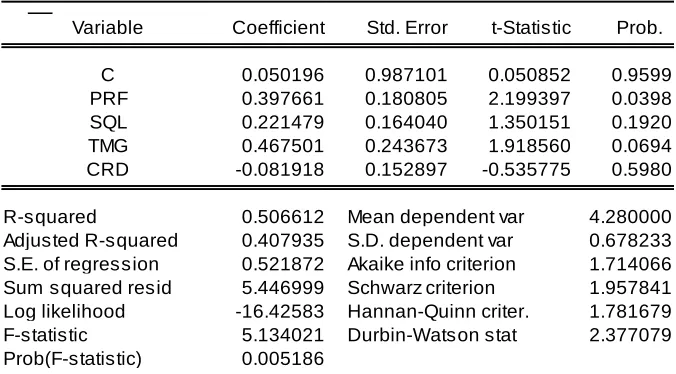
In the final stage of analytical part, effect of IT application in logistics activities is estimated on the operational efficiency of Angren Logistics Center based on the survey data. In OLS test operational efficiency is fixed as dependent variable, performance, service quality, timing and cost reduction are chosen as independent variables (See Equation 3). OLS test is run by means of EVIEWS 9.5 analysis tool.
Table 3. OLS test results
Estimated by means of EVIEWS 9.5.
Variable Coefficient Std. Error t-Statistic Prob.
C 0.050196 0.987101 0.050852 0.9599 PRF 0.397661 0.180805 2.199397 0.0398 SQL 0.221479 0.164040 1.350151 0.1920 TMG 0.467501 0.243673 1.918560 0.0694 CRD -0.081918 0.152897 -0.535775 0.5980
Licensed under Creative Common Page 232 Absolutely contrary results are obtained in OLS test to Cronbach’s alpha test results. OLS test reveals that benefits of IT use in timing of logistic activities have the most significant impact on operational efficiency with 0.467501 coefficient, where cost reduction negatively influences with power of (-0.081918) coefficient. Contribution of IT use supported operational efficiency with 0.397661 and 0.221479 coefficients respectively.
CONCLUSION
This study possesses a particularity of approaches, methods and analyses among all literatures and studies dedicated to IT’s impact on logistics companies’ operational efficiency. Despite strikingly distinguishing results from conducted tests, positivity of the application of IT in logistics is an absolute and unavoidable trend. Impact of IT on transportation and service sectors are clear and irrejectable in terms of benefit and convenience in operating the business. In empirical analysis conducted in this paper, an author attempted to measure the impact of IT in logistics service provision in the sample of the largest logistics company in Uzbekistan. Managerial responses showed that application of IT in logistics services positively impact on company’s service quality, timeliness, operational efficiency and financial profile. Scope this small-scale research is limited with only one logistics company in Uzbekistan. Therefore, an author attempted to present general view of local logistics services market and extent of applying IT by selecting the largest logistics service provider.
REFERENCES
Alshawi, S. (2001). Logistics in the Internet Age: Towards a Holistic Information and Process Picture. Logistics Information Management, Vol. 14, No. 4, pp. 235-241.
Krmac, E. (2007). Interdependence between Logistics and Information and Communication Technologies (ICT).Promet – Traffic & Transportation, Vol. 19, No. 2, pp. 115-119.
Pankowska, M. and Soltysik-Piorunkiewicz, A. (2013).Green Information Technology in Logistics Enterprise.Polish Journal of Management Studies. Vol. 2013-8, pp. 220-229.