2076
Classification And Detection Of Nutritional
Deficiencies In Coffee Plants Using Image
Processing And Convolutional Neural Network
(CNN)
Khenilyn P. Lewis, Juancho D. Espineli
Abstract: Coffee farmers or growers have difficulty in classifying nutritional deficiencies in coffee plants. Proper detection of these nutritional deficiencies could help them in giving proper intervention to plants. The study was conducted to classify and detect the nutritional deficiencies in coffee plants using image processing and Convolutional Neural Network (CNN). Once the nutritional deficiency is identified, the prot otype will display recommended fertilizer for the plant. One thousand images with eight nutritional deficiencies were used in the study namely, Boron (B), Calcium (Ca), Iron (Fe), Nitrogen (N), Phosphorus (P), Potassium (K), Magnesium (Mg) and Zinc (Z). The study covered the four varieties of coffee named Arabica, Robusta, Excelsa and Liberica existing in the Philippines. The capturing of images for testing and training the dataset were done in coffee farms and nurseries in Cavite State University, National Coffee Research, Development and Extension Center (NCRDEC) and Amadeo, Cavite. Experimental and development research designs were used. Image processing techniques was utilized in converting the images into grayscale and binary values for threshold and segmentation. Convolutional Neural Network (CNN) provides the predicted nutritional deficiencies in the coffee plants through classification and detection. Results shows that CNN has a high accuracy in detecting and classifying the nutritional deficiencies in coffee plants. The prototype was evaluated, and results shows that it is an effective alternative for classifying and detecting the nutritional deficiencies in coffee plants. Index Terms: classification, coffee, convolutional neural network, detection, image processing, machine learning, nutritional deficiencies
—————————— ——————————
1
INTRODUCTION
Coffee is known as the most important crop commodity in the world [1]. People around the world drink two billion cups of coffee every day. A total of 25 million of families depend for coffee for living specifically for business or as growers. For the last 15 years, 43 percent of coffee consumption has arisen worldwide [2]. The first coffee tree in Philippines was planted in Lipa, Batangas and in 1860s coffee are exported to America. Batangas reigned the coffee industry in the country and was followed by Cavite in planting coffee in 1876. However, due to insect manifestation coffee trees in Batangas was destroyed and few of surviving trees was transferred to Cavite. As of 2019, Batangas produces 13 percent of the coffee supply in CALABARZON (Region IV-A) and Cavite produces 67 percent [3]. The climate and soil condition in the Philippines are suitable for planting coffee. Because of this, the country could produce the four varieties of coffee namely, Arabica (Coffea arabica), Liberika (Coffea liberica), Excelsa and Robusta [5]. Arabica is the most expensive variety of coffee and usually cultivated in high elevation areas. Liberika (Kapeng Barako) is known for strong flavor and aroma. Excelsa has bigger berries compared to Arabica. Robusta is being used for expresso and instant coffee mixes. Moreover, Robusta is the commonly grown variety coffee in country which has a total production of 69 percent in 2015. Followed by Arabica which contributed 24 percent and Excelsa and Liberica [6].
Adequate nutrients are essential to plants for growth. During the vegetation to pre-flowering of coffee plants, Nitrogen and Potassium promote the growth of tissues in new plants. Calcium is for leaf growth that provides high yield for plants. Magnesium serve as fuel for developing tissues and Sulfur to maximize the growth of the plant through protein. During the post flowering to berry formation, Nitrogen and Potassium serve as maintenance for plant growth and support berry strength. Calcium is for strong healthy tissues. Magnesium and micronutrients are for growth maintenance and berry production. These nutrients are needed by the plants in their berry expansion and berry maturity [9]. These nutrients are in need necessary for the growth of coffee plants. A healthy coffee plants could maximize the number of yields that may produce. However, identification of nutritional deficiencies is done manually by the coffee growers or experts. Characteristics and symptoms of plants in terms of nutritional deficiencies are usually like other plants. Coffee growers or farmers should have enough knowledge to these symptoms so that they could perform the correct interventions [12]. Numerous applications of digital image processing have been recorded in different field. Digital image processing is the manipulation of images using the computer [10]. It converts the physical images into corresponding images and extract the information using algorithms. Digital image processing includes image collection, image processing and image analysis [11]. This study was conducted to utilize an image processing technique, implement Convolutional Neural Network (CNN) and measure the effectiveness for classifying and detecting nutritional deficiencies in coffee plants.
2
RELATED
WORK
This section discusses the related works in image processing and algorithms as basis for classifying and detecting the nutritional deficiencies in coffee plants. A neural network was trained to detect the nutritional deficiencies in coffee plants. As a result, a Kappa coefficient of 0.96 for Nitrogen and
______________________________________
• Khenilyn P. Lewis is currently pursuing doctor in information technology in AMA University-Quezon City, Philippines. She is also working as a faculty member in Cavite State University, Cavite, Philippines. E-mail: [email protected]
• Juancho D. Espineli is currently the dean of the school of graduate
studies in AMA University- Quezon City. E-mail:
2077
Phosphorus deficiency and 0.92 for Boron. It was also observed that the higher the number of images the higher the result for Kappa [8]. Digital image processing of 355 images with nutritional deficiencies in coffee plants such as magnesium, manganese and iron was utilized in the study. Results shows an accuracy of 67.5 percent. The image was pre-processed from RGB image. The visual features are extracted to the image and then built using a Random forest model. The Random Forest algorithm was used to classify the nutritional deficiencies present in the coffee plants [12]. Image processing was used in identifying and classifying disease in plant. The steps include pre-processing, training and identification. Pixel similarity was the basis of the algorithm for segmentation in identifying the leaf disease in the plant. An algorithm was proposed that does not employ segmentation. Rather, the Principal Component Analysis was directly applied to RGB colors of the leaf images. The study used a Multilayer Perceptron (MLP) Neural Network with one hidden layer and determined if the sample has disease or not [14]. Image is defines as two dimensional array in forms of rows and columns represents as function, F(x,y).
Fig.1. Image rows and columns
Pixel is used to denote elements in digital image processing. Image processing has three steps. First, importing images using image acquisition tools. Second, analysis and manipulation of image. Last, is the output image or result based from analysis [15]. In terms of nutrients, the study covered the macronutrients and micronutrients. Macronutrients are chemical elements representing the 96% of the plants’ composition. Some macronutrients are Nitrogen (N), Phosphorus (P), Potassium (K), Calcium (Ca), and Sulfur (S). Some micronutrients are Boron (B), Iron (Fe) and Zinc (Z). The images are used for training KNN, Naïve Bayes and Neural Network classifiers. The experimental results show that the developed procedure has a high accuracy, being the better results associated to the identification of Boron (B) and Iron (Fe) deficiencies [14].
3
PROPOSED
METHOD
This section discusses the research design, nutritional deficiencies and proposed method in classifying and detecting the nutritional deficiencies in coffee plants.
3.1 Research Design
The study utilized experimental-developmental research designs. Identification of the nutritional deficiency of the coffee based on its leaf’s appearance was done. The identification of nutritional deficiencies was collaborated with agriculturists and soil expert. Developmental research is a study that includes
design, development and evaluation. The approach is to meet the consistency and effectiveness of the system or prototype to be developed [18]. It also answers the questions of why, how, what and whom as it includes the process of development and evaluation. Since it develops and evaluates, to is intended to provide justification in works and progress to contribute in different fields and areas of knowledge. In addition, it delivers the specific and general processes of pre-test and post-pre-test research design [17].
3.2 Research Environment
The coffee leaves used in the training and testing of data were collected at the National Coffee Research, Development and Extension Center (NCRDEC), Indang, Cavite and coffee farms in Amadeo, Cavite. The NCRDEC is the national leader in coffee research and development in the country as designated by the Department of Agriculture Research Bureau of Agricultural Research (DA-BAR).
3.3 Respondents of the Study
The respondents of the study were the coffee growers and farmers in Amadeo, Cavite since they are the end user of the study. To evaluate the functionality of the prototype, Information Technology experts were also included.
3.4 Data Preparation
The study used 1000 images of coffee leaves with nutritional deficiencies in Boron, Calcium, Iron, Nitrogen, Phosphorus, Potassium, Magnesium and Zinc. The classified nutritional deficiencies were manually identified and verified by an agriculturist and soil expert.
3.5 Testing and Evaluation
In evaluation, the study used a researcher-made evaluation form based from ISO/IEC 25010:2011 in terms of its functionality, performance efficiency, usability, reliability, maintainability and portability.
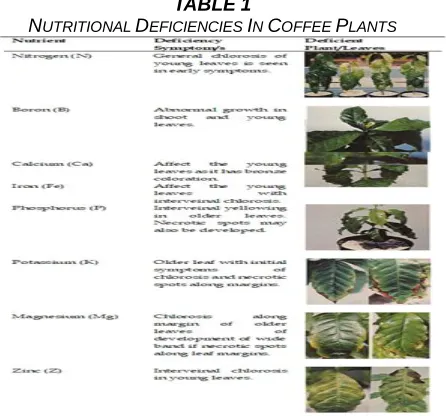
3.6 Nutritional Deficiencies
Healthy plants are visually shown in leaves which are alive in green color. In this study, eight nutritional deficiencies were found during the data gathering [16].
TABLE 1
2078 3.7 Proposed Approach
The study utilized the image processing and Convolutional Neural Network in classifying and detecting the nutritional deficiencies in coffee plants.
Fig. 2. Steps in classifying and detecting the nutritional deficiencies in coffee plants
Figure 2 shows the first step in image acquisition followed by image pre-processing. Pattern extraction will take place to classify and detect the nutritional deficiency present in the coffee leaves.
Fig. 3. Conceptual framework of the study
Figure 3 shows the proposed approach in classifying and identifying the nutritional deficiencies in coffee plants. The images of coffee leave were taken using two (2) Logitech cameras. The leave should be place inside the prototype and should be seen in the display. Once the images are captured it will be saved in a SD card as storage. During the image processing, the images is converted from RGB to grayscale. The resize image in grayscale is converted into vector input. Once the images are in vector format, tensor flow will be used in the Convolutional Neural Network (CNN). The CNN algorithm will classify and detect the input images. The LCD will be used to display the detected nutritional deficiency in the leaves. It will be the basis for the recommended fertilizer in the plant.
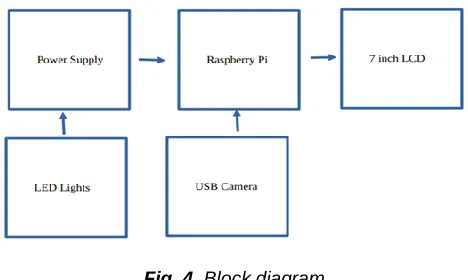
Fig. 4. Block diagram
Figure 4 shows the block diagram of the prototype. The power supply and USB cameras are attached to the raspberry pi
device and output will be displayed in the 7-inched LCD.
Fig. 5. Architectural model of the study
3.8 Materials
Materials used in the study are Raspberry Pi 4, 7 inched Liquid Crystal Display (LCD), SD card, Logitech cameras with maximum resolution of 2048 x 1536 pixels in .jpeg format, Power Supply and Sintra Board. Python was also used in coding preparation.
3.9 Classification
Convolutional Neural Network (CNN) is the most commonly wide algorithm for image processing, object detection and the like. In CNN image classification, images are captured and processed or classify under certain categories. In this study, the captured images of coffee leaves are categorized under the eight nutritional deficiencies.
Fig. 6. CNN architecture
The first layer of CNN is extracting the features of images in the convolution. Convolution handles the image features and pixels of the input data using image matrix or filter matrix.
3.10 Evaluation of the Proposed Algorithm
The evaluation of the prototype in classifying and detecting the nutritional deficiencies in coffee plants is done using the formula (1) [13].
(1)
Where:
D = Detection Accuracy t = Ground Truth r = Result
2079
image detection process. The ground truth (t) is determined by the actual number of leaves with nutritional deficiencies. In determining the nutritional deficiencies, the researchers with agriculturists and soil expert manually verify the leaves. Lastly, result (r) is determined by the number of leaves with nutritional deficiencies detected by the algorithm.
3.11 Statistical Treatment of Data
After data collection, the raw scores were tallied and tabulated in a columnar sheet using Microsoft Excel. To determine if the prototype complies with the ISO, the evaluation responses from the respondents were used as basis from which the weighted mean was utilized.
Where: =the computed mean f=frequency of the response
=sum of all the products of f and x =sum of all the subjects/respondents
3.12 Scaling and Quantification of Data
The data gathered using a rating scale which ranged from 1 to 5, of which five (5) is the highest and one (1) is the lowest. Each score range has a corresponding numerical scale and appropriate verbal descriptions shown in the Table 2.
TABLE 2
SCORING AND QUANTIFICATION OF DATA
4
RESULT
AND
DISCUSSION
The researchers used the experimental and developmental method in this study. The leaves with nutritional deficiencies were manually verified by agriculturists and soil expert.
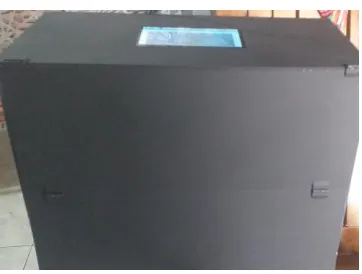
Fig. 7. The prototype
Figure 7 shows the prototype and screen loading of the software. The device is directly connected to a power source either in a 220 volt or a power bank.
Fig. 8. Inside the prototype and image acquisition
Figure 8 shows the inside view of the prototype with Excelsa leave variety. The raspberry is located to the upper part together with cables and wires, cameras are used to capture data and LED lights to provide equal and balance lightning inside the device.
Fig. 9. Sample screen capture of leaves
Figure 9 shows the sample screen input a leave in the prototype. Two cameras were used to capture the leave depending to its size because there are leaves that are too large. The detected nutritional deficiency will be displayed together with the recommended fertilizer.
Fig. 10. Coffee leave in different threshold value
2080
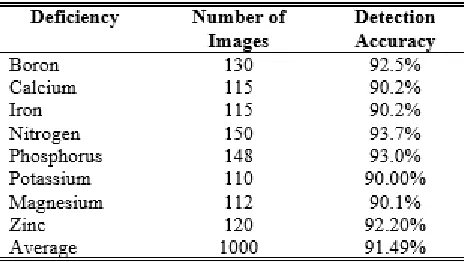
The prototype was tested by capturing the suspected leaves with nutritional deficiencies. The device was set up and the captured images was verified by an agriculturist and soil expert. The results of testing for classification and detection of nutritional deficiencies were presented in table 3.
TABLE 3
SUMMARY OF THE DETECTION ACCURACY
Table 3 shows the detection and classification results of the study. Detection accuracy for Boron (92.5%), Calcium (90.2%), Iron (90.2%), Nitrogen (93.7%), Phosphorus (93.0%), Potassium (90.00%), Sulfur (90.1%) and Zinc (92.20%). The overall detection accuracy is 91.49 percent. The result of evaluation was ―Strongly Agree‖ conducted by end users and Information Technology experts. It implies that the used of image processing techniques and Convolutional Neural Network (CNN) is an effective way of detecting and classifying the nutritional deficiencies in coffee plants.
5
CONCLUSIONS
The study proposed a model for classifying and detecting nutritional deficiencies in coffee plants using image processing and Convolutional Neural Network (CNN). Nutritional deficiencies in Boron, Calcium, Iron, Nitrogen, Phosphorus, Potassium, Magnesium and Zinc were correctly classified using the proposed algorithm. Based on the result of evaluation, CNN provide a high level of accuracy in terms of detecting and classifying the nutritional deficiencies in coffee plants. High accuracy for classification can be obtained using numerous numbers of images. The level of detection and classification could also be acquired depending the size of leaves, the higher threshold value for smaller leaves.
6
FUTURE
WORK
The researchers suggest performing deeper researchers for CNN and image processing with regards to coffee. Also, this research can be improved in terms of portability and innovative collaboration with another platform technologies.
7
ACKNOWLEDGEMENT
The researchers would like to acknowledge the help of AMA University-Quezon City, Cavite State University, National Coffee Research, Development and Extension Center (NCRDEC), Office of the Provincial Agriculturist- Trece Martires City, Cavite, Municipal Agriculturist of Amadeo, Cavite and Commission on Higher Education (CHED) K12 unit.
8
REFERENCES
[1]. R. Le Pelley. ―Pest of Coffee‖. Longmans, Green and
Co. Ltd, London and Harlow. 19690307548. 2019.
[2]. J. Siddle & V. Venema. ―Saving Coffee from Extinction‖. BBC News Magazine. 2015. globalwarming-sowhat.com [3]. A. Papa. ―Strengths and Challenges of Philippine Coffee Production‖. 2019.PressReader, https://www.pressreader.com/philippines/agriculture-9ggr/20190301/282368336064710
[4]. Philippine Statistics Authority (PSA). ―Major Non-Food and Industrial Crops‖. Quartely Bulletin. 2019
[5]. Philippine Coffee. Philippine Coffee Board. 2019. [6]. Philippine Coffee Industry Roadmap 2017-2019.
Department of Agriculture. 2017
[7]. D. Nosowitz. Is Coffee Really Going Extinct? 2019.
[8].J. Sosa, J. Ramirez, L. Vives & G. Kemper. ―An Algorithm for Detection of Nutritional Deficiencies from Digital Images of Coffee Leaves Based on Descriptors and Neural Networks‖. 2019 XXII Symposium on Image, Signal Processing and Artificial Vision (STSIVA)
[9]. Y. Tanzania. ―Role of Nutrients by Growth Stage in Coffe‖e. 2019. Yara, https://www.yara.co.tz/crop- nutrition/coffee/role-of-nutrients-by-growth-stage-in-coffee/
[10]. Eduardo A.B. da Silva, Gelson V. Mendonça. ―Digital Image Processing‖. The Electrical Engineering Handbook. 2005
[11]. L. Sun. ―Asphalt mix homogeneity‖. Structural Behavior of Asphalt Pavements, 2016
[12]. D. Monsalve, M. Trujillo, & D. Chaves. ―Automatic Classification of Nutritional Deficiencies in Coffee Plants‖. 6th Latin-American Conference on Networked and Electronic Media (LACNEM 2015) . doi:10.1049/ic.2015.0317
[13]. S. M. D. Lainez, & D. B. Gonzales. ―Automated Fingerlings Counting Using Convolutional Neural Network‖. 2019 IEEE 4th International Conference on Computer and Communication Systems (ICCCS). doi:10.1109/ccoms.2019.8821746
[14]. S. Kamlapurkar. ―Detection of Plant Leaf Disease Using Image Processing Approach‖. International Journal of Scientific and Research Publications, Volume 6, Issue 2, February 2016. ISSN 2250-3153
[15]. R. Gonzales. ―Digital Image Processing Basics‖. 2019 [16]. M. Nagao, K. Kobayashi & G. Yasuda. ―Mineral
Deficiency in Coffee‖. 1986. Research Extension Series. ISSN 0271-9916
[17]. K. Klaassen, &, K. Kortland. ―Developmental Research‖. 2015. 10.1007/978-94-007-2150-0_155.
[18]. R. Richey & N. Wayne. ―Developmental research‖. Lawrence Erlbaum Associates.2004. pp.1099-1130 [19]. S. Albawi, T. A. Mohammed & S. Al-Zawi.
(2017). ―Understanding of a convolutional neural network‖. 2017 International Conference on Engineering and Technology (ICET). doi:10.1109/icengtechnol.2017.8308186 [20]. J. Boulent, S. Foucher & J. Théau. ―Convolutional
Neural Networks for the Automatic Identification of Plant Diseases‖. Front Plant Sci. 2019;10:941. doi:10.3389/fpls.2019.00941
2081
cultivated in nutrient solutions with suppressed macronutrients‖. Journal of Plant Nutrition, 39(11), 1578–1588. doi:10.1080/01904167.2016.1161777 [22]. S. Hemlata, S. Shalinz & G. Seema. ―A Brief Overview
on Data Mining Survey‖. International Journal of Computer Technology and Electronics Engineering (IJCTEE) Volume 1, Issue 3
[23]. W. Jeon & R. Sang-Yong. (2017). ―Plant Leaf Recognition Using a Convolution Neural Network‖. The International Journal of Fuzzy Logic and Intelligent Systems. 17. 26-34. 10.5391/IJFIS.2017.17.1.26. [24]. G. P. Zhang. ―Neural Networks For Data Mining‖. Data
Mining and Knowledge Discovery Handbook, 419– 444. doi:10.1007/978-0-387-09823-4_21
[25]. C. Zhang, P. Zhou, C. Li, & L. Liu. ―A Convolutional Neural Network for Leaves Recognition Using Data Augmentation‖. 2015 IEEE International Conference on Computer and Information Technology; Ubiquitous Computing and Communications; Dependable, Autonomic and Secure Computing; Pervasive Intelligence and Computing. doi:10.1109/cit/iucc/dasc/picom.2015.318 [26]. N. M. Yusoff, I. S. Abdul Halim, N. E. Abdullah & A. A.
Ab. Rahim. ―Real-time Hevea Leaves Diseases Identification using Sobel Edge Algorithm on FPGA: A Preliminary Study‖. 2018 9th IEEE Control and System Graduate Research Colloquium (ICSGRC). doi:10.1109/icsgrc.2018.8657603
[27]. A. P. Marcos, N. L. S. Rodovalho & A. R. Backes. ―Coffee Leaf Rust Detection Using Convolutional Neural Network‖. 2019 XV Workshop de Visão Computacional (WVC). doi:10.1109/wvc.2019.8876931
[28]. P.S.Kesava & K.P. Peeyush. ―Autonomous Robot to Detect Diseased Leaves in Plants using Convolutional Neural Networks‖. 2019 3rd International Conference on Trends in Electronics and Informatics (ICOEI). doi:10.1109/icoei.2019.8862737
[29]. S.S.Hari, M. Sivakumar, P. Renuga, S. karthikeyan & S. Suriya. ―Detection of Plant Disease by Leaf Image Using Convolutional Neural Network‖. 2019 International Conference on Vision Towards Emerging Trends in Communication and Networking (ViTECoN). doi:10.1109/vitecon.2019.8899748