3985
Data Interpolation Using C
2
Rational Quartic
Spline
Adila Harim, Samsul Ariffin Abdul Karim, Mahmod Othman, Azizan Saaban
Abstract: This study discusses the construction of new C2 rational quartic spline scheme in from the quartic numerator and quadratic denominator with three parameters. Unlike the derivation of C2 continuity for some existing splines interpolation, the proposed rational quartic spline can achieve C2 continuity without the need to solve any system linear of equations. The main advantages of the proposed scheme is that we will obtain various C2
rational just by manipulating the free parameters. We test the proposed scheme to interpolate data and we compare the performance against established schemes in terms of root mean square error (RMSE) and coefficient of determination (R2). From numerical results, the proposed scheme is best than some existing schemes in terms of smaller RMSE and higher R2 value.
Index Terms: Quartic polynomial, Rational Quartic Spline, Error Analysis, Absolute Error, RMSE, R2, C2 continuity
————————————————————
1
I
NTRODUCTIONIn the area of computer graphics (CG), computer-aided design (CAD) computer-aided geometric design (CAGD), the uses of data interpolation are important for interpolating curve that enables modify the final shape of the interpolated data to refine by manipulating the values of parameters. But the current demand in geometric modeling is higher degree of continuity, such as C2 or more. In this study, we are particularly concerned with the construction of curve interpolation scheme with C2 continuity. Some studies in this area are given in the following paragraphs:
Lamberti and Manni [11] described the global C2 continuity shape preserving interpolation function using the cubic curves of the Hermite spline interpolation. The tension parameters were used to control the final shape of interpolating curves. The necessary and sufficient condition for convexity were given in detail. Motivated by the shortage of cubic spline interpolation, several researchers have proposed several types of rational spline interpolants in order to preserve the positivity of the positive data sets, monotonicity of the monotone data and the convexity of the convex data sets. Duan et al. [4] have constructed the weighted rational cubic spline though combination between rational cubic spline [1] and [2]. By choosing suitable values of the parameter then the weighted rational cubic spline will reduce to the scheme of [1] and [2] respectively. In their scheme, the degree smoothness attained is C1. But the C2 continuity is more possible by substituting the most suitable values of the parameters and solve the tri-diagonal system of the equations to calculate the first derivative values. Their schemes were also only applicable for equally spaced knots.
Duan et al. [5] discussed the approximation properties of three’s type of rational cubic spline i.e. rational cubic spline with linear denominator by [2], rational cubic spline with quadratic denominator by Gregory et al [3] and the rational cubic spline with cubic denominator by Sarfraz [13]. Their scheme assumed that the function to interpolate is C2 continuity in the given interval. They concluded that the rational cubic spline with the linear denominator gives the best approximation to the function that is interpolated. Wang and tan [14] have constructed the C2 continuity monotonicity preserving interpolation curves without the need to solve any nonlinear or linear system of equation. From several numerical testing, it may be not suitable to construct the monotonic interpolating curves with C2 continuity. Since the derivative obtained from C2 condition may not satisfy the sufficient condition for the monotonicity but the shape preserving interpolation for monotone data with C2 continuity is always positive. Piah and Unsworth [12] extended the idea of Karim [10] to improve the sufficient condition for monotonicity of Wang and Tan [14]. Even though the sufficient conditions were improved as what the authors claimed, but it is still not suitable to construct the C2 rational quartic spline that preserves the monotonicity of the data. Hence, Wang and Tan spline have their own limitation and not optional for C2 monotonicity preserving interpolation. Han [6] described a new family of piecewise rational quartic interpolation (quartic/quadratic) with one tension parameter. The C2 continuity can be achieved without requiring to solve the linear or nonlinear systems of equations for the unknown first derivative. The numerical result presented including the convergence analysis of the scheme, but the rational quartic spline was proposed neither have the positivity nor monotonicity properties. Therefore, it not suitable to preserve the shape of positive and monotone data. To overcome his scheme Zhu and Han [16] extended the rational quartic spline of by [10] introduced two tension parameters. The data dependent sufficient condition for C2 rational quartic interpolant to be positive, convex and monotone are respectively derived on one parameter meanwhile the other is free to be utilized. Karim [9] has constructed rational cubic spline (cubic/quadratic) with three parameter for the monotonic interpolating curve. Zhu [15] constructed new rational quartic spline (quartic/cubic) with four parameters. He claims that his proposed scheme achieves C2 continuous without the need to modify the first derivative. But based on the mathematical derivation, his scheme is very difficult to use as well as require more computation compare with our proposed scheme is this study.
___________________________
Noor Adilla Harim is currently pursuing masters of science in Applied Math degree program in Applied Math in Universiti Teknologi Petronas, Malaysia. E-mail: [email protected]
Samsul Ariffin Abdul Karim is currently senior lecturer in Universiti Teknologi Petronas, Malaysia. E-mail: [email protected]
Mahmod Othman is currently senior lecturer in Universiti Teknologi Petronas, Malaysia. E-mail: [email protected]
The purpose of this paper is to present a rational quartic spline interpolation with three parameters which can be used to construct C2 interpolation curve for data interpolation without solving the linear system equation of the consistency equation for the values of the derivatives at the knots. The control parameters have been manipulated the final shape of the interpolation. The simple sufficient condition concerning the value of the second derivative for the C2 interpolation curve and also for error analysis are developed.
This paper is organized as follows. In Section 1, we give some basic introduction as well as the related literature review. Section 2 is devoted to the rational quartic spline interpolant. In section 3, we discussed the sufficient condition for C2 continuity and derivative estimation to find out the derivative for its function. Section 4, we discuss on data interpolation using the proposed scheme and dedicated for Results and Discussion including the comparison with existing schemes and default quartic polynomial using error analysis such as RMSE and R2. The summary will be given in the final section.
2
C
ONSTRUCTION RATIONAL QUARTIC SPLINEThis section discusses the construction rational quartic spline with three parameters including the definition from Harim et al. [7, 8]. This section will introduce the C2 rational quartic spline interpolant with three parameters. Given the scalar data
} ,..., 1 , 0 ), ,
{(xi fi i n wherex0 x1 ... xn and the second
derivativedi, at the respective pointxi,i0,1,..n. Then the
rational quartic spline with three parameters i,i 0 and on the interval [xi,xi1],i 0,1,..., n 1is given by:
) ( ) ( ) ( i i i Q P x
S (1)
where 1 4 3 2 2 3 4 ) 1 ( ) 1 ( ) 1 ( ) 1 ( )
( i i i i i i i
i f A B C f
p
2 2 ) 1 ( ) 1 ( )
( i i i
i
Q
2 2 1 4 3 2 2 3 4 ) 1 ( ) 1 ( ) 1 ( ) 1 ( ) 1 ( ) 1 ( ) ( i i i i i i i i i i i f C B A f x s (2)
With hi xi1 xi,
i i i i h f f
1
and a local variable,
i i h x x
where the,
0,1The following conditions, it will assure that the rational quartic spline interpolant in Equation (1) has C2 continuity.
) ( ) ( ) ( ) ( ) ( ) ( ) 2 ( ) 2 ( 1 1 ) 1 ( ) 1 ( 1 1 i i i i i i i i i i x s x s d x s d x s f x s f x s (3)
Where the s(1)(xi) and s(2)(xi) denote the first and second
derivative respectively while for s(2)(xi) and ( )
) 2 ( i x s
shows the right and left hand side of the second derivative. By using condition in Equation (3), the C2 rational quartic spline interpolant with three parameters defined in Equation (1) has the unknowns: 1 1 1 ) 2 ( ) ( ) ( ) 2 ( i i i i i i i i i i i i i i i i i i i i i d h f C f f B d h f A (4)
The C2 continuity, s(2)(xi)=s(2)(xi), i1,2,3,..., n1 will give that i i i i i i i i i i i i h d h d
)( )] 2[( )( )]
[( 2 1 1 1 1
1
(5)
3 D
ERIVATIVEE
STIMATIONWhen the data interpolation is not from the true function, the second derivative need to be determined. There is a common method to estimate the second derivative which is the arithmetic mean method (AMM) by Delbourgo and Gregory [3]. Suppose a data
(xi, fi),i 0,1,2,..., n
is considered that. ... 1
0 x xn
x The derivation of diat the point
are estimated as follow: Let assume
i i i x x
h 1 and
i i i i h f f
1
.
For endpoint derivatives d1 and dn described as:
n n d x s d x
s(1)( 1) 1, (1)( ) (6) Which can be estimated by using the derivative estimation of Arithmetic Mean Method (AMM).
2 1 1 2 1 1 1 h h h d (7)
1 2 1 2 1 1 n n n n n n n h h h d (8) At the other point, the value diiscalculated by using Equation (5)
1 1 2 1 2 1 1 1 1 1 1 1 1 1 1 1 1 i i i i i i i i i i i i i i i i i i i i i i i i i i i h h h h h h h h d (9)
After some simplification we obtain
i i i i i i i i i i i i i i i i i i i i i h h h h d 1 1 1 1 1 1 1 1 1 1 , (10) Meanwhile or Wang and Tan [14] scheme,
1 ,... 3 , 2 3 1 3 2 1 1 1 1 11
n i h h h h h h d i i i i i i i i i i i i i (11)
3987 1
,..., 3 , 2
1 1
1
n i
h h
h h
d
i i
i i i i
i (12)
4 R
ESULT AND DISCUSSIONThis section discusses the numerical example of the data interpolation using the proposed scheme including comparison with some existing schemes for the comparison in C2 continuity. As a validation, we plotting the interpolating curve for each scheme and calculate error analysis such as absolute error, RMSE and R2 for each example. We also calculate absolute error for different value ofhi. This section discusses
the example of the data interpolation using the proposed scheme including comparison with existing schemes. As validation, we calculate error analysis for each data sets. Throughout this section, let f(x) represent true function for each example, p(x) considered as quartic polynomial, w(x) is Wang and Tan [14] scheme, z(x) considered as Zhu [15] scheme and s(x) represents the proposed scheme with suitable parameters value. Formula for absolute error, RMSE and R2 are described as in Harim et al. [7] as:
1. Absolute error
e a
e
v
v
A
( 1 3 )Where
a
v Approximation value.
e
v Exact value from true function.
2. Root mean square error (RMSE)
n v v
n
n
a e
1
2
) (
( 1 4 )
3. coefficient of determination (R2)
) ) ( )(
) ( (
) (
2 2
2 2
2
y y
n x x
n
y x xy
n
R
( 1 5 ) Where
n=Number of samples
x=The value of data x
y=The value of data y
4.1 Example 1
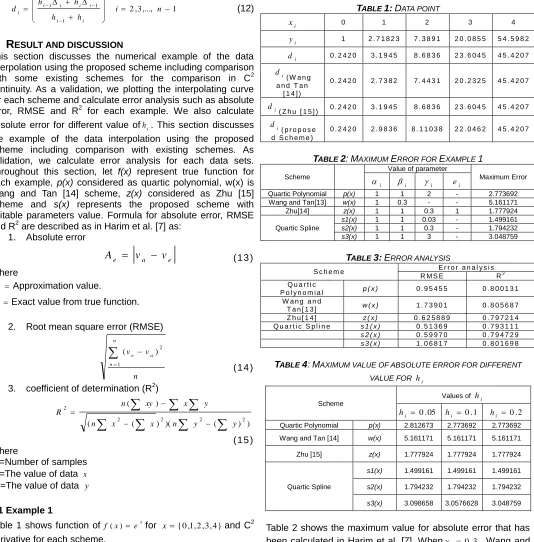
Table 1 shows function of x
e x
f( ) for x{0,1,2,3,4}and C2
derivative for each scheme.
TABLE 1: DATA POINT
i
x 0 1 2 3 4
i
y 1 2 . 7 1 8 2 3 7 . 3 8 9 1 2 0 . 0 8 5 5 5 4 . 5 9 8 2
i
d 0 . 2 4 2 0 3 . 1 9 4 5 8 . 6 8 3 6 2 3 . 6 0 4 5 4 5 . 4 2 0 7
i
d
( W a n g a n d T a n
[ 1 4 ] )
0 . 2 4 2 0 2 . 7 3 8 2 7 . 4 4 3 1 2 0 . 2 3 2 5 4 5 . 4 2 0 7
i
d
( Z h u [ 1 5 ] ) 0 . 2 4 2 0 3 . 1 9 4 5 8 . 6 8 3 6 2 3 . 6 0 4 5 4 5 . 4 2 0 7
i
d
( p r o p o s e d S c h e m e )
0 . 2 4 2 0 2 . 9 8 3 6 8 . 1 1 0 3 8 2 2 . 0 4 6 2 4 5 . 4 2 0 7
TABLE 2: MAXIMUM ERROR FOR EXAMPLE 1
Scheme
Value of parameter
Maximum Error
i
i i ei
Quartic Polynomial p(x) 1 1 2 - 2.773692 Wang and Tan[13] w(x) 1 0.3 - - 5.161171 Zhu[14] z(x) 1 1 0.3 1 1.777924
Quartic Spline
s1(x) 1 1 0.03 - 1.499161 s2(x) 1 1 0.3 - 1.794232
s3(x) 1 1 3 - 3.048759
TABLE 3: ERROR ANALYSIS
S c h e m e E r r o r a n a l y s i s R M S E R2 Q u a r t i c
P o l y n o m i a l p ( x ) 0 . 9 5 4 5 5 0 . 8 0 0 1 3 1 W a n g a n d
T a n [ 1 3 ] w ( x ) 1 . 7 3 9 0 1 0 . 8 0 5 6 8 7 Z h u [ 1 4 ] z ( x ) 0 . 6 2 5 8 8 9 0 . 7 9 7 2 1 4 Q u a r t i c S p l i n e s 1 ( x ) 0 . 5 1 3 6 9 0 . 7 9 3 1 1 1 s 2 ( x ) 0 . 5 9 9 7 0 0 . 7 9 4 7 2 9 s 3 ( x ) 1 . 0 6 8 1 7 0 . 8 0 1 6 9 8
TABLE 4:MAXIMUM VALUE OF ABSOLUTE ERROR FOR DIFFERENT
VALUE FOR hi
Scheme
Values of hi
05 . 0
i
h hi 0.1 hi 0.2
Quartic Polynomial p(x) 2.812673 2.773692 2.773692 Wang and Tan [14] w(x) 5.161171 5.161171 5.161171
Zhu [15] z(x) 1.777924 1.777924 1.777924
Quartic Spline
s1(x) 1.499161 1.499161 1.499161
s2(x) 1.794232 1.794232 1.794232
s3(x) 3.098658 3.0576628 3.048759
Table 2 shows the maximum value for absolute error that has been calculated in Harim et al. [7]. Wheni 0.3, Wang and Tan [14] has the highest value for maximum absolute error followed by the proposed scheme. Zhu [15] scheme have the smallest value but wheni 0.03 , the proposed scheme has the smallest value of maximum absolute error. For the proposed scheme, we can conclude the smallest value, the smallest maximum value for the absolute error. Table 3 shows error analysis for RMSE and R2. Scheme of Wang and Tan still have the highest values for error analysis and followed by s3(x) for the proposed scheme. Table 4 shows the maximum value for absolute error for a different valuehi . The maximum
2 . 0
i
h but s3(x) has a slightly different value forhi 0.05 .
4.2 Example 2
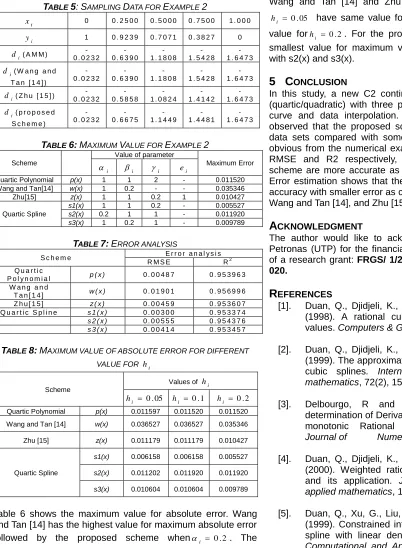
Data for Table 5 show function of
2 cos )
(x x
f for x= {0,
0.25, 0.5, 0.75, 1}. Table 5 shows the data points and derivative values using Arithmetic Mean Method (AMM) and also the C2 derivative for each scheme.
TABLE 5: SAMPLING DATA FOR EXAMPLE 2
i
x 0 0 . 2 5 0 0 0 . 5 0 0 0 0 . 7 5 0 0 1 . 0 0 0
i
y 1 0 . 9 2 3 9 0 . 7 0 7 1 0 . 3 8 2 7 0
i
d ( A M M ) 0 . 0 2 3 2 - 0 . 6 3 9 0 - 1 . 1 8 0 8 - 1 . 5 4 2 8 - 1 . 6 4 7 3
-i
d ( W a n g a n d T a n [ 1 4 ] )
-0 . -0 2 3 2
-0 . 6 3 9 -0
-1 . -1 8 0 8
-1 . 5 4 2 8
-1 . 6 4 7 3
i
d ( Z h u [ 1 5 ] ) 0 . 0 2 3 2 - 0 . 5 8 5 8 - 1 . 0 8 2 4 - 1 . 4 1 4 2 - 1 . 6 4 7 3
-i
d ( p r o p o s e d S c h e m e )
-0 . -0 2 3 2
-0 . 6 6 7 5
-1 . -1 4 4 9
-1 . 4 4 8 -1
-1 . 6 4 7 3
TABLE 6: MAXIMUM VALUE FOR EXAMPLE 2
Scheme
Value of parameter
Maximum Error
i
i i ei
Quartic Polynomial p(x) 1 1 2 - 0.011520 Wang and Tan[14] w(x) 1 0.2 - - 0.035346 Zhu[15] z(x) 1 1 0.2 1 0.010427
Quartic Spline
s1(x) 1 1 0.2 - 0.005527 s2(x) 0.2 1 1 - 0.011920 s3(x) 1 0.2 1 - 0.009789
TABLE 7: ERROR ANALYSIS
S c h e m e E r r o r a n a l y s i s R M S E R2 Q u a r t i c
P o l y n o m i a l p ( x ) 0 . 0 0 4 8 7 0 . 9 5 3 9 6 3 W a n g a n d
T a n [ 1 4 ] w ( x ) 0 . 0 1 9 0 1 0 . 9 5 6 9 9 6 Z h u [ 1 5 ] z ( x ) 0 . 0 0 4 5 9 0 . 9 5 3 6 0 7 Q u a r t i c S p l i n e s 1 ( x ) 0 . 0 0 3 0 0 0 . 9 5 3 3 7 4 s 2 ( x ) 0 . 0 0 5 5 5 0 . 9 5 4 3 7 6 s 3 ( x ) 0 . 0 0 4 1 4 0 . 9 5 3 4 5 7
TABLE 8: MAXIMUM VALUE OF ABSOLUTE ERROR FOR DIFFERENT VALUE FOR hi
Scheme
Values of hi
05 . 0
i
h hi 0.1 hi 0.2
Quartic Polynomial p(x) 0.011597 0.011520 0.011520 Wang and Tan [14] w(x) 0.036527 0.036527 0.035346
Zhu [15] z(x) 0.011179 0.011179 0.010427
Quartic Spline
s1(x) 0.006158 0.006158 0.005527
s2(x) 0.011202 0.011920 0.011920
s3(x) 0.010604 0.010604 0.009789
Table 6 shows the maximum value for absolute error. Wang and Tan [14] has the highest value for maximum absolute error followed by the proposed scheme wheni 0.2. The
proposed scheme with i 0.2 has the smallest value of the maximum value for the absolute error. From that table, for the proposed scheme, we can conclude the smallest value, the
smallest maximum value for the absolute error. Table 7 shows error analysis for RMSE and R2 for Example 2. For RMSE, Scheme of Wang and Tan [14] has maximum value followed by the quartic polynomial and zhu [15] meanwhile the values for R2 have slightly different for all schemes. Table 8 shows the maximum value for absolute error for a different valuehi . For
quartic polynomial,hi 0.1and hi 0.2 have same value for
maximum value but different value forhi 0.05 meanwhile for
Wang and Tan [14] and Zhu [15] scheme, forhi 0.1and
05 . 0
i
h have same value for maximum value but different
value forhi 0.2. For the proposed scheme, s1(x) has the smallest value for maximum value absolute error compared with s2(x) and s3(x).
5 C
ONCLUSIONIn this study, a new C2 continuity of rational quartic spline (quartic/quadratic) with three parameters are constructed for curve and data interpolation. From the error analysis, we observed that the proposed scheme is more suitable for all data sets compared with some existing schemes. It is also obvious from the numerical examples that the absolute error, RMSE and R2 respectively, obtained from the proposed scheme are more accurate as compared to existing scheme. Error estimation shows that the proposed scheme gives high accuracy with smaller error as compared to quartic polynomial, Wang and Tan [14], and Zhu [15] schemes.
A
CKNOWLEDGMENTThe author would like to acknowledge Universiti Teknologi Petronas (UTP) for the financial support received in the form of a research grant: FRGS/ 1/2018/STG06/UTP/03/1015MA0-020.
R
EFERENCES[1]. Duan, Q., Djidjeli, K., Price, W. G., & Twizell, E. H. (1998). A rational cubic spline based on function values. Computers & Graphics, 22(4), 479-486.
[2]. Duan, Q., Djidjeli, K., Price, W. G., & Twizell, E. H. (1999). The approximation properties of some rational cubic splines. International journal of computer mathematics, 72(2), 155-166.
[3]. Delbourgo, R and Gregory, J.A (1985). The determination of Derivative Parameters for a monotonic Rational Quadratic Interpolant. IMA
Journal of Numerical Analysis, 5, 397-406.
[4]. Duan, Q., Djidjeli, K., Price, W. G., & Twizell, E. H. (2000). Weighted rational cubic spline interpolation and its application. Journal of computational and applied mathematics, 117(2), 121-135.
3989 [6]. Han, X (2008). Convexity-preserving piecewise
rational quartic interpolation. SIAM Journal of Numerical Analysis, 46(2), 920-929.
[7]. Harim, A., Karim, S. A. A, Othman. M., & Saaban, A. (2019). Data Interpolation using Rational Quartic Spline with Three Parameters.under review to AIMS Mathematics on 11 October 2019.
[8]. Harim, A., Karim, S. A. A, Othman. M., & Saaban, A. (2019). Positivity Preserving Interpolation using Rational Quartic under review by Advances in Difference Equations.
[9]. Karim, A., Ariffin, S., & Saaban, A. (2017). Shape Preserving Interpolation Using Rational Cubic Ball Function and Its Application in Image Interpolation. Mathematical Problems in Engineering, 2017.
[10]. Karim, S. A. A. (2008). Rational Generalized Ball Functions for Monotonic and Convex Interpolating Curves. Master Sciences Theses, Universiti Sains Malaysia, Malaysia.
[11]. Lamberti, P., & Manni, C. (2001). Shape-preserving C2 functional interpolation via parametric cubics.
Numerical Algorithms, 28(1-4), 229-254.
[12]. Piah, A. R. M., & Unsworth, K. (2011). Improved sufficient conditions for monotonic piecewise rational quartic interpolation. Sains Malaysiana, 40(10), 1173-1178
[13]. Sarfraz, M. (2000). A rational cubic spline for the visualization of monotonic data. Computers & Graphics, 24(4), 509-516.
[14]. Wang, Q., & Tan, J. (2004). Rational quartic spline involving shape parameters. Journal of Information and Computational Science, 1(1), 127-130.
[15]. Zhu, Y. (2018). C2 positivity-preserving rational interpolation splines in one and two dimensions.
Applied Mathematics and Computation, 316, 186-20