2648
Developing Of Physics Learning Devices Through
Research Based Learning Model To Improve High
Students’ Four Cs IN THE 4.0 INDUSTRIAL
REVOLUTION ERA
Estuhono, Festiyed and Alwen Bentri
Abstract: This research is motivated by the importance of mastering the skills of four Cs (Critical Thinking and Problem Solving, Communication, Collaboration, Creativity and Innovation) in the era of the industrial revolution 4.0. One effort to realize these goals is through the development of high school physics learning tools. The purpose of this study is to develop high school physics learning tools based on the Research Based Learning model to improve the four Cs students' skills. This type of research is design research using Plomp development design which has th ree stages, namely: 1) Preliminary Research; 2) Development or Prototyping Phase, and 3) Assessment Phase. The results of the research on the development phase of the validity test showed that the average percentage of syllabus data was 92.5%, lesson plan was 94.7%, handout was 95.5%, worksheets was 94%, and assessment was 92.5%. This research produced a high school physics learning tool based on the Research Based Learning model t o improve the four Cs skills of students with very valid criteria.
Keywords: Research Based Learning, Physics, Four Cs
—————————— ——————————
1. INTRODUCTION
The industrial revolution 4.0 has impacted changes in various aspects of life including economic, business, globalization, social and also educational aspects (Schwab, 2016; Gleason, 2017; Brown & Martin, 2017). The significant impact of these changes requires that everyone has a variety of skills to face life in the future. Schwab (2016) in his book The Fourth Industrial Revolution states: In the foreseeable future, low-risk jobs in terms of automation will be those that require social and creative skills; in particular, decision making under uncertainty and the development of novel ideas. The World Economic Forum in the future of jobs report (WEF, 2015) revealed the results of a survey of the skills required in 2020 as shown in Figure 1.
Figure 1. Demands for the Year 2020 Skills
Based on the graph in Figure 1, it is known that complex problem solving skills are the most needed skills in 2020 with first place (36%), followed by social skills (19%), process skills (18%) followed by other skills . Meanwhile physical ability ranks last with a percentage of 4%. This represents that the skills needed in the era of the industrial revolution 4.0 place more emphasis on a person's soft skills than physical or cognitive abilities (McKinsey Global Institute, 2017; Schwab, 2016, Gratton, 2011). This is also reinforced from the results of a survey conducted by The American Management Association (AMA, 2010) which revealed that more than 80% of survey respondents believe that critical thinking, communication, collaboration, and creativity guarantee someone is better prepared to enter the workforce. Meanwhile, Forum’s Collaborative Innovation: transforming business, Driving Growth revealed that to achieve someone's success in the business field the most needed is collaborative skills in order to develop networks. Efforts to develop good collaborative skills are very much determined by the skill of someone communicating well (Schwab, 2016). Furthermore, The Partnership for 21st Century Skills (P21, 2015) refers to these skills as "Four Cs".Critical thinking and problem solving skills are individual abilities in a) giving reasons effectively, b) using systematic thinking, c) determining decisions and problem solving (Festiyed et al, 2018; Bialik & Fadel, 2015; NEA, 2010; Trilling & Fadel, 2009). Furthermore, communication skills are in principle an understanding and ability to share information (Lippl's, 2013) by involving the ability to think, ask, and express ideas and ideas (Piascik, 2015). Effective communication skills really help someone succeed in their career, business because they encourage someone to be able to collaborate. Pacific Policy Research Center (2010) defines collaboration skills as the ability of a person to be able to respect and work effectively with other groups. Agreeing with that, Kift & Field (2010) added that collaboration skills are the skills to work in teamwork and work cooperatively with others. Meanwhile, IBSA, 2009 defines that creativity and innovation are the ability to ————————————————
Estuhono Educational Sciences, Doctoral Program, Universitas Negeri Padang, Padang 25131, Indonesia. E-mail: [email protected]
Festiyed Department of Physics, Faculty of Mathematics and Natural Sciences, Universitas Negeri Padang, Padang 25131, Indonesia. E-mail:[email protected]
explore new ideas and use their ideas to obtain economic and social value. "Four Cs" is the 21st Century Skills which is important to be developed through integration in education in every country including Indonesia. Education in Indonesia is based on Law Number 20 Year 2003 concerning the national education system by upholding philosophical learning to know, learning to do, learning to be and learning to live together. The four philosophical principles each accommodate specific skills that need to be developed in learning activities, such as critical thinking skills and problem solving, communication, collaboration, creation and innovation relevant to the demands of the development of the industrial revolution 4.0. The development of "Four Cs" skills is done by helping students develop participation, adjusting learning personalization, emphasizing problem-based learning, encouraging collaboration and communication, increasing student involvement and motivation, cultivating creativity and innovation in learning, using appropriate learning tools, designing activities learning that is relevant to the real world, and developing student centered learning. Equally important is the role and support of the government in improving the quality of education. The government has made various efforts in order to improve the quality of education in Indonesia. One effort that has been taken by the government is to improve the curriculum. The curriculum is a blue print containing plans and arrangement of educational implementation programs developed based on the study of educational theory and practice (Bentri, 2017). The curriculum currently being developed by the government is the 2013 curriculum. The 2013 curriculum aims to prepare students to have life skills as individuals and citizens who are faithful, productive, creative, innovative, and able to contribute to the life of society, nation, state and world civilization (Permendikbud Number 70 of 2013; Musfiqon & Nurdiyansyah, 2015). Strengthening the learning process in the 2013 curriculum is done through a scientific approach, where learning encourages students to be able to carry out scientific activities which include observing, questioning, experimenting, associating, and communicating (Kusumaningrum et al, 2017; Adisendjaja et al, 2017; Elizar et al, 2018). The implementation of the 2013 curriculum through a scientific approach is carried out on all subjects in the school, including physics. Physics is one of science subjects that can develop analytical, critical, inductive, and deductive thinking skills in problem solving through scientific activities (Usmeldi, 2016; Oon & Subramaniam, 2011; Sahin & Yagbasan, 2012). Physics learning activities are carried out through exploration, experimentation, and problem solving activities to explain various phenomena that occur through scientific activities. The exploration activities carried out aim to provide opportunities for students to obtain comprehensive information. Experimental activities carried out in laboratories aim to prove or discover concepts and
principles scientifically (Liu & Li, 2011; Usmeldi, 2016). The process of communicating the results of experiments becomes a very important part in solving the problem at hand. Therefore, learning physics should accommodate these activities in order to explore and develop the skills of "Four Cs" in students. However, some research results show that physics is a subject that is less desirable because most students consider physics to be abstract so that it impacts on the low critical thinking skills and problem solving of students (Ekici, 2016; Sahin & Yagbasan, 2012). Furthermore, Usmeldi (2016) also revealed that learning physics is more likely to be teacher centered where students have not been actively involved in discovering facts, concepts, and principles of physics. This causes students to be less creative because learning does not reflect learning by doing (William & Beatty, 2005). This is strongly suspected to have caused the "Four Cs" skill not to develop properly. Another fundamental problem found in the field is the unavailability of physical learning devices that specifically encourage the development of four Cs skills (Estuhono, Festiyed & Bentri, 2019). Available learning tools are still limited to general discussion. This is suspected by the role of teachers who are still not maximized in developing learning tools that support the development of four Cs skills. As a strategic effort to overcome these problems, researchers try to develop learning tools that specifically encourage the development of four Cs skills. Development of learning tools refers to Permendiknas No. 41 of 2007. Learning tools developed include syllabi, lesson plans, handouts, worksheets and assessment tools designed through curriculum analysis, material analysis, and analysis of student characteristics. The preparation of the device is carried out systematically, clearly, specifically and provides students the opportunity to develop four Cs skills. In addition, the handout also presents a number of specific questions that lead students to think creatively in solving problems related to earthquakes. Learning handouts are also equipped with worksheets that will direct students to carry out scientific work activities so that they gain scientific skills. Based on this description, it is necessary to conduct research on the Developing of Physics Learning Devices through Research Based Learning Model to Improve High Students’ Four Cs in the 4.0 Industrial Revolution Era
2. METHODOLOGY
This type of research is design research using Plomp (2013) development design which has three stages, namely: 1) Preliminary Research; 2) Development or Prototyping Phase, and 3) Assessment Phase. Based on the three phases according to the development procedure Plomp (2013), the forms of activities carried out in the development of research-based learning models are shown in Table 1.
Tabel 1. Stage of Research Based Learning Model Development
No Development Phase Research Activities Activities Description 1. Preliminary Research
Phase
Analysis of Needs and Context
Initial investigation of the need for a research-based learning model in high school physics learning
Analyze the learning model used before
Analyze the goals and contents of high school physics subjects Analyzing the characteristics of senior high school students
2650 No Development Phase Research Activities Activities Description
Development of Conceptual Framework and Theoretical Framework
Designing and developing a conceptual framework and theoretical framework for research-based learning models in physics learning at senior high schools
2 Prototyping Phase Designing prototype Designing Prototypes: Designing research-based learning models in high school physics learning
Formative Evaluation: Perform validity tests (expert review, focus group discussions and field tests) on prototypes
Revision Revise the prototype based on formative evaluation results 3 Assessment Phase Summative evaluation Conduct practicality and effectiveness tests on prototypes
3. RESULTS AND DISCUSSION
The purpose of the development stage is to produce a learning tool based on research based learning models that is valid, practical and effective, so that it is appropriate to be used in the physics learning process. The following discussion and analysis of data from the development stage.
3.1 Validation of Learning Tools
3.1.1 Initial Phase of Learning Tools Validation
In the validation activity, experts and practitioners are asked to assess the learning tools that have been made. Assessment includes content, presentation, and language. The validator is asked to provide an assessment and
suggestions for improvements to the syllabus, lesson plans, handouts, worksheets and assessments that have been designed. The validation process at this initial stage all validators have provided an assessment, however there are some input related to the validation sheet so that it is adapted to the development carried out which refers to the research based learning model. In addition, the validator also provides input related to learning tools that are developed to be revised.
3.1.2 Revisions
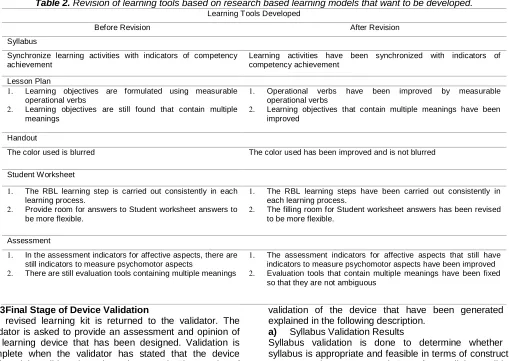
Revisions are made based on suggestions given by the validator. Suggestions provided by the validator can be seen in Table 2.
Table 2. Revision of learning tools based on research based learning models that want to be developed.
Learning Tools Developed
Before Revision After Revision
Syllabus
Synchronize learning activities with indicators of competency achievement
Learning activities have been synchronized with indicators of competency achievement
Lesson Plan
1. Learning objectives are formulated using measurable operational verbs
2. Learning objectives are still found that contain multiple meanings
1. Operational verbs have been improved by measurable operational verbs
2. Learning objectives that contain multiple meanings have been improved
Handout
The color used is blurred The color used has been improved and is not blurred Student Worksheet
1. The RBL learning step is carried out consistently in each learning process.
2. Provide room for answers to Student worksheet answers to be more flexible.
1. The RBL learning steps have been carried out consistently in each learning process.
2. The filling room for Student worksheet answers has been revised to be more flexible.
Assessment
1. In the assessment indicators for affective aspects, there are still indicators to measure psychomotor aspects
2. There are still evaluation tools containing multiple meanings
1. The assessment indicators for affective aspects that still have indicators to measure psychomotor aspects have been improved 2. Evaluation tools that contain multiple meanings have been fixed
so that they are not ambiguous
3.1.3Final Stage of Device Validation
The revised learning kit is returned to the validator. The validator is asked to provide an assessment and opinion of the learning device that has been designed. Validation is complete when the validator has stated that the device designed is valid and ready to be tested. The results of
validation of the device that have been generated are explained in the following description.
a) Syllabus Validation Results
Table 3. Syllabus Validation Results
Validator Assessment (%) Category
FM 79.2 Valid
HA 89.6 Very Valid
US 97.9 Very Valid
AR 97.9 Very Valid
DA 97.9 Very Valid
Rata-rata 92.5 Very Valid
Based on the validation results listed in Table 21, the syllabus validation results are in the percentage of 79.2% to 97.9%. The first validator gave a value of 79.92 with a valid category, the second validator gave an assessment of 89.6%, while the other three validators gave a value of 97.9% with a very valid category, so the percentage of the average syllabus value was 92.5% with a very valid category. The syllabus developed can be used for testing because the average value of all validators is at a percentage of 92.5 with a very valid category.
b) Results of the Validation of the Lesson Plan
Lesson plan validation is carried out to determine whether the components of the lesson plan and the contents of the designed lesson plan are appropriate and the standard for preparing the lesson plan is set. The validation results show that the drafted lesson plan has referred to Permen No. 41 of 2007 concerning process standards. Learning activities in the lesson plan have followed the steps of the research based learning model. The results of data processing the results of lesson plan validation that have been assessed by the validator can be seen in Table 4.
Table 4. Lesson plan Validation Results
Validator Assessment (%) Category
FM 81.0 Very Valid
HA 95.4 Very Valid
US 100 Very Valid
AR 98.3 Very Valid
DA 98.8 Very Valid
Rata-rata 94.7 Very Valid
Table 4 shows the results of the validation of 5 validators. The percentage of validation results is between values of 81.0% to 98.8%. Four validators gave values above 95%, namely, 95.4%, 98.3, 98.8% and 100% while one validator gave a value of 81.0% so that the percentage of the average value of the lesson plan was 94.7% with a very valid category.
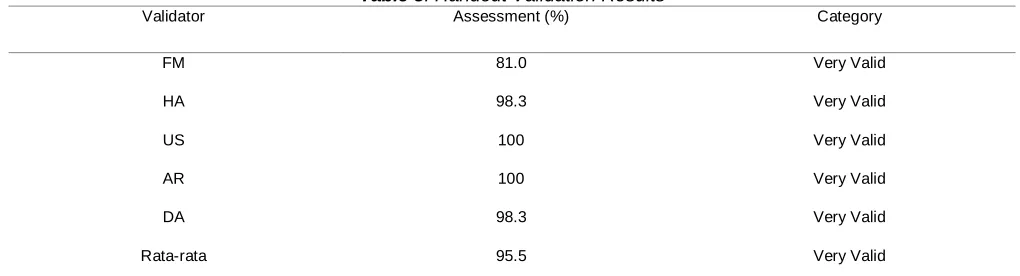
c) Handout Validation
Handout validation is done to determine whether the handout is suitable and feasible in terms of construction, content and language. The results of the validation carried out by 5 validators are shown in Table 5.
Table 5. Handout Validation Results
Validator Assessment (%) Category
FM 81.0 Very Valid
HA 98.3 Very Valid
US 100 Very Valid
AR 100 Very Valid
DA 98.3 Very Valid
Rata-rata 95.5 Very Valid
Table 5 shows that the validation of the handout was worth testing because the validation results of the five validators showed a very valid percentage of 95.5%. The first validator
gave a value of 81.0%, two validators gave a value of 98.3%, and two other validators gave a value of 100%.
2652
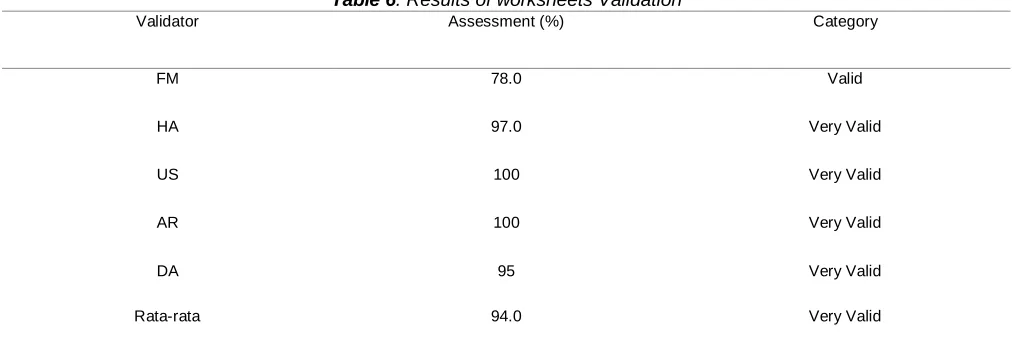
Validation of worksheets is done to find out if the worksheets that have been designed are worth testing out to
students. The results of the validation carried out by the validator are shown in Table 6.
Table 6. Results of worksheets Validation
Validator Assessment (%) Category
FM 78.0 Valid
HA 97.0 Very Valid
US 100 Very Valid
AR 100 Very Valid
DA 95 Very Valid
Rata-rata 94.0 Very Valid
Based on Table 6, the values given by the five validators are 78.0%, 97.0%, 100%, 100%, and 95%. The average of these percentages is 94.0% which is in the very valid category. Worksheets can be tested on students because the average value of worksheets validation is in the very valid category.
e) Validation of Valuation Instruments
The validation of the assessment instruments includes three domains namely cognitive, character and psychomotor. Each domain of assessment is in the rubric of assessment. Validation of the assessment instrument is carried out to determine the feasibility of the assessment rubric before being tested on students. The validation results are in Table 7.
Table 7. Validation Instrument Evaluation Results
Validator Assessment (%) Category
FM 77.9 Valid
HA 90.3 Very Valid
US 99.1 Very Valid
AR 99.1 Very Valid
DA 95.6 Very Valid
Rata-rata 92.4 Very Valid
Based on the results of the validator assessment in Table 7, it was concluded that the assessment instruments were worth testing out to students because of the five validators giving a percentage of grades 77.9%, 90.3%, 95.6%, 99.1, and 99.1%. The five values of the validator are averaged, then a percentage of 92.4% is obtained with a very valid category.
4. CONCLUSION
Based on the results of research that has been done, it can be concluded that the development of Physics Learning Equipments in physics learning at senior high schools used to improve the four Cs skills are in the very valid criteria.
REFERENCES
[1] Adisendjaja, dkk. (2017). Science Teachers’ Understanding of Scientific Inquiry in Teacher Professional Development, Journal Of Physics:
ConferenceSeries, 812, DOI:10.1088/1742 6596/812/1/012054.
[2] Bentri, A. (2017). A Model of Local Content Disaster Based Curriculum a Elementary Schools. International Journal of Geomate, 13 (40), 140-147. doi: 10.21660/2017.40.Tvet023.
[3] Bialik & Fadel. (2015). Skills for the 21st Century: What Should Students Learn?. Switzerland: Montes
Alti Educational
Foundation.http://www.curriculumredesign.org [4] Ekici, E. (2016). “Why Do I Slog Through the Physics?”
Understanding High School Students’ Difficulties”.Journal of Education and Practice, 7(7).
Series, 1185 (2019) 012041. 1-7. doi:10.1088/1742-6596/1185/1/01204
[6] Festiyed, dkk. (2018). Implementation Authentic Task to Enhance Problem Solving and Self Management for Physics College Students. IOP Conf. Series: Materials Science and Engineering. doi:10.1088/1757-899X/335/1/012068.
[7] Gratton, L. (2011). The Shif t: The Future of Work is Already Here, Collins
[8] IBSA. (2009). The Innovation and Business Industry Skills Council of Australia; Developing Innovation Skills: A Guide for Trainers and Assessors to Foster the Innovation Skills of Learners through Professional Practice. East Melbourne, Victoria: Australian Government, Department of Education, Employment and Workplace Education.
[9] Kusumaningrum, dkk. (2017). Scientific Approach and Inquiry Learning Model in The Topic Of Buffer Solution: A Content Analysis. Journal of Physics: Conference Series, 895. doi:10.1088/1742-6596/895/1/012042
[10] Liu, X., & Li, Q. (2011). Combination of the research based learning Method With The Modern Physics Experiment Course Teaching. International of studies, 4 (1).
[11] McKinsey Global Institute. (2017). Harnessing Automation for a Future That Works. New York: McKinsey Global Institute.
[12] Musfiqon & Nurdiyansyah. (2015). Pendekatan Pembelajaran Saintifik. Sidoarjo : Nizamia Learning Center.
[13] NEA. (2010). Preparing 21st Century Students for A Global Society : An Educator’s Guide To The “Four Cs”.
[14] Oon, P.T., & Subramaniam, R. (2011). On The Declining Interest in Physics Among Students from The Perspective Of Teachers. Int. J. Sci. Educ, 33, 727-746.
[15] P21 (2015). Framework for 21st Century Learning. The Partnership for 21st Century Skills. http://www.p21.org/about-us/p21-framework [16] Permendikbud No 70 Tahun 2013 Tentang Kerangka
Dasar dan Struktur Kurikulum SMA/MA. Jakarta: Depdikbud.
[17] Piascik, D. (2015). Preparing America’s Students for College and Career: Common Core Learning Standards.
http://www.mspiascik.weebly.com/common-core-learningstandards.html
[18] Plomp, T. (2013). Educational Design Research: An Introduction. Netherlands.
[19] Sahin, E., & Yagbasan, R. (2012). Determining Which Introductory Physics Topics Pre Service Physics Teachers Have Difficulty Understanding and What Accounts for These Difficulties. Eur. J. Phys, 33, 315-325.
[20] Schwab, K. (2016). The Fourth Industrial Revolution. Switzerland: World Economic Forum.
[21] Trilling & Fadel. (2009). 21st Century Learning Skills. San Francisco, CA: John Wiley & Sons
[22] Usmeldi. (2016). Pengembangan Modul Pembelajaran Fisika Berbasis Riset dengan Pendekatan Scientific Untuk Meningkatkan Literasi Sains Peserta Didik. JPPPF-Jurnal Penelitian & Pengembangan Pendidikan Fisika, 2 (1). doi: 10.21009/1.02101.
[23] William, J., & Beatty, I.D. (2005). Teaching vs Learning: Changing Perspectives on Problem Solving in Physics Instruction Monitoring Constructors of Knowledge. New Technologies and Teaching of Science. Nicosia: Cyprus.
[24] Brown-Martin, G. (2017). Education And The Fourth Industrial Revolution. Groupe Média TFO. [25] Lippl, C. (2013). The Four Cs of 21st Century Skills.
Zuluma Education Trends. http://zuluma.com/education-trends/four-cs-21st-century skills/#.VLEHY2SUde
[26] Kift, S., Israel, M., & Field, R. (2010). Learning and Teaching Academic Standards Project: Bachelor of Laws Learning & Teaching Academic Standards Statement December 2010, Australian Learning & Teaching Council. http://www.olt.gov.au/resources/goodpractice?te xt=threshold%20learning%20outcomes%20law [27] Ellizar, et al. (2018). Development of Scientific